
You are currently browsing the monthly archive for November 2009.
Father Cyprian speaks of the frightening reality of the world we live in and the look-warm Christianity of our days. The images below speak on their own – for those who still have eyes to see and ears to listen…In the midst of this reality, there are still some who take their life in Christ seriously.
An Orthodox missionary priest (Fr. Daniel Sisoev) preaching “the Word of Truth” to the Muslim world, killed at the age 35 in Russia. May Christ our Savior rest him with his saints. Amen!
“THE BLOOD OF THE MARTYRS IS THE SEED OF THE CHURCH!”
Father Cyprian: “You see that apostasy, as it goes on and advances, as we read in the books of our church, must reach its peak – the Antichrist to come. From the signs of the time, we see how Christ is approaching, Christ is coming, and we MUST be prepared! – as Christians that we are called and named, if we want to go forth and meet Him, if we want to be united with Him and rejoice with Him eternally.
We SHOULD hold two things dearer than our sight, dearer than our eyes:
First – the genuineness of Orthodoxy, and I stress this word genuineness because today even the ecumenists want to be called Orthodox!
But this along is not sufficient, just as a bird does not fly with one wing but with two wings. The second wing is Ortho-practcy – correct practice. The first then, is the correct faith, and the second is the correct life so we might be able to say to men who are far removed from the church, what Philip said to Nathaniel: “Come and see”.
Come and see what Orthodoxy means…
I pray that in this difficult time we are passing through, I stress, I repeat, and the difficult times that are await us, Christ may maintain us to the end of our lives, to the final heartbeat, in the correct faith, in the correct life. Amen!”
– Metropolitan Cyprian –
St. Catherine Monastery near Mt Sinai, Egypt
A documentary by Discovery Channel on Mt Sinai
Ecumenism – a great temptation
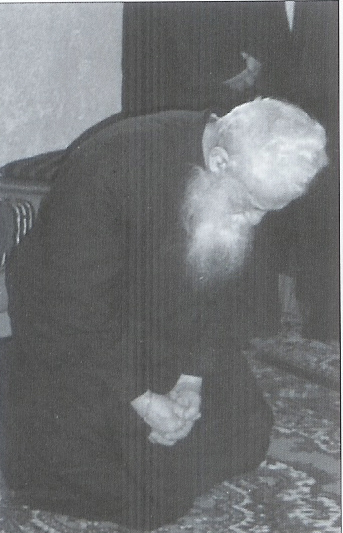
– Regarding the compromises within the church, it is very much conveyed today the idea that ecumenism is a necessity in ecclesiastical space. What are your thoughts on this?
Fr. George: – If we submit to the devil, that means a necessity? This is not a need, but a sin, a great temptation, a heresy. I think that the Orthodox Church should mind its own activity, not the interest in ecumenism and so on. The (Orthodox) Church should live in Christ as she lived until now.
– What do you think the strength of Orthodoxy consist in?
Fr. George: – The power of Orthodoxy is that, she had not changed anything in the canons set by the Holy Ecumenical Councils after its separation from Catholics, while Catholicism consists in number and organization. The power of Catholicism wears out today, the strength of Orthodoxy remains. If Orthodoxy falls, it’s through the sins of the people inside her, not by other means. Because Orthodoxy in itself is unbeatable.
– So we wear down from the inside …
Fr. George: – Yes. The problem is that we – ourselves have become corrupted, not by been influenced by others. Even now, in the European community, each church could keep its full identity, without compromise or breaking its religious doctrine, if she’ll have the awareness that she (the church) must keep her identity.
– So, we have to work on the mentality …
Fr. George: – Well, that’s the problem. If we lose our attachment to the Orthodox tradition and start to dilute ourselves in this absurd and criminal movement of ecumenism – and if it’s not criminal, it’s at least anti-Christian – then we’ll certainly be lost. It’s a great tragedy! I wonder if they really don’t understand its danger? Or perhaps they are bribed? I do not know, I do not get it …
Papocentric Globalism and the Alienation of Orthodox Ecumenists (an Orthodox awarness film)
Error
This video doesn’t exist
– What is the relationship between hierarchy and the monasteries?
Fr. George: – Generally the monasteries obey their hierarch. But only to the limit of heresy. Because of this, the hierarchy, especially in some areas, is upset. It persecutes monks, invents all sorts of things about them, all sorts of lies such as the one that they obey to the Russians, etc,. all aimed to motivate their ecumenist actions…
– If you would meet the Patriarch of Romania, Teoctist, what would you say to him?
Fr. George: – I met him many times. And I confessed everything that I thought. And I was surprised that he was opened to listen, to relay to me many things and, to not get offended. He has a balance! I am a little worried and troubled at the thought that the patriarch will die. For he maintains a balance where he is.
– How do you see the current state of our Church?
Fr. George: – As in that story that my mother used to tell us children…with the legion of devils gathered to the house of the widow who had seven children and all were praying. Even today, the Church is surrounded by legions of devils. I mean not only our own but every Orthodox Church in the world: millions of devils surrounding them.
Tribulations took place at all times, but now they seem to multiply. There are many disobedient priests and many monks wandering, which should not go in such way. Many monks are wondering to the West. Why?! They should remain in the monastery. If they do not like their monastery, that is ecumenist and so on, they should choose another monastery, because they can do so.
I mean we have to impose ourselves a discipline to respect the Church’s authority, so far as it is worthy of Christ to respected it. But you must steadfast in front of Satan! Steadfast as a pillar! to know when he faces a monk, a priest, a bishop and he will be defeated!.
(Excerpt from the book” The Life of Father George Calciu – Christiana Press, P.131/132, translated from Romanian by EC)
And now: The ECUMENICAL PATRIARCH … Visit (Worship?, or a SPECIAL MISSION?!) a synagogue in New York
Truly, the words of Father George: “Steadfast as a pillar in front of Satan!” are more truthful than ever!
Fr. George Calciu (1925-2006) – a great Romanian Orthodox confessor and spiritual father
Father George biography at: Fr George Calciu biography
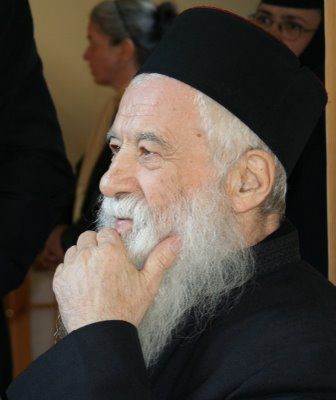
On the meaning of suffering
– Father, tell us about your suffering in prison (the gulag)!
– What can I tell you, in my arms people have died who were a thousand times more valuable than I, in prison many who were more valuable than those who survived have died in the arms of other men, and yet I, a sinner, am here. And to speak of myself again, – whether to say what good I did or what wrong I did, it would sill come out as bragging. So, I find it very difficult to talk about these things.
Generally many words of praise have been said (in relation to this); all this is dust and ashes, all vanity, but we continue to hold onto what we have received from God and what we have managed to keep through suffering, or through success, praise, or blame… Thus, we remain faithful to the Church and our nation.
My life in (communist) Romania, was full of events for better and for worse. I do not accuse or blame anyone, all these were sent by God to exercise my soul.
Someone asked me if my suffering in prison have helped me in aby way. I answered: “No, they have not helped me, but I’m the result of this suffering. If I do something, if I am anything, if you see something in me, know that is because of suffering. Without this suffering, I have nothing!”
Perhaps of all difficult questions for the human person, suffering is the most inexplicable. Why is suffering necessary? I have lived an experience of suffering that enriched my soul and I believe that suffering was necessary for me. But it is very difficult for someone to accept this principle.
When we were in prison (concentration camps), we ask each other: “Why suffering, Why us? Of all the millions of Romanians, why have we been chosen to suffer? What is the purpose? ” And God wouldn’t reveal anything to us. Everyday we cried out to God to give us less pain, and He seemed to grant us even more suffering.
Even after I was liberated from prison, I held within me this imprint of the pain, which seemed to mark my whole life thereafter. After the second imprisonment, I immigrated to the West and traveled through every country in Europe and America speaking about the result of communism. My intention was this: I could not keep silent as long as suffering, injustice, communism, the destruction of churches and the destruction of human personality took place in my country. In my wanderings I came upon a monastery and slept in its library. It was a Catholic monastery. In its library I found, among many books, a small booklet with Christian sayings. I opened it randomly at a page where I saw a reflection of Paul Claudel, a famous French writer. He said this: “Christ did not come into the world to eliminate suffering, Christ has not even come into the world to explain it. Rather, He came to fill human suffering with His presence “.
Have you heard? To fill human suffering with his presence! Then I understood that when we weep, or when we revolt or cry out “God, what are You doing to us?! … “He is present within us more than ever, despite all our sins, all our infirmities. He filled our suffering with His presence. Thus, I understood exactly the deep meaning of this pain: God is present in us!
(Nuns from Diaconesti Monastery singing at his 2 years memorial (Romanian)
{…} If Jesus Christ’ suffering was for everyone, why people’ suffering be useless and lost? God will remember everything . On the day of judgment, He will count him who suffered and has not cursed, him who suffered and prayed …. Hence, those who suffered persecution and prayed for their persecutors, prayed for the good and for the wicked, so God may return many from their unbelief and wickedness .
Other links: “Christ is Calling You!” Lenten Meditations with father George Calciu: http://www.orthodoxresearchinstitute.org/resources/sermons/calciu_christ_calling.htm
Christ suffers in us
Having taken all our human affects, – i.e. the helplessness of our body: starvation, cold, or thirst — Our Lord Jesus Christ was sensitive to human suffering, to our needs. He was sensitive when someone was sick, and healed him. The Savior often made appeal to faith. Other times, when someone was seriously ill, He would not ask if the sick one thinks he can be cured, but Christ will heal him by His word. Or Lord took pity when someone was in despair when their child had died, as was the widow of Nain.
Christ felt for someone praying for parents or neighbor’s, as was the centurion.
He felt for those who were hungry and thirsty. In fact, the Savior said: “He who gives a glass of water to one of the least of Mine, he gives it to Me“.
In so much Jesus had identified with us, that He took upon Himself all our weaknesses, all our infirmities, that anyone who suffers, Christ suffers with him! Anyone who is sick, Christ is sick with him! Everyone who hurts and weep, Christ weep with him!
Do you to expericence Christ innocent suffering? Visit the hospitals for children, visit the orphanages. Christ suffers in them. A total likeness of our Savior with us. He takes upon all our sufferings, all our sorrows.
So everything that Jesus did, was to strengthen the hearts of the faithful. He would often worked miracles, more precisely for our human weakness in thirst for a miracle. Even today we are thirsty for miracles, but a miracle is no substitute for faith. Faith, as the Apostle Paul says, is entrusted things unseen. This faith makes us see – if the tools are spiritual – what the eyes of the body cannot see and the mind cannot reason.
God reveals Himself to us in circumstances beyond our control and, our qualities. He was merciful to the thirsty and the hungry when the Apostles asked Him to send them away at dawn. Our Savior had multiplied the bread, blessed it and gave it to them. He is a God sensible to our pain, One sensible to our needs, participating in our suffering. God doesn’t regard someone as we often do – as spectators, but He gets involved in our sorrows.
(Excerpts from the book: Father George Calciu, Living Words. “To serve Christ means suffering”, Bonifaciu Press, 2009) – (Translated from Romanian by EC)
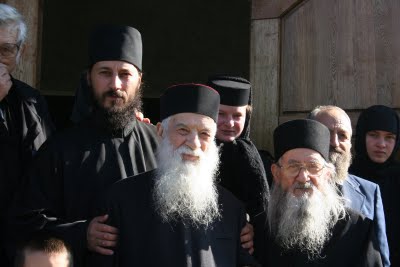 (At Diaconesti Monastery – Romania)
A Word on Anger
Man today lives under such overwhelming pressure that his nerves are strained to the limit, and even the slightest provocation arouses in him the sin of anger. Causes for anger could be the child who does not listen to us, or the husband or wife who contradicts us, or the driver who cuts us off with his car, or only seems to us to cut us off, giving a motive for us to be roused to anger. Even if, through self-restraint, our anger is not outwardly expressed or is not heard by the one who provoked it, it is still a sin, because it harms our soul and our heart It is an action against one’s own self, under the temptation of the devil to be angry.
The savior warns us in severe terms concerning anger that gives birth to verbal conflicts and the use of abusive words.
I say unto you, that whosoever is angry with his brother shall be in danger of the judgment: and whosoever shall say to his brother, Raca, shall be in danger of the council: but whosoever shall say, Thou fool, shall be in danger of hell fire (Matt 5:22).
…No one thinks evil without corrupting the heart in which God should dwell… [….]
I counsel my penitents that before they express their anger, be it in speech or gestures, be it only mentally, to utter three or five times, “Lord Jesus Christ, Son of God, have mercy on me, a sinner.” And if they say the prayer quickly and inattentively under the oppression of anger, then they should concentrate with humility upon the word “sinner,” and their anger will abate. Many of them have succeeded inn making their life, their family relationships, their relations with other people, and even their interior life change for the better.
All the conflicts in the world have their origin in unabated anger. One is angry and wounds the other, who then responds with greater violence and strength. Once this chain is begun, it cannot be stopped except through the appeal of prayer––genuine prayer. […]
The Name of Jesus is sweet to utter. It casts our the demons and brings the angels back into the heart, into the mind, and you will bear yourself in meekness before others.
(Excerpts from article “A Word on Anger” in The Orthodox Word No.261)
The Serbian Patriarch Pavle is the hero of many stories and anecdotes. They reinforce the legend that he was a humble – popular man living a holy life. (…) Patriarch Pavle, through his way of life, was dear to many people.
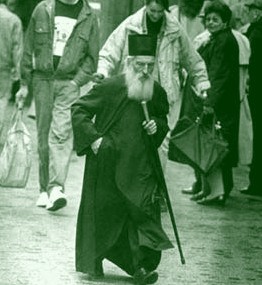
The Mercedes story
Patriarch Pavle, as he was known, continued to live a simple life even after he moved to the new residence – the Patriarchal Palace – in Belgrade. People form Belgrade often encountered him on the streets, riding the train or the bus … Once, while walking alone the hilly street of King Peter the I, towards the Patriarchate, a Mercedes – last model barely passed him, the driver – a priest from one of the well known parish in Belgrade, stopped the car and said:
– Your Holiness, permit me to invite you in! Just tell me where you heading …The Patriarch entered the car, and as soon as it started moving, asked:
— Tell me, Father, whose car is this?
– It’s mine, your Holiness!
– Stop it! – the Patriarch replied, he then got off, made the sign of the Cross and said to the priest:
-May the Lord, watch over you!
The black automobile story
The great session of the Holy Synod of the Serbian Orthodox Church had just ended. As it was the customary, his Holiness was heading to the vespers service at the Cathedral. When he exited the Patriarchal Palace, he saw many black limousines parked near and asked:
– So many luxury cars, who do you think they belong to?
– To our bishops, Your Holiness! They came with them to the Synod meeting-replied the priest who accompanied him.
— Oh, God watch over them, what would they’ve traveled with, if they weren’t taken the monastic vows of poverty?!
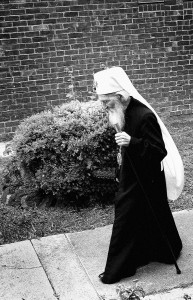
The trubbled deacon
In the Patriarchate building, it is often heard the story of the Patriarch dialogue with the deacon accompanying him everywhere; as they were ready to go to the church in Banovo Brdo, the deacon asked:
– So, how are we traveling? By car?
– By bus! – the Patriarch replied with determination.
– It’s crowded, it’s stuffy in the bus, and the church is not close …
– We’re going (by bus)! — His Holiness replied shortly.
– But … — the Deacon, following him, advance a new argument, — Your Holiness, it is summer, many people go to Ada Ciganlija [a famous pool] and buses are full of barely naked people. It is not appropriate...
– You know, Father – the Patriarch replied back – one can see what he desires to see!
Two olives
In the Patriarchal Palace several bishops are having lunch and, among them the Patriarch Pavle. The bowl with olives come to the table, among other things. Everybody knows that the Patriarch holds to the idea that the human body needs optimal only six olives. But the bishop Stephen started to take eight olives.
– Your Holiness, I took two more. What am I to do now?
– Now hold what you got, and tomorrow take two less – replied the Patriarch.
Message for America
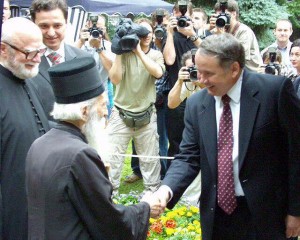
When bishop Pavle became Patriarch, (the director of BOS Museum recalls), many delegations and many foreign representatives have expressed their desire to meet him. The active American ambassador at that time in Belgrade, Warren Zimmermann, also came. The Patriarch received him in the Patriarchal Palace. The ambassador conveyed greetings and congratulations on behalf of the American people, himself and the President. At the end of the formal protocol, the ambassador had asked:
– How may we help you?
– Your Excellency, don’t intervene by setting obstacles, that is how you can help. (…)
The salaries
Patriarch Pavle refused, in fact, to get paid. He only received a small pension he was entitled to as a formal bishop of Raska and Prizren. All his needs were modest, given that he sewed his mantle and repaired his shoes ... Yet, he still had some money left of that pension. What was left of it, he divided among poor or donated it to other purposes of civic good.
It remained memorable his reaction as a bishop in 1962, when a request from bishops was made to increase their salaries:
– “But why, since we are not able to spend what we already have?”.
He did, likewise with what he received as gifts. If he received mantle material, he keep it until he met a monk or a priest not been able to afford it. Then he would calculate how much they would need to sew a cassock (mantle) and give them exactly that, so he may share the rest with others.
Renowned historian Zika Stojkovich, who has worked with the bishop Pavle during his assignment in Raska and Prizren, when editing his work” Monuments of Kosovo”, complained once to the Patriarch of the difficulty of raising money to continue the print of the work-series he had started and belonging to one of the most prominent Serbian writers, Milos Crnjanski. After been listening to him, the Patriarch rose, went to his bed, raised the pillow, picked his wallet, took out three thousand marks and handed to Stojkovich:
– “Here, it’s my contribution for the printing of Crnjanski Milos’ books. May it be for your assistance. ”
The “question mark”
A bohemian who often spent time at a cafe named “?” near the Patriarchate, whenever he would see the Patriarch, he would cross the street and ran to get his blessing. One day he said:
– Your Holiness, you and I are the best people in Belgrade aren’t we! And the Patriarch replied:
– We are, but after we empty a few glasses, no longer we’re good for anything! (…) ”
(Translated by EC)
May the Lord forgive him and rest him with His saints, Amen!
(from father Milovan Katanic wbsite)
1. Prayer as the Essential Need of Man
Prayer is the pious direction of man’s soul to God, or the communication of the heart with God, through which God is represented before man as man pours the feelings of his soul before Him. It is the lifting of the mind and the heart to God and with it man is carried to the angelic choir and becomes a member of their blessedness. Prayer is the incense most acceptable to God, that most secure bridge for the passage over the tempting waves of life, the indestructible stone of all who believe, the peaceful landing place, the divine garment which clothes the soul with great goodness and beauty. Prayer is the mother of all good deeds, the keeper of the cleanliness of the body (chastity), the seal of maidenhood, the secure fence against our eternal enemy, the devil. It drives away enemies through the name of Christ, since there is no means powerful in the heavens or on the earth. Prayer is the fortification of the world pleading for God’s mercy for our sins, that landing place which the waves cannot destroy, the enlightenment of the mind, the axe to spare destruction of sadness, the breeding of hope assuaging the wrath, the advocate to all those who are undergoing trial, the joy of those who are in prison, the salvation of those who are dying. It made the whale become the home of Jonah, it brought Ezekiel back to life from the doors of death, and it converted the flames to dew for the Babylonian youths. With prayer St. Elijah closed the heavens so that the rain did not fall for three years and six months (James 5:17). When the apostles themselves were unable to cast out the unclean spirits, Christ told them, “This one cannot go out , except by prayer and fasting” (Matt. 17:21).
There is nothing more precious in man’s life than prayer. It makes the impossible, possible; it makes the difficult, easy; the uncomfortable, it makes comfortable. Prayer is as important to man’s soul as breathing. Who does not pray is deprived of conversation with God and is similar to the tree that bears no fruit and is cut and cast into the fire (Matt. 7:19).
“When you direct yoru mind and thoughts to the heavens,” says St. Makarios the Great, “and want to unite yourself unto the Lord, then a great multitude of evil spirits, like a black cloud, lingers over you, that it might deter your path to heaven. But, just as the old walls of Jericho fell by the power of God, so too will these stones of evil which are deterring your mind be destroyed by the power of God. When you are in prayer, remember before whom you stand. Be deaf and dumb to everything that surrounds you, invoke the Lord for help and He will help you. It’s necessary to uproot all feelings of wrath and to completely cleanse ourselves of murderous feelings of bodily desires, regardless of who they might be directed to.”
2. Humility and a Contrite Heart
The teachers of the Church and the holy fathers advise that during prayer everyone have humility and a contrite heart because of one’s sins. For, if man doesn’t feel in hs heart that he is a sinner, God will not hear his prayer. This is seen in the prayer of the Pharisee and the Publican. The prayers bedewed with the tears of humility and repentance are instantly heard. Poured out from the humble soul, as the wise Solomon says, it breaks through the clouds and doesn’t delay until it reaches the Lord.
When it is time for prayer do not occupy yourself with any sort of work, for the demons look to occupy us with any sort of work during our prayer. If your soul is sweetened with any words of the prayer, continue your prayer for know that at that time your Guardian Angel is praying with you. St. Nefon once saw a monk walking and praying. The monk went but also his angel went with him, escorting the monk with a fiery spear in hand, with which he drove the demons away from the monk.
“Pray ceaselessly,” says the holy Apostle, “that you do not fall in temptation.” This ceaseless prayer consists not only in our ceaslessly praying, but also in a consant remembrance of God and a feeling that he is always before us, watching all of our deeds, intentions and thoughts. Therefore it is a beautiful habit to call upon the Lord from the heart and to pray briefly at every opportunity and at every task, beginning with, for example: “God help me! Lord, bless!” When we have concluded: “Glory to Thee, O Lord! I thank Thee, O Lord!” In surprising dilemmas, whatever temptation might be: “Lord, save! God, be merciful to me a sinner! Lord Jesus Christ, Son of God, have mercy upon me a sinner! Holy Theotokos, save us!”
It is necessary to pray not only when we feel like praying but also then when we don’t have a specific longing or disposition for it; when laziness, sleepiness, forgetfulness and such, drive us away from prayer. If we are compelled and do battle with our own bodies in order to pray, not paying attention to the large collection of dark obstacles, then that prayer will take flight to the heavens and stand before the very throne of the Lord. Night is very suitable for prayer. It is at that time that everything is quieted, calmed and the prayer that is offered to God in the evening quiet, from the depths of our hearts, is heard and on our souls descends a twofold grace from God. It’s during these prayers that the all-evil devil, with particularly great power arises and strikes the man of prayer with temptations, fear and assaults, but it is also at this time that the grace of God for spiritual aid is multiplied.
According to the general thinking of the holy fathers, prayer is considered the daughter of the fulfilling of the gospel’s commands while, at the same time, it is considered to be the mother of all virtues.
That we might protect ourselves from the distraction of our thoughts in prayer, the holy fathers advise that the mind cling all the more to the words of the prayer. From this it is better that we read the prayers from the prayer book and not from memory. This is especially necessary for the beginners and the weak. For this reason everything that is read or sung in the Orthodox Church, no matter how well it is known, is done from a book. Such an immersed mind in the words of prayer is not easily distracted by different sides. If the mind cannot concentrate and immerse itself in the words of the holy fathers, then one should read softly out loud so that one can hear oneself reading. This kind of prayer is especially helpful when one prays alone.
In prayer we shouldn’t work up our nerves, nor sigh too much, nor hold our head up, for all this is harmful. We should pray quietly, with deep, but silent sighs, our heads lowered to the ground, patiently, from time to time looking at the icon as those who truly feel sinful before God.
In public our prayer should be unheard that it might not interrupt anyone’s prayer.
If during prayer your mind wanders to other things and not to the heavens and God, do not be disheartened, but always bring it back and concentrate on the words of the prayer. After all, such a prayer will not remain fruitless even though it is not pure.
For a man in sorrow there is no greater cmforter than prayer. “Is anyone among you suffering? Let him pray” (James 5:13).
Sickness and other misfortunes which befall us are a result of sin. For this reason we are obliged to pray to the Lord that He might forgive us our sins, that toghether with that He might heal us from bodily sicknesses and tragedies of this world. When God allows hunger, war, heavy storms, droughts, hail, earthquakes and such, this comes from the sins of the people. For this reason does the source of evil lie in us. Here again is the need for us to pray to God for the forgiveness of our sins that we might free ourselves of this source of all tragedies, that we might be delivered from all natural evils that come to us in the form of terrible natural phenomena.If it happens that one asks something of God and does not receive it, this can mean that God heard the prayer but in His providential wisdom He tests the man of prayer’s endurance, and when this man endures to the end then he will receive in greater amount than that for which he prayed; or, it means that the man of prayer did not receive what he prayed for because it might lead to some evil.
But praying to God individually, alone, according to the Lord’s command (Matt. 6:6), should not be considered to be sufficient. In different situations and need in life: birth, death, marriage, building a home, sowing, departure on a long journey, sickness, etc., besides the private prayers we should all upon the graceful and prayerful help of the church and the priests, for Holy Scriptures advises us to do so (James 5:14). Besides this we shouldn’t forget our regular participation in the communal prayer in the holy church, which the holy Apostles did as well as all the saints (Acts. 1:14, 12:12), as this is the will of God (Matt. 18:20).

3. The Sign of the Cross
We should not neglect to also mention the need for us to sign ourselves with the Cross when we begin our prayer. We should do this properly and not like those who are ashamed of the Cross of Christ and weave it before their face and chest not even placing their fingers in the appropriate place. Crossing ourselves carelessly saddens our Lord and is taken as a sin of the man of prayer. Such a Cross is not only powerless but it also gives joy to the demons, for then it is not the most terrible weapon against them. The sinner is less afraid of the place of punishment than the demons are of the Cross, for they tremble and flee in fear from the Cross, afraid to even look at its power (for the power of the Cross is the Lord Jesus Christ Himself) which burns them like fire. Armed with the Cross, the holy martyrs went to the most horrible tortures. The saints healed the sick, raised the dead, fearlessly drank poison, passed through fire and water by the power of the Cross of Christ.
One of the old Christian writers, from the first centuries of the Christian Church testifies that the Christians of that era, following the Apostolic constitutions and traditions, at the beginning of every task or journey signed themselves with the Cross. They did this at departure, putting on robes, putting on shoes, at washing, before and after meals, making fires, before lying in bed, sitting after a journey, in one word: at the beginning of every task, journey or event. Today’s Christians, however, taken over by some sort of a shame, even when they visit the home of a friend at their Slava, upon sitting for the meal won’t even think to cross themselves, as if they don’t know the words of the Lord: “For whoever is ashamed of Me and My words in this adulterous and sinful generation, of him the Son of Man also will be ashamed when He comes in the glory of His Father with the holy angels” (Mark 8:38).

Patriarch Pavle, whose secular name was Gojko Stojčević, was born 11 September 1914 on the feast of the Beheading of John the Baptist in the village of Kućanci in Slavonia (Yugoslavia). He graduated from high school in Belgrade and the seminary in Sarajevo. Then he continued his education at the Theological Faculty in Belgrade. During the Second World War, Gojko was among the refugees in the monastery of the Holy Trinity in Ovčara, where he became a novice. In the monastery, the future First Hierarch of the Serbian Church taught catechism to the children of refugees. After the war, Gojko went to the Annunciation Monastery at Ovčara, where he took his monastic vows in 1948 and was ordained to the rank of hierodeacon. From 1949 to 1955, hierodeacon Pavle was part of the brotherhood of the Rača monastery, and he carried out a variety of monastic obediences. In 1954, he was ordained to the priesthood, and, in 1957, elevated to the rank of Archimandrite. From 1955 to 1957, he studied the Scriptures, New Testament, and liturgics at the Theological Faculty of Athens.
On 29 May 1957, in the Cathedral in Belgrade, Archimandrite Pavle was consecrated as Bishop of Raška and Prizren took place. As head of the diocese of Raška and Prizren, he was actively engaged in the construction of new churches and worked to restore and preserve Orthodox holy places in Kosovo and Metohija. He travelled extensively and served in many of the parishes of his diocese. However, Bishop Pavle never neglected his academic work and teaching. In 1988, the Theological Faculty in Belgrade awarded him a doctorate in theology.
In November 1990, a decision of the Holy Synod elected Bishop Pavle Stojčević the First Hierarch of the Serbian Church to replace the ailing Patriarch German Đorić (Vladyki German died less than a year later in August 1991). The enthronement of Bishop Pavle as the 44th Patriarch of the Serbian Orthodox Church took place on 2 December 1990 in the cathedral church of Belgrade. During his ministry, Patriarch Pavle visited many dioceses of the Serbian Church in the former Yugoslavia and abroad. His Holiness visited his flock in Australia, America, Canada, and Western Europe. His Holiness Patriarch Pavle wrote several books, and, for more than twenty years, The Journal of the Serbian Orthodox Church published articles by him on the liturgy. For a long time, he was President of the Synodal Commission for the translation of the New Testament Holy Scriptures.
On 13 November 2007, Patriarch Pavle was hospitalised in the hospital of the Military Medical Academy in Belgrade. On 8 November 2008, he tendered his resignation, claiming infirmity, but, on 12 November, the Archpastoral Council of the Serbian Orthodox Church decided not to grant the petition of the patriarch. During the period of the patriarch’s incapacity, the Holy Synod undertook to carry out his duties, and Metropolitan Amfilohije Radović of Montenegro and Primorsky was the effectual locum tenens.

The Serbian government declared a three-day national mourning period starting Monday after Patriarch Pavle died at 95 on Sunday. President Boris Tadić called the death of the patriarch “a huge loss” and said Pavle “united the nation”. Pavle called for peace and reconciliation in the 1990s during ethnic conflicts that resulted in the break-up of Yugoslavia. The patriarch, who was elected to head the Serbian Orthodox Church in 1990, died today of cardiac arrest during his sleep after having been hospitalised for two years in the Belgrade Military Hospital, doctors said. In the year 2000, the Serbian Church called on Slobodan Milošević, then president of the Federal Republic of Yugoslavia, to resign, after NATO air raids put an end to his crackdown on Kosovo Albanians.
Archpriest Nikolai Balashov, a deputy head of the MP Department of External Church Relations, said Patriarch Pavle was “a righteous man of our time”. Fr Nikolai said he symbolised “the spiritual unity of the Serb nation” and added that Pavle was “a great friend of the Russian Orthodox Church”. Patriarch Pavle’s burial will be at the Rakovica monastery in Belgrade on Thursday, local news agencies said after a meeting of the Church’s Holy Synod.

Link: John Chrysostom Legendary Early Church Preacher
The Life of Saint John Chrysostom
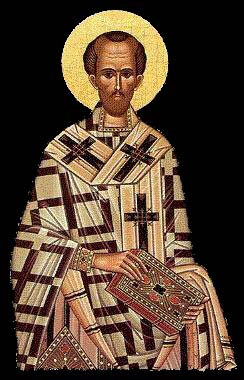 (taken from the November 1998 issue of Cornerstone)
The legion of saints of the Church is comprised of men of extraordinary ability whose talents may have been dissimilar but many of whom seem to have shared a common genius for oratory. Yet out of this vast assembly of eloquent speakers, whose reputation might have rested on their gift of expression alone, the one for whom the title “Chrysostom” (in Russian, “Zlatoust”), or “golden-mouthed” was reserved, was John of Antioch, known as St. John Chrysostom, a great distinction in view of the qualifications of so many others.
Endeared as one of the four great doctors of the Church, St. John Chrysostom was born in 347 in Antioch, Syria and was prepared for a career in law under the renowned Libanius, who marveled at his pupil’s eloquence and foresaw a brilliant career for his pupil as statesman and lawgiver. But John decided, after he had been baptised at the age of 23, to abandon the law in favour of service to the Saviour. He entered a monastery which served to educate him in preparation for his ordination as a priest in 386 AD. From the pulpit there emerged John, a preacher whose oratorical excellence gained him a reputation throughout the Christian world, a recognition which spurred him to even greater expression that found favour with everyone but the Empress Eudoxia, whom he saw fit to examine in some of his sermons.
When St. John was forty-nine years old, his immense popularity earned him election to the Patriarchate of Constantinople, a prestigious post from which he launched a crusade against excessiveness and extreme wealth which the Empress construed as a personal affront to her and her royal court. This also gave rise to sinister forces that envied his tremendous influence. His enemies found an instrument for his indictment when they discovered that he had harboured some pious monks who had been excommunicated by his archrival Theophilos, Bishop of Alexandria, who falsely accused John of treason and surreptitiously plotted his exile.
When it was discovered that the great St. John had been exiled by the puppets of the state, there arose such a clamour of protest, promising a real threat of civil disobedience, that not even the royal court dared to confront the angry multitudes and St John was restored to his post. At about this time he put a stop to a practice which was offensive to him, although none of his predecessors outwardly considered it disrespectful; this practice was applauding in church, which would be considered extremely vulgar today, and the absence of which has added to the solemnity of Church services.
St. John delivered a sermon in which he deplored the adulation of a frenzied crowd at the unveiling of a public statue of the Empress Eudoxia. His sermon was grossly exaggerated by his enemies, and by the time it reached the ears of the Empress it resulted in his permanent exile from his beloved city of Constantinople. The humiliation of banishment did not deter the gallant, golden-mouthed St. John, who continued to communicate with the Church and wrote his precious prose until he died in the lonely reaches of Pontus in 407.
The treasure of treatises and letters which St. John left behind, included the moving sermon that is heard at Easter Sunday services. The loss of his sermons which were not set down on paper is incalculable. Nevertheless, the immense store of his excellent literature reveals his insight, straightforwardness, and rhetorical splendour, and commands a position of the greatest respect and influence in Christian thought, rivaling that of other Fathers of the Church. His liturgy, which we respectfully chant on Sundays, is a living testimony of his greatness.
The slight, five-foot St. John stood tall in his defiance of state authority, bowing only to God and never yielding the high principles of Christianity to expediency or personal welfare. In the words of his pupil, Cassia of Marseilles, “It would be a great thing to attain his stature, but it would be difficult. Nevertheless, a following of him is lovely and magnificent.”
It is impossible to cover the entire life of St John Chrysostom in a few pages. However apart from providing a very brief outline of his life, we have included a little more information about his life as a monk and as Patriarch of Constantinople.

Chrysostom as a Monk (AD 374-381)
After the death of his mother, Chrysostom fled from the seductions and tumults of city life to the monastic solitude of the mountains south of Antioch, and there spent six happy years in theological study and sacred meditation and prayer. Monasticism was to him (as to many other great teachers of the Church) a profitable school of spiritual experience and self-government. He embraced this mode of life as “the true philosophy” from the purest motives, and brought into it intellect and cultivation enough to make the seclusion available for moral and spiritual growth.
He gives us a lively description of the bright side of this monastic life. The monks lived in separate cells or huts, but according to a common rule and under the authority of an abbot. They wore coarse garments of camel’s hair or goat’s hair over their linen tunics. They rose before sunrise, and began the day by singing a hymn of praise and common prayer under the leadership of the abbot. Then they went to their allotted task, some to read, others to write, others to manual labour for the support of the poor. Four hours in each day were devoted to prayer and singing. Their only food was bread and water, except in case of sickness. They slept on straw couches, free from care and anxiety. There was no need of bolts and bars. They held all things in common, and the words of “mine and thine,” which cause innumerable strifes in the world, were unknown among the brethren. If one died, he caused no lamentation, but thanksgiving, and was carried to the grave amidst hymns of praise; for he was not dead, but “perfected,” and permitted to behold the face of Christ. For them to live was Christ, and to die was gain.
Chrysostom was an admirer of active and useful monasticism, and warns against the dangers of idle contemplation. He shows that the words of our Lord, “One thing is needful”; “Take no anxious thought for the morrow”; “Labour not for the meat that perisheth,” do not inculcate total abstinence from work, but only undue anxiety about worldly things, and must be harmonised with the apostolic exhortation to labour and to do good. He defends monastic seclusion on account of the prevailing immorality in the cities, which made it almost impossible to cultivate there a higher Christian life.

Chrysostom as Patriarch of Constantinople (AD 398-404)
After the death of Nectarius towards the end of the year 397, Chrysostom was chosen, entirely without his own agency and even against his remonstrance, archbishop of Constantinople. He was hurried away from Antioch by a military escort, to avoid a commotion in the congregation and to make resistance useless. He was consecrated Feb. 26, 398, by his Theophilus, patriarch of Alexandria, who reluctantly yielded to the command of the Emperor Arcadius.
Constantinople, built by Constantine the Great in 330, on the site of Byzantium, assumed as the Eastern capital of the Roman empire the first position among the Episcopal sees of the East, and became the centre of court theology, court intrigues, and theological controversies.
Chrysostom soon gained by his eloquent sermons the admiration of the people, of the weak Emperor Arcadius, and, at first, even of his wife Eudoxia, with whom he afterwards waged a deadly war. He extended his pastoral care to the Goths who were becoming numerous in Constantinople, had a part of the Bible translated for them, often preached to them himself through an interpreter, and sent missionaries to the Gothic and Scythian tribes on the Danube. He continued to direct by correspondence those missionary operations even during his exile. For a short time he enjoyed the height of power and popularity.
But he also made enemies by his denunciations of the vices and follies of the clergy and aristocracy. He emptied the Episcopal palace of its costly plate and furniture and sold it for the benefit of the poor and the hospitals. He introduced his strict ascetic habits and reduced the luxurious household of his predecessors to the strictest simplicity. He devoted his large income to benevolence. He refused invitations to banquets, gave no dinner parties, and ate the simplest fare in his solitary chamber. He denounced unsparingly luxurious habits in eating and dressing, and enjoined upon the rich the duty of almsgiving to an extent that tended to increase rather than diminish the number of beggars who swarmed in the streets and around the churches and public baths. He disciplined the vicious clergy and opposed the perilous and immoral habit of unmarried priests of living under the same roof with “spiritual sisters.” This habit dated from an earlier age, and was a reaction against celibacy. Cyprian had raised his protest against it, and the Council of Nicea forbade unmarried priests to live with any females except close relations.
Chrysostom’s unpopularity was increased by his irritability and obstinacy. The Empress Eudoxia was jealous of his influence over Arcadius and angry at his uncompromising severity against sin and vice. She became the chief instrument of his downfall.
The occasion was furnished by an unauthorised use of his Episcopal power beyond the lines of his diocese, which was confined to the city. At the request of the clergy of Ephesus and the neighbouring bishops, he visited that city in January, 401, held a synod and deposed six bishops convicted of shameful simony. During his absence of several months he left the Episcopate of Constantinople in the hands of Severian, bishop of Gabala, an unworthy and adroit flatterer, who basely betrayed his trust and formed a cabal headed by the empress and her licentious court ladies, for the ruin of Chrysostom.
On his return to Constantinople he used unguarded language in the pulpit, and spoke on Elijah’s relation to Jezebel in such a manner that Eudoxia understood it as a personal insult. The clergy were anxious to get rid of a bishop who was too severe for their lax morals.

The Repose of Saint John and the Transfer of His Relics (adapted from the OCA website)
The saint died in the city of Comene on September 14th in the year 407 on his way to a place of exile, having been condemned by the intrigues of the empress Eudoxia because of his daring denunciation of the vices ruling over Constantinople. The last words on his lips were, “Glory be to God for all things!” The transfer of his venerable relics was made in the year 438: after 30 years following the death of the saint during the reign of Eudoxia’s son emperor Theodosius II (408-450).
Saint John Chrysostom had the warm love and deep respect of the people, and grief over his untimely death lived on in the hearts of Christians. Saint John’s student, Saint Proclus, Patriarch of Constantinople (434-447), making Divine-services in the Church of Saint Sophia, preached a sermon which in glorifying Saint John he said: “O John! Thy life was filled with difficulties, but thy death was glorious, thy grave is blessed and reward abundant through the grace and mercy of our Lord Jesus Christ. O graced one, having conquered the bounds of time and place! Love hath conquered space, unforgetting memory hath annihilated the limits, and place doth not hinder the miracles of the saint.” Those who were present in church, deeply touched by the words of Saint Proclus, did not allow him even to finish his sermon. With one accord they began to entreat the Patriarch to intercede with the emperor, so that the relics of Saint John might be transferred to Constantinople. The emperor, overwhelmed by Saint Proclus, gave his consent and made the order to transfer the relics of Saint John. But the people dispatched by him were by no means able to life up the holy relics — not until that moment when the emperor realising his oversight that he had not sent the message to Saint John, humbly beseeching of him forgiveness for himself and for his mother Eudoxia. The message was read at the grave of Saint John and after this they easily lifted up the relics, carried them onto a ship and arrived at Constantinople. The reliquary coffin with the relics was placed in the Church of the holy Martyr Irene. The Patriarch opened the coffin: the body of Saint John had remained without decay. The emperor, having approached the coffin with tears, asked forgiveness. All day and night people did not leave the coffin. In the morning the reliquary coffin with its relics was brought to the Church of the Holy Apostles. The people cried out: “Receive back thy throne, father!” Then Patriarch Proclus and the clergy standing at the relics saw Saint John open his mouth and pronounce: “Peace be to all.”
In the IX Century the feastday in honour of the transfer of the relics of Sainted John Chrysostom was written into church singing.
Holy Great Martyr Menas (Abu Mena)
(feast Day, November 11th )
Saint Menas’ life and the Monastery of Abu Mena, Egypt
(dedicated to the saint)
It is known that St. Menas was born in the year 285 A.D. in Egypt in a pious family, his parents were Eudixius and Euphemia. His parents had long been awaiting to have children. During a feast dedicated to the Virgin Mary, Euphemia was praying with tears to an icon of the Most Holy Mother of God to grant her a child, and at the end of her prayer, the Mother of God had answered from her icon “Amen”.
Months later, the blessed child Mina was to be born. His father died when Mina was 11 years old and his mother when he was only 14. At the age of 15, he joined the Roman army, where he was given a senior grade because of his father’s inheritance.
He served in Algeria for 3 years as a soldier. This occurred at the time of the pagan Roman emperors Diocletian and Maximilian, who ordered that all Christians who will not bow to idols be tortured and killed. Disgusted and sickened of the view of Christians forced to worship idols, Menas left for the desert for 5 years leading a hermit life in fasting and prayer to the true Christian God.
During the fifth year of his ascetic life, St. Menas had a revelation when he saw an angel crowning Holy Martyrs; while contemplating this image, he heard a voice saying: “Be blessed Menas, you have been called to a pious life since your childhood. You will be crowned with three crowns: one for your clean life in celibacy, second for your ascetic struggle, and the third for martyrdom “.
With his soul filled by the fiery love for Christ and strengthen by this revelation, Menas came down from the mountains, stood in the middle of the idolaters and confessed Christ. For this, he was given to torment: his body was rubbed with tarsi, burned by fire, dragged mercilessly over thistles, and pierced at the end by a sword. St. Menas received martyrdom in the year 309, in Frigia.

It is said that the soldiers who killed Menas, threw his body on fire, but for 3 days the saint’ body did not burned. His sister along with some soldiers took the saint’ body to Alexandria and placed it in a church. When the persecution against Christians had stopped, it is said that an angel appeared to Pope Athanasius of Alexandria, instructing him to remove the saint body, place it on a camel and take it to the Western Desert. In a certain place, not far from Alexandria, at the end of Lake Mariot, the camel no longer could move, no matter how hard Christians have tried to do push it forward. They understood this to be a sign from God, and buried the saint’ body there.
For several centuries, the martyred soldier Menas was no longer know, until in a certain place in the desert, the sicken sheep’s of a pastor were miraculously healed along with the pastor. The news spread quickly and many sick people start heading to that place, without even knowing the source of these healings. The place had become so familiar that even the Emperor daughter from Constantinople (Constantine the Great or Zeno), been sick with leprosy, was sent there for healing. One night when the girl was sleeping, the Great Martyr Menas appeared to her in a dream and uncovered the mystery: his holy relics were at the place of healing. St Menas asked the girl that a church will to build in his honor. Next morning, the girl was cured and she revealed her dream to the servant accompanying her.

On that site, 45 km southwest of Alexandria, the Emperor of Constantinople not only that he ordered the building of a cathedral, but an entire city was built, including streets, buildings, churches and the Baptistery, a building with two wings for the sick (one for men and the other for women and children).
The City of St Menas (Abu Mena) has became one of the most famous place of healing and pilgrimage for many Christians. Bottles of oil and holy water engraved with the saint name were found in archeological sites of various Mediterranean countries such as: in Heidelberg – Germany, Milan – Italy, Dalmatia – Croatia, Marseille – France, Dongola – Sudan and in Jerusalem. At the middle of VII century, the city was destroyed by the Muslims. The first excavation to uncover the archaeological value of the site Abu Mena began between 1905 and 1907.

About 1 km from the city of Saint Menas, an impressive monastery was built and bares part of the holy relics of St Menas. 101 monks dwell in this monastery, and serve Divine Liturgy 3 times per day.

In the year 1979, the archaeological site of Abu Mina – the marble city of Saint Mina – is included in the UNESCO list of World Heritage sites, and from 2001 the site is placed on the UNESCO list of World Heritage in danger of destruction.
The holy relics of St Mina are present also in other parts of the world, such as in the Church of St Mina from Bucharest.


“Oh, blessed Holy Martyr Menas, listen to our prayer offered to you from our hearts, and deliver us from sickness and dangers, so we may honor your memory and testify of your miracles, which by the power of the Holy Spirit you work on those who faithfully sing to Thy: Alleluia! “
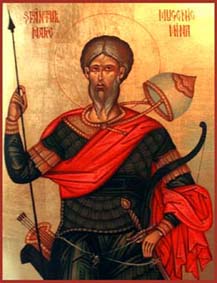
From the Miracles of Saint Menas
Once, traveling to the church of St Menas, a faithful Christian was hosted in a foreign house, and the owner of that house, knowing that the guest had money with him, rose at midnight and killed the faithful. Then, cutting his body in pieces, hid it in the pantry inside the house, awaiting daylight hours.
While the killer was in great difficulty of how and where to hide the body parts of the one killed so no one may know, Saint Menas appear to him as a soldier riding a horse and asked what was done with the man accommodated there, but the killer denied of knowing anything.
Then the Saint, descending his horse, went inside the house to the hidden place, and finding the remainings of the traveler, presented them to the killer, than with a great and fearful look had asked “Who is this?”
Fearful and trembling, having speak nothing, the killer threw himself at the feet of the saint.
Putting together all the members of the one killed and praying over him, St. Menas raised the dead and said to him: “Give praises to God!” And the dead, rising from sleep and remembering what he had suffered from the one who hosted him, glorified God for living a second time, and praise the “soldier” for risen him.
After taking the money from the one who killed him, St Menas gave them to the man he had risen, saying, “Go brother in your path”.

For The Akathyst of the Holy Martyr Menas the Wonderworker
see link below:
This holy Father was born Anastasios Kephalas in October of 1846, in Selevria of Thrace.
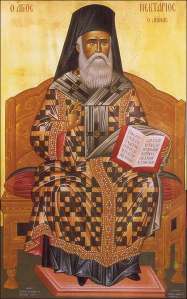
Because of the poverty of his parents, at the age of 14 Anastasios went to Constantinople to find work for their financial assistance. He did not have the fare for the boat but, he approached a boat which was ready to sail and asked the captain to take him. The captain, however, seeing him so young said to him jokingly, “Take a walk, my little one, and when you come back I will take you.” The boy understood what the captain was actually telling him and began walking away sadly. The captain turned on the engines in order to sail, but, although the engines were running, the ship would not move. The captain increased the power, but to now avail. In his helplessness the captain glanced up and his eyes met the gaze of the boy who was standing in sorrow on the shore. Against his will he was moved, and relenting, he told the boy to get on the boat. Anastasios jumped into the boat and the captain became engrossed in getting the boat to move, but, he did not get the chance as the boat began to move immediately, since it had received its “Chosen Passenger.”
In Constantinople Anastasios found work with a tobacco merchant who did not pay him as he should, therefore, he went about barefoot and in ragged clothes. But he had so much faith in God, and prayer was his only consolation. When he saw that his employer wrote and received many letters, Anastasios with his childlike mind and guileless heart, wanted to write a letter also, for he had much to say. But to whom would he write? He hadn’t any acquaintances, and he could not write to his mother because mail was not taken to the small village. And yet he felt the need to write. He wanted to write about his grievances of work and no pay, he wanted food and clothes but, he did not have the money. He did not abandon his hope in God and so he thought of writing a letter to Christ and telling him of his needs. He took his pencil and wrote: My Little Christ, I do not have an apron or shoes. You send them to me. You know how much I love You. Anastasios. He closed the letter with confidence and wrote on the envelope: “To the Lord Jesus Christ in Heaven.” On the way to mail the letter he met the owner of a merchant shop that was across the street from his work . This man knew him well and, knowing of the boy’s innocence and diligence, had come to feel great compassion for him. He was also on his way to the post office and said, “Anastasios, where are you going?” Anastasios mumbled something holding the letter in his hand. “Give it to me so I can mail it and you won’t have to walk all the way.” Frightened and unthinking, Anastasios gave him the letter. The merchant took the letter and put it with the letters he was going to mail, patted Anastasios on the head and told him to go back and he would take care and mail the letters safely.
Anastasios cheerfully returned to his work and the merchant continued on his way full of happiness over that good and exceptional boy. The merchant’s curiosity overcame him as he went to mail the boy’s letter and he read the address. His curiosity peaked and he opened the letter and read it. He was so overwhelmed with emotion that he took out some money, then put it in an envelope and sent it anonymously to the boy. Anastasios was filled with joy when he received the letter and gave thanks to God.
Some days after this, his employer saw him dressed better than usual and thought, he must have stolen money from me. He was going to beat him then fire him. But, Anastasios cried, “I have never stolen anything in my life! Please don’t hit me! My little Christ sent them to me!” The merchant across the street heard the commotion and ran over and pulled the employer aside and explained the story to him.
While Anastasios was still young, he visited the Holy places to worship. During one voyage there was a great storm in which the ship was in danger of sinking, the captain, faced with an impasse, gave orders that the lifesaving equipment be prepared for use, and “may God be our helper.” If anyone were able to save himself, well enough, otherwise, the ship would sink with every man aboard.
The Saint (little Anastasios Kephalas, then) looked at the sea, heard the captain and his despairing commands, and his eyes filled with tears, seeing that truly there was no way out. Then, at a moment when even the last hope of salvation had been lost and all were awaiting the captain’s command to abandon ship, Anastasios spontaneously went up next to the captain, and taking hold of the ship’s helm, crying and looking toward heaven, he prayed, saying, “My God, I do not want to die, I want to preach You. Why do You permit this?” He repeated these words many times. He then let go of the helm, took out a Cross he wore, which his grandmother had given him, and which contained a piece of the Venerable Cross, tied it to his belt, and went to the side of the ship and dipped it in the water, and commanding the sea, as the Lord did, with the words: “Silence! Be still.” He repeated this thrice, whereupon, O Thy wonders, Christ God!, after the third immersion and exhortation, the wind ceased and a great calm followed to the amazement of all. They continued their voyage with great joy after first, glorifying God — except for the little wonderworker, Anastasios, who was saddened for the Venerable Cross, which was a gift from his grandmother, had fallen into the sea.
As they sailed on, there were heard strange knocking sounds from below. The captain sent sailors to investigate the cause, but they could find nothing. When they reached the harbor all began disembarking, the little wonderworker Anastasios among them. As they were disembarking, knocking sounds were heard once more from the hold of the ship and the captain again ordered a search to find the cause and he also commanded that they take a small boat and examine the hull of the ship. While examining the hull, one sailor discovered the lost Venerable Cross of Anastasios where the knocking was coming from.
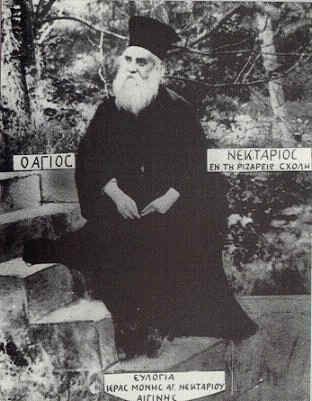
One can only imagine what took place then. The sailor immediately reported his findings, and the captain began calling little Anastasios who had gotten off the ship and was some distance away. He shouted to him, “Kephalas, Kephalas! Turn back. Come here!” and waved to him. Little Anastasios returned and received “his Treasure,” and he wore it always thereafter. This Cross is most conspicuous in the picture where the Saint is wearing his monastic skoufa.
When he was in his twenties, he went to the Island of Chios, where he entered the great and renowned monastery of Nea Moni. There he became a monk on November 7, 1875, and received the name Lazarus in his tonsure. After 2 years of being a monk, he was ordained deacon by Metropolitan Gregory of Chios, because of his great virtues and his piety, and it was at his ordination he was given the name Nektarios. Truly it was a prophetic name, a name that would give one an intimation of the divine nectar that the holy Father was to become, through his holy sermons, and especially through his holy way of life, to the pious Christian people. Thus it was that the holy Father was ordained deacon and later priest.
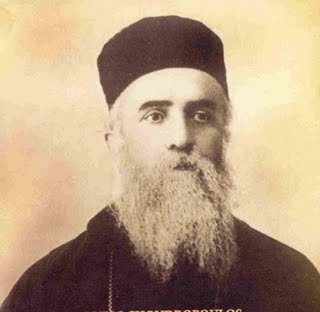
He left Chios, because of the times and of Muslim rule, and went to Egypt. There he was elected Metropolitan of the ancient city of Pentapolis. He was then made Bishop of the holy city and truly the lamp was put upon the lamp stand and it shone for all, far and wide. But because of his holy virtues, his spotless life that he had, his holy sermons, and because of all those things which made him separate from the rest of them, immediately malice arose toward him among his colleagues who were also Metropolitans of the See of Alexandria, and amongst the Bishops and higher clergy. They did not like Saint Nektarios because he was different from them. For this reason they slandered him to the Patriarch, Sophronios, saying that he was eyeing the Patriarchal Throne, because he had this “false show of piety,” as they called it. For they did not want to recognize his true virtue, and that he was a higher person, and his virtue was only show so he would be considered holy by the people. And by virtue of his popularity with the people he would be able to have the Patriarch dethroned, and all of the Orthodox Christians of Egypt would rise up to have Nektarios made Patriarch and since Nektarios was very popular with the people, the Patriarch, Sophronios was easily convinced that he was in danger. Little did they know the true worth of the man, nor understand that he was not as ambitious as they were for positions and for power and glory.
In this way, and for such reasons, they suspended the holy Father as Metropolitan of the throne of Pentapolis. The Patriarch himself, who was a very great “friend” of the Father, wrote that ambiguous letter of suspension, which later became the cause of so much scandal, saying that for “reasons known to the Patriarchate” he was suspended from the Metropoly of Pentapolis, but that he was allowed to remain at the Patriarchate and to eat at the common table so that he would have lodging and shelter. Also if he were asked by people to bless marriages or baptisms he could officiate if canonical permission was granted by the Bishops in those places or by the Patriarchate. Thus he was not defrocked nor was he suspended from ecclesiastical functions, but he was only taken away from his throne to be without position. When the Saint appeared in Athens with the paper of suspension, and these false rumors having been broadcast before he arrived, even innocent people believed the scandalous rumors because they saw a paper which said “suspended for reasons known to the Patriarchate” so it must be true. As a result both the state and the Church authorities refused to give him a position in the Church of Greece and so he was left with no means of support. He found himself in a strange country, a stranger among his own people, without food, lodging and without even the most simple means of subsistence. Everyday he would go to the office of the Minister of Religion hoping something could be done for him. They finally wearied of him and began to mistreat him and disrespect him as a Metropolitan.
Akathist to St. Nektarios of Aegina
One day as he was walking down the stairs of the office of the Minister, and after being told once again that his case was being looked into and they would let him know, he met an old friend from Egypt who knew of his former glory and virtue. His friend was surprised to see him in such a sad state, and when he learned the cause of his sadness he interceded with the Minister of Religion and Education, and they appointed the Saint to be preacher of the Diocese of Vitineia and Euboiea. Can you imagine the former Metropolitan of Pentapolis reduced to a preacher, something so simple a monk can do it, even a lay person that has a gift can be given the permission by the Synod to do. Yet he did not think that this was humiliating at all, nor did he think it was a small thing, instead he thought it was one of the greatest things to be able to preach the Word of God to the people. He never thought it was a crumb from the table that was being thrown down to him like a dog, but he immediately took it up and putting his heart into it, became earnest in his work of preaching to the people. Thus he arrived on the Island of Euboiea, and there he began to preach from church to church. But as if it were not enough that the slanders had reached Athens, they also reached Euboiea. Sadly some of the Island people rejoiced and delighted in slanderous gossip and rumors about clergy. Rumors and slanders spoken by the ungodly Bishops of Alexandria against the just and blameless St. Nektarios spread like wildfire throughout the whole Island. Many times as he was preaching, people would smirk, laugh and whisper to such a degree that it would create a big commotion in the churches of Euboiea. In the beginning the Saint did not understand, for he was truly a humble and simple man, but he later he understood that they were talking and laughing about him. Thus he saw that, instead of fortifying and edifying souls, and instead of being able to teach the Word of God, he was doing more harm than good since those people believed the rumors and would not listen to his preaching. He therefore decided to resigned, even though he had no other means of support but only his position, and in order not to further scandalize the church, he went back to Athens.
By that time there were a few people who had come to know him and realize that he was truly a good man and had been slandered with no justification. They came to love him because they could in no way see in his way of life, his conversations any evidence of the slanderous things being said about him in Egypt. These few people who came to love him were influential and helped get him appointed Dean of the Rizaries Seminary in Athens. He would liturgize at the Seminary Church of Saint George, the Great Martyr and Trophy-Bearer, as a Bishop-Priest. He would also teach the students for he was truly a wise and learned man, as is shown by the many works he has left us on the state of the souls and the resurrection of bodies, why we have the memorial services, and many other subjects.
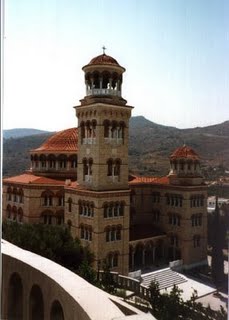
Because there was much ado in Athens, many words, much noise spiritually and physically, seeing this he, being a quiet person, wished to retire from all this and go to a place where he could be with God and to pray according to his heart. Thus he began a search for a suitable place outside of Athens and he went to the Island of Aegina. He heard that there were many small monasteries and churches there that were not being used. He found one about a two hour walk by foot from the main city, down by the sea, a little church which was once a small monastery dedicated in honor of the Most Holy Trinity. With his own hands the Father began to rebuild a few of the cells that were around the church. A blind Nun, Xenia, came to know the Father and he greatly respected her. He made her Mother Superior of the first little community. A few other souls came, and thus the holy Father Nektarios with the blind Mother and these few souls began their little convent. Because the Father was truly a gifted man, especially in matters of confession and had much discretion in spiritual matters, many would flock to him, even from the capitol. Thus the Father truly became a light on the Island of Aegina and the foremost confessor and spiritual father of Greece. Through the help of his spiritual children and donations of people who came to understand their godly way of life, they were able to expand their little convent to thirty or more Nuns and others gathered to listen to St. Nektarios preach the Word. The Saint would tell them, “I am building a lighthouse for you, and God will put a light in it that will shine unto the breadth and length of the whole world. Many shall see the light and come here to Aegina.” But the Nuns could not understand what he was saying to them, and only after the recovery of his Holy Relics and miracles he began working did they finally understood. He meant that his way of life, his very holy body, were the lighthouse, and if God was pleased He would send His light, and it would shine throughout the world. And those words he spoke to them have been fulfilled.
When the Saint went to Aegina for the very first time, there was a boy there who used to fall into trances and see prophetic things. He would go to sleep at the Royal Gates and when he awoke he would relate his dreams and they would come true. People thought his revelations came from God, but in fact he had a spirit of divination, as recorded in the New Testament, of those who prophesied through demons and so when the Father was coming on this first trip to Aegina, the boy shouted, “A Saint is coming. Go down to the seashore to meet the man of God.” He even gave his name, where he was coming from and for what purpose he was coming. So they all went down to the seashore to meet him and he was amazed at all the people who had gathered to meet him and he asked them what was wrong. The told of the boy and his revelation and the Saint immediately understood that it was a demon speaking and not God. The father saw the boy and blessed him then commanded the demon to come out. The demon came out and the boy no longer spoke of visions or uttered prophecies.
On September 20, 1920, a Nun by he name of Euphemia brought a little rassa-clad old man, who was convulsed in pain, to the Aretaieion Hospital of Athens, a state hospital for the poor. The intern asked the Nun for information to enter into the hospital register. He asked, “He is a monk?” “No a Bishop.” the Nun replied. The intern laughed sarcastically and said, “Leave of the joking Mother. Tell me his name so I can enter it in the register.” “He is a Bishop, my child. He is the Most Reverend Metropolitan of Pentapolis.” The intern muttered to himself, “For the first time in my life I see a Bishop, without Panagia, gold cross, and most significant of all,. without money!” The nun once again said, “Indeed he is a Bishop. The Metropolitan of Pentapolis. This metropoly belongs to the Patriarchate of Alexandria. He is the Most Reverend Nektarios Kephalas. Some time ago he left Egypt and came to you, as a matter of fact, because he directed Rizarios School. For some years now, however, he has lived as a monk in the convent of the Holy Trinity on Aegina. There he became gravely ill and in spite or his protests, we brought him here.” She then showed the intern the Saints credentials to prove who he was.
The intern, amazed by everything he had heard and seen, shrugged his shoulders and told the nurses to place the Saint in a third-class room were there were beds for the destitute. He was diagnosed by the doctors as having severe cystitis, a disease of the bladder. For two months the Hierarch Nektarios Kephalas lived with constant, terrible pains and at 10:30 PM on the evening of November 8, 1920, in peace and at prayer he gave his spirit unto God ant the age of 74.In the final days of his life, the Saint was in the incurables ward in the midst of many poor, sick people who were brought there to die. In the bed next to his was a man who was paralyzed for many years. As soon as the Saint gave up his spirit, a nurse and the Nun who had accompanied him, prepared his sacred tabernacle for the transfer to Aegina for burial. For this they dressed the Saint in clean clothing and in doing so they placed the Saint’s sweater on the bed of the paralytic to get it out of their way. And O, strange wonder! The paralytic immediately gained strength and arose from his bed, healthy and glorifying God.
The day he reposed, the whole hospital was filled with a strong fragrance that all the patients, nurses and doctors would come out in the halls to ask where the fragrance was coming from. For quite a few days they were not able to use the room where they had placed the relics because of the strong fragrance even though they had kept the windows open all day long. This room is now a chapel dedicated to the Saint.
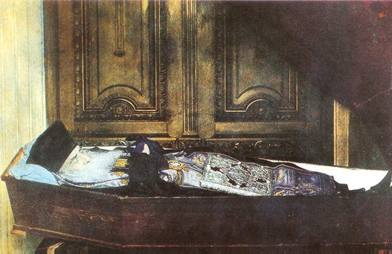
They took his relics to the Church of the Holy Trinity in Piracus while they prepared a small wooden coffin for his burial. They then took the Saint to Aegina where they gave him a simple burial at the Convent of the Holy Trinity.
Some years later, as is the custom in Greece, his grave was opened to take the relics out and to their amazement, as they opened the grave they saw that the Saint was whole and fragrant. Not even his vestments had changed in any way. It was if he had just fallen asleep and been buried that same day. They did not tell the people of Aegina about the opening of his grave because he had already worked many miracles and had become very beloved and a very large crowd would have gathered even people from Athens and other far places where he was known. So, early in the morning, as soon as they were finished with the Divine Liturgy, as it were dawning, they went to open the grave.
At the moment they were opening the grave a taxi was going by on the road below the Convent and inside was a woman of ill repute and very sinful who had just come from a resort. As they approached the Holy Trinity Convent, the fragrance was so strong she told the driver, ” Stop. What is that fragrance?” So he stopped the taxi and replied, ” Oh, here is the convent of the Holy Nectarios. What else could the fragrance be but that they must be opening his grave today and it must be coming form his grave. For many times a fragrance came from his body before they buried him, and even from the grave it comes sometimes.” She got of the taxi and ran to go see. She went up to the Convent just as they opened the coffin and saw the relics whole. She was so very moved by this and especially the fragrance that she began to weep and publicly confessed her sins. Thus she was corrected and became a prudent and Christian woman in her way of life.
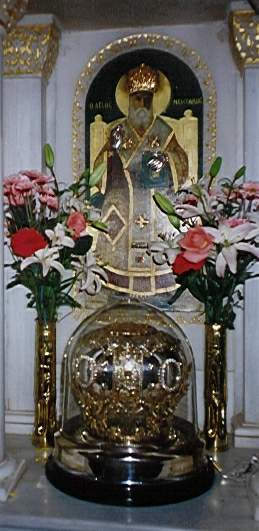
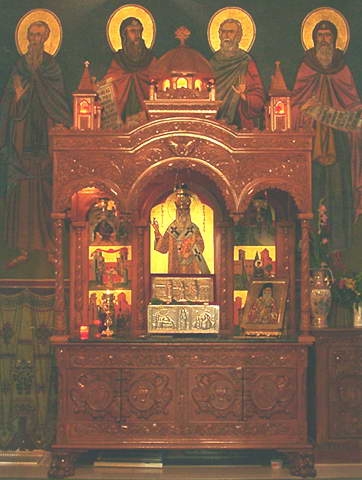
At that time they telegraphed Archbishop Chrysostom Papadopoulos in Athens and he went to the island to see the relics himself. After examining the relics, he irreverently counseled the Nuns to leave the relics in the sun and air for two or three days and then rebury them so they would dissolve. Thus it is with those who pretend to be pious, and yet in their hearts have but the smell of corruption, the stench of death. They cannot understand the things of God, but blaspheme against the very Holy Spirit by such words and actions. The nuns, fearing the censure of the Archbishop and also being simple, did as they were told. After he had been out in the sun for two days they reburied him, but within a month or two they opened the grave again and took out the relics which were still whole and placed them in a marble sarcophagus.
In 1934, fourteen years after the repose of the Saint, a doctor was coming from one of the villages on horseback and was caught in a very heavy rainstorm in the area of the Convent. He took shelter under a tree but, it was raining so hard that he thought it would not be letting up soon so since the only shelter he could see was the Convent and he decided to go there. He had known the holy Father Nectarios while he was living, but being a man who did not believe, he did not reverence the Father that much. He went and knocked on the door of the Convent and the nuns put him up for the night, but since it was evening and it was forbidden by the canons to keep any man inside the Convent in the evening, not even the priest of the Convent, they put him up in a little place outside for guests. But as the gates of the Convent had not been closed yet, he wanted to investigate what he had heard about miracles and incorrupt relics as long as he was there at the convent. So he went to were the sarcophagus was and began to pull the heavy marble top down as far as the waist of the Saint. Just then a nun came by and she yelled, “What are you doing there? What are you doing, opening our Elder’s grave?” And he replied, ” I just wanted to take a look.” “But you did not have permission,” she insisted and began to make a commotion. But in the meantime he investigated the relics anyway. (Later he said, “I was very amazed to see that it was the Father Nectarios that we all knew. And that he still could be recognized from his face and expression. Even his beard was intact. I pulled some of his beard, but it would not come out. I touched his hand and saw that it was skin. It had remained so well on the bones (there was not much flesh) and had not shriveled up. He could be recognized by anyone who had known him when he was alive.”) Then they closed the marble sarcophagus.
But whether for our sins or some other reasons, some years later the relics of the Saint dissolved, and what we have now are his holy bones. They encased his holy head in a Bishop’s mitre and opened the top so one can kiss the crown of his head. The other parts of his relics, which have much fragrance, they put in a silver box.
 Christian Dogma
 Christian Martyrs
 Christian Orthodox Churches and Monasteries
 Christian Sermons and News
 Church's Teachings on Fasting
 Ecumenism – a Great Heresy
 Father George Calciu
 Life_a Sacred Gift form God
 Orthodox Saints and Church Fathers
 Spiritual Elders
 Daily Bible Readings
 Journey to Orthodoxy
 Listen to Ancient Faith Radio
 Orthodox Calendar of Feasts and Saints
 Orthodox Christian Mission Center
 Orthodox Institute
 OrthodoxChristianNetwork TV


Recent Comments