
You are currently browsing the monthly archive for August 2010.
On “Fetal Farms” with Rev. Fr. John Breck
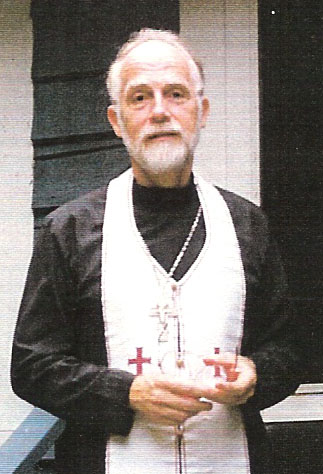
Fr. John Breck is professor of Biblical Interpretation and Ethics at St. Sergius Theological Institute in Paris. With his wife, Lyn, he directs the St. Silouan Retreat near Charleston, South Carolina. (the following article was written by Fr. Breck in 2004 when much of the “mysteries” were not yet revealed)
For some time now I have been appealing to various people to reopen the question of “the beginning of human life,” in order to base an Orthodox view of the status of the embryo on biological fact, that is, on the truth about how God creates human beings. However embryologists finally assess the issue, there is a moral line that should never be crossed. That line corresponds to implantation of the embryo on the uterine wall.
Biologists may one day convince us (indeed see bellow recent video material-our note) that the cells that make up the pre-implantation embryo are not yet “differentiated,” that is, their genes are not yet expressed so that each cell is developing into a specific organ or tissue. They may lead us to acknowledge that “individuated human existence” only begins once the embryo embeds itself in the uterine membrane and the so-called primitive streak appears, marking the beginning of neurological development. That is, they may persuade us, on the basis of irrefutable scientific evidence, that the “pre-embryo” is precisely that: the indispensable precondition to individual human existence, but not an individual human being as such.
If they do, they will first of all have to convince us that the continuum that seems to exist from fertilization through implantation and on to birth is an illusion, that any such continuum only begins after the first week or so of biological existence. However that may be, the ultimate line that must be drawn in any such speculation exists at implantation.
This means that we need to cut through the obfuscation that proponents of embryonic stem cell research, cloning and “fetal farming” have created around the question of the meaning and value of life in the womb. Until scientists prove unequivocally otherwise, Orthodox anthropology should continue to locate the beginning of individual, even “personal,” human existence at fertilization. If some day it is shown conclusively that pre-implantation embryonic life is merely the precondition, the “substratum,” of an individual human being, then perhaps we will find ourselves obliged to lift our opposition to experimentation using the pre-implantation embryo and even to the creation of cloned embryos for strictly therapeutic purposes. (Since clones would be created a-sexually from differentiated somatic cells, rather than sexually by the union of gametes, there is question as to whether they are indeed “human embryos” at all; yet the question might be rendered moot by the fact that such embryos can still be implanted in a womb and brought to term.)
Even if someday we must conclude that an individual human life does not begin at fertilization (fortunately such conclusion – based on the recent discoveries – holds no truth-our note), there can be no doubt – theological or scientific – that it exists from implantation. Once an embryo is implanted, it is indisputably a living, growing human being. As such, it deserves nothing less than the same respect and legal protection that we accord to any child or adult. To deny the child that respect and protection is to offend in the most fundamental sense that child’s civil rights, not to mention his or her moral and spiritual integrity.
This reasoning obliges us to pay careful attention to a recent development that illustrates as clearly as any other the slipperiness of the moral slope we now find ourselves on.
In a world that has tossed away its moral compass, there’s a simple and sure way to get what you want. When your initial demand is rejected, increase the demand tenfold, and they’ll give you at least what you originally asked for, and maybe a good deal more.
The abortion and pharmaceutical industries, together with other vested interests, initially demanded that “extra embryos” from IVF procedures be used as a source for stem cells. This provoked moral outrage in some quarters, so they shrewdly upped the ante. Accumulated pressure from these and related sources have just led the New Jersey legislature to pass Assembly Bill 2840, a measure likely to have more far-reaching consequences than Roe v. Wade. The bill not only legalizes the cloning of human embryos. It allows those embryos to be implanted into a woman’s uterus, grown nearly to term, and then destroyed before birth, in order that their various body tissues and organs might be used for “therapeutic” ends.
Increase the demand outrageously, and they’ll give you in any case what you originally asked for, and maybe more. Keep working this model, and eventually what was considered outrageous yesterday will seem reasonable today.
Opposition to the request for legalizing use of embryonic stem cells, in other words, moved those who would most profit from such use to make a still more outrageous demand: that babies be created, carried in the womb until the ninth month of gestation, then – by legal edict – killed. If this egregious violation of everything from human dignity to human rights is accepted in New Jersey, it will not be long before it is accepted throughout the country. “Fetal farms” will spring up, where not-quite-born-yet children will be destroyed for purposes of experimentation and organ harvesting. And yesterday’s opposition to embryonic stem cell research will “melt like wax before the fire.”
New Jersey legislature and like-minded people have upped the ante. Now they are asking not only for embryos to kill, but for fetuses to extract, dissect and distribute.
“Increase the demand outrageously,” they said to themselves, “and they’ll give us what we originally asked for, and maybe more.” Now we’re on the verge of giving them fetal farms. What will it be next time?
To order these Videos, please go to: www.cbc-network.org
Copyright Disclaimer for the above Video Material:
Under Section 107 of the Copyright Act 1976, allowance is made for “fair use” for purposes such as criticism, comment, news reporting, teaching, scholarship, and research. Fair use is a use permitted by copyright statute that might otherwise be infringing. Non-profit, educational or personal use tips the balance in favor of fair use.
Reading from the Synaxarion

When the fame of our Lord Jesus Christ came to Abgar, the ruler of Edessa, who was suffering from leprosy, Abgar sent a messenger named Ananias, through him asking the Savior to heal him of his disease, while bidding Ananias bring back a depiction of Him. When Ananias came to Jerusalem, and was unable to capture the likeness of our Lord, He, the Knower of hearts, asked for water, and having washed His immaculate and divine face, wiped it dry with a certain cloth, which He gave to Ananias to take to Abgar; the form of the Lord’s face had been wondrously printed upon the cloth. As soon as Abgar received the cloth, which is called the Holy Napkin (Mandylion), he reverenced it with joy, and was healed of his leprosy; only his forehead remained afflicted. After the Lord’s Death, Resurrection, and Ascension, the Apostle Thaddaeus (see Aug. 21) came to Edessa, and when he had baptized Abgar and all his men, Abgar’s remaining leprosy also was healed. Abgar had the holy image of our Savior fixed to a board and placed at the city gate, commanding that all who entered the city reverence it as they passed through. Abgar’s grandson, however, returned to the worship of the idols, and the Bishop of Edessa learned of his intention to replace the Holy Napkin with an idol. Since the place where it stood above the city gate was a rounded hollow, he set a burning lamp before the Holy Napkin, put a tile facing it, then bricked up the place and smoothed it over, so that the holy icon made without hands was no longer to be seen, and the ungodly ruler gave no further thought to it.
With the passage of time, the hidden icon was forgotten, until the year 615, when Chosroes II, King of Persia, was assaulting the cities of Asia, and besieged Edessa. The Bishop of Edessa, Eulabius, instructed by a divine revelation, opened the sealed chamber above the city gate and found the Holy Napkin complete and incorrupt, the lamp burning, and the tile bearing upon itself an identical copy of the image that was on the Holy Napkin. The Persians had built a huge fire outside the city wall; when the Bishop approached with the Holy Napkin, a violent wind fell upon the fire, turning it back upon the Persians, who fled in defeat. The Holy Napkin remained in Edessa, even after the Arabs conquered it, until the year 944, when it was brought with honor and triumph to Constantinople in the reign of Romanus I, when Theophylact was Ecumenical Patriarch. The Holy Napkin was enshrined in the Church of the most holy Theotokos called the Pharos. This is the translation that is celebrated today.
Apolytikion in the Second Tone
We worship Thine immaculate icon, O Good One, asking the forgiveness
of our failings, O Christ our God; for of Thine own will wast Thou
well-pleased to ascend the Cross in the flesh, that Thou mightest deliver from
slavery to the enemy those whom Thou hadst fashioned. Wherefore, we cry
to Thee thankfully: Thou didst fill all things with joy, O our
Saviour, when Thou camest to save the world.
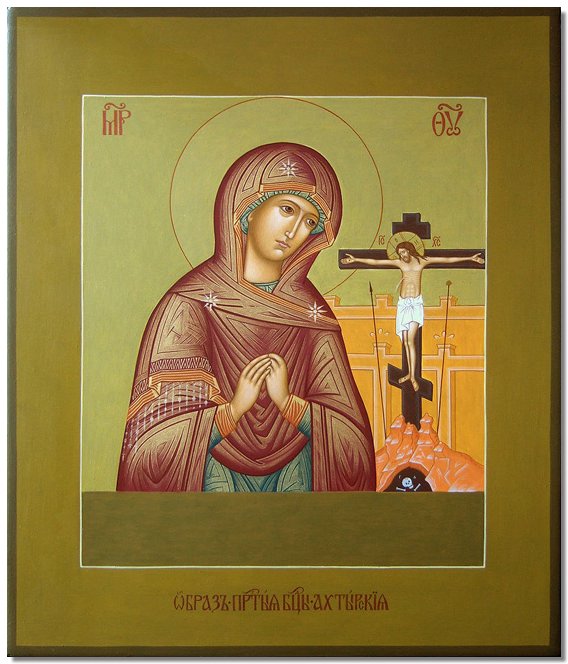
Lamentations to the Holy Mother of God, Greek/Romanian byzantine chant
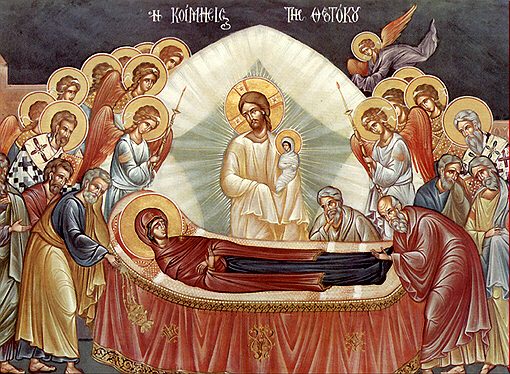
Located in the Valley of Jeoshaphat, at the bottom of Mount of Olives, the Church of Dormition was carved – in stone – over the site were for a short time, the Holy Virgin was buried. Across the street from the Church of Dormition is the Church of All Nations or the Church of Agony in the Garden of Gethsemane and, immediately near it was the Cave of Gethsemane.

Here, in the depths of the earth her holy body was placed, she who carried in her arms the Saviour of the universe! Here, in the village of Gethsemane, the apostles gathered at the edges of the earth to accompanied to the grave the Mother of Life! Here St. Thomas, arriving a bit later, has never found her precious body as it was lifted up into the heaven by her Son. Here, she had laid for a short time, the humble “handmaid of the Lord”, the most holy of all mothers, the cleanest of all virgins, the Mother of Life, the intercessor for the world, the comforter of all mothers, the supporter of virgins, the strengthener of the poor and the protector of monastics and of all Christians!
Why is it believed that the Tomb of the Virgin Mary was in Jerusalem?
According to the Holy Christian tradition, shortly after her burial, her body was raised up to heaven, not by its own power but by the power of our Lord Jesus Christ. Some strongly believe that Jerusalem is the place where the Holy Virgin Mary was buried, while others say that her burial place would be in Ephesus, the place where Saint John the Evangelist lived up until passing away in the Lord .

St. John the Evangelist took her in his care, when our Savior proclaimed to him on the Cross “Behold thy Mother”. She must had accompanied St John everywhere, but there was no testimony to indicate how long she stayed in Jerusalem and how long in Ephesus. Nothing it is said about the place where the Angel Gabriel announced her death.
The New Testament does not tell us about the death of the Blessed Virgin. However, the Tomb of Virgin Mary is described in many apocryphal books. Although not all are worthy of credence, some generalities are very apparent. ” The Dormition/Assumption of Mary ” dates back to the beginning of the II-nd century, after the latest research – the author had used as source, the tradition of the early church. This book can be considered a witness to the veneration of the place where the Virgin Mary was buried. According to this source, Jesus Himself would give instruction to the apostle Peter on the burial-place: ” the Garden of Gethsemane, outside the walls of Jerusalem, in the Valley of Jeoshaphat, acrossed from the river Chedron. “

According to the “Acts of the Apostle John – the Evangelist”, written by Prohor and composed by Lencius in 160-170, St. John the Evangelist been of an old age went to Ephesus accompanied only by Prohor and, this happened after the death of Mary. In the two letters addressed by St. Ignatius to Saint John and discovered around the year 370, it is mentioned that the Holy Virgin has spent her last days in Jerusalem. Another letter of Dionysius the Areopagite to the Bishop Titus (363), the writings of St. John on Mary’s Assumption (V century) and “The Book of the Blessed Virgin Mother of God” by Meliton of Sardes (V – VI centuries) indicate as the place for the tomb, the Garden of Gethsemane.
The Holy Fathers also speak on “the grave of the Virgin” as been located in Jerusalem. A historical work, “Euthymiaca historia “, describes the moment when the Byzantine Emperor Marcian (450 -457) and his wife Pulheria asked the Patriarch of Jerusalem, at the Fourth Ecumenical Council of Chalcedon (451), for the relics of the Theotokos. The Patriarch Juvenal answered, ” three days after sleep, the body of the Holy Virgin was raised up to heaven, and the Tomb in the Garden of Gethsemane bares only her Veil”, which was then taken to the Church of Blachernae in Constantinople (today’s capital of Turkey, Istambul).

St. Epiphanius of Salamis (403) is the first to talk about the Dormition of the Virgin, showing that St. John the Evangelist went to Ephesus alone. In the next century, Gregory of Tours, Isidore of Seville, Saint Modest, St Sophronie of Jerusalem, St. Herman of Constantinople, St. Andrew of Crete, Saint John Damascene and others fathers have spoken about the existence of the Virgin’ Tomb in Jerusalem.
The Tomb of Our Lady in Jerusalem – History
Archaeological works bring testimony to what was mentioned above. The existence of an ancient Christian basilica dedicated to the Dormition of the Virgin, along the river valley Chedron also called the Valley of Jeoshaphat in Hebrew is very important. The Tomb of Virgin Mary was situated in the north side of the Garden of Gethsemane, deep down an underground gallery carved in stone. Moreover, St. Helena – the mother of Emperor Constantine – had built a church over it between the years 325-337.

A chapel was built by Patriarch Juvenal at the beginning of the fifth century, which soon had become a center for pilgrimage. During the emperor Maurice the upper basilica was built and the old sanctuary became the Tomb of the Virgin Mary. In 614, the church was destroyed by the Persians, together with other Christian churches in Palestine. But the Basilica was rebuilt soon after, as it is testified by the visit of pilgrim Arkulf in 670.
In the eleventh century, the crusaders erected another church which is partially preserved today.

In 1187, the church is destroyed by Saladin, and everything that is left, is the southern entrance and the staircase that descended to the grave. Its constant destruction, have made the initial basilica to sink slowly, been left without natural light today.
Starting with 1757, the Tomb of the Virgin Mary was taken into the care of the Greek Orthodox Church. Archaeological excavations from 1972 had confirmed that the grave was part of a Christian cemetery dating from the first century and that its original structure with three rooms, corresponds to the technique used during that period.

Descending down the middle gallery towards the Tomb, one can see two small chapels, one on each side of the stairway. On the right is the chapel of the Saints Joachim and Anne – the parents of the Holy Virgin having an altar for worship, and on the left side is the chapel of the righteous Joseph, the Virgin protector, both been mentioned starting with the XIV century.

The Tomb of the Virgin is carved into a white stone. It is well-known for the shape that her holy body left in the rock. Over this stone a small altar was built where the Divine Liturgy is offered daily.
A miracle-working icon of the Virgin of Jerusalem lies behind her Tomb. But this is not the only miracle-working icon found here. On August 15 (new calendar) the Orthodox Church celebrates the Dormition of the Virgin. The Orthodox miracle-working icon of the Dormition, which is preserved near the Holy Sepulchre (the Holy Tomb of our Lord) is brought out on August 10 in great procession. The icon remains at the Tomb of the Virgin until August 16, when it is taking back to Jerusalem.
On the Dormition of Virgin – a word from the ” Prologs”
When our Lord and Saviour Jesus Christ, have deemed to take His Holy Mother, three days before her passing she was visited by an angel of God (Gabriel), announcing her passing from this earth to the heavenly joy. The Holy Theotokos, received the news with great joy and went to the Mount of Olives to pray .
Then returning to her home, she prepared for the burial, entrusting her neighbors that, by moving into heaven, not only they will not be forgotten but she will seek out and protect the whole world. Then she divided her garments among poor widows, had asked forgiveness from all and lying down, she prayed for the strengthening and the peace of all. And blessing everyone present, she gave her soul into the hands of her Son. And many healings took place by her blessing.
Then it was a great thunder and a miracle in the sky – that all the apostles of Christ came from around the world to Mary’ house in Jerusalem. And Peter began to sing the burial chant, and all the apostles raised her bed and accompanied her body to the grave. Arriving in the village of Gethsemane to bury her body, the apostles remained there for three more days waiting on the Apostle Thomas that was missing.

When the Apostle Thomas returned he was sadden for not been made worthy to see the fallen asleep of the Virgin, with the other Apostles. And they opened the Tomb of the Virgin that he may also see. And behold, a great wonder, the body of the Virgin was not found but only her precious shroud was left behind, as a consolation and a moving testimony that her body was lifted up into heaven.
The Mother of God and our Mother with her body undefiled, alive and glorified, was raised into heaven, thus becoming the first among us to be resurrected from the dead as a leverage to all mankind. But unlike our Lord and Savior’ Resurrection, she was taken to heaven by the angels and not by her own power. It is from heaven that she prays unceasingly for us. Let us have great confidence in her prayers and let us honor and venerate her as she is the first that can intercede to her Son for us. Glory of our Lord and Saviour in the highest. Amin!
(Translated by the blog’ author)
Apolytikion in the Fourth Tone
In faith, O ye people, leap for joy while clapping your hands; and gather in gladness on this day with longing and shout in radiant jubilance. For the Theotokos cometh nigh to departing from the earth unto the heights; and we glorify her with glory as the Mother of God in our unceasing hymns
Kontakion in the Fourth Tone
In the Immaterial Spirit, the whole world hath been mystically adorned upon the glorious memory; and it doth cry to thee joyously: Rejoice, O Virgin, thou boast of the Christian race.
The Dormition of the Mother of God
(by St. John of Damascus)
Our venerable and God-bearing Father
John of Damascus was also known as John Damascene, Chrysorrhoas, “streaming with gold,” (i.e., the golden speaker). He was born and raised in Damascus, in all probability at the Monastery of Saint Sabbas (Mar Saba), South East of Jerusalem. He is also recognized as a saint in the Roman Catholic Church.
Lovers are wont to speak of what they love, and to let their fancy run on it by day and night. Let no one therefore blame me, if I add a third tribute to the Mother of God, on her triumphant departure. I am not profiting her, but myself and you who are here present, putting before you a spiritual seasoning and refreshment in keeping with this holy night.
We are suffering, as you see, from scarcity of eatables.
Therefore I am extemporizing a repast, which, if not very costly nor worthy of the occasion, will certainly be sufficient to still hunger.
She does not need our praise.
It is we who need her glory.
How indeed can glory be glorified, or the source of light be enlightened? We are weaving a crown for ourselves in the doing.
“I live,” the Lord says, “and I will glorify those who glorify Me.”
Wine is truly pleasant to drink, and bread to eat. The one rejoices, the other strengthens the heart of man. But what is sweeter than the Mother of my God? She has taken my mind captive, and held my tongue in bondage. I think of her by day and night. She, the Mother of the Word, supplies my words.
The fruit of sterility makes sterile minds fruitful. We keep to-day the feast of her blessed and divine transit from this world. Let us then climb up the mystical mountain, where beyond the reach of worldly things, passing through the obscurity of storm, we stand in the divine light and may give praise to Almighty power.
How does He, who dwells in the splendor of His glory, descend into the Virgin’s womb without leaving the bosom of the Father?
How is He conceived in the flesh, and does He spontaneously suffer, and suffer unto death, in that material body, gaining immortality through corruptibility?
And, again, ascending to the Father, He drew His Mother, according to the flesh, to His own Father, assuming into the heavenly country her who was heaven on earth.
Today the living ladder, through whom the Most High descended and was seen on earth, and conversed with men, was assumed into heaven by death.
Today the heavenly table, she, who contained the bread of life, the fire of the Godhead, without knowing man, was assumed from earth to heaven, and the gates of heaven opened wide to receive the gate of God from the East.
Today the living city of God is transferred from the earthly to the heavenly Jerusalem, and she, who, conceived her first-born and only Son, the first-born of all creation, the only begotten of the Father, rests in the Church of the first-born: the true and living Ark of the Lord is taken to the peace of her Son.
The gates of heaven are opened to receive the receptacle of God, who, bringing forth the tree of life, destroyed Eve’s disobedience and Adam’s penalty of death. And Christ, the cause of all life, receives the chosen mirror, the mountain from which the stone without hands filled the whole earth.
She, who brought about the Word’s divine Incarnation, rests in her glorious tomb as in a bridal-chamber, whence she goes to the heavenly bridals, to share in the kingdom of her Son and God, leaving her tomb as a place of rest for those on earth.
Is her tomb indeed a resting-place? Yes, more famous than any other, not shining with gold, or silver, or precious stones, nor covered with silken, golden, or purple adornments, but with the divine radiance of the Holy Spirit.
The angelic state is not for lovers of this world, but the wondrous life of the blessed is for the servants of the Spirit, and passing to God is better and sweeter than any other life. This tomb is fairer than Eden.
And that I may not speak of the enemy’s deceit, in the one; of his, so to say, clever counsel, his envy and covetousness, of Eve’s weakness and pliability, the bait, sure and tempting, which cheated her and her husband, their disobedience, exile, and death, not to speak of these things so as not to turn our feast into sorrow, this grave gave up the mortal body it contained to the heavenly country. Eve became the mother of the human family, and is not man made after the divine image, convicted by her condemnation;
“earth thou art, and unto earth thou shalt return.”
This tomb is more precious than the tabernacle of old, receiving the real and life-giving receptacle of the Lord, the heavenly table, not the loaves of proposition, but of heaven, not material fire, but her who contained the pure fire of the Godhead.
This tomb is holier than the ark of Moses, blessed not with types and shadows, but the truth itself.
It showed forth the pure and golden urn, containing the heavenly manna, the living tablet, receiving the Incarnate Word of God from the impress of the Holy Spirit, the golden censer of the supersubstantial Word. It showed forth her who conceived the divine fire embalming all creation.
Let demons take to flight, and the thrice miserable Nestorians perish as the Egyptians of old, and their ruler Pharaoh, the younger, a cruel devastator. They were swallowed up in the abyss of blasphemy. Let us who are saved with dry feet, crossing the bitter waters of impiety, raise our voices to the Mother of God at her departure.
Let Mary, personifying the Church, lead the joyful strain. Let the maidens of the spiritual Jerusalem go out in singing choirs. Let kings and judges, with rulers, youths, and virgins, young and old, proclaim the Mother of God, and all peoples and nations in their different ways and tongues, sing a new canticle.
Let the air resound with praise and instrument, and the sun gladden this day of salvation. Rejoice, O heavens, and may the clouds rain justice.
Be glad, O divine apostles, the chosen ones of God’s flock, who seem to reach the highest visions, as lofty mountain tops.
And you God’s sheep, and His holy people, the flock of the Church, who look to the high mountains of perfection, be sad, for the fountain of life, God’s Mother, is dead.
It was necessary that what was made of earth should return to earth, and thus be assumed to heaven. It was fitting that the earthly tenement should be cast off, as gold is purified, so that the flesh in death might become pure and immortal, and rise in shining immortality from the tomb.
Today she begins her second life through Him who was the cause of her first being. She gave a beginning, I mean, the life of the body, to Him who had no beginning in time, although the Father was the cause of His divine existence.
Rejoice holy and divine Mount Zion, in which reposes the living divine mountain, the new Bethel, with its grace, human nature united with the Godhead.
From thee her Son ascended to heaven as from the olives. Let the world-embracing cloud be prepared and the winds gather the apostles to Mount Zion from the ends of the earth. Who are these who soar up as clouds and eagles to the cause of all resurrection, ministering to the Mother of God? Who is she who rises resplendent, all pure, and bright as the sun?
Let the spiritual lyres sing to her, the apostolic tongues. Let grave theologians raise their voices in praise, Hierotheus, the vessel of election, in whom the Holy Spirit abides, knowing and teaching divine things by the divine indwelling. Let him be wrapt out of the body and join willingly in the joyful hymn.
Let all nations clap their hands and praise the Mother of God. Let angels minister to her body.
Follow your Queen, O daughters of Jerusalem, and, together with her virgins in the spirit, approach your Bridegroom in order to sit at His right hand. Make haste, Lord, to give Thy Mother the welcome which is her due. Stretch out Thy divine hands.
Receive Thy Mother’s soul into the Father’s hands unto which Thou didst commend Thy spirit on the Cross. Speak sweet words to her:
“Come, my beloved, whose purity is more dazzling than the sun, thou gavest me of thy own, receive now what is mine. Come, my Mother, to thy Son, reign with Him who was poor with thee.”
Depart, O Queen, depart, not as Moses did who went up to die. Die rather that thou mayest ascend. Give up thy soul into the hands of thy Son.
Return earth to the earth, it will be no obstacle.
Lift up your eyes, O people of God. See in Zion the Ark of the Lord God of powers, and the apostles standing by it, burying the life-giving body which received our Lord. Invisible angels are all around in lowly reverence doing homage to the Mother of their Lord. The Lord Himself is there, who is present everywhere, and filling all things, the universal Being, not in place.
He is the Author and Creator of all things. Behold the Virgin, the daughter of Adam and Mother of God; through Adam she gives her body to the earth, her soul to her Son above in the heavenly courts.
Let the holy city be sanctified, and rejoice in eternal praise.
Let angels precede the divine tabernacle on its passage, and prepare the tomb.
Let the radiance of the spirit adorn it. Let sweet ointment be made ready and poured over the pure and undefiled body. Let a clear stream of grace flow from grace in its source.
Let the earth be sanctified by contact with that body. Let the air rejoice at the Assumption.
Let gentle breezes waft grace. Let all nature keep the feast of the Mother of God’s Assumption. May youthful bands applaud and eloquent tongues acclaim her, and wise hearts ponder on the wonder, priests hoary with age gather strength at the sight. Let all creation emulate heaven, even so the true measure of rejoicing would not be reached.
Come, let us depart with her. Come, let us descend to that tomb with all our heart’s desire.
Let us draw round that most sacred bed and sing the sweet words,
“Hail, full of grace, the Lord is with thee. Hail, predestined Mother of God. Hail, thou chosen one in the design of God from all eternity, most sacred hope of earth, resting-place of divine fire, holiest delight of the Spirit, fountain of living water, paradise of the tree of life, divine vine-branch, bringing forth soul-sustaining nectar and ambrosia. Full river of spiritual graces, fertile land of the divine pastures, rose of purity, with the sweet fragrance of grace, lily of the royal robe, pure Mother of the Lamb of God who takes away the sins of the world, token of our redemption, handmaid and Mother, surpassing angelic powers.”
Come, let us stand round that pure tomb and draw grace to our hearts. Let us raise the ever-virginal body with spiritual arms, and go with her into the grave to die with her. Let us renounce our passions, and live with her in purity, listening to the divine canticles of angels in the heavenly courts.
Let us go in adoring, and learn the wondrous mystery by which she is assumed to heaven, to be with her Son, higher than all the angelic choirs.
No one stands between Son and Mother. This, O Mother of God, is my third sermon on thy departure, in lowly reverence to the Holy Trinity to whom thou didst minister, the goodness of the Father, the power of the Spirit, receiving the Uncreated Word, the Almighty Wisdom and Power of God. Accept, then, my good-will, which is greater than my capacity, and give us salvation.
Heal our passions, cure our diseases, help us out of our difficulties, make our lives peaceful, send us the illumination of the Spirit. Inflame us with the desire of thy son. Render us pleasing to Him, so that we may enjoy happiness with Him, seeing thee resplendent with thy Son’s glory, rejoicing forever, keeping feast in the Church with those who worthily celebrate Him who worked our salvation through thee, Christ the Son of God, and our God.
To Him be glory and majesty, with the uncreated Father and the all-holy and life-giving Spirit, now and forever, through the endless ages of eternity. Amen
Please also see: The Perpetual Virginity of Mary
A Miracle of the Holy Virgin
Ay the Holy Monastery of Philoteous (Mt. Athos) during the German occupation, the stock of wheat was almost getting to the end and the fathers have decided to cut the charitable work! But a holy elder, Father Sava, was saddened by the fact and ask the leaders of the monastery not to do so because they will grieve Christ and His blessing will depart from the monastery. The elder appealed to many examples from the Scripture as the prophet Elijah, the Samaritan woman and others and, ultimately the fathers of the monastery listened to the elder. However they will say to elder Sava often:
– The wheat is almost finished. What are we ought to do? But the elder replied:
– My beloved fathers, that little that we have left will share with others, and our Most Holy Lady will not abandon us.
There were only 25 pounds of wheat remained in monastery stock and nothing else, thus the fathers begun to complaint again to the elder:
– Well, Father Sava the wheat is over. And now?… But the pious and faithful elder replied:
– My blessed children, do not lose hope in our “Sweet Kiss” (the Mother of God). God will take care of us all as a Good Father.
But once they have finished the bread and even before becoming hungry, a captain from Kavalla came to the monastery and asked to trade wood for wheat.
And seeing the care of the most Holy Virgin Mary that, like a good mother took care of her children, all fathers have praised and glorify God and thanked the Holy Virgin and elder Sava whom, by his holy life, was pleasing to the Virgin.
After this story the elder tells his fathers:
– Did I not say to you my beloved, that our Lady will not abandon us?

The Life of Father John (Iacob) the Romanian
Fom the Miracles of St John
The Miracles of Saint John Jacob Performed During His Reverence life
Father loanichius Paraiala (his spiritual child), as a result of a strike at the right elbow, had got an infection, and after a few years of suffering had got a tuberculosis of the bones. He had an open wound at his elbow, and through the infected wound, at the same time with the matter that drained all the time, there began to come out chips and pieces of decomposed bones.
Then the abbot of the monastery took father loanichius to a hospital in Jerusalem where the doctors decided that the father’s arm had to be cut, to which he said: ‘If I am to die from this, I want to die with all my limbs complete’, and he refused all medical intervention, running away from the hospital. When he arrived at the monastery, Saint John began to bandage him up, and to wash his wound with tea plants, and after a few washings the wound closed and healed.
Father loanichius said that as soon as Saint John put his hand on him, he felt a great quietness, the pains left him, and he was filled with a holy peace and joy, so that he felt no kind of pain .any more.
His arm recovered, but in exchange, it became rigid from the elbow.
~~~~~~~~~~~~~~~~~~~~~~~~~~~~~~~~~~~~~~~~~~~~~~
After the moving of Saint John at the cave of Saint Anna from Hazeva, father loanichius Paraiala carried with the donkey of the monastery some pieces of board, and some pieces of plate taken from some plate barrels, in order to separate the cell of Saint John. While going on a narrow and winding path, the donkey was frightened by a bird that flew out of the bush, and it threw father in an abyss of almost 20 metres.
Then father loanichius broke the same arm also from the elbow, he hurt his head and legs, and he could hardly get out of the abyss, and he could hardly arrive at the cave of the Saint who, when he saw him, was frightened too, by the way he looked.
He washed him, he tied his wounds, and his right hand was hanging from his elbow because the bones that had been caught and blocked were now broken, and his arm
Then Saint John tore a shirt, and with some towels wrapped up around his neck, he tied his arm a little bent from the elbow, and in a short time it cured again, and his right arm remained that way a litlle bent and fixed, so that he couldn’t even do the cross.
But the way he was, he worked in the garden, in the kitchen, he made bread and communion bread, he cleaned the church, he lit the icon lamps, and he did all the other obediences, because for a long time only he and father abbot Ambrose had been in the monastery.
So, this way, Saint John healed father Ioanichius twice.
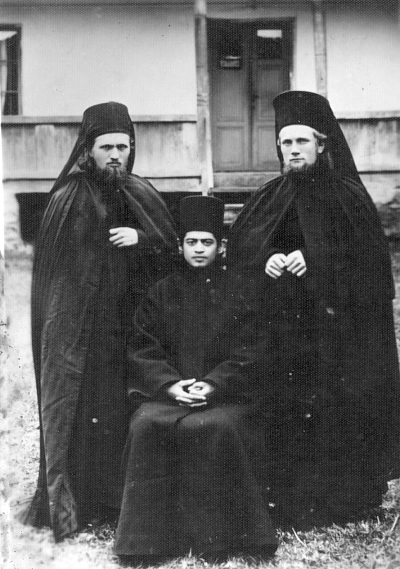
When Saint John was at the Monastery of St. Sava, there came a lot of old Bedouins or pilgrims, that fell ill on the way to the monastery, and as soon as he put his hands on them, the pains relieved them, and in a short time they recovered. The Moslem Bedouins that had known him tell about these, and they used to call him the doctor of the monastery.
~~~~~~~~~~~~~~~~~~~~~~~~~~~~~~~~~~~~~~~~~
When Saint John was at the cave one night, right at midnight some Jews came with their lanterns lighting, searching the caves where once hundreds of hermits had lived there. These were raking and digging, looking for old patrimony objects.
Not far from the cell of the Saint it was a cave in which there were put tens of skulls, and hundreds of bones of the Holy Fathers that had ended their lives in the caves.
When the robbers came near that cave, the Saint saw their flash lights, and heard them talking what they were planning to do.
Then Saint John with his hands up to the sky cried: ‘God, will you allow those outlaws break the quietness of your elected ones?’ And a great miracle happened right on the spot because the mountain fell down covering the entrance mouth of the cave, and the robbers ran away frightened falling at the bottom of the abyss from where they could hardly get out wounded, and nobody could disturb the peace of those saints.
There it became real God’s word that: if you have as faith as a mustard seed, you will move the mountains, too.
Here is how at Saint John’s pray the mountain quaked, and it did not allow those outlaws to come nearer and to disturb the peace of His Saints.
~~~~~~~~~~~~~~~~~~~~~~~~~~~~~~~~~~~~~~~~~
When Saint John lived at the cave, a Greek monk called Mitrofan, who was a painter came from the Holy Mountain. When he saw the loneliness and the quietness of the desert, he told Saint John that he wanted to come there too, but that first he had to go home to put order into his problems, and then he would come, but the saint told him: ‘If you want to come, come as you are now, and if you want to go to put order into your house, you will never come.’
Then father Mitrofan returned to the Holy Mountain, and he began to paint again some churches for two years with the thought of gainning some money, so that he won’t be in need of anything when he came in the desert.
Father Mitrofan had an apprentice that worked with him at the paintings.
That one stole him some bmshes, and other materials of great value, and the father scolded him, after which at night the· apprentice waited for him on a path and killed him.
So the prediction of Saint John became real, that if he did not come the way he was, then he would never come.
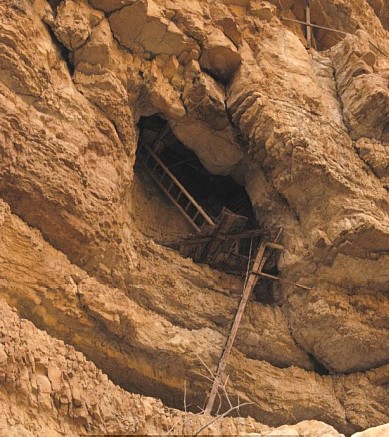
Another miracle performed by Saint John through his word when he was alive, it is told by His Reverence himself in what follows. I express exactly the words and lines written by Saint John: ‘Two years ago when father Sava came for the first time to the Jericho being very ill and disappointed, I wrote these lines to him and I asked him to keep his courage, and not to abandon us. Here is what I wrote to him then – here are the lines to father confessor Sava:
Keep the poverty of old age a little more,
Stop on the edge of life,
And first, think:
To whom do you leave your sons?
There where the Heavenly Height
Will see you, Holy Saint Sava,
He will ask you the question,
About the state of our souls.
So, prepare your disciple,
Which is worth taking your place,
Ahead the flock so poor,
And then you move in peace!
So, writing to him those lines, our old Father listened to me, and with God’s gift he gained strength and he lived two years more.’
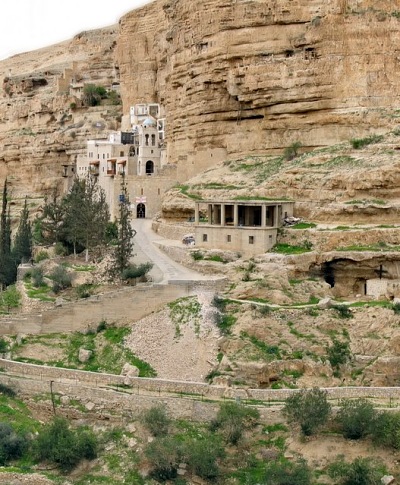
The Miracles Performed qfter He Passed Away to God
After the Relics of Saint John were brought, and they were put into the church, the Patriarch Benedict and another two bishops, summoned the synod in order to bury back the Saint saying he was not a saint, and he was not a Greek. Others said that he should be put in the grave of the monastery that was under the church, having an entrance under the staircase that climbed up to the belfry and the monastery.
But there were deposited there wheelbarrows, spades, sacks of cement, and all kinds of tools because at that time it was made the way that descended from the road to the monastery; and so, the Saint was left into the church because they did not have where to put him.
After a while when the Patriarch and the two bishops saw that there were many pilgrimages, and many people talked about St. John from Hazeva, they summoned again the synod, and they decided to bury St. John.
Immediately after that decision, the Patriarch had an infarct and he died, one of the bishops had a kidney obstruction, and in a year, all the three of them that wanted to bury St. John, died.
~~~~~~~~~~~~~~~~~~~~~~~~~~~~~~~~~~~~~~~~~~~~~
There came a group of pilgrims from Greece to cross themselves at the Holy Places, and when they arrived at Hazeva, a woman believer among them, called Hellen, when coming near the holy coffin of the Saint, said: ‘ 1’d better did not come to see this dead man which some consider to be a saint.’
When she arrived late at night to Jerusalem she couldn’t sleep, and when at daybreak she fell into a light slumber, she dreamt St. John young, with a lighted face, handsome, and he said to her: ‘Hellen! Why were you frightened by me, and what harm had I done to you?’
The following day Hellen wanted to come to Hazeva, and to pray the Saint to forgive her, but that wasn’t possible because she had to go back to Greece together with the other pilgrims.
Since then, a headache and a fright had kept bothering her until the following year she came, and she crossed at the holy coffin of the Saint, and then she healed, and she asked father Ioanichius to give her an icon of the Saint. Father had no icon, but he gave her a photo she received with great gladness, and every time she came to Jerusalem from then on, she said that the Saint helped her very much when she mentioned him in her prayers. That way she brought to the knowledge of many people from Greece the power of St. John Jacob the Romanian from Hazeva.
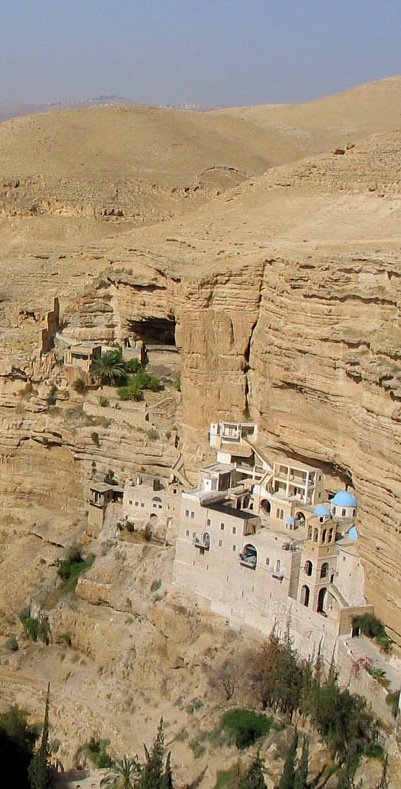
Another Christian woman from Australia dreamt a monk who told her to gather money for a holy coffin of a Saint with whole Saint Relics, but she was not told what was the name of the Saint. The following day she began to tell the dream to some more acquaintances, but nobody knew anything about that Saint.
After the Holy Relics of St. John were descended from the cave, and they were put into the church in a coffin, a group of orthodox pilgrims from Cyprus came. In that group there was a Christian woman called Cleopatra, who had seen in her dream St. John, who told her he hadn’t where to stay, he hadn’t a holy coffin. Then Cleopatra paid the money, so that the holy coffin of the Saint could be made, on which it was written it had been donated by Theodosius and Cleopatra Marcu from Cyprus.
~~~~~~~~~~~~~~~~~~~~~~~~~~~~~~~~~~~~~~~~~~~
After father abbot Amfilohius had passed away to eternity, the monastery had been left without an abbot for four years.
During that time father Ioanichius was the only monk that kept the icon lamps burning, read daily the seven praises, received the pilgrims coming to pray, and took care of the whole monastery. Then there came a Serbian father monk from the Holy Mountain, called hiero-monk Gregory who served the Holy Liturgy on Sundays and on holidays, together with father Ioanichius and nun Magdalene, when they came to receive the Holy Eucharist.
When father Gregory went to incense, after he incensed the Holy Icons and the Holy Relics, he used to pass on, without incensing the holy coffin ofSt. John because he had no piety for the Saint, and he said that he knew from the Patriarchate that father John was not a Saint, but father Ioanichius made him a Saint. One morning when he came out with the censer, he saw St. John standing up near the holy coffin and he told him: ‘You have incensed all the saints. Do you have anything against me? What wrong have I done to you that you don’t incense me, and speak ill of me?’ From then on, father Gregory had great piety, and he prayed a lot to St. John, and he said to many people what had happened at the holy coffin of the Saint.
~~~~~~~~~~~~~~~~~~~~~~~~~~~~~~~~~~~~~~~~~~~~
In 1988 the Patriarch Diodor of Jerusalem, named as an abbot at Hazeva hieromonk Sinesius, who had been before, the intendant of the Patriarch. Father abbot Sinesius was a young man of 24 when he came to Hazeva.
Like the other Greeks of the Greek Patriarchate neither that one had piety for St. John saying to father Ioanichius that he knew from other fathers and bishops that father John was a Romanian monk, and because of some sins he hadn’t putrefied, and that father Ioanichius cried up to all the pilgrims that came to Hazeva that he was a Saint, but in fact he was not.
In 1989 there came to Hazeva a Greek deacon from the Holy Mount, called Nichiforos.
That one was born in Germany. His father was a Turk that worked in a car factory, and his mother was a Greek from Greece, who had gone to Germany with her mother since childhood, and they had setded there.
Nichiforos’s grandmother (his mother’s mother) was of Macedonian origin, she had left Constanta in her youth with her parents, and she had gone to Greece where she had married a Greek, who had died after Nichiforos’s mother had been born.
Nichiforos’s grandmother grew him up in God’s fright. She took him and she christened him when he was older, in Greece, without his father knowing it, because he was a Moslem. When he was 18 he went to the Holy Mount and turned a monk, then after two years he went to America where the metropolitan bishop Natanail ordained him a deacon.
After a short time he went again to the Holy Mount where he made himself a hermit. Then he came to Jerusalem, where he met father abbot Sinesius, and that took him to Hazeva because he was alone between two Romanians and a Serbian.
Now, there were two Greeks against St. John and the two Romanians. Although the hieromonk Gregory had great piety for St. John, he could not say anything because he was also a foreigner as we were.
One day father abbot Sinesius scolded father Ioanichius because he took some Romanians to pray to the holy coffin of the Saint, and he gave them some books with the poems and the learnings ‘Spiritual Food’, and he forbade him to write anything about St. John saying that, that buried corpse stank (had a fetid smell), and that he had to be buried.
Then father Ioanichius sighed deeply, and he told him in my presence: ‘It won’t be 40 days, and you’ll see with your eyes, and your disciple too, if St. John is a Saint or not.’
The next morning I saw father abbot Sinesius entering the church with his beard out, and when father Ioanichie asked him why he had cut his beard he said: ‘A monk came last night in my cell which beat me terribly, and set fire on me, but there was nothing that could be burnt in my cell except for my beard.’
Then every night, for 40 days, that monk would come and beat him the whole night, until he confessed his guilt and he prayed to the Saint to forgive him.
During that time Nichiforos contradicted us all the time with regard to St. John to whom father Ioanichius told: ‘Never mind, St. John will take care of you, too.’ After that, Nichiforos began to go to the Bedouins, to eat and to sleep with them in their huts. After 6 months Nichiforos went to the Jericho, he took off his monk clothes, he left the great hermit clothes, he baptized as a Moslem, he got the name of Mustafa, and he married an Arabian widow with two children.
During that time father abbot Sinesius was moved too, in his place the Patriarch of Jerusalem brought another father abbot from the Monastery of St. Sava, father Anthony.
But as the other father abbot, neither that one had too great a piety for St. John, he didn’t treat us like Sinesius did, in exchange, for him, the Saint was father John, not the Saint.
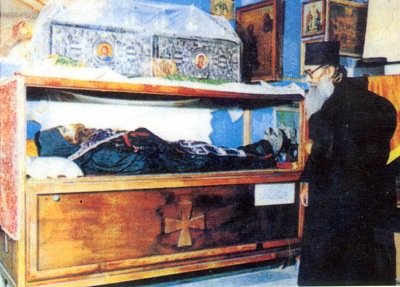
After St. John was canonized by the Romanian Orthodox Church, the Patriarch Diodor of Jerusalem settled to send to Romania two Metropolitan bishops of the Jerusalem Patriarchate to a Pan-Orthodox Synod that was organized by the Metropolitan Church of Moldavia in J assy.
The Patriarch of Jerusalem decided to send to Romania together with that two Metropolitan bishops, a piece from the Holy Relics of St. John.
Then, the Patriarch sent father abbot Antony to bring him a finger from the hand of the Saint to send it to Romania.
Father Abbot Anthony was in a hurry, he opened the holy coffin of the Saint, he broke in a hurry a finger from the right hand of the Saint, and that was all. He remained stiff with the Saint’s finger in his hands, and he felt a mortal cold shiver from top to toe. He felt on his head a cold hand, then a stream as cold as ice began to flow down his spine, after which some hot waves suffocated him, trying to take his soul of his chest, his heart beat so hardly that he thought something was breaking in his head, and he had a terrible buzzing in his ears, and he could not hear or see anything.
He would have wanted to shout at St. John to ask for his forgiveness but he had no voice. But his mind was clear and he said in his thought: ‘Saint John, I had sinned before you out of ignorance but now, please forgive me, and don’t punish me for my ignorance and my sins.’
Then it was a great miracle, and father Anthony was set free from those terrible ties, after which he put the Saint’s finger in his place, he fell down on his knees near the Saint’s holy coffin, he prayed a lot, after which crying, he entered the altar, he dressed with all the priest’s vestments, he burned the censer, he incensed the holy altar and the church, the holy coffin of St. John and for the first time a Greek priest sang to him the hymn of the Saint: ‘Into you, father … ‘ then he knelt again by the holy coffin of the Saint, he prayed a lot after which he opened the lid of the holy coffin, he kissed the hands of St. John, he took with great care and shyness the Saint’s finger, he put it in a silver box wrapped in a vestment, and he carried it to the Patriarchate. That miracle was performed in August 1992.
Since then, the father abbot had prayed much to St. John, he sang his hymn, and he mentioned him in all his prayers, and then he mentioned St. John with all the other Saints.
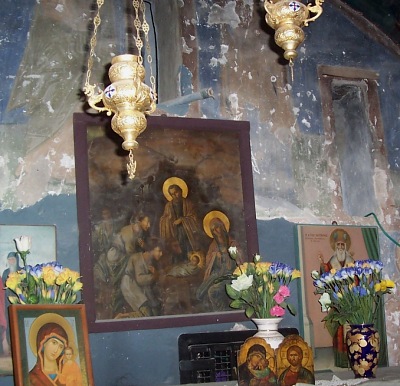
Not long after that, a group of worshippers from Greece entered the church, that left after they had prayed. Their guide saw that a woman was missing, so he went back to the monastery thinking she fell, and she had an accident on the stairs. He called for her, and he looked for her everywhere, and he found her by the Saint’s holy coffin, crying and praying, on her knees.
At that time I was in the church, and I changed the candles left burning by the worshippers. When the guide entered the church, father abbot Anthony came with him. Then the guide shouted at the woman saying: ‘Ela Maria. Let’s go Maria, the coach is leaving, and it’s a long way to go to the other monasteries, too.’
Maria stood up crying, she took the ring off her finger, she took off from her neck a golden chain with a medallion and a golden cross, she took her watch off her hand, and sobbing she said: ‘Let everybody leave because I don’t need anything from now on, and I don’t go anywhere because now I healed here at the holy coffin of the Saint from a hard disease I had suffered for 15 years, after I had given birth to a boy called Ioannis (John).’
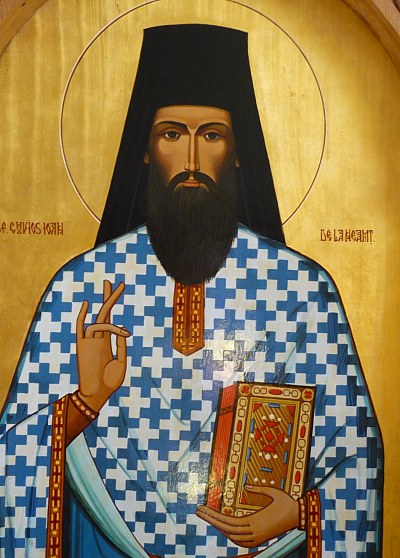
In April 1994 a group of worshippers from Greece came to Hazeva. There was in the group a woman with her daughter. The mother was almost 50 years old, and the daughter was almost 18 years old.
When the daughter tried to come near the holy coffin of St. John with a burning candle in her hands, a Greek monk Ghermanos stopped her because she was not dressed properly. Her mother being together with her daughter, making great noise, was down upon monk Ghermanos saying that her daughter, being a young lady, could dress as she liked. Monk Ghermanos replied: ‘The church is a holy place, a place of praying. It IS not a place of entertainment, and not a beach where you can go no matter how, even undressed.’
The daughter felt uneasy, she went out on the balcony, and when her mother approached to kiss the holy coffin of St. John, the Saint turned his head to her he sighed deeply, and the Saint’s face was covered all over by water drops.
The woman screamed, and she ran away down the stairs scared, descending towards the gate, where she fell down breaking both her legs.
All were frightened by that happening. The fathers of the monastery took a litter, and they helped the woman to be carried to the coach.
The woman confessed in front of everybody that she was guilty because she hadn’t brought up her daughter well, and when she came near to worship, she doubted the Saint, thinking he was a corpse, not a Saint.
Then asking father Ghermanos for forgiveness, she confessed that Saint John punished her for her sins.
Since then, St. John had remained with his head turned to the right, as ifhe reproved those who approach without piety, and dressed indecently.
(Taken from “The Life, The Miracles and the Akathistos Hymn of St. John Jacob, from Hazeva)
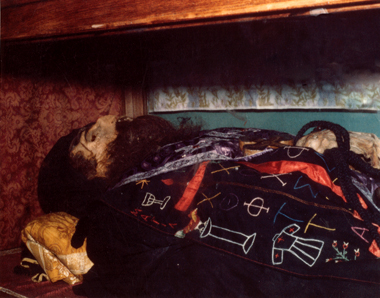
Akathistos Hymn to Saint John Jacob the Romanian
(written by Saint John Jacob’s disciple, father Ioanichius Paraiala)
Kontakion 1:
To thee, O great hermit of the Church of Christ, O pastoral adviser of the monks and offspring of Moldavia, come all ye faithful Christians to praise and cry out:
Rejoice, O pious Father John the New from Hazeva!
Ekos 1:
The Creator of Angels and of mankind, our Lord God Almighty has chosen thee from the beginning to leave all vanity of this world and with thy heart enflamed by divine love, thou ran to the salvation of reclusory, for which wondering we sing to thee:
Rejoice, thou who from childhood hast loved God;
Rejoice, for been burned by thine divine love, thou ran away from all vanity;
Rejoice, thou who rose from faithful parents Maxim and Katherine;
Rejoice, thou who didst receive the name of the Holy Prophet Elijah at thy baptism;
Rejoice, thou who wast left an orphan since childhood;
Rejoice, for Maria thy grandmother took care of thee;
Rejoice that for a while she was thy earthly protector;
Rejoice for she had taught thee in thine Holy Christian Faith since childhood;
Rejoice, for thy childhood had been difficult;
Rejoice, for it hast helped thee to gain eternal life;
Rejoice, O pious Father John the New from Hazeva!
Kontakion 2:
Having followed the schools of the time in thy village and alienated from thy acquaintances O father, thou hast kept in thy soul the yearning for the supreme serving of Christ, never taking part in childish games but always singing from thy heart to Thee: Alleluia!
Ekos 2:
When thou wert only 10 years old, thy grandmother and only earthly comforter dying, thou wert entrusted to see in the Holy Altar of the Church, a marvelous vision of Thy Resurrection of Christ our Savior, for which we sing to thee:
Rejoice, for having a pure heart thou saw Christ our God;
Rejoice for at the grave at thy parents, thou often used to go to burn candles;
Rejoice, for God hast been thy only comfort, strengthening and hope;
Rejoice, thou who from early childhood didst show to be a fervent worker of the prayer of Jesus;
Rejoice, for thy heart was not attached to vain things;
Rejoice, for thou hast taken Christ’ Pure Mother as thy protector;
Rejoice, for in thy loneliness, thou didst find quietness;
Rejoice, for in God’s will thou hast entrusted thy life;
Rejoice, O pious Father John the New from Hazeva!
Kontakion 3:
Having finished primary school in thy native village, the gymnasium then the secondary school, thou hast confessed thy thoughts to thy Elder – Abbot Eugene Laiu, wanting to become a monk and to sing unceaselesily to Thee: Alleluia!
Ekos 3:
Giving up all the vanity for Christ’s love and praying before the relics of the Holy Martyr John the New from Suceava, thou didst follow thy way to sacred Monastery of Neamt, for which we sing to thee:
Rejoice, Allhappy soul loved by God;
Rejoice, for bishop Nicodim Munteanu didst accept thee;
Rejoice, for thou wert given the obedience to the sick;
Rejoice, for thou didst help many by learning the physician’s skills
Rejoice, thou who didst wonder at thine creation;
Rejoice, thou who day and night un-ceaselessly prayed to Thy Heavenly Father;
Rejoice, for thy great zeal in reading spiritual councils;
Rejoice, thou who greatly loved thine Holy Church, thine people and the spiritual writings;
Rejoice, O pious Father John the New from Hazeva!
Kontakion 4:
After becoming a monk, thou took the name of the Great Baptist John, O pious father and sought God’s care day and night, for thee wert to live the life of a hermit in places where thine great prophet dwellest and sung to God: Alleluia!
Ekos 4:
As once Abraham left thy country and thy relatives, o father so didst thee left Moldavia for thine Holy Places, for which we sing to thee:
Rejoice, thou follower in the faith of the Patriarchs;
Rejoice, for resembling the Saints with thy strive;
Rejoice, thou – obedient with Abraham;
Rejoice, with Jacob who saw God;
Rejoice, thou without wickedness like Moses;
Rejoice, like David in meekness;
Rejoice, for thou didst show the patience of Job;
Rejoice, thou who reproved errors, with the boldness of the Great Baptist;
Rejoice, foreseer of the future with the old prophets;
Rejoice thou who fervently prayed at thine Holy Places;
Rejoice, O pious Father John the New from Hazeva!
Kontakion 5:
At the instruction of Holy Patriarch Damianos from thine Holy Church of Jerusalem, thou were accepted in the covenant of Saint Sava, singing to Thee: Alleluia!
Ekos 5:
Thy struggles in the monastic obedience were many, O pious father, but with the help of Thee, Whom you dearly held in thy heart, thou didst carry everything with love, for which we sing to thee:
Rejoice, O pious Father John;
Rejoice, follower of Saint Sava in virtues;
Rejoice, thou who resembled Anthony in holiness;
Rejoice, thou who didst strive as the Great Arsenius;
Rejoice, that all the badly sick fathers were seeking for thy help;
Rejoice, with the Great Sisoes in deeds;
Rejoice, consolation of the Christian’s pilgrims seeking for thee;
Rejoice, that for thy great charity
“Physician of the monastery” all called thee;
Rejoice, that through the miracle of thine Holy Mother, thou were saved from the Bedouins’ attack;
Rejoice, thou who carrest for all as didst Christ thy Master;
Rejoice, O pious Father John the New from Hazeva!
Kontakion 6:
Longing for the life of a hermit, O father, thou took the blessing of hieromonk Sava to depart for Kumrran desert, singing to Thee: Alleluia!
Ekos 6:
Thy stay in Kumrran wast short, O Father, when the Bedouins rushed in with their cattle so thou had to depart for the cave of Kalomana in the Valley of Jordan, for which thee hear from us:
Rejoice, thou who searched for silence;
Rejoice, that from the attack of a wild beast, thou wast saved through a great miracle;
Rejoice, that departing from passions, thou didst oppose evil;
Rejoice, thou who dwelled not far from the Monastery of Saint Gherassim form Jordan;
Rejoice, for great harness thou didst endure there;
Rejoice, for having settled in Kalomonas cave, thou didst receive a disciple;
Rejoice, thou who wast consumed by the same zeal and love for Thee;
Rejoice, for in the Jordan Valley, thou sang praises;
Rejoice, thou who wast struck by a serious illness of the stomach;
Rejoice, for despite of thy illness, thou carried out the monastic law and the cannons;
Rejoice, O pious Father John the New from Hazeva!
Kontakion 7:
This illness hast tormented thee for one-half year, O Father, and thee grew even weaker to a total exhaustion, but with joyful heart thou sang to Thee: Alleluia!
Ekos 7:
When the war burst in the Holy Land, thou wert put in the concentration camp with the Italians and the Germans for almost a year, for which hear from us these:
Rejoice, for these temptations didn’t frighten thee;
Rejoice, thou who didst endure all for Christ’s love;
Rejoice, for in the storms of life, thou grew stronger;
Rejoice, that in troubles and pain, thou hast run to God for help;
Rejoice, that weakened by the stomach pain, thy only hope was from Above;
Rejoice, that from the camp thou wast saved by the power of Jesus;
Rejoice, for once again, thou wast received in the Lavra of Saint Savas;
Rejoice, for thou wert ordered to the same obedience;
Rejoice, for thou went to the Monastery of Saint Theodosius;
Rejoice, thou who wast healed from Above’
Rejoice, O pious Father John the New from Hazeva!
Kontakion 8:
Having being deemed worthy to be received into the holy order of the deaconate and then the priesthood at our Lord Holy Sepulcher in Jerusalem, thou wast longing to go to the desert, singing to Thee: Alleluia!
Ekos 8:
So great was thy joy when thou arrived at a quiet place, having becoming the Abbot of the Romanian Skete in Jordan, thou prayed for thy native country and for all thine people, for which hear from us these:
Rejoice, thou who served with great zeal at the Skete in Jordan;
Rejoice, for great were thy battles;
Rejoice, that for 5 years thou hast served at this Romanian Skete;
Rejoice, that from there thou hast travelled to the Hazeva Desert;
Rejoice, O father much longing for the desert;
Rejoice, for in the Monastery of Saint George from Hazeva, thou hast served for a year;
Rejoice, thou who didst seek for a complete silence;
Rejoice, for in the sweat of reclusory, thou put out the coals of thy passions;
Rejoice, O pious Father John the New from Hazeva!
Kontakion 9:
Through God’s grace and the care of thine Pure Mother, thou arrived at a place of quietness and total collectedness in the cave where Saint Anna hast lived the life of a recluse, singing to Thee: Alleluia!
Ekos 9:
Burnt by the desire to live the rest of the days in that blessed place, thou hast strived in great labors, for which hear from us these:
Rejoice, seer of God;
Rejoice, dwelling of heavenly light;
Rejoice, for been crucified to the world, thou offered thyself as a sacrifice to Thee;
Rejoice, model of salvation of the country Above;
Rejoice, firm ground of the hesychasts;
Rejoice, rare flower of the Jordan Valley,
Rejoice, great hermit and instructor of the monks;
Rejoice, elect guardian of chastity;
Rejoice, fervent servant of thine Most Pure Mother;
Rejoice, for been enlightened form Above, thou hast accepted the priesthood;
Rejoice, O pious Father John the New from Hazeva!
Kontakion 10:
Having been difficult for many to reach that secluded place, thou didst receive at thy cave only those souls genuinely seeking salvation, urging them to unceaselessly sing to Thee: Alleluia!
Ekos 10:
Thou hast instructed all thy spiritual children to remember death, the Day of Judgment and the Holy Sacrifice of our Merciful Christ, for which we sing to thee:
Rejoice, father John pious thinker;
Rejoice, with Basil the Great teacher of the remembrance of death;
Rejoice, skillful instructor with John the Golden Mouth;
Rejoice, server of Liturgy with Saint Gregory;
Rejoice, O Father dwelling with thine angels;
Rejoice, bearer of Christ;
Rejoice, ardent guardian of the monastic promise;
Rejoice, dearest keeper of the Holy Cannons;
Rejoice, with Holy Nicodim defender of the Orthodox Faith;
Rejoice, preserver with great zeal of the Tradition of the Holy Fathers;
Rejoice, O pious Father John the New from Hazeva!
Kontakion 11:
Seeing thy angelic life in the Cave of Saint Anna, it is proper for us to strive for a sinless life, asking Christ for a new beginning and to sing to Thee: Alleluia!
Ekos 11:
Great comfort has found all those wondering to the Holy places, thy Cave and the Romanian Skete from Jordan, O pious Father, for which you hear from us these:
Rejoice, precious treasure of the One Christian Church;
Rejoice, ardent intercessor for your kinsmen;
Rejoice, chosen jewel of the pious priests;
Rejoice, strength and help for the meek;
Rejoice, for a great heavenly vision wast revealed to thee before departing this life;
Rejoice, thou who wast rise to great heights for thy striving;
Rejoice, oil with sweet fragrance of Heavenly Grace;
Rejoice, one longing for the remembrance of thy kinsmen;
Rejoice, our protector before the Righteous Judge;
Rejoice, heavenly pearl and skylight of the Romanian nation;
Rejoice, O pious Father John the New from Hazeva!
Kontakion 12:
Thy departure from this transient life was wondrous O father, when all thine saints whom thee honored and composed hymnody were awaiting thy soul to accompanying it into thine Heavenly Bliss, all crying with joy: Alleluia!
Ekos 12:
All pious Orthodox Christians rejoicing at thy holiness of life, O Pious Father John, and marveling at thy Holy Relics, they sing to thee:
Rejoice, angel in the body now rejoicing with them;
Rejoice, dweller with thine Saints,
Rejoice, intercessor with thine Apostles and Martyrs;
Rejoice, with the Righteous and Pious who left this life;
Rejoice, protector in times of danger;
Rejoice, shining star of the clergy;
Rejoice, for spiritual food thou left to us in thy writings;
Rejoice, comforter of the hopeless and despaired;
Rejoice, thou who hast work wonders though thy holy relics;
Rejoice, for venerating them, thou fillest our souls with endless yearnings;
Rejoice, O pious Father John the New from Hazeva!
Kontakion 13:
O Pious Father John pleasing Thee, receive from us this pious hymn and ardently pray to Allmerciful God for thy nation and all Orthodox faithful that we may be delivered from all snares, disgust, dangers and despair, and at the end of our lives intercede for us before thine Heavenly Throne, O father, so together with thee we may sing the angelic praise: Alleluia!
(This kotakion is read three times, then follow with the first ekos and the first kotakion).
A Prayer to Saint John Jacob the Romanian (to follow…)

Its image is gentle but its intent, perfidious
There is a “spirit” unveiling in Europe and the world in general, a (proteic) New-Age kind of spirit that frequently changes its appearance and speech, striking the Christian world from all sides. Its image is generally gentle, its discourse attractive, but its intent perfidious. This spirit can speak in beautiful words about family, but its intent is to annihilate it. It can also sermonize on the Church, full of “love” for all, a sort of religious syncretism, but its urge is primarily to dispel Orthodoxy. It can speak about nations and their homelands as something that it tries to support, but its intent is to destroy both the Church and the nations. This spirit is called ecumenism.
And this whole “beautiful” discourse, which takes on many faces, has only one purpose: the destruction of nations, the abolition of the Orthodox Church in particular and the establishment of a group of leaders, anointed by I do not know whom… to win over all nations to their spirit, to initiate them into certain social, political and religious orders, so that those leaders may always direct [world events]. Let us not be deceived! I live among these “speaders” of prolific and protean discourses that cover the world. And I know their hearts. They have no good intention for our Church! Under the guise of Christian love, of Christian peace, they hide their perfidious intent. And I came here to say: Do not get allured by it! …
In this “New Age” spirit I’m referring to, nothing exists with an absolute value.
For their intent is to destroy all the elements of the Faith, the moral elemets, the elements of kinship on which we have relied, since – so to say – there is no absolute truth. The truth, according to them, is that which I possess [i.e. subjective truth]. And therefore, when my neighbor is wrong, I cannot tell him: “You’re deceived!” Nor can he tell me that I have erred, because we are absolute entities [onto ourselves]. We have our opinions which are absolute, but before others, they hold no value! This game of hiding the truth is an insidious invention of Satan.
On the True face of Ecumenism
(An interview taken by a reporter in 2005)
Interviewer: – Father, can a Christian, a Muslim and a Jew live together in peace and harmony and what would be the secret?
Fr. George: – Their mutual respect; this is the only manifestation of good harmony. In no case, the participation in common prayer or services. These are things that break the elements of dogma of different religions.
Interviewer: – Does everyone worship in the same God?
Fr. George: – Not always… We only know One (Trinitarian) God, Who reveals Himself to us and we worship Him. Other forms of gods are distorted or false.
Interviewer: – What do you believe to be the greatest temptation that an orthodox faithful faces today?
Fr. George: – Ecumenism.
Interviewer: – …My next question was if you agreed with the existence of the ecumenical dialogue, but…
Fr. George: – No. Absolutely not. For that ecumenism is a more subtle form of masonry. Masonry tries to destroy the Orthodox faith and the Christian faith in general. Ecumenism is trying to cling on few ideas that seem very generous: why shall we argue among ourselves, let us live like brothers, let us love one another, we can worship together and pray together … things that are not allowed in Orthodoxy. All the 7 Ecumenical Councils forbid the co-prayer with those apart from Orthodoxy. If we do not obey these canons, and become subject to ecumenism and the pressures and promises of the West, which are all vein lies, it means that we violate all canons of the Orthodox Church, the only true ecumenical one.
Interviewer: – Under the current state of the media when Masonry is so publicized, please underline few elements as of what this anti – Christian movement means!
Fr. George: – Masonry is a demonic organization that worships Lucifer, has some secrets and keeps them firmly, but reveals itself to the world as a charitable organization that takes care of the poor. Every Masonic Lodge deals with Unitarianism or an order, but beyond these facts, the Spirit of God is absent and all these are made up for deceit. So (my child), do not be fooled by it. Not everyone who speaks promptly in the name of God has Him in his heart, and they have Him the least. The greatest danger is this process of globalization and the anointing of some individuals entitled to lead mankind. Who is anointing them? They are the anointed sons of Satan and not sons of the living God.
As for us been “small” and having no “powerful speech”, let’s keep our faith and let us not forget that we represent the true faith that saves, and lets strive with all out power to fulfill the duties to our nations and our Church.
(Taken from Fr George’ Living Words, translated by EC, to be continued)
 Christian Dogma
 Christian Martyrs
 Christian Orthodox Churches and Monasteries
 Christian Sermons and News
 Church's Teachings on Fasting
 Ecumenism – a Great Heresy
 Father George Calciu
 Life_a Sacred Gift form God
 Orthodox Saints and Church Fathers
 Spiritual Elders
 Daily Bible Readings
 Journey to Orthodoxy
 Listen to Ancient Faith Radio
 Orthodox Calendar of Feasts and Saints
 Orthodox Christian Mission Center
 Orthodox Institute
 OrthodoxChristianNetwork TV


Recent Comments