
You are currently browsing the category archive for the ‘Great Lent 2010’ category.
“Intercommunion, that is to say participating with heretics in the Holy Sacraments, and especially of our Holy Eucharist, is the most shameful betrayal of our Lord Jesus Christ.”
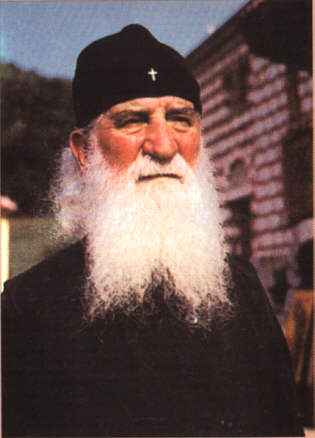
(From the book Orthodox Faith and Life in Christ by St. Justin Popovich)
Ecumenism and the Ecclesiology of Saint Cyprian of Carthage
by Fr. Daniel Degyansky
Saint Cyprian of Carthage developed with fearless consistency a doctrine of the complete absence of Grace in every sect which had separated itself from the True Church. His doctrine is one of the basic foundation blocks of Orthodox ecclesiology and it stands in direct opposition to the presuppositions of the ecumenical movement. Moreover, his warnings about the enemies of the Church have traditionally guided Orthodox in their response to those outside Her fold:
Not only must we beware of what is open and manifest, but also what deceives by the craft of subtle fraud. And what can be more crafty, or what more subtle, than for this enemy…to devise a new fraud, and under the very title of the Christian name to deceive the incautious. [139]
Saint Cyprian’s warnings about enemies of the Church who call themselves “Christians” in order to destroy the Faith can be applied to many of those who support unity through the contemporary ecumenical movement. The fact that such application is seldom made gives us evidence of just how far contemporary ecumenism has removed some Orthodox from the criterion of truth that is their Faith.
The essence of Saint Cyprian’s reasoning lay “in the conviction that the sacraments are established in the Church.” That is to say, they are effected and can be effected only in the Church, in communion and in communality. Therefore, every violation of communality and unity in itself leads immediately beyond the last barrier into some decisive outside. To Saint Cyprian every schism was a departure out of the Church, out of that sanctified and holy land “where alone rises the baptismal spring, the waters of salvation.” [140] Saint Cyprian was adamant in his position with regard to the Church’s rejection of the validity of an heretical sacrament:
For it is no small and insignificant matter which is conceded to heretics, when their baptism is recognized by us; since thence springs the whole origin of faith and the saving access to the hope of life eternal. And the divine condescension for purifying and quickening the servants of God. For if any one could be baptized among heretics, certainly he could also obtain remission of sins. If he attained remission of sins, he was also sanctified.[141]
Saint Cyprian felt that if the True Church recognizes the sacraments of those outside of Her realm, She gives credibility to heretics and schismatics:
For if they shall see that it is determined and decreed by our judgement and sentence, that the baptism wherewith they are there baptized is considered just and legitimately in possession of the Church also, and the other gifts of the Church; nor will there be any reason for their coming to us, when, as they have baptism, they seem also to have the rest. But further, when they know that there is no baptism without, and that no remission of sins can be given outside of the Church, they more eagerly and readily hasten to us, and implore the gifts and benefits of the Church, our Mother, assured that they can in no wise attain to the true promise of divine grace unless they first come to the Truth of the Church.[142]
The teaching of Saint Cyprian on the Gracelessness of those outside the True Church is directly related to his teaching on unity and communality: “Therefore, we ought to consider their faith who believe without, whether in respect of the same faith they can obtain by grace, for if we and the heretics have one faith, we may also have one grace.” [143] Strictly speaking, the theological premises of Saint Cyprian’s teaching have never been rejected. At the same time, neither has the Orthodox Church ever unequivocally applied Saint Cyprian’s conclusions. In fact, the First Canon of Saint Basil, if carefully analyzed, suggests that the issue of schism and heresy is more complex, in practical terms, than the theory of Saint Cyprian would suggest. Thus the canonical norms of the Orthodox Church do not state that schismatics are in all circumstances without Grace. Ecumenists have used Saint Basil’s position, at times, to defend their activities (though in the course of deviation from correct Orthodox teaching, it must be noted, many Orthodox ecumenists have come to believe that “schism” and “heresy” are terms without meaning, except when they can be used to berate those Orthodox who oppose the ecumenical movement). In fact, however, the ecclesiological teachings of Saint Cyprian complement and stand side by side with those of Saint Basil, since they are unified by the function of “economy,” by which the theoretical exactness of Saint Cyprian’s teaching is rendered effective in the oikonomia of practical application.
Thus, there are those who quite wrongly think that the Church has in some instances acknowledged that the sacraments of sectarians, and even of heretics, are valid. They wrongly assume that the Church admits that sacraments can be celebrated outside of the strict canonical limits of the Church—a perilous assumption, indeed. The Church, for example, may under extraordinary circumstances accept adherents from sects, and even from heresies, not by way of Baptism, but rather by Chrismation or even by their simple profession of our Orthodox Faith. But in so doing, She does not recognize, as some theologians incorrectly assert, what is outside Her domain; rather, by “economy,” the Church, being the Pan–Mystery, as Archimandrite Justin expresses it, creates Grace where there was no Grace, filling the empty form of a mystery (sacrament) unknown to Her. At the same time, before the emergence of whole bodies of Christians separated from the historical Orthodox Church, there were times when those who had lapsed in their Faith even for a generation were received back into the Church without being Baptized. But here, too, it was the correct form of their empty mysteries which the Church accepted, not the validity of their sacraments. By “economy,” then, the primacy of the Church was extended beyond Herself to create Grace in what was done outside Her boundaries. But in so doing, in no way whatsoever did She accept what was beyond Her boundaries. She acted beyond the Canons, but not in violation of them:
As a mystical organism, as the sacramental Body of Christ, the Church cannot be adequately described in canonical terms or categories alone. It is impossible to state or discern the true limits of the Church simply by canonical signs or marks…. In her sacramental, mysterious existence the Church surpasses canonical measurements. For that reason a canonical cleavage does not immediately signify mystical impoverishment and desolation. All that Saint Cyprian said about the unity of the Church and the sacraments can be and must be accepted. But it is not necessary, as he did, to draw the final boundary around the body of the Church by canonical points alone.[144 ]
Saint Augustine of Hippo, espousing opinions clearly outside the consensus of the Church Fathers, wrote that within the sects and divisions of Christianity the “union of peace” had been broken and torn asunder, but in their mysteries the “unity of the Spirit” had not been terminated. This shows, as Father Florovsky observes, “the unique paradox of sectarian existence: the sect remains united with the Church in the grace of the sacraments, and this becomes a condemnation once love and communal mutuality have withered.” [145] Thus, Saint Augustine directly affirmed “that in the sacraments of sectarians, the Church is active; some she engenders of herself, others she engenders outside, of her maid–servant, and schismatic baptism is valid for this very reason, that it is performed by the Church.” [146] According to Saint Augustine, then, “the Holy and Sanctifying Spirit still breathes in the sects, but in the stubbornness and powerlessness of schism healing is not accomplished.” [147]
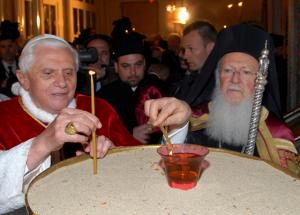
Ecumenists have used Saint Augustine’s thought to confirm that there are valid sacraments outside the Orthodox Church. By the same token, those opposed to ecumenism have concluded from the same thought that the rites of the schismatics are not sacraments, but a blasphemous caricature thereof. Some Orthodox conservatives affirm, indeed, that salvation can be found only within the confines of the Orthodox Church, thus arguing that all schismatics are condemned to damnation. The conclusions of the ecumenists are absolutely incorrect. The Orthodox Church accepts no sacrament outside of Her boundaries except, again, as empty forms. Moreover, Saint Augustine is writing about the undivided Christianity of an age which knew nothing of the hundreds of sects which constitute the Christian world of our day, many of them so far removed from the historical Church and Her rich doctrines that only by their belief in Christ can they be defined as Christians. It is an act of intellectual dishonesty to use his words about sects and heresies in the ancient Church as though they applied clearly to contemporary times. Nor, as we have pointed out, is the thinking of Saint Augustine about the validity of the sacraments of heretics and sectarians in agreement with the Patristic consensus or internally consistent.
At the same time, it is wrong for “conservatives” to interpret the words of Saint Augustine in such a way as to suggest that the Orthodox Church compromises the Providence of God. The Church has always affirmed the dominance of love within the confines of Her exclusive claims that only in Her bosom does salvation rest. Because of God’s love, the Orthodox Church can at once proclaim that salvation is possible only for Orthodox Christians and, at the same time, refuse to compromise Divine Providence by condemning all others to damnation. And because of the love which prompts the Church in Her mission, She at times reaches out in the spirit of “economy” to fill with Her exclusive Grace the empty forms of non–Orthodox religious acts. In so doing, however, the Orthodox Church never, until the advent of ecumenism, acknowledged the validity of any sacrament outside Her boundaries.
In many ways, the Orthodox Church cannot accept the precepts of modern ecumenism because they also violate the spiritual teachings of the Fathers about personal integrity as a foundation for ecclesiastical validity. In the fourth century, Saint Ephraim the Syrian said, “Pride does not permit a man to accept the teachings handed down by Tradition.” [148] The Orthodox tend to see separation and disunity in Christianity not as the result of a tragic process of mutual alienation, but of pride and sin. Thus, the second major schism in Christianity, the Great Schism of 1054, can be seen in the following way:
By the anathema against papism the Church proclaimed that the pope and his followers abandoned the Church, lost the Truth (which is Christ), and were submerged in the depths of error from which Christ came to free them. Their teachings were declared a delusion of the Evil One, and a poison to the souls of men, and any communication with them makes us like them by cutting us off from the Grace of God, from His Holy Church, and estranges us from the path of salvation, placing us rather on the road to perdition.[149]
The root causes of heresy and schism, then, are the intransigence and sin of prideful men. Heresy and schism do not just happen; they are caused. They rise out of spiritual delusion, spiritual disease, and alienation from the ways of God and His Church. Deviation from Orthodox Truth in the form of ecumenical activities has had a negative effect on the Church, as though to prove that schism and heresy are not the products of misunderstanding, but of the willful deviation of wrong believers from the True Church. For instance, Orthodox theologians have come to reject the Canons of the Church, so that they can justify their ecumenism. Thus the late Archpriest John Meyendorff, a well–known spokesman for Orthodox in America, dismisses the Canons which forbid joint prayer with heretics as archaic and no longer applicable to the Church. He claims that these Canons were intended to apply to prayer with conscious apostates from the True Church, “and not sincere Christians who never personally left it.” [150] Thus individual responsibility for wrong belief becomes an inessential part of Christian confession—a novel idea, indeed. By the same token, not a few Orthodox theologians and Hierarchs are beginning to see a place for Orthodoxy in the ecumenical “branch theory.”
While claiming to love the Orthodox Faith, they violate their promises at Ordination to defend the Truth and instead openly state that the Orthodox Church is just as guilty of divisiveness as the heretics and schismatics who separated themselves from the Church of their own free will. Again, to hold such views or to participate in ecumenical activities which champion such ideas is to deny the existence of the True Church and Christ’s earthly presence. Thus one who participates in such ecumenism perforce denies Christ.[151] Ecumenism, in short, has led many Orthodox to deny the very existence of Christ as we Orthodox understand Him.
Endnotes
139. St. Cyprian of Carthage, The Unity of the Church (Mahopac, NY: Kursk–Root Icon Hermitage, n.d.), p. 3.
140. Florovsky, Ecumenism I , p. 36.
141. St. Cyprian of Carthage, “Epistle to Jubianus,” in Vol. 5 of The Ante–Nicene Fathers, ed. Alexander Roberts and James Donaldson (Grand Rapids, MI:Eerdmans Publishing Co., 1986), p. 382.
142. Ibid., p. 385.
143. Ibid., p. 380.
144. Florovsky, Ecumenism I , p. 37.
145. Ibid., p. 42.
146. Ibid., p. 41–42.
147. Ibid., p. 42.
148. “Stolen Doctrines,” The Orthodox Christian Witness, Vol. 19, No. 29 (17/30 March 1986), p. 3.
149. Alexander Kalomiros, “The Anathema of 1054” (Seattle: St. Nectarios Educational Series, No. 69).
150. Meyendorff, Witness, p. 46.
151. Lev [Archbishop Lazar] Puhalo, “Can One be an Ecumenist without Denying Christ?,” Orthodox Life, Vol. 24, No. 3 (May–June 1974), p. 33.
From Orthodox Christianity and the Spirit of Contemporary Ecumenism, by Fr. Daniel Degyansky. (Etna: CA, The Center for Traditionalist Orthodox Studies, 1997 [1992]), pp. 76-83. Fr. Daniel is a Priest in the Orthodox Church in America (OCA).
Saint John (Ioan) Cassian – the Roman
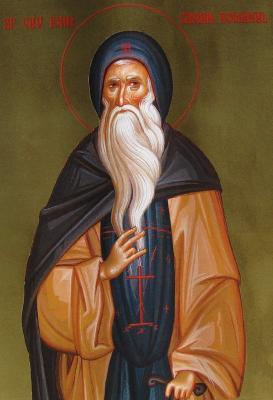
His Life: The West gave very few Church fathers. St John Cassian was only technically one of them. He was born in the south of Romania, in a region that had been visited by the Apostle Andrew, in about 360 AD. As a son of a wealthy family, St John was given a very good education. While he was still in his teens, however, he and his friend Germain heard of the monks in the deserts who gave their lives to Christ our Saviour. These two friends love the Lord and His Holy Church and they longed t go to a monastery and give their lives to Christ also. The two youths set out for the Holy Land. After a long and difficult journey by sea and by land, they came at last to Bethlehem. Here the two entered a monastery and began to struggle for their salvation. Saint John and Germain spent several years in the monastery of Bethlehem and they heard many stories about the wondrous monks of Egypt. The monks in Egypt were the most spiritual and wisest of all monks, and the two young men desired to visit them and learn from them. The abbot of their monastery gave them a blessing and they set out. After a long boat trip from the city of Joppa, the friends arrived in the town of Thennesus, on the Nile River. From there, they began to visit all the famous monasteries of Egypt. Most important, Saint John Cassian wrote down whatever the great elders and fathers of Egypt told him. These teachings he later put into a book which he called “Conferences” and this book is one of those works we call “Patristic Writings”.
Saint John and his friend Germain spent seven years in Egypt, not only learning from the monks, but also living their life with them. The two learn the true monastic life and loved the desert, but at the end of seven years, they had to return to their monastery in Bethlehem. They stayed in Bethlehem for only two more years and then, with the blessing of their abbot, they returned to Egypt for two more years. After this, the two monks went to Constantinople, where the great saint and father of the church John Chrysostom, was patriarch
Saint John Cassian and Germain stayed in Constantinople for about 5 years.
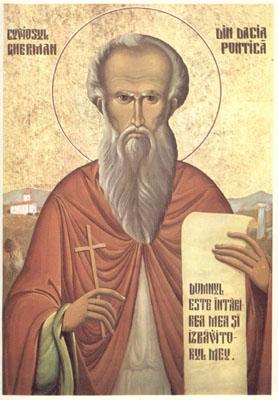
Saint Germain (Gherman the Romanian)
Saint John Chrysostom ordained them both – he made Germain a presbyter and Saint John Cassian a deacon, and he appointed both of them to the duties of his cathedral. The two learn much from our holy father John Chrysostom.
When Saint John Chrysostom was slandered and driven into exile in 405, Saint John Cassian and Germain went to Rome to try to get support from Chrysostom. Here, Saint John Cassian was ordained a presbyter. The saint then returned to France (Gaul) and built a monastery in the forest near the town of Marseille. His monastery was very much like those in Egypt and the Holy Land and soon monks came to him. Other monasteries began to grow up in the West, and most of them followed the example of Saint John Cassian’s monastery.
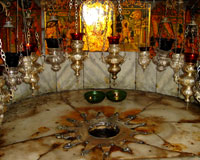
Those were the days when the West was still Orthodox and Saint John Cassian was a great Orthodox father who helped to defend the Orthodox Faith against false teachings. In his time, the two great falls teachings of the West were those of Pelagius of Britain and Augustine of Hippo. In addition to these, the heresy of Nestorius was harming the faithful and Saint John wrote a very important work against the teachings of this heretic. Saint John Cassian’s other famous work is called “The Institutes” and it gave the rules and teachings for the monasteries.
Our holy father John Cassian was the true founder of Orthodox monasticism in the West. He was a great teacher and defender of our Saviour’s Holy Orthodox Faith. This Holy Father reposed in the Lord at the age of 75, in the year 435. His sacred relics were buried in his own Monastery of Saint Victor. John Cassian’s relics are kept in an underground chapel in the Monastery of St Victor in Marseilles. His head and right hand are in the main church there.
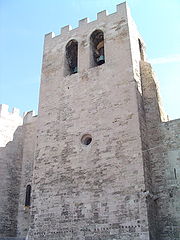
(Life Taken from the book “Great Fathers of the Church” by Archbishop Lazar Puhalo)
Saint John Cassian: On The EIGHT PRINCIPAL VICES (Philokalia)
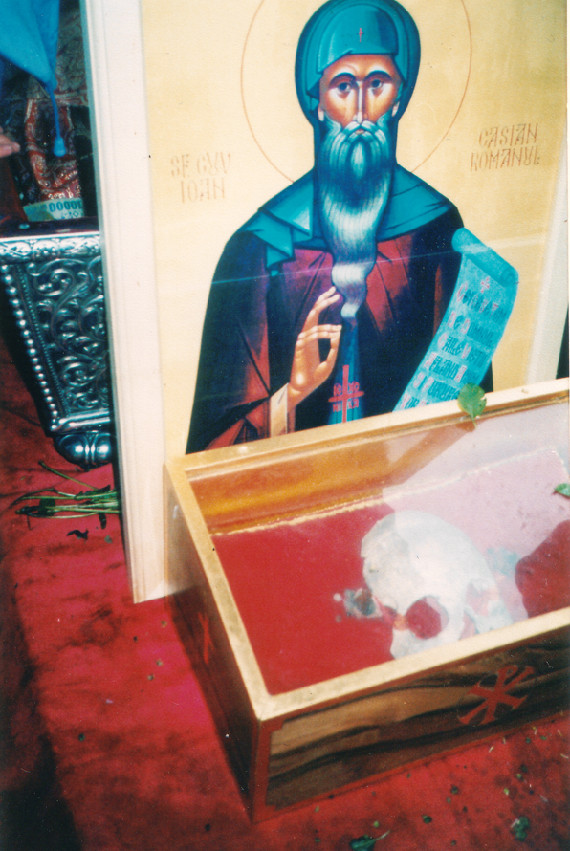
(Precious Head of St John)
The Cave of St. John Cassian and the Monastery dedicated to the Saint in Southern Romania
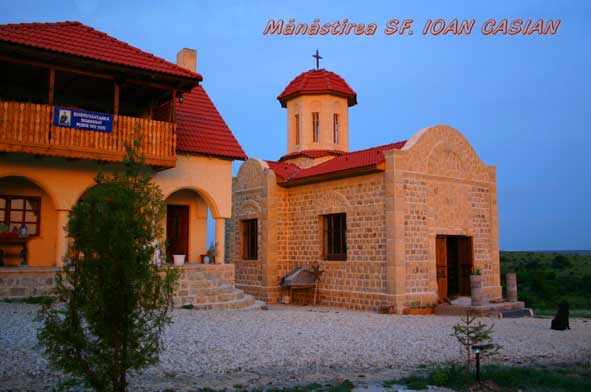
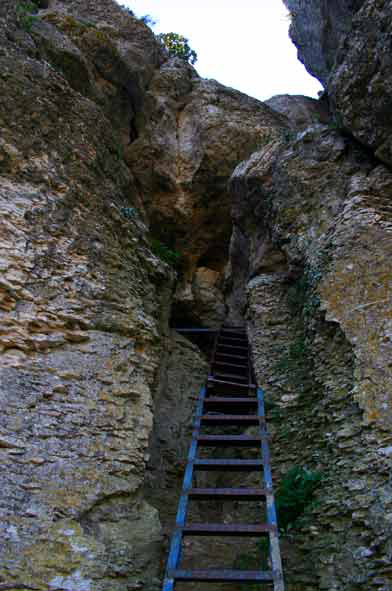
Hidden from sight, through the rough forms of the Hill of St. John Cassian, the cave opens into a rocky wall, above the valley of Casimcea. A narrow path, with steps carved in limestone, arranged recently, is leading to the entrance of the cave. The cave is spacious and without the usual moisture.
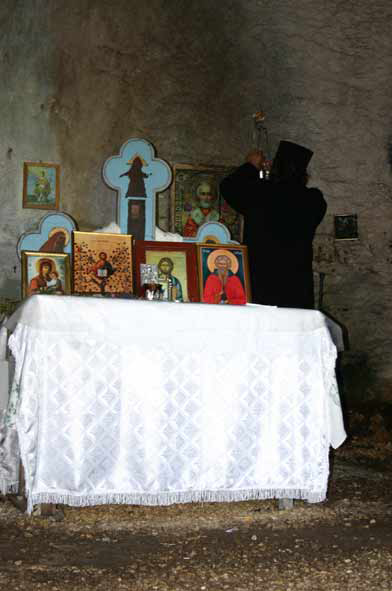
The central space of the cave continues laterally with narrow and long galleries. From the left side of the cave one can get to a room not to big known among locals for centuries, as the Holy Cell of Saint John Cassian.
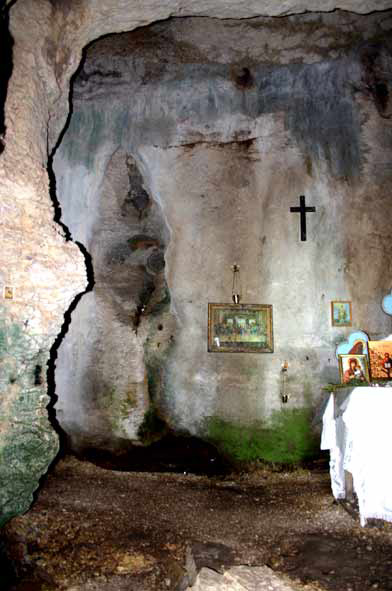
The ancient monks used the cave as a dwelling place but also for liturgical services, the inner part of the cave resembles much with a church. On the cave walls, incised in limestone, one can distinguish signs of crosses, traces of inscriptions, scattered Cyrillic letters and the word “Aghios “= Holy (Greek).
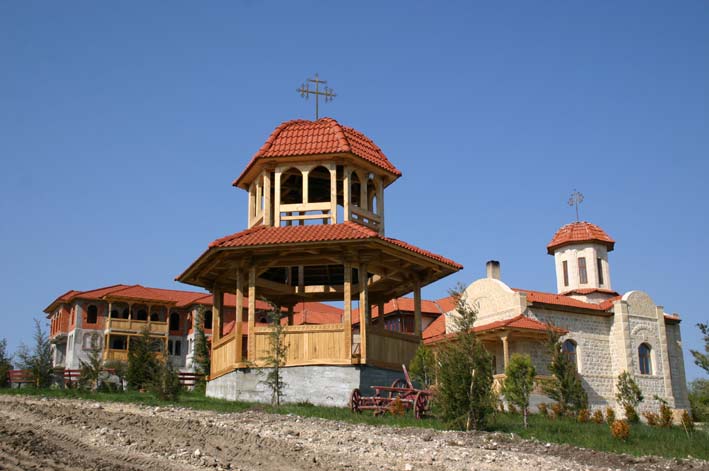
Monastery dedicated to St John from Romania

(Old inscriptions in stones, the cave of St John Cassian)
Metropolitan Jonah of OCA
Confessors of Christ from the Gulag: Valeriu Gafencu
Taken from the book: “The Saint of the Prisons”
(Translated by Monk Sava)
“When he was feeling better,” continues his friend – Ianolide, “Valeriu spoke beautifully and with fervor, focusing mainly on his favorite subject: interior purification and union with Christ. “’Through baptism, we received purifying grace, while being anointed with Holy Chrism, we have been adorned with all the gifts of the Holy Spirit. But this blessed internal state is ineffective within us; we are Christians in name only.
We live in a world of confusion, of loose morals, of sin. It’s considered shameful to be a believer and old-fashioned to be moral. The baptized man, in order to be saved, has to live all his life in the Holy Spirit, but we haven’t succeeded in doing this. We have believed, we have prayed, we have kept the faith, we have suffered, but in order to be united with Christ, one must purify oneself inwardly through confession and renew oneself through Holy Communion. Therefore unite yourself to Christ conscientiously and with great steadfastness, making yourself a bearer of His holiness, His power, His love, His light, His immortality. You must oppose sin mercilessly. Then you will be reborn. There is no path of compromise.’
“Another time he said to us, ‘The teaching of Christ is so wonderful, so consummate, that if we understand it, we have the most powerful argument possible for the existence of God. When I had this revelation, I wept from pain and from happiness! Those who believe in Him must bear witness to this truth even if it means being martyred. Wasn’t the Son of God killed as an enemy of His people?’
“The seed that he scattered brought forth fruit. Day by day, people drew ever closer and ever more sincerely to Christ, Who became the source and guide of their lives and their thoughts. “One day Valeriu was feeling so bad that we thought he was going to die. In addition to all the other illnesses he suffered from, he also developed acute appendicitis. He could have been left to die, but that would not have been ‘humanitarian.’ Humanitarianism is the hypocrisy of cruelty, it brings to light the poisonous and lamentable domain of the Communist revolution, with its slogans and beautiful vestments.
So the doctor sent a report to prison administration so that he could be transported to the hospital in town for an operation. The penitentiary agent came to him and said: “’Your life is in my hands. If you don’t have this operation, you will die.’ “Valeriu smiled indulgently and answered: “‘If one man’s life depends on another, then this man indeed has great responsibility! But if everyone would realize that their lives depend on God, then everyone would value the life of his neighbor!’ “’You’re crazy,’ the agent said to him, and sent him to the operating room under strict guard. “When he came back to the sanatorium, the agent said to him: “ ‘Look, you were face to face with death! You see, we wanted to show you that your life is in our hands. Maybe now you’ve changed your mind and you’ll cooperate with us. We’ll give you streptomycin. (Streptomycin was the first antibiotic remedy for tuberculosis).
You’ll also get packages from your family. And you know what might happen later?… You’re an intelligent man and you could be useful to us. We know
that you’re not interested in politics, but in religion, but isn’t the patriarch and all of his priests on our side now? Why don’t you join our side too? You have a lot to gain!’“
’I thank you for allowing me to have an operation. From now on, my torments will go on even longer…. As for the rest, between you and me, there is a matter of conscience. For the sake of my spiritual freedom I have decided to die. It is good that the truth be told plainly, and I serve the truth. I am not the judge of others, but a confessor of God.
There is nothing under the sun that can survive without God. You cannot accept Christ. I cannot accept spiritual death.’
“’I told you already that you are crazy!’ shouted the agent. ‘I’m going to file a report. You are a reactionary, a fascist, an enemy of the people, in the service of American bandits! We know how to deal with people like you! You’re only fit to die! Go and die with your Christ! I won’t try to stop either Him or somebody like you!’
’You can kill me now, but no one can kill Him any longer. He is a stumbling block for all kinds of pride. Understand well that Christ is the only power that can deliver mankind from suffering and sin.’
“’Give up all this nonsense. The truth is on our side!’“
’The truth is love that sacrifices itself for the poor and the persecuted!’
“’Look here, you’re staring death straight in the face and you’re giving me mystical sermons?! You want to convince me too? See, now you’ve gone too far! You’ve spread yourself too thin.’
“Valeriu struggled to keep looking at him, because his eyelids had grown heavy. He felt worn out physically, but an internal joy compelled him to speak about faith in order to leave an eternal testimony. The smile of his measureless love blossomed on his cheeks. He prayed in secret for this unhappy man and for God to deliver the world from leaders like him.
“The agent was confused, muddled. He swore a blue streak and then ordered that Valeriu be taken back to his room. “’You can’t say that I didn’t behave decently with you’, the agent later added. ‘I offered you life, but you want death. The devil understands all this!’ “And then they parted company. After that, the agent never bothered him again, but came back into the room many times to take a long look at him.
“Valeriu realized that he would never get anything from the agents, but he took it upon himself to say to them, ‘There are very valuable people here who can be of use to the country, but they are dying because they have neither streptomycin nor news from their families. You can save them!’
“But the agents didn’t want to save them. In their belief system, the individual didn’t count, any man could be replaced with another. What counted was the system. The ideas of these prisoners undermined the system, therefore their prison sentences were definitive. “
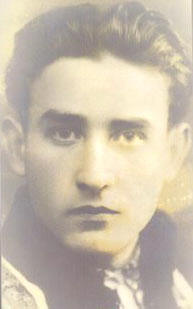
Valeriu had a discussion regarding this issue only one additional time, with an inspector from Bucharest. The inspector stopped at Valeriu’s bed and asked him: “ ‘What’s your name, prisoner?’
– Mr. Inspector. I am the prisoner Valeriu Gafencu,’ he responded, using the required greeting. “’Aha,’ said the inspector, looking at him sternly. “’
– Mr. Inspector, we ask that you grant us the same rights the Communist prisoners had here!’
– “’We will not repeat the mistakes of the past,’ answered the inspector drily. ‘Our humanism does not apply to reactionaries.’ “
– ’Mr. Inspector,’ continued Valeriu, ‘the men here are sick, powerless. Every day, one of us dies. Besides we are subjected to threats of terror and torture.’
– “’How dare you speak to me that way?! We don’t want to turn you into heroes! At best, we’ll make you informers, and your wives and sisters prostitutes!’ “
– Valeriu was deeply pained and answered, ‘The sins of this world have to be atoned for. We, prisoners here, we are atoning for many sins. All of us, however, are in the hands of God.’
– “’You are a mystic bandit! You will die here! Don’t think for one moment that you will get out alive! Even the sickly way you are now, you too will be forced to undergo re-education!’ “
– ’The way I am is an advantage,’ answered Valeriu, ‘because I won’t be able to last for long. A few blows will be enough to finish me.’
– “’Go to hell!’ shouted the inspector. ‘We’ll make sure that you die slowly, painfully, until you give up that Christ that you‘re trying to scare us with. We hate Him, and you, and all of you! We’re going to destroy you all! Here there is no more Christ, dead or resurrected. We’ll see to it that future generations don’t know His lies or yours! We ourselves are the christs of this world!’ “
– ’May God forgive you,’ answered Valeriu and lowered his head in prayer, expecting to hear an order that he be crushed to pieces. “But he wasn’t killed then. His toil continued for a while longer.”
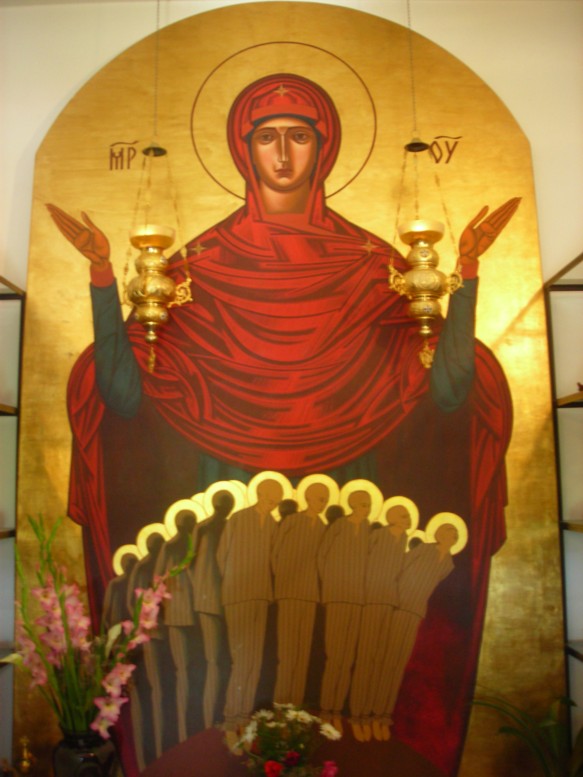
I Saw the Mother of God
During the night of his last Christmas, toward dawn, Valeriu testified to his friend – Ioan Ianolide:
“This night, I kept vigil. I was waiting for my carol to come. I wanted it to be very beautiful. I sang it in my head. I heard it in the high heavens, from where it descended. Rather difficult for me, since I don’t know musical notes and I have to sing by ear. So I was awake, lucid and serene, when, all of a sudden, I noticed a photograph of Seta – the girl he had loved – in my hand. Amazed by this, I lifted my gaze and at the head of my bed I saw the Mother of God, clothed in white, vivid, real. She was without her child. Her presence seemed material to me. The Mother of God was actually beside me. I was happy. I forgot everything. Time seemed endless. Then she said to me:
“’I am your love! Don’t be afraid. Don’t doubt. My Son will be victorious. He has sanctified this place now for future life. The powers of darkness are growing and will frighten the world still more, but they will be scattered. My Son is waiting for people to return to the faith. Today, the sons of darkness are bolder than the sons of light. Even though it may seem to you that there is no more faith left on earth, nevertheless, know that deliverance will come, albeit through fire and devastation. The world still has to suffer. Here, however, there is still much faith and I have come to encourage you. Be bold, the world belongs to Christ!’
“Then the Mother of God disappeared and I remained overwhelmed with happiness. I looked at my hand, but the photograph was no longer there.”
Poem
My eyes are sad and my forehead tired
From so much vigil and waiting.
My heart is sick, worn out
From difficult and prolonged running
And cries like a wounded bird.
When my eyes close and I seek within myself
The power to climb Golgotha to the top,
A voice, an echo from the depths
Says to me meekly, “Life is Jesus!
The precious pearl is within you.”
I look at the wondrous morning
Of the Resurrection from the grave,
With Magdalene, as if another time,
I kneel before Thee, weeping.
And I am happy and weep with Thee in thought.
(Delivered Feb 21, 2010.)
Dr. Harry Boosalis speaks about the inner crises of contemporary man: despair, depression, delusion due to lack of faith and the answer to it, which is neither found in humanism nor in the falls doctrines or aspirations for a New World Order – but in simply returning to Christ and the Truth: Orthodoxy.
MP3 with Fr. Seraphim Rose:
On The Ecumenical Movement_Signs of the Times I
On the Apostasy of the Church_Signs of the Times II
On the Antichrist
Metropolitan Cyprian (from the Holy Synod of Ressistance)’ sermon (fragments) on The Sunday of Orthodoxy, Greece, 1995
“You see that apostasy, as it goes on and advances, as we read in the books of our church, must reach its peak – the Antichrist to come. From the signs of the time, we see how Christ is approaching, Christ is coming, and we MUST be prepared! – as Christians that we are called and named, if we want to go forth and meet Him, if we want to be united with Him and rejoice with Him eternally.
We SHOULD hold two things dearer than our sight, dearer than our eyes.
First – the genuineness of Orthodoxy, and I stress this word genuineness because today even the ecumenists want to be called Orthodox!
But this along is not sufficient, just as a bird does not fly with one wing but with two wings. The second wing is Ortho-practcy – correct practice. The first then, is the correct faith, and the second is the correct life so we might be able to say to men who are far removed from the church, what Philip said to Nathaniel: “Come and see”.
I pray that in this difficult time we are passing through, I stress, I repeat, and the difficult times that are await us, Christ may maintain us to the end of our lives, to the final heartbeat, in the correct faith, in the correct life. Amen!”
Please sign:
A CONFESSION OF FAITH Against Ecumenism (English)
ΟΜΟΛΟΓΙΑ ΠΙΣΤΕΩΣ Κατά του Οικουμενισμού (Greek)
ИСПОВЕДАЊЕ ВЕРЕ (Russian)
Mărturisirea de credinţă împotriva ecumenismului (Romanian)
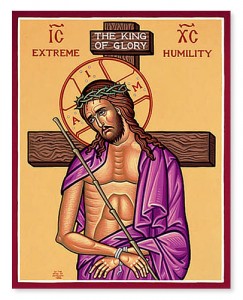
The following lecture was given by Metropolitan Kallistos at the beginning of the Great Lent 2010
(St Mark Orthodox Church, Washington DC)
Please note:
This video is for viewing purpose only! Not to be reproduced (Copyright)! If you’d like to own any of his eminence talks (in the professional format) on the Eastern Spirituality, please go to www.oltv.tv or www.olconference.com
The following lecture was given by Metropolitan Kallistos at the beginning of the Great Lent 2010.
Please note:
This video is for viewing purpose only! Not to be reproduced (Copyright)! If you’d like to own any of his eminence talks (in the professional format) on the Eastern Spirituality, please go to www.oltv.tv or www.olconference.com
May the Lord Jesus Christ our God grant you a bless lenten journey
(Blog author)
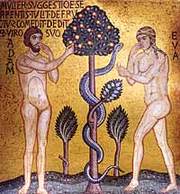
The Holy Fathers have appointed the commemoration of Adam’s exile from the Paradise of delight here, on the eve of the holy Forty-day Fast, demonstrating to us not by simple words, but by actual deeds, how beneficial fasting is for man, and how harmful and destructive are insatiety and the transgressing of the divine commandments. For the first commandment that God gave to man was that of fasting, which the first-fashioned received but did not keep; and not only did they not become gods, as they had imagined, but they lost even that blessed life which they had, and they fell into corruption and death, and transmitted these and innumerable other evils to all of mankind. The God-bearing Fathers set these things before us today, that by bringing to mind what we have fallen from, and what we have suffered because of the insatiety and disobedience of the first-fashioned, we might be diligent to return again to that ancient bliss and glory by means of fasting and obedience to all the divine commands. Taking occasion from today’s Gospel (Matt. 6:14-21) to begin the Fast unencumbered by enmity, we also ask forgiveness this day, first from God, then from one another and all creation.
(Taken from the Orthodox Weekly Bulletin)
A Sermon by Metropolitan Kallistos Ware
on the Sunday of Forgiveness
(delivered at St. Mark Orthodox Church in Washington, DC)
See also: Adams’ Lament by St. Siluan of Mount Athos
Please note:
This video is for viewing purpose only! Not to be reproduced (Copyright)! If you’d like to own any of his eminence talks (in the professional format) on the Eastern Spirituality, please go to www.oltv.tv or www.olconference.com
Lecture given February 12, 2010 at St. Katherine Greek Orthodox Church
Metropolitan Kallistos
(formerly Timothy Ware)
Titular Metropolitan of the Ecumenical Patriarch in Great Britain
Professor Emeritus, Oxford University
Best known as the author of the book The Orthodox Church and its companion volume The Orthodox Way
Co-translator of the Philokalia
Produced English translations of the Lenten Triodion and
the Festal Menaion
 Christian Dogma
 Christian Martyrs
 Christian Orthodox Churches and Monasteries
 Christian Sermons and News
 Church's Teachings on Fasting
 Ecumenism – a Great Heresy
 Father George Calciu
 Life_a Sacred Gift form God
 Orthodox Saints and Church Fathers
 Spiritual Elders
 Daily Bible Readings
 Journey to Orthodoxy
 Listen to Ancient Faith Radio
 Orthodox Calendar of Feasts and Saints
 Orthodox Christian Mission Center
 Orthodox Institute
 OrthodoxChristianNetwork TV


Recent Comments