
„Whoever desires to come after Me, let him deny himself, and takeup his cross, and follow me” (Mark 8.34)
Fr. Evans (audio): feasts-of-the-savior-exaltation-of-the-cross_2008-09-27
Other sermon on the Feast of the Elevation of the Holy Cross:
http://ancientfaith.com/podcasts/thearena/holy_cross_sept2010
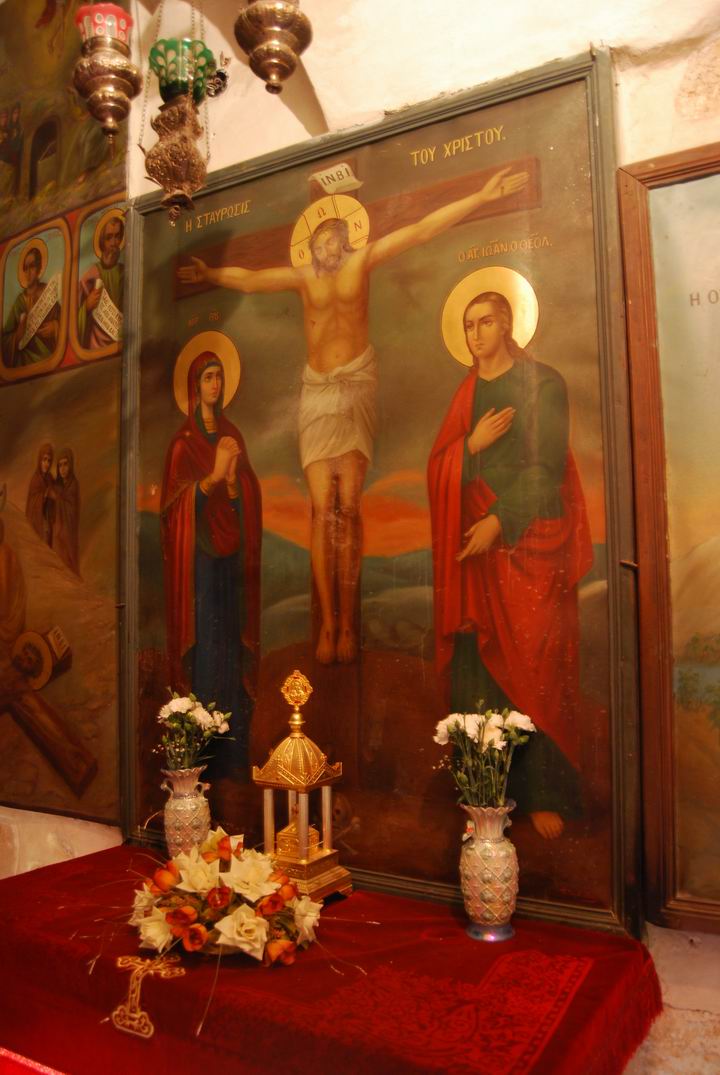
The Holy Cross is recognized as one of the most important symbols of Christianity. In the past, Latins used to define the cross by the word “crux” and Greeks by the word “Stavros”, designating first the vertical pole – then the horizontal – on which those sentenced to death were crucified. This instrument of torture was consecrated by the precious blood of our Lord and Savior Jesus Christ when He was crucified, thus becoming for the Christian man a holy and life-giving object. For the Orthodox Christian, the Holy Cross is both a symbol of human redemption and an object of worship. By this, we see and honor at once: the sacrifice of the Son of God and the wooden cross that our Lord was crucified on – as the Altar of His sacrifice. The sign of the cross is thus the sign of the “Son of Man” and of the Christian man. In making the sign of the cross over our body as a seal, we show our participation in Christ’s sanctifying sacrifice.

The Cross and its ancient origin
The sign of the cross was used as a sacred symbol in one form or another by many pagan peoples, long before the emergence of Christianity. In Paganism this symbol had mythical significance. According to the researchers, the cross had originated among the ancient Babylonians of Chaldea, and was used as a symbol of the pagan god Tammuz. Since the Bronze Era, the sign of the cross was used by many tribes in Europe as a symbol of consecration for the newborns. Also, the symbol of the cross was used among Aryan civilization as a representation of mystical light of the pagan gods or sacred fire and even the sun. The ancient scientists believed that the middle of the universe was where the earth meets the sky, and the four arms of the cross indicated the four cardinal points.
The Cross in the Old and the New Testament
The Holy Scripture and Holy Tradition give us evidence about the meaning of the Holy Cross, before and after the crucifixion of our Lord, the sign of the Holy Cross becoming a bookmark for the believing Christian.
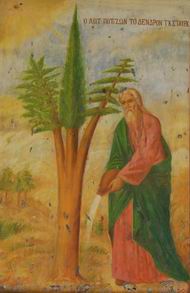
The Holy Cross is represented in the Old Testament as the “tree of life” rising from the earth, the commandment of God in the midst of earthly paradise, together with the “tree of knowledge for good and evil” (cf. Genesis 2, 9) . “The Tree of Life” is the metaphorical name of the Holy Cross, a name that appears starting even with the first pages of the Holy Scripture. The cross is also portrayed in books of divine services, as well as in paintings.
Moses passed through the Red Sea the people of Israel by the power of the divine cross, freeing them from the Egyptian slavery. He raised the rod, and stretched out his hand across the sea, than the sea split in two as the Jews passed to the dry land. When the Egyptians entered the sea, Moses, by God’s commandment, stretched his hand with the rod again, and made the sign the opposite way. The waters closed together, and the Egyptians were drowned at sea (see Exodus 14, 21-27).

Moreover, the patriarchal blessing, that Jacob gave with his hands to the two sons of Joseph, Ephraim and Manasseh, was a blessing with his hands crossed, prefiguring the Holy Cross – 1,500 years before Christ.
The New Testament shows, more explicitly than the Old Testament, the divine teachings about the importance of the Holy Cross.
The Holy Cross is the real and historical divine altar of Christianity; the altar on which Christ was “once sacrificed to raise many sins” (Hebrew 9, 28). The Cross is “the power of God” (I Cor. 1, 18) for those who desire to be saved, that is for those who believe. In the divine power of the Cross, the Apostle Paul rejoiced despite his human sorrows and distress (cf. Gal. 6, 14). The Cross is “the divine seal” on the forehead of the faithful, seal by which they escape visible and invisible enemies and plagues.

In the New Testament, the Cross is also the sign of the Son of Man at His second coming. Christ himself told his disciples – wanting to know when the second coming and End of the world will be (cf. Matthew 24, 3) – that, among many signs that will appear in the sky, there will be one “sign of the Son of Man” (Matthew 23, 30), – the Holy Cross.

The Cross in the Christian worship
Archaeological discoveries from Palestine have shown that the sign of the Cross has been used by the very first Christian community in Jerusalem. Among the first works – where the cross appears as a Christian symbol with mystical meanings related to human salvation brought by Christ’s crucifixion – is that of Minucius Felix: „Octavius”, written at the end of the second century.

Then the cross appears as a Christian symbol in the writings of St. Clement of Alexandria, when he speaks of the “sign of God”, which was foreshadowed by the letter number 318 from Genesis 14:14, as explained in the Epistle of Barnabas. For the number 300, the letter “T” has been used in the Hebrew alphabet, the similarity with the sign of the cross been obvious. For the letter “18” – the first two letters of the name “Jesus Christ” were used which shows the connection between Christ and the Cross.

Starting with the IV-th century AD, the veneration of the Holy Cross was generalized, manifesting itself publicly and officially entering the divine worship of the Church. To this have contributed the apparition in the sky of the „wonder sign of the cross”, by which Constantine the Great was encouraged in the battle with Maxentiu. After his victory, Constantin the Great had placed it as an emblem on flags and other official documents and coins; and forbidden nailing to the cross those condemned to death.

Another miracle was the discovery the Cross of our Savior (in the year 326) in the place of His crucifixion.
St. Helena, the mother of Emperor Constantine the Great, built a large church on the site of our Lord’ tomb (the Holy Sepulcher church) and another church at the site of His crucifixion (Basilica of the Holy Cross) – consecrated on September 13, 335 – when the veneration of the Holy Cross entered the Christian worship.
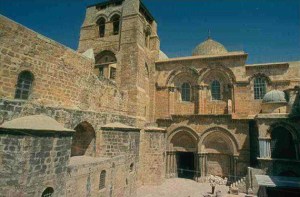
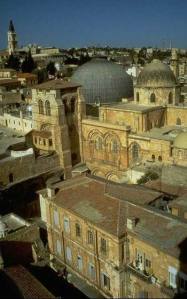
Starting with 431 AD, the crosses have been placed in churches and plants, but the use of the crosses on domes did not appear until the year 586.
The Church’s teaching on the veneration of Holy Cross was formulated by the VII Ecumenical council of Nicea (787) and completed by the local council of Constantinople (869), when it was proclaimed that the Holy icons, the Holy Gospel and the Holy Cross should be equally venerated.
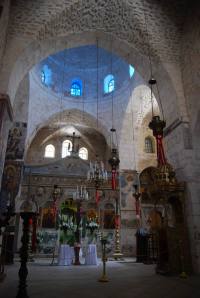
In the Orthodox Church, the cult of the Holy Cross is manifested in celebrations dedicated to her. Of these we mention: the Elevation of the Holy Cross (the Day of the Cross or Carstov) on September 14, Sunday of the Cross (Third Sunday of the Great Lent), Procession with the Holy Cross (August 1) and the Apparition of the sign of the Holy Cross to Emperor Constantine the Great (May 7)
The Eastern tradition celebrates the Holy Cross in many prayers and hymns made in her honor and praise, being a divine sign, inexhaustible in its meaning and a source of vital power.
 Christian Dogma
 Christian Martyrs
 Christian Orthodox Churches and Monasteries
 Christian Sermons and News
 Church's Teachings on Fasting
 Ecumenism – a Great Heresy
 Father George Calciu
 Life_a Sacred Gift form God
 Orthodox Saints and Church Fathers
 Spiritual Elders
 Daily Bible Readings
 Journey to Orthodoxy
 Listen to Ancient Faith Radio
 Orthodox Calendar of Feasts and Saints
 Orthodox Christian Mission Center
 Orthodox Institute
 OrthodoxChristianNetwork TV


3 comments
Comments feed for this article
June 3, 2010 at 9:07 PM
Helena Honovich
referred to above –
Please I don’t understand this — could you help me to understand. thank you
“For the letter “18″ – the first two letters of the name “Jesus Christ” were used which shows the connection between Christ and the Cross.” ????
June 4, 2010 at 9:55 AM
orthodoxword
Hi There,
1. For what I have read, the number 318 found in the OT (see Genesis 14:14) is interpreted by some Holy Fathers of the church as the 318 bishops of the Orthodox Church from the first Ecumenical council of Nicaea reflecting God’s providence for the chosen people (fathers and saints of the church) and their successors (see all the Ecumenical Councils of the church including the 7th council where the cult of “the Holy Cross/ Holy Icons, Saints, etc.” was ultimately established) in clarifying church dogma.
2. On the other hand, other fathers, such as Clement of Alexandria spoke about the number 318 (300+18), as been “a sign from God” as in the old Hebrew alphabet the letter “T” (a similarity with the sign of the Cross) was used for the number 300, and the number 18, was represnted in Hebrew by two letters: יְה מָשִ which happened to be the two initials of our Lord Jesus Christ in the Hebrew: יְהוֹשֻׁעַ (Yĕhōšuă‘, Joshua) מָשִׁיחַ (Christ).
Please keep in mind, this (exp. at point 2) is not a church dogma, but instructions we find in the old writtings of the ealry fathers of the church that can guide us in better understanding certain misteries and they are not to be taken “literaly” or understood strictly in a “rational sense” but with a “contrite and dispassionate heart” illumined by the Spirit when we abandoned our whole life at the feet of Christ, as many of the great fathers and saints of the church did. That’s way we trust the Holy Fathers of the church, because through their dispassionate life, they spoke in the Spirit. Please advise if you know more and forgive me for the confusion of this article.
June 5, 2010 at 3:29 PM
terratraditions
Thank you for your response. I will absorb it. And if anything else comes up…I will reply. Thanks again.