
You are currently browsing the monthly archive for March 2010.
Motto: “Sleepwalking Christians are the heart of the crisis of Western civilization in our day. They are unwilling or unable to offer explicitly Biblical alternatives to the collapsing humanist order. Until about 1980, they fervently believed that the humanists possessed some legitimate title to the seats of power in this world, and they still believe that common natural law moral and legal principles are sufficient to hold the world system together until Jesus comes back in glory. So they sit on the sidelines of life, waiting for Jesus to bail them out, or “up”, literally. Just as He bailed out Israel when the Assyrians arrived? Just as He bailed out Judah when the Babylonians arrived? Just as He bailed out Latvia, Estonia, and Lithuania when the Soviet troops arrived? But we’re different, of course. We’re Americans. No need to worry. And if 1.5 million babies are aborted here each year, it isn’t the Christians’ fault. Jesus is coming soon. Sit tight. Pray. And don’t miss the Superbowl next Sunday…”
(Gary North in the “Healer of the Nations” )
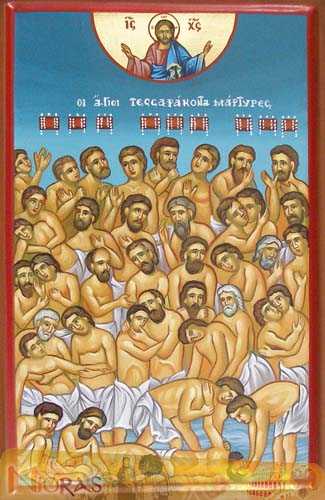
All of them were soldiers in the Roman army and steadfastly believed in the Lord Jesus. When the persecution of Christians began during the reign of Licinius, they were brought to trial before the commander. When he threatened to strip them of their honor as soldiers, one of them, St. Candidus, responded, “Not only the honor of being a soldier, but take away our bodies, for nothing is more dear or honorable, to us than Christ our God.” After that, the commander ordered his servants to stone the holy martyrs. While the servants were hurling stones at the Christians, the stones turned and fell back on the servants, severely striking them. One of the stones struck the commander’s face and knocked out his teeth. The torturers, angry as wild beasts, bound all of the holy martyrs and tossed them into the lake and stationed a guard around it so as to prevent any of them from escaping. There was a terrible frost and the lake froze around the bodies of the martyrs. So that their pain and suffering would be worsened, and in order to persuade one of them to deny Christ and acknowledge the idols of Rome, the torturers heated a bath by the side of the lake in sight of the frozen martyrs. Indeed, one of them was persuaded. He came out of the water and entered the bath. And behold, an extraordinary light appeared from heaven which warmed the water in the lake and the bodies of the martyrs. With that light, thirty-nine wreaths descended from heaven over their heads. Upon seeing this, a guard on the shore removed all his clothes, confessed the Name of the Lord Jesus and entered the lake so that he could become worthy of the fortieth wreath in place of the betrayer. Indeed, the last wreath descended upon him. The next day the entire town was astonished when they saw that the martyrs were still alive.
Then, the wicked judges ordered that the lower part of their legs be broken and their bodies thrown into the water so Christians could not recover them. On the third day the martyrs appeared to Peter, the local bishop, and summoned him to gather their relics and remove them from the water The bishop with his clergy went out into the dark of night and beheld the relics of the martyrs shining brightly in the water. Every bone which was separated from their bodies floated to the top and glowed like a candle.
Bishop Peter gathered and honorably buried them. The souls of these martyrs, who suffered for all of us, went to the Lord Jesus, resurrected with glory. They suffered honorably and were crowned with unfading glory in the year 320 A.D.
(Written by Bishop Nikolai Velimirovich in “The PROLOG FROM OHRID”)
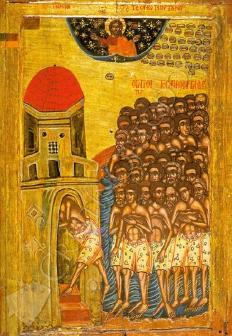
The 40 Holy Martyrs from Lake Sebaste, celebrated on March 9, formed a community of witnesses who confessed Christ, being thrown into a frozen lake, where they were warmed by the love they manifested for each other.
These Holy Martyrs remind us much more than an event that took place 1700 years ago; they show us “the way of the Christian”, the way that contemporary martyrs and confessors for Christ had followed, while suffering in communist concentration camps or earlier persecution under the pagan Roman law.
We remember today a brilliant Aleksandr Solzhenitsyn – when asked at a press conference his opinion on why the terrible events behind the Iron Curtain had occurred, why millions of Christians were carted away, tortured, starved and worked to death in Gulag slave camps, he gave this simple, yet startling, response: “Man has forgotten God”…and, we remember many more – with a pure and sincere love for Christ who had the “guts” to reject a life of compromise and wickedness. “Now is the time for repentance!” cried out from his deathbed confessor Valeriu Gafencu martyred for Christ in the concentration camps.
The message of martyrdom is the same at all times and places and, it has the same value today, because it is the message of our crucified Savior.
Let us pray to the Holy 40 martyrs and to all the saints to enlighten and show us the way in these unstable and confusing times. Amen!
Please also see: Let us honor the Martyrs – by father George Calciu
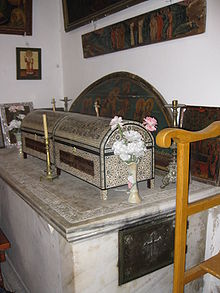
Quotes from Aleksandr Solzhenitsyn
“Man has set for himself the goal of conquering the world but in the processes loses his soul.”
“The salvation of mankind lies only in making everything the concern of all”
“Own only what you can always carry with you: know languages, know countries, and know people. Let your memory be your travel bag.”
“Justice is conscience, not a personal conscience but the conscience of the whole of humanity. Those who clearly recognize the voice of their own conscience usually recognize also the voice of justice.”
“A state of war only serves as an excuse for domestic tyranny.”
“For a country to have a great writer is like having a second government. That is why no regime has ever loved great writers, only minor ones.”
“Hastiness and superficiality are the psychic diseases of the 20th century, and more than anywhere else this disease is reflected in the press. “
“I have spent all my life under a Communist regime, and I will tell you that a society without any objective legal scale is a terrible one indeed. But a society with no other scale but the legal one is not quite worthy of man either.”
“You only have power over people so long as you don’t take everything away from them. But when you’ve robbed a man of everything, he’s no longer in your power – he’s free again.”
„Whoever desires to come after Me, let him deny himself, and takeup his cross, and follow me” (Mark 8.34)
Fr. Evans (audio): feasts-of-the-savior-exaltation-of-the-cross_2008-09-27
Other sermon on the Feast of the Elevation of the Holy Cross:
http://ancientfaith.com/podcasts/thearena/holy_cross_sept2010
The Holy Cross is recognized as one of the most important symbols of Christianity. In the past, Latins used to define the cross by the word “crux” and Greeks by the word “Stavros”, designating first the vertical pole – then the horizontal – on which those sentenced to death were crucified. This instrument of torture was consecrated by the precious blood of our Lord and Savior Jesus Christ when He was crucified, thus becoming for the Christian man a holy and life-giving object. For the Orthodox Christian, the Holy Cross is both a symbol of human redemption and an object of worship. By this, we see and honor at once: the sacrifice of the Son of God and the wooden cross that our Lord was crucified on – as the Altar of His sacrifice. The sign of the cross is thus the sign of the “Son of Man” and of the Christian man. In making the sign of the cross over our body as a seal, we show our participation in Christ’s sanctifying sacrifice.

The Cross and its ancient origin
The sign of the cross was used as a sacred symbol in one form or another by many pagan peoples, long before the emergence of Christianity. In Paganism this symbol had mythical significance. According to the researchers, the cross had originated among the ancient Babylonians of Chaldea, and was used as a symbol of the pagan god Tammuz. Since the Bronze Era, the sign of the cross was used by many tribes in Europe as a symbol of consecration for the newborns. Also, the symbol of the cross was used among Aryan civilization as a representation of mystical light of the pagan gods or sacred fire and even the sun. The ancient scientists believed that the middle of the universe was where the earth meets the sky, and the four arms of the cross indicated the four cardinal points.
The Cross in the Old and the New Testament
The Holy Scripture and Holy Tradition give us evidence about the meaning of the Holy Cross, before and after the crucifixion of our Lord, the sign of the Holy Cross becoming a bookmark for the believing Christian.
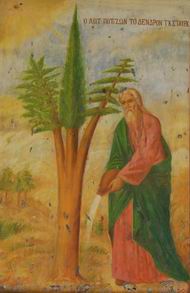
The Holy Cross is represented in the Old Testament as the “tree of life” rising from the earth, the commandment of God in the midst of earthly paradise, together with the “tree of knowledge for good and evil” (cf. Genesis 2, 9) . “The Tree of Life” is the metaphorical name of the Holy Cross, a name that appears starting even with the first pages of the Holy Scripture. The cross is also portrayed in books of divine services, as well as in paintings.
Moses passed through the Red Sea the people of Israel by the power of the divine cross, freeing them from the Egyptian slavery. He raised the rod, and stretched out his hand across the sea, than the sea split in two as the Jews passed to the dry land. When the Egyptians entered the sea, Moses, by God’s commandment, stretched his hand with the rod again, and made the sign the opposite way. The waters closed together, and the Egyptians were drowned at sea (see Exodus 14, 21-27).

Moreover, the patriarchal blessing, that Jacob gave with his hands to the two sons of Joseph, Ephraim and Manasseh, was a blessing with his hands crossed, prefiguring the Holy Cross – 1,500 years before Christ.
The New Testament shows, more explicitly than the Old Testament, the divine teachings about the importance of the Holy Cross.
The Holy Cross is the real and historical divine altar of Christianity; the altar on which Christ was “once sacrificed to raise many sins” (Hebrew 9, 28). The Cross is “the power of God” (I Cor. 1, 18) for those who desire to be saved, that is for those who believe. In the divine power of the Cross, the Apostle Paul rejoiced despite his human sorrows and distress (cf. Gal. 6, 14). The Cross is “the divine seal” on the forehead of the faithful, seal by which they escape visible and invisible enemies and plagues.

In the New Testament, the Cross is also the sign of the Son of Man at His second coming. Christ himself told his disciples – wanting to know when the second coming and End of the world will be (cf. Matthew 24, 3) – that, among many signs that will appear in the sky, there will be one “sign of the Son of Man” (Matthew 23, 30), – the Holy Cross.

The Cross in the Christian worship
Archaeological discoveries from Palestine have shown that the sign of the Cross has been used by the very first Christian community in Jerusalem. Among the first works – where the cross appears as a Christian symbol with mystical meanings related to human salvation brought by Christ’s crucifixion – is that of Minucius Felix: „Octavius”, written at the end of the second century.

Then the cross appears as a Christian symbol in the writings of St. Clement of Alexandria, when he speaks of the “sign of God”, which was foreshadowed by the letter number 318 from Genesis 14:14, as explained in the Epistle of Barnabas. For the number 300, the letter “T” has been used in the Hebrew alphabet, the similarity with the sign of the cross been obvious. For the letter “18” – the first two letters of the name “Jesus Christ” were used which shows the connection between Christ and the Cross.

Starting with the IV-th century AD, the veneration of the Holy Cross was generalized, manifesting itself publicly and officially entering the divine worship of the Church. To this have contributed the apparition in the sky of the „wonder sign of the cross”, by which Constantine the Great was encouraged in the battle with Maxentiu. After his victory, Constantin the Great had placed it as an emblem on flags and other official documents and coins; and forbidden nailing to the cross those condemned to death.

Another miracle was the discovery the Cross of our Savior (in the year 326) in the place of His crucifixion.
St. Helena, the mother of Emperor Constantine the Great, built a large church on the site of our Lord’ tomb (the Holy Sepulcher church) and another church at the site of His crucifixion (Basilica of the Holy Cross) – consecrated on September 13, 335 – when the veneration of the Holy Cross entered the Christian worship.
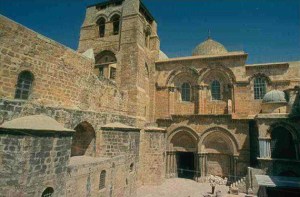
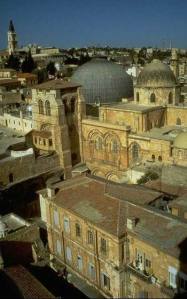
Starting with 431 AD, the crosses have been placed in churches and plants, but the use of the crosses on domes did not appear until the year 586.
The Church’s teaching on the veneration of Holy Cross was formulated by the VII Ecumenical council of Nicea (787) and completed by the local council of Constantinople (869), when it was proclaimed that the Holy icons, the Holy Gospel and the Holy Cross should be equally venerated.
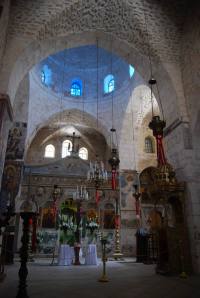
In the Orthodox Church, the cult of the Holy Cross is manifested in celebrations dedicated to her. Of these we mention: the Elevation of the Holy Cross (the Day of the Cross or Carstov) on September 14, Sunday of the Cross (Third Sunday of the Great Lent), Procession with the Holy Cross (August 1) and the Apparition of the sign of the Holy Cross to Emperor Constantine the Great (May 7)
The Eastern tradition celebrates the Holy Cross in many prayers and hymns made in her honor and praise, being a divine sign, inexhaustible in its meaning and a source of vital power.
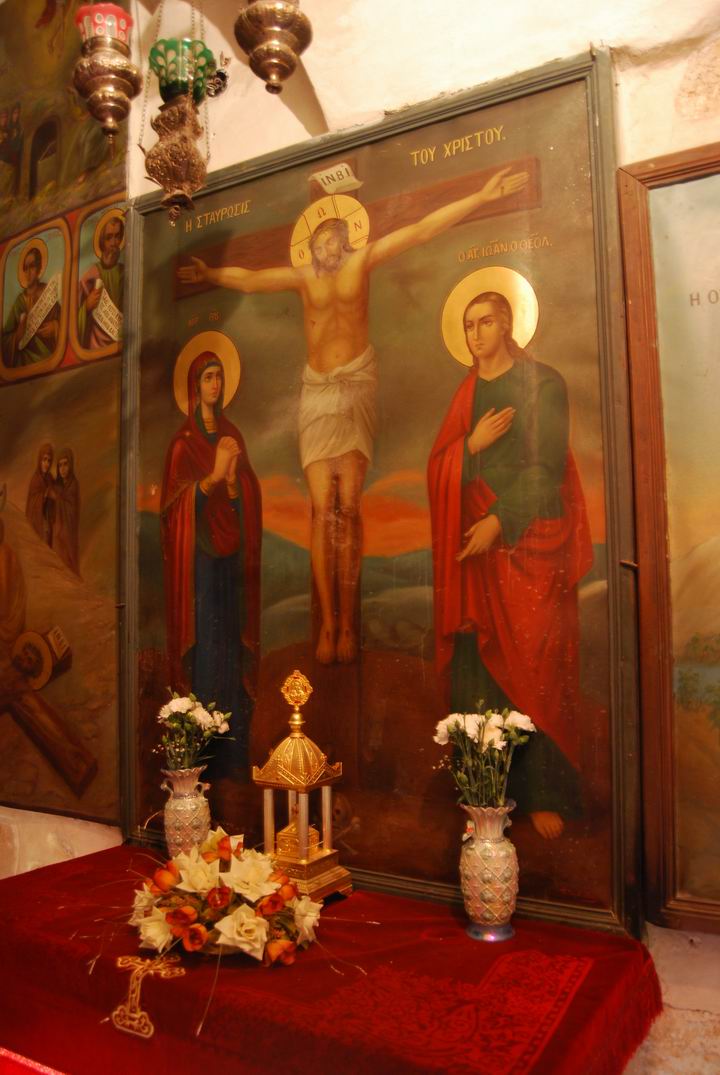
Please also see an older post with Metropolitan Kallistos: “Salvation in Christ, The Meaning of the Cross”
Saint Nikolai’s life at:
St Nikolai of Zica
Saint of the Day: Nikolai_Velimirovich (audio)
Prayers by the Lake (text) at:
Bishop Velimirovich Prayers by the Lake of Ochrid
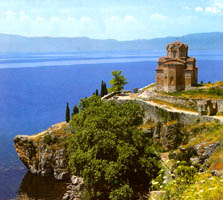
REFLECTION by St Nikolai Velimirovich
Why do some people, well educated and baptized as Christians, fall away from Christianity and give themselves over to philosophy and to learned theories, pretending these to be something more truthful than Christianity? They do so for two principal reasons: either out of a totally superficial understanding of Christianity or because of sin. A superficial understanding of Christ rejects Him and flees from Christ as does a criminal from a judge. Superficial and sinful Christians were as often enraged and infuriated with Christianity as were the pagans. To the superficial and culpable, it was more comfortable for them to bathe in the shallow swamp of human thoughts than in the perilous depth of Christ. For those who sincerely follow Christ, He constantly calls them to a greater and greater depth; as He once said to the Apostle Peter, “Put out into deep water” (St. Luke 5:4). St. Mark the Ascetic writes that the law of God is understood in accordance with the fulfillment of the commandments of God: “Ignorance compels a person to speak in opposition to that which is beneficial and insolence multiplies vice.”
CONTEMPLATION
To contemplate the Mystery of Communion as a Mystery of the Perfection of Love:
1. Because on the part of Christ, it means giving completely of Himself to His faithful;
2. Because of this, Christ is received with faith and trust on the part of the faithful;
3. Because of this, it leads to the joyful, fruitful and saving union of God with man.
HOMILY: Traveling with Christ into the deep
“Put out into deep water” (St. Luke 5:4).This is how our Lord commanded Peter and the rest of the apostles “after He had finished speaking” (St. Luke 5:4). This means that He first gave instructions and immediately following that, He called them to action. This is also important for us. For as soon as we learn something from the Gospels, we immediately need to go out and implement it. The works of the disciple are dear to the Lord, not only the disciple. “Put out into deep water.” Along the shore, from the shallow waters, our Lord spoke to the people who were less enlightened in the mysteries of God’s Kingdom. He invited the apostles out into the deep. There is less danger in the shallow waters, but the catch is also smaller. In the shallow waters there are snakes, frogs and other lesser repulsive water creatures. That is all the danger. In shallow waters there are only small fish; that is the entire catch. But in the greater depths, the danger is also greater. There you have large sea creatures and great storms. That is dangerous.
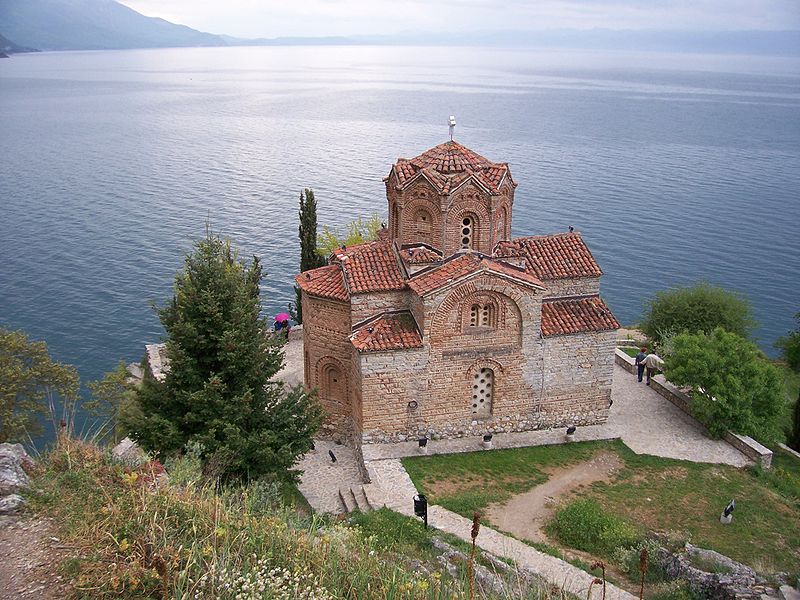
But there are also much larger and better fish in enormous quantity; that is the catch. O, enlightened one, come therefore into the deep! “Put out into the deep” mysterious sea of life, but do not set out without Christ in your boat. By no means. You might spend the entire night of your life not catching anything, as Peter said, “We have toiled all night and have taken nothing” (St. Luke 4:5). Not only that, but you could face far worse if Christ is not in your boat. Perhaps the winds could carry you away and cast you into an abyss. Perhaps the monstrous and enormous beasts of the sea will consume you. The winds, O enlightened one, those are your own passions which accompany you unavoidably if you set out into the deep without Christ. The enormous and monstrous beasts of the sea are demons who, with the blinking of an eye, can destroy you as with the blinking of an eye “the herd of about two thousand swine rushed down a steep bank into the sea, where they were drowned” (St. Mark 5:13).
However, if you are going out with Christ into the deep, do not be afraid of anything; but go rejoice fully and courageously glued to Christ. You will lay hold of the best catch; and you will fill both boats with it, the physical and the spiritual. You will snare the best catch, O dedicated one, and, without any dangers, you will arrive to theshore, to the shore of the Kingdom of Christ. Nowhere without Christ! Neither in shallow places nor into the deep. In the shallow places you will become vexed by hunger and by many minor disgusts, but into the deep a greater evil will befall you.
O, my Almighty Savior, You are our Helmsman, our Defense, our Harbor.
(Taken from the “Prolog from Ochrid”, Lenten Meditations by St Nikolai Velimirovich)
(In light of St Gregory Palamas teachings on the Eastern Tradition, an excerpt from the amazing work of V. Lossy)
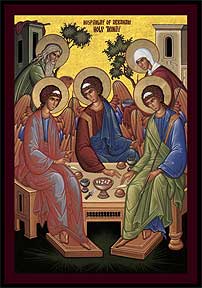
“The theology of the Eastern Church distinguishes in God the three hypostases, the nature or essence, and the energies. The Son and the Holy Spirit are, so to say, personal processions, the energies natural processions. The energies are inseparable from the nature, and the nature is inseparable from the three Persons. These distinctions are of great importance for the Eastern Church’s conception of mystical life:
1. The doctrine of the energies, ineffably distinct from the essence, is the dogmatic basis of the real character of all mystical experience. God, who is inaccessible in His essence, is present in His energies ‘as in a mirror,’ remaining invisible in that which He is; ‘in the same way we are able to see our faces, themselves invisible to us in a glass,’ according to a saying of St. Gregory Palamas. (Sermon on the Presentation of the Holy Virgin in the Temple). Wholly unknowable in His essence, God wholly reveals Himself in His energies, which yet in no way divide His nature into two parts–knowable and unknowable–but signify two different modes of the divine existence, in the essence and outside of the essence.
2. This doctrine makes it possible to understand how the Trinity can remain incommunicable in essence and at the same time come and dwell within us, according to the promise of Christ (John xiv, 23). The presence is not a causal one, such as the divine omnipresence in creation; no more is it a presence according to the very essence–which is by definition incommunicable; it is a mode according to which the Trinity dwells in us by means of that in itself which is communicable–that is to say, by the energies which are common to the three hypostases, or, in other words, by grace–for it is by this name that we know the deifying energies which the Holy Spirit communicates to us. He who has the Spirit, who confers the gift, has at the same time the Son, through whom every gift is transmitted to us; he also has the Father, from whom comes every perfect gift. In receiving the gift–the deifying energies–one receives at the same time the indwelling of the Holy Trinity–inseparable from its natural energies and present in them in a different manner but none the less truly from that in which it is present in its nature.
3. The distinction between the essences and the energies, which is fundamental for the Orthodox doctrine of grace, makes it possible to preserve the real meaning of St. Peter’s words ‘partakers of the divine nature.’ The union to which we are called is neither hypostatic–as in the case of the human nature of Christ–nor substantial, as in that of the three divine Persons: it is union with God in His energies, or union by grace making us participate in the divine nature, without our essence becoming thereby the essence of God. In deification we are by grace (that is to say, in the divine energies) all that God is by nature, save only identity of nature . . ., according to the teaching of St. Maximus (De ambiguis). We remain creatures while becoming God by grace, as Christ remained God in becoming man by the Incarnation.
These distinctions in God which are made by the theology of the Eastern Church do not in any way contradict its apophatic attitude in regard to revealed truth. On the contrary, these antinomical distinctions are dictated by a concern for safeguarding the mystery, while yet expressing the data of revelation in dogma. Thus, as we have seen in the doctrine of the Trinity, the distinction between the persons and the nature revealed a tendency to represent God as a ‘monad and triad in one’, with the consequence that the domination of the unity of the nature over the trinity of the hypostases was avoided, as was the elimination or minimizing of the primordial mystery of the identity-diversity. In the same way, the distinction between the essence and the energies is due to the antinomy between the unknowable and the knowable, the incommunicable and the communicable, with which both religious thought and the experience of divine things are ultimately faced. These real distinctions introduce no ‘composition’ into the divine being; they signify the mystery of God, who is absolutely one according to His nature, absolutely three according to His persons, sovereign and inaccessible Trinity, dwelling in the profusion of glory which is His uncreated light, His eternal Kingdom which all must enter who inherit the deified state of the age to come.”
Taken from The Mystical Theology of the Eastern Church (pdf), SVS Press, pgs. 85-87
 Christian Dogma
 Christian Martyrs
 Christian Orthodox Churches and Monasteries
 Christian Sermons and News
 Church's Teachings on Fasting
 Ecumenism – a Great Heresy
 Father George Calciu
 Life_a Sacred Gift form God
 Orthodox Saints and Church Fathers
 Spiritual Elders
 Daily Bible Readings
 Journey to Orthodoxy
 Listen to Ancient Faith Radio
 Orthodox Calendar of Feasts and Saints
 Orthodox Christian Mission Center
 Orthodox Institute
 OrthodoxChristianNetwork TV


Recent Comments