
You are currently browsing the monthly archive for October 2010.
Saint Dimitri the New (Basarabov)

Saint Dimitri the New (Basarabov) lived in the 13th century and little is known about his life. He was born in the village of Basarabov, located on the banks of the River Lom, near the town of Russe. A shepherd in his early years, it is said that St Dimitri had later became a monk, dedicating himself to fasting, prayers and vigils. For his humble life, God entrusted him with the power to work miracles. The pious Dimitri knew the moment of his death beforehand, and choose the place of his final rest between two stones that were gradually covered by the river. The place of his rest was unknown until a sick child had a revelation when the pious Dimitri appeared in her dream and said: “If your parents would take me out of the water, I will heal you!”
(1st Chant from the Kanon of St. Dimitri the New, Romanian)
A ray of light had appeared for quite some time at the site where the holy relics were found, leading people to initially believe that a treasure was hidden in that place.
Acting at the girl’s advice, they searched the place and found the relics of pious Dimitri, glittering as gold. The saint’ body was taken to the village of Basarabov. Between 1769 and 1774, during the Russian-Turkiss war, the relics were brought to Romania with the intention of being sent to Russia.
However, Metropolitan Grigorie (Gregory) of Walachia, insisted that they should be given to the Romanian people as a gift for the sufferance they endured during the war. The relics were taken in great procession to the Patriarchal Cathedral of Bucharest.
The saint’s right hand was sent to Kiev, where it has been preserved to this day. The Synod of the Romanian Orthodox Church, had great devotion to Saint Dimitri the New and starting with 1950, the saint was venerated nationwide and recognized as the patron saint of Romania’s capital city.
The Monastery of Saint Dimitri the New
The Monastery of Saint Dimitri Basarabov was founded over the cave where Saint Dimitri the New lived his ascetic life. The Monastery is located near the town of Basarabov, Bulgaria.

The village of Basarabov, initially located 3-4 km from the river Danube, was moved slightly to Ivanovo, near the cave where Saint Dimitri lived.

Located in the picturesque valley of the Lom river, the Basarabov Monastery, is the only monastery in Bulgaria carved in the rock and inhabited since its establishment.

Where river Lom meets the Danube, climbing to Ivanovo, the pilgrim will encounter more then 300 caves dug in the rocky side of river. Almost 40 of these caves were transformed into small churches where Divine Liturgy was served for several hundred years. Many wall frescoes of the original caves have lasted until today. The monastery and the caves of Ivanovo are part of UNESCO patrimony.
The Monastery of Saint Demetrius Basarabov — Brief History
The Monastery of St Dimitri the New was founded by the family of Basarabs and was initially under the care of John the Basarab, and first ruler of Romanian Country.

The present monastery of St. Demetrius was built in 1865. It consists of a church, built in the cave of St. Dimitri, and some cells carved in the rocks nearby.

The Monastery was burned down during the Russian-Turkish war. At that time more than 60 valuable icons from the church were stolen. The village of Basarabov was completely destroyed and the relics could not longer remained in the ravanged church.

The earliest historical evidence about this Monastery dates back to the XV century, in some of the tax records of the Ottoman Empire. An extensive description of the property owned at that time by Vlach leader Ivanko Basarab, the father of Tsar Ivan Alexander – is found in one of these registers, called “Timar” and it’s the oldest written record where the name of the town Basarbov is mentioned.
In 1911, a Committee of historical vestiges was established at the National Museum of Archeology in Sofia. The main task of this committee was to develop an archaeological map for the whole country of Bulgaria.
A Czech pilgrim who took several scientific trips to Bulgaria between 1887 and 1892, was called to be part of the committee. In 1912, Skorpil went on a trip on the river Lom, and at that time he would visit and describe the famous monastery of Basarbov.

Because of the Turkish rules in Bulgaria, it is unknown when the monastery was abandoned by the archaeologists.
The future bishop of Smolyan, Father Tikhon, took care of Basarabov monastery around 1919.
A new committee having the task of raising money to re-build the cells was established in 1937. The monastery cells were finished and blessed on May 14, 1937, but have survived only until 1940, when a flood destroyed the entire building.
Monk Chrysanthos, who settled here from 1937 until 1961, started to raise donations for the restoration of damaged cells. Thus, in less than one month, he gathered enough money to raise two cells near the church and were finished on August 30, 1940.


The new church will retain the iconostasis – carved in wood in 1941. A large icon of Saint Dimitri the New standing up, depicts his wonders. The icon bares an inscription in Cyrillic Greek and Romanian languages.

The monastery also bares the cell and burial place of father Chrysanthos, as well as the remains of other monks that struggled in this place.
Saint Dimitri the New (Basarabov)
Some researchers believe that the new Saint Dimitri of Basarabov have lived during the flourishing of hesychasm, while others believe that he lived in the XII century. Paisius of Hilandar recorded in his chronical that St. Dimitri is a recent saint of our times because he was still living in 1685. In a copy of the Slavo-Bulgarian chronic of monk Panteleimon from Russe, it is said that St. Dimitri lived in the eighteenth century and was buried in the Monastery of Basarabov.
The saint nationality is not clear, as in the eighteenth century many villages in tha region of Russe had mixed population.


According to Paisius of Hilandar and his famous book “the Slavo-Bulgarian History”, Saint Dimitri the New led the simple life of a layman/ peasant. In the notes of Nicholas Nemtov teacher (1898) in Basarabov, it is mentioned that Saint Dimitri attended the Church of St. John, every Sunday and holiday, and the rest of the days he was watching the village’ cows, receiving only bread and water, and only from the wealthy people of the village.
Saint Dimitri will later become a monk in the Monastery of Basarab founded in the outskirts of his village. Teacher Nemtov also describes how the relics of St. Dimitri Basarabov were discovered. It is said that a young maiden from the village of Cherven Voda lost her sight. One night, she was dreaming that she went to the monastery of Basarabov, was washing her face with water from the fountain of St. Dimitri, and regained her sight.

The young girl tells her parents about the dream and decided to go to Basarabov. Arriving at dawn, she remained overnight with her parents, wanting to wash with water from the fountain the next early morning. But at night, having great eye pain, the girl went to the fountain, washed and regained her sight. Looking over the river Lom – passing in front of the monastery, she saw several lit candles and torches, and in the water the holy relics of Saint Dimitri shining as gold.


The girl’s father is called, but he does not see anything. The next day, the body of the saint is found and removed from the river by the priests of Russe. The holy relics of St. Dimitri are taken first to the city of Russe, but the oxen pulling the cart with his relics stopped in front of his father’s house. A church will be built here baring the name of the saint.
The tradition also tells us how the Turks during an attack, in search for a treasure, unearth the saint relics. Finding the relics of St Dimitri, the turks threw then into the river Lom, where they remained hidden between the shore and the rocks, for 33 years until they were found by a pious Christian. They were taken to Basarbov village, where they have worked countless miracles.

In a miracle recorded before the relics were to be taken to the Metropolitan Cathedral in Bucharest, it is said how a Turk tried to steal a silver candle at night from the Church of St. Dimitri. Suddenly his legs became paralyzed and the turk will remained until the next morning in front of the shrine with the holy relics.
During the Russo-Turkish War (1768-1774), his holy relics were transported to Bucharest by General Peter Saltykov, and placed with great devotion and joy in St. Constantine and Helen’ Patriarchal Cathedral, where they are preserved until today.
Holy Great Martyr Demetrius (Dimitri) of Thessalonica
Commemorated October 26 (Nov. 8th by civil calendar)
(Life taken from the Prologue of Ohrid)

This glorious and wonderworking saint was born in Thessalonica of noble and devout parents. Implored of God by childless parents, Demetrius was their only son, and so was raised and educated with great care. Demetrius’s father was a commander in Thessalonica. When his father died, Emperor Maximian appointed Demetrius as commander in his place. As he appointed him, Maximian, an opponent of Christ, particularly recommended that he persecute and exterminate the Christians in Thessalonica. Demetrius not only disobeyed the emperor but openly confessed and preached the Lord Jesus Christ in the city of Thessalonica. When the emperor heard of this he became furious with Demetrius. Then, when he was returning from battle against the Sarmatians, Maximian stopped at Thessalonica to investigate the matter. The emperor summoned Demetrius and questioned him about his faith. Demetrius openly acknowledged his Christian Faith to the emperor and also denounced the emperor’s idolatry. Maximian cast Demetrius into prison. Knowing what was awaiting him, Demetrius gave all his goods to his faithful servant Lupus to distribute to the poor, and joyfully awaited his imminent suffering for Christ the Lord. An angel of God appeared to him in prison, saying: “Peace be to you, O sufferer of Christ; be brave and be strong!” After several days, the emperor sent soldiers to the prison to kill Demetrius. The soldiers found the saint of God at prayer and ran him through with lances [in 306 A.D.]. Christians secretly took his body and honorably buried it. Healing myrrh flowed from the body of the martyr of Christ, curing many of the sick. Soon, a small church was built over his relics.
An Illyrian nobleman, Leontius, was afflicted with an incurable illness. He hastened, with prayer, to the relics of St. Demetrius and was completely healed. In thanksgiving, Leontius erected a much larger church on the site of the old church. The saint appeared to him on two occasions. When Emperor Justinian wanted to translate the relics of the saint from Thessalonica to Constantinople, flaming sparks sprang from the tomb and a voice was heard: “Stop, and do not touch!” And thus, the relics of St. Demetrius have remained for all time in Thessalonica. As the protector of Thessalonica, St. Demetrius has appeared many times, and on many occasions has saved Thessalonica from great calamity. His miracles are without number. The Russians considered St. Demetrius to be the protector of Siberia, which was conquered and annexed to Russia on October 26, 1581.
The Church of St. Demetrios the Great Martyr from Thessalonica
The Church of St. Demetrius the Great Martyr, also known as “the Mirth streaming ‘, is an Orthodox church in Thessalonica, Greece. The Church dedicated to the patron saint of the city: St. Demetrius, dates from the period when Thessalonica was the second largest city of the Byzantine Empire.

The city of Thessalonica, the second largest city in Greece and the principal city of ancient region of Macedonia, was the capital of one of the four Roman districts of Macedonia. The name of this city comes from the wife of Cassander and sister of Alexander the Great – the one who founded the city.

The Christian Community of Thessalonica was founded by St. Paul during his second missionary journey, when he preached in the jewish synagogue of this city.
The everyday life of these Christian communities, as presented by the Apostle Paul in his second epistle to the Thessalonians, can be considered a model, because the life and ministry of the citizens of Thessalonica determined St. Paul’s to always give thanks to God our Lord for them. “We always praise/thank God for all of you, as we remember you in our prayers.” (Thessalonians 1, 2)

St. Demetrios Church is one of the main attractions of the city of Thessalonica, many pilgrims come here to venerate the mirth-streaming relics of St. Demetrios the Great Martyr. The church also belongs to the paleo-Christian and Byzantine Monuments of Thessalonica, being part of UNESCO World Heritage since 1988.

The first church was built on this site in the early fourth century, shortly after the year 313, replacing an existing Roman bath in that area. A century later, a prefect called Leontios, replaced the small church with a much larger one, a basilica with three apses.
The initial Church was destroyed by fire in several occasions and was restored later, (between 629 and 634) into a basilica with five apses. This church, almost identical to that which we see today will quickly become the most important place of worship in the city.

Inside the church , a structure called “ciborium” holds the holy relics of St Demetrios.

The Basilica of St. Demetrius the Great Martyr is famous for its Byzantine art/mosaics and iconography, dating from the last rebuilding of the church to the iconoclastic period of 730.

A mural mosaic depicting St. Demetrius, with those involved in the restoration of the church, is a rare one preserved in the period that followed the sad memory of the death of the Byzantine Emperor Justinian. One of the inscriptions found in the mosaics, gives glory to God for the deliverance from the attacks by the pagan, in the year 612.

The rest of the mosaics that adorn the interior of the church have disappeared during the four centuries when the building functioned as a mosque (1493-1912), or during the great fire of 1917, which, along with roof and upper walls, destroyed a large part of the building. There are a number of black and white photographs that show the value of this priceless Byzantine monument that was destroyed after the great fire.

The full restoration of the church was completed only in 1949. The Church retains an underground crypt, where according to the tradition, the martyrdom of St Demetrios took place.

The excavations have also revealed the ruins of a Roman bath, where it is believed that the Holy Great Martyr Demetrios was imprisoned and, later, executed by the Roman soldiers, and an ancient fountain where, it is believed that the soldiers discarded the body of martyr Demetrius.

The tomb of St. Demetrios is considered an archaeological site since 1918, when it was discovered. Between 1985-1988, a series of excavations took place in the northern part, thus restoring one other part of the tomb.

The Holy Great Martyr Demetrios (the Myrrh Streaming) is commemorated on the 26 of October.
Through the prayers of the Holy Great Martyr Demetrios, Lord Jesus Christ have mercy on us. Amen!
Elder Paisie of Sihastria, a Testament of Divine Love

See also: The Life Of Elder Paisios of Sihastria and of Sihla
From the teachings of Elder Paisius
(Taken from “The Orthodox Word” No. 272, 2010)
ON PRAYER
(The first eleven sections of these teachings have been transcribed from a recording of a talk that Elder Paisius had with a nun, at which other women were present. For this reason the elder sometimes uses a singular address and sometimes a plural)
Any prayer is a gift from God. And we, the weakest, have prayer of the lips. For the time being, we fulfill this, my dear. The well is deep, but the rope is short and the bucket is small. In the morning read the Akathist to the Mother of God and in the evening read her Paraclesis (a supplicatory service to the Mother of God, including the canon to her) the Creed-unfailingly, at least once a day-and Psalm So, two to three times a day. Of course, this rule is voluntary. “Our Father” -without number. “Lord Jesus” (the Jesus Prayer: “Lord Jesus Christ, Son of God, have mercy on me, a sinner) without number. Prostrations-without number. Each one does what he can, just as the bee does not take all the nectar from the flower. But it’s very good if you do a little rule. I know this myself: if! get up and do a little of my rule, it seems as if I’m a different man all day long. But if you get up in the morning and you whirl around the house-because you have this and that to do-then your whole day goes poorly. So do a little of your rule every day, like the righteous Job, who offered sacrifice every day for his children in case they had sinned in their thoughts (cf Job 1:5).
Every day you should do as many prostrations to the Mother of God as you can-at least twelve prostrations-and at each prostration say this, like an old woman: “Mother of God, do not leave me … do not leave me, Sweet Mother of God.” Do not forget the Mother of God, my dear, do not forget her, because our dear Mother is so very good. So, my dear, don’t abandon prayer.. .. Do one more prostration, read one more psalm, say another “Lord Jesus” …. You must do a little bit of a rule, because a dirty shirt is not washed only with water-you must also have soap and something stronger to clean it.
And if you say the Jesus Prayer one hundred times, at least ten times out of the hundred it will be said with real meaning. When you talk with someone, you do not speak without your mind. It should be even more so when you speak with God! That’s what Fr. Daniel taught me: “0 Paisius, brother, don’t let your thoughts leave your cell!”
Thoughts will still come, but don’t talk with them. Don’t pay heed to them. Seek to have your mind occupied with prayer all the time; say “Lord Jesus” all the time. Become accustomed to saying this prayer all the time, and for every Akathist or Paraclesis unread every day, do twenty-four prostrations-at least that many …. Now, at midnight, here at Sihla (and at Sihastria) there is vigil. Try to get up, make the sign of the Cross three times, say “0 Heavenly King;’ “Our Father;’ and whatever else you know, do twenty-four prostrations-and it will count as if you had attended the whole vigil.
When we cannot weep in prayer, this is also for our humility, my dear, so that we will humble ourselves. We do not necessarily need to sob. A sacrifice unto God is a broken spirit; a heart that is broken and humbled God will not despise. (Ps. 50:17)
The devil too can sometimes help you weep, so that afterwards you’ll become prideful and be lost. A woman came here once and said to me, “Father, I do one hundred prostrations every day.” But she had been doing it without a blessing. And so I said to her, “From now on, don’t do one hundred but do only twenty-four prostrations each day. You have a blessing only for that.” And she came to me a month later, crying, and said to me, “Father, I was not able to do those twenty-four prostrations each day. I don’t know what happened, but I can’t do them-I, who had been doing one hundred prostrations, which were very easy for me to do, was not able even for one day to do the twenty-four prostrations that you gave me to do.” Do you see? A fight with the enemy occurred, because these were done with a blessing. When she had done the one hundred, she was doing them with a little pride.
Thus, do everything with the blessing of your spiritual father. Go to your spiritual father where you live and ask him to give you a rule of prayer. He will then know your rule of prayer and how much he has blessed you to do. Do what he gives you, as you have a blessing for that. It’s also good to ask for counsel and a blessing for any good deed you wish to do, such as fasting for a day. Everything you do, perform with the blessing of your spiritual father, my dear, so that the enemy may not gain power over your labor.
On Unbelief and Doubt
What do you mean you don’t believe? Hold your tongue! Who is it that brought you to the monastery? These are the thoughts of the devil. Why do you listen to what the enemy says? The devil’s aim is to make people doubt and believe that there is no God. Because if there is no God, then neither is there any sin, and people can do anything. Doubt is halfway to the renunciation of God; that is why the devil tempts us. The Savior says that the days will come-and, look, they have come (cf Luke 18:8). Some people say that man was made from an ape. It was a madman who said this; man is the image and likeness of God.
Even Jesus was tempted. Satan first said to him thus, Command that these stones be made bread (Matt, 4:3). The Scripture says: “bread” [plural], and not “bread” [singular] in order to show the first temptation of the devil is the temptation of the belly-of luxury, clothes, etc. Then he said to Him: Cast Thyself down [from the temple] for it is written, He shall give His angels charge concerning Thee and in their hands they shall bear Thee up (Matt. 4:6). This is sectarian pride, because the sectarians are constantly saying, “It is written …. ” And the third temptation was, All these things will I give Thee, if Thou wilt fill down and worship me (Matt. 4:9). This is the temptation that the atheists fall into; this is atheism. But Christ was victorious over all these temptations, in order to show us that we too can be victorious.
Don’t allow yourself to be tempted, my dear, since this is from the devil. So what if you don’t sense the fragrance from the holy relics? Ponder upon the deeds of the saint, on his life. Sometimes when I have received the great and holy Chrism (Holy Chrism is made from a special recipe that includes numerous fragrances. It is consecrated on Great Thursday by the Patriarch or chief hierarch of a Local Church, and is used by priests in the Sacrament of Chrismation.- TRANS), it didn’t have a fragrance. Have faith, my dear.
Once there were two old men, and they wanted to go to Jerusalem.
One became sick on the road and went back. The other went further on, but the ship broke into pieces and he lost everything, and so he too had to return. But he remembered that his companion had strongly entreated him to bring him a piece of wood from the Holy Cross. Then, out of love for the sick man, he tore a piece of wood from the ship and returned home with it. He went to the house of the sick man, and he didn’t tell him what had happened to him or that he hadn’t made it to Jerusalem. And that one asked him, “Did you bring me a piece of wood from the Holy Cross?” “Yes.” And he gave him the piece of wood from the ship. And the sick man venerated and kissed it with so much faith that he was made welL And many miracles were performed with that little piece of wood from the ship on all who thought it was wood from the Holy Cross. Look at what faith does. He who has undoubting faith has been saved, is being saved, and will be saved!
ON DESPONDENCY
What is this about despair and despondency? Despondency, despair-this is the greatest sin. Don’t say, “I won’t be saved, I’m praying in vain.” No, say, “Where are these thoughts coming from? Oh, no.
With the help of our dear Mother of God, I will be saved.” The door of Paradise is open, my dear, if we want to enter; God does not force anyone. He may sometimes drag someone in-by sending an illness or a difficulty, but God loves him who gives willingly.
Perhaps it is written somewhere: “Any sin is forgiven, but blasphemy against the Holy Spirit is never forgiven” (cf Matt. 12:31). But, is it your thought? No! It’s his blasphemy, the enemy’s. (St. John Climacus writes concerning blasphemous thoughts, i.e., thoughts against that which is holy: “If you have blasphemous thoughts, do not think that you are to blame. God knows what is in our hearts and He knows that ideas of this kind come not from us but from our enemies [the demons]” (Ladder of Divine Ascent, step 23)·-ED). The devil does this-he gives you blasphemous thoughts in order to bring you to despair, and then he also reminds you that blasphemy against the Holy Spirit is never forgiven. No, my dear, it’s his blasphemy. And you come to Confession and tell what came into your mind: “Father, I have blasphemous thoughts, I have profane thoughts about the Mother of God, about God, about icons, about monks, about priests …. ” Thoughts must be revealed in a timely manner. What is this despair? Come, reveal it and raise yourself again. Confession is a second baptism. Through the mystery of Confession we raise ourselves again. And do this all the time: fall and get up …. Don’t let yourself stay in despair.
How is it possible that you don’t love God? These are thoughts of the devil. Be quiet! What do you mean you don’t believe? Who brought you here to the monastery? Why do you listen to what the enemy says? And why will you not be saved? No, my dear, stop it-with the help of the Mother of God, we will be saved. Because if we were able to accomplish everything [on our own], we’d become prideful and would be even worse: “I have mental prayer, I give alms …. ” But if you see that you can’t do it, then you humble yourself more. The power of God is perfected in weakness (cf. II Cor. 12:9). Do everything that depends on you. Pray more, confess more, go to church more often, partake of Holy Communion more often, at least every month …. And do not be afraid, because you will not go to hell. Fast on Fridays until you are hungry. Read another [spiritual] book. Always say the Jesus Prayer and don’t forget the Mother of God. And take this notebook of mine that I compiled for the benefit of him who wants to imitate Christ. Examine it, study it. It’s like a confession. It teaches you what to do and how to do it. And do everything that depends on you.
So, my dear, let us from now on make a good beginning. We live with hope in the life beyond the grave. When I was a child, my mother would tell me, “We will fast, my dear child, and after the fast is ended, you’ll see red eggs and cheese and stuffed cabbage leaves …. ” It’s still like that. We fast while contemplating what we will eat after the fast has ended.
Sihastria Monastery
On NOT CONDEMNING OUR NEIGHBOR
May you not judge anyone, my dear. It’s a great sin for you to judge.
When you see someone that has sinned, be merciful to him: “0 Lord, the poor thing, look what the devil did to him;’ … and don’t judge anyone. And see everyone the same-don’t say that one is better and another is not as good. Don’t condemn anyone. See everyone as better than yourself And don’t care what others do; take heed to what you do.
There was a brother named Coprius who, seeing that he was unable to fight with heretics, began to pray: “Lord, take so and so from off the earth, because, look, he does so much evil; he is a stumbling block to so many people.” And thus he would pray continually. And one night he dreamt that Jesus descended from the Cross and turned His cheek toward Coprius and said to him, “Strike me, Coprius, strike me …. If I am ready to crucify Myself a second time for this soul, why are you praying for Me to kill him?” So, do you see how things are, my dear?
ON ALMSIVING
Do you have compassion for the poor? Don’t pass judgment on them, my dear. If you can, help them. And even if you don’t give them money, have pity on them. But if you have it, give it. Give alms by works or by word. Do both if you can. Don’t give them too much, so that you end up regretting it. But don’t ever judge them: “If I give to them, do you think I give to them out of compassion? I give to them in order to get rid of them.” And if you give, flee as much as you can from pride. Don’t think: “Well, isn’t my deed great?” There were saints who gave even the clothes off their backs. So we really never do anything great.
Almsgiving must be done in secret. You can also go about in luxurious clothing and give alms so that no one knows.
There are saints in our days who did their good deeds without others knowing. They made St. Jacob (Elder Paisius is speaking of St. John Jacob the Romanian of the Holy Land. He was a monk of Neamts Monastery who went to the Holy Land in 1936 and remained there for the rest of his life. For the last eight years of his life, he labored in the cave of St. Anna, together with one disciple, and reposed on August 5/18, 1960. Twenty years later his relics were found to be incorrupt and he was glorified as a saint. His relics were then brought to the Monastery of St. George the Chozebite, where pilgrims frequently come to venerate them.-ED) sell wine in a tavern, and when someone would come in to buy a drink, the saint would say to him, “Don’t buy so much-buy a little less; you have children waiting for you at home.” Twenty years after his repose, when they dug him up, his clothes and footwear were just as they were when they had buried him. His beard and hair were the same; they even combed it. And no one had known until then. Do you understand? …
Of course, those who have husbands, families, and children must first take care of their own household, and only after they have provided for them should they give alms. The one who gives alms to others-to strangers-and lets his own children go hungry and shiver from the cold, that one does not give alms for God, but for human glory so that people will say, “Why, look how compassionate he is! Look-he gave everything, he sold everything!” Take care of your own family first, and then take care of others. Thus say the canons, thus says the Bible.
ON HUMILITY
An old man once asked me, “Fr. Paisius, what is pride, and how does it come?” (This man wandered about in winter, barefoot in the snow with his head uncovered.) “Brother George, pride is when you consider yourself something more than another, that you are better, nicer than another.. .. ” “Poor me, Fr. Paisius, do I have anything good?” He stayed eight years with me … Fr. Gennadius Avatamanitei. And he had poor eyesight, like me.
Look, this is pride: when you consider that you know more than another, that you can do something better than another. This is pride. And it’s very dangerous, because God does not like this pride. If you consider that you know more, that you’re more capable, that you can do more, take care that you don’t become like the man who pondered on all that he was able to accomplish, on the things that he could set aright, and on his fasting, while the one near the door wept and beat his chest because he had done nothing good. That one near the door obtained more than the one who thought to himself that he was something. This is the story of the Publican and the Pharisee (cf. Luke 18:10-14).
For the Savior says, When ye shall have done all those things which are commanded you, say, we are unprofitable servants: we have done that which was our duty to do (Luke 10:17).
No matter how many times you get angry, anger will not bring about God’s righteousness. When you get angry, know that there is the spirit of rebellion, the spirit of pride, and the spirit of vainglory. It urges you not to humble yourself but to think: “Why, I’m not so bad after all!”
You see, I can say about myself: “Listen, my good men, I am more sinful, stupid, and wicked than any other person.” But if someone starts to call me stupid and ugly, just see how puffed up and angry with him I become. “What is that to you? Why are you concerned with me?” And so on. So, is this humility? When another person insults you and humbles you against your will, then see if you can say: “He had to do this to me-he had to-God commanded him to do this because I have insulted someone else.” This is true humility; not when I myself say that I’m stupid. When another person insults you, then prove your humility and quickly say, “God commanded him to insult me.” When someone takes something from you by force, say, “God commanded him to take it from me because I have also taken from someone else.” When someone forces you to move from one place to another, say, “God has changed my location in order to change my bad habits and ways.” This would be true humility. If someone asks for your coat, give him also your shirt. If someone hits you on your right side, turn to him the other also (cf. Matt. 5:39-40, Luke 6:29). See if you can do this, because we must follow the commandments of Christ. But if someone hits us across the face and we turn around and hit him back four times, we have returned to him fourfold, and we have not followed Christ’s commandment.
When I was younger, the abbot put me to the test. Once he kicked me out of the church. I had been singing in the choir, and I had sung in my own way, “Jesus, Son of God, have mercy on me;’ and it seemed to me that I sang so beautifully. I had become prideful in my heart. And one time the abbot came in, and when he heard me he gave me a jab in the ribs and said: “Get outside! Get out, you donkey, what is this bellowing?” I thought I was singing so nicely, and then look what I experienced. And I think to myself even now: 0 insidious pride, how it clings to all the seams!
A young man once came to me here. He was of a somewhat delicate appearance. He had come from Bucharest to ask me, “Are you Fr. Paisius?” Well, I answered him, “There may be others, too-I can’t be the only one.” And he said: “I have heard about you, and I came to see you.” Then I said to him this word:
Do not believe all that you hear.
Do not do all that you can.
Do not say all that you know.
Do not give all that you have.
Woe to that man who receives praise that exceeds his life and deeds.
Humility springs forth out of love, because if you love someone you don’t upbraid him so that he’s disgusted with himself. You don’t get angry with him so that he languishes, because if you get someone angry, the poor thing can’t even eat, pray, or sleep. Therefore, make sure that in no way do you anger anyone. But it’s impossible to never anger anyone! Perhaps without realizing it, you’ve said a troubling word. So, when you meet the one you’ve angered, immediately make a bow to him, “Forgive me, my dear, for angering you.” And when you’ve said, “Forgive me;’ all the anger goes away at once. It’s completely broken, nothing at all remains. And when the devil looks there, he sees that he was fooled. There’s nothing written there anymore.
Never even think of pleasing men. To be dishonored by men-this is good. And what if people say that you have sins? Don’t you? We must endure insults, my dear, because the Savior Christ praised us for this:
Blessed are ye) when men shall revile you) and persecute you) and shall say all manner of evil against you falsely for My sake (Matt. 5:11). We must endure everything with humility, my dear, endure with humility for the love of Christ, so we can just win not all of Paradise but only a little corner, however small.
Humility seems difficult to you, my dear. But try to lift the rock first and only then say, “I can’t.” Humility of heart springs forth from the love for God, my dear.
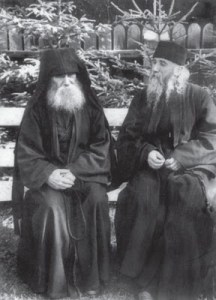
[Elder Paisius (Olaru) with Elder Cleopa (Ilie) on right]
ON OBEDIENCE AND LOVE
Obedience-this is of great benefit, my dear. That is, it’s of great benefit not to do your own will. In a monastery you must never do your own will. Say, for example, that you want to rest a little, but it’s not possible-just then you’re called to an obedience. You want to pray, but you’re called to leave your prayer and go. So you have to cut off your own will. But if you go to your obedience and say in your mind, “My, my, see how the enemy put it into his mind to call me, just as I wanted to pray a little-and it just wasn’t possible;’ then He does not receive your prayer, because you reproached the one who called you.
Obedience with love, my dear.
Come to me occasionally, when you’re in the neighborhood. But you should have your regular confessor there, so you can confess more often and partake of Holy Communion as often as he allows you. Heed your confessor, my dear. Follow where he leads you. And don’t go about from confessor to confessor, because what one gives you, the other will take away. But obey your confessor as if he were God.
Oh, how much the abbot tested me to see ifI would obey. Sometimes he would confuse me as only he knew how. I didn’t know what work to do, and he said, “Do this;’ and so I did it. Then he said to me, “Now, this isn’t good. Why did you do it?” He had asked me to do it, and then he asked me why I had done it! Indeed, he would sometimes pick at me, give me a little poke in the ribs ….
ON DEATH
The best teacher for us is death. There was a song: “The Song of the Blind Man.” A blind man would play on the fiddle and sing. He was from Pipirig,7 but he has since died. I heard him sing the song, and I liked it. Would you also consider my song? Here it is:
Death, pitiless death,
You take all from the house,
Whether they be young or old,
Whether they be servant or master,
Whether they be masters of the earth,
You prepare them for the tomb.
Even if he lives quite well,
No one escapes you.
To some you come while they are riding in their car,
To others while weeding the garden,
And to some you come
And stop their heart.
After all,
You come to all for a reason,
And sometimes even without a reason.
You just come and take
Whomever and however you please.
O death, I beg you with tears,
If you are to come to me soon,
Please do not come angrily,
To cut me with your scythe,
Nor put in my glass
Some of your bitter medicine,
But come with a little hammer
And sever me slowly
From head to toe,
So as to heal the wound that hurts.
For your medicine is good,
Too good for words to say.
And your little hammer is holy,
Because it parts me from this earth.
So, death, be good
And comfort me with your hand,
And your mouth, which is forever sweet.
Allow me to sign myself with the sign of the Cross,
So that with my lips I can say
My last prayer,
And with my eyes
Shed many tears,
So as to wet my cheeks
And wash away my sins
With which I have angered the Lord.
And so, with many tears I ask,
Mother of God, help me
To separate myself easily from my body
And to die in peace.
And may the angel of Christ
Show himself joyfully to me
And say, “Come, my dear,
Let me take you to God.” Amen.
Well, now, all of this is my song. I’d like it to be remembered, for it’s not at all easy to live, and it’s so very difficult to die. Those who have died forgot their whole life, and at the hour of death they only remembered what they had done wrong. This was all that remained before their eyes.
There was a man who was hiding under the table, under the bed.
He kept saying, “Don’t leave me, Fr. Paisius, don’t leave me!” “What can I do for you, my dear?” I would say. When I tried to take him out from under there, he would move to the other side. “Don’t leave me, Fr. Paisius!” he kept saying. “What can I give you, my dear-a little piece of sugar?” “No.” “Some candy?” “No.” “Some medicine?” “No.” He was asking for something else. He was asking for something that he should have prepared during his life. And when he died-God forgive him-it wasn’t even warm weather, bur we weren’t able to keep his body in church. They took him outside. They said the prayers for the dead outside. He stayed outside for three days. All the fluids flowed out from his body. Everything, everything flowed out, and it smelled from far away …. There you have it.
My dear daughter, it’s no joke. If we had the fear of death always in our mind, that is, the awareness that at any moment we could die, we would not be able to sin so easily. When the thought of something foolish would come into your mind, by remembering your death you would stop yourself immediately, saying: “God forbid-what if death should take me right now? What would I do?” You’ve seen what the Savior Christ says: “In whatever state I find you when your end comes, in that I will judge you.”(This quotation is taken from the Conversation with Trypho, a ]ew, chap. 47, by St. Justin Mart yr.-ED). If you ponder your death, you’ll immediately stop any sin that comes into your mind. Has it come into your mind to steal? Say to yourself, “No, this is a sin; what if death were to come now?” If you are about to hit someone, say to yourself, “No, it will hurt him, and that’s a sin. What if the Lord calls me now, and I don’t have time to reconcile myself?” It’s said that death is the best teacher, which stops you from all sins.
For this, dear brother,
Whether you will live a long or short life,
Throughout your life never forget,
Do not forget that you will die.
“Do not forget that you will die.” “What if death finds me now when I’ve done something foolish, or thought or said something bad, or am in a quarrel with someone?” And so it is. The immediate thought of death restrains you. “Oh my, if I die in that state …. I’ll certainly no longer steal and no longer quarrel, so that I won’t die in enmity:’ Because however death finds you, that’s how you’ll be judged …
The old blind man continues to sing:
Death knocks at the window,
And I am not prepared.
Even from their swaddling bands,
Babes are destined to die.
After they grow a little,
They are even more comely,
But they are not spared from death.
Youth is also like a Bower
That soon falls onto the road,
Young today, and tomorrow he dies
From a merciless illness.
And old age, my dear brother,
Like a hoarfrost from the east, Always ready to die
And to breathe his last.
For this, dear brother,
Whether you live a long or short life,
Never forget that you will die.
The idea is this: We’re all subject to sin, and if we have a healthy conscience, the moment we bring to mind that we’ve done something bad, immediately our conscience reproaches us. Or, when the enemy puts it into your mind to do something foolish, a healthy conscience immediately brings to your mind that you will die and you stop yourself:
“I may die this very hour … ”
Therefore, being subject to sin and death, we know that we must give up our life immediately whenever the Lord asks it of us, and then the end will come. And if our end is unforeseen, then we should be ready for it all the time. We should have just confessed, and we should be at peace with everyone. We should not somehow pass through life without thinking of death, and then allow death to find us unprepared. Because if you remember your death, you’ll receive much greater benefit, and you’ll humble yourself, thinking to yourself that you’re not eternal on earth, but quickly passing ….
It’s very difficult for a person who avoids Confession until the end of his life, until the moment of death. What can you say when death comes? What can you take with you? Because you don’t have anything you can take ….
When the Russians came in 1944, I was home at Cozancea Skete, and suddenly I heard someone yell, “Oh dear! The Russians are coming!” We couldn’t believe it. We thought to ourselves: “Well then, good men, aren’t these Romanians of ours awfully stupid, letting them come freely here from the Nistru9 River? Isn’t our border on the Nistru? And they couldn’t stop them?” Well, just as I went out to get water, I met the army which had come from the Prut River. “Well, ‘priest: why haven’t you left? We’ll put your head on a stick, ‘priest.'”
Good people, what was I to do? I was about twenty kilometers from the Nistru. I took the pail of water, and I quickly went home. What should I take with me? How should I depart? I needed one change of clothes … I needed a book … I needed the Psalter … I needed the Horologian. I had already filled a shepherd’s bag, but I also needed a blanket. What would I do if I had to sleep on the road? So I put a blanket in the bag. After I had filled two shepherd’s bags the old man, Gennadius, who was staying with me, was watching me prepare to depart, but he didn’t know where I was going. Suddenly I hurled both bags into a corner and, that’s it, I calmed down. I decided not to go. Others left, scattering to the four winds, but Gennadius and I remained. By the next morning, the Russians had filled the whole courtyard. When I came with the key to the church, they were standing there in front of it. They had built a big fire. They had put a cauldron on the fire and a cow into the cauldron, and they were all standing around it. They were all ripping off pieces of the cow and eating it, but most of it was still raw meat. They got hold of me and asked me for vodka. They’d go about looking for women and drink. They would do whatever they pleased. I said to them, “There are no women here. There are only monks here.” They asked, “What are monks?” I said, “This is a monastery.” I also began to tell some lies. I said, “This is a collective farm; here everyone eats together at one table.” Then they asked me, “So, where is the boss?” I said, “He ran away.” They said, “Don’t worry, we’ll catch him.”
They were there for almost a half a year. We submitted to them, and for a time they also learned from us. We also learned from them. Then they took everything that they liked and left. They were planning to go to Berlin.
There you have it, dear one. That’s how it was, my dear.
So, my daughter, for the man who leaves Confession to the moment of his death, it’s like this: “I’m now on the brink of departure and I look here and there to see what I can take with me. Look, I hardly have anything to take.” We must confess and prepare ourselves at all times and in good time, so when the hour comes for us to die we may have our bags packed and ready, tied up at the door. We must be ready to just snatch them and go when our time unexpectedly comes. There is no time for packing when death comes, dear, just as there wasn’t any time for us when the Russians were at the door back in 1944. At the moment of death, you can no longer do it, my dear. Then it’s no longer possible for anybody to prepare. No, my dear, no packing is possible then.
There was an old woman – Catrina was her name. And she would talk about death like we’re talking now, “Holy Death, please tell me when you’ll take me, so that I can prepare myself, Holy Death.” She was always talking like that. One day you would hear her addressing Holy Death, and the next day as well. She would always be speaking about death, but she didn’t see it coming. Then one day, death appeared, saying, “Come on, Catrina. Are you ready? Come on, because I’ve come to take you:’ “Oh, poor me! 0 Holy Death, I’ve asked you for such a long time now to come and tell me when you wanted to take me! I wanted to be told in advance. Why didn’t you come, Holy Death, to tell me?” And death replied, “What do you mean I didn’t come, Catrina? Wasn’t your ear hurting you for a while?” “Well, yes, it hurt me … ” “Wasn’t your head aching, Catrina?” “Why, yes!” “And what about you heart and your feet, Catrina?” “Yes, they hurt me, too.” “Well, that pain was me, Catrina, telling you to prepare yourself, that I would come soon to take you.” “Yes, well, is that the way you were speaking to me, Holy Death?” “That’s the way I know how to speak, Catrina … ” And he took Catrina. So you see, that’s how death speaks with us. It’s just like when you’re guilty of a crime-you’ve committed some foolish act. Before you’re taken to prison, a summons is first sent to you and, after that, a citation, and then follows a warrant-and then, that’s it.. .. It takes you, and it no longer leaves you alone. The summons is a twinge in the side so that you’ll prepare yourself to go confess to a spiritual father. The citation is another pain, so that you’ll receive Communion. And when the warrant comes, it won’t let you go …. That’s it! ”I’m taking you whether you’re ready or not!” “God reward you that I was made ready …. I’m finished. Come on …. ” That’s it, my daughter. I don’t want you to get confused by my crazy talk.
It is said that Alexander the Macedonian, after he had conquered the whole world, said, “When I die, bury me in a coffin with holes for me to extend my hands outside, empty, so that the whole world can see that Alexander the Macedonian, he who conquered the world, took nothing with him to the tomb.” And they buried him just as he desired-with his hands empty, left outside. Do you see? He wasn’t a stupid man; in that era he was a man of great valor. All those who have gone after human glory-which is usually what the whole world goes after-have regretted it in the end, because they tired themselves in vain.
Therefore, it would be very good if, from this moment on, we made a good beginning, my daughter. Things pass, they move downwards, and the moment will come when God will arrange that you take the final exam …. Oh my … that last one is the exam, no joke. Let us pass that one, dear daughter, because then there are no intercessions, no advocates, nor any other studies, but only deeds, if you’ve done them. That’s all that remains: that which you promised at your tonsure.
ON HAPPINESS
So, my daughter, since you happen to be here on these feast days, I wish you many years-but not for them to be too happy, because happiness in this world isn’t really so healthy. When a man is too happy in this world, he forgets God and forgets death.
Do you remember what St. Paul said? “I will not glory but in my infirmities and my weaknesses” (cf. II Cor. 12:5). A night and a day 1 have been in the deep [of the sea] (II Cor. 11:25). He didn’t know where he was for three days. Once they let him down in a basket; he was beaten with rods; he was stoned. Look at what he gloried in. He didn’t rejoice that he performed miracles, that he was educated, that he did something, that he set things right. And when he said: 1 knew a man in Christ above fourteen years ago … such as one caught up to the third heaven) … whether in the body or out of the body) 1 cannot tell… (II Cor. 12:2-3), he knew very well who it was-himself-but he didn’t want to put himself forward thus. And what he saw there … it’s not for us to know; for he was not a man to spend his life scratching his head like I do. For what he saw, what he heard, the mind and tongue of man cannot speak …. Further on, he gives himself away: Through the abundance of the revelations God allowed the messenger of Satan to buffet me (II Cor. 12:7). Here you are! It’s obvious. It was he himself Don’t you see? Lest I be exalted …. For this thing I besought the Lord thrice) that it might depart from me (II Cor. 12:7-8). And He said NO! He said, NO! Because in weakness God works miracles. So that’s how it was for St. Paul in order for him to be a chosen vessel. Therefore, from the great persecutor that he was, he became the most burning zealot, the most devoted, the most chosen vessel among all. He said many times: I am not meet to be called an apostle (I Cor. 15:9), and I am the least of the apostles (I Cor. 15:9). From a persecutor, from a vessel of dishonor, he became a vessel of honor. This is how God works. He can make a sinful man, through repentance and tears, into a believing man, a man who can be of benefit to himself and to others. So, this is how God helps you, dear daughter: from a dirty vessel-like me, my dear, tried by all sorts of lowly misfortunes, sins, and corruption-God makes you a pure vessel, a vessel of honor, in order to serve Him at His table of honor.
I don’t want either wealth or glory or riches for you here, because I know that from these come other troublesome things. If you have, by the grace of God, love and holy desire, then there, beyond the grave, will our future be. And doing God’s will, you’ll have much gain here as well, and beyond the grave you’ll have eternal blessedness, unto the ages of ages. And beyond, we’ll rejoice, where there are neither tears, nor sorrow, nor sighing, but life everlasting. Amen.
We cannot be saved if we love the pleasures of the world.
ON LOVE
Love helps a lot, my dear daughter. “Love with brotherhood surpasses great wealth.” 10 Have love one for another, because from love springs forth mercy. Love suffereth long and is kind … love vaunteth not itself: is not puffed up … seeketh not her own, is not easily provoked, thinketh no evil, rejoiceth not in iniquity …. Love never faileth (cf. I Cor. 13:4-8). If only we had this, then we would have genuine spiritual love! If we have love, we have all of these. Love makes you endure illness and even makes it dear to you, because it cleanses you of all filth. And if you have love for Christ, you’ll endure everything, both abuse and mockery. From love also comes patience. Then you’ll no longer be disgusted by someone who’s sick; it will seem to you that he smells like perfume. The greatest act of love is to take care of a sick person. If you take care of him with love and patience, he’s saved through you, and you’re saved through him.
It’s an impure act when you become angry. Anger does not do the work of God and does not bear the fruit of love. When you’re angry, the Spirit of God is not present, neither is the spirit of love; it’s the spirit of pride and vainglory that’s present.
WORDS ON FAREWELL ADDRESSED TO VICTORIA
Be like the little bees that go about from flower to flower and gather only the juice from which they can make honey. A bee flies from flower to flower-to many flowers. But they don’t stay where there’s no nectar from which they can make honey-they flee. So, may you collect from all only what is good and beneficial to you. Let the rest just slip by, as though through raindrops.
Let me tell you a story: A gypsy was walking along the road. He was very well dressed. He was carrying a tin bucket. There were also a lot of other people traveling on the same road. It began to rain heavily, and everyone took shelter wherever they could, but the gypsy did not have anywhere to hide. What did he decide to do? He took off his clothes and put them in the bucket, turned it upside down and then sat on it until the rain stopped. When the rain ended, he put his clothes back on. The people asked him, “How did you manage to stay dry? How is it that you didn’t get rained on? How did you not get wet?”
And he said, “Through the raindrops-I simply squeezed myself between the raindrops.” So, you, too, must squeeze yourself between the raindrops so that you don’t get wet from the rain of sin ….
What day is it today? August 9, 1981. Let the memory of these places remain with you-the springs, the mountains, and the fir trees-and next year at this time recall: “Hmm, last year at about this time we found ourselves up there at Sihla, talking with an almost completely mute old man (because I didn’t have anything to say), almost completely deaf (because I don’t hear well); a blind old man who tells us some fancies of his while weaving together two pieces of straw:’ and, “I wonder if he’s still alive?” Yes, next year-there’s a long time until next year. At least those who live close by-you’ll wonder, you’ll ask about me-and if love persuades you, don’t forget these places, stop by here again. I believe that there’s no telling whether we will meet again when you return. But I would like for all of you who were here to forgive me, because perhaps some of you may have been offended. Don’t be scandalized by what you’ve seen and heard, for what’s heard is one thing and what’s seen is another. Woe to that man who receives praise that exceeds his life and deeds. You who have benefited-if any of you have benefited from coming here-commemorate me. Commemorate me at least in this way: “Friends, that man wasn’t learned, but he did have a desire, a certain zeal to help us. And he wove together two pieces of straw in order to benefit us by any means-such was his wish. And we-some of us profited and others were offended.”
I think to myself that if I have a few more days to live, these were granted to me because there’s still some rust left that must be scraped off with whatever God deems useful to cleanse me. Everything granted by God is useful, and we must be satisfied with whatever God has in store for us-He knows how much time is still necessary for our cleansing. For example, God calls some youths to Him in heaven so that they may no longer sin; while, on the other hand, He leaves some of the elderly on earth to repent. See God’s judgments? They’re marvelous! Therefore, may God be praised that He is still patient with us, while 1, instead of repenting, continue accruing sins. I still scold people, “Hey, why are you doing this?” “What kind of person would … ?” “What do you think you’re doing?” I’ve blamed people this way, and even though I’ve consoled them afterwards in some way or another, it’s still not a righteous thing to get angry, for wrath doesn’t work the righteousness of God.
1here was a young novice who died on Saturday, after I had tonsured him a monk on Thursday. His name was Gervasius. Before dying, he addressed me, “Father, bring my spiritual father here so I can receive Communion.” After I had carried out all his requests, he said, “Light the candle at once, Father!” I put the lit candle into his hand and decided to help him hold it, but he said, “Let go, Father, I can hold it.” “All right, if you can hold it, then go ahead.” He held the candle for about two minutes. He then looked up, first to the right and then to the left. When he looked to the left, his face darkened, but when he looked to the right, he became slightly joyful. “Father, extinguish it- I still have a bit of time.” After that, he again said, “Fr. Paisius, go tell my spiritual father to come and read the prayers for the departure of the soul for me.” When I heard this, I exclaimed, “You want this, too?” I then went back to the spiritual father and recounted the whole matter. “Father, he’s asking that you come and read the prayers for the departure of the soul.” Gideon, the poor father, was furious. “What are you trying to do, force people to die quicker? No, I’m not coming!” I persisted, and after he gave me a good scolding, I hurried back. Gervasius was waiting for him. “Is that father coming?” “He is.” The father came. “What do you want, Gervasius?” “Father, I want you to read the prayers for the departure of the soul for me.” So he read the prayers and left. By this time, the other fathers of the monastery, who heard what was going on, had come, since by now it was already morning. So I pulled the bed into the middle of the room and we gathered around his bed, looking at the young monk. He was saying, “I hear you but I can no longer see you.” He was seeing something else now. Suddenly he said, “Forgive me.” “May God forgive you;’ we replied. He then appeared to swallow something, took a deep breath, then a short one, and then another lengthy one, and reposed. A monk for three days-and I have been a monk for sixty-some years, and I still haven’t made a good beginning. I still haven’t prepared myself for death. “Hmm, I should add another layer here, maybe another rock, this one is not really suitable here … ” See how the wicked one deceives us? That nineteen-year-old died, after being a monk for three days; as they say in the books: He was an “old youth” and a “young elder.” Early in their lives, God takes to Himself those youths that are good because they haven’t sinned, and He leaves the elderly so that they may repent.
That’s how it is, my dear. May God strengthen you, unite you, and give you wisdom, so that you’ll endure in the monastic life. Carry your cross of suffering to the end through patience, meekness, and obedience, and you’ll be saved. May the good God grant many years to those who are healthy and much patience to those who are sick. May God grant great patience to those in need of it and spiritual joy of soul for the man who is diligent. May you live and labor in obedience, in that which is profitable for salvation. God grant you patience, love, and good hope, and don’t forget the decision that you’ve made-stand by it until the end. Let us pray more, so that God may grant us patience, meekness, and love-because if we have love, we have everything. Let us even endure insults, because this is how the Savior praises us: Blessed are they who are persecuted for righteousness’sake (Matt. 5:10). We will endure all for His love, my dear one, so that we can win, not all of Paradise, but a little corner, however small.
All of you-make a good beginning for yourselves. You who have limped, straighten yourselves; and those of you who haven’t, take charge of yourselves. Never put your faith in people, because man is subject to change-today he gives to you and tomorrow he asks from you; today he praises you and tomorrow he insults you. However, if you place your hope in God’s mercy, you will never encounter failure.
That’s it-that’s about all I’m able to do, because I’m overwhelmed by things which are unseen and which only I feel.
What can I say about myself? Because I can’t see well, I always break something. I put a needle here and it falls down: “Oh, no, where is it? I put it here. Did someone steal it?” And, look here … ! Look how I make mistakes and become suspicious of others. Oh, well! I sin profusely just because I can neither see nor hear, and I suspect others. See how the enemy deceives us?
Yes, that’s how it is, my dear …. Peace in the country, peace in the world, peace in the monastery, peace in your homes. Maybe you’ll no longer find me tomorrow, because it’s already time for me to depart. But you’ll remember these places and long to see these stones. However, with God’s mercy, if we’re still alive next year, remember that last year, a stupid, blind old man wished you well. I am old and will depart when God wills, but we’ll meet again, no doubt, here or there, at the gates of Paradise … not in any other place. May God strengthen you, unite you, and give you wisdom, because there are only two roads: to Paradise or to hell. We must decide which to follow and, until the end, carry our cross of suffering through patience, meekness, love, and obedience-and we’ll be saved.
My dear, I will leave … and I would like everything that you have seen and heard from me to remain in your memory-that it be unto your salvation. Yes, dear one, and commemorate me when you remember, without any obligation. Amen.
On the Passions
(The remaining sections of Elder Paisius’ teachings were addressed to a group of women)
My dear ones, this life is very difficult; you have to fight until death against your nature’s passions. Fire, hell, and fornication-they never say they’ve had enough and are satisfied. There are old men who don’t break free from this passion [fornication]. Don’t you know how terribly tempted the saints were? But the Mother of God watches over you. If you have faith and the fear of God, the Mother of God will also protect you. You’ve seen some of her miracles. But don’t enter into conversation with the thoughts. If you don’t consent to them, you haven’t sinned. The thoughts will come, but don’t talk with them; pay them no heed. So, thoughts and temptations perhaps come to us also; perhaps some thoughts among these have come also to me. But if you take no notice of them, they depart.. .. But they’ll come even more often to those who rarely go to church and forget to pray!
Let us guard our five senses, dear one. May you preserve purity, but not just bodily purity. Purity is also of the heart and of the thoughts. Pray always. And, God forbid, don’t agree with what your thoughts tell you. And when you do have thoughts and passions and temptations, think of the Mother of God and try to sing to her “It is truly meet;’ because the Mother of God protects you. If she has watched over you until now, I believe that she will also watch over you from now on. You must make your way through life like the gypsy through the rain drops. That is how we must go through this life. The body and the devil must be deceived. Say to them, “Leave me alone, leave me alone this year.” And by the following year who knows what will happen? So, my dear, don’t speak with thoughts. Tell them: “Flee from here!” You sin only when you stop and think: “How can I do this, how can I manage to do that…?”
May you keep away from boys like fire. When you see a boy or a man, let it be as if you had seen a rock. And keep away from your imagination. Don’t ever think about a man’s body, or a woman’s body, or anything like this. Let it not interest you, because other thoughts begin from these. For me, thoughts like these perhaps flash through my mind, but they pass by, fly over, like a flock of birds. Now they no longer come to me. Because I neither know about them, nor do they interest me, nor do I want to know them-God forbid! They pass through my head like a lightening flash, like a gleam. Just pray that the thought be sent somewhere else. Don’t talk with it.
You must tell your thoughts in good time to your confessor, my dear.
And at Confession don’t vulgarly say whatever comes into your mind, but say, “Father, I have blasphemous thoughts, I have defiling thoughts, I have passions and desires;’ or, “I have evil and blasphemous thoughts about monastics, about priests; I have dirty passions …. ” So from now on keep away from all the desires and passions that you’ve had. And don’t forget this either: a kiss is the first chapter of sin.
If you want to spend your life in purity, never even consider pleasing people. To be as despised by them as possible-yes, that’s right. And never enjoy being praised, my dear-that too is a form of pride. And when the thought comes into your head that you’re better than others and that you’re worthy of being praised, say this to yourself: “Who has committed more shameful sins than I have?” Because this sin is not a small thing, dear one ….
If you are resolute in living in purity and banish idle thoughts and make the resolve that “I will not do this until I die;’ then the idle thoughts will depart, and they will assault you less.
So, my dear, from these three paths, you must choose one: to marry, to enter a monastery, or stay as you are and preserve your virginity in the world, doing God’s will as you’re able without anyone knowing. In the monastery you’re under a rule of life with vows. If you’re not in a monastery, you’re acting according to your free will, without making vows. There are many who have kept their virginity in the world and did not manage to come to the monastery, and they are reckoned in the ranks of monastics. If you die in the world with your mind in the monastery, then you’re in the ranks of the nuns. The man sanctifies the place; the place doesn’t sanctify the man. You can be saved anywhere in Bucharest or somewhere else. The most important thing is to have sobriety.
Did you make an oath that you’ll go to a monastery? My dear, don’t make any more oaths about this. You must not swear. If you want to go to the monastery, see how the Mother of God draws you, step by step. But don’t swear anymore, my dear. Always say, “Look, if it will lie in my power and if God will help me, I’ll do such and such.” Okay, my dear. Do not lose your good disposition. And if you pray, the Mother of God will enlighten you, my little lamb. You have my complete blessing to love the life of purity. Yes, you made an oath; you made oaths many times that you’ll go to a monastery. If it’s meant to be, you’ll be His bride. It’s much easier in the monastery than in the world, my dear. No one compels you to get married. Know that few have regretted that they entered a monastery, but many more have wept because they regretted marrying. (I’m referring to those who are seeking their salvation.) You can’t take a husband simply in order to look at him. You have obligations, and it’s quite difficult. Then come the children. Little lamb, for the time being, remain in the world with your thoughts in the monastery. Many young people wanted to go to the monastery but have died in the world, and they attained to the monastic ranks. And many monks have lived in the monastery with their mind in the world, and they attained to the ranks of the laity. Have fear of God, be good, and avoid the passions. Don’t forget that indulgence in passions constitutes a kind of suicide. 50 do this, my dear, and the Mother of God will protect you.
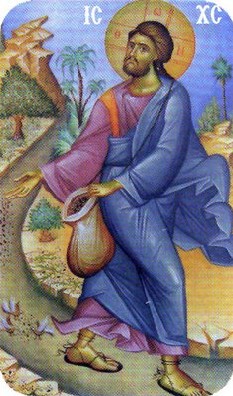
Sunday of Luke 8:5-15
and of Holy Fathers from the 7th Ecumenical Council of Nicaea
350 holy Fathers of the Seventh Ecumenical Council, which gathered in Nicaea in 787 under the holy Patriarch Tarasius and during the reign of the Empress Irene and her son, Constantine Porphyrogenitus, to refute the Iconoclast heresy, which had received imperial support beginning with the Edict issued in 726 by Emperor Leo the Isaurian. Many of the holy Fathers who condemned Iconoclasm at this holy Council later died as Confessors and Martyrs for the holy Icons during the second assault of Iconoclasm in the ninth century, especially during the reigns of Leo the Armenian and Theophilus.
“In this parable, our Savior creates four human typology. The first one represents the careless man. A mystical author and philosopher Sir Kierkegaard, called this type the wing man, or the taster understanding those wondering from flower to flower, seeking the joy of this earthy life and ending with their wings broken and trapped into the dust. These are people who reject God’s word but allow themselves to be dragged by all sorts of ideological, Gnostic or philosophical ideas. They have no stability and are berried by all the wrong teachings of this world; like a wall on which is written all the false ideas of the present and past times. Let us be attentive and reflect who among us is like the earth in which the seed falls but bear no fruit?
The second category is (represented by) those who hear the word of God, receive it with joy, but it is enough for one shadow to overcome them. It is sufficient for one disaster to strike, one persecution as it took place and it is still unfolding in our world today – especially in America where the persecution is very subtle and insidious – for them to be lost. And in many aspects, this is perhaps more dangerous than communism, when we knew who was (doing) good and whom evil. It was as the white and black. Now, we do not know where good and wrong is. Everything is gray shaded. So it is Europe, the “United Europe”. And we identify with those who hear the word of God, receive It and are joyful, then a tribulation strikes, or the hot sun… (cf. Luke. 8: 6) as the parable says. The hot sun warms and dries the soil and the seed from our soul, dies.
You know that in communism, during the religious persecution, those who were patriots had separated easily from the traitors. Some had failed, others had compromised or committed evil, while others had suffered and if they haven’t been arrested, they resisted silently under grounds, praising God to help them in this troubled life. I wondered sometime: … how many people back then, had not compromise religiously?
And I was moved to see in the church, how people raised their arms to God screaming loudly Lord, have mercy on me! while I was reading the prayers for forgiveness and I was saying out loudly every name so that the Lord God may hear their prayers and send His mercy.
I was impressed to see such faith, which you do not find in the West. These spontaneous manifestations of the soul crying out to God.
But I was even more troubled when I saw that many of these people have a dual personality: in the church they are believers, they lit candles, they come and may or may not attend the whole service, but when they leave the church they become like beasts. Brother rises against his brother to fight for a piece of land… they deceive each other in many ways. This is a kind of doubled spirit.
In communism, this kind of duality was very different. Beck then many would listen to the Voice of Europe, went to church, but in public will cry that they do not believe and praised Ceausescu or others. This lie has been perpetuated for a long time.
Nowadays, a new form, more dangerous than before is being perpetuated in our country, because now we no longer fear any religious threat. Now, under the pressure of the times, or under the influence of many theories, or simply because it is convenient, some of us deny God and bring no fruit. Reflect on which one of us fit in this category, or we did not so long ago.
A third category of people are those dominated by passions. And they bear many, all sorts of human passions: fornication, drunkenness, greed, all those passions that make our heart a land filled with weeds, thorns and brambles. And even if the word of God touches us, even if we turn back to Him with love, our passions which we bared for sometime, are stronger than us. And this is because our repentance is not genuine! It’s just a moment of openness towards God which we do not immerse our heart in, we do not make of it the healing source for our soul, we opened for a time then we forget.
Our passions had flared within us stronger than the Call (to Christ) and the virtues that God sows into our heart. And we do not bring forth any fruit, and without fruit we are deemed for eternal punishment. Who among us can identify himself here?
The fourth category of people are those who hear the Word, endeavor in struggle, serving the Lord with joy, are looking to fertilize their spiritual soil, to understand more deeply the word of God; they come to church to confess and commune and do good to those around them, and become a light for the world. Some may struggle less, others more. God has given everyone a talent: to some He gave one talent, to other He gave three talents, and to another He gave five talents. Everyone got something and each of us must bring forth to God a gift equal to the gift he received. Him who got a talent, needs to bring one more. Him who received two talents, let him brings two more, and him who were given five, let him brings five more. He, who bears fruit this way, is truly one who heard the word of God and was fruitful.
And the Lord said also: “He who has ears to hear, let him hear.”
Look around you and within yourself and sincerely see where you are. If you have good intention and do not try to deceive yourself or others, acknowledge exactly where you stand. Then truly, when our Savior had said “He who has ears to hear”, you are those who properly understood.
And your sincere look of where you stand – in this typology that our Savior had created – will convinces me that from now on you will truly begin to serve Christ and to bring forth fruit. Even thought it may seem small, let us strive for it.”
(Taken from: Father George Calciu: “To serve Christ means suffering”, translated by EC)
Motto: (Lk. 6:24-30)
The Lord said to the Jews who had come to him, “But woe to you that
are rich, for you have received your consolation.
“Woe to you that are full now, for you shall hunger.
“Woe to you that laugh now, for you shall mourn and weep.
“Woe to you, when all men speak well of you, for so their fathers did
to the false prophets…

“The Beatitudes” with Elder Paisios of the Holy Mountain
(Taken from the Elder’ Sixth Epistle)
Sister Abbess Philothei, Your blessing,
Today, a kind of craziness took hold of me and I took the pencil, as does the madman who writes his outbursts on the wall with charcoal, and I sat down to write my own things on paper like one crazed, and, again, like a lunatic, to send them to you in writing. I am doing this latter craziness out of much love for my Sisters, that they might be edified, even if only a little.
The reason for the initial craziness was five letters, one after the other, from various parts of Greece on a variety of subjects. While the events described were great blessings of God, those who wrote to me had fallen into despair because they dealt with them in a worldly way.
After replying accordingly to their letters, I took the pencil like a madman, as I have said, and wrote this epistle. I believe that even a fifty-cent piece from your journeying brother will be something toward a flint for each one of the Sisters so as to light a little candle in her cell and offer her doxology to our Good God.
I feel great joy when every Sister, with her particular cross carries out the equivalent struggle with philotimo.
It is a small thing to give to Christ a heart equal in size and as luminous as the sun out of gratitude for His great gifts, and especially for the particular honour He showed us monks by conscripting us with personal summons to His Angelic Order.
A great honour also belongs to the parents who were thus made worthy of becoming related to God. Unfortunately, however, most parents do not realize this and, instead of being grateful to God, are infuriated etc., for they see everything in a worldly way, like those people I mentioned earlier, who became the reason for me to take the pencil and write everything that follows.

1. Blessed are those who loved Christ more than all the worldly things and live far from the world and near God, with heavenly joys upon the earth.
2. Blessed are those who managed to live in obscurity and acquired great virtues but did not acquire even a small name for themselves.
3. Blessed are those who managed to act the fool and, in this way, protected their spiritual wealth.
4. Blessed are those who do not preach the Gospel with words, but live it and preach it with their silence, with the Grace of God, which betrays them.
5. Blessed are those who rejoice when unjustly accused, rather than when they are justly praised for their virtuous life. Here are the signs of holiness, not in the dry exertion of bodily asceticism and the great number of struggles, which, when not carried out with humility and the aim to put off the old man, create only illusions.
6. Blessed are those who prefer to be wronged rather than to wrong others and accept serenely and silently injustices. In this way, they reveal in practice that they believe in “one God, the Father Almighty” and expect to be vindicated by Him and not by human beings who repay in this life with vanity.
7. Blessed are those who have been born crippled or became so due to their own carelessness, yet do not grumble but glorify God. They will hold the best place in Paradise along with the Confessors and Martyrs, who gave their hands and feet for the love of Christ and now constantly kiss with devoutness the hands and feet of Christ in Paradise.
8. Blessed are those who were born ugly and are despised here on earth, because they are entitled to the most beautiful place in Paradise, provided they glorify God and do not grumble.
9.Blessed are those widows who wear black in this life, even unwillingly, but live a white spiritual life and glorify God without complaining rather than the miserable ones who wear assorted clothes and live a spotted life.

10. Blessed and thrice blessed are the orphans who have been deprived of their parents’ great affection, for they managed to have God as their Father already from this life. At the same time, they have the affection they were deprived of from their parents in God’s savings bank “with interest”.
11. Blessed are those parents who avoid the use of the word “don’t” with their children, instead restraining them from evil through their holy life – a life which children imitate, joyfully following Christ with spiritual bravery.
12. Blessed are those children who have been born “from their mother’s womb” (Mt. 19:12) holy, but even more blessed are those who were born with all the inherited passions of the world, struggled with sweat and uprooted them and inherited the Kingdom of God in the sweat of their face (Cf. Gen. 3:19).
13. Blessed are those children who lived from infancy in a spiritual environment and, thus, tirelessly advanced in the spiritual life.
Thrice blessed, however, are the mistreated ones who were not helped at all (on the contrary, they were pushed towards evil), but as soon as they heard of Christ, their eyes glistened, and with a one hundred and eighty degree turn they suddenly made their soul to shine as well. They departed from the attraction of earth and moved into the spiritual sphere.
14. Fortunate, worldly people say, are the astronauts who are able to spin in the air, orbit the moon or even walk on the moon.
Blessed, however, are the immaterial “Paradise-nauts”, who ascend often to God and travel about Paradise, their place of permanent abode, with the quickest of means and without much fuel, besides one crust of bread.
15. Blessed are those who glorify God for the moon that glimmers that they might walk at night.
More blessed, however, are those who have come to understand that neither the light of the moon is of the moon, nor the spiritual light of their soul of themselves, but both are of God. Whether they can shine like a mirror, a pane of glass or the lid of a tin can, if the rays of the sun do not fall on them it is impossible for them to shine.
16. Fortunate, worldly people tell us, are those who live in crystal palaces and have all kinds of convenIences.
Blessed, however, are those who’ve managed to simplify their life and become liberated from the web of this world’s development of numerous conveniences (i.e. many inconveniences), and were released from the frightening stress of our present age.

17. Fortunate, worldly people say, are those who can enjoy the goods of the world.
Blessed, however, are those who give away everything for Christ and are deprived even of every human consolation for Christ. Thus it is that they manage to be found night and day near Christ and His divine consolation, which many times is so much that they say to God: “My God, Thy love cannot be endured, for it is great and cannot be fit within my small heart”.
18. Fortunate, worldly people say, are those who have the greatest jobs and the largest mansions, since they possess all possibilities and live comfortably.
Blessed, however, according to the divine Paul, are those who have but a nest to perch in, a little food and some coverings99• For, in this way, they’ve managed to become estranged from the vain world, using the earth as a footstool, as children of God, and their mind is constantly found close to God, their Good Father.
19. Fortunate are those who become generals and government ministers in their head by way of heavy drinking (even if just for a few hours), with the worldly rejoicing over it.
Blessed, however, are those who have put off the old man and have become incorporeal, managing to be earthly angels with the Holy Spirit. They have found Paradise’s divine faucet and drink from it and are continually inebriated from the heavenly wine.
20. Blessed are those who were born crazy and will be judged as crazy, and, in this way, will enter Paradise without a passport.
Blessed and thrice blessed, however, are the very wise who feign foolishness for the love of Christ and mock all the vanity of the world. This foolishness for Christ’s sake is worth more than all the knowledge and wisdom of the wise of this world.
I beg all the Sisters to pray for God to give me, or rather take from me my little mind, and, in this way, secure Paradise for me by considering me a fool. Or, make me crazy with His love so I go out my self, outside of the earth and its pull, for, otherwise my life as a monk has no meaning. I became externally white as a monk. As I go I become internally black by being a negligent monk, but I justify myself as one unhealthy, when I happen to be so; other times, I excuse myself again for being ill, even though I am well, and so I deserve to be thoroughly thrashed. Pray for me.

May Christ and Panagia be with you,
With love of Christ, Your Brother, Monk Paisios
(“Precious Cross”, December 2, 1972).
Republished and translated by blog’ author from “Orthodox Typos”, October 1st, 2010
(one of the Orthodox publication of Greece)

Heated disagreement at Vienna between the representatives of the Orthodox Church, as reflected in the statements of Metropolitan Ioannupol of Pergamon, the representative of the Moscow Patriarchate: Bishop Hilarion and the Vatican representative for the „unity” of the Christian Churches.
Orthodox Typos: the dialogue with the heretics has to stop permanently, “here and now”, in order to stop the harm/deceit of the faithful and the clergy. Alive is our Lord God, Who protects His Orthodox Church.
Our Lord is a Living God! This was seen at Vienna, where the Theological Dialogue was held between the Orthodox and the Catholics over the Pope’s primacy in the first millennium. The dialogue ended in failure, to the great disappointment of the Ecumenist’ bishops of the Church of Greece, who constantly deceit/slander the faithful (that worrie to keep the tradition and the Holy Canons) and distort the thinking and the Orthodox faith by recognizing as canonical the heresy of Papism. The dialogue has ended in failure because the papal representatives did not step back and have remained steadfast in supporting the papal supremacy. The dialog was also led to failure due to the heated disagreements between the representatives of the Orthodox Churches. Each Orthodox representative exposed issues that brought hardship to the Dialogue. The Orthodox have exposed different views regarding of how the unity is to be understood. This arise from the official statements of both Ecumenist Metropolitan of Pergamon: Kir Ioannis Zizioulas, the Vatican official on „unity “: “Archbishop” and reformer – Mr. Koch, the Metropolitan and Foreign Minister of the Moscow Patriarchate: Bishop Hilarion, but also of Metropolitan Seraphim of Ioannupol, who in his interview, labeled those opposed to dialogue with the Catholics as mentally ill people. :(
It doesn’t means that if some people are crazy, they have the right to question our Orthodox thinking (Amen.gr, 09/26/2010 )
The Metropolitan of Ioannupol was the first of the participants, who made public in an interview, the failure of the Dialogue.
Seraphim of Ioannupol had declared: “At Vienna we continued the debate over text analysis that began in Cyprus and we had not yet completed the final form of this text. The Committees have the responsibility to edit this text based on the points made in the debate and to prepare us a working/text document with the additions and comments of the members from the Joint Commission. This text refers to the first millennium and analyzes the role of the bishop in the life of the Church at the local, regional and wider level. The text of this publication is not currently available, because does not have a final form . The Roman Catholics have their views on how they understand the role of the bishop of Rome in the first millennium, and the Orthodox are referring to the place that the historical Patriarchs had in the old historical Patriarchates of the East: in Constantinople, Alexandria, Antioch and Jerusalem …
NP (the interviewer): Your Eminence, lets insist a bit on the question of primacy …
Metropolitan of Ioannupol: As I already mentioned, the theme of primacy (in general, and not as something pertaining to the Pope, transl note) is something that appears as a pastoral need in the life of the Church, and pertains to the bishops of the Church, first in a diocese, and later in a larger region with several Dioceses,
– to convene to chair and to coordinate the synaxes of the bishops who act together, by invoking the descent of the Holy Spirit on the basis of Scripture and the Holy Tradition of the Church,
– for keeping the faith and the order of the Church which the heretics or schismatics were distorting.
It is a way to defend the soteriological path of the faithful.
In this context we refer to the bishop’s place in the life of the church during the first millennium and, of course of the bishops at Rome, Constantinople, Alexandria, Antioch, Jerusalem, Salamis, and other important religious centers that were developed in the first millennium, which we referred to.
It doesn’t mean that because the Roman Catholics presented points – as they desire to see the place of the bishop of Rome, the Orthodox have to accept them, nor that the Roman Catholics are obliged to accept the points that are presented by the Orthodox regarding the role of the bishops in the life of the Orthodox Church of the first millennium. We are just in the beginning of the dialogue, to prepare proposals for a later stage to be sent to our Holy Synods for decisions.
Those participating in the dialogue have no power to take decisions, our role is to highlight a common way of the church of the first millennium and to see how the faith was guarded in unity. The responsibility in making decisions belongs to the Holy Synods of the local Orthodox Churches, and if a final stage is reached, of course, to a Pan – Orthodox Synod. The dialogue is still in its early stage, and only the Holy Spirit knows how much of this will bear fruit … “
The Statements of the Representative of the Moscow Patriarchate
The Foreign Minister of the Moscow Patriarchate, Metropolitan Hilarion, according to “Romfea.gr ” had also made a declaration. The Metropolitan made it clear that some statements had been scheduled for debate while others have been debated, because there were serious disagreements over the Pope’s jurisdiction in the first millennium, something which the Metropolitan Ioannupol also reported. (…)
Bishop Hilarion noted that “the work (text) of the Joint International Commission for Theological Dialogue between the Roman Catholic Church and the Orthodox Church, which was made public by some mass-media does not reflect the position of the orthodox side in the issue over the primacy of the Bishop of Rome and can be treated only as an auxiliary material for future work.”
‘Despite media allegations, there was no openness in the meetings of the Commission for Theological dialog between the Orthodox and Roman Catholics in Vienna, ” Kir Hilarion added.
Kir Hilarion further added that:
“The meeting from Vienna was held to debate the role of the Bishop of Rome in the first millennium. On this basis of discussion a document was prepared last year in Cyprus by the Coordinating Committee. This axilliary text circulated in the mass media without approval for that. It has been assumed that at Vienna this text will be finalized and end the debate. However, things turned out to be different. Much time was spent debating this text status.”
Also, Kir Hilarion noted that
“The Orthodox representatives had insisted from the beginning that this text proposal cannot be formally published by the Commission nor that it can be signed by its members .”
‘ Our view is that this text requires an essential review in what follows, and only after that it can receive the status of an ‘ auxiliary text material’ ( instrumentum laboris ), which will be used to prepare future texts, but it will have no official status “, said Kir Hilarion added.
Referring to the role of Bishop of Rome, he stressed that:
“The text has purely a historical meaning, because it speaks only about the role of the Bishop of Rome and, does not cover nearly any of the bishops of other local Churches of the first millennium, thus giving a false impression of how the Old Christian Church was administrated at that time.”
“Furthermore – he added – the text lacks a clear and obvious finding that the jurisdiction of bishop of Rome in the first millennium did not include the Church in the East (the actual Orthodox Church, transl note).”
He also noted:
“We hope that these goals and gaps will be filled properly once the text is processed. After a debate, the Commission has decided that this text requires further processing and that the final decision on its status will be postponed for the next meeting of the Committee, that is in the next two years. Until then we will prepare a new text, which will deal with the same problem, but from a theological prospective.”
“For it is very evident for the Orthodox members that in the first millennium, the Bishop of Rome in the West did not exert exclusive jurisdiction over the Christian Church in the East, because in the East, the Church was divided territorial between the four patriarchs of the Constantinople, Alexandria, Antioch and Jerusalem, ” he stressed.
He concluded that:
„The Bishop of Rome had no direct jurisdiction in the East, although in some historical cases resorted to the Eastern bishops in theological disputes by arbitration”.
‘But these appeals were not systematic and can not in any way be interpreted as meaning that the Bishop of Rome in the East was seen as holder of supreme dominion over the Ecumenical Church”.
„I hope that at the next meeting of the Commission, the Roman Catholic Church will accept this position, which is based on countless historical evidence, ” the president for External Relations of the Moscow Patriarchate added.
The Metropolitan of Pergamum
The Ecumenist Metropolitan of Pergamon: Ioannis Zizioulas, admitted there are issues and agreed with the Vatican representatives for the „unity”, that this model of unity is deemed for the future.
He therefore requested that the Orthodox Church needs to strengthen its universal unity, a concluding fact for the sharp disagreements between the Orthodox representatives in the Dialogue. Because it resulted that the papacy has not taken any step back in the dialogue, Kir Ioannis also called out to the Catholic representatives to stress more the conciliatory dimension. He stated that “if these two things will happen, then the result will come quickly.”
Next, by referring to an Pan – Orthodox Synod he said (according to Romfea.gr) :
‘ Of course we must be united in faith a lot. Regarding an Pan – Orthodox Synod, we worry – and we admit it – that the autocephaly is a problem mainly when it is linked to nationalist themes. But I ‘m happy to say that we made a satisfactory progress towards a Pan -Orthodox Synod.
Orthodox Typos: “The Dialogues need to Stop!”
The Ecumenist bishops, the Phanar (Ecumenical Patriarchate) and the Church of Hellas (Greece) must stop these kind of theological dialogues, for they expose and scandalize the faithful people. The Papists have demonstrated once more at Vienna that are unrepentant and inflexible in their heretical theories such as the primacy and infallibility. They had demonstrated that they refuse the synodalicity. And, it is finally shown, that the representatives of the Orthodox Churches do not have a common position or vision on the ‘unity’, and that they do not consider papacy, “a sister Church”. To continue the Dialogue means a real provocation for the people of faith.
“Man by himself, has no power to fulfill the commandments of God”
Saint Siluan of Mt. Athos
A word that I think we should always bear in mind when we read or hear the Gospel and, especially the Gospel pertaining to the love of one’ enemies, that is read on this Sunday during Divine Liturgy.
Father Raphael Noica (a disciple of Elder Sophrony Sakharov from Essex) takes this further and says: “God, by commanding these things to us, does not expect us to be able to do them, because He knows that we do not have the power within us to fulfill His Word.”
How can this be? Does it mean then that God is asking us “the impossible”? Yes, and in a certain sense, this is what He asks of us! For His commandments are not merely moral requests accessible to the simple human’s will. God’s commandments are “a revelation of the divine life” (Elder Raphael N) to which Christ calls us. They are Divine commandments and not human commandments.
Does it mean then that God is absurd? No, but it means what Father N. Steinhardt used to call “God’s noble spirit,” Who put into your lap a “good measure, pressed down, shaken together, & run over” (cf. Lk. 6, 38). God wants to give us EVERYTHING, He wants us to be like Him, to partake of His life and therefore He commands us things impossible to human nature; in fact, through His commandments, He calls us to an absolute call, a call of a “final authority” which we cannot ignore.
At the same time, by this kind of commandments God wants us to discover our inability to live by ourselves and become humbled in Him, in a total hopelessness, to look deeply into our weakness and wickedness, and desperately ask Him for help. As we hear it in today’ Gospel: “My grace is sufficient for you, for my power is made perfect in weakness.” (2 Cor. 12, 9), and by living the awareness of our weakness in doing the divine will, we get ready to receive Him! In other word, if we would receive much more than our efforts or merits, we would be too proud and mock the “gift” (grace) that is given to us! “Joyfully I will praise rather in my weaknesses, so that the power of Christ may live in me” (Ibid.).
When I will empty myself of any trust in me, of any reliance on my own power and my own opinion that I did anything good, only then I can be filled up by the grace of God! For only by divine power, by the grace of the Holy Spirit one can do things of the Spirit and of God, that is … the Gospel’ commandments.
I thought that these things must be made clear before we talk about the Gospel commandments and, in particular about the commandment of love culminating in the love for enemies. And this is because many wrongly assume that it is very handy to love all people and love even the enemies of the Church, by imagining that they are already fulfilling so easily the hardest commandments of Christ and judging those whom according to their understanding, “do not love.”
While others, at the opposite pole, deceitfully believe that if they cannot naturally fulfill the divine commandments (i.e. they cannot love or can be gentle, ..), then these commandments are not been asked of them (especially if they live in the world), so they either give up the fight or will take from Christianity only certain things “accessible” to their nature. Both of these extremes are denounced by the Fathers of the Church as been wrong paths. Then, without realizing, they reduce the Gospel to a pure natural, humanistic or psychological content.
The first (category) live very much in imagination and, been lead by nature or emotions, by more intense or exalted feelings, they get to believe that it is very easy for them to love and that they even “have love” for all … to them, the more firm words by which Orthodoxy separates itself from deceit and called evil by its name, may seem too extreme and loveless. They only want to see “what is good” and “pink” and their “love” is more a projection of one’ psychological needs for safety and comfort which automatically exclude or deny what is “uncomfortable “.
At the other pole, love is almost out of the question, or something ” fad and sensible” we need not, because what is important is to be tough and courageous, and to use “strong” expressions against opponents, all under the motivation of “defending” the truth.
Some of us climb up in our imagination and believe to have reached the exceptional measures of our brother from the Paterikon (collection of sayings of the Desert Fathers) “that from so much goodness, He did not know what’s evil”, while others believe we are dispensed from the Gospel’ commandments, since we like more to win the fight over ideological “enemies of our nations” or strictly from the stand point of correctness of the Holy Canons.
Some dream of a universal peace and harmony and are troubled at the words of our Lord saying: “I came not to bring peace, but division” or when they hear that the Holy Fathers have commended us not to have fellowship with the heretics. While others understand spiritual warfare as an endless quarrel.
But authentic Orthodoxy is taking the “royal path”. Love for one’ enemies is necessary for our salvation, let us go on the narrow way of acquiring it, let’s recognize that we do not have it and that … we need to ask God for it!
At the same time, I cannot see the black as white or call the white, black because: the enemies of the Church are real, and there are many wolves in sheep’s clothing, not all are good, beautiful and well-indented and … I cannot confuse the brother with the foe. I ought to be (spiritually) awakened to discern the wheat from the chaff and not to compromise with the evil or become an advocate of the “son of lies”!
True love does not deny nor justify evil, does not overlook the cruel reality of the fallen world, does not cover injustice and shamelessness, but it assumes them with the burning pain of a compassionate heart. I must not sin by cowardice and stupidity and allow evil to unfold freely (without me doing anything). But this does not entitle me to condemn without appeal or to mock those who seem lost, some however without their consent. But I must have mercy towards all and pray for the salvation of all, to become truly a “son or daughter of the Most High; for He is kind to the ungrateful and the selfish.” (Luke 6, 35) and wants all men to be saved and come to the knowledge of the truth. Amen!
 Christian Dogma
 Christian Martyrs
 Christian Orthodox Churches and Monasteries
 Christian Sermons and News
 Church's Teachings on Fasting
 Ecumenism – a Great Heresy
 Father George Calciu
 Life_a Sacred Gift form God
 Orthodox Saints and Church Fathers
 Spiritual Elders
 Daily Bible Readings
 Journey to Orthodoxy
 Listen to Ancient Faith Radio
 Orthodox Calendar of Feasts and Saints
 Orthodox Christian Mission Center
 Orthodox Institute
 OrthodoxChristianNetwork TV


Recent Comments