
You are currently browsing the monthly archive for January 2011.
Abortion: An Orthodox Christian Perspective on the Sanctity of Human Life
Reflection:
Each human being is unique creation of God. Each one of us has never been before and will never be again – throughout all eternity each human being who is, has, and will be conceived is unique.
By Rev. Deacon John Protopapas, Executive Director,Orthodox Christians for Life
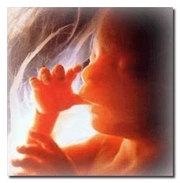
Overview
The Orthodox Church regards abortion as premeditated murder. As such, She strongly opposes it because God demands the protection of all innocent human life, including that of the unborn child. The humanity (personhood) of that child exists from conception, a scientific fact that has always been recognized and unquestioned in Orthodox theology from the very beginning. Indeed, conception and not birth is the moment of the union of soul and body.
The Early Church – of which the Orthodox Church is a living witness – expressed a disgust and horror of abortion at any stage of pregnancy; it always regarded it as abhorrent and an abomination before God because it is the killing of a human being.
The present-day Orthodox Church’s teaching on abortion can be directly traced to the earliest written Christian document, the Didache (late 1st Century), constantly reiterated through the centuries in Patristic writings and canon law, and finally compiled in the Photian Collection which was adopted as the official ecclesiastical law book of the Church in 883 A.D. and is still in effect today.
The canons of the Orthodox Church consider abortion as premeditated murder and all those who participate in the procedure – that is, those who perform, promote, prescribe, advocate, support and undergo abortion – as murderers. For the penitent, excommunication of periods up to ten years are still prescribed – the same as for any repentant murderer.
The Source of Christian Teaching
The teaching of the Orthodox Church on abortion is not arbitrary or the result of a monastic “anti-feminine attitude.” The preciousness of pre-natal human life can be traced throughout both the Old and New Testaments and Jewish Talmudic tradition. It is even expressed in our modern worship services on the feast days. The principle theme in the Church’s understanding of the sanctity of human life is the fact that we are made in the image and likeness of God as illustrated in the Genesis account –
“. . . then the Lord formed man of dust from the ground and breathed into his nostrils the breath of life (ruah), and became a living being. . .” [Gen 2:7].
The breath of life (ruah) is a special gift that God gave to Adam directly and is not given to the animals (Gen. 1:24-30). Very clearly, man is not just a superior animal, but a very special creation of God.
Throughout the Old Testament man is revealed not only as a special creature, but as coming into being for a purpose:
Jeremiah 1:5 the prophet was set aside: “Before I was formed in the womb I knew you, and before you were born I consecrated you and appointed you to be a prophet to the nations.”
The Messianic passage of Isaiah (49:1,5) which prefigures Christ: “The Lord called Me from the womb, from the body of my mother He named Me by name . . . and now the Lord says who formed Me from the womb to be His servant. . .”
In Psalm 139:13,16, the Psalmist details an intimate relationship between God and man:
“For thou didst form my inward parts, thou didst knit me together in my mothers womb…Thy eyes behold my unformed substance; in thy book were written every one of them, the days that were formed for me, when as yet there was none of them. . .”
A similar theme can also be seen in Job 10:8, 9, and 11.
The basic ethical/moral principle on the sanctity of human life which forbids the taking of innocent human life appears in the commandment of Exodus 20:13 which is usually translated, “Thou shall not kill.” However, the Hebrew word for here is “ratasch” which means an intentional and unjustified killing of a human being; the words for accidental deaths and killing in self defense are “katal’ and “harag.”
Thus, the commandment should be more correctly translated as, “Thou shall not murder.”
Abortion was common in many cultures of antiquity but not with the Jews.
Though there is no specific condemnation of abortion in the Old Testament, biblical researchers have found no reference to non-theraputic abortion in any of the texts through 500 AD. In Jewish tradition, deliberate abortion – like the pagan practices of exposure and human sacrifice – was unthinkable. In fact, when the Jews did revert to these pagan practices – as in the time of Jeremiah – they were severely punished by an angry God.
The first direct reference to the death of an unborn child is in Exodus 21:22- “When men strive together, and hurt a woman with child so that there is a miscarriage, and yet no harm follows, the one who hurt her shall be fined, according as a woman’s husband shall lay upon him; and he shall pay as the judges determine.”
The two theological “schools” in ancient Judaism were the majority Alexandrian – which required punishment for damage to the fetus depending upon its state of development – and the Palestinian – which only required punishment for any harm to the mother. Both schools addressed the personhood of the unborn from a legal rather than a moral aspect and their discussions centered on either accidental or therapeutic (necessary) abortions. No moral implications can be drawn from these legal debates, but it is important to note that both condemned deliberate abortion as disrespect for life and the shedding of innocent blood. The real distinction between the two concerned the severity of the penalty for an accidental or therapeutic abortion.
The fact that human life is a precious in the sight of God is illustrated in Genesis9:5-6: “For your lifeblood I will surely require a reckoning; of every beast I will require it and of man; of every man’s brother I will require the life of man. Whoever sheds the blood of man by man shall his blood be shed; for God made man in His own image.”
Even if an animal killed a man, it was put to death. However, this is a profoundly interesting passage for another reason: the second sentence is rendered by many Orthodox Jewish rabbis as: Whoever sheds the blood of man within man shall his blood be shed; for God made man in his own image.” The phrase “man within man” is understood to refer to the unborn child. Consider this passage in context with the rest of the verse: Whoever sheds the blood of “man within man” (man by man) shall his blood be shed; for God made man in his own image. And you be fruitful and multiply, bring forth abundantly on the earth and multiply in it.”
Taken in its totality, it is easy to discern why modern Orthodox Jews prohibit abortion with very few exceptions. The Jewish abhorrence of the shedding of innocent blood and their respect for human life – including that of the unborn – was the foundation for the Christian doctrine on abortion.
Another dimension of the reverence for human life can be seen as St. Paul declares that the body is the dwelling place of God, likening it to a temple: “Do you know that you are God’s temple and that God’s Spirit dwells in you? If any one destroys God’s temple, God will destroy him. For God’s temple is holy, and that temple you are.” [1 Cor 3:16-17]; “. . .for we are the temple of the living God; as God said, ‘I will live in them, and move among them, and I will be their God. . .” [2 Cor. 6:16]
“Do you not know that your bodyis a temple of the Holy Spirit within you which you have from God? You are not your own; you were bought with a price. So glorify God in your body.” [1 Cor. 6:19-20]
Within Man’s being is a place of residence for God’s Spirit, something again unique in Creation. Thus Man exists at the intersection of the spiritual and physical worlds – between heaven and earth – and, as a creation of God, is worthy (axios) to worship, adore, and be in communion with Him. Man is much, much more than merely a rational animal. He a worshipping creature – “Homo Adorans,” as Fr. Alexander Schmemann has described him in “For the Life of the World.” Man, then, is a unity of the material and the spiritual. Scripturally, the whole man prays to, adores, and worships God and, so, Man is a creature uniquely created to love, worship and be in communion with God as is no other part of Creation.
Orthodox Worship
If we turn to the Festal cycle, the consciousness of the personhood of the unborn is strikingly manifest especially in three important Feasts: The first is the Feast of the Conception of John the Baptist (September 23) in which we sing: “Rejoice, O barren one, who had not given birth; for behold you have clearly conceived the one who was about to illuminate the whole universe, blighted by blindness. Shout in joy, O Zacharias, crying in favor; truly the one to be born is a prophet of the High!” John the Baptist existed as a human being and a part of God’s plan of salvation from the moment of his conception.
The second is the Conception of the Theotokos (December 9). Here the vesperal hymn proclaims: “Behold the promises of the Prophets are realized for the Holy Mountain is planted in the womb, the Divine Ladder is set up, the great Throne of the King is ready, the place for the passage of the Lord is prepared . . .” It is notable that both Elizabeth and Anna were advanced in years and barren. Thus they were considered “cursed” in the Jewish tradition where children were a sign of God’s blessing. (Consider that mind-set with our own of today and how God’s Plan is being affected by the hundreds of millions who will never participate in it.)
The quintessential Feast illustrating the Church’s belief of the importance of human beings from the moment of conception is the Annunciation (March 25) which is so important that a Divine Liturgy must be served even when it falls on Great and Holy Friday! The Annunciation Troparion makes a most profound statement:
“Today is the beginning of our salvation, the revelation of the eternal mystery! The Son of God becomes the Son of the Virgin as Gabriel announces the coming of grace…”
This is a far cry from the “pro-choice” rhetoric of “Who knows when life begins?” or the degradation of the unborn by calling him a “blob of tissue” and a “product of conception.”
Can any Christian seriously propose that Jesus Christ was ever a “blob” or an appendage of the Theotokos’s body?
At the Great Compline the hymnography makes this astonishing claim: “…O marvel! God has come among men; He who cannot be contained in a womb; the timeless One enters time…For God empties Himself, takes flesh, and is fashioned as a creature, when the angel tells the pure Virgin of her conception…” This is not sung at the feast of our Lord’s Nativity but at His conception!!! Such concepts as “viability” and “quickening” are utterly without meaning and irrelevant.
Scripture and the Unborn
In the New Testament, consciousness of the personhood of the unborn is clearly manifested. The same word – brephos – is used for the child in the womb as out of the womb unlike modern medical and scientific distinctions of “zygote,” “embryo,” “fetus“ etc. used to differentiate among the stages of pre-natal life. The Latin word “fetus” simply means “little one” and was never intended as a means of denying humanity to the child dwelling in his mother’s womb. A similar pattern of language occurs in the Old Testament as in the book of Job 3:16 in which he refers to: “Infants [gohlal] which never saw the light.” In Luke 1:41 we find another astonishing image of the scriptural consciousness of the personhood of the unborn: “And when Elizabeth heard the greeting of Mary, the babe leaped in her womb” Here, the unborn John the Baptist recognizes and rejoices at the unborn Messiah – a “fetus” greeting a “fetus.” This is not just a “literary device” as some would insist.
It illustrates the narrator’s consciousness of the already existing personality – and Divine calling – of an unborn human being. We do celebrate the birth of John the Baptist, the Theotokos, and the Lord Jesus Himself, but we also celebrate their conception – their entry into time and the physical world – the “fulness of time” as it is called by St. Paul.
A more profound point to this all is that these feasts, especially the Annunciation, point to the Incarnation. By Jesus Christ taking on our humanity from the moment of conception, existing in the pre-natal condition in the womb of the Theotokos, experiencing birth, living through infancy to adulthood, and finally physical death, God sanctified every moment of human existence – from conception to death. There is more to this – God also completely identifies with us in our fallen suffering nature, and by dying for us on the cross, He expresses His solidarity with us: whether we are a zygote, embryo, fetus, infant, child, adolescent, adult, or elderly: human existence is a continuum from conception, and – yes – beyond death to life eternal in the Lord!
The Orthodox Church has had a long history of outspoken condemnation of abortion which dates from Apostolic times. Although the aforementioned feasts did not exist in Apostolic times, they illustrate the living Tradition from which Church teaching on the uniqueness and sanctity of human life, born and unborn sprang from – it was no vacuum!!!
What The Early Church Said:
The Didache – First Century
“Do not murder; do not commit adultery; do not corrupt boys; do not fornicate; do not steal; do not practice magic; do not go in for sorcery; do not murder a child by abortion or kill a newborn infant.”
The Epistle of Barnabas – First Century:
“You shall love your neighbor more than your own life. You shall not slay the child by abortion. You shall not kill that which has been generated.
Apologia of Athenagoras of Athens- 177 AD.:
“What reason would we have to commit murder when we say that women who induce abortions are murderers, and will have to give account of it to God? For the same person would not regard a fetus in the womb as a living thing and therefore, an object of God’s care, and at the same time slay it, once it had come to life.”
Tertulian (WesternChurch) – Third Century:
“Abortion is a precipitation of murder, nor does it matter whether or not one takes a life when formed, or drives it away when forming, for he is also a man who is about to be one.”
Clement of Alexandria – Third century:
“Universal life would proceed according to nature if we would practice continence from the beginning instead of destroying, through immoral and pernicious acts, human beings who are given birth by Divine Providence.”
The Regional Council Of Elvira, Spain – 303A.D.:
Prescribes life-long excommunication for penitent persons involved in abortion. Eucharist denied even on the death bed.
The Council of Ancyra, Canon 21-314/315A.D
“Regarding women who become prostitutes and kill their babies, and who make it their business to concoct abortives, the former rule barred them for life from communion, and they are left without recourse. But, having found a more philanthropic alternative, we have fixed the penalty at ten years, in accordance with the fixed degrees.”
St. Basil The Great (330-379 A. D.):
“A woman who deliberately destroys a fetus is answerable for murder.”
“Those who give potions for the destruction of the child conceived in the womb are murderers, as are those who take potions which kill the child.”
“. . . we do not have a precise distinction between a fetus which has been formed and one which has not yet been formed.”
“. . . any hairsplitting distinction as to its being formed or unformed is inadmissible with us.”
St. Gregory of Nyssa (335-394):
“There is no question about that which is bred in the uterus, both growing, and moving from place to place. It remains, therefore that we must think that the point of commencement of existence is one and the same for body and soul.”
St. John Chrysostom (345-407):
Speaking about those who force a woman to have an abortion to hide immorality: “You do not let a harlot remain a harlot, but make her a murderer as well.”
Regarding the abortionist, St. John considered him/her: “. . . worse than a murderer.”
Quinsext Ecumenical Council, Canon 91-691 A. D.
Decreed that people “. . . who furnish drugs for the purpose of procuring abortion, and those who take fetus-killing poisons, they are made subject to the penalty prescribed for murderers.”
All these various writings and canons were codified by St. Photius, Patriarch of Constantinople in the Ninth Century, into the “Photian Collection” and are still in effect today. In fact these teachings were universal in the whole Christian Church, East and West. Even the Protestant reformers such as Luther and Calvin were outspoken in their opposition to abortion.
What the Modern Church Says:
Archpriest John Meyendorff, Theologian – 1972:
“The fact that this interruption (abortion) takes place at an initial stage in the human life process makes, of course, a psychological difference, but does not change the nature of the act of abortion being killing, and as such a very grave sin, because killing is evil…The hundreds of thousands of legal abortions performed in New York hospitals are a case of mass killing.”
Metropolitan IRENEY, Orthodox Church in America – 1973
“The very moral foundations of society are being subjected to doubt, and there is no open objection . . . the whole meaning and context of life is being reduced to the seeking of material goals, external success, and the gratification of the senses . . . As a horrible symbol of this moral decay, I cite the legalization of abortion, the frightening transgression of the most sacred of all Divine Commandments.”
(In a telegraph to President Nixon in 1973) “Together we, the Bishops of the
Orthodox Church in America, wish to convey to you, Mr. President, our feelings of shock and indignation at the recent ruling of the Supreme Court on the issue of abortion. We urge you to initiate all constitutional procedures necessary to reverse this tragic decision.”
“An abortion for convenience at any stage of gestation, is a violent termination of life. “
V. Rev. Vladimir Boreschevsky, Theologian – 1973:
“. . . human life begins at the moment of conception and all who hold life sacred and worthy of preservation whenever possible are obliged at all costs to defend the lives of the unborn children regardless of the stage of their embryonic development.”
23rd Clergy-Laity Congress – Greek Orthodox Archdiocese – 1976:
“The Orthodox Church has a definite, formal and intended attitude toward abortion. It condemns all procedures purporting to abort the embryo or fetus, whether by surgical or chemical means. The Orthodox Church brands abortion as murder; that is, as a premeditated termination of the life of a human being…The only time the Orthodox Church will reluctantly acquiesce to abortion is when the preponderance of medical opinion determines that unless the embryo or fetus is aborted, the mother will die. Decisions of the Supreme Court and State legislatures by which abortion, with our without restrictions, is allowed should be viewed by practicing Christians as an affront to their beliefs in the sanctity of life.”
Metropolitan THEODOSIUS, Orthodox Church in America – 1980:
“. . . the willful abortion of children is an act of murder and the sinful character of that act always remains, even when conception has taken place in the most tragic circumstances.”
Theologian FR. STANLEY HARAKAS – 1982:
“Human life is not an unconditional gift from God, but carries with it certain responsibilities. That God considers the taking of an innocent life to be a particularly heinous crime is evident, not only from the Sixth Commandment, but also from the story of Cain and Abel, recounted in Genesis 4:1-6. Further, the Incarnation of the Logos has, for all eternity, sanctified all human life, in both its physical and spiritual aspects.”
“. . . since God is perfect beyond our human comprehension, the process of growing more like God, of “developing our personhood” is a never ending one for every human being. It begins at conception and continues to the very moment of our physical death. Thus, no human being is a “person” or entirely “human” in the fullest sense, since none of us are exactly like God. Yet, all human beings share the same potential developing into “persons” whether they be in the womb, at the prime of life, or on their deathbed. The potential for “personhood” of the human fetus is evident not only from the Orthodox concept of psychosomatic unity, but from Scripture.”
“In opposition (to the idea that the unborn child is not a person), we profess that no human being is ever fully a “person” but that all persons have the potential to become “fully human”, to achieve union with God. Therefore, we cannot declare on the basis of “personhood”, that the fetus in the womb has no value in the eyes of both God and man than a person born.”
Regarding a woman’s “right” to her own body: “Orthodoxy rejects such notions due to the great value attached to life by God, and the fact that life is a gift which no person has the right to take. If we do not have the right to take our own lives, how much more so must it be that we have no right to take the innocent life of the embryo or fetus in the womb? . . . That the developing person inside the mother’s womb has a life separate from its mother is evident from the fact that its chromosomal makeup is different from the mother’s since it is a combination drawn from both mother and father. Further, it is genetically unique; its particular combination of traits and characteristics shall never be repeated.”
General Assembly of the Antiochian Archdiocese – 1989:
WHEREAS a recent decision by the Supreme Court of the United States of America has modified the 1973 decision of Roe vs. Wade relating to the abortion issue; and
WHEREAS the Supreme Court of Canada has struck down as unconstitutional all laws protecting the unborn, and therefore no legislation currently exists regulating abortion in Canada; and WHEREAS all prolife organizations, especially Orthodox Christians for
Life, need our support, moral and financial, in defense of the thousands of “innocents” who are deprived of the possibility of life; and WHEREAS the Orthodox Church, from its inception on the day of Pentecost, has condemned abortion as a grievous sin:
THEREFORE BE IT RESOLVED that the Antiochian Orthodox Christian Archdiocese of North America, meeting in General Assembly in Anaheim, California on 28 July 1989, reiterates its previous resolutions against abortion and asks Orthodox Christians throughout the United States and Canada to support those organizations which strive to protect the rights of the unborn.
All American Council, Orthodox Church in America – 1989:
WHEREAS the Orthodox Church in America has consistently spoken out in defense of the sanctity of life, and has done so in connection with contemporary threats to the life of the unborn, the handicapped, the infirm, and the elderly; and
WHEREAS abortion in all cases has been condemned by the Orthodox Church in America unequivocally on the basis of Orthodox theology, which faithfully reflects for today nearly two thousand years of Christian doctrine and ethical teaching; and WHEREAS, before the end of this century, “do-it-yourself” abortion will more than likely be commonplace (the RU 486 pill), and legislation will have little effect on whether or not a woman brings her child to term; BE IT THEREFORE RESOLVED THAT the Ninth All-American Council of the Orthodox Church in America strongly reaffirms the Orthodox Church’s opposition to abortion in all cases, and that it does so on theological and moral grounds; commends the efforts of Orthodox bishops, clergy, and laity to bear witness to the sanctity of life in the public arena, especially noting in this connection the work and witness of Orthodox Christians for Life; and commits the Orthodox Church in America to continued witness on behalf of the God-given sanctity of life;
BE IT FURTHER RESOLVED THAT the Orthodox Church in America recognizes that opposition to and condemnation of abortion in all cases, except to save the life of the mother, is not enough, and that the Orthodox Church and Orthodox Christians have a moral obligation to work for the creation and maintenance of Orthodox adoption agencies and for the facilitation of adoption procedures for families to consider adopting a homeless or unwanted or disabled infant, regardless of the child’s racial or ethnic background in the realization that the Church as a whole and the parish community in particular is called to give active material and spiritual support to those who accept the responsibility of adoption;
BE IT FURTHER RESOLVED THAT this Council affirms and supports the work of the Orthodox Christian Adoption Referral Service and encourages parishes and members of the Orthodox Church in America to give their material and moral support to this organization;
FINALLY, BE IT FURTHER RESOLVED THAT this Council recognizes and affirms spiritual, pastoral and educational efforts towards moral persuasion, directed to the father as much as to the mother, to help stem the present hemorrhaging of unborn and unwanted human persons and lives.
Resolution on Sanctity of Life Sunday:
WHEREAS the Orthodox Church in America has always respected the right to life of all men and women from conception to the time of natural death, and
WHEREAS the Supreme Court of the United States of America has allowed legalized abortion since January 22, 1973, leading to the deaths of 1,500,000 unborn children each year, WE HEREBY PROCLAIM the Sunday in January falling on or before
January 22 each year to be called Sanctity of Life Sunday in all churches of the Orthodox Church in America, and that on this Sunday a letter from our primate be read in all churches, and special petitions be taken at Liturgy, proclaiming our respect as a Church, for all human life.
Conclusion:
There is little more that can be said – the deliberate destruction and/or desecration of a human being is unthinkable for a true-believing Orthodox Christian. God created Man in his own likeness and image, man is a living icon of flesh and blood, in which God gave the breath of life (ruah). Killing an innocent human being can be seen is an act of blasphemy against God – it is the ultimate act of iconoclasm.
Source: http://www.oclife.org/
Abortion is not a political issue, but a moral issue that has become politicized!
See Also: The Amicus Curiae Submitted to the Supreme Court
THE PROPHECIES OF THE OLD TESTAMENT
AND THEIR FULLFILMENT IN THE NEW TESTAMENT
(Part Two)
For Part One see Here
(Please do not copy without referencing the original text!)
23. PRIEST AFTER THE ORDER OF MELCHISEDEK
THE OT. PROPHECY
[Psalm 109:4] The Lord hath sworn and will not repent: “Thou art a priest for ever, after the order of Melchisedek.“
THE NT. FULFILLMENT
[Hebrew 5:5] So also Christ glorified not himself to be made an high priest; but he that said unto him, ‘Thou art my Son, to day have I begotten thee.’
[Hebrew 5:6] As he saith also in another place, ‘Thou art a priest for ever after the order of Melchisedec. ‘
[Hebrew 5:10] Called of God an high priest after the order of Melchisedec.
24. HIS TRIUNPHANT ENTRY into JERUSALEM

THE OT. PROPHECY
[Zacharias 9:9] Rejoice greatly, O daughter of Sion; proclaim it aloud, O daughter of Jerusalem; behold, the King is coming to thee, just, and a Saviour; he is meek and riding on an ass, and a young foal.
THE NT. FULFILLMENT
[Mark 11:7] And they brought the colt to Jesus, and cast their garments on him; and he sat upon him.
[Mark 11:9] And they that went before, and they that followed, cried, saying, Hosanna; Blessed is he that cometh in the name of the Lord!
[Mark 11:11] And Jesus entered into Jerusalem, and into the temple: and when he had looked round about upon all things, and now the eventide was come, he went out unto Bethany with the twelve.
25. PRAISED BY CHILDREN

THE OT. PROPHECY
[Psalm 8:2] Out of the mouths of babes and sucklings hast Thou perfected praise, because of Thine enemies, to destroy the enemy and avenger.
THE NT. FULFILLMENT
[Mattew 21:15] And when the chief priests and scribes saw the wonderful things that he did, and the children crying in the temple, and saying, Hosanna to the Son of David; they were sore displeased,
[Mattew 21:16] And said unto him, Hearest thou what these say? And Jesus saith unto them, ‘Yea; have ye never read, Out of the mouth of babes and sucklings thou hast perfected praise?’
26. DENIED BY HIS PEOPLE
THE OT. PROPHECY
[Esaias 53:1] O Lord, who has believed our report? and to whom has the arm of the Lord been revealed?
THE NT. FULFILLMENT
[John 12:37] But though he had done so many miracles before them, yet they believed not on him:
[John 12:38] That the saying of Esaias the prophet might be fulfilled, which he spake, ‘Lord, who hath believed our report? and to whom hath the arm of the Lord been revealed?’
27. BETRAYED BY HIS FRIEND / DISCIPLE

THE OT. PROPHECY
[Psalm 40:9] Yea, even the man of my peace in whom I hoped, who ate of my bread, hath magnified the lifting of heels against me.
THE NT. FULFILLMENT
[Mark 14:10] And Judas Iscariot, one of the twelve, went unto the chief priests, to betray him unto them.
[Mark 14:20] And he answered and said unto them, ‘It is one of the twelve, that dippeth with me in the dish.’
[Mark 14:21] The Son of man indeed goeth, as it is written of him: but woe to that man by whom the Son of man is betrayed! good were it for that man if he had never been born.
28. SOLD for THIRTY PIECES OF SILVER

THE OT. PROPHECY
[Zacharias 11:12] And I will say to them, If it be good in your eyes, give me my price, or refuse it. And they weighed for my price thirty pieces of silver.
THE NT. FULFILLMENT
[Mattew 26:14] Then one of the twelve, called Judas Iscariot, went unto the chief priests,
[Mattew 26:15] And said unto them, What will ye give me, and I will deliver him unto you? And they covenanted with him for thirty pieces of silver.
29. ACCUSED by FALSE WITNESSES
THE OT. PROPHECY
[Psalm 34:10] Unjust witnesses rose up against me; things I knew not they asked me.
NT. FULFILLMENT
[Mark 14:56] For many bare false witness against him, but their witness agreed not together.
30. SILENT BEFORE the ACCUSERS

THE OT. PROPHECY
[Esaias 53:7] And he, because of his affliction, opens not his mouth: he was led as a sheep to the slaughter, and as a lamb before the shearer is dumb, so he opens not his mouth.
THE NT. FULFILLMENT
[Mark 15:4] And Pilate asked him again, saying, Answerest thou nothing? behold how many things they witness against thee.
[Mark 15:5] But Jesus yet answered nothing; so that Pilate marvelled.
31. SPITTED UPON and BEATEN
THE OT. PROPHECY
[Esaias 50:6] I gave my back to scourges, and my cheeks to blows; and I turned not away my face from the shame of spitting…
THE NT. FULFILLMENT
[Mattew 26:67] Then did they spit in his face, and buffeted him; and others smote him with the palms of their hands,
32. HATED WITHOUT A CAUSE
THE OT. PROPHECIES
[Psalm 34:11] They repaid me with evil things for good, and barrenness for my soul.
[Psalm 34:18] Let not them rejoice against me that unjustly are mine enemies, they that hate me without a cause, and wink with their eyes.
THE NT. FULFILLMENT
[John 15:24] If I had not done among them the works which none other man did, they had not had sin: but now have they both seen and hated both me and my Father.
[John 15:25] But this cometh to pass, that the word might be fulfilled that is written in their law, ‘They hated me without a cause.’
33. DIED FOR OUR SALVATION

THE OT. PROPHECY
[Esaias 53:5] But he was wounded on account of our sins, and was bruised because of our iniquities: the chastisement of our peace was upon him; and by his bruises we were healed.
THE NT. FULFILLMENT
[Romans 5:6] For when we were yet without strength, in due time Christ died for the ungodly.
[Romans 5:7] For scarcely for a righteous man will one die: yet peradventure for a good man some would even dare to die.
[Romans 5:8] But God commendeth his love toward us, in that, while we were yet sinners, Christ died for us.
34. CRUCIFIED WITH THE TRANSGRESSORS

THE OT. PROPHECY
[Esaias 53:12] Therefore he shall inherit many, and he shall divide the spoils of the mighty; because his soul was delivered to death: and he was numbered among the transgressors; and he bore the sins of many, and was delivered because of their iniquities.
THE NT. FULFILLMENT
[Mark 15:27] And with him they crucify two thieves; the one on his right hand, and the other on his left.
[Mark 15:28] And the scripture was fulfilled, which saith, And He was numbered with the transgressors.
35. WITH HANDS AND FEET PIERCED

THE OT. PROPHECY
[Zacharias 12:10] And I will pour upon the house of David, and upon the inhabitants of Jerusalem, the spirit of grace and compassion: and they shall look upon me, because they have mocked me, and they shall make lamentation for him, as for a beloved friend, and they shall grieve intensely, as for a firstborn son.
[Psalm 21:18] They have pierced my hands and my feet…
THE NT. FULFILLMENT
[John 20:20] And when he had so said, he shewed unto them his hands and his side. Then were the disciples glad, when they saw the Lord.
[John 20:25] The other disciples therefore said unto him, We have seen the Lord. But he said unto them, Except I shall see in his hands the print of the nails, and put my finger into the print of the nails, and thrust my hand into his side, I will not believe.
36. DESPISED, INSULTED AND MOCKED
THE OT. PROPHECY
[Psalm 21:7] All that look upon me have laughed me to scorn; they have spoken with their lips and have wagged their heads:
[Psalm 21:8] “He hoped in the Lord; let Him deliver him, let Him save him, for He desireth him.’
THE NT. FULFILLMENT
[Luke 23:35] And the people stood beholding. And the rulers also with them derided him, saying, He saved others; let him save himself, if he be Christ, the chosen of God.
[Mattew 27:39] And they that passed by reviled him, wagging their heads,…
37. PLAGED BY THIRST
THE OT. PROPHECY
[Psalm 21:16] My strength is dried up like a potsherd, and my tongue hath cleaved to my throat, and into the dust of death hast Thou brought me down.
THE NT. FULFILLMENT
[John 19:28] After this, Jesus knowing that all things were now accomplished, that the scripture might be fulfilled, saith, I thirst.
38. HE WAS GIVEN VINEGAR TO DRINK
THE OT. PROPHECY
[Psalm 68:25] And they gave me gall for my food, and for my thirst they gave me vinegar to drink.
THE NT. FULFILLMENT
[Mattew 27:34] They gave him vinegar to drink mingled with gall: and when he had tasted thereof, he would not drink.
[Mattew 27:48] And straightway one of them ran, and took a spunge, and filled it with vinegar, and put it on a reed, and gave him to drink.
39. REPROACHED
THE OT. PROPHECY
[Psalm 68:9] Because for Thy sake I have borne reproach, shame hath covered my face.
THE NT. FULFILLMENT
[Mattew 27:44] The thieves also, which were crucified with him, cast the same in his teeth.
[Romans 15:3] For even Christ pleased not himself; but, as it is written, ‘The reproaches of them that reproached thee fell on me.’
40. PRAYED FOR HIS TORTURERS
THE OT. PROPHECY
[Psalm 108:3] In return for my love, they have falsely accused me; but as for me, I gave myself to prayer.
THE NT. FULFILLMENT
[Luke 23:34] Then said Jesus, Father, forgive them; for they know not what they do…
41. THEY CAST LOTS FOR HIS VESTURE
THE OT. PROPHECY
[Psalm 21:20] They have parted my garments amongst themselves, and for my vesture have they cast lots.
THE NT. FULFILLMENT
[Mark 15:24] And when they had crucified him, they parted his garments, casting lots upon them, what every man should take.
[John 19:23] Then the soldiers, when they had crucified Jesus, took his garments, and made four parts, to every soldier a part; and also his coat: now the coat was without seam, woven from the top throughout.
[John 19:24] They said therefore among themselves, ‘Let us not rend it, but cast lots for it, whose it shall be’: that the scripture might be fulfilled, which saith, ‘They parted my raiment among them, and for my vesture they did cast lots.’ These things therefore the soldiers did.
42. ABANDONED BY GOD
THE OT. PROPHECY
[Psalm 21:1] O God, my God, attend to me; why hast Thou forsaken me?
THE NT. FULFILLMENT
[Mark 15:34] And at the ninth hour Jesus cried with a loud voice, saying, Eloi, Eloi, lama sabachthani? which is, being interpreted, My God, my God, why hast thou forsaken me?
[Mattew 27:46] And about the ninth hour Jesus cried with a loud voice, saying, Eli, Eli, lama sabachthani? that is to say, My God, my God, why hast thou forsaken me?
43. HAD NONE OF HIS BONES BROKEN
THE OT. PROPHECY
[Psalm 33:19] The Lord keepeth all their bones, not one of them shall be broken.
THE NT. FULFILLMENT
[John 19:33] But when they came to Jesus, and saw that he was dead already, they brake not his legs:
[John 19:36] For these things were done, that the scripture should be fulfilled, A bone of him shall not be broken.
44. BURIED WITH THE WICKED
THE OT. PROPHECY
[Esaias 53:9] And I will give the wicked for his burial, and the rich for his death; for he practised no iniquity, nor craft with his mouth.
THE NT. FULFILLMENT
[Mattew 27:57] When the even was come, there came a rich man of Arimathaea, named Joseph, who also himself was Jesus’ disciple:
[Mattew 27:58] He went to Pilate, and begged the body of Jesus. Then Pilate commanded the body to be delivered.
[Matei 27:59] Şi Iosif, luând trupul, l-a înfăşurat în giulgiu curat de in,
[Mattew 27:59] And when Joseph had taken the body, he wrapped it in a clean linen cloth,
[Mattew 27:60] And laid it in his own new tomb, which he had hewn out in the rock: and he rolled a great stone to the door of the sepulchre, and departed.
45. RESURRECTED FROM THE DEAD

THE OT. PROPHECY
[Psalm 15:10] For Thou wilt not abandon my soul in hades, nor wilt Thou suffer Thy Holy One to see corruption.
[Psalm 48:14] Like sheep they are laid in hades, death shall be their shepherd.
{Psalm 48:16] Yet God shall redeem my soul out of the hand of hades, when he receiveth me.
THE NT. FULFILLMENT
[Mark 16:6] And he saith unto them, Be not affrighted: Ye seek Jesus of Nazareth, which was crucified: he is risen; he is not here: behold the place where they laid him.
[Mark 16:7] But go your way, tell his disciples and Peter that he goeth before you into Galilee: there shall ye see him, as he said unto you.
[Acts 2:31] He seeing this before spake of the resurrection of Christ, that his soul was not left in hell, neither his flesh did see corruption.
[1 Corinthians 15:4] And that he was buried, and that he rose again the third day according to the scriptures…
46. HE ASSENDED at THE RIGH HAND OF GOD – THE FATHER

THE OT. PROPHECY
[Psalm 109:1] The Lord said unto my Lord: “Sit Thou at My right hand, until I make Thine enemies the footstool of Thy feet.”
THE NT. FULFILLMENT
[Mark 16:19] So then after the Lord had spoken unto them, he was received up into heaven, and sat on the right hand of God.
[Mark 14:62] And Jesus said, I am: and ye shall see the Son of man sitting on the right hand of power, and coming in the clouds of heaven.
[Colossians 3:1] If ye then be risen with Christ, seek those things which are above, where Christ sitteth on the right hand of God.
[Ephesians 1:20] Which he wrought in Christ, when he raised him from the dead, and set him at his own right hand in the heavenly places,
[Hebrew 1:3] Who being the brightness of his glory, and the express image of his person, and upholding all things by the word of his power, when he had by himself purged our sins, sat down on the right hand of the Majesty on high;
[Hebrew 8:1] Now of the things which we have spoken this is the sum: We have such an high priest, who is set on the right hand of the throne of the Majesty in the heavens;
[Hebrew 10:12] But this man, after he had offered one sacrifice for sins for ever, sat down on the right hand of God;
[Hebrew 12:2] Looking unto Jesus the author and finisher of our faith; who for the joy that was set before him endured the cross, despising the shame, and is set down at the right hand of the throne of God.
[Acts 7:55] But he (Stephen), being full of the Holy Ghost, looked up stedfastly into heaven, and saw the glory of God, and Jesus standing on the right hand of God,
[Acts 7:56] And said, Behold, I see the heavens opened, and the Son of man standing on the right hand of God!
Study done by Archipriest/Hieromonk Michael (Mikhail) Stanciu
(Translated by EC)
(Old Testament verses taken from Septuagint translated from Greek by Sir Lancelot C. L. Brenton
originally published by Samuel Bagster & Sons, Ltd., London, 1851);
(The Psalter according to the Seventy);
(New Testament verses taken from King James Version, originally published by Oxford Press, Oxford, 1769.
“Repent, for the kingdom of heaven is at hand.”
(Matthew 4:17)

Repentance: Life’s Continual Effort
by Archpriest Victor Potapov
Bishop Ignaty Brianchaninov left us the following precious instruction: “In order to live spiritually and draw breath from grace, we must continually exhale the ashes of sin.” We sin almost constantly, if not in our deeds, then in our thoughts and feelings. Therefore it is essential to continually cleanse our souls. In the language of asceticism (teaching on religious struggle) it is known as “internal activity” or “attentiveness.” To continually repent is to pay unceasing attention to one’s spiritual life, to assess and remove from it all that is questionable and foolish. Bishop Theophanes the Recluse teaches us that one should do battle with sin at the moment it is born, i.e. when it is only in one’s thoughts. This is true battle, the ” invisible warfare” as it is called by the Athonite struggler Nicodemus of the Holy Mountain. This spiritual battle requires ability, God’s assistance, and constant prayer. As the holy Fathers of the Church write ” It is pointless to weep over the sins of the past if we do not struggle with them in the present.” Continual repentance or attentiveness is that poverty of spirit of which Christ speaks in the first Beatitude in His sermon on the mount. The call to such repentance is found throughout the Word of God and the texts of Orthodox worship.
In a sense, all of the teaching of the Church is a single call to repentance in the most profound sense of that term, i.e. it is a call to rebirth, to a complete reassessment of all values, to a new understanding and vision of life in the light of Christ.
It was not coincidentally that St. John the Baptist often repeated the words “Repent, for the Kingdom of Heaven is at hand.” The Christ began His sermon with these same words. According to the Venerable St. Ephraim the Syrian, “repentance is a field to be cultivated at all times. “Repentance is the tree of life, resurrecting those dead in sin.” Elsewhere he states, “Through repentance, earth has become heaven, for it has become filled with saints.”

In his book A Priest’s Observations, Fr. Alexander Elchaninov, an experienced spiritual director, writes, “Without our constant control over the spirit, confession, which takes place occasionally, is not successful”. The eye of the spirit, conscience, demands exercise, and without it you will see neither yourself nor your sins. According to the Venerable St. Isaac of Syria, ” He who has been able to see himself has accomplished more than one who has seen the angels.” He also wrote “One who apprehends his sin is better than one who through his prayers raises the dead.”
Sts. Ephraim and Isaac, and other spiritual strugglers after piety all recommend that in doing battle with sin, it is best to begin with the sin which most grievously attacks us. To the extent that we are rid of it, our conscience will see all the more. Moreover, it always behooves Christians to do battle against those sins which directly oppose love. The holy fathers of the Church teach that hatred, enmity, and condemnation utterly seal shut the gates of the Kingdom of God, the Kingdom of love. Thus, the first condition of true repentance is reconciliation with everyone. This is why in the Lord’s Prayer, the Christ included the words “forgive us our debts as we forgive our debtors.” This is why the Orthodox Church begins Great Lent with Forgiveness Sunday, when believers ask forgiveness of one another for personal insults and offenses, so that with a clear conscience they might begin Lent, their “invisible warfare.” The Church teaches that true love is indivisible, and that dislike for a single person will ultimately poison all love. Theophanes the Recluse writes: “In one who is at odds with anyone else, all friendship is fragile, and easily turns into enmity; of course, by bearing enmity, one cannot really love God. God is complete love, and tolerates nothing that is opposed to love.”
The commandments in the Gospel, while easy, appear difficult, for human consciousness, having fallen out of synch with life and harmony, is clouded. For example, people consider the Gospel commandment to love friend and enemy alike, to be difficult. In the sermon on the mount, the Lord says: “Love your enemies, bless them that curse you , do good to them that hate you, and pray for them which despitefully use you and persecute you” (Matt. 5:44). We see that no limits to good are imposed upon man in this commandment, one given to those who wish to rise above both their own and mankind’s selfishness, to be healed, and to depart from the state of sin.

Let us try to list those who have caused us some annoyance or insult, who have dealt with us poorly or spoken ill of us. In other words, let us recall those who are “not to our liking” and, forgiving each of them, let us sincerely pray for these souls. Let us drive out any grudge or irritation we bear them, and wish them well. Given the opportunity, let us say something nice about them to others. At every opportunity, let us help them.
Thus, as we will see for ourselves, fulfilling the commandment of love will engender a joyous feeling of spiritual freedom and profound peace. Many internal difficulties will depart from us, for we will have fulfilled the Christ’s words, believed in God, and given Him heed. The power of good will rejoice within us. Even if we do not immediately notice this peace within ourselves, it will certainly come to us as a reflection of our charity.
That a person is kind, honest, and generous always seems miraculous. Yes, it is a miracle, and a miracle far greater than moving a mountain. Something greater than a mountain is being moved – human selfishness. Such is the effect on man of our faith in God , our trust in the Lord, our repentance before Christ. When one who hates becomes one who loves, when a liar becomes truthful, when a vain person becomes modest, it is truly a miracle. Charity emanating from us first of all liberates us from our own evil; it opens within us the doors and windows through which flows the pure air of heaven. This is the rebirth born of repentance.
In repentance we see the operation not of natural forces but of supernatural grace-filled ones. And only one who believes in the Light can take into himself true love. According to biological law, men engag only in a “struggle for survival.” But according to the law of the Spirit, the battle is for the resurrection of the world, a spiritual battle which conquers selfishness, spiritual death. The Christ calls us to overcome our evil will and animal nature, to become human in the full spiritual sense of the term. The human soul is immeasurably greater than matter. As the Apostle Paul tells the Philippians, “I can do all things through Christ which strengtheneth me.” Such great, marvelous words: “I can do all things through Christ which strengtheneth me.” Through the faith granted us, we are called to be centered internally, mentally, not on our little selfish personality, but on the power of the Living God, the True Christ Jesus Who dwells in us.
The Creator and Father who brought us into being granted to our souls the freedom to make a free moral choice, to turn to Him and to repent of our sins, which constitute a betrayal of God’s truth. Yes, man is sometimes unfaithful to God; even if we do not frankly renounce God, we sometimes obliquely become betrayers of Christ, of His love and truth. Let us all repent of that.
Let us reflect upon how imperfect is our consciousness, and let us repent before God. Through repentance, the pure path to God is opened. Moreover, let us not tarry, for no one knows when his final hour will come. There is nothing more important and more needed than repentance and God’s saving forgiveness.
See Also: Many Confess, Few Repent
by Monk Moses of the Holy Mountain

The Holy Martyrs of Mount Athos (January 4th)
(murdered by the papists)
by Archimandrite Ghervasios Paraschevopoulos
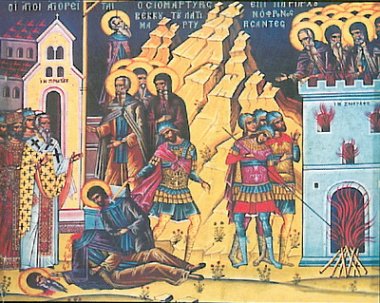
“There was a time when the Byzantine emperor of Constantinople – Michael the VIII-th, Palaeologus (1259-1282), seeking the political help of Pope Urban the IV (1261-1264), promissed to cooperate towards “the unification” of the Eastern Orthodox Church with the heretical Pope of Rome.
The king’ attempt however, met the steadfast opposition of the patriarch Joseph the Ist (1267-1275). If under differenet circumstances the patriarch would be very faithful to the king, when the king asked for “the union”, the patriarch refused and took the oath that “under no circumstances he may sign a union with the heretical pope.” Nor that he will ever acknowledge the papal authority which is contrary to the Gospel, the Holy Canons and the Holy Tradition.
The Pope’s claims with regard to the union were:
– an oath of allegiance to the pope by all clergy,
– the catechization of people should be in accordance with the faith of the pope of Rome and especially with the addition of “Filioque” in the Symbol of Faith (the Creed) by teaching that the Holy Spirit proceeds not only from the Father but also “from the Son”;
– the Pope should be considered “appointed by God” (infailible) to judge and decide irrevocably and without appeal in any dogmatic matter. “That is to say he should be the supreme authority in the Church”
Then, where are we to place the local and Holy Ecumenical Church Synods (Councils)?! Well, they must be vented, because – according to the catholic dogma – the Pope is above all the Ecumenical Councils.
Oh my Lord, such a devilish exaltation!!! Pope Clement the IV (1265-1268), successor of Pope Urban the IV cherished the same thought and the same hope. The same can be said about Pope Gregory the X (1271-1276), the follower of Clement. A steadfast “creed” and claims for all Popes and almost the same conditions for the union that the king had asked insistently!
Many theologians and later the whole church, had joined the patriarch Joseph in his resistance. This opposition had angried the king to such a degree that the persecution of faithfull began.
Some of them were tortured; others were deprived of their properties. Although the whole city of Constantinople was against this union, the emperor, blinded by envy and hate, asked the inhabitants of the imperial city to pay him the taxes for the previous 10 years! How can this be? For the king regained Constantinople from the Franks 10 years back, so for this he regarded himself as the “owner of the city!”
Even more, his delegation left for Lyon (1274), France where the pope convened a “unionist” synod, bringing back with them the proposal on the union already signed by the pope.
And what were these signed proposals? The same as those each pope had always asked of: the addition of “Filioque” to the Creed, the recognition of pope’s supremacy, and the pope’s right to be mentioned by the patriarchs during Divine Liturgy!
And the result? The agreement in question stirred new wave of indignation and revolt among all Orthodox faithful. Almost everyone opposed it and bacause the patriarch Joseph openly opposed the agreenment, he was banished from the Patriarchal Throne. What then? Oh, the heretical patriarch John Beccus the XI (1275-1282) was elected!
Soon the opposition arouse from all orthodox ranks: the clergy and the people. Among them: Evlogia, the emperor’s sister, Andronicus Paleologus, John Paleologus, Manuel Paleologus (three of the king’ family) and Isaac Raul were against his position.
The Emperor and the new “Patriarch” began to use the most tyrannical means to compel everyone to accept the falls union: fearful martyrdoms, enprisonment, tortures, blindness, the cutting of one’ tongue, killings … A physical author of these tortures was the patriarch Beccus himself!
But let us now get back to the subject! In this context, we can understand the persecution of our athonite fathers from the Holy Mt. Athos. When the king and the patriarch have heard of their opposition, they became enraged and overshadowed by the blind passion of revenge: How dare they (some monks) oppose the royal order! How dare these simple monks of Mount Athos will disregard the patriarchal mitre! Let them be persecuted. Because they proved “arongants” and had disconsidered the “unity” with the heretical pope, so they deserve to be subjected to cruel tortures and pay with their blood.
Thus the king’s messengers and the fanaticals latins, armed with stringent provisions and powerful gards, came to the Holy Mountain and began the cruel martyrdom and executions of the “reactionaries ” athonite fathers and Starets (abbots/ Elders). When in the Holy Monastery of Vatopedi at their proposal to join the “union”, the latins encounterd the resistance of the monks, they began torturing the monastics fathers. Detachment of soldiers resorted without hesitation to unimaginable tortures to fulfill the imperial orders.
Oh, worthy servants of the Master! It was for your Orthodox faith that you considered this unhuman martyrdom a crown! What a grear honor was to shed their blood for Holy Orthodoxy! Twelve monks, brave witnesses of Christ, heroes and defenders of the purity of faith, fighting with great courage against the betrayal of our Lord Jesus Christ, were led on a hill side near the monastery. It was there (on the hill), that the latins raised gallows/scatffolds, and one by one the brave monks were hanged (as we see on the icon painted in memory of their martyrdom). Bidding each other farewell they were raised on the scaffold and from there to heaven, in the sweetness and delight of the Heavenly Kingdom, where their souls will rest with the righteous.
As for the Elder, they reserved other form of martyrdom. Another type of suffering, because according to the Latin thinkers, death on the scaffold was too mild for him.

The more Elder Euthymios (Righteous Euthymios of Vatopedi) showed his steadfast contempt and protest towards unification with the heretic pope, the more the emperor as well as pope’s “well-doers” were filed with grey shadows and contempt towards the one who just witnessed the death of his monks. Sparkled by rage… how will they seek revenge? What kind of death are they reserving for him? Near the monastery was the sea. The executors took him on the boat far into the sea and there, bounded in chains, the Elder was thrown at the bottom of the sea. So “their mission” with this monastery was accomplished!
Other monasteries were next (in line). The Latin troops as well as the Latin thinkers, adhering to the emperor’ orders, summoned an assembly of all monks living in monastic cells neighboring Kareem.
The purpose of the meeting was to compel the Athonite monks and their primate – St. Cosmas, Protos Of Mt. Athos – to approve the union with the “church” of the pope. They had to “think with the Latin mind” and adopt the Latin dogmas. However, all – the Protos and the monks – opposed the proposal of such betrayal. In a single voice and one heart, they were ready to die for the Orthodox faith, the only truthful one. It was in vain that the king’s representatives have threatened the monks by death, and the Protos with the scaffold. With courage and determination to die for their faith, they spoke against the falls union with the pope. You can not reconcile – they confessed – things that are irreconcilable. Can Christ be reconciled with Belial, or with the devil? “What agreement is between Christ and Belial” (II Cor. 6.15). There can be no communion between the East and the West. From the East came illumination and from the West, darkness.
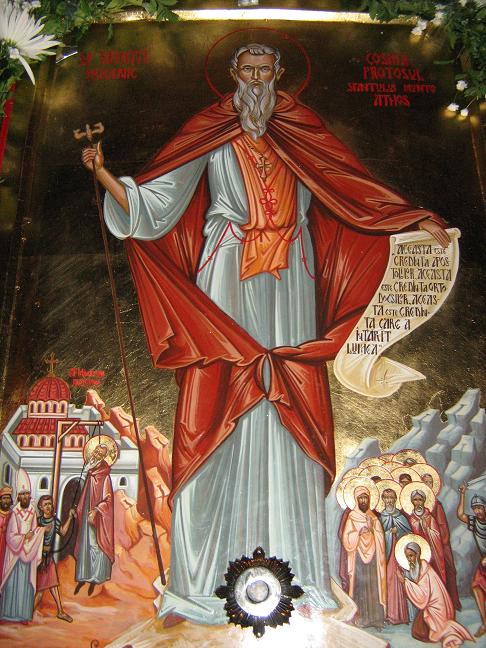
So the dialogue was deemed meaningless. In Kareem, the athonite monks remained imperturbable, firm as a rock. And the enemies began their “work”. But the more they were tortured, the more they confessed the Orthodox faith. For this they were put to death. A cruel death: to be hanged and slained. The scatfold for the Protos and decapitation for the monks. The holy land of Kareem was sucked in their precioss blood.
In the Holy Monastery of Iveron, one of the biggest on Mount Athos (with a large number of monks), the Latins had used at first peaceful means. They seemed kind and amiable at first sight. They made used of all “opportunities” to convince them to join “the papal Church”. That is what God wants, they would say. It is His will that: “they all be one” (John 17:21). But neither the courtesy, nor the flattery arguments could tempt the monks. The Iveron monks knew very well who the pope was. They knew the history and did not want to make the same mistakes.
“Unification” with the pope would mean the greatest betrayal ever made. And they would never commit such betrayal that might hold one smirched with dishonor on earth and in heaven.
As for the other athonite monasteries, they shared the same fate. It was blood, martyrdom, and death.
And … what else did latins do, “in the name of Christ”?! They commanded the soldiers to gather all the monks. The order was immediately executed and, of course, in a brutal, barbaric, and savaged way. All for the sake of the “Holy Father of Rome”. “The purpose sanctifies the means?!” they said. And the means of arrestment in question was intended to achieve unification only. Will they ever put an end to injustice?! Of course, it could not be so. Other monks shared the same fate.
Those who had their origin in Georgia (Iviria) were taken slaves in Italy or, as others relate, they were banished in Italy. The other monastics and fathers – were taken by the military guards, to the quay of Iveron Monastery.
Then, they were embarked into a broached boat intended to be sank into the sea. So it happened. All the Holy Martyrs – the priests and the brothers from Iveron monastery – were sent to the bottom of the sea yielding their soul to Him who spoke through the mouth of the Evangelist John: “Thou be faithful unto death: and I will give thee the crown of life” (Apocalypse, 2:10). In that very moment, they were crown by the angels with the crown of the rightouss martyrs for the one Holy Apostolic Church. They are commemorated every year on May, 13th.
In the Holy Monastery Zographou, the papists uses their first weapon to “burn” the Orthodox Creed of the Holy Fathers. And what weapon… the rhetorical art! The athonite fathers were called to recognize the pope as the head of the universal Church in exchange for gold and “papal mercy”.
And what remark did the Latins receive from the priests? Their reply was a testimony of the Orthodox Faith. “And who told you that the pope is the head of the Church? Who handed you such teaching? As for us, the Head of the Church is Christ! We will better die than surrender and defile this holy place by your tyranny! We will not open the gates of the monastery! Go along /away! ”
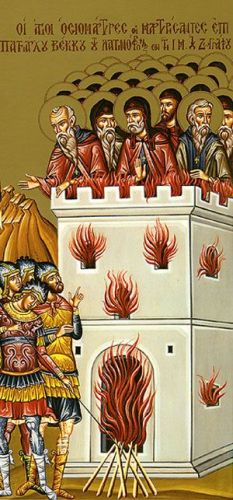
Then the enraged papists used a second weapon to teach the monks a lesson. You wonder what weapon they used?! They used fire, the stake. Dying at a stake has always been a good instrument for the pope to achieve his goals. How many people died at a stake? Christ’s “representative” on earth, always used fire for those who did not obey or worship him. The fire to burn! According to their testimony: “If you do not wish to share the same faith with us, then die!”
[…] The fathers preferred to give their lives than to abandon the faith. Our church commemorates them every year on the 22nd of September.
Dear Brothers,
No true Orthodox will ever accept the unification with the heretical pope because the unification in question means obeying the papist rules. The consequences of such obedience will be disastrous and will have a negative impact on the whole Orthodox Church. Today, defenders of orthodoxy stand as guarantors for its safety. Both our Orthodox people and Orthodox monastics living around the Holy Mount Athos always stood as a protective shield against the enemy. This protective shield is alive even today. None of the Orthodox fathers living around the Holy Mount Athos will ever accept such disastrous unification.
Archimandrite Ghervasios PARASCHEVOPOULOS
(Translated by blog’author)
Disclaimer: This article is not a call to hatred against the pope, as it may seem, but the history has to be revealed in its clarity for us to reflect on the deceit (of Satan) and the darkness one can encounter when it departs from the true faith of Christ and start calling/seeing himself infallible!
“The blood of the martyrs is the seed of the Church”, of the true Church of Christ, and their blood is a testimony of how we ought to live our lives following our Master on the cross in order that we might be resurrected with Him. Because when man no longer cares to speak the Truth, then the rocks will (the nature will start fighting against man)….
 Christian Dogma
 Christian Martyrs
 Christian Orthodox Churches and Monasteries
 Christian Sermons and News
 Church's Teachings on Fasting
 Ecumenism – a Great Heresy
 Father George Calciu
 Life_a Sacred Gift form God
 Orthodox Saints and Church Fathers
 Spiritual Elders
 Daily Bible Readings
 Journey to Orthodoxy
 Listen to Ancient Faith Radio
 Orthodox Calendar of Feasts and Saints
 Orthodox Christian Mission Center
 Orthodox Institute
 OrthodoxChristianNetwork TV


Recent Comments