
You are currently browsing the monthly archive for March 2011.
Fast and freedom

What can be more absurd than the fast, in a religion which boasts of having given the man the freedom? How can you name yourself free, when you have to refrain from the things you like, when you must do what you don’t want! The fast is the abstinence not only from food, but also from the bodily pleasures. How not to see in this an outrage to the noblest instinct that the man has – the freedom?
If the fast is an obligation, than the Gospel is a masterpiece of the absurd’s literature. Understanding this, the Protestants decided to renounce the fast. However, despite the numerous quotations brought from the apostle Paul or from the words of the Saviour Himself, the spur to fasting is like a thorn in the flesh of him, who at least scarcely, knows the Holy Scriptures.
All righteous before Christ fastened. The fast was precursory to the meeting with God or to a revelation. Moses climbed up the mountain after forty days of non-eating and thus spoke with God. The New Testament is not at all different and it begins with a fastener – John the Baptist. Christ Himself had fastened before having begun to preach. Thus, we cannot leave away the fast, departing from some biblical verses, when even those who pronounced them were great fasteners; it seems to me it is more decent to doubt our understanding’ ability of those verses.
Christ was once asked why his disciples don’t fast (Matthew 9, 14). From this many have understood that the disciples and the Saviour Himself were gluttons (Matthew 11, 19). But this event, actually, discloses us the fact that the disciples and the Saviour were all the time starving. This can be also seen very well from the conflict that they had with the Jews, because the disciples ate some ears on Saturday. The disciples were so busy with the preaching that they used to forget to eat and the fact that they picked ears, shows how hungry they were and that they were up to eat here and there. The Saviour however did not eat with them, the reproach being only for the disciples; He was the model of fasting.
The fact that the disciples used to eat little, is also emerging from the scene of multiplying the bread, where we find out that they had only five loaves of bread and two fish. Although they were far away from the locality, in an impossibility to buy food, they are ready to give this little to the crowd (without knowing that it will be multiplied), which reveals us that they were accustomed with the hunger more than the ordinary men. Hence, the Saviour and the disciples fastened, but they did not count the days as the Pharisees did. To their question though, Christ answers: “Can you make the guests of the bridegroom fast while he is with them? But the time will come when the bridegroom will be taken from them; in those days they will fast” (Luke 5, 34-35). “Those” days when the bridegroom was taken away, are Wednesday, the day of betrayal and Friday, the day of crucifixion. In the year 50, the apostles convoked a synod in Jerusalem, (see Acts) where they established for the believers to fast in these days.
Thus, the Protestants have understood well that the fast is not an obligation. The forced fast, has no motivation as any gratuitous and meaningless thing. However, this is not a reason to blame the fast. The fast should be understood in all its nobility, as it is the supreme manifestation of the human freedom. In such a way the first Christians understood the fast, a meaning that is lost nowadays. “To eat – writes St. Ephrem the Syrian in the IV century– belongs to the laws of nature, but to fast belongs to freedom”.
Who can boast that he is eating only because “he wants this”? No, you eat because you need to eat, a results from the natural instinct, not from freedom. Of course there is neither an evil in this, nor a sin, but there is also no virtue. The virtue is only the fruit of the freedom. “Any labour which is not from a perfect freedom – farther Sofronie Saharov (+ 1993) said – can not have an eternal value”. The fasting is the man’s free choice of a nobler life, which has something in it from the realities of eternal life, where there is no corruption anymore.

Reading from the Synaxarion:
Saint Patrick, the Apostle of the Irish, was seized from his native Britain by Irish marauders when he was sixteen years old. Though the son of a deacon and a grandson of a priest, it was not until his captivity that he sought out the Lord with his whole heart. In his Confession, the testament he wrote towards the end of his life, he says, “After I came to Ireland – every day I had to tend sheep, and many times a day I prayed – the love of God and His fear came to me more and more, and my faith was strengthened. And my spirit was so moved that in a single day I would say as many as a hundred prayers, and almost as many at night, and this even when I was staying in the woods and on the mountain; and I would rise for prayer before daylight, through snow, through frost, through rain, and I felt no harm.” After six years of slavery in Ireland, he was guided by God to make his escape, and afterwards struggled in the monastic life at Auxerre in Gaul, under the guidance of the holy Bishop Germanus. Many years later he was ordained bishop and sent to Ireland once again, about the year 432, to convert the Irish to Christ. His arduous labours bore so much fruit that within seven years, three bishops were sent from Gaul to help him shepherd his flock, “my brethren and sons whom I have baptized in the Lord – so many thousands of people,” he says in his Confession. His apostolic work was not accomplished without much “weariness and painfulness,” long journeys through difficult country, and many perils; he says his very life was in danger twelve times. When he came to Ireland as its enlightener, it was a pagan country; when he ended his earthly life some thirty years later, about 461, the Faith of Christ was established in every corner.
Apolytikion in the Third Tone
O Holy Hierarch, equal of the Apostles, Saint Patrick, wonderworker
and enlightener of Ireland: Intercede with the merciful God that He
grant unto our souls forgiveness of offences.
Kontakion in the Fourth Tone
The Master revealed thee as a skillful fisher of men; and casting
forth nets of Gospel preaching, thou drewest up the heathen to piety.
Those who were the children of idolatrous darkness thou didst render
sons of day through holy Baptism. O Patrick, intercede for us who
honour thy memory.

Lorica of Saint Patrick
Lorica means breastplate in Latin. The story of this prayer is that Patrick and his followers used this most beautiful prayer to protect themselves from the people who wanted to kill them as they travelled across Ireland. It is also called the Deer’s Cry (Fáed Fíada) because their enemies saw, not men, but deer. It may not have been written by Patrick, but is considered to reflect his theological focus on the Trinity.
- I arise today
- through a mighty strength,
- the invocation of the Trinity,
- through belief in the Threeness,
- through confession of the Oneness of the Creator of creation.
- I arise today
- through the strength of Christ with His Baptism,
- through the strength of His Crucifixion with His Burial,
- through the strength of His Resurrection with His Ascension,
- through the strength of His descent for the Judgment of Doom.
- I arise today
- through the strength of the love of Cherubim,
- in obedience of Angels, in the service of the Archangels,
- in hope of resurrection to meet with reward,
- in prayers of Patriarchs, in predictions of Prophets,
- in preachings of Apostles, in faiths of Confessors,
- in innocence of Holy Virgins, in deeds of righteous men.
- I arise today
- through the strength of Heaven:
- light of Sun, brilliance of Moon, splendour of Fire,
- speed of Lightning, swiftness of Wind, depth of Sea,
- stability of Earth, firmness of Rock.
- I arise today
- through God’s strength to pilot me:
- God’s might to uphold me, God’s wisdom to guide me,
- God’s eye to look before me, God’s ear to hear me,
- God’s word to speak for me, God’s hand to guard me,
- God’s way to lie before me, God’s shield to protect me,
- God’s host to secure me:
- against snares of devils,
- against temptations of vices,
- against inclinations of nature,
- against everyone who shall wish me ill,
- afar and anear, alone and in a crowd.
- I summon today all these powers between me (and these evils):
- against every cruel and merciless power that may oppose my body and my soul,
- against incantations of false prophets,
- against black laws of heathenry,
- against false laws of heretics,
- against craft of idolatry,
- against spells of witches and smiths and wizards,
- against every knowledge that endangers man’s body and soul.
- Christ to protect me today
- against poison, against burning,
- against drowning, against wounding,
- so that there may come abundance of reward.
- Christ with me, Christ before me,
- Christ behind me, Christ in me,
- Christ beneath me, Christ above me,
- Christ on my right, Christ on my left,
- Christ in breadth, Christ in length, Christ in height,
- Christ in the heart of every man who thinks of me,
- Christ in the mouth of every man who speaks of me,
- Christ in every eye that sees me, Christ in every ear that hears me.
- I arise today
- through a mighty strength,
- the invocation of the Trinity,
- through belief in the Threeness,
- through confession of the Oneness of the Creator of creation.
- Salvation is of the Lord.
- Salvation is of the Lord.
- Salvation is of Christ.
- May Thy Salvation, O Lord, be ever with us.
To learn more about the REAL St. Patrick, and find alternatives to the excesses of the “holiday” please see The Real St. Patrick\’s Day!
The Ancient Church
More on the Orthodox Chruch
See also a brief introduction to Orthodoxy based on the book “The Orthodox Church” of Metropolitan Kallistos Ware (former Anglican Timothy Ware)
Part I
Part II
The last 4 parts are on Youtube…

Motto:
“In Orthodox circles, following the Holy Fathers, we make a distinction between God’s “permissive” will and His “intentional” will. As Lord of all, God permits or allows such disasters to happen. Yet He remains a God of Love, who would never, for any reason, inflict wanton destruction on entire populations. He may allow pain and suffering to visit particular individuals, including you and me. But He does so always for a purpose, often beyond our comprehension. There is no doubt that at times He does so for our good, as a burdensome yet effective pedagogical tool to correct us and lead us to repentance. Where apparently meaningless suffering afflicts the truly innocent, we can only surrender, in faith and hope, before the impenetrable divine mystery that allows no rational analysis, no figuring out of the whys or wherefores. God, then, is involved in suffering, as He is in every other aspect of created existence.”
Fr. John Breck in: Can God Suffer?
And an older podcast (MP3) of Fr. John Oliver taken from Ancient Faith Radio at:
A Reflection on Natural Disasters
The Great Canon of St Andrew of Crete: text
St. Nicolai Velmirovich: On Fasting and Prayer
A sermon by Metropolitan Philaret (Voznesenskhy) on St Andrew of Crete’ Great Canon of Repentance
“My soul, o my soul, rise up! Why art thou sleeping? The end draws near, and soon thou shalt be troubled … ”
In a sense, these words are at the core of the Great Penitential Canon, composed by St. Andrew of Crete, one of the great Saints of God.
He addresses his soul, “My soul, o my soul, rise up, why art thou sleeping?” If that great righteous one could criticize his own soul for having spiritually fallen asleep, what can we say about ourselves?
The Holy Fathers often say that in spiritual life there is a certain paradox (an assertion that at first glance seems self-contradictory, but in fact contains a profound philosophical meaning). According to the Holy Fathers, the “spiritual paradox” rests in the fact that sinners see themselves as righteous, while the righteous see themselves as sinners. Why is this? Why does a sinner see himself as a righteous person? Because he does not know himself, while the righteous man focuses all of his spiritual power on knowing himself.
The Canon In Russian
The best of the pagans also recognized that you have to somehow know how to look into your internal world. Even in pre-Christian antiquity, we heard the phrase – attributed either to Socrates or to some other of the pagan thinkers – “know thyself.” With respect to the Christian understanding of that truth, there is after all reason for us to pray throughout Great Lent “Yea, 0 Lord and King, grant me to see my own faults … ” Were we to see them as we should, there would be no need for us to pray with such words.
We used to mention the following example from the lives of the saints: A certain righteous man began to implore God to show him to what depths sin had penetrated man’s being, to what extent it had, as it were, maimed him, filled, and defeated him. When the Lord granted the ascetic’s humble prayer and showed him the extent to which our nature was poisoned and maimed by sin, the terrified ~scetic felt that he was about to go mad, and began to implore the Lord to hide th~t awful vision from his sight as soon as possible. That is just how poisoned by sin man is.
The deeper one delves into himself, the more accustomed he becomes to comprehending his internal world, the more clearly and painfully he feels the internal harm done by sin.
In Romanian
It was for a reason that in their prayers before Holy Communion, Sts. Basil the Great, John Chrysostom, and other Saints like them called themselves the worst of sinners, unworthy to look upon the heights of Heaven. This was no rhetorical phrase-mongering, no hyperbole. They saw themselves just as what they said.
It was for a reason that St. Seraphim, that great Venerable One of the Russian Land, whom others saw as radiant as the sun, whom they saw rising up into the air while praying, liked to call himself the “poor wretched Seraphim.” For the righteous person truly feels himself to be a sinner.
If in some room there is a dirty rag, but there is no light in the room, the dirt on the rag is not visible. Should light come into the room, the dirt immediately becomes perceptible. The more light, the more clearly visible will be the dirt. Therefore, the closer the Saints approach God, the more clearly they see their sinfulness. When someone truly comes close to God, his conscience is illumined, its voice becomes clear, and sounds like a bell, sounds a reproach for any falling away from God, for any instance of being unfaithful to Him.
As to the sinner, he knows neither himself nor his soul, and even when he goes to Confession, it seems to him that he is not all that bad. When he hears about great sinners, he, like many others like him, thinks, “Well, at least I am not like that! I don’t consider myself to be a righteous person, and I am not a saint, but still, I am not that bad. Certainly there are people worse than me … “ However, no truly righteous person – a person who remembers only his own sins, and not someone else’s, one who always has compunction for them, and sees himself as meek before God would allow even the slightest self-justification to enter into his soul.
In English (St Vladimir Seminary)
We have now entered a period of repentant reflection and prayer.
Let us pray that the Lord might also truly grant unto us sinners to see our transgressions, and not those of others. We always notice others’ sins, deficiencies and blunders, but often we don’t notice our own; even if we do notice them, we don’t have any problem justifying them, but always can find a reason [to justify them]. Thus, I repeat, let us sincerely pray that the Lord grant unto us to see our transgressions, for without that spiritual sight, there can be no true repentance.
More Sermons on the Great Fast at:
“Lent: Our Personal Journey” with Metropolitan Kallistos Ware (video)

Beloved brethren! We have already reached the very gates of the holy fast! They are even now about to open before us! Already, according to the typicon of the Holy Church, we hear the instruction of our Lord Jesus Christ read to us today in the Holy Gospels about the correct way to begin thepodvig of fasting.
For if ye forgive men their trespasses,says the Gospel reading for today,your heavenly Father will also forgive you: But if ye forgive not men their trespasses, neither will your Father forgive your trespasses (Mt. 6:14–15). The holy Church greets us with this announcement at the gates of the fast! This is the requirement the Church offers us on the very threshold of the spiritual chamber of repentance. We intend to prove our repentance for various sinful distractions through various deprivations and wearing out of the body. The Gospels requires mercy from us before sacrifice, so that the sacrifice would be pleasing to God.
All who wish to begin this podvig of fasting and prayer, all who wish to reap abundant fruits of your repentance! Hear the word of God, hear God’s commandment, and let go, forgive your neighbors their sins against you. For if ye forgive men their trespasses, your heavenly Father will also forgive you: But if ye forgive not men their trespasses, neither will your Father forgive your trespasses. Amen.
St. Ignatius (Brianchaninov)
Translated by Nun Cornelia (Rees)
Also see: A Sermon with Metropolitan Kallistos (video) at:
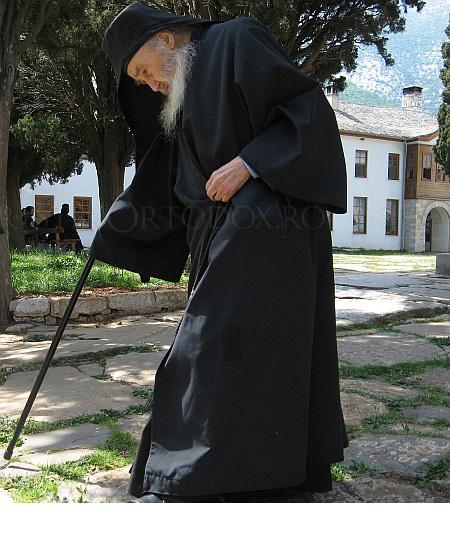
Elder Petroniu Tanase, former abbot of Prodromu Romanian Monastery from Mount Athos has followed sleep in the Lord, Tuesday, February 22.
May his memory be eternal!
On watching over the five senses
(With Elder Petroniu)
When man withdraws from the world escapes the temptation of sinful words and worldly images. By living in the world, man unwittingly hears and sees things that dirty his soul through his senses. And all these impressions and things of the world that enter his soul carry with them, a psychological and spiritual load. They awake memories you no longer want to remember, create undue spiritual tensions and leave fingerprints – as one may say – or dirty marks in the spiritual life of man. A man living in the world assimilates – even if it’s only in part, some of the sins of the world. As the old saying states that “man is what he eats”, we can also say that man is what he lives in the city, in his village or in his house. And as his body physiological composition is dependent of the materials contained in food that contribute to his good health, so the spiritual state of man becomes dependent on all these images and thoughts that penetrate through his five senses.
St. Nicodemus of the Holy Mountain has written a special work on this subject, “Guarding the five senses.”
Man must guard his senses as he would his gateways where friends but especially enemies could enter. Through these windows, dark impressions can penetrate into his soul.
These fingerprints can gradually shape the whole structure of man. During our lifetime, many impressions and deeds are recorded in one’ soul like in a book. … And these are the “books” that will be open at the Dreadful (Last) Judgment.
Man, until the end his life, is in a permanent transformation through what he hears, what he sees and what he lives. He is like a sculptor carving the wood, a piece here, a piece there… A chip on this side, a splinter on the other side and, little by little, the figure/sculpture appears. At the end of his life, man appears in his final form, modeled by everything he hears and does. And this transformation is noticed sometimes on his face. A wicket or a drunken man who lived a sinful life will show this. His figure acquires a certain appearance, connected to the sins he committed. And we elders can sense this.

But these evil fingerprints do not remain at the level of external appearance as we are accustomed to notice, but they will be engraved in man soul. Then at the Dreadful Judgment, when the books will be opened, that man will appear – though the great mystery of God – modeled by everything he did and thought. The Holy Fathers and especially of St. Niphon of the Danube says that people who have committed grievous sins, and have not change or repent, will remain distorted for eternity – a reflection of their soul, which after death will become a tangible reality. At the Last Judgment the state of man soul, more visible than his body, will portray everything man did. Sinners will have distorted figures and every grimace will reflect the sins they committed. Then – as St. Niphon says – everyone will see the sins we committed in our lifetime for they will be engraved in my personal appearance, they will express like a mirror, the structure of my soul irreparably damaged by sins. All our sins will be expressed and everyone will see our corruption.
And what is it said, in our church services, about the Dreadful Judgment? “Oh, who can suffer this scenery?” If now I’m ashamed to visibly sin against my neighbor, how will I look when everyone will see all the sins I have done?
On the Orthodox Church
1. The Orthodox Church is and must remain holy. There exists not one thing that can be accomplished without the power of the Holy Spirit. Today the spirit of the world penetrates everywhere, even in the life of the Church, in parishes and monasteries. With the help of the spiritual father, man is called to become holy through Christ who died and rose from the dead in order to deify human nature and to lift it up to heaven to the throne of the Holy Trinity.
2. The monastery ought to be far from the spirit of worldliness. According to St. Maximus the Confessor, a monk must constantly renounce the world and he will gain heavenly treasures.
3. Monasticism resembles martyrdom. Most saints mentioned in the Church ‘calendar are martyrs, and are followed by the monastics.
4. The monks have been entrusted with the liturgical treasure of the Church. A monk is called to maintain lit the lamp of liturgical life. First of all, he must attend all the daily liturgical services from his monastery.
5. The abbot has to be the spiritual father of the monastic community.
6. In his ministry, the Bishop is called to show firmness in defending the true faith before the heterodox and to promote the purity of life. The lives of St. John Chrysostom and St. Basil the Great ought to be eloquent examples to every bishop. The clergy and the faithful’ confidence in their hierarch is maintain when he remains steadfast in defending the Christian truth and in preserving the purity of life.
7. Gluttony, immorality and the love of money enslaves our world today.
Today, many sins are enacted by the so-called “human rights”. But according to the Christian teaching, man has only duties: towards God, his neighbor and God’ creation.
(Taken from the site “Friends of Mt. Athos”, translated by blog’author)
More about Elder Petroniu at:
The ABBOT OF THE ROMANIAN SKETE of MT. ATHOS, REPOSES IN THE LORD
 Christian Dogma
 Christian Martyrs
 Christian Orthodox Churches and Monasteries
 Christian Sermons and News
 Church's Teachings on Fasting
 Ecumenism – a Great Heresy
 Father George Calciu
 Life_a Sacred Gift form God
 Orthodox Saints and Church Fathers
 Spiritual Elders
 Daily Bible Readings
 Journey to Orthodoxy
 Listen to Ancient Faith Radio
 Orthodox Calendar of Feasts and Saints
 Orthodox Christian Mission Center
 Orthodox Institute
 OrthodoxChristianNetwork TV


Recent Comments