
You are currently browsing the category archive for the ‘Christian Orthodox Churches and Monasteries’ category.
The Magi precious gifts for our Lord and Savior are now found in the Monastery of St. Paul Xeropotamenos from Holy Mt Athos
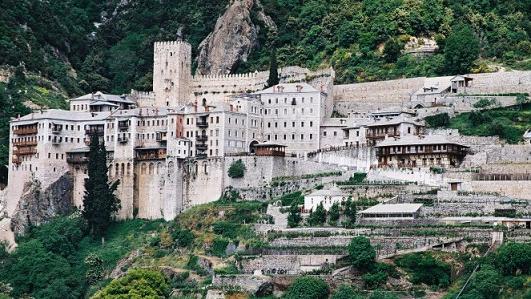
The monastery of Saint Paul, now dedicated to the Presentation of Christ, earlier honoured the Saviour, the Virgin and Saint Georgios.
Among the monastery treasury and relics are:
– the precious gifts that the Magi brought to the birth of our Lord and Savior Jesus Christ ;
– pieces of cloth our Lord was clothed at birth;
– a big piece of wood of the cross the Lord was crucified on, dressed in silver,
– a large piece of blood from the 40 Holy Martyrs;
– a finger of St. Basil, and many other Relics of the Saints.
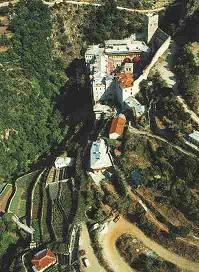
Ranking fourteenth in the hierarchy, it owes its foundation, to the 8th/9th centuries A.D., according to tradition. The monastery is probably, however, a foundation of Pavlos Xeropotamenos in the second half of the l0th century A.D. The monastery of Saint Paul only acquired a permanent place amongst the other Athonite monasteries after A.D. 1370, thanks to the intervention of the Serb monks Gerasimos Radonia and Antonios Pegases. Early in the l4th century the Palaiologoi and the kings of Serbia extended the complex, and after the Fall of the Byzantine Empire, the Christian sultana Mara, Greek and Romanian princes of the Danubian principalities made funds available for renovation and additional building. It was deserted at the time of the War of Independence but finally recovered, thanks to donations by the Russian tzars.
Spruce Island is known as the home of St. Herman (1730 – 1837), the first Saint to be canonized on American soil by the Orthodox Church.

There are two monasteries on Spruce Island; St. Michael’s Skete and St. Nilus Skete are home to Russian Orthodox monks and nuns, respectively.

Saint Herman of Alaska was born in 1756 or 1760 in Serpukhov in the Moscow Diocese of Russia. He took the name Herman when tonsured a monk in the Trinity-Sergius Hermitage, near the Gulf of Finland, about 10 miles from St. Petersburg. He then transferred to the Valaam Monastery on the islands of Lake Ladoga. He was allowed later to live in the wilderness, a hermit alone in prayer, returning to the monastery only for the services of holy days.

In 1793, Father Herman, with Father (later, St.) Juvenaly and others, were chosen to do missionary work in Alaska. By zeal and the grace of God, they brought to the Faith several thousands of Native Alaskans. However, as time went by, the missionary party was slowly cut down. Some drowned in a ship at sea. Father Juvenaly was martyred at the hands of fearful Alaskans. Eventually, only Father Herman alone, of the original party, remained.

Father Herman settled on Spruce Island, and named it, “New Valaam,” in honor of his beloved Valaam Monastery. He dug a cave out of the ground with nothing but his hands, and lived there until a cell could be built, in which he then lived until his death. He grew his own food, not only for himself but for all he cared for, digging the earth, planting, carrying heavy loads of seaweed to fertilize the earth. He was a great ascetic; he was always barefoot even in these lands of the far North, and wore only a deerskin smock, a podrasnik and a patched rassa (inner and outer cassock), and his klobuk (monastic hat). He slept very little, and only on a wooden bench with no cushion, used bricks for a pillow, and covered himself with no blankets, but only a board.

He advocated for and defended the Aleuts against sometimes oppressive authorities. He cared lovingly and sacrificially for all who came to him, counseling and teaching them, and tirelessly nursing the sick. He especially loved children, for whom he often baked biscuits and cookies.
He was a great and compelling teacher, not only to Aleuts but also to highly educated and “free-thinking” Russians and Europeans who happened to travel there, and this humble monk humbled these “great ones” by his knowledge and wisdom, converting many to the true Faith. Often Aleuts were so captivated that they stayed up with him all night, not leaving until dawn.
The elder was given great spiritual gifts by God. He often foreknew the future, telling people of events that would happen many years later, and which were shown to have come true. By his prayers, God averted forest fires from crossing a line Father Herman made, and stopped a flood from rising past the position where Father Herman had placed an icon of the Mother of God and prayed.
Father Herman reposed in the Lord in his sleep on the 25th day of December (December 12th on the ancient Calendar of the Church), in 1837. He continued to work miracles after his death, answering the prayers of the faithful in intercession for them before God.
Holy St. Herman, pray to God for us.
Troparion in Tone IV:
O venerable Herman, ascetic of the northern wilderness and gracious advocate for all the world, teacher of the Orthodox Faith and good instructor of piety, adornment of Alaska and joy of all America: entreat Christ God, that He save our souls.
Kontakion in Tone VIII:
O beloved of the Mother of God, who received the tonsure at Valaam, new zealot of the struggles of the desert-dwellers of old: wielding prayer as a spear and shield, thou didst show thyself to be terrible to demons and pagan darkness. Wherefore, we cry out to the: O venerable Herman, entreat Christ God that our souls be saved!

For more reading about St. Herman:
THE LIFE OF ST HERMAN OF ALASKA
St. Herman of Alaska Wonderworker of All America
(A beautifully carved wooden reliquary in the Resurrection Church contains the coffin with Father Herman’s relics. On top of the reliquary are: a large icon of the saint (center); as well as the “paramon” cross and metal chains (on the left) that he wore (shown in the icon at the top); and his klobuk (monk’s hat) (in the glass box on the right). Also to be found at this church is Father Herman’s hand cross, which he is shown holding in the icon at the top}.
St Spyridon Church (video link)
Feast Day, December 12.

Saint Spiridon lived during the time of king Constantine the Great and his son Constantius.
This God-bearing Father of the Church, the great defender of Corfu and the boast of all the Orthodox, had Cyprus as his homeland. He was simple in manner and humble of heart, and was a shepherd of sheep. When he was joined to a wife, he begat of her a daughter whom they named Irene. After his wife’s departure from this life, he was appointed Bishop of Trimythus, and thus he became also a shepherd of rational sheep. When the First Ecumenical Council was assembled in Nicaea, he also was present, and by means of his most simple words stopped the mouths of the Arians who were wise in their own conceit. By the divine grace which dwelt in him, he wrought such great wonders that he received the surname ‘Wonderworker.” So it is that, having tended his flock piously and in a manner pleasing to God, he reposed in the Lord about the year 350, leaving to his country his sacred relics as a consolation and source of healing for the faithful.
About the middle of the seventh century, because of the incursions made by the barbarians at that time, his sacred relics were taken to Constantinople, where they remained, being honoured by the emperors themselves. But before the fall of Constantinople, which took place on May 29, 1453, a certain priest named George Kalokhairetes, the parish priest of the church where the Saint’s sacred relics, as well as those of Saint Theodora the Empress, were kept, took them away on account of the impending peril. Travelling by way of Serbia, he came as far as Arta in Epirus, a region in Western Greece opposite to the isle of Corfu. From there, while the misfortunes of the Christian people were increasing with every day, he passed over to Corfu about the year 1460. The relics of Saint Theodora were given to the people of Corfu; but those of Saint Spyridon remain to this day, according to the rights of inheritance, the most precious treasure of the priest’s own descendants, and they continue to be a staff for the faithful in Orthodoxy, and a supernatural wonder for those that behold him; for even after the passage of 1,500 years, they have remained incorrupt, and even the flexibility of his flesh has been preserved. Truly wondrous is God in His Saints! (Ps. 67:3 5)
Apolytikion in the First Tone
O Father, God-bearer, Spyridon, you were proven a champion and Wonder Worker of the First Ecumenical Council. You spoke to the girl in the grave and turned the serpent to gold. And, when chanting your prayers, most sacred One, angels ministered with you. Glory to Him who glorified you; glory to Him who crowned you; glory to Him who, through you, works healing for all.
Kontakion in the Second Tone
Wounded by your love for Christ, O holy One, your mind given wings by the radiance of the Spirit, you put the practice of theory into deeds, becoming a sacred altar, O Chosen by God, and praying for the divine illumination of all.
(St Spyridin basilica from Corfu)

MIRACLEs In CORFU Island
For over a 100 years after his death, sweet-scented exhalations were perceived emanating from his tomb, until the local churchmen dug it up and found his body intact. The holy remains were kept in Cyprus for over 300 years. In the second half of the 17th century the Saint’s body was carried to Constantinople, until the fall of the City to the Turks in 1453. Shortly after the Turkish conquest, the priest George Kalochairetis carried off the body of the Saint, together with that of Saint Theodora and he brought them to Corfu in 1456. Since that year St. Spyridon has never ceased to be the object of devout veneration by the faithful.
Old Fortress in Corfu


Historical sources that certify the authenticity of the following event on the expulsion of the papal forces from the island, include the historical notes given by a great saint of our Church, St. Athanasius of Paros. We should all reflect upon the message of the following event.
THE GREAT MIRACLE
In 1716 the Turks had the island of Corfu under a tight siege. They had 50,000 troops and a good number of ships surrounding the island, cutting its lifeline from land and sea.
The barbarian armies had been concentrated at the far walls of the city. Pizani, a general of the forces of the Venetian Republic, was anxiously anticipating the oncoming enemy attack (since Corfu and the nearby islands were occupied by Italy at the time).
At daybreak on August 11, 1716, St. Spyridon, the patron Saint of the island, appeared in front of the enemy lines holding a glistening sword in his right hand. His austere and grandiose appearance horrified the aggressors who began to recede. The Agarenes, panic-stricken by the most awesome presence and fearless attack of the Saint, abandoned weapons, machinery and animals, running for their lives.
This great miracle became known throughout the island. The Turks had left behind 120 cannons, a large number of weapons, ammunition, animals and food.
After this powerful, surprising and most obvious miracle, the Venetian ruler Andrew Pizani, who was a Papist, wanted to erect a Papist altar inside the Orthodox Church of St. Spyridon (forever pushing for this was also the Papist Cardinal of the island). However, St. Spyridon appeared to Pizani in a dream saying: “Why are you bothering me? The altar of your faith is unacceptable in my Temple!” Naturally, Pizani reported this to the Papist Cardinal who answered that it was nothing but an evil fantasy of the devil who wanted to nullify the noble deed. After this, Pizani was much encouraged, so he ordered the necessary materials to commence construction of the altar. The materials were piled up outside of the temple of St. Spyridon. When the Orthodox priests of the temple and the Greek leaders of the island realised what was going on, they were greatly grieved. They asked to meet with Pizani to ask him to put a stop to this. Pizani’s response was quite disheartening. He said quite bluntly, “As a ruler I will do whatever I please!” At that moment, the Orthodox community of the island turned their eyes to their Saint, beseeching him to put a stop to this abomination.


(Holy Relics of St Spyridon in the Church of St Spyridon from Corfu)
That same night, St. Spyridon appeared to Pizani as a monk and told him, “I told you not to bother me. If you dare to go through with your decision, you will surely regret it, but by then it will be too late.”
The next morning, Pizani reported all this to the Papist Cardinal who now accused him of being not only faithless but also of being “yellow”. Again, after this, the ruler mustered up enough courage to order the construction of the altar.
The Papists of the island were celebrating their triumph while the Orthodox were deeply grieved. Their grief could not be comforted and with tears they begged for the Saint’s intervention to save them from the Papist abomination.
The Saint heard their prayers and intervened dynamically.
That evening, a terrible storm broke out, unleashing a barrage of thunderbolts on Fort Castelli, Pizani’s base and his ammunition barracks. The entire fort ended up in a holocaust. 900 Papist soldiers and civilians were instantly killed from the explosion, but not a single Orthodox was harmed (as they were not allowed inside the fort after dark). Pizani was found dead with his neck wedged between two wooden beams. The body of the Papist Cardinal was found thrown a great distance from the fort.
But the most incredible fact was that the same night and at the same hour, another thunderbolt struck in Venice, targeting the compound of Pizani, burning his portrait that hung on the wall. Strangely enough, nothing else was damaged. Also, the guard of the ammunition barracks saw the Saint draw near him with a lit torch. He was carried by the Saint near the church of the Crucified without a single scratch.
PRESENT TIMES

Many are the miracles of St. Spyridon to our dearest Orthodoxy. It seems that the Saint does not share the enthusiasm of certain Ecumenist clerics. Because we do not wish to draw attention to specific names at this point, we would simply like to mention that very recently, an important Orthodox hierarch in Corfu had decided to go and meet with Latin Papists outside the island, himself being a philo-Papist. However, he never made it back to the island as he suddenly dropped dead.
It seems that the Saint does not want those clerics who make openings to the Latins back in his island …

St. Catherine Monastery near Mt Sinai, Egypt
A documentary by Discovery Channel on Mt Sinai
Holy Great Martyr Menas (Abu Mena)
(feast Day, November 11th )
Saint Menas’ life and the Monastery of Abu Mena, Egypt
(dedicated to the saint)
It is known that St. Menas was born in the year 285 A.D. in Egypt in a pious family, his parents were Eudixius and Euphemia. His parents had long been awaiting to have children. During a feast dedicated to the Virgin Mary, Euphemia was praying with tears to an icon of the Most Holy Mother of God to grant her a child, and at the end of her prayer, the Mother of God had answered from her icon “Amen”.
Months later, the blessed child Mina was to be born. His father died when Mina was 11 years old and his mother when he was only 14. At the age of 15, he joined the Roman army, where he was given a senior grade because of his father’s inheritance.
He served in Algeria for 3 years as a soldier. This occurred at the time of the pagan Roman emperors Diocletian and Maximilian, who ordered that all Christians who will not bow to idols be tortured and killed. Disgusted and sickened of the view of Christians forced to worship idols, Menas left for the desert for 5 years leading a hermit life in fasting and prayer to the true Christian God.
During the fifth year of his ascetic life, St. Menas had a revelation when he saw an angel crowning Holy Martyrs; while contemplating this image, he heard a voice saying: “Be blessed Menas, you have been called to a pious life since your childhood. You will be crowned with three crowns: one for your clean life in celibacy, second for your ascetic struggle, and the third for martyrdom “.
With his soul filled by the fiery love for Christ and strengthen by this revelation, Menas came down from the mountains, stood in the middle of the idolaters and confessed Christ. For this, he was given to torment: his body was rubbed with tarsi, burned by fire, dragged mercilessly over thistles, and pierced at the end by a sword. St. Menas received martyrdom in the year 309, in Frigia.

It is said that the soldiers who killed Menas, threw his body on fire, but for 3 days the saint’ body did not burned. His sister along with some soldiers took the saint’ body to Alexandria and placed it in a church. When the persecution against Christians had stopped, it is said that an angel appeared to Pope Athanasius of Alexandria, instructing him to remove the saint body, place it on a camel and take it to the Western Desert. In a certain place, not far from Alexandria, at the end of Lake Mariot, the camel no longer could move, no matter how hard Christians have tried to do push it forward. They understood this to be a sign from God, and buried the saint’ body there.
For several centuries, the martyred soldier Menas was no longer know, until in a certain place in the desert, the sicken sheep’s of a pastor were miraculously healed along with the pastor. The news spread quickly and many sick people start heading to that place, without even knowing the source of these healings. The place had become so familiar that even the Emperor daughter from Constantinople (Constantine the Great or Zeno), been sick with leprosy, was sent there for healing. One night when the girl was sleeping, the Great Martyr Menas appeared to her in a dream and uncovered the mystery: his holy relics were at the place of healing. St Menas asked the girl that a church will to build in his honor. Next morning, the girl was cured and she revealed her dream to the servant accompanying her.

On that site, 45 km southwest of Alexandria, the Emperor of Constantinople not only that he ordered the building of a cathedral, but an entire city was built, including streets, buildings, churches and the Baptistery, a building with two wings for the sick (one for men and the other for women and children).
The City of St Menas (Abu Mena) has became one of the most famous place of healing and pilgrimage for many Christians. Bottles of oil and holy water engraved with the saint name were found in archeological sites of various Mediterranean countries such as: in Heidelberg – Germany, Milan – Italy, Dalmatia – Croatia, Marseille – France, Dongola – Sudan and in Jerusalem. At the middle of VII century, the city was destroyed by the Muslims. The first excavation to uncover the archaeological value of the site Abu Mena began between 1905 and 1907.

About 1 km from the city of Saint Menas, an impressive monastery was built and bares part of the holy relics of St Menas. 101 monks dwell in this monastery, and serve Divine Liturgy 3 times per day.

In the year 1979, the archaeological site of Abu Mina – the marble city of Saint Mina – is included in the UNESCO list of World Heritage sites, and from 2001 the site is placed on the UNESCO list of World Heritage in danger of destruction.
The holy relics of St Mina are present also in other parts of the world, such as in the Church of St Mina from Bucharest.


“Oh, blessed Holy Martyr Menas, listen to our prayer offered to you from our hearts, and deliver us from sickness and dangers, so we may honor your memory and testify of your miracles, which by the power of the Holy Spirit you work on those who faithfully sing to Thy: Alleluia! “
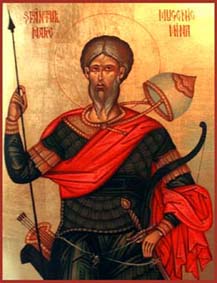
From the Miracles of Saint Menas
Once, traveling to the church of St Menas, a faithful Christian was hosted in a foreign house, and the owner of that house, knowing that the guest had money with him, rose at midnight and killed the faithful. Then, cutting his body in pieces, hid it in the pantry inside the house, awaiting daylight hours.
While the killer was in great difficulty of how and where to hide the body parts of the one killed so no one may know, Saint Menas appear to him as a soldier riding a horse and asked what was done with the man accommodated there, but the killer denied of knowing anything.
Then the Saint, descending his horse, went inside the house to the hidden place, and finding the remainings of the traveler, presented them to the killer, than with a great and fearful look had asked “Who is this?”
Fearful and trembling, having speak nothing, the killer threw himself at the feet of the saint.
Putting together all the members of the one killed and praying over him, St. Menas raised the dead and said to him: “Give praises to God!” And the dead, rising from sleep and remembering what he had suffered from the one who hosted him, glorified God for living a second time, and praise the “soldier” for risen him.
After taking the money from the one who killed him, St Menas gave them to the man he had risen, saying, “Go brother in your path”.

For The Akathyst of the Holy Martyr Menas the Wonderworker
see link below:
A documentary on the Holy Mt. Athos, named the garden of Theotokos
 Christian Dogma
 Christian Martyrs
 Christian Orthodox Churches and Monasteries
 Christian Sermons and News
 Church's Teachings on Fasting
 Ecumenism – a Great Heresy
 Father George Calciu
 Life_a Sacred Gift form God
 Orthodox Saints and Church Fathers
 Spiritual Elders
 Daily Bible Readings
 Journey to Orthodoxy
 Listen to Ancient Faith Radio
 Orthodox Calendar of Feasts and Saints
 Orthodox Christian Mission Center
 Orthodox Institute
 OrthodoxChristianNetwork TV


Recent Comments