
You are currently browsing the category archive for the ‘Contemporary Martyrs for Christ’ category.
One thing is truthful!
(My beloved) know that our relationship with God is not a joke; know that this whole world with all its civilization is a fad. You closed your eyes forever (when you die – transl. note) and will no longer know about civilization or the endeavors to the Moon or Mars, and so on … All are shadows/hollows; only one thing is truthful: our relationship with Christ, the immortality of our soul and what awaits us beyond death, aiming an eternal torment or the eternal life.
Father George Calciu
On the Priesthood
“What does the priesthood mean? It means to be an enduring witness to human suffering and to take it upon your own shoulders. To be the one who warms the leper at his own breast, the one who gives life to the miserable through the breath from his own mouth. To be a strong comfort to every unfortunate one, even when you yourself are overwhelmed with weakness. To be a ray of shining light to unhappy hearts when your own eyes long ago ceased to see any light. To carry mountains of others’ sufferings on your shoulders, while your own being screams out with the weight of its own suffering. Your flesh will rebel and say, ‘This heroism is absurd, impossible! Where is such a man, where is the priest you describe so that I may put my own suffering on his shoulders?’ Yes, nevertheless, he does exist! From time to time there awakens within us the priest of Christ who, like the Good Samaritan, will kneel down by the side of the man fallen among thieves and, putting him upon his own donkey, will bring him to the Church of Christ for healing. And he will forget himself and comfort you, O man of suffering!”
Father George Calciu
May His Memory Be Eternal!
The life of St. John (1690-1730), celebrated May 27
“But I tell you of a truth, there be some standing here, which shall not taste of death, till they see the kingdom of God.” (Luke 9:27)
One of the most popular saints among Greeks today is St. John the Russian whose incorrupt relics are the boast of the island of Euboia. The multitudes who visit his shrine are such that there is daily bus service to the shrine from Athens. Countless miracles flow from his relics and icons, and even now-when the spirit of the world is having such an oppressive effect on traditional Greek piety–icons of the Saint are often found in buses and in nearly all Orthodox homes. St. John was neither a celebrated hierarch, nor an eloquent theologian, but a simple young man who spent the better part of his life in a stable.
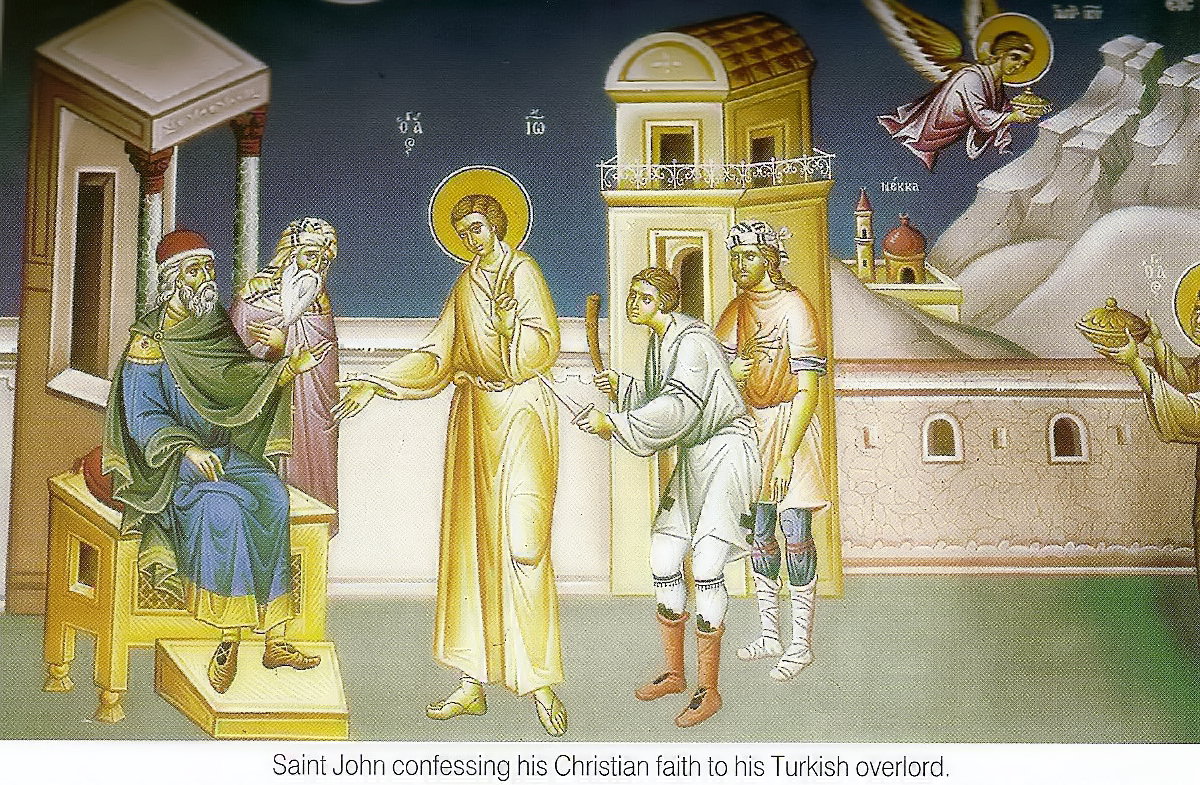
St. John was born in the south of Russia of pious Orthodox parents. He was still young when, in 1711, he took part in the battle against the Turks. Sharing the unhappy fate of many other Russian soldiers, the Saint was captured and sold as a slave to a Turkish cavalry commander from the village of Procopion near Caesarea in Asia Minor. Fanatic in their Moslem beliefs, the Turks inflicted cruel tortures upon their Christian slaves in trying to force them to renounce their faith. While some succumbed to this form of persuasion, many preferred to suffer death and a whole multitude of martyrs was thus added to the heavenly choir. In their misguided zeal the Turks would also kidnap the sons of Christians and raise them as fanatical Moslem soldiers. Procopion was the army-camp of these Christian-hating Janissaries and the new slave of the Turkish Agha became a target of their derisions. But neither their insults nor the beatings of his Turkish master were able to shake the faith of the pious Russian youth who confessed outright that he would sooner die than lose what he treasured above all–the holy Orthodox faith.

The blessed John was assigned to work in the stable where he was also told to sleep. Recalling the lowly Bethlehem cave and The manger where the Saviour of the world first lay His head, the Saint rejoiced in his rude dwelling place. In his humility he regarded his dark corner of the stable as a little paradise where he could freely offer prayer and praise to the true God. The unshakable firmness of his faith, his patience, fortitude, and gentleness of spirit, gradually won the hearts of the Agha and his wife who offered the meek stable boy to sleep in a small room near the hayloft. John, however, preferred to remain in the stable where he could toil more assiduously in the ascetic life, bringing his body into subjection to the spirit according to the Apostle’s command. He ate very sparingly and spent long hours in prayer with the Psalms of David continually on his lips. Weekly he prepared himself to partake of the Most Holy Mysteries in a nearby church, for he knew that without the strength of Christ he was powerless to persevere on the path of the true Faith. At night he would secretly go and keep vigil in the narthex of the church. The Lord rewarded the labors of His faithful servant and through him bestowed blessings also upon his Turkish master who became one of the wealthy and powerful men of Procopion. The Agha understood the cause of his new prosperity and did not shrink from telling it to his fellow citizens.
Error
This video doesn’t exist
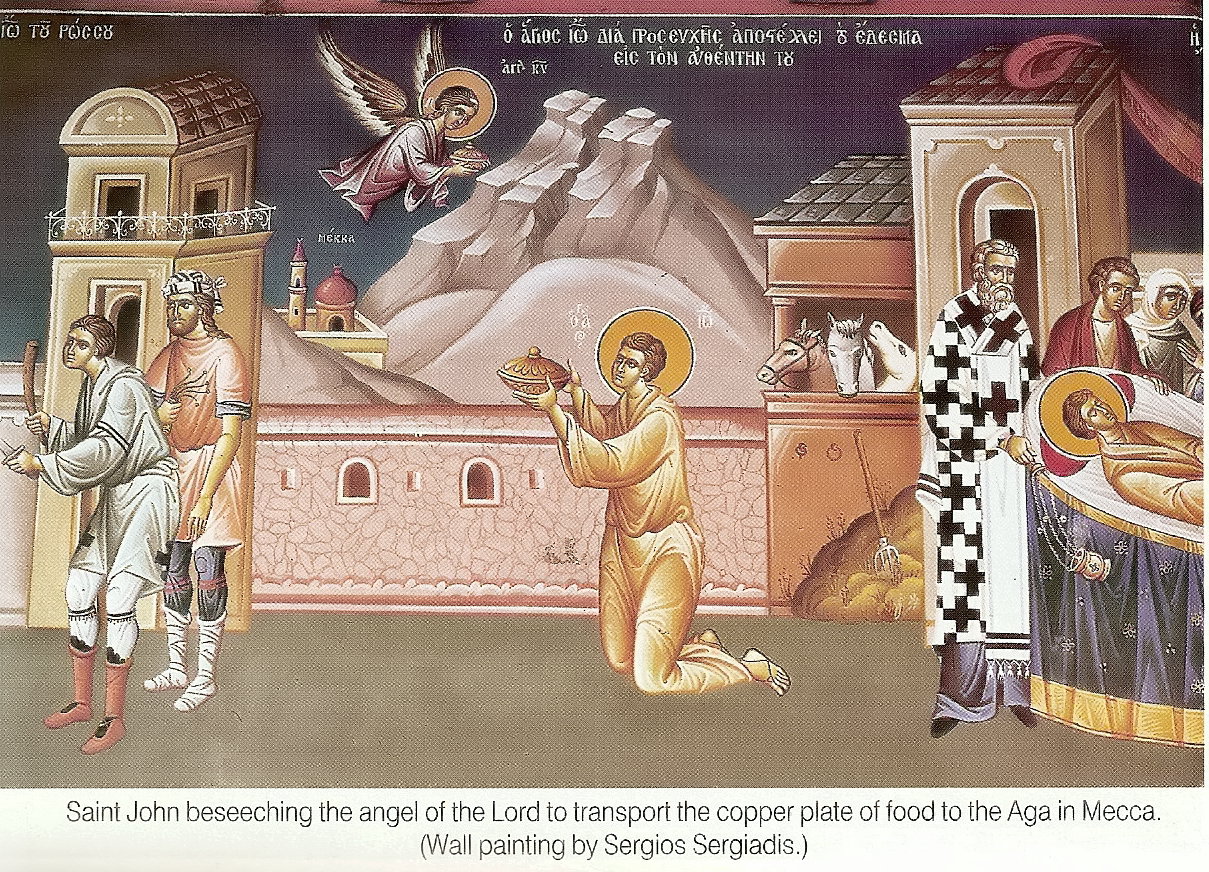
Once the Agha undertook a pilgrimage to Mecca, the city most sacred to the Moslems. While he was away, his wife invited friends and relatives to pray for the Agha’s safe return from such an arduous journey. As they were getting ready to eat. the mistress turned to John, who was serving at the table, and said, “How much pleasure your master would have, Gavan, if he were here now and ate this pilaff with us!” The pilaff, a common grain dish of the Middle East, was a favorite with the Agha. Wishing the best for his master and firmly believing in the almighty power of God, John asked for a plate full of pilaff from his mistress, saying that he would send it to his master in Mecca. The guests laughed but the mistress asked the cook to comply with the youth’s request, thinking that he would take it to some poor Christian family as was his custom.

Those who are familiar with the Gospel should not be astonished at what happened next, for did the Lord not say that faith as small as a mustard seed is enough to move mountains? Strong in his faith, the blessed one returned with the plate of pilaff to the stable and, as he was petitioning the Lord, in answer to his firm entreaty, the plate disappeared. What was the amazement of the entire household when the Agha finally returned from Mecca bringing with him the copper plate which had held the food. He had been equally astonished to discover the steaming plate of pilaff upon his return from the Mosque to the locked room where he was staying. Still greater was his confusion when he realized that the copper plate was engraved with his initials–just as all the vessels in his house. “For the sake of Allah, I cannot understand how it came even unto Mecca and who brought it!” When his wife told him of John’s request, they recognized the strange occurrence to be a miracle of God, and henceforth all considered John as a righteous man who had found favor with God.
Once again the Agha and his wife tried to persuade the blessed one to change his dwelling place, but the Saint preferred to remain among the animals, willingly fulfilling his duties and continuing steadfast in his ascetic struggles.
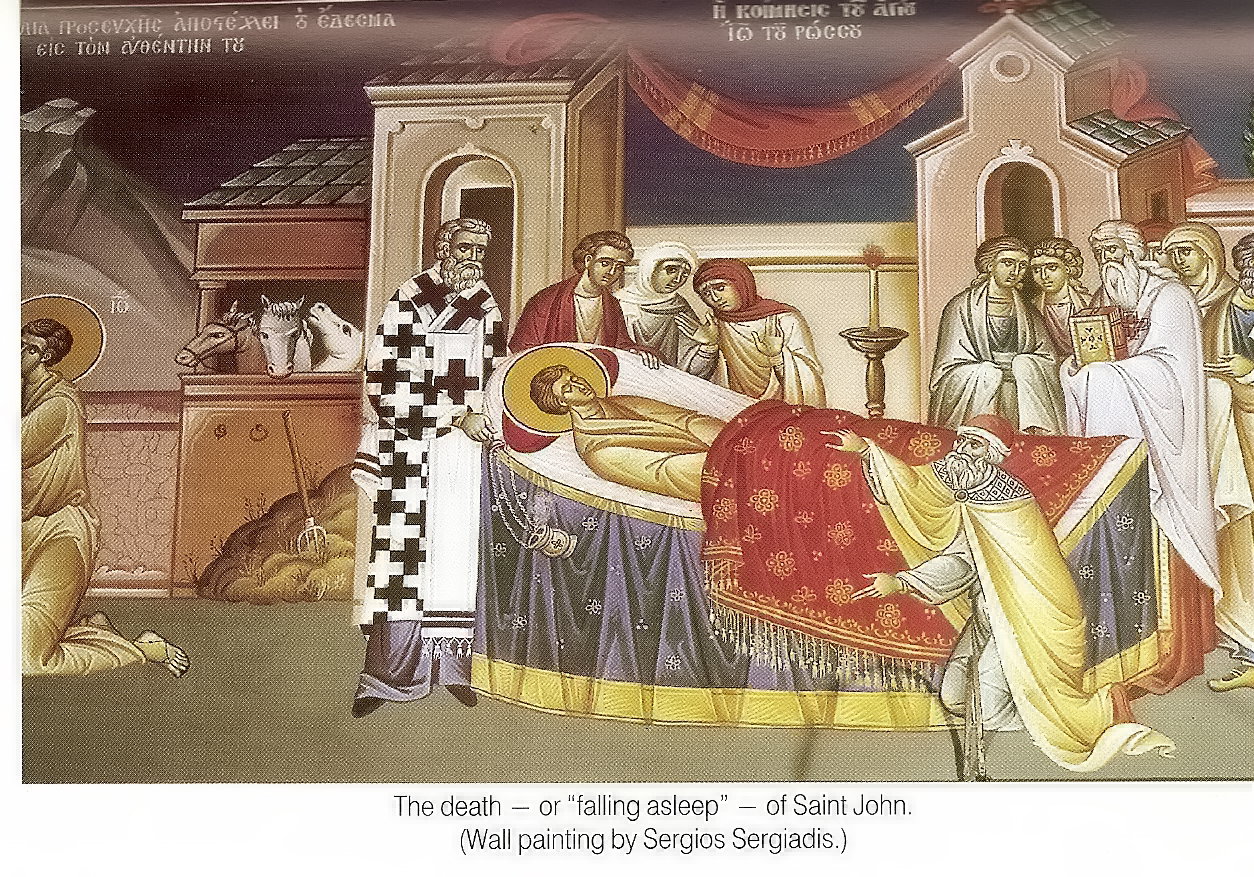
He persevered in this manner of life until, after a few years, he became ill. Foreseeing his end, he called for a priest and asked to partake of the Holy Mysteries. Fearing the fanaticism of the Turks, the priest did not want to bring the Holy Mysteries openly to the stable, but receiving wisdom from above, he thought to hollow out an apple; lining the cavity with beeswax, he placed the Holy Mysteries inside and was thus able to safely bring Communion to the Saint. Upon receiving the immaculate Body and Blood of the Lord, the blessed one surrendered his holy soul into the hands of God Whom he loved so much. He reposed on the 27 of May, 1730, having spent some forty years in this temporal vale of sin and sorrow.
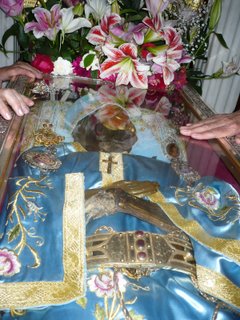
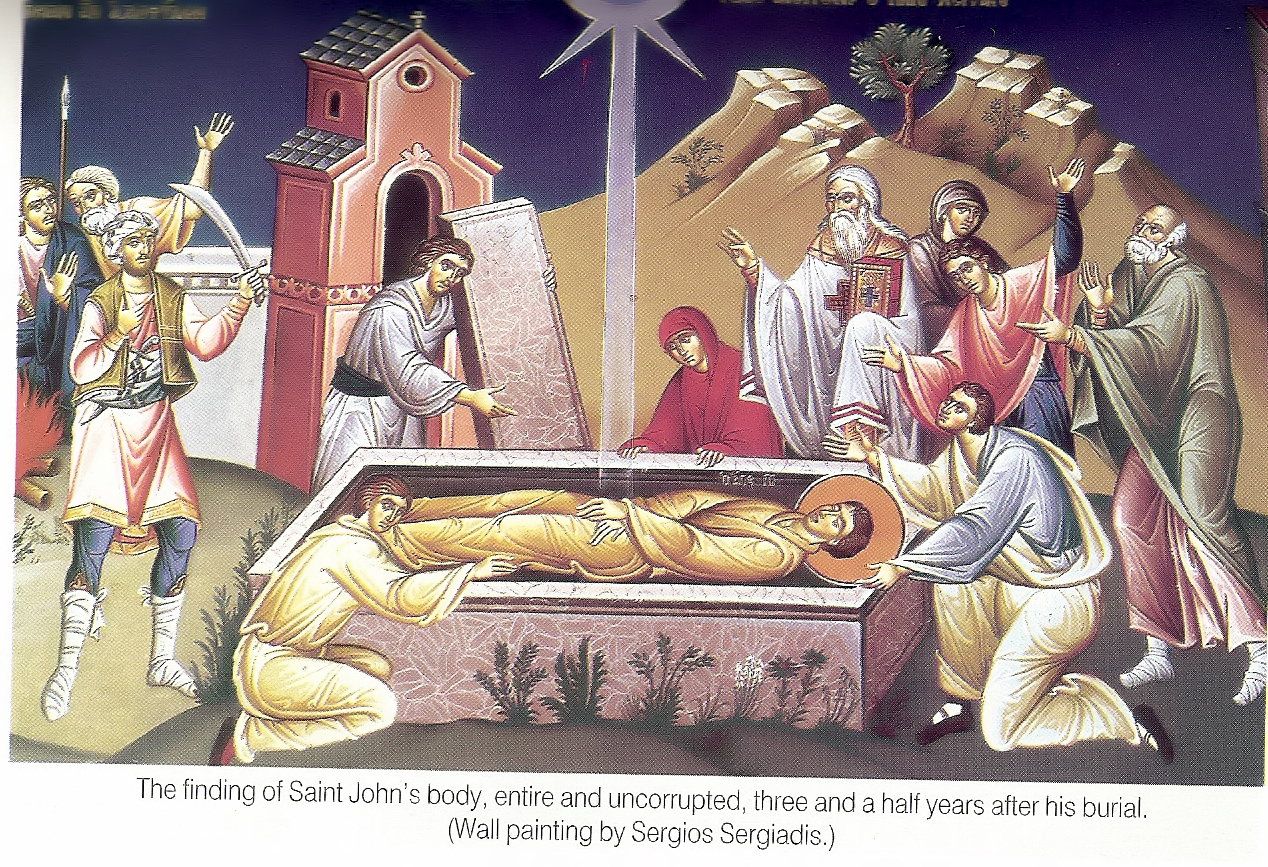
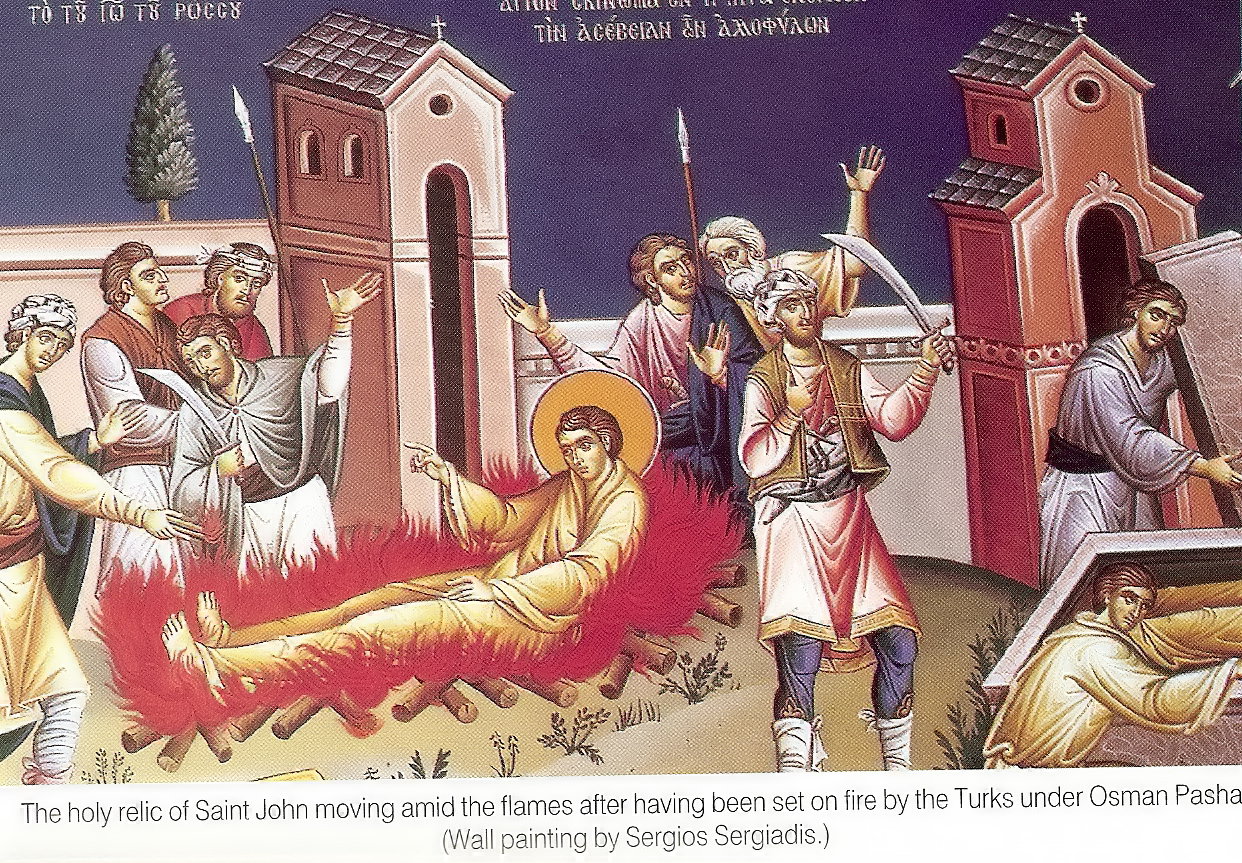
The Saint was given a Christian burial by order of the Agha who, as a token of his love and great respect for the Saint, gave an expensive cloth to cover his relics. Three years later a light appeared over the tomb which was seen by many. At the same time, the Saint appeared in a dream to his father confessor revealing that it was the will of God that his relics be exhumed, for his body was incorrupt. Until 1924 the relics were kept in the church of St. George there in Procopion. When, however, the exchange of population took place between Greece and Turkey, and many of the Christian inhabitants of Procopion were resettled on the island of Euboia, the relics of their beloved St. John were also moved and were received with great acclaim and veneration by the Greeks who built a majestic temple in his honor there in the village of New Procopion. To this day, streams of pious Greek pilgrims make their way to this village on the island of Euboia, where the Saint answers the faith of their earnest petitions with his strong and quick intercession before the throne of God.
(Based on a Life by Photios Kontoglou. The Orthodox Word, June-July, 1967)
From the MIRACLES OF SAINT JOHN
The Saint performed many wonders even after his blessed repose. A descendent of the Agha told many of the following miracle: “My children would not live except for a short time, and would die while yet infants. Their unfortunate mother, after she had lost hope in the wisdom of medicine, fled without my knowledge to the relics of the slave John, so that be might grant her a little child which would not die while yet young, so that we also might rejoice to see it as a young man or even a young girl …. In truth the righteous John heard the supplication of my wife. God granted us a strong little boy whom we called, as you know, Kole Guvan Oglu (that is, “Son of the Slave John”), and he lives through the power of God and the prayers of John even until today.”
Several times St. John has appeared in dreams and visions warning of impending dangers. Once he warned some Greek school children that the roof was about to fall; they had time enough to jump underneath their desks and when the roof fell, its beams came down upon the desks without striking even one of the children.
More recently we have heard about the miraculous healings of two severe cases of meningitis – one a 19 year old shepherd boy in southern Greece and the other a 3-year old boy in London.
Today a part of the right hand of St. John is enshrined in a special silver reliquary in the Holy Transfiguration Monastery, Boston, where many people come to venerate it and to ask the prayers of this simple Confessor of the Christian faith, knowing that the Lord – Who resisteth the proud – hears speedily the prayers of the meek.
In St. Savas Hospital for Cancer
In the big Athenian hospital of Saint Savas, a mother had been battling against the scourge of mankind – cancer – but in her case the illness proved invincible and the doctors told her children to take their mother home,
“Do not tire yourselves anymore by coming to the hospital to look after your mother!”, they told them, (The family was from the town of Kavala in northern Greece,) “There is no hope of her living, Take her home, for if she dies here you will have the bother of dealing with the hospital procedures and regulations,”
Her five children, who were gathered around their mother’s bed, began to weep on hearing the doctors’ final announcement. They wept, for it was their mother – the root of life – who was dying, and we all have only one mother in this life.
At that moment an unknown lady was passing the door of the hospital room where they were gathered, She saw the tragic scene and understood what was happening, “Is this your mother?” she asked the children, “Listen to me, do not go on like this. Above science and doctors there is God and His saints. Whatever was humanly possible you did. Recently, I went on a pilgrimage to the shrine of Saint John the Russian at Prokopi, in Euboea, where his holy body is preserved entire, and I took a little oil from the oil-lamp hanging over the Saint’s relic with which to make the sign of the cross over someone whom I have ill here in this hospital, I will do the same for your mother, and God will provide,”
(How true it is that a few words, a little compassion, a little support, can greatly comfort and help one’s fellow man who is in distress or who is grieving. Even to sit silently next to someone who is suffering, gives them courage.)
With a piece of cotton-wool, the unknown lady made the sign of the cross on the forehead of the sick woman, and left.
II is true that divine energy can be transferred not only directly but also through articles and substances used in worship, such as relics, and holy water and oil, for the Church has absolute belief In the therapeutic power of Christ. This humble way of transmitting the unsubstantial and uncreated energy of God to our bodies and our illnesses by making the sign of the cross over someone using blessed oil or water is described by the Fathers of the Church as the “highest cure and most befitting to God” (Saint John Chrysostom), It can be understood as a deep act of faith that someone should fee! unworthy to ask Christ Himself or one of His saints to come to their aid but who believes that His therapeutic power will be transmitted in this simple manner is not the essence of Christ transmitted through the simple elements of bread and wine?
But let us return to our story,
A little while after the unknown lady had made the sign of the cross over the sick woman, she opened her eyes and, seeing that her children were weeping, nodded to one of them to come close to her” Her eldest daughter drew near and her mother whispered to her.
“Why are you crying, my child?”
“Mother, it has been so many days since you have been aware that we are here and have talked to us. And you ask why we are weeping, “Yes my child, but a little while ago a young soldier came and told me that his name was Saint John the Russian, and he made the sign of the cross on my forehead and told me that I will return to life,
And in spite of her incurable illness, the mother recovered and now lives with her children and grandchildren as ordained by God and His Saint.
(8th august 1978)
A Walking Stick
If you enter the church of Saint John the Russian you will see hanging before the shrine of the Saint, like a spoil of victory, a simple and poor gift: a walking stick. It belongs to Maria Siaka, an old lady from the village of Frenaro near Ammohostos in Cyprus. For eighteen years she had been a hunchback and bent so double that her face was but a short distance from the ground. On 11th August 1978 relatives of the old lady, together with some hundred Cypriots, brought her to the church of Saint John. They lifted her up to enable her to reverence the Saint’s holy and uncorrupted body. Looking at the blessed relic the old lady wept and beseeched Saint John to grant her a little divine help for the remainder of her life. Saint John saw the grandeur of her soul, her grief and also her deep faith. At that moment, before the eyes of everyone there, it seemed that an invisible arm seized her shoulders with tremendous power and slowly began to unfold her body. Her spine creaked and returned to its original form; the old lady stood upright.
Her fellow villagers wept, the bells of the church rang, prayers of thanksgiving were offered by all the Cypriots who could not hold back their tears. Anyone who has had the fortune to be present when a miracle occurs can understand these lines.
Finally, the voice of the old lady was heard: “What can I give you my young man, my Saint? I am poor”. I will give you my walking stick which I will not be needing for the rest of my life,”
The daily papers of Nicosia reported: “Maria Siaka, after her pilgrimage to the church of Saint John the Russian in Greece, can now, after nearly twenty years of being bent double and seeing only the ground, see the faces of her fellow villagers. Thanks to the miracle of the Saint she is restored and completely well.”
(August 11th 1978)
“Do you hate me, my Saint?”
Eight years have passed since the wedding of Mr Yiorgos K. and his wife Archondoula and all this time they have waited in the hope of having a child – but in vain. A deep and incurable sorrow afflicts them. How sad life seems when a woman cannot become a mother, and does not have children. To give courage to his wife, her husband bent close to her and said: “Be patient. It is God’s will. Nothing will be changed by tears and grieving. The purpose of marriage is not only to have children; above all it is to enable us to grow spiritually and to become one with God here on earth and in eternity.”
Mrs Archondoula continued to pray every day with all her heart and soul. From the time she was a little girl her mother had taught her to pray always because, as she used to tell her, “Strong people pray, and prayer arms people with patience and endurance during life’s difficulties.”
From her youth to the present day she had come innumerable times with her family here to the Saint. Many were the times she said to Saint John: “My great Saint John, I beg you, I beseech you, to intercede for me with God that I might be worthy of becoming a mother. By men and their science, for eight years now I have been given the answer that I am not going to become a mother, that I am not going to clasp a baby in my arms – my house will be empty and my heart full of grief. I will wait, my Saint, for an answer from heaven that God will grant me a child so that my house, my heart and my life will be full of joy and happiness. I will wait, my great Saint. “
It is the evening of December the 3rd, 1979. Mrs Archondoula, gloomy and tearful, is trying to concentrate on her prayers. But she is unable to: she is tired, she does not feel well and she has a bad feeling inside her – she wants to weep, to scream, to threaten. She turns to the icon shrine and on seeing the icon of Saint John bursts into tears. “What, after all, have I done to you, my Saint? Do you hate me? Why? Why does not God give me this happiness? My Saint, do you hate me?”
It is past midnight and someone is climbing the stairs of their house. The couple wakes up. “Do not say anything”, whispers the husband. “It’ll be one of our employees who has mistaken the time and has come to get the keys to the office. Do not talk and he will leave.”
There is a knock at the door of their room, then the door opens.
A glow in the darkness delineates the figure of Saint John. “Archondoula, what was that you said in your prayers tonight? Saints do not hate anybody. It is not God’s will for you to have a baby yet. Another two years will go by and then this happiness will be granted to you.” The light then vanished and the voice of the Saint faded.
Two years went by and the joy of God came abundantly with the first child, and then with a second and a third. The sweet voices of the children filled the house and the hearts of their parents.
“The righteous cry, and the Lord heareth, and delivereth them out of all their troubles” (Psalm 34: 17)
Holy Week, Easter 1980
It was the afternoon of Palm Sunday.
“Father, my wife and I have come here to follow and celebrate with you the services of Holy Week, the Passion of our Lord. We both want to confess and if we are worthy to receive Holy Communion. But before you hear us privately we would like to tell you about our personal time of trials.
“For six months now there has been no sign of our daughter. She is in her third year at law school at Thessaloniki. Six months ago she telephoned us to say that she was moving into a new house and that she would call us again to give us her new address.
“As soon as she put the phone down, my wife and I decided to leave for Thessaloniki to find her – we live in a small town in the province of Corinth. The owners of the house where she had been staying did not hide anything from us. Our daughter had left eight days ago and they thought it likely she was being sought by the narcotics division of the police. Lately, she had been returning to the house at dawn and sleeping all day. A lecturer at the university who was a friend of ours cast us into a state of agony and fear with just one sentence: ‘You must find your daughter at any cost,’ he said, ‘she must be in great danger.’ We searched for her, but in vain.
“Two months later she telephoned her mother, and using a vulgar language our daughter had never used before threatened her, saying that we should not try to find her again and that she was finished with us. She did not want to know us and university was a waste of time – there were be~ter things in life.
“For six months now, Father, we have abandonded everything else and used all possible means to find her. She’s vanished into thin air, or she’s gone abroad, or the drugs have killed her and her body’s been disposed of. The Security Police of Thessaloniki told us that this year more than two hundred girls are missing in Greece and most of them will never be found.
“Under no circumstances could we stay at home this Easter. We went to Thessaloniki again and were sickened to the depths by the filthy things we saw at those clubs where we were trying to find her. We returned home but could not bear to stay there. We were at a complete loss as to what to do. You see, we do not have any other children, we are alone in the world. Our last hope is Saint John whom you serve here. All Greece knows about his miracles. We decided to spend Holy Week near him, without eating, and to beseech him with all our strength, all our heart and soul, and with tears, to save our child.”
On Holy Saturday they heard the words of the troparion: “Before the mystery of God let everyone be silent and stand with fear and trembling. “
“Father, we’ll be going home tonight, Holy Saturday. We thought to attend the resurrection service in the church of our small village.”
They left. But they left with a secret hope inside them, and there was joy written allover their faces.
On the afternoon of Easter Sunday all the bells of the church of Saint John were ringing for the Service of Love. I was wearing my festal priestly robes and holding the resurrectional candle and was about to start celebrating the service when I noticed through the half-opened south door of the sanctuary the couple coming towards me with a young woman.
“Father, Father, this is our daughter. Look, this is our Effie, our beloved girl. We found her in our home. She was waiting for us, Father. How can we thank the great Saint? Oh God, God, glory be to You and Your Saint.”
“Share in your parents’ joy, Effie. I am very joyful too to see you here at Saint John’s.”
“Father, I survived. This week I hovered between life and death. I had chosen death but an invisible power, after a superhuman struggle that went on inside me, literally snatched me from the hell-hole of that death and brought me to life, to my house, here. I will sing, Father, I too will sing ‘Christ is risen from the dead’,”
Effie dissolved into tears and her father clasped her shaking body in his arms,
The Service of Love was delayed twenty minutes and people were waiting, but in fact the Service of Love had already begun with Effie’s resurrection.
” .. and let us cry and shout, arise, 0 Lord, You who resurrect the fallen” (Collect of Easter Sunday).
(Miracles are taken from the book “Life and Recent Miracles of Saint John the Russian” by Archpriest Ioannis Vernezos, the Holy Shrine of St John the Russian, Prokopi, Euboea, Greece, 1999).
He that hath called thee from earth unto the heavenly abodes doth even after thy death keep thy body unharmed, O righteous one; for thou wast carried off as a prisoner into Asia wherein also, O John, thou didst win Christ as thy friend. Wherefore do thou beseech him that our souls be saved.
The holy memory, O righteous father, of thine illustrious contests hath come today gladdening the souls of those who venerate thee with reverence and faith, O John.
(Troparion of St John, in Romanian)
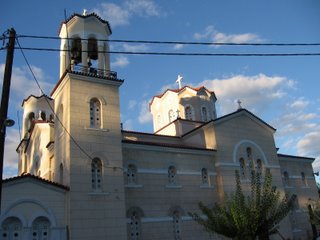
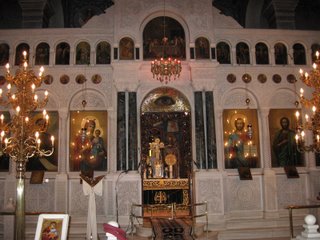
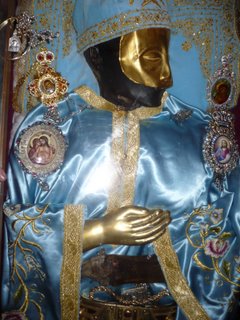
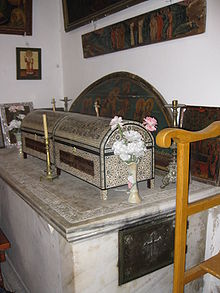
(The photos in this post are taken from the beautiful church of St John in Eubola, Greece. The church bared witness to the greatest miracle of Orthodoxy, the holy relics of the saints. The uncorupted body of St John lays in peace for over 200 year in the church).
Motto: “Sleepwalking Christians are the heart of the crisis of Western civilization in our day. They are unwilling or unable to offer explicitly Biblical alternatives to the collapsing humanist order. Until about 1980, they fervently believed that the humanists possessed some legitimate title to the seats of power in this world, and they still believe that common natural law moral and legal principles are sufficient to hold the world system together until Jesus comes back in glory. So they sit on the sidelines of life, waiting for Jesus to bail them out, or “up”, literally. Just as He bailed out Israel when the Assyrians arrived? Just as He bailed out Judah when the Babylonians arrived? Just as He bailed out Latvia, Estonia, and Lithuania when the Soviet troops arrived? But we’re different, of course. We’re Americans. No need to worry. And if 1.5 million babies are aborted here each year, it isn’t the Christians’ fault. Jesus is coming soon. Sit tight. Pray. And don’t miss the Superbowl next Sunday…”
(Gary North in the “Healer of the Nations” )
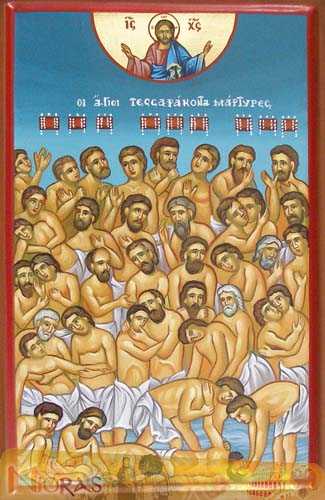
All of them were soldiers in the Roman army and steadfastly believed in the Lord Jesus. When the persecution of Christians began during the reign of Licinius, they were brought to trial before the commander. When he threatened to strip them of their honor as soldiers, one of them, St. Candidus, responded, “Not only the honor of being a soldier, but take away our bodies, for nothing is more dear or honorable, to us than Christ our God.” After that, the commander ordered his servants to stone the holy martyrs. While the servants were hurling stones at the Christians, the stones turned and fell back on the servants, severely striking them. One of the stones struck the commander’s face and knocked out his teeth. The torturers, angry as wild beasts, bound all of the holy martyrs and tossed them into the lake and stationed a guard around it so as to prevent any of them from escaping. There was a terrible frost and the lake froze around the bodies of the martyrs. So that their pain and suffering would be worsened, and in order to persuade one of them to deny Christ and acknowledge the idols of Rome, the torturers heated a bath by the side of the lake in sight of the frozen martyrs. Indeed, one of them was persuaded. He came out of the water and entered the bath. And behold, an extraordinary light appeared from heaven which warmed the water in the lake and the bodies of the martyrs. With that light, thirty-nine wreaths descended from heaven over their heads. Upon seeing this, a guard on the shore removed all his clothes, confessed the Name of the Lord Jesus and entered the lake so that he could become worthy of the fortieth wreath in place of the betrayer. Indeed, the last wreath descended upon him. The next day the entire town was astonished when they saw that the martyrs were still alive.
Then, the wicked judges ordered that the lower part of their legs be broken and their bodies thrown into the water so Christians could not recover them. On the third day the martyrs appeared to Peter, the local bishop, and summoned him to gather their relics and remove them from the water The bishop with his clergy went out into the dark of night and beheld the relics of the martyrs shining brightly in the water. Every bone which was separated from their bodies floated to the top and glowed like a candle.
Bishop Peter gathered and honorably buried them. The souls of these martyrs, who suffered for all of us, went to the Lord Jesus, resurrected with glory. They suffered honorably and were crowned with unfading glory in the year 320 A.D.
(Written by Bishop Nikolai Velimirovich in “The PROLOG FROM OHRID”)
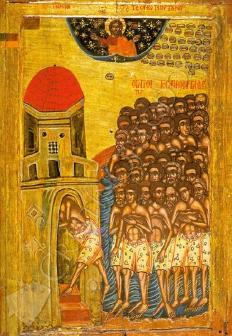
The 40 Holy Martyrs from Lake Sebaste, celebrated on March 9, formed a community of witnesses who confessed Christ, being thrown into a frozen lake, where they were warmed by the love they manifested for each other.
These Holy Martyrs remind us much more than an event that took place 1700 years ago; they show us “the way of the Christian”, the way that contemporary martyrs and confessors for Christ had followed, while suffering in communist concentration camps or earlier persecution under the pagan Roman law.
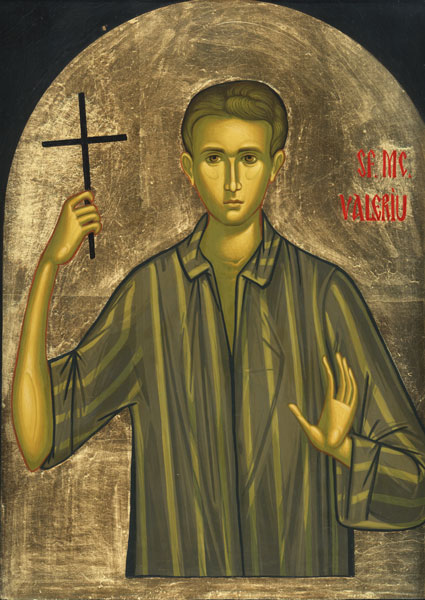
We remember today a brilliant Aleksandr Solzhenitsyn – when asked at a press conference his opinion on why the terrible events behind the Iron Curtain had occurred, why millions of Christians were carted away, tortured, starved and worked to death in Gulag slave camps, he gave this simple, yet startling, response: “Man has forgotten God”…and, we remember many more – with a pure and sincere love for Christ who had the “guts” to reject a life of compromise and wickedness. “Now is the time for repentance!” cried out from his deathbed confessor Valeriu Gafencu martyred for Christ in the concentration camps.
The message of martyrdom is the same at all times and places and, it has the same value today, because it is the message of our crucified Savior.
Let us pray to the Holy 40 martyrs and to all the saints to enlighten and show us the way in these unstable and confusing times. Amen!
Please also see: Let us honor the Martyrs – by father George Calciu
Quotes from Aleksandr Solzhenitsyn
“Man has set for himself the goal of conquering the world but in the processes loses his soul.”
“The salvation of mankind lies only in making everything the concern of all”
“Own only what you can always carry with you: know languages, know countries, and know people. Let your memory be your travel bag.”
“Justice is conscience, not a personal conscience but the conscience of the whole of humanity. Those who clearly recognize the voice of their own conscience usually recognize also the voice of justice.”
“A state of war only serves as an excuse for domestic tyranny.”
“For a country to have a great writer is like having a second government. That is why no regime has ever loved great writers, only minor ones.”
“Hastiness and superficiality are the psychic diseases of the 20th century, and more than anywhere else this disease is reflected in the press. “
“I have spent all my life under a Communist regime, and I will tell you that a society without any objective legal scale is a terrible one indeed. But a society with no other scale but the legal one is not quite worthy of man either.”
“You only have power over people so long as you don’t take everything away from them. But when you’ve robbed a man of everything, he’s no longer in your power – he’s free again.”
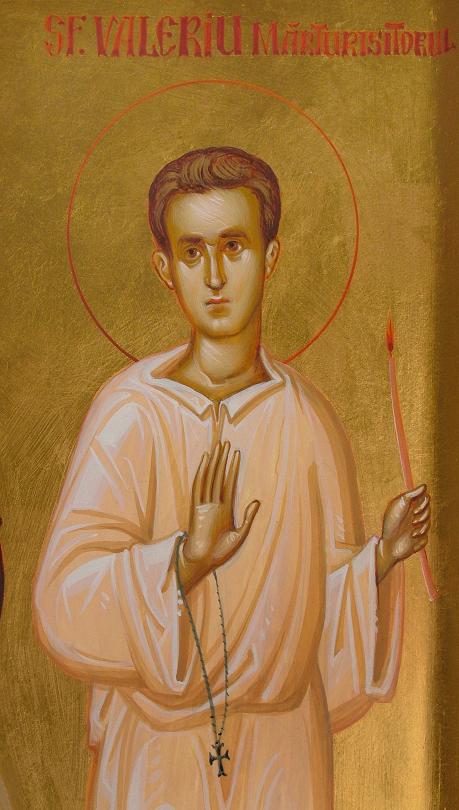
Confessors of Christ from the Gulag: Valeriu Gafencu
Taken from the book: “The Saint of the Prisons”
(Translated by Monk Sava)
“When he was feeling better,” continues his friend – Ianolide, “Valeriu spoke beautifully and with fervor, focusing mainly on his favorite subject: interior purification and union with Christ. “’Through baptism, we received purifying grace, while being anointed with Holy Chrism, we have been adorned with all the gifts of the Holy Spirit. But this blessed internal state is ineffective within us; we are Christians in name only.
We live in a world of confusion, of loose morals, of sin. It’s considered shameful to be a believer and old-fashioned to be moral. The baptized man, in order to be saved, has to live all his life in the Holy Spirit, but we haven’t succeeded in doing this. We have believed, we have prayed, we have kept the faith, we have suffered, but in order to be united with Christ, one must purify oneself inwardly through confession and renew oneself through Holy Communion. Therefore unite yourself to Christ conscientiously and with great steadfastness, making yourself a bearer of His holiness, His power, His love, His light, His immortality. You must oppose sin mercilessly. Then you will be reborn. There is no path of compromise.’
“Another time he said to us, ‘The teaching of Christ is so wonderful, so consummate, that if we understand it, we have the most powerful argument possible for the existence of God. When I had this revelation, I wept from pain and from happiness! Those who believe in Him must bear witness to this truth even if it means being martyred. Wasn’t the Son of God killed as an enemy of His people?’
“The seed that he scattered brought forth fruit. Day by day, people drew ever closer and ever more sincerely to Christ, Who became the source and guide of their lives and their thoughts. “One day Valeriu was feeling so bad that we thought he was going to die. In addition to all the other illnesses he suffered from, he also developed acute appendicitis. He could have been left to die, but that would not have been ‘humanitarian.’ Humanitarianism is the hypocrisy of cruelty, it brings to light the poisonous and lamentable domain of the Communist revolution, with its slogans and beautiful vestments.
So the doctor sent a report to prison administration so that he could be transported to the hospital in town for an operation. The penitentiary agent came to him and said: “’Your life is in my hands. If you don’t have this operation, you will die.’ “Valeriu smiled indulgently and answered: “‘If one man’s life depends on another, then this man indeed has great responsibility! But if everyone would realize that their lives depend on God, then everyone would value the life of his neighbor!’ “’You’re crazy,’ the agent said to him, and sent him to the operating room under strict guard. “When he came back to the sanatorium, the agent said to him: “ ‘Look, you were face to face with death! You see, we wanted to show you that your life is in our hands. Maybe now you’ve changed your mind and you’ll cooperate with us. We’ll give you streptomycin. (Streptomycin was the first antibiotic remedy for tuberculosis).
You’ll also get packages from your family. And you know what might happen later?… You’re an intelligent man and you could be useful to us. We know
that you’re not interested in politics, but in religion, but isn’t the patriarch and all of his priests on our side now? Why don’t you join our side too? You have a lot to gain!’“
’I thank you for allowing me to have an operation. From now on, my torments will go on even longer…. As for the rest, between you and me, there is a matter of conscience. For the sake of my spiritual freedom I have decided to die. It is good that the truth be told plainly, and I serve the truth. I am not the judge of others, but a confessor of God.
There is nothing under the sun that can survive without God. You cannot accept Christ. I cannot accept spiritual death.’
“’I told you already that you are crazy!’ shouted the agent. ‘I’m going to file a report. You are a reactionary, a fascist, an enemy of the people, in the service of American bandits! We know how to deal with people like you! You’re only fit to die! Go and die with your Christ! I won’t try to stop either Him or somebody like you!’
’You can kill me now, but no one can kill Him any longer. He is a stumbling block for all kinds of pride. Understand well that Christ is the only power that can deliver mankind from suffering and sin.’
“’Give up all this nonsense. The truth is on our side!’“
’The truth is love that sacrifices itself for the poor and the persecuted!’
“’Look here, you’re staring death straight in the face and you’re giving me mystical sermons?! You want to convince me too? See, now you’ve gone too far! You’ve spread yourself too thin.’
“Valeriu struggled to keep looking at him, because his eyelids had grown heavy. He felt worn out physically, but an internal joy compelled him to speak about faith in order to leave an eternal testimony. The smile of his measureless love blossomed on his cheeks. He prayed in secret for this unhappy man and for God to deliver the world from leaders like him.
“The agent was confused, muddled. He swore a blue streak and then ordered that Valeriu be taken back to his room. “’You can’t say that I didn’t behave decently with you’, the agent later added. ‘I offered you life, but you want death. The devil understands all this!’ “And then they parted company. After that, the agent never bothered him again, but came back into the room many times to take a long look at him.
“Valeriu realized that he would never get anything from the agents, but he took it upon himself to say to them, ‘There are very valuable people here who can be of use to the country, but they are dying because they have neither streptomycin nor news from their families. You can save them!’
“But the agents didn’t want to save them. In their belief system, the individual didn’t count, any man could be replaced with another. What counted was the system. The ideas of these prisoners undermined the system, therefore their prison sentences were definitive. “
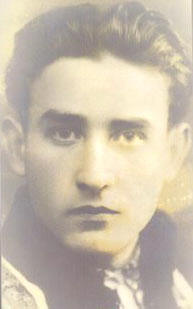
Valeriu had a discussion regarding this issue only one additional time, with an inspector from Bucharest. The inspector stopped at Valeriu’s bed and asked him: “ ‘What’s your name, prisoner?’
– Mr. Inspector. I am the prisoner Valeriu Gafencu,’ he responded, using the required greeting. “’Aha,’ said the inspector, looking at him sternly. “’
– Mr. Inspector, we ask that you grant us the same rights the Communist prisoners had here!’
– “’We will not repeat the mistakes of the past,’ answered the inspector drily. ‘Our humanism does not apply to reactionaries.’ “
– ’Mr. Inspector,’ continued Valeriu, ‘the men here are sick, powerless. Every day, one of us dies. Besides we are subjected to threats of terror and torture.’
– “’How dare you speak to me that way?! We don’t want to turn you into heroes! At best, we’ll make you informers, and your wives and sisters prostitutes!’ “
– Valeriu was deeply pained and answered, ‘The sins of this world have to be atoned for. We, prisoners here, we are atoning for many sins. All of us, however, are in the hands of God.’
– “’You are a mystic bandit! You will die here! Don’t think for one moment that you will get out alive! Even the sickly way you are now, you too will be forced to undergo re-education!’ “
– ’The way I am is an advantage,’ answered Valeriu, ‘because I won’t be able to last for long. A few blows will be enough to finish me.’
– “’Go to hell!’ shouted the inspector. ‘We’ll make sure that you die slowly, painfully, until you give up that Christ that you‘re trying to scare us with. We hate Him, and you, and all of you! We’re going to destroy you all! Here there is no more Christ, dead or resurrected. We’ll see to it that future generations don’t know His lies or yours! We ourselves are the christs of this world!’ “
– ’May God forgive you,’ answered Valeriu and lowered his head in prayer, expecting to hear an order that he be crushed to pieces. “But he wasn’t killed then. His toil continued for a while longer.”
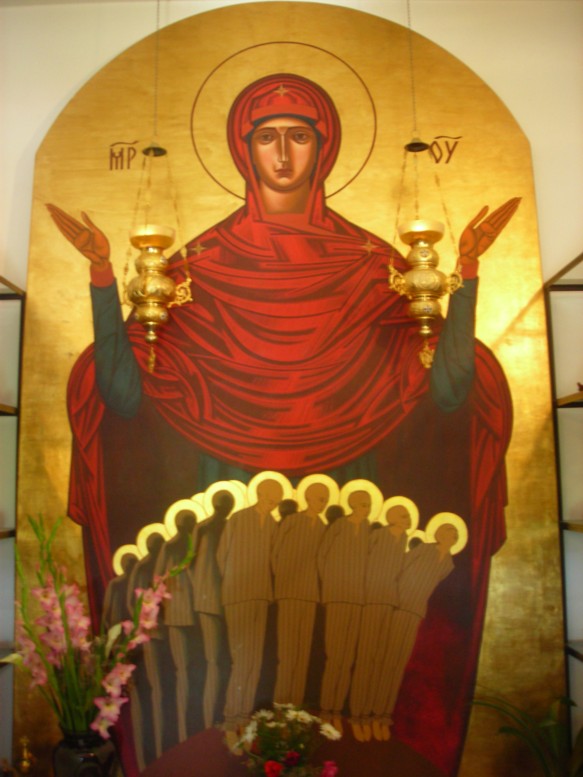
I Saw the Mother of God
During the night of his last Christmas, toward dawn, Valeriu testified to his friend – Ioan Ianolide:
“This night, I kept vigil. I was waiting for my carol to come. I wanted it to be very beautiful. I sang it in my head. I heard it in the high heavens, from where it descended. Rather difficult for me, since I don’t know musical notes and I have to sing by ear. So I was awake, lucid and serene, when, all of a sudden, I noticed a photograph of Seta – the girl he had loved – in my hand. Amazed by this, I lifted my gaze and at the head of my bed I saw the Mother of God, clothed in white, vivid, real. She was without her child. Her presence seemed material to me. The Mother of God was actually beside me. I was happy. I forgot everything. Time seemed endless. Then she said to me:
“’I am your love! Don’t be afraid. Don’t doubt. My Son will be victorious. He has sanctified this place now for future life. The powers of darkness are growing and will frighten the world still more, but they will be scattered. My Son is waiting for people to return to the faith. Today, the sons of darkness are bolder than the sons of light. Even though it may seem to you that there is no more faith left on earth, nevertheless, know that deliverance will come, albeit through fire and devastation. The world still has to suffer. Here, however, there is still much faith and I have come to encourage you. Be bold, the world belongs to Christ!’
“Then the Mother of God disappeared and I remained overwhelmed with happiness. I looked at my hand, but the photograph was no longer there.”
Poem
My eyes are sad and my forehead tired
From so much vigil and waiting.
My heart is sick, worn out
From difficult and prolonged running
And cries like a wounded bird.
When my eyes close and I seek within myself
The power to climb Golgotha to the top,
A voice, an echo from the depths
Says to me meekly, “Life is Jesus!
The precious pearl is within you.”
I look at the wondrous morning
Of the Resurrection from the grave,
With Magdalene, as if another time,
I kneel before Thee, weeping.
And I am happy and weep with Thee in thought.
Written by Valeriu Gafencu – While in the Communist Gulag
(Continued from the previous post)
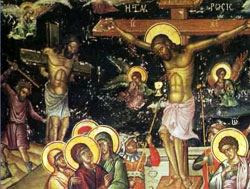
The Seven Deadly Sins
Pride: is the source of all spiritual evil. It is a spiritual greed through which the demons fell from the grace of God.
1) Are you proud, haughty, conceited?
2) Do you put too much faith in your own beauty or your wealth, have you grown proud because of them?
3) How do you behave with those who are rich or important?
4) Do you despise anyone?
5) Are you willing to talk to anyone?
6) Are you hypocritical (you say one thing, and do another)?
7) Have you bragged through deeds, words, or clothing?
8. Have you said something in order to be praised?
9) Have you slandered your neighbor in order to lower his honor and in order to raise up your own?
10) Have you born the offenses of him who offended you?
11) Have you forgiven those who upset you?
12) Have you prided yourself on your learning and knowledge?
Greed: Starting out as something abstract, egotism is put into effect through greed.
The Holy Apostle Paul is looking from this point of view when he says that greed is the root of all evil.
1) Are you greedy for food and drink [gluttony]?
2) Do you want to collect wealth or other things?
3) Are you greedy in accumulating money, have you deceived your neighbor for this reason?
4) Have you eaten or drunk secretly?
5) Have you eaten on fast days or before the Holy Liturgy?
6) Have you eaten carrion?
Laziness: is the failure to make use of the physical and spiritual powers that God has granted us to use in our lives.
1) Are you lazy?
2) Do you waste time without working?
3) Do you occupy yourself with things that are vain or pointless?
4) Do you pray regularly?
5) Do you look after your soul?
6) Do you do your duty as a clerk, worker, servant?
7) Do you force those smaller than you to do your work?
8. Have you sought a spiritual father who is more lenient?
9) Have you fulfilled your penance?
Anger: is also based upon the pivot or axis of greed.
When a man cannot fulfill his desires, he becomes angry because he is prevented from achieving his evil goal. Man is allowed to be angry only against sin.
1) Have you done evil through anger, cursing, beatings, etc.?
2) Do you get angry often? How long do you stay angry? You should know that St. Paul said, “Do not let the sun set on your anger.” (Eph 4:26)
3) Are you presently angry with anyone?
4) Have you beaten or struck anyone with a stick, a club, or your palm?
5) Have you angered or scolded anyone without good reason, spitefully?
6) Have you wished evil to someone who did you evil? Or to someone who did you good?
7) Have you gotten angry with a neighbor because he is somehow better than you? Have you envied him?
8. Have you shed anyone’s blood (in drunkenness)?
9) Have you engaged in a duel?
10) Have you prayed, in anger, that evil come upon your enemies?
Avarice (Greed): is material and spiritual.
Material when someone does not want to provide physical comfort to the poor, while spiritual when one does not want to steer someone away from evil.
1) Are you stingy?
2) Have you ever deprived a neighbor of necessary things out of stinginess?
3) Have you helped the poor?
4) Have you called both the rich and the poor to eat at your table? You should know that the Savior urges us to call to our table those who cannot repay us.
5) Do you sell items at too high a price?
6) Do you cheat people?
7) Do you regret any good deed that you have done?
8. Do you eat little and clothe yourself or your family poorly in order to grow rich?
9) Do you neglect the health of your children, wife, parents, brothers, in order to avoid spending money?
Envy (Quarreling or Jealousy): When an angry man cannot prevail over the obstacles that are in his way by anger, unable to do anything else, he sweetens his heart with the passion of envy, so that he might conceal his neighbor’s spiritual and physical honor and exalt himself.
1) Have you argued with anyone?
2) Do you like to argue?
3) Do you hate anyone?
4) Do you deride or disdain anyone?
5) Do you give advice maliciously?
6) Are you presently jealous of anyone?
7) Are you on speaking terms with everyone?
8. Have you given anyone a bad nickname?
9) Have you sown dissension between brothers?
10) Have you been jealous of anyone because he is somehow better than you and enjoys more honor, wealth, social standing, etc.?
Lust: is also a form of greed, but not of a material or spiritual order, but of a sentimental order. The sin of dissoluteness, unlike all other sins, is committed with the body.
The body is the temple of the Holy Spirit. (You can commit the sin of dissoluteness by looking at or hearing things that cause you to sin. Even eating, sleeping too much, speaking, etc.)
1) Have you fallen into fornication?
2) Or adultery?
3) Do you like to see or read books that cause you to sin in your thoughts, do you like to hear or to speak vulgar or shameful words? You should know that St.
Paul tells us that there should not be heard from our mouth any foul or filthy words, nor silly jokes that are improper, nor words that are imprudent.
4) Do you like to speak sensibly or senselessly?
5) Are you mastered by any passion?
6) Do you eat or sleep too much? You should know that St. Paul also said “All things are permitted to me, but not all things are useful.” (1 Cor. 6:12)
7) Do you have in your home paintings with naked bodies? Do you look at them passionately?
8. Have you committed sexual sins with blood relatives or spiritual relatives (godchildren, godparents)?
9) Have you touched someone’s body, overcome by the passion of lust?
10) Have you wanted to see the shameful parts of the body?
Sins That Cry Out to Heaven
A. Voluntary Killing
1) Have you killed anyone?
2) Have you sought to kill?
3) Do you want to kill anyone?
4) Have you sought to gain revenge by killing someone?
5) Have you beaten anyone?
6) Have you quarreled with or threatened anyone?
B. Sodomy (coupling against nature)
1) A man with a man or any kind of animal?
2) A man with a woman against nature?
3) Masturbation. Have you masturbated?
C. Withholding the pension or the wages of orphans, widows, workers, employees, or servants.
1) Have you withheld pensions or salaries?
For what reason, as reimbursement for something broken, or other reasons?
2) Have you withheld pay partially or unjustly?
3) Have you always compensated others for the work they have done?
D. Oppressing widows, orphans, invalids, or the helpless.
1) Have you beaten children, old people, or orphans?
2) Have you derided or made fun of them?
3) Have you oppressed anyone weaker or smaller than you?
4) Have you laughed at the crippled or the helpless?
5) Have you angered or irritated them?
6) Have you somehow been obligated to help them and failed to do so?
7) Have you helped those whom you were not required to help, or did you pass them by like the priest and the Levite in the Gospel in the story of the good Samaritan?
8. Have you deliberately caused a blind man to fall by guiding him wrong?
9) Have you made fun of anyone who is helpless, deaf, a stutterer, lame, crippled, one-eyed?
Obligations Regarding the Spiritual Life of our Neighbor
1) To protect our neighbor from sin
2) To teach the uneducated (ignorant)
3) To give good advice to those who have need of it
4) To pray to God for others
5) To comfort the sad/grieving
6) To suffer patiently when we are treated unjustly
7) To forgive the sins of others
Commandments Regarding the Physical Life of Our Neighbor
1) To give food to the hungry. Have you given or not?
2) To quench the thirst of the thirsty
3) To clothe the naked
4) To care for the sick
5) To take in and show hospitality to strangers
6) To inquire after those in prison
7) To bury the dead
Strange Sins
1) When you advise someone to sin
2) When you order someone to sin
3) When you permit someone to sin
4) When you help someone to sin
5) When you praise someone who sins
6) When you were able to but didn’t want to prevent someone from sinning
7) When you know that someone is sinning but you don’t tell him
Sins against the Holy Spirit
1) Disregarding the grace of God and having excessive trust in one’s own self
2) To believe that God does not have the power to forgive you is a very great sin.
3) To believe that you are everything and that
God has no power in the world
4) Lack of trust in God
5) Opposition to the Truth established by the
Holy Church
6) Leaving the Orthodox Church. Guard yourself from this sin, for Christ says, “He who blasphemes against the Holy Spirit has no forgiveness, but is guilty of eternal condemnation.” (Mk 3:29)
The Nine Church Commandments
1) Church attendance every Sunday and every feast day
2) Keeping the four fasting periods of the year
3) Respect toward the Church’s representatives (priests, monks, nuns)
4) Confession of sin during the four fasts
5) Guarding ourselves from heretics
6) To pray for our country’s leaders and the officials of the church
7) To abstain from weddings and parties during the fast periods
8. To protect those things belonging to the church from inappropriate use
9) To keep the fasts and to say the prayers that the bishop ordains in times of trouble
Various Sins
1) Failure to carry out one’s obligations:
a) Have you carried out all your obligations to God, to your own self, to your neighbor?
b) Have you carried out the penance given to you in confession?
2) Theft of holy things
a) Have you lied at confession?
b) Have you avoided telling everything and for what reason have you done so?
Counsels
a) Go to confession at least four times a year, during the fasts.
b) Fast before confession.
c) Maintain the same spiritual father.
d) Make a serious examination of conscience before going to confession.
e) Write down all your sins, otherwise you might forget them. After confession, burn the paper
at once.
f) Confess not only sins you have committed, but also those of your heart.
g) Do not conceal any sin.
h) Be reconciled with those who have offended you.
i) Avoid occasions of sin.
j) Give up your sins – make a promise that you will no longer sin.
k) Feel contrition for your sinfulness.
l) Guard yourself from sins.
m) Receive Communion only if you feel clean.
Otherwise, it will be for condemnation.
n) Fulfill in a holy manner the penance given to you by your spiritual father.
o) Judge only yourself for the sins you have committed.
Each one of us has his or her own mission to fulfill, but we must heed the advice of our spiritual father, who puts aside our own ill-informed will, making room for the will of God in each one of us. Our spiritual father reveals the will of God in us. If we don’t heed him, we can wander astray and make mistakes that are even worse than the passions. I consider a friend anyone who sends me even one thought of love. And I wish and request that every one of my friends copy down this guide to confession. I have written this as best as I could, in great haste, out of a genuine wish to send you this guide to confession.
With all my love, Valeriu.
The end and glory be to God!
(Taken from the book “The Saint of the Prison”, Translated by Monk Sava – an American convert to Orthodoxy from Oasa Monastery)
Written by Valeriu Gafencu – while in the Communist Gulag
(continued from the previous post)
The Ten Commandments
The First Commandment:
I am the Lord thy God, thou shall not have any gods before me.
1) Do you believe in God?
2) Do you believe in the Holy Trinity?
3) Do you worship God?
4) Do you love Him?
5) Do you know Him? Have you compelled yourself to learn something about God from the books of Holy Scripture, church books, or from somewhere else?
6) Do you somehow believe in charms and magic spells?
7) Have you visited fortune tellers and astrologers?
8. Do you practice occultism?
9) Do you believe in dreams? Believe only in God.
10) Do you somehow bestow more honor upon some creature or things than to God?
11) Do you value money, food or wine, a woman or a man, more than God?
12) Have you ever grumbled against God?
13) Have you despaired because of any trouble, misfortune, or any other evil that has befallen you?
14) Have you opposed the truths of Christian teaching?
15) Have you read books that are against religion?
16) Have you given such books to someone else to read
17) Have you attended gatherings of nonbelievers?
18) Have you read their books and magazines with the intention of discovering another truth other than that of the Church?
19) Have you defended lack of faith or sects or Islam?
20) Have you brought gifts to sectarians?
21) Do you believe in superstition or paganism?
22) Is God your main concern?
23) Have you always put hope in God?
24) Do you believe that heaven and hell exist?
25) Do you believe that there will be a judgment?
26) Do you put too much trust in the goodness of God and in this way not fear judgment?
27) Do you believe that God can no longer forgive you because of the multitude and gravity of your sins?
28) Have you always sought the help of God?
29) Have you prayed regularly? Evening, morning, and at noon?
30) Do you go to church regularly?
31) At prayers and at church do you think only of God?
32) At the end of the day, do you remember God?
33) Have you brought thanks to God through all your deeds?
34) Have you sought His help before doing something?
35) Do you sometimes say prayers only from habit?
36) Do you think of other things during the time of prayer?
37) Does the thought ever come to you that you cannot be saved?
38) Have you put off repentance until old age?
39) Do you deliberately go late to church?
40) Do you pay attention to the service?
41) Do you laugh or talk or look at other people when in church?
The Second Commandment:
Thou shall make no graven image or the likeness of any thing of what is in heaven or on earth, in the sea or on the earth, nor shall you worship them or serve them.
1) Do you believe that some men are great and have the same value that Christ had? For example, philosophers or religious leaders.
2) Do you believe in the holy icons?
3) What kind of worship do you accord them?
4) Do you believe that an icon is in fact the very saint that it depicts?
5) Do you believe in people – your wife, your husband, your child – instead of believing in God?
6) Do you worship things such as money, food, drink, or other pleasures?
7) Is your own mind your only law and do you do only that which it tells you?
The Third Commandment:
Do not take the name of the Lord Thy God in vain.
1) Have you ever sworn by God the Father or by the Savior Jesus Christ?
2) Have you sworn by the angels, archangels?
3) Have you sworn by the Holy Virgin?
4) Have you sworn by the saints, the church, Pascha, the oil lamps, the icons, the cross, or other things?
5) Have you brought false witness to the Name of God?
6) Have you sworn other kinds of oaths, for example on your eyes, your life, the salvation of your soul? For the Savior said, „Let your speech be yes and no; for anything more than that is of the devil.”
7) Have you cursed anyone? Have you sent others to the devil or yourself?
8. Do you have the habit of cursing those who do you wrong? The Savior taught us to pray for them.
9) Have you sworn a false oath?
10) Have you sworn a true oath?
11) Do you use as an oath the word “zău,” which is an abbreviation for “pe Dumnezeul meu” [upon my God]?
The Fourth Commandment:
Remember to keep holy the Sabbath day.
Sunday is the Lord’s day. And all the feast days instituted by the church throughout the year have the same value.
1) Have you kept all Sundays and feast days?
2) Were you in church on each of those days?
3) Did the other members of your household keep them, did they attend church, did you prevent them for any reason?
4) Have you given others work on those days? Do you go to church late?
5) Did you keep the Lord’s day in a worthy manner? Or is it for you an ordinary day or a day for parties and amusements? Do you go to church in the morning? In the afternoon do you read books that are useful and constructive for the soul?
6) Do you look after your soul more on those days than on others?
7) Have you done or participated in a clacă (see 199)?
8. Do you behave improperly in church?
9) Have you cursed the church or the servants of the Holy Altar?
10) Do you honor priests as the servants of God?
Do you make fun of them or disdain them? Do you gossip about them and speak of their sins?
11) Do you pray for them? Do you obey them?
_____________________________________________________________
(199 Clacă: An informal gathering around a campfire for conversation,
music, and dancing. – Translator’s note)
The Fifth Commandment:
Honor thy father and thy mother.
1) Have you beaten your parents or in-laws?
2) Have you abused them or persecuted them?
3) Have you heeded their advice?
4) Have you deceived them in any way?
5) Have you taken advantage of their good faith?
6) Have you helped them when they are in difficulty?
7) Have you done church services for them after their deaths?
8. Have you helped your brothers and sisters?
9) Have you taken care of your wife and children?
For St. Paul says, If anyone does not look after his own, and especially those of his own household, such a one has abandoned the faith and is worse than a non-believer. (1 Tim 5:8)
10) Have you beaten your wife? Have you held anything against her? Have you abused her?
11) Have you honored your husband? Have you loved your husband or wife as your own self?
12) Have you deceived your husband or wife?
13) Have you made his/her life more difficult? Do you nag or criticize?
14) Have you sufficiently looked after the spiritual well-being of those in your household?
15) How have you behaved with your spiritual fathers? Godparents, teachers, priests? Have you respected them and helped them?
16) Have you been insolent or stubborn with your parents?
17) Have you upset them? Angered them?
18) Have you spoken ill of them or derided them?
19) Have you made fun of their weaknesses?
20) Have you been mindful of your religious obligations?
21) Have you been ashamed of them?
22) Have you spent money on useless things (tobacco or other pleasures), causing your family to be lacking in necessary things?
If you are a parent:
23) Have you steered your children on the path of the Church, in word and in deed?
24) Have you set a bad example with arguments, drunkenness, filthy language, lying, stealing, dishonor, gossiping, laziness?
25) Do you live with a concubine and the children see it?
26) Have you punished them for bad deeds: such as arguing, lying, fighting, stealing? Have you spared them out of mercy?
27) Have you prayed for your children, wife, husband, brothers, sisters, parents?
28) Were you too harsh or too easy on your children?
29) Have you had bad servants who taught your children things harmful for the soul? If you are a guardian:
30) Have you fulfilled all your material and moral obligations toward the children?
31) How have you behaved with your servants or apprentices?
32) Have you paid them honest wages, have you held anything back for any reason?
33) Have you encouraged them to fulfill their religious duties?
34) Have you encouraged them to commit any sin?
If you are a servant:
35) Have you obeyed your master or boss?
36) Have you diligently fulfilled all your duties?
37) Have you done your work in a careless, slipshod manner?
38) Have you stolen anything?
39) Have you told bad stories about the house to others?
The Sixth Commandment: Thou shall not kill.
1) Have you ever killed anyone, voluntarily or involuntarily?
2) Do you want to kill anyone, or have thoughts of revenge? Have you ever praised anyone who killed?
3) Do you want anyone to die, in order to gain their wealth, wife, husband, etc.?
4) Have you beaten anyone?
5) Have you threatened anyone?
6) Do you hate anyone, are you reconciled with all those you know?
7) Do you wish anyone evil, death, or harm?
8. Do you rejoice when evil befalls your fellow man?
9) How do you behave with those around you?
10) If you are a man, have you abandoned your children?
11) If you are a woman, have you voluntarily abandoned your baby?
12) Have you sought to kill yourself, directly or indirectly?
13) Have you gone hunting?
The Seventh Commandment:
Thou shalt not commit adultery.
Those unmarried commit fornication, those married adultery.
1) Have you committed fornication, or if you are married, adultery?
2) Do you live as a concubine?
3) Do you sin against nature – masturbation or homosexuality?
4) Do you desire to sin with the husband or wife of another?
5) Do you seek opportunities to commit sexual sins?
6) Do you think about shameful things too much?
7) Do you seek to recall such scenes?
8. Do you want to see the shameful parts of the body?
9) Do you speak about shameful things?
10) Have you read books that give you sexual pleasure?
11) Have you urged anyone to commit such sins?
12) Have you caused someone else to sin through clothing or dressing up?
The Eighth Commandment:
Thou shalt not steal.
A priest cannot forgive the theft of something that has not been returned. Therefore, give back what you stole and then go to confession.
1) Have you stolen money or other objects from the state, society, or any man?
2) Have you done harm to others?
3) Have you helped those you have harmed to recover?
4) Have you taken adequate care of the wealth of another man that has been entrusted to you?
5) Have you given back money or other objects that you borrowed?
6) Have you received stolen things (things that were stolen)?
7) Have you given back things that you found?
8. Have you secretly changed the property line between you and your neighbor?
9) Have you urged someone else to do this?
10) Have you charged too much interest for borrowed monies?
11) Have you altered merchandise and then sold
it as if it were good?
12) Have you deceived anyone by weighing or counting goods wrongly?
13) Have you taken things by force from someone smaller than you?
14) Have you accepted bribes?
15) Have you taught children to steal?
16) Do you have thoughts about making money by dishonorable means?
The Ninth Commandment:
Thou shall not bear false witness.
1) Have you sworn a false oath?
2) Have you lied?
3) Have you born false witness?
4) Have you behaved correctly with your neighbor?
5) Have you lied to him?
6) Have you told lies about others?
7) Have you purposefully spread false account about others?
The Tenth Commandment:
Thou shall not covet thy neighbor’s wife.
Thou shall not covet thy neighbor’s goods.
1) Have you desired the wife, daughter, husband, or son of your neighbors?
2) Have you desired the wealth of your neighbor?
3) Have you desired the social status of someone higher than you?
4) Have you hated your neighbor for any reason?
5) Have you desired the house, the land, the vineyard, or the work of your brother?
(Taken from the book “The Saint of the Prison”
Translated by Monk Sava – an American convert to Orthodoxy from Oasa Monastery) to be continued…
“A man, as well as people, has value to the degree
to which he has understood the Gospel and can
follow the teaching of Christ”
(scholar: Simion Mehedinti)
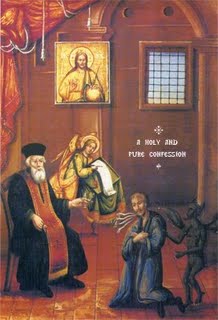
A Guide to Confession – Written while in the Communist Gulag by Valeriu Gafencu
Introductory Notes: In general, too little is known about the spiritual life of confessors in Communist prisons and the various types of such confessors. It is true that until the collapse of Communism it was impossible to uncover anything, while after the collapse in 1990 testimonies of the survivors were not always available to those who were interested. Nevertheless, it would be of no small benefit to anyone to devote oneself to reading testimonies of those who passed through these prisons. In them, one would find such valuables which can rightly be compared to those found in a Paterikon or in the lives of the saints. Among the many portraits of the confessors, one will be found in particular that is recalled with reverence by all and is considered a saint: Valeriu Gafencu. Nicknamed “the saint of the prisons”3 by Father Nicolae Steinhardt) a Jew converted to Orthodoxy) in a truly inspired moment, Valeriu Gafencu was one of the more impressive figures who lived an admirable spiritual life amidst prison conditions. Through his sacrificial love springing from a perfect dedication of his life to Christ, he remains painted in the most luminous of colors in the hearts of those who knew him. Father Gheorghe Calciu wrote, “I have no doubt that he is a saint. He lived the word of God to such a level that it was incomprehensible for us”.
The spiritual atmosphere of Aiud played an important role in Valeriu’s spiritual formation. It was here that he experienced a moment of Illumination and succeeded, through the grace of God, to see his own sins. The work of repentance that began at that time gave rise to a state of spiritual joy that would accompany him through all of his trials. After Aiud came the prison at Pitesti (1948 – 1949), then a few months at Văcăresti, and finally the convalescent prison at Targu-Ocna (1950 – 1952). Confined to bed rest at Targu-Ocna in an advanced stage of tuberculosis, Valeriu was the haven where his prison mates found comfort and drew their strength. Through his faith and influence many things were made possible. Several atheistic prisoners returned to God, so-called re-education-through-torture attempts were thwarted, bonds of special brotherly love among prisoners were forged, a spirit of sacrifice for the sake of the more seriously ill was promulgated. His grace-filled presence created a spiritual atmosphere unique in the history of the Communist gulag. Knowing beforehand the day of his passing to the Lord, Valeriu was found at the moment of death in such a state of grace, that his friend Ioan Ianolide, who was beside him at the time of his passing, later testified,
“In eternity I could not wish to be in a more exalted state, for then [at the moment of Valeriu’s passing] I was totally, completely happy.”
Men like Valeriu Gafencu and other confessors of the prisons through whom the Holy Spirit worked with power, men worthy of high regard, await their place in the calendar, being the surest models of Christianity for us in these times dominated by confusion. Their lives deserve to be made known not for earthly glory, but “so that people living in these times, darkened by so much stray wandering, a result of estrangement from God, will know that such chosen ones existed in the twentieth century, men who raised themselves to the same level of faith and sacrifice as that of the early Christian martyrs.
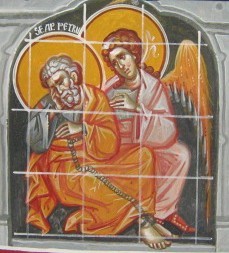
Let him who is without sin be the first to cast a stone at her.
(John 8:7).
Most assuredly I say to you that you will weep and lament, but the world will rejoice; and you will be sorrowful, but your sorrow will be turned into joy. (John 16:20)
He arose from supper and laid aside his garments, took a towel and girded Himself. After that, he poured water into a basin and began to wash the disciples’ feet, and to wipe them with the towel with which he was girded. (John 13: 4-5)
Now there was leaning on Jesus’ bosom one of His disciples, whom Jesus loved. (John 13:23) “A new commandment I give unto you, that you love one another; as I have loved you, that you also love one another.” (John 13: 34)
“By this all will know that you are my disciples, if you have love for one another.” (John 13: 35)
What sin is!
Sin is treading upon the law of God, a voluntary or involuntary treading, in knowledge or in ignorance, in deed, in word, in thought. Sin is dishonor toward God, insult, disdain, defamation, ingratitude and wounding toward the Divine being, in an egocentric spirit.
Sin is a lack of faith and a lack of confidence in God and in His law, and too much faith and confidence in oneself, such that a man becomes a law unto himself, because whenever you break the law of God, you obey another law, your own, or the devil’s.
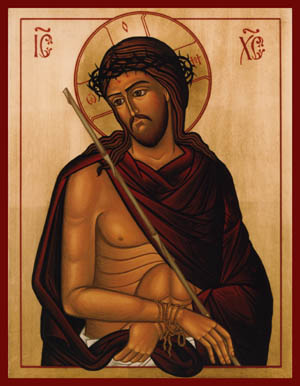
Sin is a second crucifixion of Christ, for through sin all the insults, mockery, and beatings are renewed. The nails, the spear, the thorns, through sin, Christ feels them all again. Today, however, the blows no longer come from those who defamed Him and shouted, “Crucify Him! Crucify Him!” Now they are administered by those who say they believe in Him, who say that they follow His commandments, that they love Him. Now it is those who are baptized who spit in His face, it is those who call themselves Christians who put the crown of thorns on His head, now it is they who slap Him, who nail Him to the cross, who goad Him with the spear, those for whom Christ suffered mockery and beating and for whom He shed His blood on Golgotha in order to make them sons of God, in order to open the gates of heaven for them, to destroy death and demolish hell.
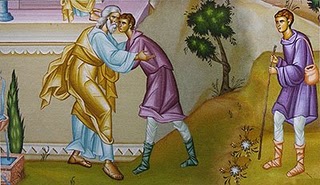
Sin is estrangement from God and drawing near to the devil. It is estrangement from the house of the Father and life in a faraway country with the devil’s pigs.
Because we are the servants of him whom we serve (John 8:34), sin means slavery to the devil. When you sin, you no longer consider what God has done for you, you are no longer His son, and you do not think about His justice, by which He will punish those who sin against His will. Through sin, all the creatures of God act contrary to the purpose for which they were created. The mouth was not created by God that we might curse and swear with it or slander and curse our neighbor, but that we might use it to speak things useful to the soul. God did not give you a mind so that you can find arguments to distance yourself from Him, but that you might find arguments to draw near Him. The eyes were not made so that we might look at things that damage the soul, but that we might look upon God’s creation and give Him thanks. Just so, the ears, hands, and feet were not made in order that we might distance ourselves from God. Don’t you want to acknowledge the goodness and long-suffering of God? For you should know that time was given to you in order to gain paradise, and you waste it believing that God will no longer judge, that He will forgive us, that there are others much worse than you.
The Consequences of Sin
The evil brought about by sin:
1) Through sin, we lose the most precious gift that we have received from God. Without this gift, the soul remains deformed.
2) Through sin, the Holy Spirit is taken from us and we are no longer recognized as sons.
3) Through sin, we lose the eternal blessedness of heaven. We lose the possibility of union with God and life together with the saints. We lose eternal light and rest.
4) We attain unto hell with its unquenchable fire and its eternal darkness.
5) Through sin, we lose all the good deeds that we may have done previously, for God will judge you according to the state in which He finds you.
6) Through sin, we lose the help of God (to the extent that you are found in sin).
Confession
Do you not weep at the thought that you have lost heaven? Does the sorrow you have caused God not make you tremble?
Does the thought of hell not frighten you? Do you not seek to acquire the state that you have lost? Is it still possible? Yes! But you must want it….
From the very beginning, God has known our powerlessness and has given us the possibility of being purified from sins. He knew that man will sin as long as he lives and that no one is without sin, and therefore He said to His disciples: Whatever you bind on earth will be bound in heaven, and whatever you loose on earth will be loosed in heaven, words through which He instituted the sacrament of Confession.
Confession or repentance is a bath from which the soul emerges relieved from the weight of sin and cleansed from the filth of sin, a bath in which we are cleansed of all our defilements and errors.
Confession is a medicine that heals the soul of the wounds inflicted by demons, a medicine that renders ineffective the poison of sin.
Confession turns a sinner away from the devil and back to God and restores His connection with his Creator.
Confession leads the soul to deeds and things that are for the sake of and according to the soul. Confession restores a man clean before God. Confession prepares the soul and body to receive the body and blood of our Savior Jesus Christ. Confess in the Church four times a year to the same spiritual father.
When you examine your conscience, consider yourself guilty, don’t justify yourself; think about the following things:
1) The motive or aim with which or for which you sinned. The following day, try to avoid the same situation.
2) The intention with which you sinned.
3) The surroundings, avoid them the following day.
4) The place where you sinned.
5) Whether your sin influenced others by encouraging them to sin also.
6) The number [of times you’ve performed this particular sin] …. Confession must be done with contrition of heart and a sense of regret. Contrition of heart is the grief and pain that the memory of the sin causes you. This pain consists not only in feeling the sin, to sigh and weep for it, but consists primarily in hating the sin. Regret is the pain that the repentant feels because he now lacks the grace of God and has earned torment. The church has established the rule that one should fast for seven days before confession, or possibly less. The sick are excused. Write down your sins on paper and read them alone before your spiritual father. Make a promise before God to not repeat your sins.
The Ten Commandments (to be continued)….
(Taken From the book “The Saint of the Prison” Translated by Monk Sava – an American convert to Orthodoxy, from Oasa Monastery)
On the 14,000 Holy Infants were killed by King Herod in Bethlehem. When the time came for the Incarnation of the Son of God and His Birth of the Most Holy Virgin Mary, Magi in the East beheld a new star in the heavens, foretelling the Nativity of the King of the Jews. They journeyed immediately to Jerusalem to worship the Child, and the star showed them the way. Having worshipped the divine Infant, they did not return to Jerusalem to Herod, as he had ordered them, but being warned by God in a dream, they went back to their country by another way. Herod finally realized that his scheme to find the Child would not be successful, and he ordered that all the male children two years old and younger at Bethlehem and its surroundings be killed. He thought that the divine Infant, Whom he considered a rival, would be among the dead children.The murdered infants thus became the first martyrs for Christ. “
Christ is Born, Glorify Him!
In the festive atmosphere that embraced heaven and earth, just few days from the Nativity feast of our Lord and Savior Jesus Christ, the Church coats herself in much sorrow for the innocent babies slain by king Herod’s cruelty. Back than Jesus was saved from the wrath of Herod. Still today, He suffers the torment of death with each of the babies slain by modern tools of medicine, by the will of a society that had lost its balance and sense of life and raised to the rank of the law, the grivial sin of murdering babies.
Truly the commandment of the Gospel “Thy shall not kill!” no longer holds true in a world that calls the good evil and the evil good.
Life starts at conception
Most people do not know what happens during an abortion. Perhaps many women who committed abortion did not know that actually they killed a child. Why? Because they are told that by the third month in the womb they bear only “a ball of cells” and not a true man.
British Professor Stuart Campbell, a researcher at “Create Health Clinic” in London, managed to obtain, through a new type of ultrasound scan, three-dimensional images that allow viewing of fetal movements in real time. The study demonstrates for the first time that life begins with fertilization and not at birth. At the moment of conception, 46 chromosomes with 30,000 genes combine and determine all our physical characteristics: gender, facial and bodily features, eye color, hair and skin. Then, in just a few weeks, from one cell a tiny man is formed, having all the organs already present and able to work.
What happens following the 3 months – in which some argue that the fetus is merely “a ball of cells”?
The heart starts beating 18 days post conception, fetal blood passes through the umbilical cord, the placenta where the metabolic exchanges take place between the mother and the child: the child passes to the mother the remnants of carbon dioxide and the mother provides oxygen and nutrients. In about 3 weeks the hands start to form and at 8 weeks, the fingers. The fetus can move the fingers and open his/her mouth.
At 40 days, the brain function is measured by EEG waves. This wonderful control center – the brain – sends messages to both mother and child.
At 2 months, the baby fingerprints are already imprinted in the skin.
At about 7 weeks, the first spontaneous movements are noticed, although the mother usually doesn’t feel the baby moving until about 16 weeks.
At 18 weeks, the fetus is active and energetic and makes numerous muscle flexes and can give sufficiently strong punches and kicks :)
At 26 weeks, the fetus can do a wide range of child specific gestures – to scratch, to smile, to hiccup and suck his/her fingers …

“Let children come to me …”
(the choice is made by God not by the pregnant women)
by Fr. Alexander Stanciu
Before enjoying the light of this life, God had ordained that the child will dwell and develop for 9 months in the safest shelter of the world: his mother’s womb. Today, however, man has transformed this possible safest shelter in the most dangerous place for that, although the child can do nothing to defend himself, his life can be taken even by the dearest person, his MOTHER .
The conceived fetus becomes a human being at the time of fecundation, when God created immortal soul of man. The sin of abortion is a form of murdering baby Christ, Who in a certain way, is born with every baby. From the moment of conception, the child bears the image of God, and through Baptism will carry the image of Christ within. If this image is destroyed, in the women womb Christ is been crucified once more. Saint Nicodemus of the Holy Mountain goes so far as saying that a mother who commits abortion, does not kill one human being, but in so much she is killing as many survivors as would have resulted if her child had lived.

Can abortion ever be recommended?
Lets follow these three examples:
1. The father is an alcoholic, the mother has tuberculosis. They have four children. The first one is blind. The second one died. The third child is deaf, and the fourth has tuberculosis. She becomes pregnant again. Given this extreme situation, would you take into account the recommendation of abortion?
2. A little black girl, aged 13, was raped by a white man, the little girl became pregnant. If you were her parents, would you recommend abortion?
3. A teenager girl is pregnant. She is not married. Her fiancé is not the father of the child. He is very upset and plans to leave her. In this case, would you consider abortion appropriate?
If you said “yes” to the 1st question: You have killed Beethoven.
If you said “yes” to the 2nd question: You have killed a great black singer of religious music, Ethel Wathers.
If you said “yes” to the 3rd question: You just decided to kill Jesus Christ.
The Silent Scream of a Fetus – Child faced with Extinction
(The following educational material is not recommended for children!)
Part 1.
Part 2.
Part 3.
Part 4.
Part 5.
Father Cyprian speaks of the frightening reality of the world we live in and the look-warm Christianity of our days. The images below speak on their own – for those who still have eyes to see and ears to listen…In the midst of this reality, there are still some who take their life in Christ seriously.
An Orthodox missionary priest (Fr. Daniel Sisoev) preaching “the Word of Truth” to the Muslim world, killed at the age 35 in Russia. May Christ our Savior rest him with his saints. Amen!
“THE BLOOD OF THE MARTYRS IS THE SEED OF THE CHURCH!”
Father Cyprian: “You see that apostasy, as it goes on and advances, as we read in the books of our church, must reach its peak – the Antichrist to come. From the signs of the time, we see how Christ is approaching, Christ is coming, and we MUST be prepared! – as Christians that we are called and named, if we want to go forth and meet Him, if we want to be united with Him and rejoice with Him eternally.
We SHOULD hold two things dearer than our sight, dearer than our eyes:
First – the genuineness of Orthodoxy, and I stress this word genuineness because today even the ecumenists want to be called Orthodox!
But this along is not sufficient, just as a bird does not fly with one wing but with two wings. The second wing is Ortho-practcy – correct practice. The first then, is the correct faith, and the second is the correct life so we might be able to say to men who are far removed from the church, what Philip said to Nathaniel: “Come and see”.
Come and see what Orthodoxy means…
I pray that in this difficult time we are passing through, I stress, I repeat, and the difficult times that are await us, Christ may maintain us to the end of our lives, to the final heartbeat, in the correct faith, in the correct life. Amen!”
– Metropolitan Cyprian –
Ecumenism – a great temptation
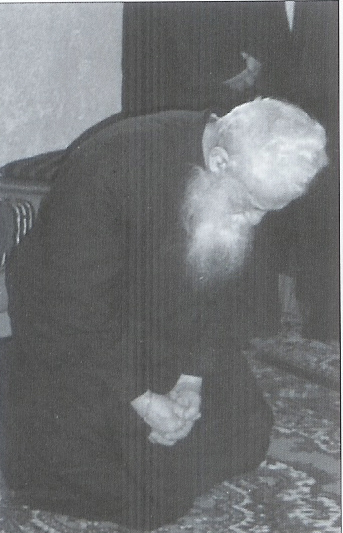
– Regarding the compromises within the church, it is very much conveyed today the idea that ecumenism is a necessity in ecclesiastical space. What are your thoughts on this?
Fr. George: – If we submit to the devil, that means a necessity? This is not a need, but a sin, a great temptation, a heresy. I think that the Orthodox Church should mind its own activity, not the interest in ecumenism and so on. The (Orthodox) Church should live in Christ as she lived until now.
– What do you think the strength of Orthodoxy consist in?
Fr. George: – The power of Orthodoxy is that, she had not changed anything in the canons set by the Holy Ecumenical Councils after its separation from Catholics, while Catholicism consists in number and organization. The power of Catholicism wears out today, the strength of Orthodoxy remains. If Orthodoxy falls, it’s through the sins of the people inside her, not by other means. Because Orthodoxy in itself is unbeatable.
– So we wear down from the inside …
Fr. George: – Yes. The problem is that we – ourselves have become corrupted, not by been influenced by others. Even now, in the European community, each church could keep its full identity, without compromise or breaking its religious doctrine, if she’ll have the awareness that she (the church) must keep her identity.
– So, we have to work on the mentality …
Fr. George: – Well, that’s the problem. If we lose our attachment to the Orthodox tradition and start to dilute ourselves in this absurd and criminal movement of ecumenism – and if it’s not criminal, it’s at least anti-Christian – then we’ll certainly be lost. It’s a great tragedy! I wonder if they really don’t understand its danger? Or perhaps they are bribed? I do not know, I do not get it …
Papocentric Globalism and the Alienation of Orthodox Ecumenists (an Orthodox awarness film)
Error
This video doesn’t exist
– What is the relationship between hierarchy and the monasteries?
Fr. George: – Generally the monasteries obey their hierarch. But only to the limit of heresy. Because of this, the hierarchy, especially in some areas, is upset. It persecutes monks, invents all sorts of things about them, all sorts of lies such as the one that they obey to the Russians, etc,. all aimed to motivate their ecumenist actions…
– If you would meet the Patriarch of Romania, Teoctist, what would you say to him?
Fr. George: – I met him many times. And I confessed everything that I thought. And I was surprised that he was opened to listen, to relay to me many things and, to not get offended. He has a balance! I am a little worried and troubled at the thought that the patriarch will die. For he maintains a balance where he is.
– How do you see the current state of our Church?
Fr. George: – As in that story that my mother used to tell us children…with the legion of devils gathered to the house of the widow who had seven children and all were praying. Even today, the Church is surrounded by legions of devils. I mean not only our own but every Orthodox Church in the world: millions of devils surrounding them.
Tribulations took place at all times, but now they seem to multiply. There are many disobedient priests and many monks wandering, which should not go in such way. Many monks are wondering to the West. Why?! They should remain in the monastery. If they do not like their monastery, that is ecumenist and so on, they should choose another monastery, because they can do so.
I mean we have to impose ourselves a discipline to respect the Church’s authority, so far as it is worthy of Christ to respected it. But you must steadfast in front of Satan! Steadfast as a pillar! to know when he faces a monk, a priest, a bishop and he will be defeated!.
(Excerpt from the book” The Life of Father George Calciu – Christiana Press, P.131/132, translated from Romanian by EC)
 Christian Dogma
 Christian Martyrs
 Christian Orthodox Churches and Monasteries
 Christian Sermons and News
 Church's Teachings on Fasting
 Ecumenism – a Great Heresy
 Father George Calciu
 Life_a Sacred Gift form God
 Orthodox Saints and Church Fathers
 Spiritual Elders
 Daily Bible Readings
 Journey to Orthodoxy
 Listen to Ancient Faith Radio
 Orthodox Calendar of Feasts and Saints
 Orthodox Christian Mission Center
 Orthodox Institute
 OrthodoxChristianNetwork TV


Recent Comments