
You are currently browsing the category archive for the ‘Contemporary Martyrs for Christ’ category.
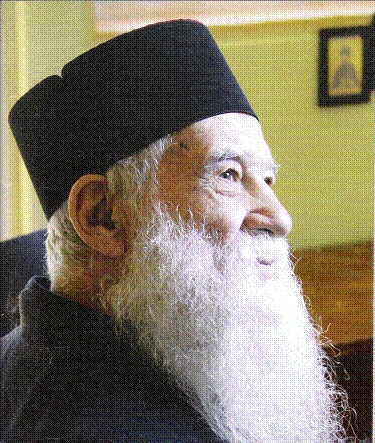
Fr. George Calciu (1925-2006) – a great Romanian Orthodox confessor and spiritual father
Father George biography at: Fr George Calciu biography
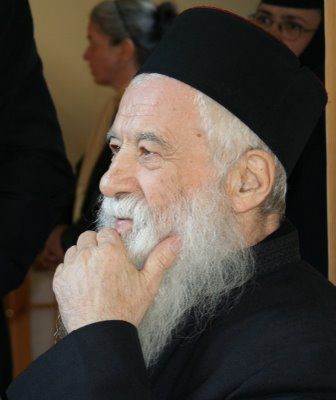
On the meaning of suffering
– Father, tell us about your suffering in prison (the gulag)!
– What can I tell you, in my arms people have died who were a thousand times more valuable than I, in prison many who were more valuable than those who survived have died in the arms of other men, and yet I, a sinner, am here. And to speak of myself again, – whether to say what good I did or what wrong I did, it would sill come out as bragging. So, I find it very difficult to talk about these things.
Generally many words of praise have been said (in relation to this); all this is dust and ashes, all vanity, but we continue to hold onto what we have received from God and what we have managed to keep through suffering, or through success, praise, or blame… Thus, we remain faithful to the Church and our nation.
My life in (communist) Romania, was full of events for better and for worse. I do not accuse or blame anyone, all these were sent by God to exercise my soul.
Someone asked me if my suffering in prison have helped me in aby way. I answered: “No, they have not helped me, but I’m the result of this suffering. If I do something, if I am anything, if you see something in me, know that is because of suffering. Without this suffering, I have nothing!”
Perhaps of all difficult questions for the human person, suffering is the most inexplicable. Why is suffering necessary? I have lived an experience of suffering that enriched my soul and I believe that suffering was necessary for me. But it is very difficult for someone to accept this principle.
When we were in prison (concentration camps), we ask each other: “Why suffering, Why us? Of all the millions of Romanians, why have we been chosen to suffer? What is the purpose? ” And God wouldn’t reveal anything to us. Everyday we cried out to God to give us less pain, and He seemed to grant us even more suffering.
Even after I was liberated from prison, I held within me this imprint of the pain, which seemed to mark my whole life thereafter. After the second imprisonment, I immigrated to the West and traveled through every country in Europe and America speaking about the result of communism. My intention was this: I could not keep silent as long as suffering, injustice, communism, the destruction of churches and the destruction of human personality took place in my country. In my wanderings I came upon a monastery and slept in its library. It was a Catholic monastery. In its library I found, among many books, a small booklet with Christian sayings. I opened it randomly at a page where I saw a reflection of Paul Claudel, a famous French writer. He said this: “Christ did not come into the world to eliminate suffering, Christ has not even come into the world to explain it. Rather, He came to fill human suffering with His presence “.
Have you heard? To fill human suffering with his presence! Then I understood that when we weep, or when we revolt or cry out “God, what are You doing to us?! … “He is present within us more than ever, despite all our sins, all our infirmities. He filled our suffering with His presence. Thus, I understood exactly the deep meaning of this pain: God is present in us!
(Nuns from Diaconesti Monastery singing at his 2 years memorial (Romanian)
{…} If Jesus Christ’ suffering was for everyone, why people’ suffering be useless and lost? God will remember everything . On the day of judgment, He will count him who suffered and has not cursed, him who suffered and prayed …. Hence, those who suffered persecution and prayed for their persecutors, prayed for the good and for the wicked, so God may return many from their unbelief and wickedness .
Other links: “Christ is Calling You!” Lenten Meditations with father George Calciu: http://www.orthodoxresearchinstitute.org/resources/sermons/calciu_christ_calling.htm
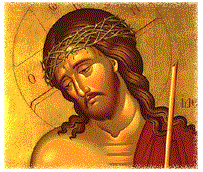
Christ suffers in us
Having taken all our human affects, – i.e. the helplessness of our body: starvation, cold, or thirst — Our Lord Jesus Christ was sensitive to human suffering, to our needs. He was sensitive when someone was sick, and healed him. The Savior often made appeal to faith. Other times, when someone was seriously ill, He would not ask if the sick one thinks he can be cured, but Christ will heal him by His word. Or Lord took pity when someone was in despair when their child had died, as was the widow of Nain.
Christ felt for someone praying for parents or neighbor’s, as was the centurion.
He felt for those who were hungry and thirsty. In fact, the Savior said: “He who gives a glass of water to one of the least of Mine, he gives it to Me“.
In so much Jesus had identified with us, that He took upon Himself all our weaknesses, all our infirmities, that anyone who suffers, Christ suffers with him! Anyone who is sick, Christ is sick with him! Everyone who hurts and weep, Christ weep with him!
Do you to expericence Christ innocent suffering? Visit the hospitals for children, visit the orphanages. Christ suffers in them. A total likeness of our Savior with us. He takes upon all our sufferings, all our sorrows.
So everything that Jesus did, was to strengthen the hearts of the faithful. He would often worked miracles, more precisely for our human weakness in thirst for a miracle. Even today we are thirsty for miracles, but a miracle is no substitute for faith. Faith, as the Apostle Paul says, is entrusted things unseen. This faith makes us see – if the tools are spiritual – what the eyes of the body cannot see and the mind cannot reason.
God reveals Himself to us in circumstances beyond our control and, our qualities. He was merciful to the thirsty and the hungry when the Apostles asked Him to send them away at dawn. Our Savior had multiplied the bread, blessed it and gave it to them. He is a God sensible to our pain, One sensible to our needs, participating in our suffering. God doesn’t regard someone as we often do – as spectators, but He gets involved in our sorrows.
(Excerpts from the book: Father George Calciu, Living Words. “To serve Christ means suffering”, Bonifaciu Press, 2009) – (Translated from Romanian by EC)
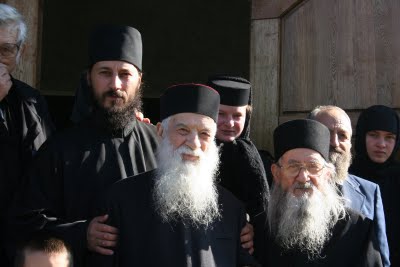 (At Diaconesti Monastery – Romania)
A Word on Anger
Man today lives under such overwhelming pressure that his nerves are strained to the limit, and even the slightest provocation arouses in him the sin of anger. Causes for anger could be the child who does not listen to us, or the husband or wife who contradicts us, or the driver who cuts us off with his car, or only seems to us to cut us off, giving a motive for us to be roused to anger. Even if, through self-restraint, our anger is not outwardly expressed or is not heard by the one who provoked it, it is still a sin, because it harms our soul and our heart It is an action against one’s own self, under the temptation of the devil to be angry.
The savior warns us in severe terms concerning anger that gives birth to verbal conflicts and the use of abusive words.
I say unto you, that whosoever is angry with his brother shall be in danger of the judgment: and whosoever shall say to his brother, Raca, shall be in danger of the council: but whosoever shall say, Thou fool, shall be in danger of hell fire (Matt 5:22).
…No one thinks evil without corrupting the heart in which God should dwell… [….]
I counsel my penitents that before they express their anger, be it in speech or gestures, be it only mentally, to utter three or five times, “Lord Jesus Christ, Son of God, have mercy on me, a sinner.” And if they say the prayer quickly and inattentively under the oppression of anger, then they should concentrate with humility upon the word “sinner,” and their anger will abate. Many of them have succeeded inn making their life, their family relationships, their relations with other people, and even their interior life change for the better.
All the conflicts in the world have their origin in unabated anger. One is angry and wounds the other, who then responds with greater violence and strength. Once this chain is begun, it cannot be stopped except through the appeal of prayer––genuine prayer. […]
The Name of Jesus is sweet to utter. It casts our the demons and brings the angels back into the heart, into the mind, and you will bear yourself in meekness before others.
(Excerpts from article “A Word on Anger” in The Orthodox Word No.261)
Holy Great Martyr Menas (Abu Mena)
(feast Day, November 11th )
Saint Menas’ life and the Monastery of Abu Mena, Egypt
(dedicated to the saint)
It is known that St. Menas was born in the year 285 A.D. in Egypt in a pious family, his parents were Eudixius and Euphemia. His parents had long been awaiting to have children. During a feast dedicated to the Virgin Mary, Euphemia was praying with tears to an icon of the Most Holy Mother of God to grant her a child, and at the end of her prayer, the Mother of God had answered from her icon “Amen”.
Months later, the blessed child Mina was to be born. His father died when Mina was 11 years old and his mother when he was only 14. At the age of 15, he joined the Roman army, where he was given a senior grade because of his father’s inheritance.
He served in Algeria for 3 years as a soldier. This occurred at the time of the pagan Roman emperors Diocletian and Maximilian, who ordered that all Christians who will not bow to idols be tortured and killed. Disgusted and sickened of the view of Christians forced to worship idols, Menas left for the desert for 5 years leading a hermit life in fasting and prayer to the true Christian God.
During the fifth year of his ascetic life, St. Menas had a revelation when he saw an angel crowning Holy Martyrs; while contemplating this image, he heard a voice saying: “Be blessed Menas, you have been called to a pious life since your childhood. You will be crowned with three crowns: one for your clean life in celibacy, second for your ascetic struggle, and the third for martyrdom “.
With his soul filled by the fiery love for Christ and strengthen by this revelation, Menas came down from the mountains, stood in the middle of the idolaters and confessed Christ. For this, he was given to torment: his body was rubbed with tarsi, burned by fire, dragged mercilessly over thistles, and pierced at the end by a sword. St. Menas received martyrdom in the year 309, in Frigia.

It is said that the soldiers who killed Menas, threw his body on fire, but for 3 days the saint’ body did not burned. His sister along with some soldiers took the saint’ body to Alexandria and placed it in a church. When the persecution against Christians had stopped, it is said that an angel appeared to Pope Athanasius of Alexandria, instructing him to remove the saint body, place it on a camel and take it to the Western Desert. In a certain place, not far from Alexandria, at the end of Lake Mariot, the camel no longer could move, no matter how hard Christians have tried to do push it forward. They understood this to be a sign from God, and buried the saint’ body there.
For several centuries, the martyred soldier Menas was no longer know, until in a certain place in the desert, the sicken sheep’s of a pastor were miraculously healed along with the pastor. The news spread quickly and many sick people start heading to that place, without even knowing the source of these healings. The place had become so familiar that even the Emperor daughter from Constantinople (Constantine the Great or Zeno), been sick with leprosy, was sent there for healing. One night when the girl was sleeping, the Great Martyr Menas appeared to her in a dream and uncovered the mystery: his holy relics were at the place of healing. St Menas asked the girl that a church will to build in his honor. Next morning, the girl was cured and she revealed her dream to the servant accompanying her.

On that site, 45 km southwest of Alexandria, the Emperor of Constantinople not only that he ordered the building of a cathedral, but an entire city was built, including streets, buildings, churches and the Baptistery, a building with two wings for the sick (one for men and the other for women and children).
The City of St Menas (Abu Mena) has became one of the most famous place of healing and pilgrimage for many Christians. Bottles of oil and holy water engraved with the saint name were found in archeological sites of various Mediterranean countries such as: in Heidelberg – Germany, Milan – Italy, Dalmatia – Croatia, Marseille – France, Dongola – Sudan and in Jerusalem. At the middle of VII century, the city was destroyed by the Muslims. The first excavation to uncover the archaeological value of the site Abu Mena began between 1905 and 1907.

About 1 km from the city of Saint Menas, an impressive monastery was built and bares part of the holy relics of St Menas. 101 monks dwell in this monastery, and serve Divine Liturgy 3 times per day.

In the year 1979, the archaeological site of Abu Mina – the marble city of Saint Mina – is included in the UNESCO list of World Heritage sites, and from 2001 the site is placed on the UNESCO list of World Heritage in danger of destruction.
The holy relics of St Mina are present also in other parts of the world, such as in the Church of St Mina from Bucharest.


“Oh, blessed Holy Martyr Menas, listen to our prayer offered to you from our hearts, and deliver us from sickness and dangers, so we may honor your memory and testify of your miracles, which by the power of the Holy Spirit you work on those who faithfully sing to Thy: Alleluia! “
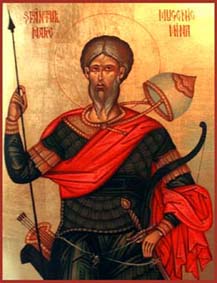
From the Miracles of Saint Menas
Once, traveling to the church of St Menas, a faithful Christian was hosted in a foreign house, and the owner of that house, knowing that the guest had money with him, rose at midnight and killed the faithful. Then, cutting his body in pieces, hid it in the pantry inside the house, awaiting daylight hours.
While the killer was in great difficulty of how and where to hide the body parts of the one killed so no one may know, Saint Menas appear to him as a soldier riding a horse and asked what was done with the man accommodated there, but the killer denied of knowing anything.
Then the Saint, descending his horse, went inside the house to the hidden place, and finding the remainings of the traveler, presented them to the killer, than with a great and fearful look had asked “Who is this?”
Fearful and trembling, having speak nothing, the killer threw himself at the feet of the saint.
Putting together all the members of the one killed and praying over him, St. Menas raised the dead and said to him: “Give praises to God!” And the dead, rising from sleep and remembering what he had suffered from the one who hosted him, glorified God for living a second time, and praise the “soldier” for risen him.
After taking the money from the one who killed him, St Menas gave them to the man he had risen, saying, “Go brother in your path”.

For The Akathyst of the Holy Martyr Menas the Wonderworker
see link below:
By Priest George Calciu who spent 21 years of his life in the comunist gulag
(Printed in April 1998 in the Holy Cross Church Newsletter)
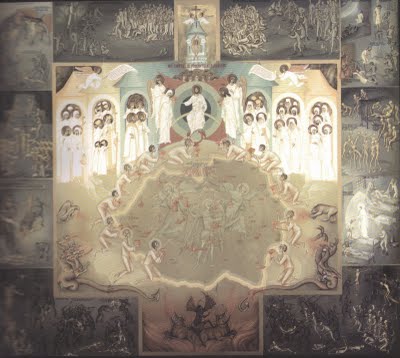
In the Orthodox Church, the saints and the martyrs occupy a remarkable place, being for us of inestimable help in prayer and in our supplications to God. In certain difficult moments all those who pray and ask for the help of the saints know that their request will never go unanswered. There exists the corresponding tradition of which the saints of whose name we bear protest us and the martyrs which fought a for a certain cause help us in our fight to defend the Church and the right faith.
So much the more, in these difficult times for the Romanian nation and for our Orthodox Church, when the dark forces war with all their might to make Romanians be divided and to go astray, it is necessary to rediscover the saints and martyrs, all those who took up their cross and stood firm before the enemy, confessing Christ and fighting for the faith and national liberty. Just as the first Church had transmitted martyrology from generation to generation and left over the ages inscribed with letters of blood the suffering of those that sacrificed themselves for Christ, so also we have the duty today to not forget, but to honor as it is fitting, according to tradition, those who sacrificed themselves in this century of world-wide heresy, for the right faith and for our Romanian nation. And if, at the beginning, the devil tried to destroy the bodies of the faithful, in this time he works at the destruction and losing of the soul. And with those who oppose him and opposed him, he has no mercy.
Now, in a few days we will relive the Mystical Sacrifice and the Resurrection of the Savior who took upon Himself the sins of man in order to make certain the possibility of our rebirth into the True Life through Resurrection, we open within the framework of our publication a new chapter: Let us honor the martyrs! In each issue we will try to keep alive the memory of those who denied themselves and took up their cross and followed Christ unto the end, Romanian Golgotha, not knowing compromise or giving up. Through the power of their prayers, through the power of their supplications to God we can hope in a Resurrection of the Romanian nation, and in a return of all the wandering sons to the right faith of our fathers.
In hoping for the canonization of the martyrs of this century as soon as it is possible, we begin this contemporary martyrology, asking for the help of the Holy Spirit to guide us into truth and faith.
In this issue we present some memories about Constantine Oprisan. I began with him because I was so moved by the fact that in a monastery in American converts to Orthodoxy, where not even one is of Romanian origin, he is considered a martyr, and his image was put in Church and honored!
(Then what follows is the article we published in the Orthodox Word on Constantine Oprisan, translated into Romanian. There is also an interview with Fr. George at the end which I left out because it mentions the name of a hierarch who refused to commemorate the present-day martyrs, in Romania.}
Elder Arsenios on Fasting
Eleder Cleopa on Prayer
St. Luke Archbishop of Simferopol the Surgeon (1877-1961)
Feastday: June 11th (New Calendar), May 29th (Old Calendar)
(His apolytikion or troparion, as translated from the original Russian and included in the latest addition of the Blessed Surgeon book)
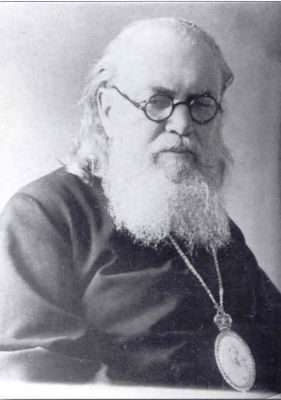
Troparion of St. Luke of Simferopol – Tone 1
O herald of the way of salvation, confessor and archpastor of the Crimean flock, faithful keeper of the traditions of the fathers, unshakeable pillar and teacher of Orthodoxy, pray unceasingly to Christ our Saviour to grant salvation and strong faith to Orthodox Christians, O holy hierarch Luke, physician wise in God.
On Science and Religion
By St. Luke, Archbishop of Crimea
“When we examine contemporary science as developed by scientists such as Lamark and Darwin, we see the antithesis and I would say the complete disagreement that exists between science and religion, on topics that concern the more basic problems of existence and knowledge. For this, an enlightened mind cannot accept at the same time both one and the other and must chose between religion and science”.
A well known German Zoologist, Ernst Haeckel (1834-1919), who was a good follower of Darwin, wrote these words some 65 years ago, in his book, “The Riddle of the Universe” that was very successful and as it seemed, had proved that faith is absurd. So says Haeckel that every enlightened man must chose between science and religion and should follow either one or the other. He considered it necessary that such men should deny religion because a logical man cannot deny science.
Truly, is this necessary? No, not at all, for we know that many and great scientists were at the same time great believers. For example, such was the Polish astronomer Copernicus who laid the foundation of all contemporary astronomy. Copernicus was not only a believer but was also a cleric. Another great scientist, Newton, whenever he mentioned the word God, he removed his hat. He was a great believer. A great bacteriologist of our time and almost a contemporary, Pasteur, who laid the basis of contemporary bacteriology, he would start every scientific work with a prayer to God. Some 10 years ago a great scientist passed away, who was our countryman, physiologist Pavlov, who was the creator of the new physiology of the brain. He too was a great believer. Would Haeckel therefore dare say that these men did not have enlightened mind because they believed in God?
So what happens now? Why even today there are some scientists, professors at Universities whom I personally know and are great believers. Why don’t all the scientists deny religion but only those who think the same as Haeckel? Because these people believe only in materials and deny the spiritual world, they do not believe in the after death life, they do not accept the immortality of the soul and of course they do not accept the resurrection of the dead. They say that science is capable of everything, that there is no secret in nature that science cannot discover. What can we answer to these?
We shall respond to them this way. You are totally right. We cannot limit the human mind that searches nature. We know that today, science knows only a part of the things we have of nature. We also understand that the possibilities of science are great. In this they are right and we don’t doubt it. What then do we doubt? Why don’t we deny religion like them and consider it contrary to scientific knowledge?
Just because we believe wholeheartedly that there is a spiritual world. We are certain that apart from the material world there is an infinite and incomparably superior spiritual world. We believe in the existence of spiritual beings that have higher intellect than us humans. We believe wholeheartedly that above this spiritual and material world there is the Great and Almighty God.
What we doubt is the right of science to research with its methods the spiritual world. Because the spiritual world cannot be researched with the methods used to research the material world. Such methods are totally inappropriate to research the spiritual world.
How do we know that there is a spiritual world? Who told us that it exists? If we are asked by people who do not believe in the Divine revelation, we shall answer them thus: “Our heart told us”. For there are two ways for one to know something, the first is that which is spoken by Haeckel, which is used by science to learn of the material world. There is however another way that is unknown to science, and does not wish to know it. It is the knowledge through the heart. Our heart is not only the central organ of the circulation system, it is an organ with which we know the other world and receive the highest knowledge. It is the organ that gives us the capability to communicate with God and the above world. Only in this we disagree with science.
Praising the great successes and achievements of science, we do not doubt at all its great importance and we do not confine the scientific knowledge. We only tell the scientists “You do not have the capability with your methods to research the spiritual world, we however can with our heart
There are many unexplainable phenomena which concern the spiritual world that are real (as are some type of material phenomena). There are therefore phenomena that science will never be able to explain because it does not use the appropriate methods.
Let science explain how the prophecies appeared on the coming of the Messiah, which were all fulfilled. Could science tell us how the great prophet Isaiah, some 700 years before the birth of Christ, foretold the most important events in His life and for which he was named the evangelist of the Old Testament? To explain the far sighted grace possessed by the saints and to tell us with which physical methods the saints inherited this grace and how they could understand the heart and read the thoughts of a person they had just met for the first time? They would see a person for the first time and they will call him by his name. Without waiting for the visitor to ask, they would answer on what troubled him.
If they can, let them explain it to us. Let them explain with what method the saints foretold the great historical events which were accurately fulfilled as they were prophesied. Let them explain the visitation from the other world and the appearance of the dead to the living.
They shall never explain it to us because they are too far from the basis of religion- from faith. If you read the books of the scientists who try to reconstruct religion, you will see how superficially they look at things. They do not understand the essence of religion yet they criticize it. Their criticism does not touch the essence of faith, since they are unable to understand the types, the expressions of religious feeling. The essence of religion they do not understand. Why not? Because the Lord Jesus Christ says “No one can come to me unless My Father who sent Me draws him to Me.(John 6:44)
So it is necessary that we be drawn by the Heavenly Father, it is necessary that the grace of the Holy Spirit enlighten our heart and our mind. To dwell in our heart and mind through this enlightenment, the Holy Spirit and the ones who were found worthy to receive the gift of the Holy Spirit, those in whose heart lives Christ and His Father, know the essence of faith. The others, outside the faith cannot understand anything.
Let us hear the criticism against Haeckel from a French philosopher Emile Boutroux (1845-1921). So says Boutroux, “The criticisms of Haeckel concern much more the ways, than the essence, which (the ways) he observes with such a materialistic and narrow view, that they cannot be accepted by religious people. Thus the criticism of religion by Haeckel is not referred to, not even in one of the principles that constitutes religion”.
This is therefore our opinion regarding Haeckel’s book “The Riddle of the Universe” which up to day is considered the “Bible” for all those who criticize religion, which they deny and find it contrary to science. Do you see how poor and tasteless arguments they use? Don’t become scandalized when you hear what they say about religion, since they themselves cannot understand its essence. You people, who may not have much of a relationship with science and do not know much about philosophy, remember always the most basic beginning, which was well known by the early Christians. They considered poor, the person who knew all the sciences yet he knew not God. On the other hand, they considered blessed the person who knew God, even if he knew absolutely nothing about the worldly things.
Guard this truth like the best treasure of the heart, walk straight without looking right or left. Let us not bother with what we hear against religion, losing our bearings. Let us hold on to our faith which is the eternal indisputable truth. Amen.
St Luke, Archbishop of Crimea,
Topics and Discussions,
“Orthodox Kypseli” Publications- Thessaloniki
St. Luke Life
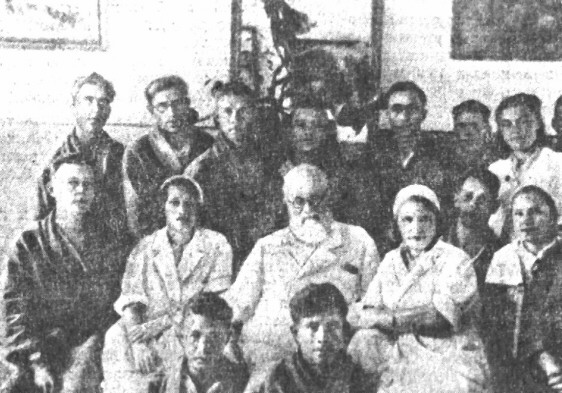
St. Luke was born Valentine of Felix Voino-Yassenetsky in Kertz on April 27th 1877. His mother was Orthodox, but later did not attend church, while his father, a Roman Catholic, was deeply pious and influenced Valentine very much. His faith was much influenced by both his proximity to the Holy Lavra of the Kiev Caves (which his family lived near) and a copy of the Holy Bible he received upon graduating High School. He had a great talent for and desire to pursue art, however, his desire to do something to help the poor peasants around him was overriding, and he attended medical school in Kiev, and graduated in 1903.
+
In 1904, the Russo-Japanese War brought Valentine to the Far East as a surgeon, where he met his future wife Anna Vasilievna Lanskaya. They married and had four children. During this time, as a surgeon, Valentine became specially trained in opthamological operations, along with regional anesthesia and the surgery of pyogenic infections (which later became areas of research for him). He also displayed immense faith in those difficult times. The family would entertain a nun from the Fiodorovski monastery once a month, and they would attending church regularly. Valentine also refused to perform an operation without first praying before an icon of the Theotokos in the operating room, and then signing the patient with iodine in the sign of the Cross. In fact, one time the Communist Party officials removed the icon, at which point Valentine refused to return to surgery until it would be returned. Soon, the wife of one of the party officials needed an operation, and specifically requested Valentine. He, however, refused to perform the surgery until the icon of the Panagia was returned. They complied with his request, and he returned to surgery.
+
Valentine’s wife, who came down with tuberculosis, died prematurely. Though Valentine grieved deeply for his wife, he was able to see the hand of the Lord guiding him even through this difficult time, both by Him choosing one of the nurses to help raise his children, and by calling him to the priesthood. In obedience to Archbishop Innocent, Valentine hastily followed Christ’s divine call, and was ordained a deacon on January 26th, and a priest on February 2nd, 1921. In fact, because of the need for a bishop, Fr. Valentine also obeyed the call of the people and underwent the monastic tonsure (being given the name “Luke”, as he resembled the Evangelist in many ways) and was consecrated a bishop.
+
This period of time was extremely difficult for the Russian Orthodox Church, as they were constantely being assulted from the right (zealots and schismatics) and from the left (the athiest government and their heretical “Living Church”). Because of St. Luke’s confessions of faith (and despite his immense medical and scientific achievements), he was imprisoned, tortured, and exiled for 11 years in total, to Siberia, and other trecherous locales. Besides persecution from the government, he had to deal with heretics from the “Living Church” who masqueraded as Orthodoxy and drew people away from the Church, and schismatic individuals who also caused unneeded harm in those turbulent years.
+
St. Luke’s virtues, struggles and achievements are staggering. As a Grace-filled hierarch of the Church, he re-opening many churches that had been closed by the Communists, produced deep theologic works, and supported the faithful while drawing many to Orthodoxy. In addition, his love, skill and devotion to his patients saved thousands, (especially injured soldiers in war), and his research techniques were award-winning, and were thought to still be recognized by his fellow surgeons fifty years later. After a lifetime of such medical accomplishments and spiritual struggles in his confession for the Faith, St. Luke reposed in the Lord as the Archbishop of Simferopol (Crimea) on June 11th (New Calendar) 1961.
+
St. Luke’s incredible virtues, love for the Lord and his fellow men, and accomplishments helped sustain the faithful immensely in those difficult days of the Atheist state. After his death, the Communist Party sought to use propaganda and intimidation to minimize his achievements, but the overwhelming love and devotion of the faithful thwarted their plans. Whereas the funeral procession was supposed to last a few minutes without psalmody or honor, it ended up lasting hours, as the faithful planted themselves around the hurse, and did not let it speed away to the cemetary. Miraculously, a huge flock of doves followed the procession from the church to the cemetary.
+
Later, the remains of St. Luke were disinterred, and it was found that his heart remained incorrupt. What a beautiful reminder of the never-ending love that he showed towards Christ and towards his fellow men, especially the sick and suffering! In November of 1995, he was proclaimed a Saint by the Ukranian Orthodox Church.
+
Besides being beloved in Russia and the Ukraine, St. Luke is also very well-loved in Greece. Specifically, the life of St. Luke, written by Archimandrite and Abbott of the Monastery of Sagmata, Nektarios Antonopoulos, has sold thousands of copies, and is in its 14th edition of printing. Many churches (some of them quite large) have been built in honor of St. Luke of Simferopol in Greece alone in recent years. The Monastery of Sagmata (outside of the city of Thebes in Greece) also houses relics of St. Luke, which there and everywhere continue to work many, many miracles through his intercessions.
+
One incredible miracle involved a young boy who was an excellent piano player. The tips of three of his fingers were cut off accidentally, and he was afraid that he would never be able to play piano again. After he and his grandmother prayed to St. Luke to help him, his fingers began to spontaneously regrow, and in 10 days, were totally normal! Today, the boy plays better with that hand than his other, unaffected hand.
+
May St. Luke, the great defender of Orthodoxy in these latter days, the wondrous healer of souls and bodies, the teacher, the hierarch, and the holy father, intercede with Christ for all of us! Amen!
(Retrieved from Full of Grace and Truth blog: http://full-of-grace-and-truth.blogspot.com/2008/10/st-luke-archbishop-of-simferopol.html)
The Saint’s last words
“My children, very much do I entreat you,
Arm yourselves with the armor that God gives, That you may withstand the devil’s tricks.
You can’t imagine how evil he is.
We don’t have to fight with people but with rulers and powers, in effect the evil spirits.
Take care!
It’s no use to the devil for anyone to think and feel
that he is close to him.
A hidden and unknown enemy is more dangerous than a visible enemy.
O how large and terrible is the army of the demons.
How numberless is their black horde!
Unchanged, untiring, day and night, seeking to push all of us who believe
in the name of Christ, to lure us on the road of unbelief, of evil and of impiety.
These unseen enemies of God have made their sole purpose, day and night to seek our destruction.
But do not be afraid, take power from the name of Jesus.”
By Father George Calciu
What new word can I share with you my friends? Since then (1) many long years have passed. A new generation has arisen, tested by unique experience and, perhaps, touched by a new skepticism born from contact with the Western world estranged from the right Faith.
Perhaps today, even more so than when I delivered those “Seven Homilies to the Youth” (1), the soul of young people – whom I consider as much my friends as I did back then (because I still speak in the name of Jesus Christ) – is increasingly assaulted by mental illness.
This is brought about by the treacherous propaganda from the West, under the mask of liberal democracy, which often takes on the appearance of Christianity, just as Satan dons angelic light to deceive as many as possible.
Back then (in communism) you were oppressed through force, which created within you a natural resistance against a system of materialistic thinking and formed within you a mystical dimension. You, my young friend, did not believe anything that was told to you then, because, as you know, under the guise of relative truth, which the rulers of the time had proclaimed as absolute truth, a complete and totalitarian lie was hidden.
Back then, the voice of the priest reached you through the spoken homily at the price of his liberty and even his life, and the truth of Christ consoled a soul wounded by the violence of political language and physical terror.
Back then you were told of Communist internationalism and of an exclusively materialistic existence, which sought to kill the universal love of the Savior. Then, you were told that you were a mere instrument, without freedom, in the social and political mechanism, and that only integration into this necessity would bring you freedom. However, Christ is calling you to a greater freedom of a totally different order when He says, Sanctify them through Thy Truth; Thy word is Truth (John 17:17) and, in another place, Ye shall know the Truth, and the Truth shall set you free (John 8:32).
It is not so, my friend, that back then the Christian Truth appeared crystal clear and easily understandable to you?
Today, in the nest of lies which surrounds you from all sides, are you still able to distinguish the Truth from the lies as easily?
Under the invasion of American and Protestant-style “evangelization”, in which partial truths of Christianity are preached before a satanic background of rock music and in the form of a “cheep sham spectacle”, full of shrieks and false tears, with miracles and healings falling upon your confused head, how can you find the true Christ in your heart?
Yesterday, under the terror of Communism atheism, you could robe your soul with the body of the Lord, anointed with myrrh, as when Joseph and Nicodemus put him in the tomb.
Today seduced by the infernal rhythm of drums and the barbaric rhythm of sectarian preaching, you no longer find God, and you stand, like Mary Magdalene, crying in from of the empty tomb of your soul.
Who stole God from you? Which gardener has hidden Him from you, so that now you are alone and crying?
Return to the simple truth of faith and to the account of the Resurrection of Christ! Run like Peter and John towards the Lord’s tomb, stoop down, enter, and you shall see and you, shall believe, knowing the Scripture, that Jesus had to rise from the dead!
Perhaps yesterday, when Communism tried to wrench any faith from your heart and to form you into a mere cog in the gears of the social machinery, you, out of a spirit of youthful revolt had more Christ in your soul than you have today.
Today you are attacked from all sides with the sound of the rhythmic drumming of all the anti-Christian organizations, which wish to create an amorphous mass out of the world’s nations, easily led to their intended destination. So it happens in the political world – a few individuals are anointed in secret and installed to govern all people from positions of international power. They determine which nations have the right to bear children and which must abort them; they substitute themselves to God and sketch the destiny of nations according to their pleasures and interests. Whoever does not submit shall perish!
This totalitarianism is expressed, more and more, even in the life of the Church, through Masonic-style ecumenical international organizations, which actually impose a new religion, a new liturgy divested of sacredness, the Holy Mysteries, and ritual, like a modern theatrical production.
These so-called religious theaters – which you see gathered in all the public marketplaces, led by some of the Western youth – represent the desanctification of Christianity and the Liturgy. Unfortunately even some Orthodox clergy have taken part in the de-sacramentalization of the Liturgy, as in the case of the brochure Reconciliation – the Gift from God and the Beginning of New Life, edited in Iasi, in 1995, where among the editors is found an Orthodox priest (of course, not without the approval of his hierarch). This work, in its liturgical part, is an attack on the sanctity of Orthodox Liturgy and a negation of its Mysteries.
How can you not stand, like Mary, in front of an empty tomb? All these attacks are pointed against you, young men, especially against you, because you are more deprived of protection and you are more sensitive to injustices. Your attackers want to tell you that you are an empty tomb if you no not submit to them.
However, it is written: Beloved, believe not every spirit, but try the spirits whether they are from God; because many false prophets are gone out into the world (I John 4:1).
Who can test today if the spirits come from God when the Orthodox and catholic priests themselves preach an anti-Christian Messianic message, similar to the sects established by rebels against the Church? Who protects you from straying, my younger brother? Who is to enrobe your heart with the presence of true Christ and not with the false christs of this age.
As many as received Him, to them He gave power to become the sons of God, even to them that believe on His name; which were born, not of blood, nor of the will of the flesh, nor of the will of man, but of God. And the Word was made flesh, and dwelt among us, (and we beheld His glory, the glory as of the only begotten of the Father) full of grace and truth…And of his fullness have all we received , and grace for grace (John 1:12–14,16).
You were born, young man, not of desire of the flesh, nor of the will of man, but from God, Who became flesh for you and of Whose fullness you partook, and grace after grace you have received.
This grace is a shield against fornication, to which your modern teachers push you. They tell you that liberty is the eradication of any obstacle facing you; that a good conscience is a talisman; that honor is an old-fashioned, obsolete notion; that sexuality is the unleashing of the beast within you; that your likeness to Christ is a story created by the priests; and that the love of God and neighbor is a new way of inhibiting your personality. Search in your heart, beyond this diabolic ticket of lies, and you will find the Truth, the only one that shall set you free! And the supreme Truth is the Resurrection, the Resurrection of Christ, as the lever for your own resurrection.
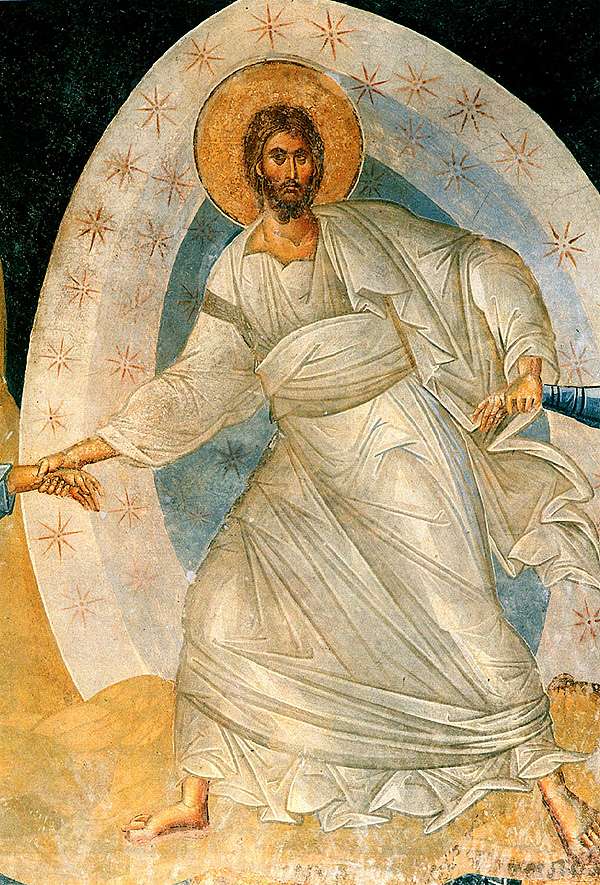
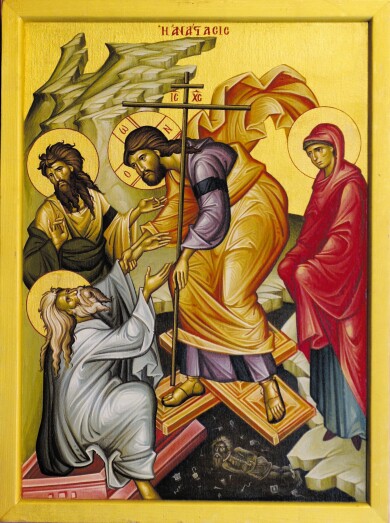
As we approach Passion Week, which we meet filled with pain and repentance for our own participation in the slaying of Christ, not only by the mere decadence of the old Adam but through our actions at every moment and our daily falls. Through these we have wounded Him Who is the ideal of human perfection. The priest proclaims from the altar ‘the death of God’ again and again during the 12 Passion Gospels in a wearing and haunting way. “O my sweet springtime, O my sweetest child, where has Thy beauty gone?” (3). We will be mournful and full of tears, but never despairing, because we know that the time has come to when the Son of Man will be betrayed and delivered into the hands of high priests, who will judge, condemn and give Him over to death, but on the third day He will rise (cf. Matt. 16:21, 17:22-23, 20:18-19; Mark 10:33-34; Luke 9:22, 18:31-35). This is way we sing during the Lamentation service: “As a lion hast Thou fallen asleep in the flesh, O Savior, and as a young lion hast Thou risen from the dead, putting off the old age of the flesh”. (4).
With torn flesh, ravaged by torments, Christ arises as a lion cub, renewed trough the total spiritualization of the body. As a lion cub, He comes out of the myrrh-filled linen shroud, leaving it untouched yet retaining its form. As a lion cub He ascends, illumined, through the stone of the tomb without leaving a trace – the stone which the angel would later remove in order to show the women that Jesus was no longer in the grave. Come, see the place where the Lord lay (Matt. 28:6).
Christ is Risen!
Paradoxically, the priest who said to you that Christ had died now proclaims, in the brilliant light of the Truth, that He is Risen. He knows and he preaches the Truth of the Resurrection with conviction. Friend, you are no longer an empty tomb! The risen Christ dwells in you and His joy remains wholly in you.
During Pascha of 1981, I was in the prison of Aiud. Early that morning, when the guards was changing shifts, I broke every diabolic rule of the prison by saying to the guard (one of the cruelest): “Christ is Risen!” He hesitated a few moments, in which, like lightening, I saw passing on his face the innocence of childhood, when his mama or grandma led him by the hand to church and when he heard the angelic voice of the priest saying: “Christ is Risen!”
After this moment of hesitation, he softly answered me; “Truly, He is Risen!” It was for me the most assuring proof that I was never misled in this regard: the one who was torturing me (for Christ) was confessing the Resurrection of the Lord! I cried in silence with tears of joy.
Late, cornel Prisacaru (5) came to try to prove to me there, behind the bars, in cold and hunger, through Marxist arguments, that it was stupid to believe and affirm the Resurrection of Christ. When he entered my cell, I said: “Christ is Risen!” He gazed fixated a few seconds and asked me in return: “ Did you see Him?”
“I did not see Him, Mr. cornel but I believe in the Resurrection through the authority of those who saw Him risen and confessed it: apostles and disciples, myrth-bearing women, solders who lay as dead men, penetrated by the light of the Resurrection, millions of martyrs who, in the moment of their martyric deaths, have had the vision of the risen Christ. You have not seen the North Pole, but you don’t doubt its existence, through the authority of those who informed you. You have not seem Marx or Engels or Lenin but you believe in their existence and, I assume in their theories, through the authorities of those who speak to you about them…”
I was wasting myself in a stupid and cadaverous argument, using human proofs, dead before they were uttered, when the supreme Truth consists in its simple proclamation. I was encountering in some way the same circumstances as had the Apostle Paul when he made use of philosophy before the Athenian citizens, speaking about the irrational and antirational act of the Resurrection (cf Acts 17:16-34). I was slaying little by little, the spirit of Truth which the previous guard had kindled in my cell through the simple confirmation of the Resurrection: “Truly he is Risen!”…
Young friend, I can enumerate biblical proofs of the Resurrection; I can send you to the tomb with Peter and John to see how Jesus came out from the linen cloth without changing its form, or through the rock without breaking it; I can tell you of all of His appearances to the apostles, disciples and saints. They are all, in my mouth, smoke and haze, if the Spirit of God does not speak through me.
Christ has risen in your heart even before I or someone else could tell you. And you knew this fact and confirmed it, the same as my guard, when you cried from the deepest unarguable conviction: “Truly He is Risen!”
Hristos a Inviat! Adevarat a Inviat!
Do not run after spectacles; do not run after cheep miracles performed on stage, do not run to the senseless babbling of the sectarians: their incomprehensible words are serpents coming out of their mouth! Do nor run to the theatrical preaching of any of them; they are all lies, they are all hidden weapons of Satan! Go to the simplest truth, to the most indisputable and even more undisputed:
Christ is Risen! Truly He is Risen!
(Published in The Orthodox Word, No. 255, 2007;
in honor of father George blessed memory).
(1). The year 1978, when the first 7 homilies to the Christian youth were delivered and for which father George was later arrested and imprisoned by the atheist-communist government of Romania.
Father George after immigrating to the Western world, used to comment: ”Communism had clearly divided the good from the evil. Today, there are many gray spaces as they teach us that everything is good, everything is truthful, everything is acceptable, everything is permissible”…
(2). Father George gave this homily in 1998 speaking almost prophetically about our world’ evolution.
(3 & 4). From the Lamentation Matins (service) of Great Saturday.
(5). A different guard than the one previously mentioned.
(Commentaries by blog’ author)
(By Fr. Gheorghe Calciu, Washington D.C., Nov. 9, 1885)
It is by God’s will that I stand before you today. Three months ago I was a prisoner of the communist regime in Romania, persecuted and watched together with my family by agents of the secret police, though I did nothing other than preach Jesus Christ in the church where I served. Two years ago I was in the Romanian prisons and the same agents endeavored to destroy me. There were many of them; I was alone and defenseless. There was no law to prevent them from committing such a crime; there were no moral principles to stop them. I had faith, they had force; then again, they had nothing because they did not have God. I had the love and spiritual help of my fellow man, praying for me throughout the world; they had nothing but their hate. And because this conflict was a spiritual one, they were defeated, in spite of all the material power on their side.
Three months have passed since I was forced to leave my country. I left behind a life of 60 years with all that encompasses: good deeds and mistakes, times of falling and rising up again, friends and enemies, and an enormous treasury of suffering which I value above all else because it is a suffering for Christ.
The beatitudes: fericirile-gl-i-de-macarie-ieromonahul-byzantion
For the Christian youth in Romania, as well as for the non-Christian, I became a symbol of suffering for Jesus Christ and a symbol of nonviolent resistance against the brutal communist ideology which violates a young person’s soul. Had I remained there and perhaps suffered martyrdom, it may have had greater impact, but it was God’s will that I come here to fulfill His plan for me which is being gradually revealed.
Death holds a certain fascination. It is like a deep precipice that at once attracts and repels you. It frightens you with physical destruction, but when death becomes intimate with you, when for years death has been your companion, it is difficult to resist its call. In the spring of ’81 I had a deep longing for a martyr’s death, but God did not grant it to me. During my confinement I was visited spiritually by Christ, by many of the saints of the Church and some of my deceased relatives–my mother in particular. They talked to me in spirit…comforting me in my sufferings and loneliness.
When translated into words these sufferings acquire a blend of remoteness, even fabrication, But when experienced with every fiber of my being, when I was encompassed only by walls and by the depressing malice of the guards–the only human faces I could see –had not God’s Grace surrounded me more so than at any time in freedom, I should have come to think that the world was made only of executioners and victims. Everything was intensely “hot” then: pain and faith. I had such a keen sensibility that not only the blows and insults caused me pain, but even the evil thoughts of my torturers.
When Daniel the Prophet was cast into the den of lions, God sent His angel and shut the lions’ mouths and they did not hurt him because he was found blameless before them (Dan. 6:22). But God did not shut the mouths of his denouncers. When I was cast into the lions’ den–the communist prisons-God did not shut the mouths of the lions nor the mouths of my denouncers, but He took me out of there and preserved me…
During a period of over one hundred days, the administration of Aiud prison tried to kill me by hunger, by cold and by terror. This was begun at a time when Nicolae Ceausescu, the chief of the communist party in Romania, was traveling all over Europe attending merry banquets offered him by presidents, kings and queens of Europe. But nothing from these banquets reached poor Lazarus.
The triumphant reception of their president convinced the guards that Ceausescu was esteemed in the Free World and precious to Romania, and therefore, anyone who didn’t accept his decisions had to be killed. And I was one of those people. Their course of extermination started on July 20 and ended after November l, 1980. For ten days I was isolated in a windowless cell without air, with a jacket and a pair of pants both torn to pieces, without buttons, without a belt, and with food only once every days. In the evening a wooden board was lowered from the wall and I was allowed to rest for six hours. The remaining l8 hours I had to spend on the concrete floor of the cell. After ten days they put me back in my regular cell for two days, then isolated me again for another ten days. This game of death lasted more than one hundred days.
The guard assigned to me was the party secretary of the prison. Poisoned by communist indoctrination, he insulted me with such dirty and humiliating words that I preferred to be beaten rather than listen to his insults. Nothing was holy for him, no one was spared his insults–neither I nor my parents, nor my wife, nor my son, not my priesthood, not even God.
Twice a day I was walked to the restroom to empty the “tineta” (a wooden or clay bowl which served as a latrine bucket). Those walks were the worst torture I experienced. I was insulted, hit and sometimes pushed; it happened that the contents of the “tineta” spilled onto the concrete and I was then forced to clean it up with my bare hands.
During my internment I served the Holy Liturgy every Sunday and Church holiday. At first the guards insulted me and beat me to make me give it up. I held fast and at last they left me alone. To their way of thinking I was crazy, but my craziness was the kind spoken of by Saint Paul: “For the preaching of the cross is to them that perish, foolishness; but unto us which are saved, it is the power of God. For it is written, I will destroy the wisdom of the wise, and will bring to nothing the understanding of the prudent” (l Cor. l:l8-19).
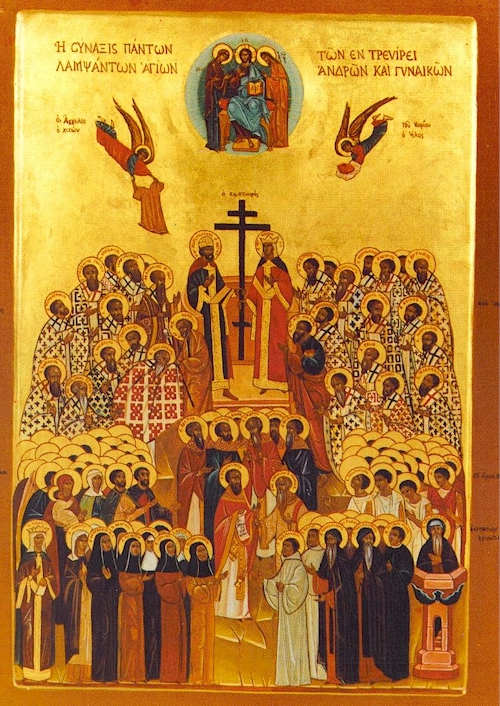
It was Sunday and I was isolated. It was one of the days without food and I couldn’t serve the Divine Liturgy because I had no bread. The Orthodox Liturgy is celebrated with bread and wine, and the central moment is then when the Holy Spirit descends and transforms bread and wine into the Body and Blood of Christ in a real though invisible way· From that moment our attitude towards the Holy Chalice is humble, loving and fearful, as inspired by the presence of the Saviour. In prison we had no wine, but we had bread and through necessity admitted by these extreme circumstances, my service was complete.
and through necessity admitted by these extreme circumstances, my service was complete.
On that Sunday I asked the Lord to help me forget my sadness at the impossibility of serving the Holy Liturgy for lack of bread. Nevertheless, a thought came to me: to ask the guard for some bread. The evil guard was on duty and I knew that my request would make him angry; he would insult me and he would ruin the peace I had in my soul for that holy day. But the thought persisted and grew so strong that I knocked on the iron door of the cell. A few minutes later the door was violently opened and the furious guard asked me what was the matter. I asked him for a piece of bread, no more than an ounce, for serving the Holy Liturgy. My request seemed absurd to him; it was so unexpected that his mouth dropped open in amazement. He left slamming the door as violently a s he had opened it. Many other hungry prisoners asked him for bread, but I was the first to ask for bread in order to serve the Divine Liturgy.
I regretted my impulse.
Twenty minutes later the door of my cell opened half-way and quietly the guard gave me the ration for a whole day: four ounces of bread. He shut the door as quietly as he had opened it· And if I had not been holding the bread I would have thought that it was all an illusion.
This was the most profound and most sublime Holy Sacrament I have ever experienced. The service was two hours long and the guard did not disturb or insult me as at other times; the entire duration of the isolation section was peaceful.
Later, after I had finished the Liturgy and the fragrance of the prayer was still in my cell, the door opened quietly and the guard whispered: “Father, don’t tell anyone I gave you bread, or you’ll ruin me.” “How could I tell this to anybody, mister first sergeant? You acted as an angel of God · ..because the bread you gave me became the Body of Christ. In so doing you served by my side, and your deed is now recorded in eternity. ‘
Without answering, he quietly shut the door, looking at me until the last moment. After that he never insulted me and during his eight hours of duty I had the most peaceful time of isolation.
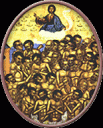
I have related this double aspect of my confinement–the suffering and the divine consolation-to make you understand that God secretly balances our lives. If we have God we shall never collapse from the pain of this world. During our most atrocious suffering we suddenly discover oases of light and sacred joy.
In his Diary, the Russian writer F.M. Dostoevsky wrote prophetically of what would happen in this century: “My people will descend to such depths that they will desecrate the holy altars with their bloody boots, with their blasphemous hands they will take the Holy Chalice with God’s Blood in it and will spit in it while they will kill the priest before the Holy Table and, dissatisfied with even this, they will crush the Chalice itself on the ground and fire shots into the Holy Blood, But then the triumphant Cross will rise and my people will return to God.” If the first part of this prophecy has been accomplished, why should the second part not be fulfilled? People that turned coat under the communist terror are coming back to faith, the youth are turning their eyes to Christ.
If the world oppresses us, then Jesus comforts us; if the earthly powers kill us, Jesus gives us the martyr’s crown; if the kings cast us into the lions’den, the Son of God shuts the mouths of the animals; if we are sad, our joy is Jesus. We are not alone and we are not deserted…
Suffering has many faces and it is very difficult to describe all of them here. I know an Orthodox priest, Fr. Gavrila Stefan, whose life is spent on Golgotha. He was defrocked in 197l. Ever since then he lives in poverty and terror along with his wife and eight children, the oldest of whom is 16. He was arrested and released several times and his only hope is Divine Pity. While I was in prison he visited my family several times, and after each visit the secret police arrested him because he was forbidden to enter Bucharest, On his last visit, shortly before I was released from prison, he told my wife a terrible thing: “Madam, three days ago I killed our last sheep.” This was in the summer of 1984 when his wife was in the eighth month of pregnancy. How are they living now? What is their new-born baby eating?
Where the pain is great, great also is the mercy of God, because God never gives a man more than he can carry.
In 1978, before the Feast of Pascha, I preached in the church to the youth. I delivered a series of sermons called “Seven Words to the Youth.” As a consequence my hierarchs, upon the order of the communist supreme authority–Nicolae Ceausescu–excluded me from the church and delivered me into the hands of the secret police. I was despondent and terrified at the very prospect of imprisonment and maybe death in prison. I went to my older sister who was then about 70 years old, a simple woman who has always been in contact with the wisdom of the Romanian soul. After I had finished complaining she said to me: “My dear, I’ll tell you a story from here. from the countryside. You are educated and you will understand its meaning.
“When God created the world He also created sorrow, suffering and trouble; and He laid them on a big stone and the stone broke; He laid them on a big tree and the tree withered; and finally He laid them on man and man carried them. And so will you, my brother, carry your sufferings.”
And so I did. The proof is that I’m here before you and told you this wise Romanian folktale.
Taken from a talk delivered by Fr. Gheorghe Calciu at a conference in Washington D.C. on Nov. 9, 1885 sponsored by CREED-the Christian
Relief Effort for the Emancipation of Dissidents-which was
instrumental in Fr. Gheorghe’s release.
 Christian Dogma
 Christian Martyrs
 Christian Orthodox Churches and Monasteries
 Christian Sermons and News
 Church's Teachings on Fasting
 Ecumenism – a Great Heresy
 Father George Calciu
 Life_a Sacred Gift form God
 Orthodox Saints and Church Fathers
 Spiritual Elders
 Daily Bible Readings
 Journey to Orthodoxy
 Listen to Ancient Faith Radio
 Orthodox Calendar of Feasts and Saints
 Orthodox Christian Mission Center
 Orthodox Institute
 OrthodoxChristianNetwork TV


Recent Comments