
You are currently browsing the category archive for the ‘Orthodox Sermons & News’ category.

Newsletter N 1. January 1970
New Year sermon, 31 December 1969
In the Name of the Father, the Son and the Holy Ghost.
Once again a new year is approaching. When we are young we greet the new year with open hearts and it seems to us that everything is possible in it. It stretches before us like an endless plain of virgin snow; no footprint has yet marked the whiteness. Everything is possible, everything is pure and shining. In declining years we await the new year with a kind of inner patience, we feel that it will be a repetition of the past. There may be new events in plenty but they will be familiar, earthly happenings which we know how to live with. In both cases we are mistaken. Yes, the new year lies before us like a path that no one has yet trodden, a clear, virgin plain that must flower with a wealth of human good deeds. Whatever our age a path lies ahead of us and it is up to us to make it the way of the Lord, or not. It depends on us whether for those around us and for future generations we make a track to Heaven or to Hell, either eternal Hell, or simply the cruel human hell on earth. And at the same time what lies before us is, as old age sees it, the usual and familiar, only that it has never happened to us before. Life may be as ordinary as ever, but we may be different, the same events may occur again but be quite new because we have changed.
We can enter this year creatively, but only on condition that we enter with hope, that is with the certainty that the Lord is in this year, that He is the master and will lead us to the right place, and with the faith that nothing in this year will happen without the will or acquiescence of God. If this is our attitude we shall see that nothing is chance, (whoever believes in chance does not believe in God) that there are no pointless meetings and every person is sent us by the Lord. And if we enter this year with the knowledge that everything — light and dark, good and terrifying — is a gift of God and is sent us so that through us faith, hope, love, joy and the strength of the Lord should enter the world, if we firmly believe that every person who crosses our path is sent in order that we may bring him the word or action of the Lord or receive it from him, life will be meaningful and rich. Otherwise it will remain a matter of chance, an endless string of fortuitous events. Let us enter upon the new year with this faith and hope and this burning of the spirit, let us receive each other and anyone whom God may send us as the Lord receives us on our way, and let us accept anything that befalls us as coming from the hand of God, and in all circumstances let us be Christ’s; then all will be well.
The year has passed and many are now seeing the new year in the Kingdom of God. They have run their course; we are still on earth. Let us remember those who lived among us, those whom we knew and loved, and those whom we barely noticed through inattentiveness. Let us remember them now at the throne of God; let us remember all those countless people who perished miserably this year from illness, in accidents, in war. Let us remember everyone and leave out no one, and enter into this new year with a heart open to all. And before we separate, let us sing ‘eternal memory’ to all the departed, and let us keep that eternal memory in our hearts with love and thanksgiving to God that He let us meet people whom we could love and respect and whose example could inspire us. (Choir: eternal memory) May God bless the new year: I wish you a happy new year, to live, to love God, to love people and to serve them.


We are on the threshold of the Holy and Great Lent. This Sunday of the expulsion of Adam from Paradise as the last rest before our spiritual struggle, places us at the beginning of our sinful life on earth. We are banished from Heaven because of disobedience, pride and non-abstinence. A life on earth full of struggle, suffering, tears and death, is our “reward” for sin.
The state of Adam banished from paradise, which is also our state, is reflected in the humble hymns of this Sunday: “Standing Adam at the gate of Eden, wiping for his nakedness and moaning:
Woe to me, that I disobeyed Your good commandment and being stripped of Your glory, alas, with shame I am laden. Woe to me, naked of my innocence and left in poverty. Now oh Eden, I will not delight in your sweetness…”
So, the struggles, the sorrow and wiping of lent are the sorrow and mourning for our lost Heaven, which we ought to regain with much suffering. This Sunday Gospel reminds us again of the two great deeds: humility and love, which are the basis of all good deeds. But fasting together with prayer and struggle can be thwarted by the enemy if we are not attentive. Therefore our Savior teaches us: “And when you fast, do not look dismal, like the hypocrites, for they disfigure their faces that their fasting may be seen by men. […] But when you fast, anoint your head and wash your face, that your fasting may not be seen by men but by your Father.” (Matthew 6: 16-18).
Let’s not forget the lesson from the parable of the Publican and Pharisee when we fast. Lets struggles with love but guard our work and keep it silent. Let the withering of our body be clothed in the gladness of our heart, thinking about the great benefit that fasting brings. The anointing of our head and the washing of our face should not be taken literally, but in a spiritual sense. Saint Maximus the Confessor tells us that the face is the icon of our entire live, and the head is the symbol of the mind (see Philokalia). So the washing of the face means to cleanse our lives from all defilement of sin, and to anointing of the head means to acquire a mind full of divine knowledge.
Worldly cares usually occupy all of our time and there is no respite to care for the soul. But the worries should be proportioned to the significance of our labor. As our Savior tells us: “Do not lay up for yourselves treasures on earth, where moth and rust consume and where thieves break in and steal, but lay up for yourselves treasures in heaven […] For where your treasure is, there will your heart be also.” (Matthew 6: 19-21).
These earthly possessions compared to the one expensive treasure – our soul, do not deserve the attention they are given. We cannot ignore the bodily careless, but the caring for the soul should come first, so this Lenten journey, a time of weariness and cleansing of soul, should not be spent in many of the worldly cares.
In particularly, The Holy Gospel draws our attention to the love of neighbor, namely the forgiveness of our neighbor as a great deed, well pleasing to God. So much our Savior stresses the forgiveness of our neighbor that without it, He does not forgive our sins: “If you forgive men their trespasses, your heavenly Father also will forgive you; but if you do not forgive men their trespasses, neither will your Father forgive your trespasses.” (Matthew 6: 14-15)

While all sin is directed against God and only from Him we can obtain forgiveness, however, of the sin against our neighbor God does not forgive us without his/her approval. Therefore, when we ask someone forgiveness that we offended him, he replies: “May God forgive you! ” Meaning: I ‘ve forgiven you, so the Lord God will forgive you. And that is how God forgives us.
First we need forgiveness from God for the renewal of our mind and our labor during this lent will follow this path. So in our daily Prayer to our Lord, we commit before God: “Forgive us Lord, our sins, as we forgive our debtors.” Without this forgiveness, God does not forgive us. Not only that He doesn’t forgive us, but He also will not receive our good deeds. This is told clearly by our Saviour: “Therefore if you bring your gift to the altar, and there remember that your brother halt aught against you, leave there you gift before the altar, and go your way; first be reconciled to your brother, and then come and offer you gift.” (Matthew 5: 23-24)
Elder Petroniu Tanase of the Mt Athos

Winter holidays in the midst of Arab Spring

“Christ is born, glorify Him… sing unto the Lord all the earth and joyfully praise Him all ye nations for He is glorified!”
It’s the liturgical song that expresses the joy of the Church that our Christ Savior was born. The joy that unites heaven and earth, angels and men. A joy that we all felt and we mostly lived it liturgically, ecclesiastically, Eucharistically – in the great mystery of the Divine Liturgy. We could say that is something normal and that is how our ancestors lived. In our nation, yes, it’s normal. But unfortunately not all Christians had the holy peace that we’ve all enjoyed at Christmas.
Every time the Gospel is read, on the Sunday after the Nativity of our Lord, we are presented with a family [the Holy family of the Virgin Mary and righteous Joseph] in the Middle East, fleeing [with the baby Jesus] from the human hatred [of Herod]. From infancy, the Holy Child experienced suffering. From the cradle, He began to bear His Cross. But He wasn’t alone… Immediately it followed the 14,000 innocents, the first martyrs of the Church – the infants. And the series of this genocide continues until today…
This Christmas feast, in the home’ land of the Christ Child, in the Middle East, Christians celebrated it – with tears. Tears for the loved ones who have died, tears for the many which cannot be found, tears for their churches and their cemeteries, tears that Christ was born in a world too cruel.
Tears began to flow starting with the eve of the great feast, while in our country, children brought the good news. On December 24, 2013 during Vespers in the Dora neighborhood of Baghdad, a church was mined. 26 Christians that were praying in the church have died and 38 were injured. At the same time, in the Athorien plaza of the same city, two bombs targeted a cafe owned by a Christian family. 11 more dead and 21 wounded were added to those murdered in the church.
In Egypt, a little after midnight on December 26, during the Divine Liturgy, a bomb exploded in the nave of the Coptic church: Abba Anthony. There, 23 martyrs were counted and about a hundred were injured. According to the eyewitnesses, “there were body parts [of those martyred] spread everywhere, on the streets, outside the church and even in the Holy Altar. The dead were placed before the altar, covered with newspapers and the vigil continued… ” The eyewitnesses also attested that “the security forces withdrew an hour before the bombing of the church.”
These may seem to us like events from a parallel world. But in fact they were acts of ordinary Muslims, trained by a series of fanatical clerics. And if they were attributed to the rebels, we must say that there were also government orders. In most Arab countries, the Muslim government leaders have passed law bills that prohibit Christian liturgical worship during the period of December 6, 2013 to January 7, 2014.

In the Islamic Republic of Iran, a government decision was instituted that ‘recommends’: “the local Christian churches to reduce the pomp for the celebrations of Christmas and New Year, in order not to disturb the days of mourning and self-flagellation of the Shiite Muslims.”
In Iraq, some teachers from the elementary schools in Baghdad and Mosul have scheduled final exams on December 25, forcing Christian students to attend school on the day of the Nativity. Some Muslim clerics in their sermons insisted that to tell someone Merry Christmas is worse than fornication . . . and even worse than murder!
At home, we enjoyed the caroling, the lights and the Christmas tree, we attended church and we extended this joy into our family homes. With or without the snow we felt it as a magic winter. We lived the holidays, as we desired.
In the Middle East however, the winter continued with the Arab Spring, which brought tears and pain. But Christ was also born for them. Perhaps more than He was for us! That He may bring comfort to their souls. There, were the carols were absent, the holy angels sang instead: “Christ is born, glorify Him … sing the Lord all ye nations and joyfully praise Him, for He is glorified!”
“Copyright Disclaimer Under Section 107 of the Copyright Act 1976, allowance is made for “fair use” for purposes such as criticism, comment, news reporting, teaching, scholarship, and research. Fair use is a use permitted by copyright statute that might otherwise be infringing. Non-profit, educational or personal use tips the balance in favor of fair use.”
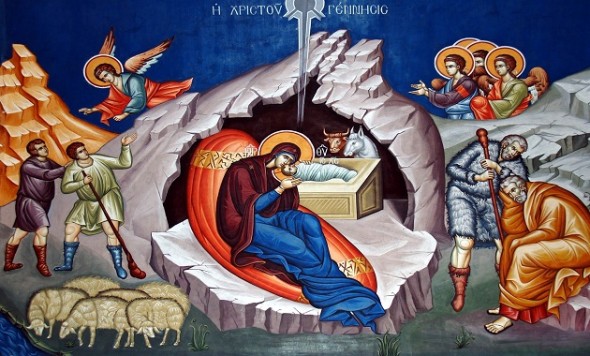
From the beginning I would like to ask: do we all feel in good standing for this Christmas celebration? Are we all at peace with each other? Do we welcome this festival – so to say – naturally or are we at unrest or hide anxiety, stress or worries within?
If someone would walk through the city streets, the markets and see how people rush here and there, to finish shopping, could say: “How unhappy are these people and how they should otherwise feel, as they find themselves worry on all these things? How unfortunate they are!
How can someone welcome Christmas and celebrate it, I mean every day? As I said today at the Holy Liturgy, we do not only wait for Christmas, but we live it even now. On Christmas day Christ was born. So this fact that Christ was born does not only include the entire time or our whole life, but encompasses eternity, it embraces everything. Therefore, everywhere and every day is Christmas.
Christmas is not a static day enclosed in time as something “magic: as soon as that day comes, we enter in.” Because that day will come and go like any other, unless we are truly prepared for it. And we are prepared when these very days we celebrate, leaven within us and help us. Therefore, what kind of Christmas will someone celebrate when he is not in order, when his soul does not rest in God, when agitation, restlessness, emptiness, hopelessness, or despair rest within? Our whole life in this world lays on hope. Man’ existence is one full of hope. If someone misses this, what can Christmas do for him? If someone doesn’t live this belief, can Christmas mean anything? If they do not have the fullness of God within their soul, can Christmas do something for them?
But what makes man be in good standing? So this question whether are we ready for Christmas, I ask again as we move closer to the feast, to free us from worries and anxieties. Man is not in order when he tries to ignore – as some try to simply forget – nor when he seeks justification or excuses. The one thing that puts man in order, the thing in which man finds rest, is repentance; to repent before God, to humble himself before God, to return wholeheartedly to God. Without repentance there is no Christmas. No matter the circumstances at home, repent before God and before your brothers.
This of course involves the love for God and the love of neighbor. Mo matter how [difficult] things are… For love creates a different atmosphere, another state, then people can truly come together to celebrate Christmas. But I mean true repentance! Again, repentance is not to forget certain things. As sometimes when someone in a certain place feels exposed, he remembers facts, conditions, things that humiliate and grieve him, so he wants to move to another place hoping that he will be placed in order. This is flying from temptations. Of course, sometimes this could be good, if there is no other choice, or because man has no courage to do otherwise, however this does not bring healing. That one thing that man needs, the thing that really helps with his healing is to repent before God for all that he did, for all that he accused Him for. To repent of every sin before God and sinful as he is, with his ego wounded and exposed, or in whatever sate he may be, to have the courage to stand before God. If you have the courage to stand before God, with your sins …, this means either courage or repentance. And of course, everyone can distinguish between the courage and repentance. Otherwise if man conceals his sins, he will hide his true self and will try to appear before God completely innocent. In this case, man becomes unconscious of his sins, or more precisely in psychological terms, he reject his sinful passions in his sub consciousness then he’ll appears before God somewhat repentant, somewhat in order, somehow humble, somewhat upright, [thinking that] perhaps this is how God wants him to be. However, this does not mean putting oneself in order.
Repentance is not as easy as we may think. And please take heed of this. […]
And I would say that repentance is a blessing from God. If God does not give you His grace to repent, you cannot repent. Therefore man must not take repentance at ease. We mentioned another time, what it is written in the Apocalypse (Revelation): There were [will be] disasters, terrible things [will] happened, cities [will be] destroyed, many [will] perished, and yet “people did not repent of their wickedness”. They still did not return to God. And another evil came upon them, another plague, and they still did not repent. And this is written, a second and a third time.
We not certain whether man [humanity] will repent, even when man is going through difficult times, it may only seem that he repents. This kind of repentance that occurs in a forceful way, let’s say in a moment where you are at limit, it is not true repentance; that there is an earthquake or the world comes to its end, and you’re ready to repent… Or the war is imminent, or your life is in danger, so you repent. Such repentance does not hold. For man forsook God, then God abandons man, and man remains unrepentant and although he sees, he hears, he does not intend to return to God in repentance for God to heal him and save his soul.
Repentance is a great wonder. For this we say “Lord Jesus Christ, have mercy on me, a sinner.” This prayer is a work of repentance. I mean that you repent when you ask for His grace, His forgiveness, but also you ask for repentance. It’s like asking repentance when you say: ” Lord Jesus Christ, have mercy on me.” He who asks repentance, unceasingly says: “Lord Jesus Christ, have mercy on me,” and when you neither can, nor that nothing happens to you and you’ll give up, it means that you had no real desire for repentance.

From Simeon Kraiopoulos – “On repentance”
Source: http://paterikakeimena.blogspot.ro/2011/12/blog-post_1903.html
Father George CALCIU and a Life Sacrificed for Christ

“The only chance of survival for Eastern Christianity
is that of a warfare through the Word.
Our solution is of Calciu-Dumitreasa… “
N. Steinhardt
The future priest George Calciu-Dumitreasa was born in 1925 in Mahmudia, Tulcea, Romania, having been the eleventh child and the youngest of the faithfull parents Dumitru Calciu and Ileana Calciu (former Balan). In his memoirs (and especially in the book „The life of Father George Calciu – after his testimony and those who knew him”, edited by Diaconesti Monastery, Christiana Press, Bucharest, 2007), father George with his humorous style, noted that he learned more practical theology from his peasant mother than from all the treaties and theological schools he attended.
The young George followed the gimnasium in his native village and, then as a high school student in Tulcea, he came in contact with the Legionary Movement and joined, like most young people of his generation, the Fellowships of the Cross (a youth organization of the „legion of the Archangel Michael” intended for high school and junior college students where political views were only secondary, its primary focus was for an education of its memmers in intellectual, national morals, Christian values and brotherhood).
Eager to help the poor peasants among whom he grew up, the young George opts after the baccalaureate for the School of Medicine in Bucharest. When he was arrested in May 1948 he was a medical student in the second year.
Like many young people of his time zealous in faith and with national pathos, members of the Brotherhood of the Cross or perhaps only supporters of the Legionnaire’ cause, the young student George experinced the hell of Piteşti prison. At Piteşti, between the years of 1949 and 1951, under the worst physical and psychological tortures, overcomed by weakness and confusion („they called me the fallen angel with blue eyes” father used to say), he is „recruited” for a short time in the team of the torturers led by the sinister „instructor” Eugen Ţurcanu. Ţurcanu, a diabolical character, was once part of the legionnaire movemet but then recruted by the communist party as a key collaborator in the “Piteşti’ experiment” and lastly eliminated with no scruples by the regime.
However, the young student George Calciu will have a spectacular moral comeback refusing to take part in the Securitate [comunist’ secret service] wicked plan and overturning the trial intended for Ţurcanu and his colaborors; trial by which the comunists were not seeking justice but just to defend their party, through the old method of „finding the scapegoats”.
The young George Calciu finds the courage to point at the real culprits at large: the Secret Service Department of the Communist party founded by Kremlin which planed this odious process of “re-education” by using Ţurcanu and others like him as instruments in trying to promote the falls idea that everything was done by the exiled Legionaries and not by the regime.
With Piteşti, the redeeming odyssey of Paulinic dimentions of young George began, followed until 1963 by inprisomnent in Gherla, Jilava and Aiud and until 1964 by a house arrest in Bărăgan; a George no longer accepting any compromise and determined after his release to sacrifice the rest of his life for Christ and His Church. As I once commented: “This man’s life after the tragic experiment of Piteşti has become one of repentance, confession of faith and sacrifice. […] Perhaps no one after experiencing Piteşti was able to reach such moral comeback, an unrefuted victory over the evil. Because there is the case: George Calciu, it can be said that the Piteşti experiment has failed. Piteşti has physically crushed people, but it could not ultimalety destroy the Man. The greatly tempted George Calciu was not only tring to save himself but he eventually saved the human dignity in the face of what phylosopher Mircea Eliade called the terror of history.”
Having being released in 1964, George finds the strength to rebuild his life and fulfill that exemplary promise; he marries Adriana Dumitreasa (herself with two brothers that had passed through the communist prisons) who gives birth to their only son, Andrew (currently an attorney in Washington DC and father of a son). He is “tolerated” by the Securitate to enrole in the college of Philology and then – with the support of the brave and skilful Patriarch Justinian – in the school of Theology. He teaches French literature for a short period of time, then he is ordained priest and named professor of the New Testament at the Theological Seminary in Bucharest.
After the great earthquake from 1977 (prompted by the demolishion of Enei Church in Bucharest and the communists villain campaign directed by Ceausescu against the holy churches), Father George resumes his open battle with the communist regime and during the Great Lent of year 1978, he starts preaching in Radu Voda Church (then on its front steps when the church officials of the time had tried to stop him by locking the doors of the church) his famous homilies “Seven Words to the Youth,” – a series of sermons calling the youth and especially the future priests, to resistance in the name of Christ and harshly criticizing the atheistic materialism and the insanity of the Ceausescu’ regime.
His sermons had a local and international resonance, especially through the radio station “The Free Europe” but also circulated in typewritten copies, “under hand”, marking destinyes and consciousness.
After many threats, slanders and prosecution (everted also at his family and at his loyal students, so-called “calcişti”) with the intent to stop him, Father George is arrested again (on May 10, 1979), alleged with absurd charges and sentenced to 10 years of inprisonment (later changed to seven and one-half years) of which he executed five years. Father George was released on April 20, 1984 following the international pressures (from the West) directed at the communist regime of Romania.
So Father George Calciu executed a total of 21 years of inprisonment under the communists: 16 years under Gheorghiu-Dej regime (from 1948 to 1964, including one year of house arrest) and 5 years under Ceauşescu regime (from 1979 to1984)!
In 1985, he was practically forced to leave his country along with his family – once again greatly tested. After a brief stop in Western Europe, father moved to the United States – where he was granted “the honorary citizenship”, however with no pecuniary advantage. So practicly father had to start his life over again, working initially as a construction worker – although he’d already reached the age of 60 – to be able to survive and support his family.
Thus, to the 21 years of inprisonment, 21 more years of exile were added.
In America, Father George Calciu continued to endeavored, as much as the Lord strengthen him, to fight the good fight in the name of Christ and his nation. Besides his parish ministry (in Alexandria, VA), he advocated before many international fora in defending many oppressed Romanians; father had also met – among others – with presidents François Mitterrand, Ronald Reagan, as well as King Michael the Ist of Romania; he was a central presence at all important meetings of the diaspora; he published the book “Christ Is Calling You. A Course in Catacomb Pastorship” (St. Herman of Alaska Press, Platina, California, 1997) and much more…
Starting with 1990 after the fall of Communism, father will return every autumn, to visit the home land he had loved and unwillingly abandoned, bringing the same message of unity and forgiveness. In a travel journal from 2003, he noted with tenderness and bitter introspection: “Every year, the spirit of love for my country and its people, its monasteries and their dwellers, for my dear friends and relatives, draws me back to the steps of my childhood and youth and to the joys and sufferings I’ve experinced there – the most precious treasure of those 6 decades of my living in Romania, until the time of my estrangment [exile] 18 years ago. It is like a endless abiss that split my life in two in 1985, deeper and wider than the inprisonment. Maybe because even in prison, my life was following its course on the country soil, and perhaps it is why I always live contemplating my next visit back, passing over an ocean of waters and memories… “
On November 23, 2006, Father George would had turned 81 years. But he passed on November 21 (at 13.10, or 20.10 Romanian time) after 3 days of coma at the Fairfax Hospital, VA brought – at the request of his family – from the Central Military Hospital in Bucharest, where he had spent a prior month and was visited for the last time by many who loved him; by Patriarch Teoctist of Romania and by Metropolitan Bartolomeu Anania – his spiritual instructor who confessed and communed him for the last time.
Departed in the Lord two days before turning 81 years, father was brought back to Romania on the Feast of the Apostole Andrew and laid in the Monastery Church of Radu Voda, where once father delivered the “Seven Words to the Youth.” The official ceremony [memorial service] took place on December 2, and was led by His Beatitude Patriarch Teoctist of Romania in the presence of his Eminence Archbishop Iosif Pop, Bishop Varsanufie Prahoveanul and Bishop Irenaeus Duvlea from America, representing his Eminence Archbishop Nathaniel of OCA. The Patriarch delivered a memorable speech evoking in addition to the theological and spiritual virtues of the newly reposed, father long struggle against the atheist and materialist regime of Romania as well as father “martyrdom in the communist prisons.”
At noon we departed for Petru Voda, father burial place that he had chosen in his will. Thousands of faithful from all over the country and abroad, gatered at Petru-Voda Monastery for the memorial service led by Archimandrite Justin Pārvu (aboot of the monastery and a former political prisoner under communists) in the presence of 34 priests. Father George was layed to rest – and it’s now seven years! – at the foot of “Romania Holy Mountains”, in the heart of Petru Voda, having as “companions in suffering” Abbot Justin Pārvu and poet Radu Gyr. And with no doubt, powerfull is their threefold prayer before God for those who will receive according to their love.
(Răzvan CODRESCU, Christian Journalist)
Father George 7 years memorial service:
Motto: “I write unto you young men, because you have overcome the evil”
[I epistle of St. John 2:13]
By Rev. Fr. Basil (Vasile) Mihoc, professor of theology

My beloved, victory requires struggle. There is no victory without a battle. We live in a world where it is desired that people, and especially the youth, may be defeated in their struggle and “freed” to become enslaved.
If we observe the demonic work around us, we can see its deception for it wants to give us the impression that in fact, there is no need for a spiritual battle. Many passions are now proclaimed as the norm and it’s no longer desired to fight against them! The enemy hides itself but is at work: “I write unto you young men, because you have overcome the evil” says St John, the apostle of love. The enemy has become very cleaver and it gives us the impression – in various ways – that there’s no need to fight.
In our times, even some churches proclaim a Christ that is nice and sweet, a “new Christ” that accepts man’ sins as normal and unfortunately many so-called “churches” have fallen into this trap. In the West, there are church’ leaders that proclaim loud and clear that the sins against human nature [i.e. homosexuality] are normal. Why not accepting gay couples as normal or why not have priests possessed by such ugly passions? Why not a “Christ” that is a nice guy?… So they’re troubled when they encounter Orthodox Christianity and see icons that depict a Christ who is too serious!

Recently, I was asked by an Orthodox layman, why Christ doesn’t smile in our icons? … so He can look cute. Our Christ is too serious!
My beloved, Christ is serious for He sees the wickedness of the evil one and to what extent we are affected by it!
Life is a serious thing and it involves battle against evil. If you are not aware of this struggle you are the victim of the devil.
“I write unto you young men, because you have overcome the evil one.” – again, victory implies struggle. Any serious thing in this life is gained through hard work! Through a disciplined battle, an ascetical struggle as St. Paul puts it: “He who strives for an earthly crown practices self control…”
But the Apostle of love [St. John the Evangelist] continues:
“I wrote unto you young men, because ye are strong, and the word of God abideth in you, and ye have overcome the evil one”.
We can say that this second word of the apostle addressed to the youth comes with details on this victory. The victory doesn’t just happen by itself.
“I wrote unto you, young men, because ye are strong” – do we realize the youth that the Apostle John was referring to, when he wrote these words? A strong youth!
It seems that we do not know many strong young people today!
Today’s youth seems very fragile spiritually as they are systematically weakened, almost programmed, I may say. Today, we live in a world that weakens the spirit, the people and of course it exercises this the most on our children, in our youth. In order to be strong you need to be strengthened.
There are young people who dream to have strong muscles – so they exercise their body. Sure, this is not a bad thing if it’s done in moderation. But very few young people long for the spiritual strength, the saintly’ strength of an athlete in Christ!
Many long for adventure and dream of a life full of interesting things…
I’d like to tell you that the most exciting adventure is a life lived in Christ. If you desire a life full of wonderful surprises then begin a life in Christ, which is a narrow path in the beginning but it expands as you travel on. This path begins in your heart, the point where Christ meets you and as you advance on it, it widens to the infinite, reaching the Kingdom of God.
The path of sin is broad and it seems wide at first, but it continuously narrows until it reaches a dead-end, where there is no way out.
The narrow path however, requires discipline, struggle and seriousness but by advancing on it, it will reveal itself in its lovely infinity.
So, do you think you’re strong?
To become strong one has to be fortified by the means that we Christians been offered by the power of Christ, through the Holy Spirit. “You are strong and the word of God abideth in you”.
In fact, the explanation follows in Matthew 13 in the parable of the sower; in this parable, it is said that the seed is the word of the kingdom, so we call it God’s word, but in Matthew, it is especially called “the word of the kingdom”.
Does this word “Kingdom”[Βασιλεία του Θεού or vasileia tou theou] or the Kingdom of God interest you, does it find any meaning in your lives today?
Some have devalued its meaning as we see in some places, the houses of the kingdom or the Jehovah’s homes. So, for many the word “kingdom” [βασιλεία – or Vasilia] has lost its meaning.
My beloved, let it not be so! The saving word of Christ is the “word of the kingdom”. We must also consider its substrate [βασιλεία]which in Aramaic is “Malkuta” or the “word of the kingdom of God”! God is accepted as King, He reigns, but this implies that we are reining with Him! It’s an adventure to become king, isn’t? The Lord calls us to this adventure – to reign with Him in His Kingdom!

This word must remain in us… The parable in Mathew gives us a lesson, saying that the seed of the word is often stolen quickly once was sown on stony ground or among thorns. Only some of the seed falls on good ground and bear fruit, one 30, other 60, and another 100 fruits. When St. John the evangelist talks about the youth that is strong, he means that “the word of the kingdom” remains in this youth, and it is not easily stolen, or stifled. It is His word that is germinating, growing, blooming and bears fruit within us. When the word of God abideth within you, says the Apostle, you have overcome the evil one.
Every time we say the Our Father, we ask to be delivered from the evil one!
“You have overcome the evil one” – the devil is this evil one that lurks our lives, our eternal lives, but also this physical life. He wans us to become lost on the way.
My beloved youth, we are called to a victorious battle! We confess Christ as the One who overcomes evil. On the Holy Cross we read these inscripted words: Jesus Christ NI KA – Jesus Christ who overcomes [conquerors]. He calls us to be victorious in this fight with Him, in this adventurous wonderful battle for the Kingdom of God. Amen.

On the “rights” of the demoniacs
(by Father Constantine S).

Lets go back a couple thousand years ago, somewhere in the land of Gadhara, where our Saviour was greeted by two demoniacs, who lived in the graves (Matt. 8: 28-34) The two possessed men were acting so fiercely that nothing could keep them still, even the most powerful chains, and no one dared to pass by them because of fear. The demons were cast out by Christ Who allowed them to enter a herd of pigs, that once possessed by the unclean spirits run into the nearby sea shore, perishing. The consequence was that the inhabitants of those lands asked Jesus firmly to leave their land.
Surely, a lot can be said on the inhabitants of Gadhara that asked Christ to leave their land for “the damage” He had caused to them. Placing it into the current context, we can also think how the people of that land, by their gesture, have fought for the “demoniacs rights”. If these two possessed men chose to serve the powers of darkness (as no one will get possessed unless he does the devil’ will), why not leave them as such and respect their choice? In other words, why they should be discriminated against just because they are different from other people? You can be a man living in the community, having a normal family, but you can also be demonized, living in isolation… So why should we bother these people? Especially when intervening in their healing, you risk to have a consistent loss. That’s how the inhabitants of Gadara were probably thinking, concerned not to disturb the community of demoniacs, quite large in those days.
The Gergesens of our days however, have progressed as they work preventively. They no longer wait for God’s intervention so they may ask Him to leave their lives, but watch for Christ not be present at all in society, so that He may not heal anyone from certain passions. And for this, they need laws to restrict the access of God in schools and public places, leaving (at least for now) the chance that He may be present in private places.

The contemporary Gergesens, fearing discrimination damages, rush to offer to all the “sexually diverse” [possessed] the “right” to live forever in their tombs of loneliness, in suffering and un-fulfillment as a man and woman in the family. Under the pretext of respecting “human rights”, it is hidden in fact the inability of contemporary man to truly love. We don’t love others when we leave then in a state of been continuously traumatized, we do not help by “respecting their right” to suffer alone or even as a gay couple with pretends to be “married”. We love man when we intervene to free him from the pain that makes him to wrongly choose. A wrong choice to his initial longing for God and paradise, that is impossible to be voided by laws and directives.
We have become accustomed to evil
(by Fr. George Calciu)

Today we’ve got used to all evil. So much we’ve became accustomed to this state that no one is disturbed by a new heresy that arises. We’re no longer troubled by homosexuality, or by a “Da Vinci Code”. We are accustomed to evil. It is the darkest side of us all. We are accustomed to evil in such a way that we no longer notice it. This is our moral state in today’ world. Every heresy that occurs primarily earns its presence in the city, by the dirty laws of society and all modern societies have such laws. They’re all in the service of the Antichrist to destroy all morals, to isolate the person, to create division, to make him a slave, a mare cog of the Government’s agenda. No matter whether you live in the “greatest” democracy! All these have made us to slowly get used to evil. Today no one cries out on what happens near us, or when Jesus is mocked, or that our faith is been transformed into a game. Christians are considered retarded because they believe in Jesus Christ. We are been told that there is no other faith but only what is palpable: and “the right” to enjoy life, without restraint!

If we’re allowed to say… the human soul became a little hell. As we live, move or act in this world, each one of us is wearing his own mask and communicates through it, yet deep down in our soul, it is as dark as it can possibly be. If we do not put out the old man, if we are not been reborn, what would it follow?
We must not be surprised or confused when we see man, in critical times, revealing this image as the evil within comes out. When someone is not reborn in Christ, if the body and soul do not become temples of the Holy Spirit, although this part of the soul remains “protected” [by the mask], no matter how hard he tries to cover it, one day will come out. And it will come out not to vanish but to hurt, to reveal the evil power that reigns within.
Many descended into hell – millions of people – including the prophets and the righteous men of God, from Abel to Christ Himself, still hell remained hell. We can say as we study things, that we believe in the truth of the Gospel of Christ, and try to improve ourselves, to be transformed by it. Of course this has importance, as it ought to produce a change within us that only Christ can do, by descending into the hell He conquered.
To note that the Orthodox icon of the Resurrection is not depicting Christ standing over the grave, but it shows Him in hell, crushing all its power. In this depiction of the Resurrection, there are fallen gates, bolts, nails … Nothing was left as it was. Everything was shaken, the gates were opened, and the souls freed to come out.
So it is with the human soul: if Christ doesn’t enter, nothing will change. Certain truths we receive and believe, but alone are not enough as we filter them through our own understanding, because at a final analysis this does not change the old man.
As Christians, we believe in the truths of Christ’ Gospel, go to church, commune, and all we have gained – especially in the recent times – is [spiritual] comfort.
So we have found “a method” – and how did this happen?- that the old man, the idol within remains intact. Our inner state remained intact, and we have become Christians on the surface!
(Archimandrite Simeon Kraiopoulos, in “The Mystery of Salvation”).
The newly departed servant of Christ,
Elder Justin (Pârvu) of Romania and his Words of Wisdom

Motto: “If we would be willing to descend into our selves to correct a bit this avalanche of wrongdoings, then our prayer will be heard, the world would be more at peace and our life would suit more the Lord’ liking.
We have become increasingly hostile towards each other by our own selfishness, we see no one but our selves… and when we reach this state of no longer caring for those near us, we encounter the greatest fall”.
Man’ freedom is at the measure of his genuine love
Freedom becomes precious only when it is lost. Or at least, this is how we think. All his life man seeks to be free, but does not appreciate the gift of his freedom until it is too late. Freedom is in our body but also in our heart. Freedom is in action but also in the mind and the intellect. Man is free by how genuinely he loves and is attached to the values of the faith.
We are free when we accept God’s plan for our life, and when we strive to achieve it. Being free does not mean lethargy and bliss, but the fulfillment of your human condition.
Freedom does not mean to do what I always wish, as many times by doing what I like I do the will of the devil. Freedom is at the measure of man discernment, and his capacity to choose between good and evil. Man must realize that only in Truth he can live freely and with so much confusion in this world, he should avoid deception. It was what Communists did not understand, that only on the Cross the human soul gains true freedom, that all their methods of torture and psychological pressure to re-educate us, have made more saints than slaves, have sanctified our land by the martyrs blood.
Freedom is hard to understand when one has not lived in those times [of persecution], and our Christians today barely reflect of this past.
The thirst for God and the love for all people

The thirst for God directs us towards the love of our neighbor and vice versa. So great is the power of love that one who reaches a genuine love for all people denying oneself, receives the gift of healing.
This is the true “follower” of Christ! Such man loves with the love of Christ all those fallen, thus partakes in Christ’ mission on earth and save himself.
Man is half love, half struggle
(Excerpt from an interview given by the Elder Justin in 2007)
Q: – Father Justin, from your experience of “burying yourself in man suffering”, what do you think, does man need: to be understood or to be loved?
Elder Justin: – Man needs to be loved. But to love him, you must first understand him. If you see him fallen down, then you must give him your hand. The love of neighbor is one’ measure of the love for God. If you cannot love the one near you, if you do not help him, you cannot say you love God.
The love of neighbor is the first step towards salvation, on this step one must labor until he reaches the greatest love for God.

Q: – During the communist regime, we have been [spiritually] poised by the slogan “new man”. Do you think we ended up with this “new man”?
Elder Justin: – You mean, in a materialistic sense? Maybe how the communists had imagine a man freed from the “bondage” of faith and of the Holy Spirit…! But a new man purified and renewed… not so.
But I want to speak more of the new man reborn in Christ, a man that’s quite rare in our present times. The renewal of man and of the world can happen only through the Resurrection of Christ, in its profound meaning. This is the new man, whom every mother preparing to bring babies into the world, must dream of modeling.
Q: – Einstein once said that “the progress made by man, compared with the development of his character, is enough to terrify …”
Elder Justin: – Yes… for a soul that’s at peace with itself can fit the whole world within; while in the soul that’s bitter, soured and distressed, nothing can enter…
Q: – How do you think man should be?
Elder Justin: – Man is – or should be! – Half love and half sacrifice, struggling to keep love undefiled.
Q: – A great thinker of the last century, Carl Gustav Jung said: “For a young man is almost a sin or at least a risk to be too much preoccupied with himself, while for the elder man, it is a duty and a necessity to commit to a more serious self study.” How do you see this?
Elder Justin: – At the end of this search man must find God. God made man in His own image, and God dwells in everyone. Young or old, man must clean up the inside of his being, for no one knows when the end comes…
Q: – Someone said that “in an empty mind, the devil finds shelter”…
Elder Justin: – He is speaking of the man who has the basket always full, for he cares for the wheat needed to be milled. And this wheat is our constant cry to God: “Lord Jesus Christ, Son of God, save us.” If the enemy finds our mind wandering in useless things, he will enter and find shelter directing it at his pleasure (…)
Q: – Is there a question that man is rendered to never find the answer in this life?
Elder Justin: – It depends on what someone wants to know. Man has all the answers within himself. About his birth, his life and the meaning of his salvation. But if he wants to find answers to meaningless questions, then he will be constantly miserable. If he seeks answers to questions related to his faith, his purpose in life, he will find happiness.

Q:- Is doubting a sin for the Christian?
Elder Justin: – Yes, but there are “permitted” doubts. A doubt that you’re still alive after a fervent prayer, when your whole being had burned in prayer… This kind of doubt is allowed.
Q: – Father, what is humility?
Elder Justin: – Humility is a fair self-assessment of our human dimensions in relation to the [universe] infinite. Humility accompanied by patience move mounts, that’s how powerful can become for any Christian…
Q: – What is Golgotha [Calvary] for today’ Christian?
Elder Justin: – Man’ unbelief makes every day into a Golgotha.
Q: – Man today is more skeptical than fifty years ago? What can you say to encourage him to go forward, to cope with the trials of life?
Elder Justin: – Our modern man puts too much heart into trifles and details, is assaulted by a lot of false things and does not know how to choose. If you choose wisely, things will become easy and the life beautiful. If you choose wrongly, you are struggling. If you doubt that you have chosen well, your heart is also troubled. Our contemporary man has become too materialistic, a subject to the new tyrant: money. Everywhere we look, we hear that money is everything, the master of this world. He, who makes money his master, makes himself a servant to the devil.
Today, many dramas arouse not from differences in ideas, but from the battle with money, with all that is material. Man bought by it losses his faith and his values and becomes a mare currency.
Q: – How do you define the word happiness? … What advice would you give to Christians who come to you and say they are unhappy?
Elder Justin – Happiness is when you meet with the love of Christ humbly in prayer.
People understand happiness differently. Some who want much may not get it, and feel unhappy. While others may desire less, receive it and are content….

Q: – So happiness is at the measure of man…
Elder Justin: – Happiness is the faith that dwells in us. We have seen people that have many riches, great social positions and they’re still unhappy, because they lock faith!
Q” – There is a story in the Egyptian Paterikon: it happened that a wise elder once sat at the table with several brothers; as they were eating, the elder saw in the spirit how some ate honey, others bread, and some others dung. And the elder marveled and prayed to God, saying, “Lord, reveal to me this secret, how is that the same food is on the table before all, but they seem to eat different food.” And a voice came, saying, “They who eat honey are those who with fear, trembling and spiritual joy sit at the table and pray unceasingly so their prayers go up to God as incense. Those that eat bread give thanks to God for the food, and they who eat dung, are those who complain: “this is good, this is rotten”….
Elder Justin: – Yes, gratitude for what one has received is after all, a measure of man’ faith.
We need to pray with our hearts

• We must honored with much gratitude the sacrificial love of our martyrs.
• It is very important to know how to pray. And often, we monks in monasteries do not pray, but we just seem to be praying. It’s not enough to go to church and to sit there like you did your duty or obligation. We must insist on inner prayer. In vain we say many prayers with our mouth or our mind, if we do not sail deeply, if we do not live what we pray.
• In our times, even the laity need to deepen the Jesus prayer, as it will become our only salvation – prayer into the heart; the heart is the root of all passions and there we must labor. In the past we were able to go by in a more easy – superficial way, but for the times awaiting us, this will not be enough. If we will not have the prayer rotted in our hearts, we will not resist the psychological persecution awaiting us, because soon they will come with [hidden] methods to re-educate our minds. (the elder had the gift of prophesy/ clairvoyance, tr. note).
• Today I find that indifference [acedia] is the hardest sin. Our hearts no longer move in prayer, we have no tears of repentance. There will come a time when only those who feel the grace of the Spirit will be able to distinguish good from evil, for on its own, the human mind cannot discern. There will be times of great confusion and only the Holy Spirit can save us.
So, pray my beloved, pray so you may not enter into [temptation] deception! For only through prayer we can receive God’s grace. If we do not pray and continue in laziness and carelessness, then it is possible to lose the instinct of repentance. God forbid that we may not lose conscious!
(Translated by EC)
See also: The Repose of Elder Justin (Pârvu)

May our Lord rests his soul with His saints, Amen!
 Christian Dogma
 Christian Martyrs
 Christian Orthodox Churches and Monasteries
 Christian Sermons and News
 Church's Teachings on Fasting
 Ecumenism – a Great Heresy
 Father George Calciu
 Life_a Sacred Gift form God
 Orthodox Saints and Church Fathers
 Spiritual Elders
 Daily Bible Readings
 Journey to Orthodoxy
 Listen to Ancient Faith Radio
 Orthodox Calendar of Feasts and Saints
 Orthodox Christian Mission Center
 Orthodox Institute
 OrthodoxChristianNetwork TV


Recent Comments