
You are currently browsing the category archive for the ‘Orthodox Sermons & News’ category.

by Father Eugene T.
Today’s world is so abundant in performances as if nothing else is looking more ardently than these. If someone has something to say, he must make his discourse into a show, otherwise will go unnoticed and almost no one has interest to listen to a message without sensationalism.
Unfortunately many Christians judge their faith according to how much spectacular it contains. The words: humility, simplicity of faith, hard labor, repentance and prayer no longer please the modern “religious consumer”. We are constantly in search of wonders. Is there somewhere an elder that can foresee our problems before they occur? Or perhaps one that can absolve us of all sins without any effort on our part! So if we find him, there we must go…
The Gospel of Christ is full of miracles but paradoxically to some, is totally unspectacular. Our Saviour healed the sick, the terminally ill, casted out demons, multiplied the bread and fish, raised the dead simply just by His word. There was no pompous speeches, no preparation of those present (today we would call viewers) or special effects! Such was with the healing of the blind man; the miracle was simple, unspectacular.
These are the acts of our Lord. He does not create shows, He has no need to impress, but simply He wills and things happen according to His word.
At the opposite pole stays Satan, who is the master of special effects. Having nothing to offer, the evil one feels the need to impress, to hide under the false glow of sensationalism its emptiness and nothingness. Today many people seek a spectacular faith and through it they willingly make themselves victims of the devil.
So there are many vendors of religious ideas who turn God into a show, deceiving those in search of easy happiness.
Do you seek excitement? Satan will give it to you abundantly! But after the pulling of the curtain you will find that the price of this “ticket” was your soul.
Through the healing of the blind man, Jesus Christ showed us the way to salvation. In order to be healed, the spiritually blind passed these three tests:
The test of obedience – he agreed to be smeared with mud and obeyed the command to go and wash in the pool of Siloam;
The test of temptation – he was left alone to fight the Pharisees and did not give into their temptation to deny Him who healed him. More so, he confessed Him even at the risk of attracting the hatred and the revenge of the Pharisees;
The test of faith – after his encounter with the Pharisees, Jesus asked him: Do you believe in the Son of God? God did not force him to believe but required his faith in full freedom. So freely, the blind asked: Who is He that I may believe? And Jesus answer: You’ve both have seen Him and talked to Him!
To His creation, God gives freedom to reflect and understand. And the healed man, hearing how great is his healer, more than a prophet, immediately cried out: Lord, I believe, and he worshiped Him.

The other disciples had already seen the prints of nails in Jesus’ side. Thus, they had no need to say the words of Thomas; but even seeing this, they still couldn’t reach a firm belief in the Resurrection.
The title “Lord” often articulated in the New Testament, and then in the first Christian centuries, refers particularly to Christ. It means the Supreme Lord, the attribute of the One Unique God. Seeing Him truly risen, Thomas recognizes Him as the One True God; One Who rules over all creation and is not overtaken by anything. He is the One God, the Master of all and therefore God of all, Who can not be conquered by death.
By crying, “My Lord and my God,” Thomas also expresses an emotional relationship of human love: “You are my Lord!” Thus, Thomas finds the ultimate foundation of his existence.
In general, man is seeking for the absolute, for a foundation that does not depend of mortal things. We’re not solely satisfied by a relationship with things that cannot grant us eternal life, cannot give us the infinite. There must be Someone Who can give sense to the human person and the things in the world we depend on, and in Whom everything finds meaning.
In Christ we were showed this very foundation and the intangible was made accessible to us. By saying “My Lord and my God,” Thomas declares that he has found the Absolute, that ultimate foundation for his life. Through His Resurrection, Christ had shown us that He can give life even to the weak flesh, and through His precious body, God is united with all men. He united our mortal body with the eternal.
(Father Dumitru Stăniloae, Commentary to St. Cyril of Alexandria’ homily on the Gospel of John)
Biblical Palestine is not only a land of Christian pilgrimages but also of great religious processions. The processions are mainly related to our Savior’s life on earth and to the great feasts of the church throughout the year.

The Orthodox processions are more numerous, rooted in the Gospel and the Holy Tradition. In this sense, they are not simple rituals or religious demonstrations but an important part of the intimate life of Orthodoxy in the Holy Land.
The road to Calvary – Via Dolorosa or Via Cruxes – constantly reminds man of the measure of God’s love for him. This love is seen, more than ever, on Great (Passion) Friday, when many faithful walk the narrow streets of the old city of Jerusalem in the footsteps of our Savior.


Via Dolorosa – follows the crowded streets of Jerusalem, from the Monastery “Ecce Homo”, ending at the Holy Sepulcher or the Church of the Resurrection. According to the Christian tradition, this is the path that Jesus followed from the Roman courtroom proceedings to His crucifixion and His burial.
Via Dolorosa remains in the memory of thousands of faithful pilgrims of the holy places over the two millennia of Christianity. Its tradition is rooted deep in history. Once the Christian Emperor Constantine the Great (mid-fourth century) provided Christianity freedom of worship, nothing could stop the love and desire of Christians to walk in the footsteps of the God-Man, Jesus Christ – who gave His life for the world.

In the Byzantine times, the pilgrims followed almost an identical way, but without making the 14 stops that have remained in the Church tradition. Over the centuries, the way from the Garden of Gethsemane to the Church of the Holy Sepulcher has changed several times (with small differences).

By the early eighth century, the road to Calvary trajectory was changed: From the Garden of Gethsemane, the pilgrims were headed to Mount Zion, surrounding the Temple Mount, then to the Church of the Holy Sepulcher.


For most of the pilgrims the exact path that Christ followed is of little importance, given the inner meaning that this is the place where the salvation of human race began, despite the crowds and the shops all around it seeking to distract the pilgrims.
The first procession starts on Palm Sunday morning around 08.00 from Bethany to Jerusalem. Hundreds of Orthodox clergy from many countries, and thousands of pilgrims caring palms in their hands, are walking about 6 km from the village of Martha and Mary (the sisters of Lazarus) to the holy city of Jerusalem. The procession is lead by a bishop riding on an ass, just as Jesus did on His glorious entry into Jerusalem.


The convoy of the faithful enters Jerusalem through the gate called St. Stephen’s gate of traditionally the sheep gate, following the way of the cross to Golgotha, and stops in front of the Church of the Holy Sepulcher. Then the Divine Liturgy is officiated in the Great Church of the Resurrection.


The second procession takes place in the evening of Holy Thursday. The procession begins at Praetorium, where our Saviour was judged and sentenced to death by Pilate. Over the cave where our Saviour was chained and stoned a small Orthodox Chapel was built. The Cave and the Chapel are called “Praetorium.” It is the place where on Thursday afternoon, thousands of pilgrims, many priests and bishops gathered to start the services for our Lord’ Holy Passion. The first five Gospels are read here.


Starting with the sixth Gospel, the convoy of clergy and pilgrims, with lighted candles in their hands, proceed to Calvary. On the way, the priests make 14 stops, according to the tradition. At each stop, the bishop clothed in black, reads the rest of the Gospels. The last two Gospels are read before Calvary and in front of the Holy Sepulcher, where the procession ends.

Further, other clergy led by a metropolitan, begin the service of the 12 Gospels Matins in the Church of the Resurrection, near Holy Sepulcher. Thus the Holy Passion service is repeated once again in the church ending after midnight.

The third procession takes place in Jerusalem, on Great and Holy Friday. On Friday morning the crowd of pilgrims lead by about 12 bishops and clergy gathered at the Church of the Praetorium, for the liturgy of the “Royal Hours.”
After this service ends, the people, the priests and the bishops start to walk in great procession from the Praetorium to the Church of the Holy Sepulcher.

Many bishops clothed in (dark) robes of mourning lead the procession, as they carry a large wooden cross, which retains some of the original wood from the Holy Cross of our Lord, while the other clerics hold the Holy Gospel, icons and censers.
The faithful hold lit candles in their hands. The procession stops in many places where, according to the tradition, our Lord fell under the heaviness of the cross. People kneel and the bishops read the Holy Passion Gospels. After the procession enters the Church of the Holy Sepulcher, the cross is placed over the rock of Golgotha, the place where our Lord was crucified. Here the Gospels of our Lord’s crucifixion are read.
Part of the clergy stand guarding the Holy Cross, until all the people have venerate it. The procession of our Savior’s crucifixion ends with a moving sermon, delivered by a metropolitan. It’s a service of great spiritual challenge, bringing tears to many eyes, a taste of the great and saving passion of our Lord Jesus Christ.

The 14 stops of Via Dolorosa
The Garden of Gethsemane, where our Lord has spent Holy Thursday or His last night in freedom is covered by eight olive trees, almost forgotten by time, as a witness to the blood shed by Christ in prayer. The Church of Agony or the Church of All Nations, where our Savior is depicted torn by pain, was erected over the Garden of Gethsemane. From this place one can see St. Stephen’s Gate or the Lions Gate, through which Christ entered Jerusalem, in His way to Golgotha.


Via Dolorosa – starts at the ruins of the ancient Roman fortress Antonia, at the Gate of Archdeacon Stefan located in the Muslim Quarter and continues for about one kilometer to Calvary or the Church of the Holy Sepulcher. This is the road that Jesus Christ walked caring the heavy cross on His back to open our way to salvation.


Following the tradition of the Church in Jerusalem, Via Dolorosa is divided into 14 stops, each marking a special event. The first 9 stops occur at different points of the city, while the last five stops take place inside the Church of the Holy Sepulcher. All 14 stops are marked by a sign with inscriptions written in English, Hebrew and Arabic,

1. The judgment place of Pontius Pilate where Christ was judged and sentenced to death
Over the ruins of ancient city Antonia, where Christ was scourged, a church was erected called “The Flogging Chapel.” In this place once named Gavatta – “paved with stones”, Pilate used to hear and judge the matters of the people of Israel. This place was situated at a distance of approximately 300 meters west of the Lions Gate.
The place retains a number of original stones of the courtroom or Lithostratos. The “squares and triangles” engraved on he floor were made by the Roman soldiers. It reminds us how the Roman soldiers cast lots for Christ’s clothes.


2. The Praetorium – placing the heavy cross on our Lord shoulders, Who start His way to Calvary
In the Praetorium, the Jews condemned the Son of God to death crying out “Crucify him, Crucify him.” Within walking distance of this place there is a Catholic Church called “Ecce Homo!” – “Behold the Man”, which brings to mind the words by which Pilate presented Jesus to the crowd. Over the cave where our Lord was thrown with His feet and hands chained, a small Orthodox Chapel was built.
From the Praetorium, Via Dolorosa continues trough the Valley of Tyropeon crossing the ancient city of Jerusalem. The arch called “Ecce Homo”, reminds us how our Saviour was crowned with thorns and pushed to the Cross. The Arch is the remaining of a gate built by Emperor Hadrian, its current name being given in the sixteenth century.

3. The first fall of Christ under the heavy cross.
The third stop is at the crossing streets emerging from the Lions and the Damascus Gates. The tradition records that in this place Christ fell under the heaviness of the wooden cross for the first time. The polish chapel raised in this place marks this painful moment. From here, walking towards the left on Damascus Street, one can get to the middle of Holy City, where Christ met His Mother.

4. The meeting of Christ with His grieving Mother.

The Christian tradition says that the Virgin Mary – theTheotokos met her Son, bowed under Cross. In this holy place a small Armenian chapel was built. The mosaic depicting this scene is the work of polish artist Zieliensky.
The church raised here still preserves the original mosaic floor dating from the fifth century.

5. Simon of Cyrene takes up the cross of our Lord
The fifth station, the place where Simon of Cyrene was forced to help Christ in caring His cross, is marked by a Franciscan chapel. Then the road to Calvary curbs to the right, reminding us how Veronica’s veil become of the first iconographic depiction of our Savior.

6. The meeting of our Lord with Veronica – wiping His face with her veil.
From the Franciscan chapel one can walk down the narrow street, paved with large stones that seem forgotten by time, to arrive at the Church of St. Veronica. This church retains many of the original features of an ancient church – the Monastery of St. Cosmos. Restored by Barluzzi, in 1953, the church preserves a series of arcs from the church built by the Crusaders. A crypt under the church is dedicated to the holy image of Christ.
The face printed on Veronica’ veil is considered to be the first icon of Christ, not made with hands, but by the love of a virgin.
Veronica’s name is thought to come from the Latin words “vera + icon”, which means “true icon”. From this church, the road continues on though the bazaar, where the seventh, eighth and ninth stops are marked.
7. The second fall of our Savior under the cross.
The seventh stop is the place where our Lord falls for the second time, weakened by the heaviness of the cross. The Franciscan chapel raised here reminds us how Christ suffered as a man even for those who did not understand His infinite love for humanity. In the ancient times, the city of Jerusalem ended here.


8. The Lord greets the women wailing for Him
At the eighth stop of Golgotha, Christ comforted His Mother, the myrrh-bearing women and all faithful women weeping for him. The place is marked by the Church of St. Charalambos barring an inscription on outside walls in Greek, NIKA.

Strengthening the women, Christ tells them not to weep for him but for themselves and their children, meaning for the sins of the world: “Do not weep for me, but weep for yourselves and your children. “A Latin cross, inscribed in the wall of the Greek monastery remind us of this moment.

9. The third fall of our Saviour
Within the walking distance from the eighth stop, the ninth stop reminds us of the third falling of Christ under the weight of the Cross. In the tradition of the Greek Orthodox Church, it is said that the three falls of Jesus represent the three days He spent in the tomb.
The following stops are in the Church of the Holy Sepulcher, from its courtyard to the tomb.

10. Golgotha – the place where our Lord is stripped of his garments
Reaching Calvary, located in the ancient times outside the city but today in the heart of Jerusalem, the heart of the pilgrim is overtaken by profound feelings. The huge white tile rock where the cross of Christ was placed so He may be crucified on it is now found in the Church of the Holy Sepulcher. Here Jesus was stripped of his clothes and nailed to the Cross.
Many tears are shed approaching the door that hides behind it the holiest place on Earth. It’s the place where salvation began, the place where death was defeated, where love conquered all.

11. The nailing of our Saviour to the Cross
Stepping into the Church of the Holy Sepulcher, everything is touching, the stones wiped by the tears and prayers of many faithful; the mosaics of rare beauty, the candles with scarce light. The Stone of the Anointing lays just in front of us, but the pilgrim will go first to the upper room to worship at the place where Jesus was nailed to the cross in the presence of His mother. A huge mosaic depicting this painful scene of the Love crucified.


12. The Crucifixion -His death on the Cross
Near the place where Jesus was nailed to the cross, it’s the Stone of Mountain Calvary, where the cross was placed, and Christ lifted up in the view of all. A Greek Orthodox altar was built above the rock of Calvary or Golgotha. Every pilgrim can reach and touch by hand the place where the cross was erected.

13. Our Lord Descent from the Cross – the Stone of Anointing
After Christ death, and after crushing the legs and the two thieves, the three bodies were taken down from the cross. Christ’s body was placed on a stone to be anointed and covered in a shroud, according to Jewish custom, before being placed in the tomb. The rectangular stone of the Anointing, washed by countless tears and prayers, is always fragrant and covered in myrrh; the many lamps that hang over this stone are a symbol of watchfulness, that we may remember to always keep the lamp of our hearts on, awaiting the Bridegroom.

14. Christ burial and Resurrection

After worshiping the Stone of Anointing, the pilgrim walks to the Holy Sepulcher – where a small chapel was raised over the place where our Savior’s body was laid. This is the holiest place of Christianity, sheltering both the Tomb and the miracle of the Resurrection. The Holy Sepulcher is divided into two rooms: the first – the chamber of the angel that proclaimed to the mirth barring women the Resurrection of Christ and, the second room that carried once the life-giving body of Christ.


Christ loves Lazarus, Martha and Mary. Yet in His divine wisdom that transcends ages, He chooses to come a bit late to his friend’s bed where he’s lying seriously ill. He waits for the disease to follow its course, although He hurts at the pain of Lazarus death. He feels his friend pain and sees his soul ascending to heaven. Jesus knows everything about Lazarus as He knows about us… every word whispered, every thought, every tear, the moment of our death and our whole life.
Then going to the tomb, Jesus weeps before calling the spirit of the one dead for four days. The eyes of God shed tears for the human death. Through Him, the pain of all those dead throughout history is heard. In front of Lazarus tomb, Christ feels the universal death, the earth that has became a huge graveyard, a field flooded with tears, a tomb of life. It is from this pain that flow the tears from the eyes of the Lover of mankind. It is the pain of Him who loves infinitely, Him who was abandoned by the man lost in sin. It is the lamentation of the Father Who sees His only Son, begotten to be immoral but Who returns to the grave. Because of human perdition, the whole universe became a great sarcophagus. But the King of life, eternally in love with the human soul will do everything to turn man from his own destruction.
Then, through tears, Christ utters the words that abolish death: Lazarus, come out! It is the calling of man from death, of all mankind from the womb of nothingness; from the tomb of Lazarus who is born again shaking off the miasma of death and coming to light.
The raising of Lazarus from the dead is the ultimate prophecy of the resurrection of the Son of God and the tomb becomes a womb for eternal life.
The tomb of Christ is the ontological matrix of the new aeon of a humanity deified by grace. And the resurrection of Lazarus is the practice, the training to enter immortality, the beginning of the Kingdom of God.


By Hieromonk Moses the Hagiorite, Vatopaidi Monastery, Mt.Athos
Many people ignore or do not will to acknowledge the true meaning of these days (of fast), consuming themselves with their routine (monotonous) everyday life. The modern man complains that life is tiring him, yet makes no step towards a fundamental change. He takes on strict diets sometimes, yet disregards the fast. He can make time for a counseling psychologist, can spend hours in front of television, but finds no time for a spiritual father or for the church.
Today’s man does not want to offer but he’d rather receive with not much effort or personal sacrifice. Too afraid to look himself in the eyes, he runs away from himself and struggles in his inner emptiness.
The Great Fast works like an X-Ray, like a (video) camera or like a mirror. In a certain way, we do not welcome it because it reveals our hidden reality.
Today’ spirit of consumerism, comfort and pride leaves man a prisoner of the many unnecessary things that have filled his life. The Great Lent is a halt in the routine rush of life and an opportunity for transfiguration. The prayer of blessed Ephraim the Syrian that in this period it is said hundreds of times during the religious services, urges us to abandon sloth, a lot of care, love of power and idle talk and gain purity, humble thoughts, patience and love. This beautiful and meaningful prayer ends by asking God: “Grant me to see my own faults and not to judge my brother…”

Let’s abandon gossip, judgment of others that continually stain our soul and let’s move the focus on ourselves correcting our fallings.
The Great Lent urges us to return to one-self and it contributes to our healing from the spiritual diseases that darken our minds and make our lives difficult and bitter.
If we manage to reach this self-knowledge and repentance, then the Great Lent will not be a gloomy and barren time for us, or a simple time to fulfill the “moral duties”, but an opportunity to soften our hardened hearts, which will lead us to the love of people and the love for God.
The excessive rationalism of the difficult time we live in, strives to keep us away from what is mystical, from all that is holy – unspeakable and beyond nature – mystery.
And the result of this state comes to light. Everywhere melancholy and despair reigns, wounding the soul. It is time to see from the depth of our hearts, that we have become estranged and, the time is ripen to return to the cradle of Crucified Love.
Often during the time of Great Lent, temptations, trials, tribulations and failures occur. These will come for us to mature, to acquire balance and a child like nature. Let’s not forget that the life of the Christian is one with the Cross. Without crucifixion comes no resurrection.
The Great Lent is a beautiful time for preparation, a semi-darken corridor leading us to the chamber full of light. The members of this preparatory time are prayer and fasting. But prayer and fasting without humility and love, bares no fruit. The fasting and prayer aim to temper our selfishness.
Let’s not loose this opportunity offered once again by the Great Fast, as we’re slowly approaching its end. In the Church, our problems find their solution. The cold winter is followed by spring. Following the clouds, the sunny weather is even more beautiful. The Triodion is followed by the Pentecostarion. And now, as a wonderful hymn says, is the “time of repentance and the hour for prayer.”
(Translated by blog author).
A prayer composed by Rev Fr Eusebius Vittis (+2009)
“O Lord my Jesus, meek and humble in heart, I wholeheartedly beg and beseech You:
From the desire to be admired by others, release me.
From the desire to be loved by others, release me.
From the desire to be sought out by others, release me.
From the desire to be honored by others, release me.
From the desire to be praised by others, release me.
From the desire to be preferred by others, released me.
From the desire to give advise to others, release me.
From the desire to be commended by others, release me.
From the desire to be cared for by others, release me.
Release me from the fear that they will humiliate me.
Release me from the fear that they scorn me.
Release me from the fear that they will reject me.
Release me from the fear that they will slander me.
Release me form the fear that they will forget me.
Release me form the fear that they will offend me.
Release me from the fear that they will suspect me.
Lord, grant me to desire that others be loved more than me.
Lord, grant me to desire that others be esteemed more than me.
Lord grant me to desire that the good view of others increase, and that my own decrease.
Lord, grant me to desire that others be put to use more than me.
Lord, grant me to desire that others be praised more than me.
Lord, grant me to desire that others be remembered, and not me.
Lord, grant me to desire that others be preferred and chosen over me.
Lord, grant me to desire that others make progress in virtue more than me, if of course I could achieve something like that on my own.”
Father George Calciu – On the parable of the talents

“He gave to every man according to his strength”, says the Gospel.
To some, He gave five talents. I assume this is the sum of qualities that God granted to some of us according to our human strengths.
He gave to some two talents, and to others He gave one talent. So everyone received something. There’s not one man in this world, who has not received something from God. No matter how much we like to complain or think that we have no grace or gift from God, yet we were granted something. And a talent doesn’t mean only one gift, for a talent was a coin of great value. Certainly, some have received a little more, and others less. But everyone has received enough for himself.
What does mean to multiply the talents?
In this parable we are told, “to invest them as to acquire interest”. This means to use your gifts for the purposes that God had entrusted you. Every one of us live in a society, is part of a community or a church. All of us strive to do something for the church, for the community and for our fellow man. How we labor with the gifts that God has entrusted us, can gain us double.
Yet, there are some who say: “God gave me a gift, what am I to do with it? I’ll keep it and return it to Him at the last judgment, for what belongs to Him is His. “
These are the people who live in neutrality. In our Christian understanding, the evil in itself did not exist, only the good. When the good is absent, evil is born taking the place of good. So no one can say: “I do not care whether I do good as long as I do not harm anyone. I do not care for my neighbor’ warfare for I do not ask him for help.”
To not do good means to partake of evil, for where goodness is missing, evil takes the lead.
If you do not care that your neighbor is ill, you’re doing the will of Satan. When you do not care that your neighbor lives in poverty and perhaps a little help from you can get him out of his misery, you have committed evil. In the battle between good and evil, salvation or perdition, there is no neutral zone, for we’re all created by God and He is asking us to be His laborers.
Christianity is the religion of active works. Jesus Christ was active. He came into the world wanting to save us all. He did everything that was need: He cared for the spirit but also for the flesh. He healed the sick, gave sight to the blind, cleansed the lepers, raised the dead, raised from the bed of suffering the sinner and the paralyzed. He conversed with the sinful women and with the publican. He called all to salvation. This means there is not one man in this world whom He gave no talent or who is not called to salvation. If one will not be saved, is because he did not want to be saved.
Everyone is called to serve the church, to serve God. Each one of you received one talent and God is asking you to use it. Multiply it by good deeds for your spiritual growth and for your salvation. Win the love of Him Who came into the world and was crucified for us.
So I ask all of you to contribute to the work of the Church by your good deeds, by your words and by your prayers. Preach the word of God outside the Church, oppose the sects that seek to dismantle the true Church of Christ, have love for one other, and live in unity.
Lets put off the quarrels! Lets put off the hatred! Lets renounce criticism!
Each one of us can be honored but also can be subject to condemnation. Lets seek neither praise nor criticism, but (seek) to serve Christ in a complete unity, as St. Paul says, “The Church is the Mystical Body of Christ. The Head of the Church is Christ and we are its members. If one member suffers, the entire body will suffer. If one member rejoices, the whole Church will rejoice”.
This is your talent. These are the five talents we received from our Saviour and we need to multiply them. The Church belongs to you all, it is not solely the priest’ work, and I ask you to sacrifice for the Church, to bear fruit, to use the talent that God has giving you that the church may grow and become to the world that Holy Church where God dwells, and where all can be saved. Amen!
By Father Valentine Istrate
Another school, another shooting: a 16-year-old had walked into a high school in CA last Thursday shooting one pupil and fired at others. A 20 years young man enters a school in Connecticut killing 27 people, mostly children. In 1996, a man kills 17 children in Dublin, Scotland. In 1999, two young men enter Columbine High School and kills 12 children. In 2007, a man killed 32 people at Virginia Tech University, US. July 2011, a young man kills 69 people in Utoya Island, Norway. And we can go on…

There are several common coordinates of these tragedies.
First they are committed by young people mostly students or former students of those schools.
Another common aspect of these horrors is that the attacker committed suicide. What follows: lamentations, thousands of candles, tears, and incendiary statements… After a week or two everything is erased with a sponge, only to be reminded perhaps a year later, then forgotten…
Some things are to be said about these tragedies from Western schools. One is that today our young people find themselves in an enormous moral drift, having lost their sense and believes in the traditional values in favor of a civilization based on rapidly infused pleasures/fan, visually and not only. Adrenaline surge in youth can manifests in bodily or mental excitements: car competitions, etc.
It is no news that our children have become so “educated” in magic, occultism, extremism, firearms and other sinister “games” by modern television and Internet, that from this to the attacks that kill dozens of victims it’s only one step.
And the fact that the attacker committed suicide means that he can never be held accountable for murder, which is even more absurd.
Why not ban all firearms in the West? Why not immediately arrest those who own weapons to prevent such disasters? Some will say: crimes can also be committed using knifes. Perhaps, not at this scale. A gun can become a weapon of total destruction, without any possibility of defense.
Behind these horrors, lies a profitable industry and the billions obtained from this market are more powerful than the cry of a mother longing for her child.
Meanwhile, world governments indulge in silence, in this “conspiracy” of death, with weapons been only one part of the equation. Thousands of factories working tirelessly to produce death…
On the other hand, in the United States, the “conservative” mentality focusing on traditional values advocates for the right to possess firearms, allegedly for defense.
This residue of the past based on fear and “predator ideology” has nothing to do with Christianity as its adherents claim.
A man carrying a weapon can any time go mad and kill; or it can fall in the hands of an ignorant child, someone educated in violence, or a malevolent. A world ill by nothingness and aberrant in its smallest details should not have access to guns.
Any argument against a total ban to civilian’ weapons is in fact a play on the scaffold of death, a prolegomena to the kingdom of the one who is a murderer from the beginning of the world – Satan.
Once I was called to confess a woman in the terminal stage of her illness. Poor woman had only few days to live. While she barely whispered her confession, her two boys “played” outside with two pistols with compressed air, pulling fervently into a trigger, while laughing hysterically and I passed by them with my heart trembling.
During confession, it was hard for me to ignore the silly shots. The woman in tears tried to excuse her goofy boys. I said only: “God forbid not to shoot at each other.” After only few minutes following her confession, we heard a terrible scream. One of the bullets bounced off the leg of one of the boys. I smiled bitterly and realized that every weapon is actually a toy of the wicked, which eventually triggers his will when you least expect it. The man with a gun in his hand is a device or a prophecy of hades.

“In the midst of clash of mutually destructive errors, the church stands revealed not only by her own teaching but by that of her rivals. The church ordained by the Lord and established by His apostles, is One for all but the frantic falling of discordant sects has severed from her; and it is obvious that these dissentions concerning the faith resulted from a distorted mind, which twists the words of Scripture into conformity with its opinion, instead of adjusting that opinion to the words of the Holy Scripture”. (St. Hilary of Poitiers)
Focusing on this text by St. Hilary of Poitiers, Fr. Irenei explores the Saint’s conviction that the multitude of heresies and errors surrounding us in the world are not to be feared or to become a cause for despair, for through their very error the Truth of Christ is revealed all the more in the Church. For the audio please see: Ancient Faith Radio podcast

Traditional Christian leaders have often shown the multiple wounds of Western societies, where the family was dethroned and humiliated by irresponsible legislation. Traditional family has been the foundation of healthy societies, without which the whole civilization will collapse. Despite this, family as the primary institution of human society is constantly under attack by governments and now “churches” that have anti-human ideology.
In the West, the traditional family is attacked by fornication – cohabitation outside marriages, divorce, hedonistic massive secularization and permissive legislation, while in the East, the family is attacked in her monogamous nature, equal dignity of the spouses, and promoting a family based on consumerism.
The homosexual “marriage” that threatens the social foundation of the United States and other Western countries is another scourge to the future of humanity.
Since 2005, eight governments have legalized same-sex partnerships, raising this sinful anomaly to the dignity of marriage. Changes in the law have made divorce a very convenient alternative but with disastrous consequences for children and parents alike. For Christian morality, divorce is a lost cause, most countries allowing it with the exception of Vatican and the Philippines.
Abortion, contraception, fornication, pornography industry and so on… constitute a true threat to the traditional Christian family.
The effect of this reality is frightening: in 20 years the sociologists estimate that natality will be reduced to zero, the immorality will cause a rapid aging of the population – especially children, while homosexual partners will be entitled to adoption.
Several Christian leaders have warned that society will face extinction sooner than expected due to the massive pandemic of “disrupted erotic behavior” coupled by a culture of death.
We remember Christ’s words referring to the End of the world “abomination and desolation will stand in the holy place”.
A well renowned Greek theologian several years ago said that “all these outline the transformation of our world in a huge city of Sodom /Gomorrah”. Does anyone anticipate its end?
Blessed are the poor in spirit,
for theirs is the Kingdom of Heaven. (Matthew 5:3)
(Life of St. Paraskeva)
Saint Parascheva’s Feast Day – October 14th
Saint Parascheva was born in the village Epivat in Eastern Tracia, at the beginning of the XI-th century, in a family of Christian believers. By the age of 15, she dedicated herself to the monachal life. Currently, she is recognized mostly by the Orthodox Churches from Romania, Greece, Bulgaria, Russia and Serbia.
Saint Parascheva’s relics were brought to Iasi in 1641, during the reign of the ruler Vasile Lupu, and they were placed in the Church of the Three Hierarchs (Trei Ierarhi Church). People also call her Saint Friday.
Over a million persons come every year, from abroad, to worship Saint Parascheva’s Relics
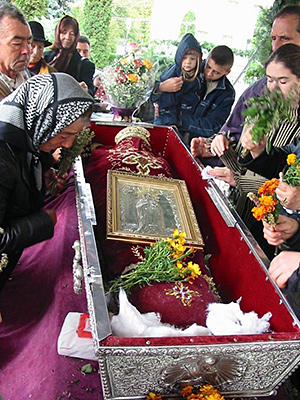
Coffin with the holy relics of St. Parascheva, Iasi, Romania
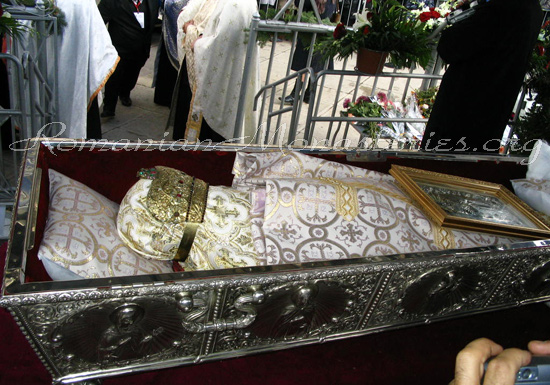
Saint Parascheva is considered the Protector of Moldavia and Bucovina, being the most popular of all the Saints whose relics are in Romania. Christians believe in the miraculous powers of Her relics.
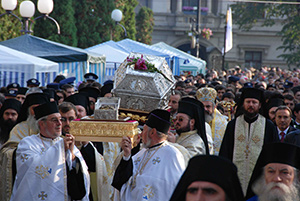
Every year, on the celebration of Pious Saint Parascheva’ day, the shrine with her relics is carried out of the church and they are exposed on the esplanade of the Metropolitan Cathedral
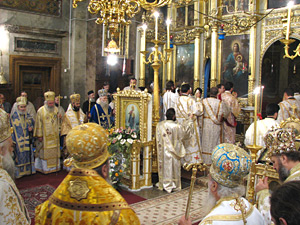
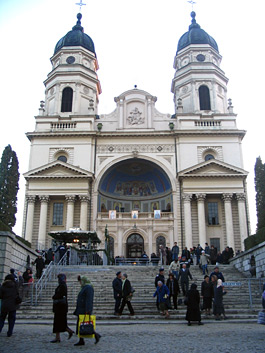
Saint Parascheva’s Dedication Day falls in the same day with the Feast of the Metropolitan Cathedral from Iasi. Her feast day has become in the past 15 years, an important Christian manifestation for the region of Moldavia. On this occasion about 1 million pilgrims arrive in Iasi, most of them waiting for hours in a line which covers 2-3 kilometers in order to reach the relics of the Saint and pray.
Generally, on the 12th of October the holly relics are brought out of the church and they are exposed on the esplanade of the Metropolitan Cathedral. Then, on the 13th of October, Her feast day, a procession is being organised on the streets nearby.
In the Eastern Orthodox tradition there are three different saints known as St. Parascheva.
The first one was born in Rome, in the 2nd century, and is considered a healer and a protector of cattle and crops. She is commemorated on August the 8th. The second one was born in Iconia and she died during the reign of the emperor Diocletian in the 3rd century. Her feast day, October 27th, is observed mostly in Dalmatia. The third one, the one whose relics are sheltered in the metropolitan cathedral in Iasi, Romania, lived around the year 1000 A.D. and she is the best known and the most widely revered by Eastern Orthodox Christians. Variations of her name include St. Parascheva of Tirnovo, St. Parascheva the Serbian, St. Parascheva of Belgrade, St. Parascheva the New, St. Parascheva the Young, and St. Parascheva of the Balkans.
(Fragment from the Acathyst Hymn of St Parascheva the New, Romanian)
St. Parascheva was born at the beginning of the 11th century A.D. into a wealthy, noble, and pious Christian family in the town of Epivat (now in Turkey) on the shores of the Marmara Sea. At the age of ten, while attending the liturgy in the “Church of the Holy Theotokos”, she heard the words, “Whosoever will come after Me, let him deny himself and take up his cross, and follow me.” The words of the Lord had a profound effect on the young girl, and they became the subject of her meditations. The future St. Parascheva began to dress poor people in her expensive clothes – her good deeds later earning her recognition as a patron saint of such trades as spinning, sewing, weaving, and knitting – but her parents objected, finding the girl’s charity more than they could understand or support, and trying to get her to stop. To follow her calling, Parascheva abandoned her wealth and privileges, left her parents, and ran away to Constantinople. There, near relics of saints, she spent her time in prayer, meditating on the words of Christ.
To elude her parents, who were traveling from city to city trying to find her, she moved to Chalcedon, and then to the “Church of the Most Holy Theotokos”, in Heraclea Pontica, near the Black Sea. She spent the next five years there, living an austere life of continuous prayer and devotion. During her prayers she received visions of the Holy Virgin Mary and in one of the visions, she was instructed to go to Jerusalem. After spending some time in the city, she joined a convent in the Jordanian desert. A few years later, she returned to Constantinople and then, at the age of twenty-five, moved to the village of Katikratia where, at the “Church of the Holy Apostles”, she lived the remaining two years of her life.
Legend has it that many years later an old sinner was buried near her grave. Parascheva appeared in a dream to a local monk, showed him the place of her burial, and asked him to “take that stinky corpse away from me. I am light and sun, and I cannot bear to have near me darkness and stench.“ The monk, with some local help, began to dig out the place he had seen in his dream and when they found the remains of the Saint, her uncorrupted body was emitting spiritual fragrances. Then they interred the Saint in the “Church of the Holy Apostles”, where she had spent the last years of her earthly existence.
Later on her relics were moved to Tirnovo, in Bulgaria, then to Belgrade, in Serbia, and finally to Constantinople. In 1641, they were given as a gift to the Prince of Moldavia, Vasile Lupu, in recognition of his support for the Ecumenical Patriarchy of Constantinople. Her intact relics have remained in Iasi ever since. She is venerated as the Protector of Iasi and all of Moldavia and each year, hundreds of thousands of Orthodox faithful and hierarchs from many countries gather in Iasi to celebrate her feast day and venerate her holy relics, which continue to work miracles.
Doxa to St Parascheva by Byzantion at Metropolitan Cathedral of Iasi, Romania
 Christian Dogma
 Christian Martyrs
 Christian Orthodox Churches and Monasteries
 Christian Sermons and News
 Church's Teachings on Fasting
 Ecumenism – a Great Heresy
 Father George Calciu
 Life_a Sacred Gift form God
 Orthodox Saints and Church Fathers
 Spiritual Elders
 Daily Bible Readings
 Journey to Orthodoxy
 Listen to Ancient Faith Radio
 Orthodox Calendar of Feasts and Saints
 Orthodox Christian Mission Center
 Orthodox Institute
 OrthodoxChristianNetwork TV


Recent Comments