
You are currently browsing the category archive for the ‘Orthodox Sermons & News’ category.
St John Chrysostom: A Homily for the New Year (On the Kalends of January)
[Translated by Seumas Macdonald], an excerpt…

[…] The whole year will be fortunate for you, not if you are drunk on the new-moon [New Year’ Day], but if both on the new-moon [January 1st], and each day, you do those things approved by God. For days come wicked and good, not from their own nature; for a day differs nothing from another day, but from our zeal and sluggishness. If you perform righteousness, then the day becomes good to you; if you perform sin, then it will be evil and full of retribution. If you contemplate these things, and are so disposed, you will consider the whole year favorable, performing prayers and charity every day; but if you are careless of virtue for yourself, and you entrust the contentment of your soul to beginnings of months and numbers of days, you will be desolate of everything good unto yourself. […]
Strong drink does not produce delight, but spiritual prayer; not wine, but a learned word. Wine effects a storm, but the Word [of God] effects calm; the former transports in an uproar, the latter expels disturbance; the former darkens the understanding, the latter lightens the darkened; the former imports despondencies that are non-existent, the latter drives away those there were [1]. For nothing is so accustomed to produce contentment and delight, as the teachings of [our] philosophy [wisdom]: [which is] to despise present affairs, to yearn for the things to come, to consider nothing of human affairs to be secure, and if you behold some rich man not to be bitten with envy, and if you fall into poverty not to be downcast by that poverty. Thus you are always able to celebrate festivals.
For the Christian ought to hold feasts not for months, nor new moons, nor Lord’s days, but continually through life to conduct a feast befitting him. What is the feast that befits him? Let us listen to Paul speaking, “Therefore let us celebrate the feast, not in the old leaven, nor by leaven of evil and wickedness, but with the unleavened bread of sincerity and truth.” [1 Corinthians 5,8].
If then you have a clean conscience, you hold a feast continually, nourished with good hopes, and reveling in the delight of the good things to come; then just as if you conducted yourself lacking boldness, and you were liable from many sins, and if there be ten thousand feasts and holy-days, you would be in no better state than those grieving. For what is the benefit to me of bright days, if my soul is darkened in its conscience? If then one wishes to gain some benefit from the new moon, do this. When you see the year ending, thank the Lord, because he had led you into this cycle of years. Stab the heart [‘prick the heart’] reckon up the time of your life, say to oneself: “The days run and pass by, the years fill-up, we have progressed much of the way; What good is there for us to do? Will we not depart from here, empty and deserted of all righteousness, the judgment at the doors, the rest of life leads us to our old age.”
These things, [from the new moon], contemplate on New Year’s Day, these from the circuit of the years, recollect. Let us reckon the future day, no longer something spoken to us that, which was said to the Jews by the prophet, “Their days slipped away in vanity, and their years with haste” [Psalm 77:33 LXX]. This is the feast which I mentioned, the continual one, and the one not delayed by the passage of years, not limited by days, both the rich and the poor will be able to celebrate in the same manner: For here there is no want of wealth, nor provision, but only of virtue. Do you not have wealth? But you have the fear of God, a treasure more fruitful than all wealth, not consumed, not changed, not spent-up. Look to heaven, and to the heaven of heavens, the earth, the sea, the air, the kinds of the animals, the manifold plants, the whole nature of human-beings; consider the angels, archangels, the powers above; recall that these are all creations of your Master. It is thus not poverty to be the slave of the providential Master, if you have him as your propitious Lord. The observation of days is not of Christian philosophy [teaching, wisdom, see notes], but of Hellenic error.
Into the city above you are enrolled [i.e. as a citizen] into the polity [2] there you are reckoned, you will mingle with the angels; where light does not give way to darkness, nor day fulfilled to night, but is always day, always light. To these therefore let us look continually. “For seek”, he says, “the things above, where Christ is seated at God’s right hand.” [Col 3:1] You have nothing in common with the earth, where the courses of the sun are, and circuits, and days; but if you live rightly, the night will be day for you; just as then for those living in licentiousness and drunkenness and intemperance, their day is turned into the darkness of night, not with the sun’s extinction, but the darkening of their mind by inebriation.

To be passionately excited towards these days, and to receive greater pleasure in them, and to kindle lights in the forum, and to weave wreaths, is of childish folly. But you have been freed from this weakness, and come into adulthood, and been enrolled in the polity of the heavens. Do not therefore kindle sensate fire in the forum, but kindle spiritual light in your mind. “For let”, he said, “your light shine before men, so they may see your good works, and they will glorify our Father in the heavens.” [Mt 5:16; Chrysostom has ‘our Father’ for ‘your Father’].
This light brings you much recompense. Do not crown the door of the house, but display such a way of life so that you will receive the crown of righteousness on your head from the hand of Christ. Let nothing be done rashly, nor simply; thus Paul enjoins that all things be done for the glory of God. “For whether you eat,” he said, “or drink, or do whatever, do all for the glory of God” [1 Cor. 10:31. This verse provides the theme for the rest of the sermon].
And what is it, he says, to eat and drink for God’s glory? Call the poor man, make Christ a participant of the table, and you eat and drink for God’s glory. But not this alone does he enjoin us to do for God’s glory, but all the rest as well, as to go into the forum, and to remain at home; let these both be done for God’s sake [διὰ τὸν Θεὸν and so throughout]. And how are these both to be done for God’s sake? Whenever you come into church, whenever you partake of prayer, whenever of spiritual teaching, the advance has occurred for God’s glory. Again, it is to remain at home for God’s sake. And how is this? [i.e. How will one glorify God in this action of staying at home?]
Whenever you hear disturbances, disorderly and diabolical processions, the forum filled with wicked and undisciplined men, remain at home, free from this disorder, and you remain for God’s glory. Just as spending time at home and going-out is able to be done for God’s sake, thus also of praise and censure. And what is it to praise something for God’s glory, he says, and to accuse? You sit frequently in workplaces, you see evil and wicked men passing by, raising the eyebrows [a sign of haughtiness and importance], puffed up, trailing many parasites and flatterers, wearing expensive clothes, surrounded with some mystique, seizing all things, avaricious. If you hear someone saying, “Is he not enviable, is he not blessed?” Rebuke [the word], accuse it, [have] silence, pity, and weep; this is what it means to censure for God’s sake.
Censure is teaching of philosophy to those meeting together and is so strong of virtue [3], so as to no longer long [more literally, ‘gape’.] for the things of everyday life. Say to the one saying these things: “Why is this man blessed? Because he has a marvelous horse and a golden bridle, and possesses many servants, and wears bright clothing, and bursts [4] each day in drunkenness and luxury?” But for this reason he would be wretched and cursed, and worthy of a thousand tears. I see then that you are able to praise nothing of him, but all things external to him, the horse, the bridle, the clothing, of which nothing is his. What then, tell me, is more pitiable than this, when his horse, and the horse’s bridle, and the beauty of his clothes, and the bodily vigor of his servants are marveled, but he passes by upraised? Who then could be poorer than this man, having nothing good of his own, nor anything that he is able to carry away from here, but is adorned entirely by external things? For adornment and riches are properly our own, not servants and clothing and horses, but virtue of soul, and wealth of good deeds, and confidence towards God.
Again, you see another man, a pauper, rejected, despised and passing his life in poverty and virtue, considered unhappy by his companions: commend this man, and the praise of this man as he passes by is exhortation and counsel of a useful and good way of life [politeia]. If they say, “He is wretched and miserable,” say that this one is the most blessed of all, having God as his friend, passing life in virtue, possessing a wealth never failing, having a pure conscience. For what harm is there to him from the lack of possessions, when he is going to inherit heaven and the good things in heaven? And if you yourself philosophize in this manner, and instruct others, you will receive a great reward from both censure and from praises, doing both for God’s glory. And that I do not allure you vainly saying these things, but that a certain great recompense exists with the God of all things for those whose intellect is thus disposed, and that the thing has been considered a certain virtue, [that is] the resolving to do such things, hear what the prophet says concerning those so living, and how he places things in an order of perfections, the despising of those doing wickedness, and the glorifying of those fearing God.
 For after recounting the other virtue of the one who will be honored by God, also he says, of what sort one must be to dwell in the holy tabernacle, that is blameless, and performing righteousness, and wicked-less, and this he adds: For saying, “Who did not deceive with his tongue, and did no harm to his neighbor” [Ps 15:3 (Ps 14:3 LXX)] he adds, “The one doing evil is set at naught before him, but those fearing the Lord he glorifies” [Ps 15:4 (Ps 14:4 LXX)] showing that this is one of those perfections, that is to despise the wicked, and to praise and bless the good. And again elsewhere this same thing he makes plain, saying, “Your friends were exceedingly honorable to me, God, their beginnings [poss. authorities] became very strong.”[5] Whom God praises, do not censure: he praises the one living in righteousness, even if he be poor; whom God turns away, do not praise: he turns away the one living in wickedness, even if he be surrounded by much wealth. But if you praise, and if you censure, do both as God wishes. For there is even accusing unto the glory of God. How? Frequently we are vexed with our servants. How then is there accusing for God’s sake? If you see someone drunk, or stealing, whether servant, or friend, or some other of those related to you, whether running into the theatre, or having no concern for their soul, or swearing [i.e. swearing oaths], or perjuring [i.e. to swear falsely] or lying: be angry [6], punish, turn them back, correct; and you did all these things for God’s sake. And if you see someone sinning against you, and omitting something of their service toward you, pardon them, and you are forgiven for God’s sake. But now many do the opposite, both to their friends, and to their servants. For when they sin against them, they become bitter and unforgiving judges; but when they insult God, and ruin their own souls, they produce no rationale. Again, is it necessary to make friends? Make them, for God’s sake. Is it necessary to make enemies? Make them, for God’s sake. And by what means does one make friends and enemies for God’s sake? If we do not attract those friends, whence money is taken, whence sharing of a table, whence obtaining of human patronage, but pursue and make those friends, those able always to order our soul, counsel necessities, rebuke sinners, expose trespassers, restore those fallen, and aiding by counsel and prayers to lead to God. Again, it is permitted to make enemies for God’s sake. If you see someone undisciplined, abominable, full of wickedness, replete with unclean teachings, tripping you up and harming you, stand apart and turn away, just as also Christ commanded, saying, “If your right eye trips you up, pluck it out and cast it from you” [Mt 5:29] commanding those friends, those being desirable in the rank of eyes [7], and necessary in the things of everyday life, to cut off, and to cast out, if they harm you with regard to the salvation of the soul. If you share in their meetings, and you prolong your speech, do even this for God’s sake, and if you keep silent, keep silent for God’s sake.
And what is it to participate in the meeting for God’s sake? If you are seated with someone, converse nothing concerning daily affairs, nor of simple things even vainly and nothing of those related to you, but concerning our philosophy, concerning Hell, concerning the Kingdom of the Heavens, but not superfluities and unprofitable things, such as, “Who entered authority? [8] Who lost power? For what reason was so-and-so injured [possibly with a technical or financial sense: fined, punished]? Whence did so-and-so profit and become better off? What did so-and-so dying leave behind to such-and-such? How did so-and-so miss out, expecting to be listed among the foremost of the heirs?” And many other such things. Let us not then discuss such things, nor bear others discussing [them]; but let us consider what-doing or what-saying is to please God. Again, it is to keep silent for God’s sake, being maltreated, abused, suffering a thousand evils, if you bear them nobly, and emit no blasphemous word against the one doing these things to you. Not to praise and to censure alone, nor to remain indoors and to go out, not to utter and to keep silent, but also to weep and mourn, and to enjoy and delight is to God’s glory.
For when you see either a brother sinning, or yourself falling into a transgression, [if] then you groan and mourn [these two verbs continue the protasis of the conditional], then you gain from the grief a salvation without regret, just as Paul says, “For grief according to God produces a salvation without regret” [2 Cor. 7:10]. If you see another person being highly esteemed, then do not disparage him, but as for one’s own goods give thanks to God, to the one making your brother illustrious, and you receive a great reward from this joy.
What then, tell me, is more pitiable than the envious, when it is permitted both to rejoice and to profit through joy, and they prefer rather to grieve upon the advantages of others, and with the grief to yet also attract a punishment from God, an unendurable retribution. And what need is there to speak of praise, and of blame, and of pain, and of joy, when indeed even from the least of these things and from the meanest [‘mean’ in the sense of cheap, frugal, vulgar] events the greatest things are to be profited, if we do them for God’s sake?
[…]
“Whether you eat, whether you drink, whether you do some other thing, do all for the glory of God” [1 Cor. 10:31]. If we pray, if we fast, if we accuse, if we pardon, if we praise, if we censure, if we enter, if we exit, if we sell, if we buy, if we are silent, if we converse, if we do any thing else whatsoever, let us do all for the glory of God, and if something be not for the glory of God, neither let it be done, nor be spoken by us; but in place of a great staff, in place of arms and safeguard, in place of unspeakable treasures, wherever we might be, let us carry around this word with us, having inscribed it upon our understanding, so that doing and speaking and trafficking all things for the glory of God, we shall obtain the glory that is from him both in this world and after the journey here [i.e. after this life]. “For those that glorified me”, he says, “I will glorify” [1 Sam 2:30; (1 Reg. 2.30 LXX)]. Not therefore with words, but also through deeds let us glorify him continually with Christ our God, because all glory befits him, honor and worship, now and always unto the ages of ages. Amen.
For the entire sermon see Source.
Notes:
Philosophy, both here and throughout Chrysostom, refers to Christianity as both a distinct set of beliefs, and a set of practices or way of life. It highlights the rivalry between the Christian philosophy, and the philosophical schools of the Hellenism.
[1] i.e. the former brings new dependencies that previously were not there, but the latter drives away those that were present beforehand.
[2] politeia, like philosophy, is a key concept-work for Chrysostom. It refers variously to the body of Christians both on earth and in heaven, their way of life as citizens, and their ordered existence in the church. It is also a rival politeia to that of Plato’s Republic and the like.
[3] This first half of the sentence is as confusing in the Greek as in the English.
[4] Migne’s Latin has solvitur which we might render ‘dissolves’, thus picking up the idea of moral dissolution in a wanton life. The Greek διαῤῥήγνυται is difficult to construe.
[5] Ps 138:17 LXX. Ps 139:17 MT differs radically from this reading.
[6] ἀγᾰνακτέω, the same verb used for ‘vexed’ above.
[7] Chrysostom’s meaning seems to be ‘those friends whom we hold as dear as our own eyes’, which Migne’s Latin also implies.
[8] N elected officials would enter office on the Kalends, which presumably explains the kind of political conversation Chrysostom has in view.
Father George Calciu – On New Year’ Eve Celebration

This end of the year – the New Year’ Eve that the world celebrates – not been established or sanctified by the church, cannot be considered sacred, but only a human invention. Do we (Christians) have to celebrate it? Are we to attend the fireworks, the songs and all sorts of scandals, parties? … No.
We praise our Lord in the church. For it is in the church we’re awaiting “the end”. If God would have ordained the end of times tonight, He wouldn’t made His Son’ Nativity at Christmas!
What is the relation between a sacred event and the first of January? Absolutely no connection. And why some say that the end (of the world) is when the world decides – as a new millennium begins – and not when Christ will come? Or at least at the Annunciation!
All these are for the devil’ deceit. The overcrowding of people, the delirium seizing all, the craziness, the fireworks, the drinks, the champagne flowing … I was watching last night what happened in Paris. Someone said that in Rome, where the congregation of the Pope gathered (and I could not understand why he gave blessing to the world and the city on January 1st 2000 when there is no sacred event to celebrate)… we do not know how many millions of bottles of champagne flowed…. And someone else wound announce: more champagne in Paris! Then, more beer in Germany! So, this is the measure of “sanctity” for the New Year! […]
To read the entire sermon see Here.
A wish for the New Year: towards eternity…
(Fragment of a Homily delivered by Metropolitan Augustine of Florina in the Church of St. Panteleimon, Florida, 31.12.1974, during the New Year’ Eve services)

[…] Towards the eternity we step, my brothers. And now, another year had passed. We welcome a new year. What will it bring us? We do not know.
As for us been dull, we do not know if we will live tomorrow. Unceasingly one has to wait his departure, especially us elders, reaching the sunset of life. But also the young. We do not know “What the present moment will offer “. And I wonder next year, in a day like this, how many of us will still be here living? And what events await our people in the New Year? What will it happen in the Balkans, the Mediterranean and the world? … Are you imagining dreams and envision an endless life? But eternity is approaching my dear; the biggest moment is waiting to rise.
What should I wish you, my dear? Wealth, glory, honors, delights, pleasures? … How meaningless is everything. “Vanity of vanities, all is vanity“ (Ecclesiastes 1, 2). Only one thing remains: your belief in Christ. There is no other name that can give us joy and hope during this coming year, Whom us children praise and exalt into the ages of ages. Amen!

It is extremely provocative to say the least to put into prison the Abbot of the Vatopaidi monastery, Efrem, when politicians who have confessed to accepting bribes are still at large! The judicial council decided on December 23 to remand into custody Fr. Ephrem in order to ensure that he will not leave the country. The prosecutor clashed with the investigator on the issue. After the elder’s apology, the prosecutor, Panayiotis Matzounis, argued in favor of the imposition of restrictive conditions rather than the custody remand. The conditions were prohibition of travel, bail of 200,000 Euro and personal appearance at a police station twice a month. Mr. Yiannis Matzouranis, who appeared for the Elder argued that ‘the remand into custody decision had no moral or legal base’.
The custody decision against a clergyman renowned world wide for his charitable work and spiritual mission a few days before Christmas comes to add to the woes which befell the country as a result of the gloomy political and financial conditions. Needless to say no one has so far been accused or found guilty or imprisoned for the country’s degradation! It was only yesterday that the Vice President of the government, E. Venizelos told the plenary of the House of Representatives that any investigation into money laundering in Switzerland on behalf of Mps constitutes a mockery since ‘anyone can set up an offshore company rather than keeping a personal account’.
Deep down no one wants to remember those who confessed that they had accepted bribes from Siemens, which they either put in their pockets (as in the Manteli case) or in the party coffers (as in the Tsoukatou case). Yet justice and the political system have found a monk as a target for their purging; a monk whom for a long time they hold hostage to political intrigue without any evidence as to his personal involvement in any issue under investigation. In this indescribable Greek reality show, monk Ephrem is judged as ‘likely to leave the country’ and is remanded into custody. Yes, during the entire time of his judicial ordeal, this ‘likely to leave’ monk has visited several countries and gave 48 presentations. Recently he even visited Moscow at the invitation of the Russian President and the Prime Minister. At the end of these visits, Elder Ephrem always returned to his country and his monastery even though he suspected that the outcome of this whole process might be regrettable.
Elder Ephrem of Vatopaidi is therefore accused of financial machinations, him that once returned from Russia, gave away all the money he had gathered from donations (made by the faithful venerating the Holy shrine: “the belt of the Virgin” during his recent pilgrimage to Russia) to the Greek dioceses and a philanthropic canteen from the cities of Thessaloniki and Athens, to help the suffering believers due to Greece’ recent economic crisis.
Abbot Father Ephraim received the unexpected news with Christian love and deep faith in the divine providence. He appeared ready to comply with any provision of the authorities, including preventive detention. Elder Ephrem addressing to his monastic community of Vatopaidi, had asked the fathers of Vatopaidi to receive these news with spiritual eyes and not to condemn those who accuse him, and to continue their religious asceticism in unity, love and harmony.
The Russian Church believes that the arrest of Abbot
Ephrem of Vatopaidi is a groundless sanction

Moscow, December 26, Interfax – The decision to arrest the Rector of Vatopedi Monastery on Mount Athos, Archimandrite Yefrem (Ephrem) is “unreasonably tough”, the secretary for Inter-Orthodox Affairs in the Synodal Department for External Church Relations Archpriest Igor Yakimchuk told Interfax-Religion.
”It is an unprecedented event and, of course, we’re concerned. Even if Father Yefrem is someway guilty, to arrest of a rector, a monk is an extreme sanction,” Father Igor said.
According to him, it is difficult to say whether there are grounds for detaining as it requires good knowledge of Greek legislation and the essence of the case, but the very fact of detaining Father Yefrem on the Eve of Christmas in Greece “raises big questions.”
Father Igor is perplexed that “a new turn of this case” started after Father Yefrem triumphantly returned from Russia with the Belt of the Mother of God. ”Perhaps, is a coincidence, but many people see some political backgrounds here,” the interviewee of the agency said. The Foundation of St. Andrew the First-Called believes that such legal decisions can be explained only with “political engagement of certain circles of Greek establishment, which thus want to demonstrate the West that they are ready to refute principles pertaining the spiritual life fixed in the Greek Constitution.”
”The fact that court actions were turned against a spiritual leader, one of the most respected people on Athos, an elder suffering from many diseases is especially outraging,” the Foundation officials wrote in their statement. The Foundation urges the governing body of Athos, Patriarch Kirill of Moscow and All Russia, representatives of other local Orthodox Churches and ordinary believers to speak for Father Yefrem as he “is exposed to prosecutions, which exceed the formal reason for launching the case.” Earlier, the Foundation of St. Andrew the First-Called had for the first time received the Belt of the Mother of God from the Vatopedi Monastery. After visiting St. Petersburg the shrine was taken to other Russian cities. The last point was Moscow. The belt returned to Athos on November 28. Three million of people venerated the Belt of the Holy Virgin while the shrine was in Russia.
Please also see:
http://vatopaidi.files.wordpress.com/2009/08/filladio-immb-english.pdf
UPDATE:
Cyprus stands by Elder Ephrem
The Arrest of Archimandrite Ephrem is a hostile attack against Athonite monks and Orthodoxy
The Holy Community of Mount Athos Stands By Elder Ephraim of Vatopaidi
Guardian of Holy Virgin’s Belt from Mt. Athos Decides To Go To Jail
Greek Abbot Jailed Pending Trial Over Land Scandal Probe That Cost Ministers Their Jobs
Cypriot Abbot To Be Held Behind Bars in Greece
Photos of Elder Ephraim Leaving Mount Athos
Photos and Video of Protests Supporting Elder Ephraim
Russian Orthodox Rise in Defense of Arrested Vatopedi Monk
Patriarch Kirill Asks Greek President To Release Vatopedi Monastery Superior From Custody
Vatopedi Monk in Jail as Minister Warns ‘Meddlers’
Greece Jails Abbot Ephraim in Mount Athos Fraud Case
Father Ephraim – Prisoner of Cell 2 in the Koridallos Prison

Nativity’ Troparia!
“Thy nativity, O Christ our God,
has shown to the world the light of wisdom;
for by it, those who worshipped the stars
were taught by a star to adore Thee
the Sun of Righteousness,
and to know Thee, the Orient from on high.
O Lord, glory to Thee.”
The Church of the Nativity and the oldest Church of the Holy Land is situated approximately 8 km from Jerusalem to the east of Bethlehem. Its surrounding covering some 12,000 square meters, include an Orthodox Monastery, a Catholic and an Armenian quarter.

Its foundation begins in the second century, when St. Justin the Martyr identified for the first time the grotto or the cave of the Nativity as been the sacred birthplace of Jesus Christ. The original church was erected quite early – in the year 326 – by Saint Helena the mother of Emperor Constantine the Great .
In 531, the Emperor Justinian the Great gave it a new shape which has been preserved until today. Some of the historical facts about the church are quite interesting. For example, during the invasion of the Persians (in 614), the place was left untouched by the invaders, which were impressed to see the Nativity scene with the Magi from the east dressed in Persian’ costumes.

The entrance into the church is through a carved door, very low into the ground and suggestively called ‘the door of humility”. The tradition testifies that the height of the door was intentionally carved this way by Christians, to prevent non-believers to enter and as a defense to the Muslim’ attacks.

The basilica of the Nativity is divided into four separate longitudinal areas divided by four rows of columns that were built in the Corinthian style. Each row includes 11 columns depicting the apostles of Christ’s with their names written in Greek and Latin. Recent archaeological excavations had revealed part of the old Byzantine mosaics that were covering the original ground-floor of the church.

The Shrine of the Nativity has three altars: a central altar and two others on the side apses. From here, one can descend into a small cave – the Nativity Cave – located just below the central altar.

A silver star fixed in marble represents the place of the manger and is surrounded by fifteen candles that burn continuously. A Latin inscription testifies that: “”Hic de Virgine Maria Jesus Christus natus est” („Here the Virgin Mary gave birth to Jesus Christ”).
The basilica of the Nativity is administered by different Christian denominations. The Cave of the Nativity is under the jurisdiction of the Orthodox Church.
“From heavenly skies, I hear a song divine,
Thy three Magi, with gifts they come,
From far above, a star that shines
Enlightens the Magi.
That mighty gifts they may bring forth
In white rucksacks, while signing
To One new baby born.
The humble baby lays in peace
And joyful in a manger,
While Holy Virgin sways.
And seeing this,
We all rejoice.
Thy heavenly sky and the whole earth
Are sanctified by Him
Christ our King,
Came to redeem
All those who may believe.
We worship Thee,
Christ long-awaited Savior,
Eternally being glorified;
From far above, a song divine….”
A Blessed Nativity to all my readers!
A documentary on the history of Orthodox – Byzantine iconography
Please also see

Fresco from Huretzi Monastery, Romania
This fresco depicting “the life of the genuine monk” is especially found in older Orthodox monasteries. Although this fresco depicts “the steadfast monk – the Christ’ follower,” we should also affirm that it represents “the one true Christian” who regardless of his social status, is a follower of Christ through his actions.
The genuine monastic is he who dies for the world to take on a permanent battle with his passions and his thoughts until his last breath. Ordinary Christian, married or not, has the same duty, to die to the world and start the same battle towards passions until the end.
Since the path to Christ’ Kingdom is narrow and rough, it is clear that the Christian whether be a monk or a layman, faces similar difficulties. St. John Chrysostom referring to the great labor toward salvation of both monastics and laymen alike, said: “The only difference between a layman and a monk is that the first is married and the other is not.”

The fresco representing the true monastic is usually depicted in the entrance of the church near other icons such as “the Ladder of Divine ascent” and “the Dreadful Judgment.”
In the center of the icon, the monk is showed as been crucified, dressed in his black cassock, barefooted, with his feet nailed to the bottom of the cross; his face is peaceful and his eyes and his mouth closed. To his right it is written: “Place a watch oh Lord upon my mouth.”
In his hands, he holds two burning torches, and an inscription near this says: “Thus, let your light shine before men that they may see your good deeds.” On his chest, he lays a parchment baring the words: “Create in me a clean heart, O God, and renew a right spirit within me.”
On his womb, another writing will say: “Oh man, do not be deceived by gluttony.” Bellow his womb, another inscription writes: “Kill the members of thy earthly man!” Then, bellow his knees: “Prepare your feet for the Gospel of peace.”
At the top of the cross, a paper chiseled in stone depicts the following: “As for me, I will boast only in the cross of my Lord.

Both arms of the cross bare a seal at the end. The seal on the right bares the word: “And ye shall be hated by all for my name’ sake, but he who endures to the end shall be saved.” The seal at the left says: “Anyone of you, who does not renounce all that he has, cannot be my disciple.” And the seal at the bottom of the cross, placed under his feet, writes: “Narrow is the gate and rough is the path that leads to salvation and few are those that find it.”
A dark cave with a dragon coiled inside is represented at the right side of the cross, near which it is written: “the consuming/eternal hades.” Above the mouth of the dragon, a naked young man with his eyes tied by a knot, holds a bow with its arrow pointing at the monk asking: “Commit fornication!” A name is written over the young man as: “the lover of fornication.” Many snakes are depicted above the cave, which suggest: “our thoughts.” A demon is portrayed near this scene with a rope pulling away the cross and saying: “You cannot bare it!” And on the right side of the cross, another small cross is placed with a flag upon which is written: “I can do all through Christ, Who has clothed me with power.”

A tower and a gate are seen at the left side of the cross. A man clothed in gold and fur, riding a white horse passes through this gate holding a glass of wine in his right hand and a spear in his left hand. Above his spear it is written: “Take pleasure in the riches of this world, the vain world!”
A hole is drawn behind this rider and death coming out, wearing a big coat over its shoulders and a clock upon its head, upon which it is writing: “Death and the grave.”
Two angels are depicted near the monk arms on both sides, each holding a paper in his hands; the angel from the right bares: “God sent me to your strength ” and the angel from the left: “Do good and do not be afraid.”
At the top of the cross lies the open sky, where Christ stands with the open Gospel upon His chest that reads: “If any man wants to come after me, let him deny himself, take up his cross and follow me. ” In His right hand He holds a crown, and in His left a wreath of flowers. Immediately below our Savior, two angels are looking at the monk holding a long parchment where it is written: “Fight the good fight so you may receive the crown of righteousness.”
Some Thoughts On Fasting
Source: Conciliar Press
(From an Orthodox Pastor, From the Fall 2008 issue of The Handmaiden Journal – Vol. 12)

Fasting is not optional for Christians. Neither are prayer and almsgiving. Our Lord did not say “if you fast,” but rather “when you fast.” He Himself fasted. Those to whom He personally directed His words and teachings maintained a tradition of fasting. Perfecting that tradition by coupling it with prayer and almsgiving, our Lord revealed that the very heart of our lives as Christians is rooted in these ascetic traditions.
However, our Lord was also clear in chastising those who observed the fast, who prayed, and who gave alms for the purpose of being observed and applauded by others or as a means to fulfill the law. Indeed, the Pharisees received their reward: “My,” they delighted in hearing, “aren’t they spiritual, aren’t they righteous, aren’t they generous, and aren’t they worthy of emulation?” But their actions were to no avail, and brought with them no heavenly blessing. Hence, we are taught to fast “in secret,” to pray “in secret,” to give alms “in secret,” not allowing our left hand to know what our right hand is doing, so that our heavenly Father will reward us openly.
Fasting as Preparation for True Celebration
Our Lord fasted for forty days before beginning His public ministry. This indicates that one aspect of fasting is preparation. The Church’s fasting seasons prepare us to celebrate, to feast, and to focus our attention on that which we anticipate celebrating, rather than on the mundane things that all too often compete for, or dominate, our attention.
While food is an essential element of any celebration—as we are reminded on Pascha, as our festal food is blessed, or as we bless fruit on the Great Feast of Transfiguration—it can also be a preoccupation, something that can dominate our time and attention to the detriment of more important aspects of our earthly existence. Sadly, before major celebrations we tend to spend inordinate amounts of time planning menus, testing new recipes, and the like, all with the hope that our celebration will be memorable, enjoyable, and tasty. In the process, the very thing we gather to celebrate is often obscured, misplaced, and lost.
This is especially so in the days—or, to be more specific, the months—leading to the celebration of Christmas, during which we are tempted to focus our preparations on foods, decorations, gifts, and the like, rather than on the glorious mystery of the Incarnation, which is at the very heart of our faith as Christians. The Nativity Fast (like all the fasting seasons) is meant to remind us to prepare ourselves spiritually, to bring under control those things, including food, that are well within our control, but that we have allowed to control us, and to apply the self-control that fasting teaches us to other areas of our lives.
Fasting from Passions, not from “Prohibited Foods”
During the first week of Great Lent we are reminded that, while fasting from food, we must fast from our passions—anger, gossip, jealousy—while intensifying our vigilance, our prayer lives, and our ministry to others, especially the least among us. Hence, fasting as a preparation is quite the opposite of the worldly preparations that all too often focus our celebration on ourselves, rather than on our Lord and the joyous mysteries He so lovingly shares with us and engages us in celebrating.
Of course, fasting from food is at the very heart of the ascetic life. Food can be a passion, a preoccupation that can easily dominate our lives. We fret over what to eat and what not to eat. We agonize over trans fats, cholesterol, carbs, and calories. We drink Ensure to gain weight, and then sign up at a weight loss clinic to lose it. In fact, we have an entire TV network devoted to food! All too often, we have ceased “eating to live” and instead “live to eat.”
If fasting is ever to become a real solution to this preoccupation with food, we need to recognize that fasting does not mean merely avoiding certain “prohibited” foods while partaking of others that are “approved.” Years ago, I was given a Lenten cookbook that, in the preface, offered an extremely detailed explanation of the Church’s fasting tradition. As was to be expected, it noted that one should refrain from eating meat and meat products, dairy products, fish, wine, and oil. And also, as was to be expected, it noted that eating shellfish—lobster tail, crab legs, scallops, prawns and shrimp, clams, and the like—does not violate the fast. But, curiously, this preface offered a warning, in bold underlined letters, that when eating shellfish, one should not use drawn butter, but melted margarine, since butter is a dairy product! How ridiculous, I thought. Emptying ourselves of our passion for food involves reducing not only how much and what we eat, but also how much time we spend thinking about food, preparing food, reading about food, discussing food, and manipulating food to fit the fasting tradition of the Church.
The same cookbook offered a recipe for a Lenten chocolate cake, at the end of which was written, “Your family will enjoy this delicious cake so much that you’ll want to serve it all year ’round!” Consider this: One could devise a Lenten weekly menu that, while fully avoiding meat and meat products, dairy products, fish, wine, and oil, would be anything but ascetic—lobster tail on Monday, grilled prawns on Tuesday, Alaskan king crab legs on Wednesday, lemon-drenched shrimp on Thursday, and scallops on Friday, all with melted margarine so as to avoid butter, of course! Legally, this indeed fulfills the fasting laws, but it completely misses the spirit of fasting, as does the yummy Lenten chocolate cake or the tofu Italian “sausage” or “chicken wings” guaranteed to “taste like the real thing.”
It’s only my opinion, but approaching fasting in this manner—”this is permitted, but that isn’t”—not only misses the mark of fasting, but can become a spiritually dangerous temptation, the same temptation to which the Pharisees succumbed by adhering meticulously to the externals of the law while remaining clueless as to its internal spirit. This approach can easily lead to spiritual pride and delusion and the self-satisfaction that comes in assuring oneself that “while I’m delighting in this tasty cake, I’m relieved to know that it meets all Lenten requirements since there’s not a drop of half-and-half in it.” This, it seems to me, is neither fasting, nor ascetical, nor a desire to free oneself from a preoccupation with food. In fact, it reflects the opposite, as more time is spent figuring out how to make tofu taste like sausage than it would take to simply and mindlessly fry a link of real sausage.

Putting the Time Saved and Money Saved to Work
Taking things one step further, this legalistic approach to fasting is utterly detached from prayer and almsgiving. The time saved by not worrying about what we’ll eat or how we’ll prepare it, much less adapting recipes to fit Lenten rules, could be more wisely spent in prayer, in worship, in meditation and the reading of Scripture or the Holy Fathers. To the degree we rely on very simple and basic foods and spend little time in food preparation during the fast, we’ll have time to reflect on the countless other things (our anger, our jealousy, our self-centeredness, our sloth, our despair, our lust for power, our idle talk) that are surely within our control, but that we so often have allowed to control us.
And, to take all of this one step further, might not the money saved by purchasing simple food be stewarded more wisely by giving it to those who have less, or nothing? By quietly and anonymously giving it to an agency that assists those who are out of work or homeless or abused? Might we not devote a portion of our time to volunteering at one of those agencies, feeding those in need with the loving and personal human contact that reveals God’s presence in this world?
Preparation for the Heavenly Banquet
Fasting is not optional. Neither are repentance, prayer, almsgiving, preparation, asceticism, ministering to the least among us, wisely managing our time and talents and treasures, struggling to overcome our passions, and so on. They’re all related, interconnected, essential. So fast we must—to the extent that we can—without comparing ourselves to others. Still less should we engage in endless and spiritually dangerous public discussions on what we’ve given up this Lent or how weary we’ve become by fasting from those things (including but hardly limited to food) that we’ve allowed to control us even though we have the ability, with God’s help, to control them.
Fast we must, in the Holy Spirit rather than in the spirit of the Pharisees, and in secret, without fanfare or discussion. And fast we must, delighting not in our ability to transform chocolate cake into a Lenten delight, but in allowing our Lord to transform us as we delight in tasting and seeing how good He, the “Bread which came down from heaven,” truly is. Such fasting not only prepares us for the celebration of His Incarnation or Resurrection, but prepares us for the eternal heavenly banquet, to which He invites us, in His Kingdom.
(The author, a priest of thirty-four years, is rector of a parish of the Diocese of the Midwest of the Orthodox Church in America).
A documentary on the Mysteries of the Jesus Prayer
One correction to the narrator remark comparing the Patriarch with the Pope of Rome;
– In the Orthodox Church the Patriarchs are the ‘First Among Equals’, not above the others. In the early history of Christianity, before the Schism in 1054, there was no “Pope of Rome” (to the rang he elevates himself today) but only Patriarchs of local Orthodox Christian Churches, which they all were “First Among Equals”. The Pope of the Christian Church of Rome (the Western Christian Church) before the Schism had the same status with the rest of the Patriarchs of the Christian East.
(The Jesus Prayer in Greek recited by Elder Ephrem Phyloteuos)
More on The Jesus Prayer from the Wisdom of Greek Elders
(more on youtube)
More from the wisdom of the Orthodox Elders (Elder Ephrem) on “Vain Glory and Emptiness”
On the 11 Sunday of Mathew 18:23-35
with Elder Sofian

Beloved brothers in Christ,
Today’s Gospel begins with the exhortation of forgiving those who wrong us, as we find in the (prayer) “Our Father”. There are other places in the Holy Scripture where our sweet Jesus insists on forgiveness and a state of peace among us. For example when our Savior said: “When thou bring thy gift to the altar, and there rememberest that thy brother hath aught a complaint against thee, leave thy gift before the altar, and go thy way; first be reconciled to thy brother – for neither thy gift nor thy prayer will be received. ” (cf. Mat 5:23-24)
Today we learned a powerful lesson about a rich and great man – God Himself – who loaned ten thousand talents to his servant, but seeing that he cannot pay, He forgave all his debt.
But what happened then? The man that was forgiven meets his debtor who owed him a very small amount – one hundred denarii – but his debtor been poor, had no means to return them.
So he that was just forgiven seized his servant by the throat demanding him to pay without delay! What a great contrast between his master goodness and his parsimony, because a hundred denarii was insignificant.
But when his fellow servants saw this they went and reported to their lord all that had taken place, and then his master summoned and delivered him to the jailors, till he should pay all his debt (cf. Mat 18:23-35).
In this parable Jesus tells us what will await us if we do not forgive those who wrong us in any way. It is the same concept that our Savior emphasizes unceasingly throughout his earthly life: if we do not forgive, we are not been forgiven. […]
We often carry ourselves towards others as the great debtor of this parable. Although much is forgiven of us, we forgive very little or nothing. But instead, we ask with boldness that we may always be forgiven by God as if our Lord will not sense our hypocrisy and wickedness. And for that, we were asked a very small thing: “If you forgive man their sins, God will forgive yours.”
Our Lord urges us to overcome our pride by forgiving our neighbor and for this small effort we too, can gain eternity, as He said: “The extent by which you measure others, it will be measured to you”; “Judge not, lest you’ll be judged”; ” Forgive and you will be forgiven” – these are small requests, Christian brothers! If only we can find within us the courage of humility, kindness and meekness of heart so that we can truly forgive … That’s why this parable is given to us, to strive for a life of prayer, almsgiving and fasting, as they all work together for our spiritual ascent.
But why are we ought to forgive? First, if you do not forgive, you make your lives a living hell. The Holy Fathers tell us that: “forgiveness is the eldest daughter of love”. He that cannot forgive cannot love. So the man that cannot love others, can neither love God. And to love Him, we must first be reconciled with our neighbors.
We ought to forgive so we may live in good standing with all and with God. We cannot live in isolation, we need each other – as family members need each other – and those in a factory or in offices need to communicate with each other. […]
And we are been told: “Let not the sun retire (go down) upon your wrath,” for if many days pass without making up, evil and hatred will grow within us. And if it is a group of people, the hatred it’s expressed as a terrible silence, a silence that seethes anger and malice. Arguments, insults, threats, even beating and murder! Such life is awful – a life of hell. We bring hell to us, we call the evil in our lives through our inability to forgive.
There are families where spouses do not speak to each other for months, until the marriage breaks in divorce. There are brothers, relatives or friends who because of some differences fell and, instead of making up immediately, remained silent and the anger deepened and it’s now old and more difficult to reconcile.
How can such man full of hatred pray? Who is he addressing to? Is he praying to God? When God asked him: “Forgive, so I may forgive you.”
There are even worse cases. After going against each other, they pray to God to punish their enemy severely, in spite of what God commanded us – to forgive, and he asks God to make his enemy into dust or to “poor His thunder upon him”… an expression of profound evil. Instead of thinking that he can also be wrong and to make an effort to reconcile his own soul, he begins to curse and stirs even more hatred.
There are neighbors that after fighting with each other, when they pass by they look the opposite direction not to see each other. I ask such people – who are usually Christians and seek God – how can they pray and how can they ask forgiveness from God if they cannot forgive others?
Humanly speaking, it is easier to slander and take revenge, but this proves that you are overcome by weakness and the lowest instincts.
But to control oneself and to forgive show greatness and a sign that the Spirit is God – the spirit of peace – rests within you. He that can control himself and forgets insults cuts off from the root any trace of hatred, because the forgiven feels humbled and do not dare to respond with evil.
There are instances where two men, equally guilty: one humbles himself and asked forgiveness but the other does not want to hear. What are we to do then? Instead of me answering, I will give you a parable from the Paterikon:
“A certain brother had something against another brother. And, understanding this, he went to his brother wanting to humble himself, apologize and be reconciled with him. Knocking at his brother door, the man didn’t receive him. Seeing this, he was disgusted. And going to his elder, he wept that his brother who he wanted to ask forgiveness and be reconciled, did not receive him, nor he opened the door for him.
But the elder said “Search my child and take heed that you may have a thought in your heart telling you that – you are not guilty nor that you caused your brother any harm – and may tell you that he is the guilty one! Thus you feel you have no fault in this and you blame him. Wherefore God does not give encouragement to your brother to open his door to receive you, because it is not with true repentance you search him, but overcome by pride. So go and put in your heart that you’re also wrong, and only as such go to meet him. And God will grant him humility and strength to be reconciled with you “(…). By hearing this – the brother was humbled and, following his staret advise went again to his brother and pleaded for forgiveness. Knocking at his door, the brother heard and opened. Then he humbly bowed to him saying: “Forgive me, brother, that I disgusted you!” And they embraced each other with great joy. “
[…]
The (holy) fathers instruct us: when you want to apologize and the other does not receive it, consider whether you have offended him in any way. Take heed at your heart and humble yourself and only thus go to him.
Lets not blame our enemies, and only blame ourselves. Because if we are honest with ourselves, we must admit that we too have done some harm and they remember it. First humble thyself before God and then go to your brother; humble yourself from the heart – and God will change the disposition of your brother and reconciliation will take place.
My beloved brothers, God is ever present in man’s lives. Yet we do not sense the presence of God in every soul, but He is present in us all, He directs our emotions to submit in love and peace to each other, because God is love – in His omnipotence, He directs us to love and reconciliation. And God can change the disposition of others, if you humble thyself before Him from the heart, but if you refuse to reconcile, then God will abandon you.
In this sense we have another story in the Paterikon:
“During the early persecution, when Christians were tormented and murdered for their faith in Christ, they seized two brothers/monks and threw them in prison until the next day. The following day, they were taken out to be martyred. But these two brothers had enmity against each other.
While laying in prison beaten and tormented, one humbled thyself to the other and said: “Brother, tomorrow we will be brought before their court where they will torment and murder us and we will go to the Lord. Because of this, the hatred and jealousy that was and is still among us, it is proper to give up, be reconciled, and forgive one another before we die, that in a clean state, we may embrace death for the love of Christ, so we may be worthy of the crown of martyrdom.
And saying this he bowed down before his brother saying:” Forgive me brother, and you too may be forgiven by me and by God! But the other, overcome by jealousy, refused to forgive him. The next day in the morning they were taken out to be slandered. He, who did not want to reconcile and forgive his brother, seeing that was terrified and denied Christ, but the other brother, got courage in the Lord and received martyrdom.
When the one who denied Christ was asked: “Why haven’t you deny Christ yesterday, so you had not been tormented?” He answered: “I left my Lord, when I didn’t reconciled with my brother, then His grace and help also left me and been abandoned by Christ, I denied Him “.
Thus, if we cannot forgive our brother, His grace departs from us, and we give into all sorts of temptations, then who will protect us when God will turn His face from us…
In such cases, we ought to examine our conscience to see whether we carry some part of the blame, then we must overcome our pride and humble ourselves as the brother of this story.
And if the other does not respond nor he wants to forgive us, we must strive to forgive him from the heart and pray for him, that Christ may soften his heart and help us to truly forgive.
So my advise to you regarding these people, is to strive not to speak evil of them [….]
It’s better to pray for them, that God may enlighten and help them understand that they are wrong.
And by carrying ourselves with gentleness, humility and genuine kindness, pure at heart from any human haughtiness and evil, peace will rest within us – that peace which only God can give, that inner peace which Jesus spoke of: “My peace I give to you, not as the world gives you.” – the Peace of Christ … And we will be granted a true forgiveness from God when we say: “Forgive us as we forgive.” […]
“Forgiveness, the beginning of Love”

by Hieromonk Savatie
[…]
– Father, although I want to forgive, I often remember what others had done to me!?…
– It is a struggle! We cannot forgive from the beginning. But if we struggle in this, God will send His grace to help us. We see how hard is to forgive, because it is difficult, perhaps the hardest labor.
But people who have never practiced it often say (assume) that: “What’s so difficult with this, after all I forgave all so I’m saved!”
But those who truly struggle know how hard this is. So it was not so simple what my elder told me: “Every night before you go to sleep forgive all from the heart and say: Lord I have forgiven everyone, I praise You to forgive me. And God will save you!”
This is a permanent struggle. Constantly, we must seek reasons to benefit those that wrong us: may be he was tired, maybe he is sick, (spiritually) he is less instructed than I am, it’s me that I did not understand him correctly, I was tired and upset … Lets take the blame upon us. It is a spiritual exercise by which we can be perfected in Christ.
So do not feel troubled, because no one can reach this state at once, as if it was so easy, then this command will no be at the center of the Gospel; God had not promised His kingdom for a thought that is so easy to achieve. It is hard labor. But through practice, if we persevere in seeking this, we will succeed.
Love, says St. Silouan of Mt. Athos, can be learned, it can become a habit.
We ought to struggle to have good thoughts and to reject the evil ones – let not converse or believe in them. So then we can become true disciples of Christ as He told us: “It is by this that man will know that you are my disciples – if you love one another.” (John 13:35)
But only through great effort, through inner work, we may reach this measure.
(Translations by EC)
Copyright: Please ask permission before coping any content from this blog, Thank you.
Feast day: July 2 (June 19 on the Julian calendar)
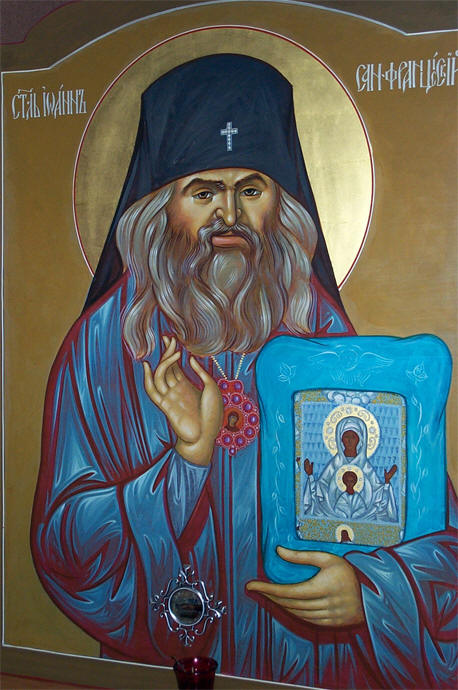
From the Sermons of Saint John at:
More about the life of St John
Pastoral Letters of Archbishop John
The Monastery of St John of San Francisco
A documentary on the life of St. John:
Copyright Disclaimer
Under Section 107 of the Copyright Act 1976, allowance is made for “fair use” for purposes such as criticism, comment, news reporting, teaching, scholarship, and research. Fair use is a use permitted by copyright statute that might otherwise be infringing. Non-profit, educational or personal use tips the balance in favor of fair use.
Saint John’ glorification, San Francisco, CA, 1994
Holy John, pray to our Lord Jesus Christ for us, Amen!
The interview and sermon were given by Fr. George Calciu in Romania (2005), 1 year before passing in the Lord.
Please also see the recent state of unrest unfolding in Greece in regards to the new “Citizen Card”, commented by Fr. Peter Heers on Ancient Faith Radio.

“The Citizen’s Card” and Orthodox Opposition in Greece: Part I
“The Citizen’s Card” and Orthodox Opposition in Greece: Part II
 Christian Dogma
 Christian Martyrs
 Christian Orthodox Churches and Monasteries
 Christian Sermons and News
 Church's Teachings on Fasting
 Ecumenism – a Great Heresy
 Father George Calciu
 Life_a Sacred Gift form God
 Orthodox Saints and Church Fathers
 Spiritual Elders
 Daily Bible Readings
 Journey to Orthodoxy
 Listen to Ancient Faith Radio
 Orthodox Calendar of Feasts and Saints
 Orthodox Christian Mission Center
 Orthodox Institute
 OrthodoxChristianNetwork TV


Recent Comments