
You are currently browsing the category archive for the ‘Orthodox Sermons & News’ category.
The life of Prophet Isaiah, taken from “Prolog of Ohrid”

This great prophet was of royal lineage. Isaiah was born in Jerusalem of Amoz his father who was the brother of Amaziah, the king of Judah. By the great grace of God that was in him, Isaiah was made worthy to see the Lord Sabaoth on the throne in heaven surrounded by six-winged Seraphims who continuously sing: “Holy, Holy, Holy, is the Lord of Hosts [Sabaoth]” (Isaiah 6:3). Isaiah prophesied many things to individual men as well as to the people. On one occasion, he walked naked around the streets of Jerusalem for three days prophesying the imminent fall of Jerusalem by the Assyrian King Sennacherib, reminding the king and the leaders of the people not to hope in assistance from the Egyptians or Ethiopians for they, also, will be subjugated by the same Sennacherib, but rather to trust in help from God the Most High. This prophesy, as well as other prophecies, were literally fulfilled. Isaiah’s most important prophecies are the ones concerning the Incarnation of God, the conception of the All- Holy Virgin, John the Forerunner and about many other events of the life of Christ. [“Therefore, the Lord Himself shall give you a sign; Behold a virgin shall conceive, and bear a son, and shall call His name Emmanuel” (Isaiah 7:14). “For unto us a child is born, unto us a son is given; and the government shall be upon his shoulder: his name shall be called Wonderful, Counselor, The Mighty God, The Everlasting Father, The Prince of Peace” (Isaiah 9:6). “The voice of him that cries in the wilderness, Prepare ye the way of the Lord and make straight in the desert a highway for our God” (Isaiah 40:3).] This discerning man, because of the purity of his heart and because of his zealousness toward God, also received the gift of working miracles. Thus, when the besieged Jerusalem suffered from drought, Isaiah prayed to God and water flowed from beneath Mount Zion. This water was called Siloam which means: “sent.” Later, the Lord directed the man, blind from birth to bathe in this water in order for him to see. During the reign of King Manasses, when Isaiah thundered against the pagan customs of the king and the leaders comparing that generation with Sodom and Gomorrah, the anger of the leaders and the people rose up against this great prophet. He was captured, led out of Jerusalem and was sawed in half. Isaiah lived and prophesied about seven-hundred years before Christ.
The Holy Prophet Isaiah and some of his prophesies on the Messiah
The Book of the Prophet Isaiah (OT)
Chapter 53
1. O Lord, who has believed our report? and to whom has the arm of the Lord been revealed?
2 We brought a report as of a child before him; he is as a root in a thirsty land: he has no form nor comeliness; and we saw him, but he had no form nor beauty.
3 But his form was ignoble, and inferior to that of the children of men; he was a man in suffering, and acquainted with the bearing of sickness, for his face is turned from us: he was dishonored, and not esteemed.
4 He bears our sins, and is pained for us: yet we accounted him to be in trouble, and in suffering, and in affliction.
5But he was wounded on account of our sins, and was bruised because of our iniquities: the chastisement of our peace was upon him; and by his bruises we were healed.
6 All we as sheep have gone astray; every one has gone astray in his way; and the Lord gave him up for our sins.
7 And he, because of his affliction, opens not his mouth: he was led as a sheep to the slaughter, and as a lamb before the shearer is dumb, so he opens not his mouth.
8 In his humiliation his judgment was taken away: who shall declare his generation? for his life is taken away from the earth: because of the iniquities of my people he was led to death.
9 And I will give the wicked for his burial, and the rich for his death; for he practiced no iniquity, nor craft with his mouth.
10 The Lord also is pleased to purge him from his stroke. If ye can give an offering for sin, your soul shall see a long-lived seed:
11 the Lord also is pleased to take away from the travail of his soul, to shew him light, and to form him with understanding; to justify the just one who serves many well; and he shall bear their sins.
12 Therefore he shall inherit many, and he shall divide the spoils of the mighty; because his soul was delivered to death: and he was numbered among the transgressors; and he bore the sins of many, and was delivered because of their iniquities.
The Gospel according to St. Matthew (NT)
Chapter 27
27:1 When the morning was come, all the chief priests and elders of the people took counsel against Jesus to put him to death:
27:2 And when they had bound him, they led him away, and delivered him to Pontius Pilate the governor.
27:3 Then Judas, which had betrayeth him, when he saw that he was condemned, repented himself, and brought again the thirty pieces of silver to the chief priests and elders,
27:4 Saying, I have sinned in that I have betrayed the innocent blood. And they said, What is that to us? see thou to that.
27:5 And he cast down the pieces of silver in the temple, and departed, and went and hanged himself.
27:6 And the chief priests took the silver pieces, and said, It is not lawful for to put them into the treasury, because it is the price of blood.
27:7 And they took counsel, and bought with them the potter’s field, to bury strangers in. 27:8 Wherefore that field was called, The field of blood, unto this day.
27:9 Then was fulfilled that which was spoken by Jeremy the prophet, saying, And they took the thirty pieces of silver, the price of him that was valued, whom they of the children of Israel did value;
27:10 And gave them for the potter’s field, as the Lord appointed me.
27:11 And Jesus stood before the governor: and the governor asked him, saying, Art thou the King of the Jews? And Jesus said unto him, Thou sayest.
27:12 And when he was accused of the chief priests and elders, he answered nothing.
27:13 Then said Pilate unto him, Hearest thou not how many things they witness against thee?
27:14 And he answered him to never a word; insomuch that the governor marveled greatly. 27:15 Now at that feast the governor was wont to release unto the people a prisoner, whom they would.
27:16 And they had then a notable prisoner, called Barabbas.
27:17 Therefore when they were gathered together, Pilate said unto them, Whom will ye that I release unto you? Barabbas, or Jesus which is called Christ?
27:18 For he knew that for envy they had delivered him.
27:19 When he was set down on the judgment seat, his wife sent unto him, saying, Have thou nothing to do with that just man: for I have suffered many things this day in a dream because of him.
27:20 But the chief priests and elders persuaded the multitude that they should ask Barabbas, and destroy Jesus.
27:21 The governor answered and said unto them, Whether of the twain will ye that I release unto you? They said, Barabbas.
27:22 Pilate saith unto them, What shall I do then with Jesus which is called Christ? They all say unto him, Let him be crucified.
27:23 And the governor said, Why, what evil hath he done? But they cried out the more, saying, Let him be crucified.
27:24 When Pilate saw that he could prevail nothing, but that rather a tumult was made, he took water, and washed his hands before the multitude, saying, I am innocent of the blood of this just person: see ye to it.
27:25 Then answered all the people, and said, His blood be on us, and on our children.
27:26 Then released he Barabbas unto them: and when he had scourged Jesus, he delivered him to be crucified.
27:27 Then the soldiers of the governor took Jesus into the common hall, and gathered unto him the whole band of soldiers.
27:28 And they stripped him, and put on him a scarlet robe.
27:29 And when they had platted a crown of thorns, they put it upon his head, and a reed in his right hand: and they bowed the knee before him, and mocked him, saying, Hail, King of the Jews!
27:30 And they spit upon him, and took the reed, and smote him on the head.
27:31 And after that they had mocked him, they took the robe off from him, and put his own raiment on him, and led him away to crucify him.
27:32 And as they came out, they found a man of Cyrene, Simon by name: him they compelled to bear his cross.
27:33 And when they were come unto a place called Golgotha, that is to say, a place of a skull,
27:34 They gave him vinegar to drink mingled with gall: and when he had tasted thereof, he would not drink.
27:35 And they crucified him, and parted his garments, casting lots: that it might be fulfilled which was spoken by the prophet, They parted my garments among them, and upon my vesture did they cast lots.
27:36 And sitting down they watched him there;
27:37 And set up over his head his accusation written, THIS IS JESUS THE KING OF THE JEWS.
27:38 Then were there two thieves crucified with him, one on the right hand, and another on the left.
27:39 And they that passed by reviled him, wagging their heads,
27:40 And saying, Thou that destroyest the temple, and buildest it in three days, save thyself. If thou be the Son of God, come down from the cross.
27:41 Likewise also the chief priests mocking him, with the scribes and elders, said,
27:42 He saved others; himself he cannot save. If he be the King of Israel, let him now come down from the cross, and we will believe him.
27:43 He trusted in God; let him deliver him now, if he will have him: for he said, I am the Son of God.
27:44 The thieves also, which were crucified with him, cast the same in his teeth.
27:45 Now from the sixth hour there was darkness over all the land unto the ninth hour. 27:46 And about the ninth hour Jesus cried with a loud voice, saying, Eli, Eli, lama sabachthani? that is to say, My God, my God, why hast thou forsaken me?
27:47 Some of them that stood there, when they heard that, said, This man calleth for Elias. 27:48 And straightway one of them ran, and took a sponge, and filled it with vinegar, and put it on a reed, and gave him to drink.
27:49 The rest said, Let be, let us see whether Elias will come to save him.
27:50 Jesus, when he had cried again with a loud voice, yielded up the ghost.
27:51 And, behold, the veil of the temple was rent in twain from the top to the bottom; and the earth did quake, and the rocks rent;
27:52 And the graves were opened; and many bodies of the saints which slept arose,
27:53 And came out of the graves after his resurrection, and went into the holy city, and appeared unto many.
27:54 Now when the centurion, and they that were with him, watching Jesus, saw the earthquake, and those things that were done, they feared greatly, saying, Truly this was the Son of God.
27:55 And many women were there beholding afar off, which followed Jesus from Galilee, ministering unto him:
27:56 Among which was Mary Magdalene, and Mary the mother of James and Joses, and the mother of Zebedee’s children.
27:57 When the even was come, there came a rich man of Arimathaea, named Joseph, who also himself was Jesus’ disciple:
27:58 He went to Pilate, and begged the body of Jesus. Then Pilate commanded the body to be delivered.
27:59 And when Joseph had taken the body, he wrapped it in a clean linen cloth,
27:60 And laid it in his own new tomb, which he had hewn out in the rock: and he rolled a great stone to the door of the sepulcher, and departed.
27:61 And there was Mary Magdalene, and the other Mary, sitting over against the sepulcher.
27:62 Now the next day, that followed the day of the preparation, the chief priests and Pharisees came together unto Pilate,
27:63 Saying, Sir, we remember that that deceiver said, while he was yet alive, After three days I will rise again.
27:64 Command therefore that the sepulcher be made sure until the third day, lest his disciples come by night, and steal him away, and say unto the people, He is risen from the dead: so the last error shall be worse than the first.
27:65 Pilate said unto them, Ye have a watch: go your way, make it as sure as ye can. 27:66 So they went, and made the sepulcher sure, sealing the stone, and setting a watch.
Please also see:
THE PROPHECIES OF THE OLD TESTAMENT on the MESSIAH – Part I
and
THE PROPHECIES OF THE OLD TESTAMENT on the MESSIAH – Part II
The Church of St. Mary of Magdalene, Jerusalem

The church dedicated to St. Mary of Magdalene is part of a Russian monastery situated on the Mount of Olives and located very close to the Garden of Gethsemane in Jerusalem near other important places of Christian worship such as the Church of All Nations and Dominos Flevit.
St. Mary of Magdalene (of Magdala) is one of the myrrh-bearing women out of whom Jesus had cast seven demons.
The place of St. Mary of Magdalene in the Holy Scripture
After her miraculous healing by our Lord, Mary or Maria, the woman from Magdala, along with other disciples, had followed Jesus all His earthy life [as the Scripture narrates: “Now it came to pass, afterward, that He went through every city and village, preaching and bringing the glad tidings of the kingdom of God. And the twelve were with Him, and certain women who had been healed of evil spirits and infirmities–Mary called Magdalene, out of whom had cast seven demons” (Luke 8 1-2)], been one of the myrrh-bearing women who went to the Holy Tomb on Easter morning to anoint the holy body of our Lord with spices (myrrh), as it was accustomed in the Hebrew tradition.

Mary of Magdalene was the first our Risen Lord appeared to, after His resurrection, as we read: “Now when Jesus was arisen early the first day of the week, he appeared first to Mary Magdalene, out of whom he had cast seven devils. And she went and told them that had been with him, as they mourned and wept. “ (Mark 16, 9-10).
Saint Mary of Magdalene and the tradition of red eggs
Since the ancient times during the Easter holidays, Christians have painted and decorated eggs. The egg is the symbol of a new life. Serving as a symbol of Easter, the red egg represents the Resurrected Christ, Who rises from the tomb breaking its seals. While breaking the eggs, Christians proclaim the Resurrection by saying: “Christ is Risen! Truly, He is Risen!”
The old Christian tradition attributes the red eggs to St. Mary of Magdalene.
It is said that after the Resurrection of Jesus Christ, Mary of Magdalene making use of her relationship with some prominent persons in Jerusalem, managed to arrive at a banquet held by the emperor Tiberius, with the intention to publicly proclaim the Resurrection of Jesus.
When the king passed by Mary who was holding a boiled white egg in her hand, seeing him, she proclaimed: “Christ is Risen!” Hearing this, the king laughed at her saying: “The chance that Jesus was raised from the grave is as likely as this egg you hold in your hand to turn red.” And at that very moment, the egg turned red.

The second tradition connected with the red eggs, comes especially from Greece. Thus, it is said that after the Crucifixion, Mary of Magdalene and Mary the Virgin and Mother of Jesus, placed a basket of eggs at the foot the Cross. The eggs were colored in red by the blood drained from the wounds of our crucified Lord. Taking the basket of red eggs Mary of Magdalene brought it before the emperor Tiberius Caesar.
The Church of St Mary of Magdalene – brief history
The church of St. Mary of Magdalene from Jerusalem was built in 1886 by Tsar Alexander the III-rd of Russia in honor of his mother, Empress Maria Alexandrovna. The church was built in a traditional Russian Style specific to sixteenth and seventeenth centuries Russia with its roof of golden domes (seven in number) in the form of an “onion”.
In 1888, the Great Duke Sergey Alexandrovich (the brother of Alexander the III-rd) and his wife Duchess Elizabeth of Hesse-Darmstadt (a granddaughter of QueenVictoria and the sister of the last Empress of Russia), attended the consecration of the church as representatives of the king.

The Great Duchess of Russia loved this church very much and she chose the famous painter Sergey Ivanov (1864-1910) for its decoration. Sergey has painted many scenes from the life of St. Mary of Magdalene, many lasting until today.
Above the iconostasis, there is an icon depicting St Mary of Magdalene holding a red egg while standing before the Roman Emperor Tiberius. She tells the king about the unjust trial of Jesus Christ. It is known that after the crucifiction of Jesus, Herod who was then governor of Jerusalem was sent into exile.

The iconostasis, made of white marble and bronze, is composed of a series of icons painted by renowned Russian artist Vereshchaguin. To the right of the iconostasis on a carved wooden throne, stands the miracle working icon of Our Most Holy Lady Hodighitria, brought from Lebanon. In the sixteenth century, the icon has miraculously escaped a fire that affected the whole church. During the cholera epidemic, many wonderful cures were attributed to this icon.
The church preserves the relics of two holy martyrs of Russia: the Duchess Feodorovna Elizabeth and the nun Varvara Yakovleva, both thrown into prison during the Bolshevik revolution of 1917 and martyred on July 18, 1918.
The Great Duchess Elizabeth, after her husband’ assassination in 1905, entered the monastic life. She founded a convent of nuns in Moscow, preoccupied mainly with charity works. After the revolution from 1918, Duchess Elizabeth, her sister Varvara and other members of the imperial family, was thrown into an abandoned mine where they died of starvation.

The bodies of two ascetics Elizabeth and Varvara, were brought to Jerusalem in 1920, and placed inside the crypt of St Mary of Magdalene Church.
The two women have been canonized as holy martyr in 1981, when their relics have been translated into the church for veneration.
The church basement also buries Princess Andrea of Greece’ body – the granddaughter of Duchess Elizabeth and the mother in law of Queen Elizabeth the IInd of England. Princess Andrea of Greece (Alice of Battenberg) and the mother of the Duke of Edinburgh visited the church in 1930. Her last wish was that her body be buried beside her aunt, Duchess Elizabeth.

During the Nazi domination, the princess has helped many Jews to hide from persecution, saving their lives. She died in 1969 in the Buckingham Palace. Her desire to be buried in the church St Mary of Magdalene was fulfilled only in 1988, when her body was placed in the underground crypt of the church.
The monastic community of St. Mary of Magdalene was founded in 1936 by Mother Mary (Robinson), a pious woman from England who after her conversion to Orthodoxy became a nun. The community includes approximately 30 nuns of different ethnicities: Russian, American, Australian, Arabic, Serbian and Romanian.

(Translated and adapted by blog author)
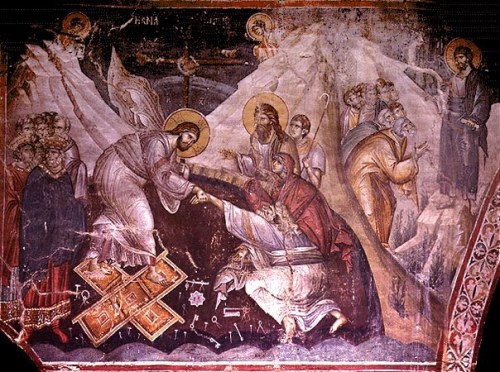
By Archiamandrite Justin Popovic
(blessed memory; commemorated April 7)
People condemned God to death; with His Resurrection He condemned them to immortality. For striking Him, God returned embraces; for insults, blessings; for death, immortality. Never did men show more hate towards God than when they crucified Him; and God never showed His love towards people more than when He was resurrected. Mankind wanted to make God dead, but God, with His Resurrection, made people alive, the crucified God resurrected on the third day and thereby killed death ! There is no more death. Immortality is surrounding man and his entire world.
With the Resurrection of the God-Man, the nature of man is irreversibly led toward the road of immortality and man’s nature becomes destructive to death itself. For until the Resurrection of Christ, death was destructive for man; from the Resurrection of Christ, man’s nature becomes destructive in death. If man lives in the faith of the Resurrected God Man, he lives above death, he is unreachable for her; death is under man’s feet. Death where is thy sting? Hell, where is thy victory? And when a man who believes in Christ dies, he only leaves his body as his clothes, in which he will be dressed again on the Day of Last Judgement.
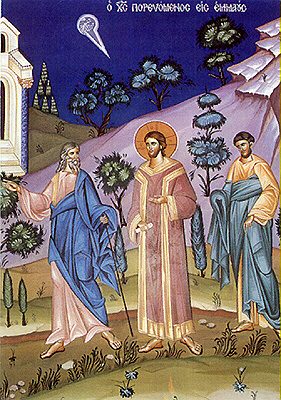
Before the Resurrection of the God-Man, death was the second nature of man; life was first and death was second. Man became accustomed to death as something natural. But after His Resurrection the Lord changed everything: and it was only natural until Christ’s Resurrection, that the people became mortal, so after Christ’s Resurrection it was natural that the people became immortal.
Through sin, man becomes mortal and temporal; with the Resurrection of the God-Man, he becomes immortal and eternal. In this lies the strength, in this lies the power, in this lies the might of Christ’s Resurrection. Without the Resurrection there is no Christianity. Among the miracles, this is the greatest one; all other miracles begin and end with it. From it sprouted the faith and the love and the hope and the prayer and the love toward God.
(Taken from “Philosophical Cliffs”)
Holy Fire Jerusalem, 2011 -the miracle of Holy Orthodoxy
Christ is Risen!
Truly, He is Risen!
The Great Canon of St Andrew of Crete: text
St. Nicolai Velmirovich: On Fasting and Prayer
A sermon by Metropolitan Philaret (Voznesenskhy) on St Andrew of Crete’ Great Canon of Repentance
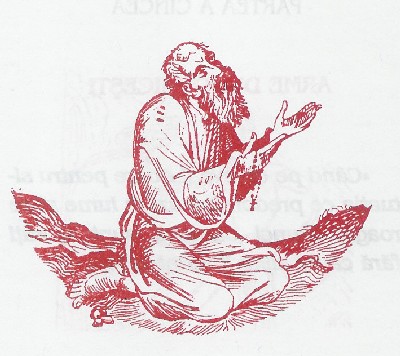
“My soul, o my soul, rise up! Why art thou sleeping? The end draws near, and soon thou shalt be troubled … ”
In a sense, these words are at the core of the Great Penitential Canon, composed by St. Andrew of Crete, one of the great Saints of God.
He addresses his soul, “My soul, o my soul, rise up, why art thou sleeping?” If that great righteous one could criticize his own soul for having spiritually fallen asleep, what can we say about ourselves?
The Holy Fathers often say that in spiritual life there is a certain paradox (an assertion that at first glance seems self-contradictory, but in fact contains a profound philosophical meaning). According to the Holy Fathers, the “spiritual paradox” rests in the fact that sinners see themselves as righteous, while the righteous see themselves as sinners. Why is this? Why does a sinner see himself as a righteous person? Because he does not know himself, while the righteous man focuses all of his spiritual power on knowing himself.
The Canon In Russian
The best of the pagans also recognized that you have to somehow know how to look into your internal world. Even in pre-Christian antiquity, we heard the phrase – attributed either to Socrates or to some other of the pagan thinkers – “know thyself.” With respect to the Christian understanding of that truth, there is after all reason for us to pray throughout Great Lent “Yea, 0 Lord and King, grant me to see my own faults … ” Were we to see them as we should, there would be no need for us to pray with such words.
We used to mention the following example from the lives of the saints: A certain righteous man began to implore God to show him to what depths sin had penetrated man’s being, to what extent it had, as it were, maimed him, filled, and defeated him. When the Lord granted the ascetic’s humble prayer and showed him the extent to which our nature was poisoned and maimed by sin, the terrified ~scetic felt that he was about to go mad, and began to implore the Lord to hide th~t awful vision from his sight as soon as possible. That is just how poisoned by sin man is.
The deeper one delves into himself, the more accustomed he becomes to comprehending his internal world, the more clearly and painfully he feels the internal harm done by sin.
In Romanian
It was for a reason that in their prayers before Holy Communion, Sts. Basil the Great, John Chrysostom, and other Saints like them called themselves the worst of sinners, unworthy to look upon the heights of Heaven. This was no rhetorical phrase-mongering, no hyperbole. They saw themselves just as what they said.
It was for a reason that St. Seraphim, that great Venerable One of the Russian Land, whom others saw as radiant as the sun, whom they saw rising up into the air while praying, liked to call himself the “poor wretched Seraphim.” For the righteous person truly feels himself to be a sinner.
If in some room there is a dirty rag, but there is no light in the room, the dirt on the rag is not visible. Should light come into the room, the dirt immediately becomes perceptible. The more light, the more clearly visible will be the dirt. Therefore, the closer the Saints approach God, the more clearly they see their sinfulness. When someone truly comes close to God, his conscience is illumined, its voice becomes clear, and sounds like a bell, sounds a reproach for any falling away from God, for any instance of being unfaithful to Him.
As to the sinner, he knows neither himself nor his soul, and even when he goes to Confession, it seems to him that he is not all that bad. When he hears about great sinners, he, like many others like him, thinks, “Well, at least I am not like that! I don’t consider myself to be a righteous person, and I am not a saint, but still, I am not that bad. Certainly there are people worse than me … “ However, no truly righteous person – a person who remembers only his own sins, and not someone else’s, one who always has compunction for them, and sees himself as meek before God would allow even the slightest self-justification to enter into his soul.
In English (St Vladimir Seminary)
We have now entered a period of repentant reflection and prayer.
Let us pray that the Lord might also truly grant unto us sinners to see our transgressions, and not those of others. We always notice others’ sins, deficiencies and blunders, but often we don’t notice our own; even if we do notice them, we don’t have any problem justifying them, but always can find a reason [to justify them]. Thus, I repeat, let us sincerely pray that the Lord grant unto us to see our transgressions, for without that spiritual sight, there can be no true repentance.
More Sermons on the Great Fast at:
“Lent: Our Personal Journey” with Metropolitan Kallistos Ware (video)

Beloved brethren! We have already reached the very gates of the holy fast! They are even now about to open before us! Already, according to the typicon of the Holy Church, we hear the instruction of our Lord Jesus Christ read to us today in the Holy Gospels about the correct way to begin thepodvig of fasting.
For if ye forgive men their trespasses,says the Gospel reading for today,your heavenly Father will also forgive you: But if ye forgive not men their trespasses, neither will your Father forgive your trespasses (Mt. 6:14–15). The holy Church greets us with this announcement at the gates of the fast! This is the requirement the Church offers us on the very threshold of the spiritual chamber of repentance. We intend to prove our repentance for various sinful distractions through various deprivations and wearing out of the body. The Gospels requires mercy from us before sacrifice, so that the sacrifice would be pleasing to God.
All who wish to begin this podvig of fasting and prayer, all who wish to reap abundant fruits of your repentance! Hear the word of God, hear God’s commandment, and let go, forgive your neighbors their sins against you. For if ye forgive men their trespasses, your heavenly Father will also forgive you: But if ye forgive not men their trespasses, neither will your Father forgive your trespasses. Amen.
St. Ignatius (Brianchaninov)
Translated by Nun Cornelia (Rees)
Also see: A Sermon with Metropolitan Kallistos (video) at:
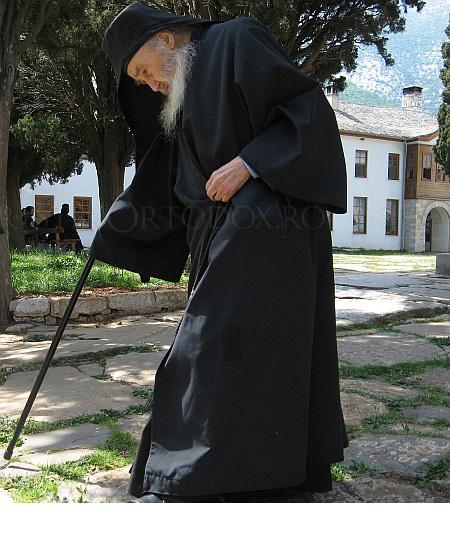
Elder Petroniu Tanase, former abbot of Prodromu Romanian Monastery from Mount Athos has followed sleep in the Lord, Tuesday, February 22.
May his memory be eternal!
On watching over the five senses
(With Elder Petroniu)
When man withdraws from the world escapes the temptation of sinful words and worldly images. By living in the world, man unwittingly hears and sees things that dirty his soul through his senses. And all these impressions and things of the world that enter his soul carry with them, a psychological and spiritual load. They awake memories you no longer want to remember, create undue spiritual tensions and leave fingerprints – as one may say – or dirty marks in the spiritual life of man. A man living in the world assimilates – even if it’s only in part, some of the sins of the world. As the old saying states that “man is what he eats”, we can also say that man is what he lives in the city, in his village or in his house. And as his body physiological composition is dependent of the materials contained in food that contribute to his good health, so the spiritual state of man becomes dependent on all these images and thoughts that penetrate through his five senses.
St. Nicodemus of the Holy Mountain has written a special work on this subject, “Guarding the five senses.”
Man must guard his senses as he would his gateways where friends but especially enemies could enter. Through these windows, dark impressions can penetrate into his soul.
These fingerprints can gradually shape the whole structure of man. During our lifetime, many impressions and deeds are recorded in one’ soul like in a book. … And these are the “books” that will be open at the Dreadful (Last) Judgment.
Man, until the end his life, is in a permanent transformation through what he hears, what he sees and what he lives. He is like a sculptor carving the wood, a piece here, a piece there… A chip on this side, a splinter on the other side and, little by little, the figure/sculpture appears. At the end of his life, man appears in his final form, modeled by everything he hears and does. And this transformation is noticed sometimes on his face. A wicket or a drunken man who lived a sinful life will show this. His figure acquires a certain appearance, connected to the sins he committed. And we elders can sense this.

But these evil fingerprints do not remain at the level of external appearance as we are accustomed to notice, but they will be engraved in man soul. Then at the Dreadful Judgment, when the books will be opened, that man will appear – though the great mystery of God – modeled by everything he did and thought. The Holy Fathers and especially of St. Niphon of the Danube says that people who have committed grievous sins, and have not change or repent, will remain distorted for eternity – a reflection of their soul, which after death will become a tangible reality. At the Last Judgment the state of man soul, more visible than his body, will portray everything man did. Sinners will have distorted figures and every grimace will reflect the sins they committed. Then – as St. Niphon says – everyone will see the sins we committed in our lifetime for they will be engraved in my personal appearance, they will express like a mirror, the structure of my soul irreparably damaged by sins. All our sins will be expressed and everyone will see our corruption.
And what is it said, in our church services, about the Dreadful Judgment? “Oh, who can suffer this scenery?” If now I’m ashamed to visibly sin against my neighbor, how will I look when everyone will see all the sins I have done?
On the Orthodox Church
1. The Orthodox Church is and must remain holy. There exists not one thing that can be accomplished without the power of the Holy Spirit. Today the spirit of the world penetrates everywhere, even in the life of the Church, in parishes and monasteries. With the help of the spiritual father, man is called to become holy through Christ who died and rose from the dead in order to deify human nature and to lift it up to heaven to the throne of the Holy Trinity.
2. The monastery ought to be far from the spirit of worldliness. According to St. Maximus the Confessor, a monk must constantly renounce the world and he will gain heavenly treasures.
3. Monasticism resembles martyrdom. Most saints mentioned in the Church ‘calendar are martyrs, and are followed by the monastics.
4. The monks have been entrusted with the liturgical treasure of the Church. A monk is called to maintain lit the lamp of liturgical life. First of all, he must attend all the daily liturgical services from his monastery.
5. The abbot has to be the spiritual father of the monastic community.
6. In his ministry, the Bishop is called to show firmness in defending the true faith before the heterodox and to promote the purity of life. The lives of St. John Chrysostom and St. Basil the Great ought to be eloquent examples to every bishop. The clergy and the faithful’ confidence in their hierarch is maintain when he remains steadfast in defending the Christian truth and in preserving the purity of life.
7. Gluttony, immorality and the love of money enslaves our world today.
Today, many sins are enacted by the so-called “human rights”. But according to the Christian teaching, man has only duties: towards God, his neighbor and God’ creation.
(Taken from the site “Friends of Mt. Athos”, translated by blog’author)
More about Elder Petroniu at:
The ABBOT OF THE ROMANIAN SKETE of MT. ATHOS, REPOSES IN THE LORD
“If I forget thee, O Jerusalem…”

If anyone be a prodigal as I, take courage and turn back; For the gates of God’s mercies are opened to all.
On this day we celebrate the Sunday of the Prodigal Son, dedicated as the second service of the Triodion by the divine Fathers for the following reason. There are some who recognize much in themselves that is unbecoming, who live a life of great dissipation from their youth, whose lives are full of drunkenness and immorality, who having fallen thus into the depths of evil, become despondent, giving birth to pride, from whence they have no desire to advance to any of the virtues, preferring their bondage to evil and falling ever deeper into evil. Having a fatherly love for even these individuals, and desiring to lead them out of their despair, the Holy Fathers prescribed this parable for the second preparatory Sunday in order to tear up the passion of despair by the roots, to lead them to acceptance of the virtues, and to demonstrate to sinners the abundance of God’s compassion upon sinners and prodigals in His great goodness and love for mankind. For there is no sin which cannot be overcome by the knowledge of His love for mankind, and this is what is presented in this parable of Christ. Now the sons of man, that is of the Word, God and Man, are two: the righteous and the sinful. It is the eldest who abides ever in God’s blessings, following His commandments and remaining always by Him. But the younger son, having become attached to sin and renouncing his closeness to God through shameful deeds, has wasted God’s love for mankind and for him and has lived as a prodigal. For having completely rejected Him after whose image he was created, and having followed an evil demon, willingly enslaving himself to this demon’s pleasure, he was unable to fulfill his desire. For sin is an unsatisfying thing that becomes an habitual source of temporary pleasure. It may be compared to the husks that are fed to swine. At first it seems that they might be something tasty, but they turn out to be very dry and are much like weeds, which is how sin takes possession. For the Prodigal Son had hardly come to his senses when, perishing from hunger for virtue, he comes to his father, saying, “Father, I have sinned before heaven and before thee, and I am not worthy to be called thy son.” Yet the father receives him in repentance, not reproaching him, but embracing him and kissing him in a display of divine and fatherly love. And he clothes him, a symbol of baptism, putting a ring on his finger, a symbol of the grace of the all-Holy Spirit. He also puts sandals on his feet, not so much as a protection from some serpent or scorpion that might sting him on his path to God, but rather as a means of crushing the heads of those creatures. And then in an tremendous display of joy he slaughters the fatted calf for him, his only-begotten Son, and the Father grants him communion of his body and blood. Now the elder son expresses his amazement at his father’s limitless mercy. But the lover of mankind exhorts him to silence with loving and kind words of humility, saying, “Thou art ever with me, and it was meet that we should make merry and be glad, for my son was formerly dead in his sin and is alive again, having repented of the foolish things he has done. He was lost, since he was far from me in his licentious habits, and he was found by me, suffering in my compassion and calling him back in my mercy.”
This parable may be applied to us as well, which is why the holy Fathers have prescribed it for today. We who have sinned as the prodigal are encouraged to weed out despair and fear through repentance, confession and good deeds. For this is a great aid and a powerful weapon against the assaults of the adversary.
In Thine ineffable love for mankind, O Christ our God, have mercy upon us. Amen.
Kontakion, Tone 3
I have recklessly forgotten Thy glory, O Father;
and among sinners I have scattered the riches which Thou gavest me.
And now I cry to Thee as the Prodigal:
I have sinned against Thee, O merciful Father;
receive me a penitent
and make me as one of Thy hired servants.
By The Waters of Babylon
by blessed Fr.Seraphim (Rose), March 1965
“By the rivers of Babylon, there we sat down, yea, we wept, when we remembered Zion“.
In these words of the Lenten psalm, we Orthodox Christians, the New Israel, remember that we are in exile. For Orthodox Russians, banished from Holy Russia, the Psalm has a special meaning; but all Orthodox Christians, too, live in exile in this world, longing to return to our true home, Heaven. For us the Great Fast is a session of exile ordained for us by our Mother, the Church, to keep fresh in us the memory of Zion from which we have wandered so far. We have deserved our exile and we have great need of it because of our great sinfulness. Only through the chastisement of exile, which we remember in the fasting, prayer and repentance of this season, do we remain mindful of our Zion.
“If I forget thee, O Jerusalem…”
Weak and forgetful, even in the midst of the Great Fast we live as though Jerusalem did not exist for us. We fall in love with the world, our Babylon; we are seduced by the frivolous pastimes of this “strange land” and neglect the services and discipline of the Church which remind us of our true home. Worse yet, we love our very captors – for our sins hold us captive more surely than any human master – and in their service we pass in idleness the precious days of Lent when we should be preparing to meet the Rising Sun of the New Jerusalem, the Resurrection of our Lord Jesus Christ.
There is still time; we must remember our true home and weep over the sins which have exiled us from it. Let us take to heart the words of St. John of the Ladder: “Exile is separation from everything in order to keep the mind inseparable from God. An exile loves and produces continual weeping.” Exiled from Paradise, we must become exiled from the world if we hope to return.
This we may do by spending these days in fasting, prayer, separation from the world, attendance at the services of the Church, in tears of repentance, in preparation for the joyful Feast that is to end this time of exile; and by bearing witness to all in this “strange land” of our remembrance of that even greater Feast that shall be when our Lord returns to take His people to the New Jerusalem, from which there shall be no more exile, for it is eternal.
 Valentine day: “A Pink Holiday”
Red hearts, pink ribbons, candy packaged in purple, “angels” suspended in fluffy and blue clouds, among other sweet things that feel “good” – to the soul eager for “cute happenings” – are just some of the elements of Valentine’s Day.
Every February 14th – the day of St. Valentine in the West – is celebrated with great fast, and this “holiday” had penetrated so deeply into the mind of modern man, for if you ask what greater holiday is to be celebrate in February, you are been answered without hesitation: Valentine’s Day! This day becoming a clear marking on the twisted map of consumerism.
Valentine’s day – a business under the mask of a “holiday”
Absolutely all traders are trying to profit from this; in fact, this commercial love lasts only for a day. A day in which most business are trying hard to give “deals”: a bouquet of flowers – 40 dollars, a puffy heart – only for few dollar, a candle shaped as a heart to burn just for one hour – few dollars. Everything that you may want…ceramic vases, underwear, monkeys, jewelry, books, and why not, slippers and bath towels so naturally, as long as there is a demand, these toys will continue to sell.
All like in the real story of the Tower of Babel …
Valentine’s Day – the invasion of red hearts
Almost all the products that vendors offer for the so-called day of love, have at least one red heart. Obviously, these offers are designed for every budget, so that anyone by spending a small or great amount, may get into the “spirit” of the American celebration of St. Valentine.
Valentine’s Day – Origin!
The Valentine’s Day has its origins in the tradition of ancient Rome, when festivities were organized on February 15, in the honor of the pagan gods Juno and Pan. Because it was also a celebration of fertility, the pagan practice required that the unmarried young girls may write love notes, and these messages were placed in an basket for the boys to extract one randomly. According to that tradition, the participants were obliged to court primarily the one “elected” based on the message written on that note, and of course, this started all sorts of stories …
Valentine’s day was also called long ago, the Birds Wedding Day, because it was thought that the birds choose their mate on this very day.
With time, these pagan Roman habits acquired a Christian character becoming falsely a celebration of fertility attributed to St Valentine.
Be my Valentine?!
The day of Saint Valentine, the “patron of lovers”, had lost its meaning in legends and the history of the Roman Empire. Today, the Catholic Church recognizes at least three different saints all martyred, called Valentine or Valentinus, but not on this day.
 One legend says that Valentine was a priest who served the III-rd century in Rome. When Emperor Claudius the II-nd decided that unmarried men were better soldiers than those with wives and families, outlawed marriage for young people. The Emperor wanted to form a “real team” of unmarried men as potential soldiers. Valentine, realizing the injustice of this decree, continued to officiate marriages for young lovers in secret. When his work was discovered, the king sentenced him to death. Other traditions say that Valentine was killed for attempting to help Christians to escape from the terrible prisons where Christians were beaten and tortured.
According to another legend, Valentine is the one who sent the first valentine greeting while in prison, after he fell in love with the daughter of a prison guard and, before he died, it is said that he wrote a letter which he signed it “from your Valentine”.
St. Valentine in the Orhodox Church

Every year, on February 14, Orthodox Christians are facing a double paradox. First, everyone heard of Valentine’s Day, so in a sense, anyone can define briefly this “holiday” while not many seem to know who is Saint Valentine.
On the other hand, many are annoyed by the fact that on this day in the Orthodox calendar, we do not see any saint to bear this name. Another intersting fact is that even the Roman Catholic calendar doesn’t post a saint with this name on this day. St. Valentine mentioned in one of the legend above, was removed from the Roman Catholic calendar in 1969 due to ambiguity of this man life that wound lead to his consecration. Currently, on February 14, the Roman church comemorates Saints Cyril and Methodius.
So from a Christian view, we are not mastaken to say that Valentine’s Day, dispite all “marketing” is a “holiday” when we remember no one! Saint Valentine been commemorated by the Orthodox Church on July 30th.
Saint Valentine the Bishop was born in 175, in Interamna (an italian region called today Umbria). He was ordained priest by St. Feliciano of Foligno, and Bishop of Interamna by Pope Victor the Ist, in 197.
An outstanding preacher of Christ Gospel, a wonder-worker and healer, St Valentine was much loved by his followers. He healed Frontanus, the brother of a Roman governor, from a very difficult disease. When Cherimon the son of the famous philosopher Craton, got sik, under Frontanus’s instructions, called Bishop Valentine of Rome for councel. Cherimon suffered from a debilitating disease that contorted his whole body. After St. Valentine spent a night in prayer, Cherimon was completely healed. After showing himself to his father Craton, the philosopher decided to be baptized and his whole family embraced Christianity along with his three disciples.
Saint Valentine was arrested, tortured and beheaded in Rome, at the age close to one hundred years, from the order of governor Furius Placid, during the persecution of Emperor Marcus Aurelius. Saint Valentine was murdered in secret, at night, to avoid any rebellion form the people of Terni. His holy relics are found today in the church of Terni, Italy.
The three baptized disciples of Craton: Procus, Ephiv and Apollo, were murdered together with St. Valentine in 273.
In the Orthodox calendar, the Holy Martyr and Bishop Valentine, is commemorated on July 30. In the Orthodox Church. there are many martyrs who bared his name: Holy Martyrs Mark Sotirih and Valentine – October 24, Holy Martyr Valentina – February 10, St. Valentine the Martyr – April 24, St. Valentine the priest – July 06, and Holy Martyr Valentina – July 18.
(Life of the Saint – translated by blog’author)
“Repent, for the kingdom of heaven is at hand.”
(Matthew 4:17)

Repentance: Life’s Continual Effort
by Archpriest Victor Potapov
Bishop Ignaty Brianchaninov left us the following precious instruction: “In order to live spiritually and draw breath from grace, we must continually exhale the ashes of sin.” We sin almost constantly, if not in our deeds, then in our thoughts and feelings. Therefore it is essential to continually cleanse our souls. In the language of asceticism (teaching on religious struggle) it is known as “internal activity” or “attentiveness.” To continually repent is to pay unceasing attention to one’s spiritual life, to assess and remove from it all that is questionable and foolish. Bishop Theophanes the Recluse teaches us that one should do battle with sin at the moment it is born, i.e. when it is only in one’s thoughts. This is true battle, the ” invisible warfare” as it is called by the Athonite struggler Nicodemus of the Holy Mountain. This spiritual battle requires ability, God’s assistance, and constant prayer. As the holy Fathers of the Church write ” It is pointless to weep over the sins of the past if we do not struggle with them in the present.” Continual repentance or attentiveness is that poverty of spirit of which Christ speaks in the first Beatitude in His sermon on the mount. The call to such repentance is found throughout the Word of God and the texts of Orthodox worship.
In a sense, all of the teaching of the Church is a single call to repentance in the most profound sense of that term, i.e. it is a call to rebirth, to a complete reassessment of all values, to a new understanding and vision of life in the light of Christ.
It was not coincidentally that St. John the Baptist often repeated the words “Repent, for the Kingdom of Heaven is at hand.” The Christ began His sermon with these same words. According to the Venerable St. Ephraim the Syrian, “repentance is a field to be cultivated at all times. “Repentance is the tree of life, resurrecting those dead in sin.” Elsewhere he states, “Through repentance, earth has become heaven, for it has become filled with saints.”

In his book A Priest’s Observations, Fr. Alexander Elchaninov, an experienced spiritual director, writes, “Without our constant control over the spirit, confession, which takes place occasionally, is not successful”. The eye of the spirit, conscience, demands exercise, and without it you will see neither yourself nor your sins. According to the Venerable St. Isaac of Syria, ” He who has been able to see himself has accomplished more than one who has seen the angels.” He also wrote “One who apprehends his sin is better than one who through his prayers raises the dead.”
Sts. Ephraim and Isaac, and other spiritual strugglers after piety all recommend that in doing battle with sin, it is best to begin with the sin which most grievously attacks us. To the extent that we are rid of it, our conscience will see all the more. Moreover, it always behooves Christians to do battle against those sins which directly oppose love. The holy fathers of the Church teach that hatred, enmity, and condemnation utterly seal shut the gates of the Kingdom of God, the Kingdom of love. Thus, the first condition of true repentance is reconciliation with everyone. This is why in the Lord’s Prayer, the Christ included the words “forgive us our debts as we forgive our debtors.” This is why the Orthodox Church begins Great Lent with Forgiveness Sunday, when believers ask forgiveness of one another for personal insults and offenses, so that with a clear conscience they might begin Lent, their “invisible warfare.” The Church teaches that true love is indivisible, and that dislike for a single person will ultimately poison all love. Theophanes the Recluse writes: “In one who is at odds with anyone else, all friendship is fragile, and easily turns into enmity; of course, by bearing enmity, one cannot really love God. God is complete love, and tolerates nothing that is opposed to love.”
The commandments in the Gospel, while easy, appear difficult, for human consciousness, having fallen out of synch with life and harmony, is clouded. For example, people consider the Gospel commandment to love friend and enemy alike, to be difficult. In the sermon on the mount, the Lord says: “Love your enemies, bless them that curse you , do good to them that hate you, and pray for them which despitefully use you and persecute you” (Matt. 5:44). We see that no limits to good are imposed upon man in this commandment, one given to those who wish to rise above both their own and mankind’s selfishness, to be healed, and to depart from the state of sin.

Let us try to list those who have caused us some annoyance or insult, who have dealt with us poorly or spoken ill of us. In other words, let us recall those who are “not to our liking” and, forgiving each of them, let us sincerely pray for these souls. Let us drive out any grudge or irritation we bear them, and wish them well. Given the opportunity, let us say something nice about them to others. At every opportunity, let us help them.
Thus, as we will see for ourselves, fulfilling the commandment of love will engender a joyous feeling of spiritual freedom and profound peace. Many internal difficulties will depart from us, for we will have fulfilled the Christ’s words, believed in God, and given Him heed. The power of good will rejoice within us. Even if we do not immediately notice this peace within ourselves, it will certainly come to us as a reflection of our charity.
That a person is kind, honest, and generous always seems miraculous. Yes, it is a miracle, and a miracle far greater than moving a mountain. Something greater than a mountain is being moved – human selfishness. Such is the effect on man of our faith in God , our trust in the Lord, our repentance before Christ. When one who hates becomes one who loves, when a liar becomes truthful, when a vain person becomes modest, it is truly a miracle. Charity emanating from us first of all liberates us from our own evil; it opens within us the doors and windows through which flows the pure air of heaven. This is the rebirth born of repentance.
In repentance we see the operation not of natural forces but of supernatural grace-filled ones. And only one who believes in the Light can take into himself true love. According to biological law, men engag only in a “struggle for survival.” But according to the law of the Spirit, the battle is for the resurrection of the world, a spiritual battle which conquers selfishness, spiritual death. The Christ calls us to overcome our evil will and animal nature, to become human in the full spiritual sense of the term. The human soul is immeasurably greater than matter. As the Apostle Paul tells the Philippians, “I can do all things through Christ which strengtheneth me.” Such great, marvelous words: “I can do all things through Christ which strengtheneth me.” Through the faith granted us, we are called to be centered internally, mentally, not on our little selfish personality, but on the power of the Living God, the True Christ Jesus Who dwells in us.
The Creator and Father who brought us into being granted to our souls the freedom to make a free moral choice, to turn to Him and to repent of our sins, which constitute a betrayal of God’s truth. Yes, man is sometimes unfaithful to God; even if we do not frankly renounce God, we sometimes obliquely become betrayers of Christ, of His love and truth. Let us all repent of that.
Let us reflect upon how imperfect is our consciousness, and let us repent before God. Through repentance, the pure path to God is opened. Moreover, let us not tarry, for no one knows when his final hour will come. There is nothing more important and more needed than repentance and God’s saving forgiveness.
See Also: Many Confess, Few Repent
by Monk Moses of the Holy Mountain

A wish for the New Year: towards eternity…

[…] Towards the eternity we step, my brothers. And now, another year had passed. We welcome a new year. What will it bring us? We do not know.
As for us been dull, we do not know if we will live tomorrow. Unceasingly one has to wait his departure, especially us elders, reaching the sunset of life. But also the young. We do not know “What the present moment will offer “. And I wonder next year, in a day like this, how many of us will still be here living? And what events await our people in the New Year? What will it happen in the Balkans, the Mediterranean and the world? … Are you imagining dreams and envision an endless life? But eternity is approaching my dear; the biggest moment is waiting to rise.
What should I wish you, my dear? Wealth, glory, honors, delights, pleasures? … How meaningless is everything. “Vanity of vanities, all is vanity“ (Ecclesiastes 1, 2). Only one thing remains: your belief in Christ. There is no other name that can give us joy and hope during this coming year, of Whom, children praise and exalt into the ages of ages. Amen!
+ Bishop Augustine
(Fragment of a Homily delivered by Metropolitan Augustine of Florida in the Church of St. Panteleimon, Florida, 31.12.1974, during the New Year’ Eve services)
 Christian Dogma
 Christian Martyrs
 Christian Orthodox Churches and Monasteries
 Christian Sermons and News
 Church's Teachings on Fasting
 Ecumenism – a Great Heresy
 Father George Calciu
 Life_a Sacred Gift form God
 Orthodox Saints and Church Fathers
 Spiritual Elders
 Daily Bible Readings
 Journey to Orthodoxy
 Listen to Ancient Faith Radio
 Orthodox Calendar of Feasts and Saints
 Orthodox Christian Mission Center
 Orthodox Institute
 OrthodoxChristianNetwork TV


Recent Comments