
You are currently browsing the monthly archive for July 2009.
Elder Arsenios on Fasting
Eleder Cleopa on Prayer
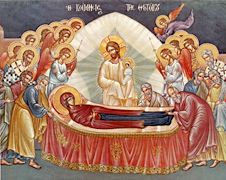
Fast of the Dormition of the Mother of God
August 1st-14th
<In giving birth you preserved your virginity, in falling asleep you did not forsake the world, O Birthgiver of God. You were translated to life, O Mother of Life, and by your prayers deliver our souls from death.>
– Tropar of the Dormition
<Gluttony makes a man gloomy and fearful, but fasting makes him joyful and courageous.
And, as gluttony calls forth greater and greater gluttony, so fasting stimulates greater and greater endurance.
When a man realizes the grace that comes through fasting, he desires to fast more and more.
And the graces that come through fasting are countless….>
~Saint Nikolai of Zicha~
Biblical Story of the Dormition of the Mother of God
The Holy Scriptures tell us that when our Lord was dying on the Cross, He saw His mother and His disciple John and said to the Virgin Mary, “Woman, behold your son!” and to John, “Behold your mother!” ( John 19:25-27 ). From that hour, the Apostle took care of the Theotokos in his own home.
Along with the biblical reference in Acts 2:14 that confirms that the Virgin Mary was with the Holy Apostles on the day of Pentecost, the tradition of the Church holds that she remained in the home of the Apostle John in Jerusalem, continuing a ministry in word and deed.
At the time of her death, the disciples of our Lord who were preaching throughout the world returned to Jerusalem to see the Theotokos. Except for the Apostle Thomas, all of them including the Apostle Paul were gathered together at her bedside. At the moment of her death, Jesus Christ himself descended and carried her soul into heaven.
Following her repose, the body of the Theotokos was taken in procession and laid in a tomb near the Garden of Gethsemane. When the Apostle Thomas arrived three days after her repose and desired to see her body, the tomb was found to be empty. The bodily assumption of the Theotokos was confirmed by the message of an angel and by her appearance to the Apostles.
On Fasting and freedom
By Hieromonk Savatie Bastovoi
What can be more absurd than the fast, in a religion which boasts of having given the man the freedom? How can you name yourself free, when you have to refrain from the things you like, when you must do what you don’t want! The fast is the abstinence not only from the food, but also from the bodily pleasures. How not to see in this an outrage to the noblest instinct that the man has – the freedom?
If the fast is an obligation, than the Gospel is a masterpiece of the absurd’s literature. Understanding this, the Protestants decided to renounce to the fast. However, despite the number of quotations brought from the apostle Paul or from the words of the Saviour Himself, the spur to fasting is like a thorn in the flesh of that who at least scarcely knows the Holy Scriptures.
All righteous before Christ fastened. The fast was precursory to the meeting with God or to a revelation. Moses climbed up the mountain after forty days of non-eating and thus spoke with God. The New Testament is not at all different, it begins with a fastener – John the Baptist. Christ Himself had fastened before having begun to preach. Thus, we cannot leave away the fast, departing from some biblical verses, when even those who pronounced them were great fasteners; it seems to me it is more decent to doubt our understanding ability of those verses.
Christ was once asked why his disciples don’t fast (Matthew 9, 14). From this many have understood that the disciples and the Saviour Himself were gluttons (Matthew 11, 19). But this event, actually, discloses us the fact that the disciples and the Saviour were all the time starving. This can be also seen very well from the conflict that they had with the Jews, because the disciples ate some ears on Saturday. The disciples were so busy with the preaching that they used to forget to eat and the fact that they picked ears, shows how hungry they were and that they were wont to eat here and there. The Saviour however did not eat with them, the reproach being only for the disciples; He was the model of fasting.
The fact that the disciples used to eat little, is emerging from the scene of multiplying the bread, where we find out that they had only five loaves of bread and two fish. Although they were far away from the locality, in an impossibility to buy food, they are ready to give this little to the crowd (without knowing that it will be multiplied), which reveal us that they were accustomed with the hunger more than the ordinary men. Hence, the Saviour and the disciples fastened, but they did not count the days as the Pharisees did. To their question though, Christ, tell them “Can you make the guests of the bridegroom fast while he is with them? But the time will come when the bridegroom will be taken from them; in those days they will fast” (Luke 5 , 34-35). “Those” days when the bridegroom was taken away, are Wednesday, the day of betrayal and Friday, the day of crucifixion. In the year 50, the apostles convoked a synod in Jerusalem, where they established for the believers the fast in these days.
Thus, the Protestants have understood well that the fast is not an obligation. The forced fast, has no motivation as any gratuitous and meaningless thing. This is not, however, a reason to blame the fast. The fast should be understood in all its nobility, as it is the supreme manifestation of the human freedom. In such a way the first Christians understood the fast, a meaning that is lost nowadays. “To eat – writes St. Efrem Sirius in the IV century- belongs to the laws of the nature, but to fast belongs to the freedom”. Who can boast that he is eating only because “he wants
this”? No, you eat because you cannot not to eat, your will results from the natural instinct, not from the freedom. Of course there is neither an evil in this, nor a sin, but there is also no virtue. The virtue is only the fruit of the freedom. “Any labour which is not from a perfect freedom – farther Sofronie Saharov (+ 1993) was saying – can not have an eternal value”. The fasting is the man’s free choice of a nobler life, which has something in it from the realities of eternal life, where there is no excrement anymore.

Troparion – Tone 3
Holy Passion-bearer and healer Panteleimon,
entreat the merciful God,
to grant our souls forgiveness of transgressions.
Kontakion – Tone 5
You emulated the Merciful One,
and received from Him the grace of healing,
Passion-bearer and healer Panteleimon;
by your prayers, heal our spiritual diseases
and continually drive away the temptations of the enemy
from those who cry out in faith “Save us, O Lord.”
The life of Saint Panteleimon the All-Merciful at: SOURCE
Other links: St Panteleimon
Akathist to Great Martyr-Healer Panteleimon at : Prayer to St Panteleimon
Fr. George shows how we can learn from the great Prophet in terms of healing ourselves. A podcast from Ancient Faith Radio at: Ilie
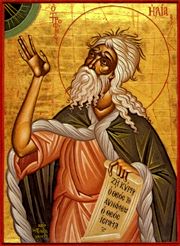 Troparion – Tone 4
An angel in the flesh and the cornerstone of the prophets,
the second forerunner of the coming of Christ,
Glorious Elijah sent grace from on high to Elisha,
to dispel diseases and to cleanse lepers.
Therefore, he pours forth healings on those who honor him.
Kontakion – Tone 2
Prophet Elijah of great renown,
seer of the mighty mighty works of God,
by your command you held back the rain!
Pray for us to the only Lover of mankind!
Holy, Glorious Prophet Elijah
( Commemorated on July 20 )
The Holy Prophet Elijah is one of the greatest of the prophets and the first dedicated to virginity in the Old Testament. He was born in Tishba of Gilead into the Levite tribe 900 years before the Incarnation of the Word of God.
St Epiphanius of Cyprus gives the following account about the birth of the Prophet Elijah: “When Elijah was born, his father Sobach saw in a vision angels of God around him. They swaddled him with fire and fed him with flames.” The name Elijah (the Lord’s strength) given to the infant defined his whole life. From the years of his youth he dedicated himself to the One God, settled in the wilderness and spent his whole life in strict fasting, meditation and prayer. Called to prophetic service, which put him in conflict with the Israelite king Ahab, the prophet became a fiery zealot of true faith and piety.
During this time the Israelite nation had fallen away from the faith of their Fathers, they abandoned the One God and worshipped pagan idols, the worship of which was introduced by the impious king Jereboam. Jezebel, the wife of king Ahab, was devoted to idol worship. She persuaded her husband to build a temple to the pagan god Baal, which led many Israelites away from the worship of the true God. Beholding the ruin of his nation, the Prophet Elijah began to denounce King Ahab for impiety, and exhorted him to repent and turn to the God of Israel. The king would not listen to him. The Prophet Elijah then declared to him, that as punishment there would be neither rain nor dew upon the ground, and the drought would cease only by his prayer. Indeed, the word of Elijah was a torch (Eccles. 48: 1) The heavens were closed for three and a half years, and there was drought and famine throughout all the land.
During this time of tribulation, the Lord sent him to a cave beyond the Jordan. There he was miraculously fed by ravens. When the stream Horath dried up, the Lord sent the Prophet Elijah to Sarephta to a poor widow, a Sidonian Gentile who suffered together with her children, awaiting death by starvation. At the request of the prophet, she prepared him a bread with the last measure of flour and the remainder of the oil. Through the prayer of the Prophet Elijah, flour and oil were not depleted in the home of the widow for the duration of the famine. By the power of his prayer the prophet also performed another miracle: he raised the dead son of the widow.
After the end of three years of drought the Merciful Lord sent the prophet to appear before King Ahab, and promised to send rain upon the earth. The Prophet Elijah told the king to order all of Israel to gather upon Mount Carmel, and also the priests of Baal. When the nation had gathered, the Prophet Elijah proposed that two sacrificial altars be built: one for the priests of Baal, and the other for the Prophet Elijah who served the True God.
The Prophet Elijah told them to call on their gods to consume the sacrificial animals with fire, and he would call on his. Whichever was first to send fire on the sacrifice would be acknowledged as the true God. The prophets of Baal called out to their idol from morning till evening, but the heavens were silent. Towards evening the holy Prophet Elijah built his sacrificial altar from twelve stones, the number of the tribes of Israel. He placed the sacrifice upon the wood, gave orders to dig a ditch around the altar and commanded that the sacrifice and the wood be soaked with water. When the ditch had filled with water, the prophet turned to God in prayer. Through the prayer of the prophet fire came down from heaven and consumed the sacrifice, the wood, and even the water. The people fell down to the ground, crying out: “Truly, the Lord is God!” Then the Prophet Elijah had all the pagan-priests of Baal put to death, and he began to pray for rain. Through his prayer the heavens opened and an abundant rain fell, soaking the parched earth.
King Ahab acknowledged his error and repented of his sins, but his wife Jezebel threatened to kill the prophet of God. The Prophet Elijah fled into the Kingdom of Judea and, grieving over his failure to eradicate idol worship, he asked God to let him die. An angel of the Lord came before him, strengthened him with food and commanded him to go upon a long journey. The Prophet Elijah traveled for forty days and nights and, having arrived at Mount Horeb, he settled in a cave.
The Lord told him that the next day Elijah would stand in His presence.There was a strong wind that crushed the rocks of the mountain, then an earthquake, and a fire, but the Lord was not in them. The Lord was in “a gentle breeze” (3 Kings 19: 12). He revealed to the prophet, that He would preserve seven thousand faithful servants who had not worshipped Baal. Later, the Lord commanded Elijah to anoint Elisha into prophetic service. Because of his fiery zeal for the Glory of God the Prophet Elijah was taken up alive into Heaven in a fiery chariot. The Prophet Elisha received Elijah’s mantle, and a double portion of his prophetic spirit.
According to the Tradition of Holy Church, the Prophet Elijah will be the Forerunner of the Dread Second Coming of Christ. He will proclaim the truth of Christ, urge all to repentance, and will be slain by the Antichrist. This will be a sign of the end of the world. The life of the holy Prophet Elijah is recorded in the Old Testament books (3 Kings; 4 Kings; Sirach/Ecclesiastes 48: 1-15; 1 Maccabees 2: 58). At the time of the Transfiguration, the Prophet Elijah conversed with the Savior upon Mount Tabor (Mt. 17: 3; Mark 9: 4; Luke. 9: 30). Orthodox Christians of all times, and in all places, have venerated the Prophet Elijah for centuries. The first church in Russia, built at Kiev under Prince Igor, was named for the Prophet Elijah. After her Baptism St Olga (July 14) built a temple of the holy Prophet Elijah in his native region, at the village of Vibuta.
In iconography the Prophet Elijah is depicted ascending to Heaven in a fiery chariot, surrounded with flames, and harnessed to four winged horses. We pray to him for deliverance from drought, and to ask for seasonable weather.
Retrieved fronm OCA website at: http://ocafs.oca.org/FeastSaintsViewer.asp?FSID=102060
St. Seraphim of Sarov Life and Teachings at: http://www.orthodoxphotos.com/readings/SOS/
Troparion of St. Seraphim, Tone 4
Thou didst love Christ from thy youth, O blessed one,/ and longing to work for Him alone thou didst struggle in the wilderness with constant prayer and labor./ With penitent heart and great love for Christ thou wast favored by the Mother of God./ Wherefore we cry to thee:/ Save us by thy prayers, O Seraphim our righteous Father.
Kontakion of St. Seraphim, Tone 2
Having left the beauty of the world and what is corrupt in it, O saint,/ thou didst settle in Sarov Monastery./ And having lived there an angelic life,/ thou wast for many the way to salvation./ Wherefore Christ has glorified thee, O Father Seraphim,/ and has enriched thee with the gift of healing and miracles./ And so we cry to thee:/ Rejoice, O Seraphim, our righteous Father.
From the Teachings of St. Seraphim of Sarov
About God
God is fire, warming and igniting the heart and inward parts. So, if we feel coldness in our hearts, which is from the devil (for the devil is cold), then let us call the Lord: He, in coming, will warm our heart with perfect love, not only towards Himself, but to our neighbors as well. And the coldness of the despiser of good will run from the face of His warmth.
Where there is God, there is no evil. Everything coming from God is peaceful, healthy and leads a person to the judgment of his own imperfections and humility.
God shows us His love for man not only in those instances when we do good, but also when we affront Him with our sins and anger Him. With what longsuffering he bears our lawlessness! “Do not call God a rightful Judge,” says St. Isaac, “for His rightful judgment is not seen in your deeds. True, David called Him a righteous judge and rightly, but the Son of God has shown us that God is good and merciful even more. Where is His righteous judgment? We were sinners, but Christ died for us” (St. Isaac the Syrian, Word 90).
The Reasons for Christ’s Coming
Christ came because of: (1) God’s love towards the human race: “For so God loved the world, that He gave His only begotten Son” (John 3:16); (2) the restoration of the image and likeness of God in fallen man; (3) the salvation of human souls: “For God sent not his Son into the world to condemn the world; but that the world through him might be saved” (John 3:17).
And so, we, following the goals of our Redeemer, the Lord Jesus Christ, must lead our lives according to His Godly teaching, in order to save our souls by it.
Faith
Faith, according to the teachings of St. Antioch, is the beginning of our union with God: the true believers are the stone of the church of God, prepared for the edifice of God the Father, which is raised up to the heights by the power of Jesus Christ, that is, by the Cross and help of the grace of the Holy Spirit. “Faith without works is dead” (James 2:26). The works of faith are love, peace, longsuffering, mercy, humility, bearing one’s cross and life by the spirit. True faith cannot remain without works. One who truly believes will also surely perform good works.
Hope
All those having firm hope in God are raised to Him and enlightened with the radiance of eternal light.
If a person does not have superfluous care for himself, out of his love for God and for virtuous deeds, and knows that God will take care of him, then this hope is true and wise. But if a person places all his hope in his works, and turns to God in prayer only when unforeseen misfortunes befall him, then he, seeing that he lacks the means of averting them in his own abilities, begins to hope for help from God — but such a hope is trivial and false. True hope seeks the one Kingdom of God and is sure that everything necessary for this mortal life will surely be given. The heart cannot have peace until it acquires this hope. This hope pacifies it fully and brings joy to it. The most holy lips of the Saviour spoke about this very hope: “Come unto Me, all ye that labour and are heavy laden, and I will give you rest” (Mt. 11:28).
Love for God
He who has acquired perfect love for God goes through this life as if he did not exist. For he considers himself a stranger to all that is visible, and awaits with patience that which is unseen. He is completely transformed into love for God and has abandoned all worldly attachments.
He who truly loves God considers himself a wanderer and newcomer on earth, for in him is a striving towards God in soul and mind, which contemplates Him alone.
As for care of the soul, a person in his body is like a lighted candle. The candle must burn out, and a person must die. But as our soul is immortal, so our cares should be directed more toward the soul than the body: “For what is a man profited, if he shall gain the whole world, and lose his own soul? or what shall a man give in exchange for his soul? (Mt. 16:26)” for which, as is known, nothing in the world can serve as ransom? If the soul alone is worth more than all the world and the worldly kingdom, then the Kingdom of Heaven is incomparably more precious. We consider the soul as most precious for the reason stated by Macarius the Great, that God did not desire to bond and unite His spiritual essence with any visible creation except man, whom He loves more than any of His creations.
Love for Neighbors
One must behave affectionately toward one’s neighbors, not showing even a hint of offense. When we turn away from a person or offend him, it is as if a rock settles on our heart. One must try to cheer the spirit of an embarrassed or dejected person with words of love.
When you see a brother sinning, cover him, as counseled by St. Isaac the Syrian: “Stretch out your vestment over the sinner and cover him.”
In our relations with our neighbors we must be equally pure towards everyone in word as well as in thought; otherwise we will make our life useless. We must love others no less than ourselves, in accordance with the law of the Lord: “Thou shalt love … thy neighbour as thyself” (Lk. 10:27). But not so much that our love for others, by extending past the boundaries of moderation, diverts us from fulfilling the first and main law of love towards God, as our Lord Jesus Christ himself taught: “He that loveth father or mother more than me is not worthy of me: and he that loveth son or daughter more than me is not worthy of me” (Mt. 10:37).
Mercy
It is necessary to be merciful to those wretched and wandering. The great lightgivers and Fathers of the Church took great care concerning this. In relation to this virtue we must try by all means to fulfill the following law of God: “Be ye therefore merciful, as your Father also is merciful,” and, “I will have mercy, and not sacrifice” (Lk. 6:36; Mt. 9:13). The wise heed these saving words, but the foolish do not heed them. For this reason the reward is also different, as is said: “He which soweth sparingly shall reap also sparingly; and he which soweth bountifully shall reap also bountifully” (2 Cor. 9:6).
The example of Peter the Breadgiver, who, for a piece of bread given to a beggar, received forgiveness for all his sins (as was revealed to him in a vision) may prompt us to be merciful to our neighbors — for even a small alms may contribute to the obtaining of the Heavenly Kingdom.
Giving alms must be done with a spiritually kind disposition, in agreement with the teachings of St. Isaac the Syrian: “If you give anything to him who asks, may the joy of your face precede your alms, and comfort his sorrow with kind words.”
Non-Judgment and the Forgiveness of Offenses
It is not right to judge anyone, even if you have seen someone sinning and wallowing in the violations of God’s laws with your own eyes, as is said in the word of God: “Judge not, that ye be not judged” (Mt. 7:1). “Who art thou that judgest another man’s servant? to his own master he standeth or falleth. Yea, he shall be holden up: for God is able to make him stand” (Rom. 14:4). It is much better always to bring to memory the words of the apostle: “Wherefore let him that thinketh he standeth take heed lest he fall” (1 Cor. 10:12).
One must not harbor anger or hatred towards a person that is hostile toward us. On the contrary, one must love him and do as much good as possible towards him, following the teaching of our Lord Jesus Christ: “Love your enemies, do good to them that hate you” (Mt. 5:44). If then we will try to fulfill all this to the extent of our power, we can hope that God’s light will begin to shine in our hearts, lighting our path to the heavenly Jerusalem.
Why do we judge our neighbors? Because we are not trying to get to know ourselves. Someone busy trying to understand himself has no time to notice the shortcomings of others. Judge yourself — and you will stop judging others. Judge a poor deed, but do not judge the doer. It is necessary to consider yourself the most sinful of all, and to forgive your neighbor every poor deed. One must hate only the devil, who tempted him. It can happen that someone might appear to be doing something bad to us, but in reality, because of the doer’s good intentions, it is a good deed. Besides, the door of penitence is always open, and it is not known who will enter it sooner — you, “the judge,” or the one judged by you.
Penitence
One desiring salvation must always have a heart inclined towards penitence and contrition: “The sacrifices of God are a broken spirit; a broken and a contrite heart, O God, thou wilt not despise” (Ps. 51:19). With such a contrite spirit a person can avoid without trouble all the artful tricks of the devil, whose efforts are all directed towards disturbing the spirit of a person. By this disturbance he sows tares (i.e., weeds), according to the words of the Gospel: “Sir, didst not thou sow good seed in thy field? from whence then hath it tares? He said unto them, ‘An enemy hath done this’” (Mt. 13:27-28). But when a person struggles to have a meek heart and to keep peace in his thoughts, then are all the wiles of the enemy powerless; for, where there is peace of thought, God Himself resides: “In Salem also is his tabernacle, and his dwelling place in Zion” (Ps. 76:2).
We offend the greatness of God with our sinning throughout our entire lives, and so must always humbly ask the Lord forgiveness for our sins.
Fast
The leader of feats and our Saviour, the Lord Jesus Christ, before setting out on the feat of redeeming the human race, fortified Himself with a lengthy fast. And all ascetics, proceeding to work for the Lord, armed themselves by fasting and did not set out on the path of the Cross without the feat of fasting. They measured the very success of their ascetism by their success in fasting.
Despite their fasting, and to the surprise of others, the holy fathers did not know weakness but always remained hearty, strong and ready for the task at hand. Illnesses were rare among them and their lives were extraordinarily prolonged.
During the time that the body of one fasting becomes thin and light, the spiritual life attains to perfection and reveals itself through miraculous manifestations. The spirit then performs its actions as if in a bodiless body. External feelings are as shut out, and the mind, renouncing the worldly, ascends to the heavenly and becomes completely immersed in the contemplation of the spiritual world. Yet not everyone can take upon himself strict rules of abstinence from everything, nor deprive himself completely of all that serves to relieve infirmities: “He that is able to receive it, let him receive it” (Mt. 19:12).
One should take enough food everyday to strengthen the body, so that it can be a friend and helper to the soul in accomplishing virtues: otherwise it can happen that through the exhaustion of the body the spirit can weaken. On Wednesdays and Fridays, particularly during the four Lenten periods, follow the example of the Fathers and take food once a day — and the Angel of the Lord will affix himself to you.
Patience and Humility
It is necessary always to be patient and to accept everything that happens, no matter what, with gratitude for God’s sake. Our life — is a minute compared to eternity. And for this reason “the sufferings of this present time are not worthy to be compared with the glory which shall be revealed in us” (Rom. 8:18).
Bear the insults of your enemy in silence, and open your heart only to the Lord. Try in any way possible to forgive those who humiliate you or take away your honor, by the words of the Gospel: “Of him that taketh away thy goods ask them not again” (Lk. 6:30).
When people curse us, we must consider ourselves unworthy of praise, imagining that if we were worthy, everyone would be bowing down to us. We must always, and before everyone, humble ourselves, according to the teachings of St. Isaac the Syrian: “Humble yourself and you will see the glory of God within yourself.”
Illnesses
The body is the handmaid of the soul, and the soul — its queen. Therefore it often happens that by the mercy of God our body is debilitated by illnesses. Passions weaken because of illnesses, and the person becomes well. Sometimes bodily illness itself is born of passions. To bear illness with patience and gratitude is regarded as a feat, and even more than one.
One elder, suffering from dropsy, told this to the brethren who came to him, desiring to heal him: “Fathers, pray, that my inner person is not subjected to a similar illness. But concerning the present illness, I ask God that he not suddenly relieve me of it, “for though our outward man perish, yet the inward man is renewed day by day” (2 Cor. 4:16).
The Spiritual World
The spiritual world is gained by sorrows. The scriptures say: “We went through fire and through water: but thou broughtest us out into a wealthy place” (Ps. 66:12). For those who desire to serve God the path lies through many sorrows. How can we praise the holy martyrs for the sufferings which they bore for God, when we cannot even bear a fever?
Nothing so aids the acquiring of internal peace as silence, and as much as is possible, continual discussion with oneself and rarely with others.
A sign of spiritual life is the immersion of a person within himself and the hidden workings within his heart.
This peace, as some priceless treasure, did our Lord Jesus Christ leave his followers before His death, saying, “Peace I leave with you, My peace I give unto you: not as the world giveth, give I unto you” (John 14:27). The apostle also spoke this about it: “And the peace of God, which passeth all understanding, shall keep your hearts and minds through Christ Jesus” (Phil. 4:7); “Follow peace with all men, and holiness, without which no man shall see the Lord” (Heb. 12:14).
In this way, we must direct all our thoughts, desires and actions toward obtaining God’s peace, and always cry out with the Church: “Lord, thou wilt ordain peace for us” (Is. 26:12).
It is necessary by all means to try to keep one’s spiritual peace, and not to become provoked by insults from others. To do this, it is necessary always to restrain oneself from anger, and by careful watch to guard the mind and heart from unclean waverings.
Insults from others must be borne without disturbance; one must train oneself to be of such a nature, that one can react to insults as if they did not refer to oneself. Such an exercise can bring serenity to our heart and make it a dwelling of God Himself.
We see an example of such a lack of malice in the life of St. Gregory the Miracle-Worker. A certain immoral woman demanded payment from him, purportedly for a sin committed with her. He, not in the least angry with her, humbly said to one of his friends: pay her the price which she demands, quickly. The woman became possessed as soon as she accepted the unrighteous payment. The bishop then prayed and exorcised the evil spirit from her.
If it is impossible not to become indignant, then at least restrain your tongue according to the words of the Psalmist: “I am so troubled that I cannot speak” (Ps. 77:4).
In this instance we can take as examples for ourselves St. Spyridon of Tremifunt and St. Ephraim the Syrian. The first bore an insult when he entered the palace by the demand of the Greek emperor: one of the servants present in the emperor’s chamber, taking him for a beggar, laughed at him, did not allow him to enter the chamber and even struck him on the cheek. St. Spyridon, being without malice, turned the other cheek to him, according the word of the Lord (see Mt. 5:39). The Blessed Ephraim, living in the desert, was once deprived of food in the following fashion. His pupil, carrying the food, accidentally broke the vessel on the way. Blessed Ephraim, seeing the pupil downcast, said to him: “Do not grieve, brother. If the food did not want to come to us, then we will go to it.” And so the monk went, sat next to the broken vessel, and, gathering the food together, ate it. He was thus without malice!
In order to keep spiritual peace, it is necessary to chase dejection away from oneself, and to try to have a joyful spirit, according to the words of the most wise Sirach: “Sorrow has killed many, but there is no good in it” (Sir. 30:25).
In order to keep spiritual peace it is also necessary to avoid judging others in any way. Condescension towards your neighbor and silence protect spiritual peace. When a person is in such an state, then he receives Godly revelations.
In order not to lapse into judgment of others, it is necessary to be mindful of oneself, to refuse to receive any bad information from anyone and to be as if dead to others.
For the protection of spiritual peace it is necessary to enter into oneself more often and ask: Where am I? In addition, it is necessary to watch that the physical senses, especially sight, serve the inner person, not diverting the soul with mortal items, because the gifts of grace are received only by those who have inner workings and keep watch over their souls.
Feats
Blessed Seraphim told those followers who strove to take excessive feats upon themselves that not complaining and humbly bearing insults are our “verigi” and our hair shirt. (The word verigi in Russian means iron chains and various weights. A hair shirt is clothing made of thick, very coarse wool; some ascetics wore these things to burden their body.)
It is not necessary to undertake feats beyond one’s strength. Instead, one must try to keep our friend — our body — right and capable of performing virtues. One must follow the middle route, turning neither to the right hand nor the left (Prov. 4:27), giving the spirit the spiritual, and the body the physical things necessary for maintaining temporal life. One should also not refuse that which society legally demands, according to the words of the Gospel: “Render therefore unto Caesar the things which are Caesar’s; and unto God the things that are God’s” (Mt. 22:21).
One should condescend to one’s soul in its infirmities and imperfections, endure one’s deficiencies as we bear the failings of others, not become lazy, and continually urge oneself to be better.
If you have eaten too much food or done anything else related to human weakness, do not be upset. Do not add injury to injury, but, urging yourself to correction, courageously try to keep spiritual peace according to the words of the Apostle: “Happy is he that condemneth not himself in that thing which he alloweth” (Rom. 14:22). This same meaning is contained in the words of the Saviour: “Except ye be converted, and become as little children, ye shall not enter into the kingdom of heaven” (Mt. 18:3).
Any success in any area we must assign to the Lord and say with the prophet: “Not unto us, O Lord, not unto us, but unto thy name give glory” (Ps. 115:1).
Purity of Heart
We must continually protect our heart from unclean thoughts and impressions, according to the words of the author of the book of Proverbs: “Keep thy heart with all diligence; for out of it are the issues of life” (Prov. 4:23).
Purity is born within the heart from extended safekeeping of it, to which the vision of the Lord has access, according to the assurance of eternal Truth: “Blessed are the pure in heart, for they shall see God” (Mt. 5:8).
We should not reveal unnecessarily what is best in the heart, for only then does that which has been accumulated remain in safety from enemies visible and invisible, when it is kept as a treasure in the innermost heart. Do not open the secrets of your heart to everyone.
Identifying Movements of the Heart
When a person accepts anything Godly, then he rejoices in his heart, but when he has accepted anything devilish, then he becomes tormented.
Having accepted anything Godly, the heart of a Christian does not demand outside persuasion that it is from the Lord, but becomes convinced through the act itself that this acceptance is something heavenly, because he feels the spiritual fruits in himself: “love, joy, peace, longsuffering, gentleness, goodness, faith, meekness, temperance” (Gal. 5:22-23). But if the devil were to transform himself even into an angel of light (see 2 Cor. 11:14), or presented thoughts of the most worthy appearance, the heart still would feel some sort of doubts, trouble in its thoughts and disturbance of feelings.
The devil is like a lion, hiding in ambush (Ps. 9:29). He secretly sets out nets of unclean and unholy thoughts. So, it is necessary to break them off as soon as we notice them, by means of pious reflection and prayer.
During the singing of psalms, feats and great vigilance are demanded for our mind to be in conformity with our heart and lips; for otherwise stench is added to the incense in our prayers. For the Lord disdains a heart with unclean thoughts.
Let us continually, day and night, fall before the face of the goodness of God with tears, that He purify our hearts of any evil thought, so that we might worthily bring Him the gifts of our service. When we do not accept the evil thoughts put in us by the devil, we perform a good deed.
The unclean spirit has a strong influence only on the passionate; but those purified of passions he touches only indirectly and externally. A person in his youth cannot avoid being disturbed by physical thoughts. But he must pray to the Lord God, that the spark of depraved passions dies out at the very beginning. Then the flame within him will not become more intense.
Excessive Care about Worldly Matters
Excessive care about worldly matters is characteristic of an unbelieving and fainthearted person, and woe to us, if, in taking care of ourselves, we do not use as our foundation our faith in God, who cares for us! If we do not attribute visible blessings to Him, which we use in this life, then how can we expect those blessings from Him which are promised in the future? We will not be of such little faith. By the words of our Saviour, it is better first to seek the Kingdom of God, for the rest shall be added unto us (see Mt. 6:33).
Sorrow
When the evil spirit of sorrow seizes the soul, then, by filling it with bitterness and unpleasantness, it does not allow it to pray with necessary diligence; it disrupts the attention necessary for reading spiritual writings, deprives it of humility and good nature in the treatment of others and breeds aversion to any discussion. For the sorrowful soul, by becoming as if insane and frenzied, can neither accept kind advice calmly, nor answer posed questions meekly. It runs from people as if from the perpetrators of its embarrassment, not understanding that the reason for its illness — is within it. Sorrow is the worm of the heart, gnawing at the mother that bore it.
He who has conquered passions has also defeated sorrow. But one overcome by passions will not avoid the shackles of sorrow. As an ill person can be identified by the color of his face, so is one overcome by passions distinguished by sorrow.
It is impossible for one who loves the world not to feel sorrow. But he who despises the world is always cheerful. As fire purifies gold, so sorrow in God — penitence — purifies the sinful heart.
The Active and the Contemplative Life
A person consists of a soul and body, and therefore his life’s path should consist of both physical and spiritual activities — of deeds and contemplation.
The path of an active life consists of fasting, abstinence, vigilance, kneeling, prayer and other physical feats, composing the strait and sorrowful path which, by the word of God, leads to eternal life (Mt. 7:14).
The contemplative life consists in the mind aspiring to the Lord God, in awareness of the heart, focused prayer and in the contemplation of spiritual matters through such exercises.
Anyone desiring to lead a spiritual way of life must begin with the active life, and only later set about the contemplative, for without an active life it is impossible to lead a contemplative one.
An active life serves to purify us of sinful passions and raises us to the level of functioning perfection; at the same time it clears the way to a contemplative life. For only those cleansed of passions and the perfect can set out on that other life, as can be seen from the words of the Holy Scriptures: “Blessed are the pure in heart, for they shall see God” (Mt. 5:8), and from the words of Gregory the Theologian: “Only those who are perfect by their experience can without danger proceed to contemplation.”
If it is impossible to find a mentor who is able to direct us on the path to a contemplative life, then in that instance we must be guided by the Holy Scriptures, for the Lord Himself commands us to learn from it, saying: “Search the Scriptures; for in them ye think ye have eternal life” (John 5:39). One should not abandon the active life even when a person has so excelled in it that he has reached the contemplative, for the active life assists the contemplative and uplifts it.
The Light of Christ
In order to accept and perceive the light of Christ in one’s heart, it is necessary to divert oneself from the external as much as possible. First, by cleansing the soul with penitence and good deeds with true faith in the Crucified; then, by closing the physical eyes, it is necessary to immerse the mind in the heart and appeal to the name of our Lord Jesus Christ continually. Then, by measure of our zealousness and fervor of spirit for the Beloved (Lk. 3:22), a person with the calling of this name finds delight, which arouses a thirst toward greater enlightenment.
When a person internally contemplates the eternal light, his mind becomes clean and free of any sensory notions. Then, by being completely immersed in the contemplation of uncreated beauty, he forgets everything sensory, does not want to see even himself, but desires to hide in the heart of the earth, if only not to be deprived of this true good — God.
Acquiring the Holy Spirit
(from the Saint’s Conversation with Motovilov)
The true goal of our Christian life consists of acquiring God’s Holy Spirit. Fasting and vigil, prayer, mercy, and every other good deed performed for Christ — are means for acquiring the Holy Spirit of God. Only deeds performed for Christ give us the fruits of the Holy Spirit.
Some say that the foolish virgins lacking enough oil in their lamps is meant to be understood as a lack of good deeds (see Mt. 25:1-12). Such an understanding is not completely correct. How could there have been a lack of good deeds when they, though foolish, are still called virgins? For virginity is the highest virtue, as a state equal to the angels, and could by itself serve in place of all other virtues. I, the wretched, think that they did not have enough of the grace of the All-Holy Spirit of God. These virgins, because of their spiritual injudiciousness, supposed in performing good deeds that it is only necessary to do good works to be a Christian: “We performed a good deed and thus did God’s will.” Whether or not they had received the grace of the Holy Spirit, whether they had attained it, they did not even bother to find out … But, this acquiring of the Holy Spirit is in fact that oil which the foolish virgins lacked. They are called foolish because they forgot about the essential fruit of virtue — the grace of the Holy Spirit — without which there is no salvation for anyone and cannot be. For “through the Holy Spirit every soul is quickened, and through its purification, it is exalted and illumined by the Triune Unity in a Holy mystery.” The Holy Spirit Himself settles in our souls, and this occupation of our souls by Him, the All-Ruling, and this coexistence of our spirit with His One Trinity, is granted only through the diligent acquiring, on our part, of the Holy Spirit, which prepares, in our soul and body, the throne for the coexistence of God the All-Creator with our spirit, by the immutable word of God: “And I will walk among you and will be your God, and ye shall be my people” (Lev. 26:12).
This is the very oil in the lamps of the wise virgins, which burned brightly and steadily; the virgins with these burning lamps could await the Groom coming at midnight, and enter the chamber of joy with him. The foolish ones, seeing their lamps going out, though they went to the market to buy oil, did not manage to return in time, for the doors were already locked. The market is our life; the doors of the bridal chamber — locked and not permitting entrance to the Groom — human death, the virgins wise and foolish, Christian souls; the oil, not deeds, but the grace of the All Holy Spirit of God received through them, transforming from decay to incorruption, from emotional death into spiritual life, from darkness to light, from the manger of our existence, where our passions are tied like beasts and animals, into a church of God, into the all-lighted chamber of eternal joy in Jesus Christ.
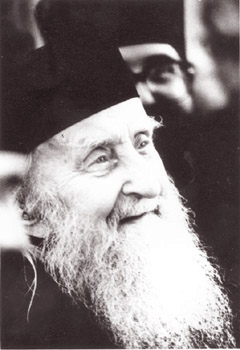
On July 11, 1993 Archimandrite Sophrony, the spiritual elder of the Monastery of St. John the Baptist at Tolleshunt Knights, England, fell asleep in the Lord. Father Sophrony was well known throughout the Orthodox world as the compiler of the writings of St. Silouan and the author of his life. And to those who were privileged to be acquainted with him personally, he was known for the spiritual love and joy which his presence called forth and radiated from him.
The monastery had been informed that the only way that it could bury people on its property was to build an underground crypt, which it proceeded to build, and to which Elder Sophrony said that he would not repose until the crypt was ready. Then, having been told of the expected completion date of July 12, Elder Sophrony stated that he “would be ready”. On the 11th, Elder Sophrony reposed; and on the 14th was his funeral and burial, attended by monastics from around the world. At the time of Fr Sophrony’s repose, there are 25 monastics in the monastery, a number that has remained steady since then. Mother Elizabeth, the eldest nun, reposed soon after, on the 24th. This was in accordance with Elder Sophrony’s words that he would repose first, and she would repose soon after.
On Prayer, a book containing Elder Sophrony’s writings on prayer, particularly the Jesus Prayer, was published posthumously.
The praying mind does not think – does not reason – but lives. Its activity consists, not in the manipulation of abstract concepts but in participation in being. The truly praying mind has to do with categories different in quality from those of rational reflection. It is concerned, not with intellectual categories but with actual being, which cannot be confined within the narrow framework of abstract concepts. (Elder Sophrony)
A MODERN-DAY SAINT AND HIS DISCIPLE: SAINT SILOUAN AND FATHER SOPHRONY
By Archpriest Michael G. Dahulich
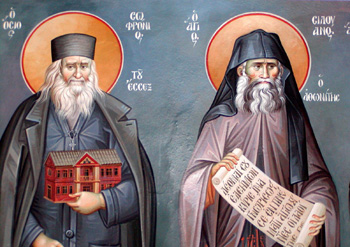
Orthodoxy in Great Britain today is particularly blessed by the presence of a growing monastic community, with both monks and nuns, at Tolleshunt Knights, Essex (under the Ecumenical Patriarchate), founded by Archimandrite Sophrony. Here a central place is given to the Jesus Prayer. Here the monastery is widely visited by pilgrims from all over the world, seeking theosis … to live in their lives the words of Saint Paul the Apostle: “It is no longer I who live but Christ Who lives in me, and the life that I live in the flesh I live in the faith of the Son of God Who loved me and gave Himself up for me” (Gal. 2:20-21).
(…) Archimandrite Sophrony also went to Mount Athos, in 1925, and there, at the Monastery of St. Panteleimon, became a disciple of Staretz Silouan. He listened to his spiritual father’s teachings and was guided by his holy life. Like him he taught, “In this world there is nothing more difficult than to be saved” because the first step in progress towards becoming “like God” is “to love one’s enemies.” Father Sophrony took the writings of his staretz, which were penciled in laborious, unformed characters on old scraps of paper, edited them and published them in many languages. He also wrote his biography.
The Goal Of Everyone
Anyone who draws the conclusion that the central teaching of Saint Silouan and, in fact, the whole Orthodox Church — theosis — deification and union with God — the transfiguration of the body and cosmic regeneration — is remote from the actual experience of ordinary Christians, has entirely misunderstood the Orthodox teaching.
Deification, “becoming like God” is not something reserved for a few select initiates, but something intended/or all alike. The Orthodox Church believes that it is the normal goal for every Christian without exception. Certainly we shall only be fully deified on the Last Day, but for each of us the process of divinization must begin here and now in the present life. It is true that in this present life very few indeed attain full mystical union with God. But every true Christian tries to love God and to fulfill His commandments; and so long as we sincerely seek to do that, then however weak our attempts may be and however often we may fall, we are already in some degree deified.
The fact that a person is being deified does not mean that he or she ceases to be conscious of sin. On the contrary, deification always presupposes a continued act of repentance. A saint may be well advanced in the way of holiness, yet he or she does not therefore cease to employ the words of the Jesus Prayer, “Lord Jesus Christ, Son of God, have mercy on me a sinner.” Saint Silouan used to say to himself, “Keep thy mind in hell and despair not.” Other Orthodox saints have repeated the words, “All will be saved, and I alone will be condemned.” Orthodox theology is a both a theology of glory and of transfiguration, but also a theology of penitence.
Nothing Extraordinary
There is nothing esoteric or extraordinary about the methods which we must follow in order to be deified. If someone asks, “How can I become like God?” the answer “is very simple.” In the words of Bishop Kallistos (Ware), “… go to Church, receive the Sacraments regularly, pray to God ‘in spirit and in truth,’ read the Gospels, follow the commandments. The last of these items — ‘follow the commandments’ — must never be forgotten.” Orthodoxy firmly rejects any kind of mysticism that seeks to dispense with moral rules.
Theosis is not a solitary but a “social” process. Deification means “following the commandments”, and these commandments were briefly described by Christ as love of God and love of neighbor. The two forms of love are inseparable. A person can love his neighbor as himself only if he loves God above all; and a person cannot love God if he does not love his fellow man. (I John 4:20). Thus there is nothing selfish about theosis; for only if he loves his neighbor can a person be deified. “From our neighbor is life, and from our neighbor is death,” said St. Anthony of Egypt. “If we win our neighbor we win God, but if we cause our neighbor to stumble we sin against Christ.” (…)
The Questions Remain
How can the average American relate to the lives of Staretz Silouan and Father Sophrony from atop Mount Athos or in the cloister of the Monastery?
How can we live the life of a spiritual saint in a world that is so dominated by materialism?
How can we strive towards theosis when we are faced by temptations from the world and its demons and dragged down by and down to the level of the world and its values, or rather, the lack thereof?
Things To Remember
In answering these questions, we must always remember:
1. Staretz Silouan and Father Sophrony were human beings like you and me, “working out their own salvation” (Philippians 2:12).
2. Their standards are our standards. There are not two sets of commandments or two sets of morality. We are all called to be holy. There is only a difference in degree.
3. Like me, Staretz Silouan had been a sinner. But as we all ought to, he considered himself “first” of all sinners and repented.
4. So too. Father Sophrony was a sinner — for a time, he doubted the truths of the faith; he lived outside of the Church and her Mysteries. He was a non-practicing, nonbeliever who considered himself “first” of all sinners.
5. Like we need to. Brother Simeon readily made a confession of his sins; he heard the saving words of forgiveness from his spiritual father: “You have confessed your sins before God. Know now that they have all been forgiven… Now we will make a fresh start … Go in peace, and rejoice that the Lord has led you to this haven of salvation.”
But,
Brother Simeon went to the Russian Monastery of St. Panteleimon and started on a new ascetic life. We cannot go to the Monastery; so what are we to do?
Bring The Monastery Home
It is true that we cannot all join the Monastery, leave our families, our jobs and our responsibilities in the world. But, we can take the Monastery, its goals and ideals, its purity of faith, and the very spiritual experience of it, into our homes … into our daily lives.
Every day — a day of prayer, several times each day — with the community, the whole family, praying together— not just for ourselves, but everyone, even our enemies.
Every Sunday and holyday — a day of liturgical worship — receiving Holy Communion together as a family — having received Holy Confession the night before.
Every day, but at least Sunday and each feastday — a day of reading from the Scripture — perhaps at table like in the Monastery, or in the living room — together, the whole family, hearing the Word of God, and then discussing it under guidance.
Every day, as individuals and as the community of the family — living the commandments, summed up in love of God and love of neighbor — in all that we do, we ask, “What would Jesus want me to do or say or think; how would He want me to be?”
And, finally, when we each of us “misses the mark” or “falls short of the glory of God” (Romans 3:23), we repent anew of our sins, asking the forgiveness of all our family members in the flesh and in the faith, and ourselves forgiving others, even our enemies. The humility of which St. Silouan speaks, can begin to be found by reading sincerely the Prayers before Holy Communion.
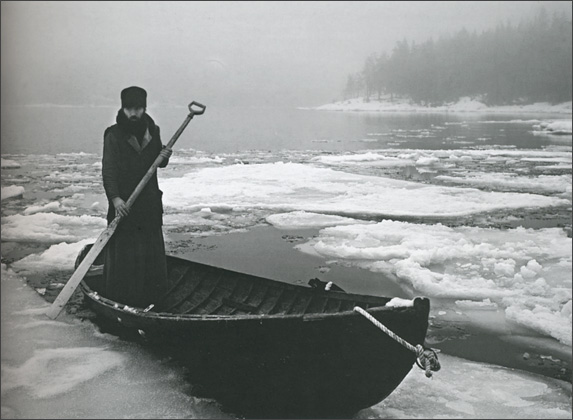
Every Room is a Church
Every room in our home is like the inside of the Monastery:
1. In the family room is our icon corner, where we pray together and read the Scripture together as a community in Christ.
2. In our living room, there is no music or television program, book or magazine, friend or neighbor or visitor and their behavior — that is not compatible with Christ and His teachings.
3. In our kitchen, the same rules for eating and drinking in moderation, and fasting according to the guidelines of the Church, are followed as they are in the monastery.
4. In every bedroom, we practice the virtue of chastity — in marriage as in the celibate life — as in the Monastery, although not in the same degree.
5. In the office, we practice the same honesty in finances, in dealing with people and possessions, as the monks do in the monastery.
6. In the closets and basements of our lives, we clean out the “rubbish” and the “dark secrets” regularly and thoroughly — as in the Monastery — through the mystery of holy confession.
7. In every room of our home, we live as the hymn of the Nativity beckons us: “God is with us!” And each day over the ways of the world we choose with Joshua: “Choose today whom you will serve. As for me and my household, we will serve the Lord” (Joshua 24:15).
Forgiving One’s Enemies
In previous lectures on the life of St. Silouan, we heard repeated that the true test of our salvation really lies in truly loving our brother and truly forgiving one’s enemies as Christ Himself did. Last week we heard a poignant expression of how difficult that is. In response I should like to share with you a story on the importance — no, the necessity — of forgiveness of one’s enemies. It comes to us from the Kievan Caves Patericon. It, is the story of the Holy and Righteous Titus the Presbyter, whose feastday is commemorated on February 27.
The Patericon chronicles the story in these words: “The person who is filled with anger can see only anger in God, but that world of God which exceeds the limits of the mind is revealed to those who have peace in their heart and soul. The Lord clearly demonstrated this through His servant, Blessed Titus (Tito) the presbyter. St. Titus, a monk in the Caves Monastery, was honored with the priestly rank, and he passed a life worthy of the joy of the saints.
“This blessed one had a spiritual brother, a hierodeacon by the name of Evagry. St. Titus bore a strong and unhypocritical love for the deacon. Their harmonious and sincere love was a source of inspiration for everyone.
“The enemy of mankind, because of his hatred of all good, worked long and hard to sow tares among this wheat, and he succeeded in raising up anger and bitterness between these two friends. He darkened them with such hatred that if the one approached while censing the church, the other would turn and walk away from the incense, or if he failed to walk away, the one censing walked past without censing him. They remained in this spiritual darkness for a long time and even dared to serve and to bear the Holy Gifts and take Communion in this state. The brethren constantly begged them to become reconciled, but they did not even want to hear of it.
“At length. Father Titus became critically ill. Realizing that he was near death, he began to weep over his sins and sent for Fr. Evagry, with the words, ‘Forgive me, brother, for the Lord’s sake, for having offended you with my anger.’
“Not only did the deacon refuse to forgive the presbyter, but he even began to curse him with cruel words. The brothers saw that Fr. Titus was approaching his last breath and they dragged Fr. Evagry by force to the dying monk’s cell to make amends with him. When the deacon was brought in, the ill priest immediately drew himself from his bed and fell at the feet of his former friend, tearfully beseeching: ‘Forgive me, Father, and bless!’
“Father Evagry, however, showed himself to be so unmerciful and inhuman that he tore himself away from the brethren and loudly declared to everyone present: ‘I will never reconcile with him, neither in this age nor in the future one.’
“Scarcely had he said these words when he fell to the floor. The brothers tried to raise him up, but they saw that he was lifeless and they could not bend his arms, nor even close his lips and eyes. Fr. Titus, on the other hand, rose to his feet completely well.”
Terror fell upon everyone at the sight of this sudden dreadful death accompanied by such a miraculous healing.
Christ’s True Disciple
We have another such example to follow in our spiritual life — an excerpt from “How to Be Christ’s True Disciple,” contained in Indication of the Way into the Kingdom of Heaven, written by Saint Innocent (Veniaminov), the Apostle to America (published by Holy Trinity Monastery in Jordanville, N.Y., 1994).
Saint Innocent tells us: “Jesus Christ loved everyone, and did every kind of good to all. So we too should love our neighbors and, as far as possible, do good to them either by deed, or word, or thought.
“Jesus Christ forgave His enemies all that they did to Him, and over and above that did them every kind of good and prayed for their salvation. So too we should forgive our enemies, repay with good the evil done us, and bless those who curse and abuse us, with full faith and hope in God, the most just and all-seeing Judge, without Whose will not even a hair of our head will be lost. By bearing wrongs without complaint, without revenge and with love, you will act as a true Christian.
“Jesus Christ, being meek and humble in heart, never sought out desired praise from others. So too we should never boast or pride ourselves on anything at all, or seek praise from others. For instance, if you do good to others, if you give alms, if you live more piously than others, or if you are more intelligent than your fellows, do not be proud of it either before men or to yourself, because all that you have that is good and praiseworthy is not yours but the gift of God — only sins and weaknesses are your own, and all the rest is God’s.
“To follow Jesus Christ means also to obey the word of Jesus Christ. Therefore we must listen to, believe and practice all that Jesus Christ has said in the Gospel and through His Apostles, and we must do all this without artifice or temporization but in simplicity of heart. He who listens and attends to the word of Jesus Christ may be called His disciple, but he who listens to and carries out His word and will with simplicity of heart and with perfect devotion is His true, beloved disciple.
“And so, that is what it means to deny oneself, to take up one’s cross and follow Christ. That is the true nature and straight way into the Kingdom of Heaven. And that is the way by which Jesus Christ Himself lived on earth, and by which we Christians must go. There never was and never will be any other way.”
The Ultimate Questions
Even though we may not be glorified and proclaimed Saints, officially by the Church, like Staretz Silouan was, the ultimate goal of every Orthodox Christian is deification — theosis — to become like God.
We know from the words of Father Sophrony, “In this world there is nothing more difficult than to be saved.”
Can we do it? YES, with God’s grace, we can. After all, we know of those who have… and we know the way they did it… It’s nothing new.
Will we do it? I pray that each of us, inspired by the lives of St. Silouan and Fr. Sophrony, will follow their examples…
Must we do it? YES, it is a matter of life and death… our life and our death… our eternal life and our eternal death.
Through the prayers of Saint Silouan and Father Sophrony, Lord Jesus Christ Son of God, have mercy on us and save us!
To Him be the glory, unto ages of ages. Amen!
(Source: Archpriest Michael G. Dahulich. A Modern-day Saint
And His Disciple: Saint Silouan and Father Sophrony //
Alive in Christ: The Magazine of the Diocese of Eastern Pennsylvania,
Orthodox Church in America. 1997. Vol. XIII. N 3. P. 55-61.)
Teachings of Saint Silouan on Love
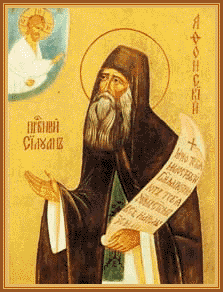
The soul cannot know peace unless she prays for her enemies. The soul that has learned of God’s grace to pray, feels love and compassion for every created thing, and in particular for mankind, for whom the Lord suffered on the Cross, and His soul was heavy for every one of us.
The Lord taught me to love my enemies. Without the grace of God we cannot love our enemies. Only the Holy Spirit teaches love, and then even devils arouse our pity because they have fallen from good, and lost humility in God.
I beseech you, put this to the test. When a man affronts you or brings dishonor on your head, or takes what is yours, or persecutes the Church, pray to the Lord, saying: “O Lord, we are all Thy creatures. Have pity on Thy servants and turn their hearts to repentance,” and you will be aware of grace in your soul. To begin with, constrain your heart to love enemies, and the Lord, seeing your good will, will help you in all things, and experience itself will show you the way. But the man who thinks with malice of his enemies has not God’s love within him, and does not know God.
If you will pray for your enemies, peace will come to you; but when you can love your enemies – know that a great measure of the grace of God dwells in you, though I do not say perfect grace as yet, but sufficient for salvation. Whereas if you revile your enemies, it means there is an evil spirit living in you and bringing evil thoughts into your heart, for, in the words of the Lord, out of the heart proceed evil thoughts – or good thoughts.
The good man thinks to himself in this wise: Every one who has strayed from the truth brings destruction on himself and is therefore to be pitied. But of course the man who has not learned the love of the Holy Spirit will not pray for his enemies. The man who has learned love from the Holy Spirit sorrows all his life over those who are not saved, and sheds abundant tears for the people, and the grace of God gives him strength to love his enemies.
Understand me. It is so simple. People who do not know God, or who go against Him, are to be pitied; the heart sorrows for them and the eye weeps. Both paradise and torment are clearly visible to us: We know this through the Holy Spirit. And did not the Lord Himself say, “The kingdom of God is within you”? Thus eternal life has its beginning here in this life; and it is here that we sow the seeds of eternal torment. Where there is pride there cannot be grace, and if we lose grace we also lose both love of God and assurance in prayer. The soul is then tormented by evil thoughts and does not understand that she must humble herself and love her enemies, for there is no other way to please God.
What shall I render unto Thee, O Lord,
for that Thou hast poured such great mercy on my soul?
Grant, I beg Thee, that I may see my iniquities,
and ever weep before Thee,
for Thou art filled with love for humble souls,
and dost give them the grace of the Holy Spirit.
O merciful God, forgive me.
Thou seest how my soul is drawn to Thee, her Creator.
Thou hast wounded my soul with Thy love,
and she thirsts for Thee, and wearies without end,
and day and night, insatiable, reaches toward Thee,
and has no wish to look upon this world, though I do love it,
but above all I love Thee, my Creator,
and my soul longs after Thee.
O my Creator, why have I, Thy little creature, grieved Thee so often?
Yet Thou hast not remembered my sins.
Glory be to the Lord God that He gave us His Only-begotten Son
for the sake of our salvation.
Glory be to the Only-begotten Son that He deigned
to be born of the Most Holy Virgin, and suffered for our salvation,
and gave us His Most Pure Body and Blood to eternal life,
and sent His Holy Spirit on the earth.
O Lord, grant me tears to shed for myself,
and for the whole universe,
that the nations may know Thee and live eternally with Thee.
O Lord, vouchsafe us the gift of Thy humble Holy Spirit,
that we may apprehend Thy glory.
No heresy has ever raised up so radically and so completely against the God-Man Christ and His Church as has the Papacy, with its dogma of the infallible Pope-man. There is no doubt about it: this dogma is the heresy of heresies. (Elder Iustin Popovich)
Video links: Papocentral Globalism1
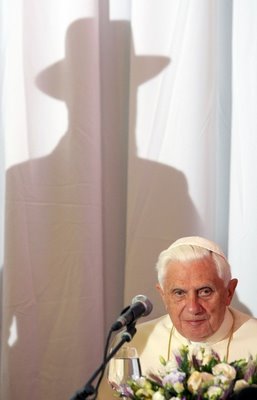
‘For it is a commandment of the Lord not to be silent at a time when the Faith is in jeopardy. Speak, Scripture says, and hold not thy peace…. For this reason, I, the wretched one, fearing the Tribunal, also speak.”
(St. Theodore the Studite, Patrologia Græca, Vol. XCIX, col. 1321)
The Heretical Pope calls for One World Government so called “global authority” on economy http://news.yahoo.com/s/nm/20090707/ts_nm/us_pope_encyclical;_ylt=AmAVd7GbgW6S4btgMieNYbus0NUE;_ylu=X3oDMTFoZGZvNWVhBHBvcwMxNgRzZWMDYWNjb3JkaW9uX3RvcF9zdG9yaWVzBHNsawNwYXBhbG1lc3NhZ2U- As s
As the worldwide apostasy is increasingly gaining momentum in the modern world and dragging along more and more souls with itself, we, as True Orthodox Christians, are called to “stand fast in Truth” and to remain unswayed by its onslaught. Remembering the words of St. Ignatius (Bryanchaninov), we are not trying to stop it with our weak hand, but rather intend to provide to those, who sincerely seek the Truth, some help on this sorrowful and narrow way, which leads to Heaven. In our last times, the Truth is very hard to come by. Almost everywhere, where it is not rejected outright, it is being diluted by servants of devil with lies and fallen human (often, even demonic) wisdom.Apostolic Church, depriving the faithful of the Holy Mysteries and corrupting their souls.
Ecumenism — is one of the mechanisms by which this mixing is achieved in practice. It is a relatively recent satanic invention, which already proved to be a huge success. Under the guise of “super-Christian love” it attempts to blur and, eventually, destroy the boundaries of the Holy, Catholic and
Blessed Elder Joseph of Vatopedi Monastery departed in the Lord!
Elder Joseph of Vatopaidi Speaks of God’s Love and the Essential Need for Repentance (Update)
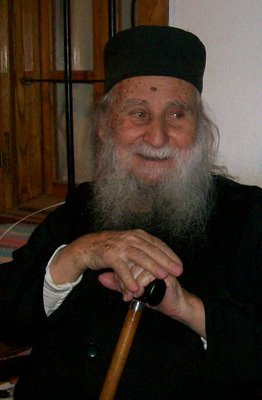
Prophecies Of Elder Joseph Of Vatopaidi
From an interview on October 26, 2001J.:
We are happy to receive you. You have our profound respect and best wishes.P.: Thank you, Father, for seeing us. The times in Russia, now, are both terrible, on the one hand, and complex, on the other.
J.: We pray that the Russian people might return to their natural state, that which existed prior to the destruction, because we have common roots and are taking to heart the situation in which the Russian people find themselves.
P.: There are many woes, of course. Drug addiction is rampant. There is the degeneration of our nation.
J.: Things are now in such a state of deterioration — a condition that is common throughout the entire world, at the present time. And it is subsequent to this specific condition, this precise limit, that the wrath of God will begin. We have reached this extreme. And it will now happen that what the Lord, in His mercy, formerly endured, He will now, acting in accordance with His righteousness, chastise, because the time has now come for that.There will be a war, and wars, and we will experience great difficulties. World power has now been seized by the Jews, and their goal is to annihilate Christianity. The wrath of God will be such that all those secret foes who are bringing about this state of affairs will be destroyed themselves. It is for this purpose, in particular, that the wrath of the Lord is being sent down: in order to destroy them, in one way or another. But this should not unduly frighten us, because we must always have hope in God. Because thousands, millions of martyrs, including our New Martyrs, suffered in exactly the same way, and we must be prepared for this and not be unduly frightened. There must be patience, prayer and hope in Divine providence, on out part. Let us pray for the renaissance of our Christianity after this war, after everything that awaits us, in order that the Lord might truly give us the strength to restore all this. But this evil will have to be endured.
P.: And how soon will Russia be reborn after that?
J.: Everything has now begun; now, there will be a great explosion. Following this, there will be rebirth.P.: Many icons, now, are streaming myrrh. We have an icon of the Saviour, which is exuding blood.
J.: And here, in Greece, too, many are streaming myrrh. The word is that the Saviour is weeping, and the Mother of God is weeping, and the icons weep.
P.: They bring an icon, and there is a clump of blood on it, like this: it’s a paper icon and so fragrant…, imagine. They took it in for analysis and it turned out that this was plasma.
J.: This is the beginning of these events, troublesome events, military ones… The movers and shakers of this evil are the Jews. They are being prompted to do this by the devil, in order to start this,… in order to destroy the seed of Orthodoxy in Greece and in Russia. This will be their chief obstacle to world domination. And they nevertheless will compel the Turks to come here, to Greece, in order to begin their work; and Greece, although she has a government, does not, in reality, have a government, as such. She lacks strength, and the Turks will come here. This will be the moment when Russia, too, will move her forces, in order to repel the Turks. Events will develop thus: when Russia goes to Greece’s aid, the Americans and NATO will attempt to prevent this, in order that there might be no union, no merger, between two Orthodox nations. They will also arouse other powers, such as the Japanese and others. There will be great slaughter upon the territory of the former Byzantine Empire. Of those who perish, there will be some 600 million, alone. The Vatican will also participate greatly in all this, in order to impede the growing role of Orthodoxy and prevent such unification. Thus will Divine providence find its fulfillment.
P.: Of course. All the prerequisites exist for this, for all these events. But there is also the fact that there is such opposition in the media. World hierarchs … {illegible} …. And how long will the president maintain this line? Is it a good one that he is holding to now?
J.: God will permit the destruction of all those who are sowing these temptations, pornography and drug addiction. And the Lord will so blind their minds that they will destroy one another without receiving any satisfaction therefrom. The Lord will permit this precisely in order to bring about a great purging. As concerns Putin, that time will not last long, and there will be an immediate war, and he will not be around for long. But, following this extensive cleansing, there will be a great renaissance of Orthodoxy, not only in Russia, but throughout the entire world; such a great surge of Orthodoxy. The Lord will extend His blessing, His Grace, just as had been the case in the first few centuries. Then, when people went to the Lord with an open heart… This will last for 3 – 4 decades, then the dictatorship of the antichrist will quickly set in. These are the terrible events that we must endure; let them not frighten us, because the Lord will shelter His own. Yes, we will surely experience difficulties, hunger, and even persecution and much else, but the Lord will not abandon His own. And those who are placed in positions of authority should compel their subjects to be with the Lord, the more; to abide in prayer, the more; and the Lord will shelter His own. The condition that will prevail following the cleansing will be one of a great renascence.
We, as pastors, must restrain as many people from sinning as we are able, in order that the Grace of God might not depart from us all. In order that we might be as close as possible to God, to repentance and to prayer… Then the Lord will always be with us, regardless of how difficult might be the circumstances. The Lord will not abandon us. We need to restrain ourselves and keep and hold our people.
Source: http://www.johnsanidopoulos.com/2009/07/prophecies-of-elder-joseph-of-vatopaidi.html
(Other Orthodox prophecies concerning the end of times and the end of the world…
http://geocities.com/kitezhgrad/prophets/index.html)
A Conversation With Elder Joseph of Vatopaidi On How One Should Recognize the Will of God
We observed that the Elder never embarked on anything without first praying. We would ask him about something in the future or for the next day, and his reply was that he would tell us tomorrow. He would do this so that he could pray first.
Our desire focused on knowledge of the divine will: how should one recognise the divine will? He would say, ‘Are you asking about this, boys, when it is the most basic thing?’ We would encourage him with increased curiosity, ‘But, Elder, isn’t God’s will known in general terms through the Scriptures and the whole of divine revelation? Since everything in our life is regulated, what other question should we monks have?’ And the Elder replied, ‘May God give you “understanding in everything” (2 Tim. 2:7). St Nilus the Calabrian prayed that he might be granted “to think and speak according to the divine will”. In general terms, to do good and every other commandment is the will of God, but the detail which governs it is unknown. “For who has known the mind of the Lord?” (Rom. 11:34); and again, “the judgements of the Lord are a great abyss” (Ps. 36:6). The divine will is not differentiated only by time, but also by place, persons and things, as also by quantity, manner and circumstance. And is that all? Man himself, when he changes his disposition, also changes the divine decision in many ways. So it is not enough to know the general expression of the divine will; one needs to know the specific verdict on the subject in question, whether yes or no, and only thus is success assured. The chief aim of the divine will is the expression and manifestation of divine love, because the driving force of all our actions is precisely the fullness of His love. If “whether we live or whether we die, we are the Lord’s” (Rom. 14:8), as St Paul says, then, however much the will we are seeking seems to be personal to us or to someone close to us, its centre of gravity is the Divine Person, for whose sake “we live and move and have our being” (cf. Acts 17:28). Have you forgotten the Lord’s prayer in the garden of Gethsemane, “if it be possible let it pass from me; nevertheless, not as I will, but as Thou wilt!” (Mt. 26:39)? Any expression of obedience towards the venerable divine will that does not have love for Him as its basis risks remaining a human action – or, to put it better, a human failing. If, as St Paul says, we have to “subordinate every thought to obedience to Christ” (2 Cor. 10:5) because “we are not our own” (1 Cor. 6:19), how is this to be implemented in the conscience of the person who gives his obedience if he does not know precisely what the divine will is for this circumstance? Besides, the ensuing divine blessing and grace, towards which we hasten, is revealed only in perfect obedience.
‘So when you want to find out the will of God, abandon your own will completely together with every other thought or plan, and with great humility ask for this knowledge in prayer. And whatever takes shape or carries weight in your heart, do it, and it will be according to God’s will. Those who have greater boldness and practice in praying for this will hear a clearer assurance within them, and will become more careful in their lives not to do anything without divine assurance.
‘There is also another way of discovering the will of God which the Church uses generally, and that is advice through spiritual fathers or confessors. The great blessing of obedience which beneficently overshadows those who esteem it becomes for them knowledge where they are ignorant and protection and strength to carry out the advice or commandment, because God is revealed to those who are obedient in His character as a father. The perfection of obedience, as the consummate virtue, puts its followers on a level with the Son of God, who became “obedient… unto the cross” (Phil. 2:8). And as our Jesus was given all power (Mt. 28:18) and all the good pleasure of the Father, so the obedient are given assurance of the divine will and the grace to carry it out successfully and to the full.
‘Those who ask spiritual people in order to discover the divine will should be aware of this point: the will of God is not revealed magically, nor does it hold a position of relatrelativity, since it is not contained within the narrow confines of human reason. In His consummate goodness God condescends to human weakness and gives man sure knowledge. But man must first believe absolutely, and secondly humble himself by thirsting ardently for this assurance and by being disposed to carry it out. This is why he receives with faith and gratitude the first word of the spiritual father who is advising him. When, however, these requirements of faith, obedience and humility do not co-exist – and it is a sign of this when someone objects or counters with other questions, or worst of all has a mind to keep asking for second opinions – then the will of God is hidden, like the sun behind a passing cloud. This is a subtle matter, and requires great care. Abba Mark says, “A man gives advice to his neighbour according to what he knows; but God works in the hearer according to his faith.” An essential requirement in seeking the divine will is that the person who is asking should make himself receptive to this Revelation, because, as I have said before, the divine will with its transcendent character is not magically contained within positions or places or instruments, but is revealed only to those who are worthy of this divine condescension.’
Source: http://www.johnsanidopoulos.com/2009/07/conversation-with-elder-joseph-of.html
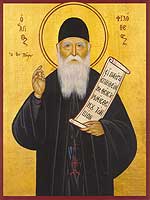 Rise up Chrysostomes, Gregories, Germanuses, Tarasiuses, Nikifori, Fotii and the rest, the old and recent Holy Patriarchs of Constantinople, who sacrificed yourselves for your flocks, to see who is on your throne. You, like the good shepherds have sacrificed your souls for your own sheep, while the present ones sacrifice their sheep for themselves and they open the door and invite the wolves to come in and destroy the flock.
When has a Patriarch fallen in such a slide, that he voluntarily struggles to deliver his flock to the wolves to be torn apart? The cause is pride, the root and cause of all sins, all the evil, all heresies, calamities and sorrows and even greater than the calamities and unhappiness, the deprivation of God’s grace.
The wolf shepherds, false teachers, false prophets and false christs, were expelled from Christ’s flock and as unrepentant , they were placed under everlasting anathemas by the Holy Fathers, the imitators of the Chief Shepherd Christ and His followers, the good, true and divine shepherds, the preservers of the decent and holy seven Ecumenical Synods.
The Orthodox Church is not used to innovations like the Westerners and the Protestants, who after their separation and without ceasing have taken up to perform innovations or reforms, to such a disrespectful and insane degree to innovate all the mysteries and holy tradition and deleting many….
There are two reasons that make the present day Arch-hierarchs to innovate and reform the Church, first pride, which makes most of the hierarchs, save some, to believe they are wiser that the Holy Fathers, and secondly gluttony and love of self. By most of them becoming, lovers of the flesh, they were abandoned by the grace of the Holy Spirit.
If the Patriarch, does not accept but rejects the suggestions of the Government of the Holy Synod, Arch-hierarchs, priests and lay followers, and insists on the union (of the Churches), then he should be renounced. For in case they do not oppose but retreat and say that they will follow the Patriarch, then there would be a far reaching destruction. Then I would have nothing else to say but woe to the Orthodox Church of Greece. Woe and to the Greek nation. For it shall be immeasurably worse than the subjugation to the Muslim and the false prophet Mohammed.
If the Pope wishes the union, let him recognize and confess all his deceits, heresies and innovations made by various Popes from the beginning and over a period of time, having separated themselves from the Orthodox Church, he will be received only if he repents, cries bitterly and humbles himself.
If they do not reject pride, both Patriarch and Pope, and do not humble themselves, imitating our Lord, not only would they not succeed but instead they will increase the separation and they will create many scandals, disturbances, confusions and great damage to and loss of their flocks. If they would imitate the Lord and humble themselves the union will succeed, they will benefit themselves and their flocks and the name of the Father in Heaven will be glorified through them like through the Apostles, for the “Lord opposes the proud and raises the humble”.
Papism is the forerunner of the anti-christ.
Orthodoxy was firmed up by the Holy Apostles and the enacting Fathers through the seven Ecumenical Synods, while illumined by the Holy Spirit.
Papism is the forerunner of the antichrist, for the Pope having been captured by arrogance and conceit, and wishing to have the highest authority of the Church and State, he tore the Church of Christ.
The Pope worshipers have fallen in many false beliefs and heresies modifying the mysteries of the Orthodox Church. Instead of the baptism they are sprinkling, instead of the mystery of communion they have Jewish unleavened bread. They got rid of the fasts and even the holy oil, nor can they perform blessings by sprinkling with holy water because they are excommunicated and thus their blessing does not hold.
I would not refrain to mention something I witnessed myself when I went to the Holy Mountain for pilgrimage. When the Emperor Constantine Michael and Patriarch Vekkos who were Pope worshipers went to the Holy Mountain during the period 1170-1200,they were pressing the monks to receive the Papism and to co-celebrate with the papists. Those that had accepted and co-celebrated, their bodies remained incorrupt but give off a foul odour. Those that refused to co-celebrate and were killed by the papists, their relics give off a pleasant odour. I wish through the grace of the Holy Spirit to enlighten your mind, to give you strength and reject the dream of deceit and languish and return to the bosom of the Church.
“If the present Hierarchs do not accept the decisions, the Canons and the traditions given by the divine Apostles and Holy Fathers of the Church but ignore them, who would then respect their own? ”
The Church and State and their leaders of the present evil days, sleep the heaviest sleep of negligence and laziness, and if they do not wake up, as well as the clergy and the people to repentance in the service of God’s commandments, of the virtues and good works, they will have to answer during the great judgment and will be punished.
Hold fast to your faith.
Hold onto your faith firmly and remain immovable on the traditions of the Divine Fathers, for we have arrived at the age that even the strong in faith are lost. Toil by studying and learning, for everything good is achieved with hard work and suffering. We shall not feel the labourl of virtue when we consider the clouds of martyrs and saints and in the future we shall be glorified.
How happy and blessed we shall be, if through a little toil we shall be judged worthy to camp in the lovely camps of Paradise and inherit the goods of the Heavenly Kingdom of God. Amen.
The apostle Paul, the mouth of Christ, commands: “Do not communicate in the works of sterile darkness that you may not become controlled. In cases where our Orthodox Faith is ignored or slandered, it is permissible to check it and have just anger, most justifiable, but silence is not permissible. But the checking must be done with discernment and prudence not with disturbance and anger, but with divine anger. God does not give up His Church and to those who fight her He will humble them and they will be smashed like a ceramic roof, but those who hold their Orthodox faith and confession till death, shall be blessed.
I bless you from the heart to never be timid in your struggles, even if you see the enemies of the Church becoming stronger….The one that struggles for the Orthodox faith and for our holy Church has the Almighty God for an ally, while the one that struggles for deceit has the ever cunning devil for ally, the weak master of darkness, of lies and all heresies, fallacies and wickedness. There is nothing more honourable, modest and holier when one struggles for the faith. And if while struggling he is killed by the enemies, without bending, he is the brightest victor and he will receive the trophy of the call above and the heavenly crown. So fight for the faith and struggle until death, to become worthy heir of the Kingdom of Heaven.
In the present time, when the Church is attacked in many ways and means by many and diverse fighters, your effort in confronting and combating will succeed, with God’s help and will save some from to- day’s flood of sin.
I congratulate you for your zeal for the dissemination of the Christian truths and for the benefit of the Christians. We should know that according to the toil and willingness each one works, rewards will be given by the wage giver Christ. While there is time, let us work spiritually and sow with labour so that we may reap in peace.
(Elder Philotheos Zervakos –
Ecumenism, Orthodoxy and Heresy)
 The report on the WCC by Bishop Raskas Artemios, that he submitted to the Synod of the Serbian Hierarchy, we publish the following important excerpts).
…… The Church is one and catholic and in her is the complete and all the truth, all the grace, everything the Lord brought with Him to earth and delivered to the people and left for their salvation.
It is one and catholic because it brings together all those that wish to be saved in an interior union, in the body of the God/man Christ.
For this, this idea of one “council” or “union” of the Churches is impossible, not permissible and unacceptable to the conscience of every Orthodox.
The boundaries, set by our Holy Fathers have been trampled, the boundaries between truth and falsehood, light and darkness, Christ and belliol.
The main aim of all these overblown emotions (basically it regards plain hypocrisy) is the wish for the Orthodox Christians to learn the “truth”, that they are brothers in Christ and members of the one and true Church together with the heterodox. This is what is discussed at the meetings, conferences and printed in the newspapers, magazines, books, the broadcasts by radio and television. All these demand to our being led to the “common cup”, the common communion that comprises the founding goal of the “dialogue of love”.
All these, according to Father Justin Popovitz, who likens it to the betrayal of Judas, the terrible betrayal of our Lord Jesus Christ and of the whole Church.
…….. As a result of this cooperation, the Serbian Orthodox Church was receiving for some time material help from the WCC, such as medicines, scholarships, trips to Switzerland, financial subsidies, for example towards the construction of the new building of the theological school. For these crumbs of help we have lost in the spiritual sphere the purity of faith, the canonical heritage of the Church and the faithfulness of the Holy Tradition of the Orthodox Church>
The presence of representatives from the Orthodox Churches at the different ecumenical meetings bear no canonical justification. They do not go there to courageously proclaim openly and firmly the eternal and unaltered truth of the Orthodox Faith and Church, but embark on compromises and more or less to agree in all the decisions and schemes that are offered to us by the non-Orthodox.
Through such actions we arrived at the Balamand, Sambezie, and Assissi, since all these include the unfaithfulness and betrayal of the Holy Orthodox Faith.
During all this period of collapse and even loss of the Church of Saint Savvas, a single and lonely voice was heard, the voice of Archimantrite Augustin Of Tselie (V1979), who alone kept the unaltered and alert conscience of the Serbian Orthodox Church. It was him who felt deeply and lived liturgically the apostolic and patristic spirit of truth and wrote about the “achievement” of Patriarch Athenagoras: “The Patriarch of Constantinople? He, with his neopapist behaviour in words and deeds scandalizes already for approximately ten years the Orthodox conscience, denying the single and totally correct Truth of the Orthodox Church and Faith, while recognizing the Roman Pontiff with all his demonic and anti-ecclesiastical pride….”.
Remembering in one hand what has been said and in the other the extreme and infallible word of the Bible, “every fruit tree is known by its fruit” it is simple to understand what we have to do.
Already in this conference we must decide “the Serbian Orthodox Church must leave the WCC and all similar organizations (such as the Council of European Churches etc) and put an end to the participation in ecumenical and atheistic manifestations.
This must be done for the following reasons.
- 1. In obedience to the Apostle Paul, who advises and recommends: “After a first and second admonition of a heretic let him go”.
- 2. This (the participation) happens to be in conflict with the holy cannons of the Orthodox Church against which we have sinned grievously.
- 3. There is nothing by the Holy Fathers of the Church that could justify the union and continuing participation in the non-ecclesiastical organization of the WCC and other similar with it.
- 4. For the salvation of our souls and the souls of the flock, that has trusted us and which for some time now we have scandalized and damaged by our participation in ecumenism, as well as for the salvation of those who still find themselves outside the ark of salvation, of the Holy Catholic and Apostolic Church and whom our determined and clear action could help them in their search for salvation and Truth, something that cannot be achieved by a retreating and godless comradeship with ecumenism.
Orthodox Kypseli Publications – Thessaloniki
Life Of St. John (Maximovitch) The Wonderworker,
Of Shanghai and San Francisco at: http://www.serfes.org/lives/stjohn.htm
Akathist of St. John: AKATHIST TO OUR HOLY HIERARCH JOHN
The glorification of the Saint, San Francisco, CA, 1994
Sermons about St. John:
From the Sermons of Saint John
On the Fall of Man
(6 March 1954)
THE WORLD WAS CREATED GOOD and called to the joy of life in union with the Source and Creator of life, the Lord God. The first to sin and to be torn from this union were angels. The angelic realm was split: some remained with God; others, in their pride, desired to live their own life, independent of God. The angelic world was split and sin was born there, but the earthly world remained good. And then the devil, which means “the one cast down from heaven,” began to strive to join the earthly realm to himself. The highest creation on earth, man, had been given a commandment by God not to eat of the tree of knowledge of good and evil. Why was the commandment given?
This tree was just like all the others, and in itself it had no outstanding characteristics. No, the knowledge of good and evil was not in the tree itself, and not for this reason was the commandment given. The Lord gave it because man was created free, and the Lord desired of man a free-willed striving and longing for union with God. The commandment was given because only through its fulfillment could man express his free will striving toward God and love for Him. And blessedness consists simply of communication with God through love of Him. The devil is burdened by his separation; he is perpetually in a state of wrath and vengeance, and it comforts him to attract others. The devil never appears as his true self, but takes on various appearances. Then, in paradise, he took on the appearance of a serpent, and gave man the idea that the commandment had not been given for the expression of man’s love for God, but rather that man would not become like God. The devil planted the thought that the command was issued, not out of God’s love, so that man would dwell in God’s love, but because God desired to dominate, and to prevent man from being as God, and from coming to know the endless and limitless joy of being.
When man came to believe this diabolical idea, he was instantly separated from God. Everything changed, and man could no longer enjoy life in God and speak with God freely and straightforwardly as children speak. There was no peace, no joy, and man began to hide from God. Everything changed: the link between God and man was destroyed and nature ceased to heed man. Weeping entered the world, and the soul became burdened.
On Holiness
(18/31 May 1953)
HOLINESS IS THE FRUIT of man’s efforts and the gift of the Holy Spirit. Holiness is reached by him who wears a cross and in the name of Christ wages warfare against the obstacles to holiness, obstacles to becoming akin to Christ. These obstacles are sins, sinful habits, firmly rooted in the soul. Struggle against them is the major work of a Christian, and in so far as he purifies his soul, so far will he receive of the Holy Spirit.
St. Seraphim taught the acquisition of the Holy Spirit, and he genuinely acquired it, for the Most Holy Mother of God recognized him as being her own. And the faithful, sincere seekers of the Truth and Light, as was Motovilov, because of their reverence, saw how this great God pleaser shone with the light of holiness.
How varied are the paths of saints! At the throne of God, in front of everyone is the Most Holy Mother of God, more glorious than the seraphim and all the angels and archangels who stood firm, faithful to God through the fearful struggle that was raised against God by the most radiant of them all, Lucifer, which means Light-bearer, who is now the devil, in other words, the one cast down to the deepest darkness. In this struggle the bright angels came so close to God that it is already impossible for them to step back or separate from Him.
All the pleasers of God are like the angels in their love and devotion. They, just as the angels, waged war against the dark forces and became strengthened in love of God. All of the prophets of the Old Testament lived in such a struggle. Godlessness prevailed, the Law of God was forgotten. The world persecuted them because they interfered with its sinful life. They hid in the “depths of the earth.” The world hated them. The prophet Isaiah was sawed in two by a wood saw, the prophet Jeremiah was trampled in a swamp. And in such surroundings they stood fast in faith and devotion. All of the righteous ones were sorrowful in the world because they were strangers to the sinful world. All of the apostles suffered in one way or another. Righteous men left for the desert. What made them saints? Suffering? Not suffering alone makes saints, but striving towards God, love of God, and the labor of overcoming obstacles to holiness, which is the fruit of man’s labor and the gift of the Holy Spirit.
Lay up Treasures in Heaven
(22 February/7 March, 1954)
THE LORD SPEAKS to all people of all times and races, and tells them something clear and well-known. Today a person is alive, but tomorrow he dies and everything that he has is lost to him. But the soul, which moves the body, continues to live and it is either comforted and happy, or sad and burdened. Man is created thus; the body must live as the soul desires. At the moment of death the soul continues to live without the body. Everything will perish except that which the soul has gathered through love and prayer. Everything virtuous done by a man is written in the soul and will not be taken from him. While a person is alive, he finds himself paying attention to many things: clothing, health, his job, studies. There are times when he is concerned only with the thought of war or a failed harvest – of everything that is necessary for life on earth.
So, too, in spiritual life there are times of special attention to what is needful for the soul. Such is Great Lent – a time of special attention, examination, of the freeing of spiritual forces. Fasting is established by the Holy Spirit. Righteous men, striving towards God, through life experience came to know the meaning of fasting and to bear witness that without fasting there can be no spiritual life. All the various attacks of the devil, all his temptations, everything concerning the diabolic world, is cast aside – becomes powerless and is shamed – when a person firmly follows the words of the Savior Himself, the Lord Jesus Christ: “…This kind goeth not out but by prayer and fasting” (Matt. 17:21).
Now is a time of fasting, a suitable time for cleansing the soul. This is the most important thing, for a soul to be able to accept the grace of God, so that those treasures will be stored up in the soul, which will not be taken from it. And then the path of its life will be straight; in the soul there will be peace and joy.
“Create in me a clean heart, O God, and renew a right spirit within me.”
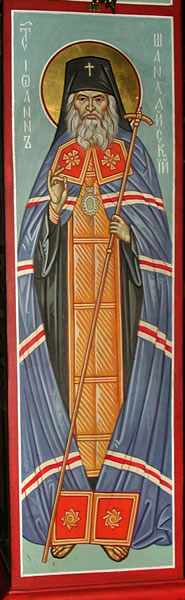
Life After Death
Saint John of Shanghai & San Francisco
Limitless and without consolation would have been our sorrow for close ones who are dying, if the Lord had not given us eternal life. Our life would be pointless if it ended with death. What benefit would there then be from virtue and good deed? Then they would be correct who say: “Let us eat and drink, for tomorrow we die!” But man was created for immortality, and by His resurrection Christ opened the gates of the Heavenly Kingdom, of eternal blessedness for those who have believed in Him and have lived righteously. Our earthly life is a preparation for the future life, and this preparation ends with our death. “It is appointed unto man once to die, but after this the judgment” (Heb 9:27). Then a man leaves all his earthly cares; the body disintegrates, in order to rise anew at the General Resurrection. Often this spiritual vision begins in the dying even before death, and while still seeing those around them and even speaking with them, they see what others do not see (1).
But when it leaves the body, the soul finds itself among other spirits, good and bad. Usually it inclines toward those which are more akin to it in spirit, and if while in the body it was under the influence of certain ones, it will remain in dependence upon them when it leaves the body, however unpleasant they may turn out to be upon encountering them (2).
For the course of two days the soul enjoys relative freedom and can visit places on earth which were dear to it, but on the third day it moves into other spheres (3). At this time (the third day), it passes through legions of evil spirits which obstruct its path and accuse it of various sins, to which they themselves had tempted it. According to various revelations there are twenty such obstacles, the so-called “toll-houses,” at each of which one or another form of sin is tested; after passing through one the soul comes upon the next one, and only after successfully passing through all of them can the soul continue its path without being immediately cast into gehenna. How terrible these demons and their toll-houses are may be seen in the fact that Mother of God Herself, when informed by the Archangel Gabriel of Her approaching death, answering Her prayer, the Lord Jesus Christ Himself appeared from heaven to receive the soul of His Most Pure Mother and conduct it to heaven. Terrible indeed is the third day for the soul of the departed, and for this reason it especially needs prayers then for itself (4).
Then, having successfully passed through the toll-houses and bowed down before God, the soul for the course of 37 more days visits the heavenly habitations and the abysses of hell, not knowing yet where it will remain, and only on the fortieth day is its place appointed until the resurrection of the dead (5). Some souls find themselves (after the forty days) in a condition of foretasting eternal joy and blessedness, and others in fear of the eternal torments which will come in full after the Last Judgment. Until then changes are possible in the condition of souls, especially through offering for them the Bloodless Sacrifice (commemoration at the Liturgy), and likewise by other prayers (6).
How important commemoration at the Liturgy is may be seen in the following occurrence: Before the uncovering of the relics of St. Theodosius of Chernigov (1896), the priest-monk (the renowned Starets Alexis of Goloseyevsky Hermitage, of the Kiev-Caves Lavra, who died in 1916) who was conducting the re-vesting of the relics, becoming weary while sitting by the relics, dozed off and saw before him the Saint, who told him: “I thank you for laboring with me. I beg you also, when you will serve the Liturgy, to commemorate my parents” — and he gave their names (Priest Nikita and Maria). “How can you, O Saint, ask my prayers, when you yourself stand at the heavenly Throne and grant to people God’s mercy?” the priest-monk asked. “Yes, that is true,” replied St. Theodosius, “but the offering at the Liturgy is more powerful than my prayer.”
Therefore, panikhidas (i.e., Trisagion Prayers for the Dead) and prayer at home for the dead are beneficial to them, as are good deeds done in their memory, such as alms or contributions to the church. But especially beneficial for them is commemoration at the Divine Liturgy. There have been many appearances of the dead and other occurrences which confirm how beneficial is the commemoration of the dead. Many who died in repentance, but who were unable to manifest this while they were alive, have been freed from tortures and have obtained repose. In the Church prayers are ever offered for the repose of the dead, and on the day of the Descent of the Holy Spirit, in the kneeling prayers at vespers, there is even a special petition “for those in hell.”
Every one of us who desires to manifest his love for the dead and give them real help, can do this best of all through prayer for them, and particularly by commemorating them at the Liturgy, when the particles which are cut out for the living and the dead are let fall into the Blood of the Lord with the words: “Wash away, O Lord, the sins of those here commemorated by Thy Precious Blood and by the prayers of Thy saints.” We can do nothing better or greater for the dead than to pray for them, offering commemoration for them at the Liturgy. Of this they are always in need, and especially during those forty days when the soul of the deceased is proceeding on its path to the eternal habitations. The body feels nothing then: it does not see its close ones who have assembled, does not smell the fragrance of the flowers, does not hear the funeral orations. But the soul senses the prayers offered for it and is grateful to those who make them and is spiritually close to them.
O relatives and close ones of the dead! Do for them what is needful for them and within your power. Use your money not for outward adornment of the coffin and grave, but in order to help those in need, in memory of your close ones who have died, for churches, where prayers for them are offered. Show mercy to the dead, take care of their souls (7). Before us all stands the same path, and how we shall then wish that we would be remembered in prayer! Let us therefore be ourselves merciful to the dead. As soon as someone has reposed, immediately call or inform a priest, so he can read the Prayers appointed to be read over all Orthodox Christians after death. Try, if it be possible, to have the funeral in Church and to have the Psalter read over the deceased until the funeral. Most definitely arrange at once for the serving of the forty-day memorial, that is, daily commemoration at the Liturgy for the course of forty days. (NOTE: If the funeral is in a church where there are no daily services, the relatives should take care to order the forty-day memorial wherever there are daily services.) It is likewise good to send contributions for commemoration to monasteries, as well as to Jerusalem, where there is constant prayer at the holy places. Let us take care for those who have departed into the other world before us, in order to do for them all that we can, remembering that “Blessed are the merciful, for they shall obtain mercy.”
ENDNOTES: Life After DeathSt John M
The Sunday of the Dread Judgment
Today is the Sunday of the Dread Judgment, and so it is natural for us to speak of the Dread Judgment and the signs of the end of the world. No one knows that day: only God knows it, but the signs of its approach are given in the Gospels and the Revelations (Apocalypse) of St. John the Theologian. For the most part, Revelations speaks symbolically and cryptically of the events of the end of the world and of the Dread Judgment, but the Holy Fathers have explained them, and there is the pure authentic tradition of the Church that also tells us the signs of the approach of the end of the world and the Dread Judgment. Before the end of life on earth there will be confusion, wars, civil strife, hunger, and earthquakes. People will suffer from fear; their hearts will fail from awaiting disasters. There will be neither spiritual life nor the joy of being alive, but a tortuous state of falling away from life. The falling away will not be from spiritual life only, but also from faith. The Son of Man, when He comes – will He find faith on the earth? People will become proud and ungrateful, refuting the Law of God. Together with a falling away from spiritual life there will also be a diminishing of moral life. Good will be exhausted and evil will grow. It is about this time that the holy Apostle John the Theologian speaks in his divinely-inspired work, the Apocalypse. He himself says that he was “in the spirit” – meaning that the Holy Spirit Itself was in him – when the fate of the Church and the world was revealed to him in various symbols. That is why this is a Divine Revelation. He presents the fate of the Church in the image of a woman who hides in the wilderness during these times. She is not obvious in life. This is happening now in Russia.
In worldly life, those forces preparing for the appearance of the Antichrist will be of primary significance. The Antichrist will be a man, not the devil incarnate. “Anti” is a word meaning “old,” or “instead of,” or “against.” That man will want to exist instead of Christ, to take His place and to have that which is Christ’s. He will want to have the same kind of influence and power over the entire world. Indeed, he will obtain that power before he perishes and the entire world perishes. He will have a helper, a magus, who will do his will through the power of false miracles, and kill those that do not recognize the power of the Antichrist. Before the destruction of the Antichrist, two righteous men will appear to condemn him. The magus will kill them, and for three days their bodies will lie unburied, and the Antichrist and his servants will rejoice to the utmost. Then suddenly these righteous men will be resurrected, and the entire army of the Antichrist will suddenly fall down dead, killed by the force of the Holy Spirit.
But what is known about the person of the Antichrist? His exact origin is unknown. His father is completely unknown and his mother a vile, false virgin. He will be a Jew from the tribe of Dan. The indication of this is that Jacob, when dying, prophesied about the future heirs of his children, and concerning Dan, he said that among his heirs “shall be a serpent by the way, an adder in the path that biteth the horses’ heels so that his rider shall fall backwards.” This symbolizes that the Antichrist shall act through cleverness and evil. In Revelation, St. John the Theologian speaks of the salvation of the sons of Israel, saying that before the end of the world many Jews will be converted to Christ, but in the list of tribes that are saved, there is no mention of the tribe of Dan. The Antichrist will be very clever and gifted, with a certain ability to deal with people. He will be charming and gentle. The appearance of the Antichrist is already being prepared before his coming: “The mystery doth already work …”
First of all, the forces preparing for his coming fight against lawful monarchical rule. The holy Apostle Paul says that the Antichrist cannot appear until “the one who restraineth” is put aside. John Chrysostom explains that the “one who restraineth” refers to a lawful, pious regime. Such a power struggles with evil. “The mystery” working in the world does not want this, does not want the struggle against evil by the power of a pious ruler – quite the opposite. It wants the rule of lawlessness, and when it achieves this, nothing more will stop the appearance of the Antichrist. He will not only be clever and charming, he will be merciful and do works of charity for the sake of bolstering his control. And when he strengthens his control to the point where the entire world recognizes him, then he will reveal his face. He will choose Jerusalem because it was precisely there that the Saviour revealed His Divine teaching and His Person, and the whole world was called to the blessedness of virtue and salvation. But the world did not accept Christ and crucified Him in Jerusalem, and during the Antichrist’s reign Jerusalem will become the capital of the world that has accepted his rule.
Reaching the summit of power, the Antichrist will demand people acknowledge that he has achieved what no earthly power and no one else has been able to do, and will demand worship of himself as an exalted being – a god. He will do only what pleases people, under the condition that they recognize him as the Supreme Power. He will provide opportunities for Church life, allow her to hold services, and promise that wonderful temples will be built, provided that he be recognized as “Supreme Being” and worshipped. He will have a personal hatred for Christ. He will thrive on this hatred and will rejoice in people’s apostasy from Christ and the Church. There will be a mass falling away from the faith, during which many bishops will betray the faith, and point to the wonderful position of the Church as justification. A search for compromise will be the characteristic state of the people’s faith. Directness of confession will vanish. People will subtly justify their fall, and solicitous evil will support such a general state of mind. People will grow used to apostatizing from the truth and will be accustomed to the sweetness of compromise and sin. The Antichrist will allow people anything as long as they, falling down before him, worship him. This will not be a new attitude toward people: the Roman Caesars were also prepared to grant Christians freedom if they would recognize the emperor’s divinity and supreme divine power. They martyred Christians only because they confessed: “One God do we worship, and Him alone do we serve.” The whole world will be conquered by him, and he will then reveal his hatred for Christ and Christianity.
How will we see? With spiritual sight. Even now, righteous people see at death that which other people around them do not see. The trumpets will sound in souls and consciences. Everything will become clear in the human conscience. The Prophet Daniel, speaking of the Dread Judgment, tells of the Ancient of Days upon His throne, and before Him a river of fire. Fire is a purifying element. Fire burns sin; sin also is burned up by sorrow. If sin has become part of a man, it burns the man himself. Then fire will flare up inside man. Seeing the Cross, some will rejoice and others will fall into despair, confusion, horror. Thus people will be separated instantly. In the Gospel narrative, some stand on the right hand, others on the left hand of the Judge — they are separated by their inner consciousness. The very state of a person’s soul casts him to one or the other side, to the right or to the left. However much more consciously and diligently a person strove toward God in his life, so much the greater his joy when he hears the words: “Come, ye blessed.” And on the other hand, the same words will kindle a fire of horror and suffering in those that did not desire Him, or avoided or fought or mocked Him in their lives. The Dread Judgment knows no witness or court records. Everything is inscribed in the souls of men, and these inscriptions, these “books,” will be opened. Everything will become clear to all and to oneself; the state of a person’s soul sends him to the right or the left. Some will go to the place of rejoicing, others to the place of horror. When the books have been opened it will become clear to all that the root of all transgressions is in a man’s soul. Consider a drunkard or a fornicator: when the body dies, some think the sin, too, has died. No — the inclination to sin was in the soul, and to the soul the sin was sweet. And if the soul has not repented of this sin, has not freed itself of it, it will come to the Dread Judgment with the same desire for the sweetness of sin and “never sate this desire.” There will be the suffering of hatred and wrath in this soul. This is the state of hell. “The fiery Gehenna” – this is the inner fire, the fire of weakness and anger, and here will be the wailing and the gnashing of teeth of powerless wrath.
 Christian Dogma
 Christian Martyrs
 Christian Orthodox Churches and Monasteries
 Christian Sermons and News
 Church's Teachings on Fasting
 Ecumenism – a Great Heresy
 Father George Calciu
 Life_a Sacred Gift form God
 Orthodox Saints and Church Fathers
 Spiritual Elders
 Daily Bible Readings
 Journey to Orthodoxy
 Listen to Ancient Faith Radio
 Orthodox Calendar of Feasts and Saints
 Orthodox Christian Mission Center
 Orthodox Institute
 OrthodoxChristianNetwork TV


Recent Comments