
You are currently browsing the daily archive for July 11, 2009.
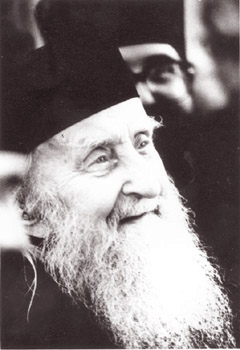
On July 11, 1993 Archimandrite Sophrony, the spiritual elder of the Monastery of St. John the Baptist at Tolleshunt Knights, England, fell asleep in the Lord. Father Sophrony was well known throughout the Orthodox world as the compiler of the writings of St. Silouan and the author of his life. And to those who were privileged to be acquainted with him personally, he was known for the spiritual love and joy which his presence called forth and radiated from him.
The monastery had been informed that the only way that it could bury people on its property was to build an underground crypt, which it proceeded to build, and to which Elder Sophrony said that he would not repose until the crypt was ready. Then, having been told of the expected completion date of July 12, Elder Sophrony stated that he “would be ready”. On the 11th, Elder Sophrony reposed; and on the 14th was his funeral and burial, attended by monastics from around the world. At the time of Fr Sophrony’s repose, there are 25 monastics in the monastery, a number that has remained steady since then. Mother Elizabeth, the eldest nun, reposed soon after, on the 24th. This was in accordance with Elder Sophrony’s words that he would repose first, and she would repose soon after.
On Prayer, a book containing Elder Sophrony’s writings on prayer, particularly the Jesus Prayer, was published posthumously.
The praying mind does not think – does not reason – but lives. Its activity consists, not in the manipulation of abstract concepts but in participation in being. The truly praying mind has to do with categories different in quality from those of rational reflection. It is concerned, not with intellectual categories but with actual being, which cannot be confined within the narrow framework of abstract concepts. (Elder Sophrony)
A MODERN-DAY SAINT AND HIS DISCIPLE: SAINT SILOUAN AND FATHER SOPHRONY
By Archpriest Michael G. Dahulich
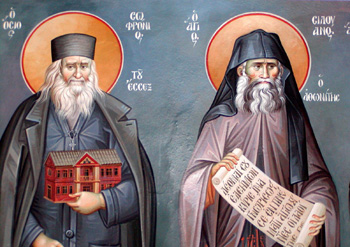
Orthodoxy in Great Britain today is particularly blessed by the presence of a growing monastic community, with both monks and nuns, at Tolleshunt Knights, Essex (under the Ecumenical Patriarchate), founded by Archimandrite Sophrony. Here a central place is given to the Jesus Prayer. Here the monastery is widely visited by pilgrims from all over the world, seeking theosis … to live in their lives the words of Saint Paul the Apostle: “It is no longer I who live but Christ Who lives in me, and the life that I live in the flesh I live in the faith of the Son of God Who loved me and gave Himself up for me” (Gal. 2:20-21).
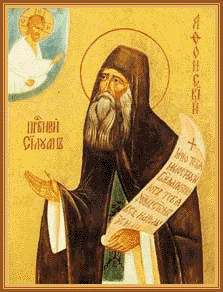
(…) Archimandrite Sophrony also went to Mount Athos, in 1925, and there, at the Monastery of St. Panteleimon, became a disciple of Staretz Silouan. He listened to his spiritual father’s teachings and was guided by his holy life. Like him he taught, “In this world there is nothing more difficult than to be saved” because the first step in progress towards becoming “like God” is “to love one’s enemies.” Father Sophrony took the writings of his staretz, which were penciled in laborious, unformed characters on old scraps of paper, edited them and published them in many languages. He also wrote his biography.
The Goal Of Everyone
Anyone who draws the conclusion that the central teaching of Saint Silouan and, in fact, the whole Orthodox Church — theosis — deification and union with God — the transfiguration of the body and cosmic regeneration — is remote from the actual experience of ordinary Christians, has entirely misunderstood the Orthodox teaching.
Deification, “becoming like God” is not something reserved for a few select initiates, but something intended/or all alike. The Orthodox Church believes that it is the normal goal for every Christian without exception. Certainly we shall only be fully deified on the Last Day, but for each of us the process of divinization must begin here and now in the present life. It is true that in this present life very few indeed attain full mystical union with God. But every true Christian tries to love God and to fulfill His commandments; and so long as we sincerely seek to do that, then however weak our attempts may be and however often we may fall, we are already in some degree deified.
The fact that a person is being deified does not mean that he or she ceases to be conscious of sin. On the contrary, deification always presupposes a continued act of repentance. A saint may be well advanced in the way of holiness, yet he or she does not therefore cease to employ the words of the Jesus Prayer, “Lord Jesus Christ, Son of God, have mercy on me a sinner.” Saint Silouan used to say to himself, “Keep thy mind in hell and despair not.” Other Orthodox saints have repeated the words, “All will be saved, and I alone will be condemned.” Orthodox theology is a both a theology of glory and of transfiguration, but also a theology of penitence.
Nothing Extraordinary
There is nothing esoteric or extraordinary about the methods which we must follow in order to be deified. If someone asks, “How can I become like God?” the answer “is very simple.” In the words of Bishop Kallistos (Ware), “… go to Church, receive the Sacraments regularly, pray to God ‘in spirit and in truth,’ read the Gospels, follow the commandments. The last of these items — ‘follow the commandments’ — must never be forgotten.” Orthodoxy firmly rejects any kind of mysticism that seeks to dispense with moral rules.
Theosis is not a solitary but a “social” process. Deification means “following the commandments”, and these commandments were briefly described by Christ as love of God and love of neighbor. The two forms of love are inseparable. A person can love his neighbor as himself only if he loves God above all; and a person cannot love God if he does not love his fellow man. (I John 4:20). Thus there is nothing selfish about theosis; for only if he loves his neighbor can a person be deified. “From our neighbor is life, and from our neighbor is death,” said St. Anthony of Egypt. “If we win our neighbor we win God, but if we cause our neighbor to stumble we sin against Christ.” (…)
The Questions Remain
How can the average American relate to the lives of Staretz Silouan and Father Sophrony from atop Mount Athos or in the cloister of the Monastery?
How can we live the life of a spiritual saint in a world that is so dominated by materialism?
How can we strive towards theosis when we are faced by temptations from the world and its demons and dragged down by and down to the level of the world and its values, or rather, the lack thereof?
Things To Remember
In answering these questions, we must always remember:
1. Staretz Silouan and Father Sophrony were human beings like you and me, “working out their own salvation” (Philippians 2:12).
2. Their standards are our standards. There are not two sets of commandments or two sets of morality. We are all called to be holy. There is only a difference in degree.
3. Like me, Staretz Silouan had been a sinner. But as we all ought to, he considered himself “first” of all sinners and repented.
4. So too. Father Sophrony was a sinner — for a time, he doubted the truths of the faith; he lived outside of the Church and her Mysteries. He was a non-practicing, nonbeliever who considered himself “first” of all sinners.
5. Like we need to. Brother Simeon readily made a confession of his sins; he heard the saving words of forgiveness from his spiritual father: “You have confessed your sins before God. Know now that they have all been forgiven… Now we will make a fresh start … Go in peace, and rejoice that the Lord has led you to this haven of salvation.”
But,
Brother Simeon went to the Russian Monastery of St. Panteleimon and started on a new ascetic life. We cannot go to the Monastery; so what are we to do?
Bring The Monastery Home
It is true that we cannot all join the Monastery, leave our families, our jobs and our responsibilities in the world. But, we can take the Monastery, its goals and ideals, its purity of faith, and the very spiritual experience of it, into our homes … into our daily lives.
Every day — a day of prayer, several times each day — with the community, the whole family, praying together— not just for ourselves, but everyone, even our enemies.
Every Sunday and holyday — a day of liturgical worship — receiving Holy Communion together as a family — having received Holy Confession the night before.
Every day, but at least Sunday and each feastday — a day of reading from the Scripture — perhaps at table like in the Monastery, or in the living room — together, the whole family, hearing the Word of God, and then discussing it under guidance.
Every day, as individuals and as the community of the family — living the commandments, summed up in love of God and love of neighbor — in all that we do, we ask, “What would Jesus want me to do or say or think; how would He want me to be?”
And, finally, when we each of us “misses the mark” or “falls short of the glory of God” (Romans 3:23), we repent anew of our sins, asking the forgiveness of all our family members in the flesh and in the faith, and ourselves forgiving others, even our enemies. The humility of which St. Silouan speaks, can begin to be found by reading sincerely the Prayers before Holy Communion.
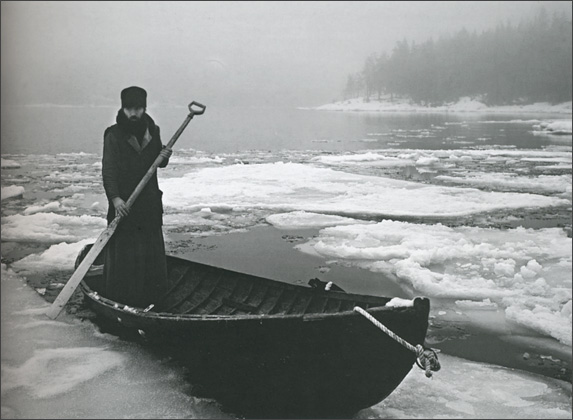
Every Room is a Church
Every room in our home is like the inside of the Monastery:
1. In the family room is our icon corner, where we pray together and read the Scripture together as a community in Christ.
2. In our living room, there is no music or television program, book or magazine, friend or neighbor or visitor and their behavior — that is not compatible with Christ and His teachings.
3. In our kitchen, the same rules for eating and drinking in moderation, and fasting according to the guidelines of the Church, are followed as they are in the monastery.
4. In every bedroom, we practice the virtue of chastity — in marriage as in the celibate life — as in the Monastery, although not in the same degree.
5. In the office, we practice the same honesty in finances, in dealing with people and possessions, as the monks do in the monastery.
6. In the closets and basements of our lives, we clean out the “rubbish” and the “dark secrets” regularly and thoroughly — as in the Monastery — through the mystery of holy confession.
7. In every room of our home, we live as the hymn of the Nativity beckons us: “God is with us!” And each day over the ways of the world we choose with Joshua: “Choose today whom you will serve. As for me and my household, we will serve the Lord” (Joshua 24:15).
Forgiving One’s Enemies
In previous lectures on the life of St. Silouan, we heard repeated that the true test of our salvation really lies in truly loving our brother and truly forgiving one’s enemies as Christ Himself did. Last week we heard a poignant expression of how difficult that is. In response I should like to share with you a story on the importance — no, the necessity — of forgiveness of one’s enemies. It comes to us from the Kievan Caves Patericon. It, is the story of the Holy and Righteous Titus the Presbyter, whose feastday is commemorated on February 27.
The Patericon chronicles the story in these words: “The person who is filled with anger can see only anger in God, but that world of God which exceeds the limits of the mind is revealed to those who have peace in their heart and soul. The Lord clearly demonstrated this through His servant, Blessed Titus (Tito) the presbyter. St. Titus, a monk in the Caves Monastery, was honored with the priestly rank, and he passed a life worthy of the joy of the saints.
“This blessed one had a spiritual brother, a hierodeacon by the name of Evagry. St. Titus bore a strong and unhypocritical love for the deacon. Their harmonious and sincere love was a source of inspiration for everyone.
“The enemy of mankind, because of his hatred of all good, worked long and hard to sow tares among this wheat, and he succeeded in raising up anger and bitterness between these two friends. He darkened them with such hatred that if the one approached while censing the church, the other would turn and walk away from the incense, or if he failed to walk away, the one censing walked past without censing him. They remained in this spiritual darkness for a long time and even dared to serve and to bear the Holy Gifts and take Communion in this state. The brethren constantly begged them to become reconciled, but they did not even want to hear of it.
“At length. Father Titus became critically ill. Realizing that he was near death, he began to weep over his sins and sent for Fr. Evagry, with the words, ‘Forgive me, brother, for the Lord’s sake, for having offended you with my anger.’
“Not only did the deacon refuse to forgive the presbyter, but he even began to curse him with cruel words. The brothers saw that Fr. Titus was approaching his last breath and they dragged Fr. Evagry by force to the dying monk’s cell to make amends with him. When the deacon was brought in, the ill priest immediately drew himself from his bed and fell at the feet of his former friend, tearfully beseeching: ‘Forgive me, Father, and bless!’
“Father Evagry, however, showed himself to be so unmerciful and inhuman that he tore himself away from the brethren and loudly declared to everyone present: ‘I will never reconcile with him, neither in this age nor in the future one.’
“Scarcely had he said these words when he fell to the floor. The brothers tried to raise him up, but they saw that he was lifeless and they could not bend his arms, nor even close his lips and eyes. Fr. Titus, on the other hand, rose to his feet completely well.”
Terror fell upon everyone at the sight of this sudden dreadful death accompanied by such a miraculous healing.
Christ’s True Disciple
We have another such example to follow in our spiritual life — an excerpt from “How to Be Christ’s True Disciple,” contained in Indication of the Way into the Kingdom of Heaven, written by Saint Innocent (Veniaminov), the Apostle to America (published by Holy Trinity Monastery in Jordanville, N.Y., 1994).
Saint Innocent tells us: “Jesus Christ loved everyone, and did every kind of good to all. So we too should love our neighbors and, as far as possible, do good to them either by deed, or word, or thought.
“Jesus Christ forgave His enemies all that they did to Him, and over and above that did them every kind of good and prayed for their salvation. So too we should forgive our enemies, repay with good the evil done us, and bless those who curse and abuse us, with full faith and hope in God, the most just and all-seeing Judge, without Whose will not even a hair of our head will be lost. By bearing wrongs without complaint, without revenge and with love, you will act as a true Christian.
“Jesus Christ, being meek and humble in heart, never sought out desired praise from others. So too we should never boast or pride ourselves on anything at all, or seek praise from others. For instance, if you do good to others, if you give alms, if you live more piously than others, or if you are more intelligent than your fellows, do not be proud of it either before men or to yourself, because all that you have that is good and praiseworthy is not yours but the gift of God — only sins and weaknesses are your own, and all the rest is God’s.
“To follow Jesus Christ means also to obey the word of Jesus Christ. Therefore we must listen to, believe and practice all that Jesus Christ has said in the Gospel and through His Apostles, and we must do all this without artifice or temporization but in simplicity of heart. He who listens and attends to the word of Jesus Christ may be called His disciple, but he who listens to and carries out His word and will with simplicity of heart and with perfect devotion is His true, beloved disciple.
“And so, that is what it means to deny oneself, to take up one’s cross and follow Christ. That is the true nature and straight way into the Kingdom of Heaven. And that is the way by which Jesus Christ Himself lived on earth, and by which we Christians must go. There never was and never will be any other way.”
The Ultimate Questions
Even though we may not be glorified and proclaimed Saints, officially by the Church, like Staretz Silouan was, the ultimate goal of every Orthodox Christian is deification — theosis — to become like God.
We know from the words of Father Sophrony, “In this world there is nothing more difficult than to be saved.”
Can we do it? YES, with God’s grace, we can. After all, we know of those who have… and we know the way they did it… It’s nothing new.
Will we do it? I pray that each of us, inspired by the lives of St. Silouan and Fr. Sophrony, will follow their examples…
Must we do it? YES, it is a matter of life and death… our life and our death… our eternal life and our eternal death.
Through the prayers of Saint Silouan and Father Sophrony, Lord Jesus Christ Son of God, have mercy on us and save us!
To Him be the glory, unto ages of ages. Amen!
(Source: Archpriest Michael G. Dahulich. A Modern-day Saint
And His Disciple: Saint Silouan and Father Sophrony //
Alive in Christ: The Magazine of the Diocese of Eastern Pennsylvania,
Orthodox Church in America. 1997. Vol. XIII. N 3. P. 55-61.)
Teachings of Saint Silouan on Love
 Christian Dogma
 Christian Martyrs
 Christian Orthodox Churches and Monasteries
 Christian Sermons and News
 Church's Teachings on Fasting
 Ecumenism – a Great Heresy
 Father George Calciu
 Life_a Sacred Gift form God
 Orthodox Saints and Church Fathers
 Spiritual Elders
 Daily Bible Readings
 Journey to Orthodoxy
 Listen to Ancient Faith Radio
 Orthodox Calendar of Feasts and Saints
 Orthodox Christian Mission Center
 Orthodox Institute
 OrthodoxChristianNetwork TV


Recent Comments