
You are currently browsing the monthly archive for June 2009.
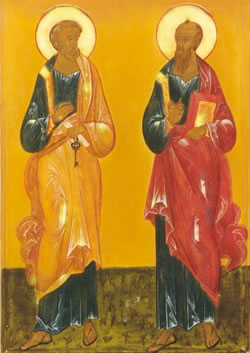
Sts Peter and Paul
With what Crowns of Praise?
Audio links: Ft Hopko – Feast of St Peter and Paul
Keys to the Kingdom – St. Peter
Chosen Instrument of Mine – St. Paul
And a Sermon By His Grace Bishop Joseph of Arianzos
With what crowns of praise Shall we crown Peter and Paul?… The former as the leader of the Apostles the latter as the one who toiled more than the others.
June is always marked by the festive commemoration of the Holy Apostles Peter and Paul which is observed by our Church on the 29th day, and indeed after fasting in honour of the chief Apostles.
The 29th of June, certainly is not the day they suffered martyrdom. Rather it is the day that in 258 AD, Pope Sixtus II transferred their very sacred relics to the catacomb of St. Sebastian in Rome. Since then, this day, as a day of common honour for both Apostles, overshadowed the day of their individual martyrdom and so from ancient times the Church honours Peter and Paul together. Not only with a common feast day but also with a common fasting period for both. Indeed the fasting period -to note as a parenthesis- during which eating fish is also permitted on Saturday and Sunday [according to a stricter tradition] or on all the days of the week except Wednesday and Friday [according to a more lenient tradition], starts on Monday after the Sunday of All Saints and ends on the 28th of June. But if Easter falls on the 3rd of May or later then there is no fast for the feast of the Apostles).
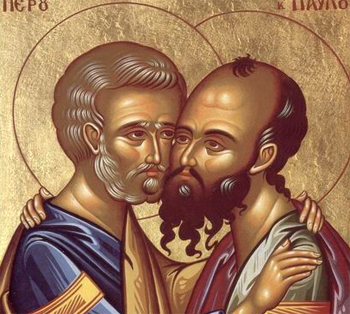
Our Church also honours them with Icons which depict the two together, either embracing themselves in a brotherly love in Christ or holding in their hands the Church in the form of a small Byzantine church so emphasising the unity of the faith and the unity of the Church mainly consisting of two different elements: The old Israel (the Jews) to whom, in the main, the missionary work of Peter was directed at, and the Gentiles (the Pagans) who correspondingly were the objects of Paul’s missionary work. Also they are honoured with common churches named after both of them. And with common hymns like the one of the vespers of their feast which we have placed as the beginning of these humble lines.
*********
With what crowns of praise shall we crown Peter and Paul? What worthy words can one find to laud the chiefs of the Apostles? What forms and ornaments of speech can one employ? What kind of poetic blossom would he gather to dedicate to them?
What can be worthy for Peter, who, when he declared that our Lord is ‘Christ the Son of the Living God” (Matthew l6:16), revealed the unshakeable stone onto which is founded and based the true faith of those who are saved and thus he himself at the same time became the first stone of the spiritual edifice of the Church?
What can stand worthy to praise “the imprisonment in various cities and the af-flictions” of Paul “the hard work and toil, the sleeplessness the sufferings of hunger and thirst, the cold and nakedness, the bas-ket, the beatings with a stick, the stoning, the journeying, the death of the sea, the shipwreck” that he endured “so that he would win people for Christ Jesus his Lord” as the muse of St. Andrew, Archbishop of Crete is wondering?
How can you praise the “Mouth of the Apostles” who “lifted up his voice and said to them” (Acts 2:14) in front of the crowd on the day of Pentecost and as many as heard this first holy divine voiced sermon of his “were pricked in their hearts” (Acts 2:41) and were baptised “and the same day these were added three thousand souls” to the Church? (Acts 2:41).
How can you praise the God-called “Teacher of the Churches who ” made all things to all men that he might by all means save them”? (1 Corinthians 9:22).
What can you first bring to memory about Peter and laud him? The enthusiasm? The humility? The saving and redeeming tears of repentance after that third “I do not know this man”? (Matthew 26:75) After this denial his complete dedication to the Godman and his triple confession of love to Him for which he heard from His mouth “feed my lambs” and “feed my sheep”? (John 21:15-17). His God-wise teaching which is contained in his two General Epistles or his all holy martyrdom for Christ in the “Eternal City” where he irrigated with his scarlet blood the newly grown tree of the Church of Rome?
What can you first call to mind about Paul and praise him? His godly zeal with which he repeatedly travelled round the Mediterranean with infinite dangers, hardships and problems in order to evangelise to its people the salvation in Christ? His patience to the “thorn in the flesh” which God granted to him to buffet him for life? (2 Corinthians 12: 7-10). His courage in front of the rulers of this world?
His politeness which made him respect even the high priest of the Judeans who transgressed the law? (Acts 23:5). The bottomless depth of his humility by reason of which, when he remembers the time that he was an enemy of the Church, he calls him-self “as one born out of due time” (1 Corinthians 15:8) and “least of the Apostles” and he comes to say “I am not great to be called an Apostle because I persecuted the Church of God? (1 Corinthians 15:9). His care and the unquenchable interest and fatherly anxiety for the spiritual development of the faithful and the support of the churches at different places as it is so characteristically evident from “by the space of these years I ceased not to warn everyone night and day with tears (Acts 20:31) and from the most affectionate “my little children of whom I travail in birth again until Christ is formed in you (Galatians 4:19) and the so responsible “that which comes upon me daily, the care of all churches” (2 Corinthians 21:28). His perfect love which compelled him to say that unrepeated “who is weak and I am not weak? Who is offended and I burn not?” (2 Corinthians 21:29). His laboriousness and the refinement of his soul which made him, despite the burden of the Apostolic duties to also pursue the humble craft of the tent maker in order to procure himself “food and clothing” so that he could preach without expense the Gospel “and not to be burden to anybody. His not loving money which made him say with modesty “I have coveted no man’s silver, or gold or apparel (Acts 20:33). Which of his virtues and which of his graces would you first bring to your memory? Only you stop at his last sacrifice, the culmination of all his unrending, unceasing throughout his life sacrifices for Christ, the sacrifice of his blood under the sword of Nero and you stop going any further by respecting the greatness of the all holy man.
With such facts on the one hand and the writer of this not having the necessary prerequisites to attempt to say words worthy of the “holy luminaries of the world” on the other, it naturally follows that the say should be given to the holy hymnographer of the Church, who expresses the voice and the conscience of her holy Body, to conclude these poor and unworthy lines with the idiomelo of Psalm 50 of the Orthros of the feast of the Apostles:
“Peter, the leader of the glorious Apostles the rock of the faith and Paul divine of the holy Church the orator and luminary who stand beside the divine throne, Intercede for us”.
from The Orthodox Messenger, v. 8(7-8)
“The light of the body is the eye: if therefore your eye be single, your whole body shall be full of light. But it your eye be evil, your whole body shall be full of darkness. If therefore the light that is in you be darkness, how great is that darkness!”
(Matthew 6:22-23)
The single eye is the love unfeigned; for when the body is enlightened by it, it sets forth through the medium of the outer members only things which are perfectly correspondent with the inner thoughts. But the evil eye is the pretended love, which is also called hypocrisy, by which the whole body of the man is made darkness. We have to consider that deeds meet only for darkness may be within the man, while through the outer members he may produce words that seem to be of the light: for there are those who are in reality wolves, though they may be covered with sheep’s clothing. Such are they who wash only the outside of the cup and platter, and do not understand that, unless the inside of these things is cleansed, the outside itself cannot be made pure. Wherefore, in manifest confutation of such persons, the Saviour says: If the light that is in you be darkness, how great is that darkness! That is to say, if the love which seems to you to be light is really a work meet for darkness, by reason of some hypocrisy concealed in you, what must be your patent transgressions!
(St. Gregory Thaumaturgus)
“No man can serve two masters: for either he will hate the one, and love the other; or else he will hold to the one, and despise the other. Ye cannot serve God and mammon. Therefore I say unto you, Take no thought for your life, what ye shall eat, or what ye shall drink; nor yet for your body, what ye shall put on. Is not the life more than meat, and the body than raiment? Behold the fowls of the air: for they sow not, neither do they reap, nor gather into barns; yet your heavenly Father feedeth them. Are ye not much better than they? Which of you by taking thought can add one cubit unto his stature? And why take ye thought for raiment? Consider the lilies of the field, how they grow; they toil not, neither do they spin: And yet I say unto you, That even Solomon in all his glory was not arrayed like one of these. Wherefore, if God so clothe the grass of the field, which to day is, and to morrow is cast into the oven, shall he not much more clothe you, O ye of little faith? Therefore take no thought, saying, What shall we eat? or, What shall we drink? or, Wherewithal shall we be clothed? (For after all these things do the Gentiles seek:) for your heavenly Father knoweth that ye have need of all these things. But seek ye first the kingdom of God, and his righteousness; and all these things shall be added unto you.”
Matthew 6:24-33
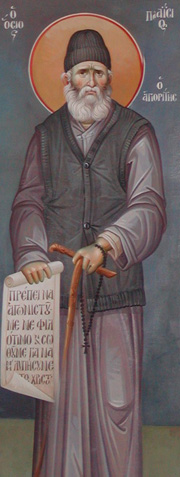
Too Many Worries Make People Forget God
An Excerpt from “With Pain and Love for Contemporary Man”
by Elder Paisios of Mount Athos (Holy Monastery “Evangelist John the Theologion”, 2006)
– Geronda (spiritual elder in Greek), does worrying about too many things take us away from God?
– Look, let me try to explain. When a little child is playing and is all absorbed with his toys, he s not aware that his father may be next to him caressing him. If he interrupts his play a bit, then he will become aware of his father’s caresses. Similarly, when we are preoccupied with too many activities and are anxiously concerned about them, when we worry too much about worldly matters, we cannot become aware of God’s love. God gives but we do not sense it. Be careful not to waste your precious energy on redundant worries and vanities, which will turn to dust one day. When you do this, you not only tire your body, but you also scatter your mind aimlessly, offering God only your fatigue and yawns at the time of prayer – much like the sacrifice offered by Cain. It follows that your inner state will be like that of Cain’s, you will be full of anxiety and sighs provoked by the devil standing by your side.
You must not waste aimlessly the fruit, the inner cure of our power and then leave the shells for God. The many cares of life sap the marrow of our heart and leave nothing for Christ. If you notice that your mind constantly wanders off to various chores that you have to do, you must realize that you are not doing well spiritually, and this should alarm you because you have distanced yourself from God. You must realize that you are closer to material things than you are to God, closer to creation than to Creator. (…)
We must learn to care about things in the right way
If we seek above all the Kingdom of Heaven and that’s all we care for, the rest will be given to us (Cf. Mt 6:33, Lk 12:13). If we become forgetful, then not only do we waste our time but we waste our own self. When we remain mindful and prepare for the next life, than this life too will become meaningful. When we start thinking of the next life, nothing is the same anymore. But if all we think about is how to make this a comfortable life, then not only are we miserable, but we end up weary and condemned.
Do not be overwhelmed with anxiety and be possessed by the thought that, “Now we must do this, next we must do that and so on,” because this way Armageddon (Rev 16:16). Will come and you will still be hard at work. Even doing things with anxiety is demonic. Tune in to Christ! Otherwise, you will appear to be living near Him but inside you will still carry the mindset of this world, and you might and up, I’m afraid like the foolish virgins (Cf. Mt 25:1-13).
The wise virgins did not only had kindness, they also had the right kind of mindfulness, unlike the foolish virgins that were careless, they were on guard and vigilant. This is why the Lord gave them the solemn warning, Be awake and watchful (Mt 25:13). They were virgins but foolish. If someone is born a fool, it is a blessing from God. She enters directly into the next life without having to pass any examinations. But if she is gifted with an intelligent mind and yet lives a foolish life, she will have no excuse on the Day of Judgment.
Can you see in the case of Martha and Mary, mentioned in the Gospel (Cf. Lk 10:38-42), how mindless care for things caused Martha to behave somewhat impudently? It seems that in the beginning Mary was actually helping her, but when she realized that Martha was nowhere near completing her preparations, she went her and went to listen to Jesus. She thought to herself, “Am I to lose time with my Christ for the sake of Martha’s salads and sweets?” As if Christ had come to their home to taste Martha’s salads and foods! It was then that Martha became annoyed and said, Lord, do You not care that my sister has left me to serve alone? (Lk 10:40).
Let us be careful, then, not to behave like Martha. Let us pray that we will become good “Marys”.
A Sermon by Saint John Maximovich, bishop of Shanghai & San Francisco
Among the Church’s feasts, there are three in honor of God’s saint which in their significance stand out from the others devoted to the saints and are numbered among the great feasts of the Church of Christ. These feasts glorify the economy of God for our salvation.
These three feasts are the Nativity of St. John the Forerunner, his Beheading, and the feast of the Holy Apostles Peter and Paul.
The apparition of the holy Archangel Gabriel to the priest Zacharias in the Temple, with the announcement of the birth to him and the righteous Elizabeth, of a son who would prepare the way for the Lord, the Savior of the world, and the subsequent fulfillment of this premise, are the first of the events related by the Evangelists.
The announcement of the holy Archangel Gabriel to Zacharias in the Temple begins the New Testament Gospel. The announcement of the same Archangel Gabriel six months later in Nazareth to the Virgin Mary concerning the birth from Her of the Son of God, Who was to become incarnate, is a continuation of the revelation of the Pre-eternal Counsel concerning the salvation of the human race.
Three months after, the Annunciation, St. John the Forerunner was born “in a city of Judah,” and six months after him Christ Himself was born in Bethlehem. These events are closely bound together. “The glorious conception of the Forerunner proclaimeth beforehand the King Who is to be born of a Virgin” (Exapostilarion, Sept. 23, Feast of the Conception of John the Baptist). The announcement of the Archangel Gabriel in the Temple, announced later to all living nearby by Zacharias, in the magnificent hymn, which he sang after the birth of the child, John and the restoration to him of the gift of speech (Luke 1:67-79), is the forerunner of the angelic hymn: “Glory to God in the highest;” which was sung in Bethlehem by the angels when they announced to the shepherds the Nativity of Christ.
The Nativity of John the Baptist is the first joy sent down by God to the human race, the beginning of its deliverance from the power of the devil, sin and eternal death.
It is true that even before the Forerunner, the Most Holy Virgin Mary was born, and angels announced Her birth to Her parents. However, at that time, only Her parents knew of the exalted lot that was prepared for the Virgin Who was born, and they themselves were not fully aware of what had been announced to them beforehand. Therefore, it was only they, who celebrated at the birth of their Daughter, while the rest of the world only later understood the joy that had been announced (to it), by this birth.
For this reason, the feasts of the Nativity of the Most Holy Theotokos and Her Entrance into the Temple were established in the Church and began to be solemnly celebrated significantly later than the other great feasts, whereas the Nativity of John the Forerunner is one of the most ancient and most venerated of Christian feasts. Sermons on this feast have been preserved from the first centuries.
From the day of the Nativity of John the Forerunner, the preparation of the human race begins for meeting the Son of God on earth. Blessed be the Lord God of Israel; for He hath visited and redeemed His people . . . And thou, child, shalt be called the prophet of the Most High: for thou shalt go before the face of the Lord to prepare His ways (Luke 1:68, 76). These God-inspired words of the priest Zacharias, after he had regained the gift of speech, were made known in all the land of Judea, causing disturbance to all living there, who asked each other in astonishment: What manner of child shall this be? (Luke 1:66).
Involuntarily the thought arose: Is this not the Messiah Himself? Judea was in an especially tense state of expectation of the Savior. Thus, the child John prepared the way for the Lord by his very birth; and even while he was still in the womb of His mother, by his leaping (Luke 1:41) he announced the coming birth of the Child Jesus, as if crying out: “Christ is born, give ye glory. Christ comes from heaven, meet ye Him” (Irmos, Canticle One of the Canon, Feast of the Nativity of Christ).
Being born exactly half a year before Christ, John the Forerunner by the exact time of his birth depicted his mission of preparing the way for the Lord. He was born at the time of the year (June 24) when the day begins to grow shorter after the summer solstice, whereas the Nativity of Christ occurs (December 25) when the day begins to grow longer after the winter solstice. These facts are an embodiment of the words spoken later, by the Forerunner, after the beginning of Christ’s preaching: He must increase, but I must decrease (John 3:30). “The herald of the Sun, the Forerunner” was John the Baptist, who was like the morning star that announces the rising of the Sun of Righteousness in the East.
Just as the very event of the Nativity of John the Baptist was the antechamber of the Nativity of our Lord Jesus Christ, so also the feast of the Nativity of John the Forerunner is also the antechamber of the feast of the Nativity of Christ. “The star of stars, the Forerunner, is born on earth today, from a barren womb, John the beloved of God, and manifests the dawning of Christ, the Orient from on high” (Glory at Lauds, of the Feast, June 24). “The whole creation rejoiceth at thy divine nativity: for thou wast shown forth as an earthly angel, O Forerunner and a heavenly man, proclaiming to us, the God of heaven incarnate” (Cantile Five of the Canon). “O Prophet and Forerunner of the coming of Christ, we who venerate thee with love, are in perplexity how worthily to praise thee; for the barrenness of her who bore thee and the dumbness of thy father are loosed by thy glorious and precious nativity, and the incarnation of the Son of God is preached to the world” (Troparion of the Feast).
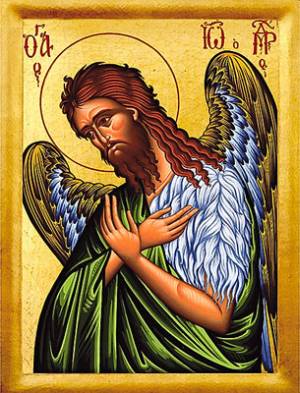
Troparion – Tone 4
Prophet and Forerunner of the coming of Christ,
although we cannot praise you worthily,
we honor you in love at your nativity,
for by it you ended your father’s silence and your mother’s barrenness,
proclaiming to the world the incarnation of the Son of God!
Kontakion – Tone 3
Today the formerly barren woman gives birth to Christ¹s Forerunner,
who is the fulfillment of every prophecy;
for in the Jordan,
when he laid his hand on the One foretold by the prophets,
he was revealed as Prophet, Herald, and Forerunner of God the Word.
We cannot confuse humility with naivety nor with dumbness. To be humble means to be undivided; the holy honor of humility is not acquired by a blind obedience to mediated lies, nor by following everything that we are told or ordered by the powerful elites of this world. We, Orthodox Christians have been very brave throughout history, when the values of our faith were betrayed and, we ought to defend them.
Elder Iustin Parvu from Petru-Voda Monastery
Fast of the Holy Apostles Peter and Paul
(June 15 – June 28)
The Podvig of the Apostles’ Fast is less strict than during Great Lent: We abstain from eating meat and dairy products throughout the Fast. The Church ustav also provides that, on Mondays, Wednesdays and Fridays during the Apostles’ Fast, we abstain from consuming fish, wine and oil; on the other days of the week, Tuesday and Thursday, we abstain from eating fish. Eating fish is permitted on Saturdays and Sundays, on days commemorating certain great Saints, and on the Feast of the Nativity of St. John the Baptist (7 July).
Teachings of St. Seraphim of Sarov on Fasting
Fasting consists not just of eating rarely, but also of eating little. And not just in eating only one meal, but in not eating much. Foolish is the faster, who waits for a specific time [to eat a meal], but then at the time of the meal is completely consumed, body and mind, with insatiable eating.
In proportion to how the body of the faster becomes thin and light, so the spiritual life attains perfection and reveals itself in wonderful ways. Then the soul acts as if in an incorporeal body. Carnal feelings are shut off, and the spirit, released from the world, ascends to heaven and completely immerses itself in contemplation of the spiritual world.
Every day one should partake of just enough food to permit the body, being fortified, to be a friend and helper to the soul in performing the virtues. Otherwise, with the body exhausted, the soul may also weaken.
Lessons from the Fathers. Fasting
There is both a physical and a spiritual fast. In the physical fast the body abstains from food and drink. In the spiritual fast, the faster abstains from evil intentions, words and deeds. One who truly fasts abstains from anger, rage, malice, and vengeance. One who truly fasts abstains from idle and foul talk, empty rhetoric, slander, condemnation, flattery, lying and all manner of spiteful talk. In a word, a real faster is one who withdraws from all evil.
As much as you subtract from the body, so much will you add to the strength of the soul.
* * *
By fasting it is possible both to be delivered from future evils and to enjoy the good things to come. We fell into disease through sin; let us receive healing through repentance, which is not fruitful without fasting.
* * *
True fasting lies is rejecting evil, holding one’s tongue, suppressing one’s hatred, and banishing one’s lust, evil words, lying, and betrayal of vows. (Holy Hierarch Basil the Great)
Do you fast? Then feed the hungry, give drink to the thirsty, visit the sick, do not forget the imprisoned, have pity on the tortured, comfort those who grieve and who weep, be merciful, humble, kind, calm, patient, sympathetic, forgiving, reverent, truthful and pious, so that God might accept your fasting and might plentifully grant you the fruits of repentance.
Fasting of the body is food for the soul.
* * *
It is necessary most of all for one who is fasting to curb anger, to accustom himself to meekness and condescension, to have a contrite heart, to repulse impure thoughts and desires, to examine his conscience, to put his mind to the test and to verify what good has been done by us in this or any other week, and which deficiency we have corrected in ourself in the present week. This is true fasting.
* * *
As bodily food fattens the body, so fasting strengthens the soul; imparting it an easy flight, it makes it able to ascend on high, to contemplate lofty things and to put the heavenly higher than the pleasant and pleasurable things of life.
* * *
The point is not only that we should come to church each day, that we should continually listen to one and the same thing, and that we should fast for the whole Forty Days. No! If we, from continually coming here and listening to the teaching, do not acquire anything and do not derive any good for our soul from the time of the fast all this does not procure for us any benefit, but rather serves for our greater condemnation, when despite such concern for us by the Church we remain just the same as before.
Do not say to me that I fasted for so many days, that I did not eat this or that, that I did not drink wine, that I endured want; but show me if thou from an angry man hast become gentle, if thou from a cruel man hast become benevolent. If thou art filled with anger, why oppress thy flesh? If hatred and avarice are within thee, of what benefit is it that thou drinkest water? Do not show forth a useless fast: for fasting alone does not ascend to heaven.
* * *
Fasting is wonderful, because it tramples our sins like a dirty weed, while it cultivates and raises truth like a flower. (Holy Hierarch John Chrysostom)
Whosoever rejects the fasts, deprives himself and others of weapons against his own much-suffering flesh and against the devil, who have power over us especially as the result of our intemperance.
* * *
We are told: It is no big deal to eat non-Lenten food during Lent. It is no big deal if you wear expensive beautiful outfits, go to the theater, to parties, to masquerade balls, use beautiful expensive china, furniture, expensive carriages and dashing steeds, amass and hoard things, etc. Yet what is it that turns our heart away from God, away from the Fountain of Life? Because of what do we lose eternal life? Is it not because of gluttony, of expensive clothing like that of the rich man of the Gospel story, is it not because of theaters and masquerades? What turns us hard-hearted toward the poor and even toward our relatives? Is it not our passion for sweets, for satisfying the belly in general, for clothing, for expensive dishes, furniture, carriages, for money and other things? Is it possible to serve God and mammon, to be a friend to the world and a friend to God, to serve Christ and Belial? That is impossible.
Why did Adam and Eve lose paradise, why did they fall into sin and death? Was it not because of one evil? Let us attentively consider why we do not care about the salvation of our soul, which cost the Son of God so dearly. Why do we compound sin upon sin, fall endlessly into opposing to God, into a life of vanity? Is it not because of a passion for earthly things and especially for earthly pleasures? What makes our hearts become crude? Why do we become flesh and not spirit, perverting our moral nature? Is it not because of a passion for food, drink, and other earthly comforts? How after this can one say that it does not matter whether you eat non-Lenten food during Lent? The fact that we talk this way is in fact pride, idle thought, disobedience, refusal to submit to God, and separation from Him. (Holy Righteous John of Kronstadt)
The greatest of the virtues is prayer, while their foundation is fasting.
* * *
The reason that fasting has an effect on the spirits of evil rests in its powerful effect on our own spirit. A body subdued by fasting brings the human spirit freedom, strength, sobriety, purity, and keen discernment. (Holy Hierarch Ignaty Brianchaninov)
If thou, O man, dost not forgive everyone who has sinned against thee, then do not trouble thyself with fasting. If thou dost not forgive the debt of thy brother, with whom thou art angry for some reason, then thou dost fast in vain God will not accept thee. Fasting will not help thee, until thou wilt become accomplished in love and in the hope of faith. Whoever fasts and becomes angry, and harbors enmity in his heart, such a one hates God and salvation is far from him. (Venerable Ephraim the Syrian)
A excellent faster is he who restrains himself from every impurity, who imposes abstinence on his tongue and restrains it from idle talk, foul language, slander, condemnation, flattery and all manner of evilspeaking, who abstains from anger, rage, malice and vengeance and withdraws from every evil.
* * *
Let thy mind fast from vain thoughts; let thy memory fast from remembering evil; let thy will fast from evil desire; let thine eyes fast from bad sights: turn away thine eyes that thou mayest not see vanity; let thine ears fast from vile songs and slanderous whispers; let thy tongue fast from slander, condemnation, blasphemy, falsehood, deception, foul language and every idle and rotten word; let thy hands fast from killing and from stealing another’s goods; let thy legs fast from going to evil deeds: Turn away from evil, and do good. (Saint Tikhon of Zadonsk)
Seest thou what fasting does: it heals illnesses, drives out demons, removes wicked thoughts, makes the heart pure. If someone has even been seized by an impure spirit, let him know that this kind, according to the word of the Lord, “goeth not out but by prayer and fasting” (Matthew 17:21). (Saint Athanasius the Great)
The strictness of the Quadragesima [the Forty Days] mortifies the passions, extinguishes anger and rage, cools and calms every agitation springing up from gluttony. And just as in the summer, when the burning heat of the sun spreads over the earth, the northern wind renders a benefaction to those who are scorched, by dispersing the sultriness with a tender coolness: so fasting also provides the same, by driving out of bodies the burning which is the result of overeating. (Saint Asterius of Amasia)
Fasting is the mother of health; the friend of chastity; the partner of humblemindedness (illnesses are frequently born in many from a disorderly and irregular diet). (Venerable Simeon, the New Theologian)
Give the body as much food as it needs, and thou shalt receive no harm, even if thou shouldest eat three times a day. If a man eats but once a day, but undiscerningly, what benefit is there to him from that. The warfare of fornication follows excess in eating – and after this the enemy weighs down the body with sleep in order to defile it. (Saints Barsanuphius and John)
As a flame of fire in dry wood, so too is a body with a full belly.(Venerable Isaac the Syrian)
Always establish one and the same hour for taking food, and take it for fortifying the body and not for enjoyment. (Venerable Anthony the Great)
Do not neglect the Forty Days; it constitutes an imitation of Christ’s way of life. (Saint Ignatius the Godbearer)
The holy fasters did not approach strict fasting suddenly, but little by little they became capable of being satisfied by the most meagre food. Despite all this they did not know weakness, but were always hale and ready for action. Among them sickness was rare, and their life was extraordinarily lengthy. To the extent that the flesh of the faster becomes thin and light, spiritual life arrives at perfection and reveals itself through wondrous manifestations, and the spirit performs its actions as if in a bodiless body. External feelings are shut off, and the mind that renounces the earth is raised up to heaven and is wholly immersed in the contemplation of the spiritual world. (Venerable Seraphim of Sarov)
The more days of fasting there are, the better the healing is; the longer the period of abstinence, the more abundant the gain of salvation is. (Blessed Augustine)
Fasts do not shorten a man’s life. Venerable Symeon the Stylite lived for 103 years, Saint Cyril the Anchorite lived 108 years, Saint Alypius the Stylite 118, Venerable John the Silent 104 years, Anthony and Theodosius the Great for 105 years, Venerable Paul of Thebes 113, Paul of Komel 112, Venerable Macarius of Alexandria 100, Venerable Sergius of Radonezh 78, Venerable Cyril Belozersky 90, Macarius Zheltovodsky 95.
Would the good people who are outside the Church be saved?
Question
Just finished reading the article: “The Guru, the youth and Elder Paissios. I had employees who worked for me who were Hindu by birth, and who were good people. I could say I am a greater sinner than them, especially because I am Orthodox. How could such a situation exist, for good and just people due to their place of birth not to have the possibility to get to know Christ? Are they demonized? If they are, then I am afraid I am too, since they are truly better, more humble than me. This puzzle bothers me a lot. I hope you are able to answer me. Forgive me.
Dear Mr…,
Christ is Risen!
We wish you good spiritual and physical health. We are happy for your interest on topics of Faith but also for your obvious love for your fellow man. Your query which you sent through the internet causes puzzlement to many Orthodox. However should it be so? Could it be that the question transcends our level of understanding or perhaps it falls under the transcendent jurisdictions of someone else? Let us make some simple considerations taking advantage of some passages in the Holy Bible, always being based on the Holy Tradition of the Church of Christ, the one and only Orthodox Church.
Some famous teacher of theology was specifically questioned by his students: “Would all those who are outside the Church, not having known Christ but being good people, be saved?” The answer provided was simple, yet it had unrivalled spiritual depth: “We who are in the Church, would we be saved?” naturally meaning, does our work conform to the Will of God? To a similar question by Peter- on what would be the future of John-the Lord responds with the known: “What is it to you? You follow Me (John 21, 20-23). He lets him know directly that it is not his concern what would happen to someone else. This is a topic that without exception belongs to the just Judge Himself. His duty as is of each disciple from the earliest times is to follow Him. To walk always on the road which He traced and to have as his only aim in life the cleansing of his mind and heart of the passions and sins and his enlightenment by the Holy Spirit so that he may become a worthy son of God, to unite with God, to obtain theosis. This is the meaning and aim of the “follow Me”, always going together with the carrying of our cross (Matt 16: 24-25).
The understanding of the distancing from all those things that belong in the sphere of the absolute knowledge of God is a little bit difficult for our curious mind to accept. However, even this can be achieved – as it happens with the acceptance of all the holy dogmas- through the steadfast and at the same time unadulterated faith to the Heavenly Father and provider of everything. This disposition is not a passive and fatalistic stance but a position of life, true life. For the one who follows Christ is not just a follower but an enlightened man (John 8:12) by the true Light.
This Lord therefore, the Truth and the Life (John 14:6) declares to us beyond any doubt that “he who believes and is baptized is saved, he who does not believe will be condemned” (Mark 16: 16). That is what we know, that is what is certain for us His disciples. For the rest it is safer to declare ignorance (we have explained this position in the previous paragraph). Of course we do not condemn someone, wherever he may belong, whatever he may have done. His “I believe” is condemned as false, his action is condemned as unbecoming or sinful but not the person. This is the area of the Judge, of our Lord Jesus Christ.
Also, specific to your question if believers of other religions are demonized, there is no teaching within the Church which states that whoever is heretic or believer of other religions is certainly overcome by unclean spirits. Of course a faith to something foreign to Christ without doubt constitutes the understanding “of the one against” and it is understood that the followers of other religions or dogmas are easily exposed to the influence of the evil spirits. This is inevitable since they do not partake in the One faith of the One Triadic God and have received a baptism (Eph 4:5) which restores and protects man (John 3:5) (in the passages of 1John 4:2-3 and Ps 95:5 you may find what the word of God says of those who do not believe in Him).
The solution to this general puzzlement resides, as was analyzed to the abandoning of this problematic interest for our fellow man. This way we do not suggest indifference but through the warm love for Christ, the total surrender of every one of our brothers to the certain, just and full of loving providence of our Holy God. This is achieved through pure prayer that is realized with faith and longing with restlessness and spiritual suffering not on the if they will be saved or not, all those who ignore the Truth (=Christ) but on the when every man will come to know the Truth and will unite with Him , becoming member of His Church. This way we become imitators of Christ, for He is the first One who desires the salvation of everyone. (“(God) wishes to save all the people and come to the truth” 1Tim 2:4).
The “father of lies” however does not cease setting obstacles, misleading us into false directions which of course do not agree with whatever Christ taught. This view of the “good man” happens unfortunately to be widely spread. Something so relevant – since everyone considers whatever he does is correct- that it whittles away the meaning of the Bible. The goal of the Christian struggle is not for us to become good and moral men, which can also be taught by some man made philosophy, what is required is to become HOLY. Our Christ tells us clearly “become holy as I am holy” 1Pet. 1:16. If goodness was enough, who of us would it not have been necessary for God Himself to be incarnated to save us. We must understand that sin does not mean some sort of deviation from certain rules but exists as a separation and denial of our Heavenly Father. So, therefore, what we all need, whether “good” or “bad”, whether great sinners or small sinners, is for a frank and continuous repentance. Namely, the awareness of our wretchedness, its confession and supplication for forgiveness through the Mystery of Confession and finally our re-unification with the Good Father.
To make it easier to understand the above suffice to think of who was the first resident of Paradise. The robber who was crucified on the right side of Jesus. Was he perhaps a good man? No! He was a violent criminal who however repented! In any case the teaching of the prophets and especially of Christ – and as a result of the whole Church- is an open and continuous invitation to repentance (Matt 4:17)
The good deeds, my brother, do not save. The Grace of our God saves, which acts over us when we draw her through humility (goodness fully tried with repentance) (Prov. 3:34).
Again however, someone may agree with the above but still wonder how those who never heard of Christ know all these. Just earlier we explained that we should act as true Christians for the benefit of all the people. Are things so simple and shallow? Permit me to submit two well known examples from the Holy Bible that have taught a lot on this topic.
The first refers to the turning back of the Apostle to the Nations, Paul (Acts 9:1-18). He not only he did not know who was truly Christ but he so morbidly hated Him that he persecuted with vengeance the Christians. His soul however had a zeal for the true God and whatever he did was through demonic deceit and ignorance. Thus, Christ Himself appeared to him and revealed Himself to him. Immediately, he believed in Him, repented and embraced Him forever. Second similar example consists of the knowledge of the true Faith of the Ethiopian of Candac (Acts8, 26-39). A total stranger to the truth. His wish for the divine led him to embrace the faith of the Jews (the single faith to the true God before the coming of Christ). It would have been easy for him to remain attached there. However, his true zeal was attracted by the Holy Spirit that sent Deacon Philip to catechize and baptize him.
We see therefore that the Ever-loving God does not only set general preachers of His Holy Bible but is involved separately with every soul. He, of course knows the how, the when and the why to act. The word of our God informs us that even the hair of our head are counted (matt 10:30)! Oh! All pure Lord what providence, what love and what condescension and affection! You who are concerned with our useless hair with how much greater care You must envelop our soul!
We hope you were helped with what you read. More will be accomplished with faith and prayer. You may get in touch with us on whatever topic you wish.
May God bless you! Good strength in your struggle for Christ.
With blessings
The Abbot
† Archimandrite Kyrill.
(Retrieved from The Holy Monastery of Pantocrator, Holy Land website: http://www.impantokratoros.gr/E5E9E2B0.en.aspx)
Homily From “The One Thing Needful,” Sermons of Archbishop Andrei (Rymarenko)
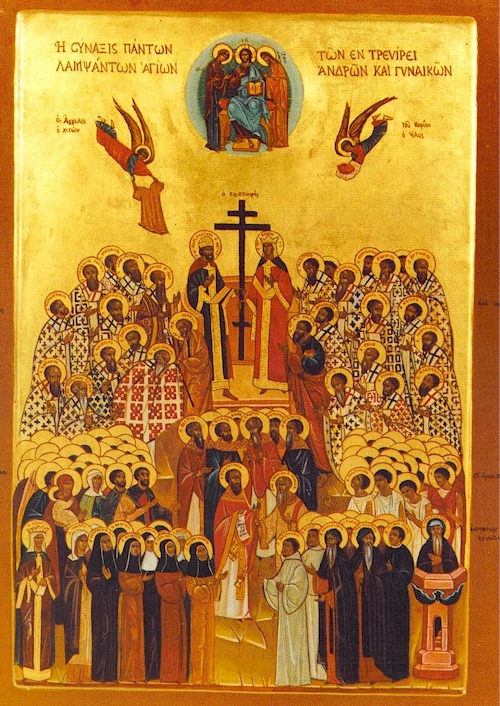
Brothers and sisters! Last week the Holy Church placed flowers in our hands, as if saying to us: See how soulless nature is obedient to its Creator. Starting with the days of Christmas, the earth has been turning toward the sun, which began to bestow upon the earth its life-giving warmth. And nature does not prove itself ungrateful toward its Creator. In answer to His caress, she has produced this glorious beauty, these flowers, and further on, will produce fruits. And what about us? In answer to the spiritual warmth of God’s Grace, so abundantly poured out on us, do we bring to our Creator spiritual beauty, flowers, fruits of virtues? After all, He became Man for our sake, died for us, rose for us, ascended into Heaven in order to send down to us His Holy Spirit. And what about us? Is not this beauty of nature around us a reproach to our conscience? Let us answer honestly. Yes, it is. But more than this, we want to justify our negligence, our ingratitude. The commandments of Christ are wonderful, we say; and if people would begin to fulfill them, then the whole earth would be transformed into a wonderful divine garden. But is this possible for weak human strength? And here this Sunday, the Sunday of All the Saints, answers this question loudly so that the whole world hears: Yes, it is possible.
All the saints being remembered today followed the example of Christ. And all of them in their time, in their circumstances of life, fulfilled God’s commandment of love of God and neighbor. Occasionally their times were difficult, maybe more difficult than ours; and not infrequently their circumstances in life were more dangerous in spiritual terms, and often in worldly terms were worse than ours. But they still proceeded, struggled, and reached the abodes on high where they now triumph.
Just look at the murals of our church and you will see them: martyrs, confessors, ascetics, fools for Christ, educated people, simple people, rich, poor, bishops, monastics, lay people. This is the Heavenly Church. She is all-embracing, and she is filled up by the earthly, Militant Church. There is room for each of us there. This is what today’s Apostle reading tells us: “Wherefore seeing we also are compassed about with so great a cloud of witnesses, let us lay aside every weight, and the sin which doth so easily beset us, and let us run with patience the race that is set before us, looking unto Jesus the author and finisher of our faith” (Heb. 12:1-2). Just think: all of these saints were live people like us. And like us, all of them were different people; and their paths were different. But all of them, absolutely all, had three qualities which they all possessed identically. These qualities are pointed out to us in today’s Gospel. They are obligatory for everyone, and this means for us, too; we cannot escape them. Here they are: ‘Whosoever therefore shall confess Me before men, him will I confess also before My Father, which is in heaven” (Mt. 10:32). This is the first thing. Don’t you feel, brothers, how important this is for us modern-day people? Why, the whole world around us as if asks us: “Are you Christian or one of ours?” We cannot leave this question unanswered. In our speech, our actions, our thoughts and feelings (for our feelings are somehow passed on to the others), we must answer loud and firm: “Yes, I am a Christian!”
Here is the second: “He that loveth father or mother more than Me is not worthy of Me: and he that loveth son or daughter more than Me, is not worthy of Me” (Mt. 10:37). Here and now, the Lord demands from you and me this all-consuming love – to love Him more than everyone and everything. And only through this love for Him will we really be able to love our relatives, strangers, and even our enemies.
Finally the third: “And he that taketh not his cross, and followeth after Me, is not worthy of Me” (Mt. 10:38). This instance does not even require explanation. Each of us has his own sorrows and difficulties in life; they are personal for each of us. It is difficult, burdensome, but such is our life; and this means, such is the Will of God for us.
Let us thank the Lord even for this cross! Without it we cannot be saved. And the Lord wants all of us to be saved, and to be united into one Triumph with all the Saints, whom we are glorifying today.
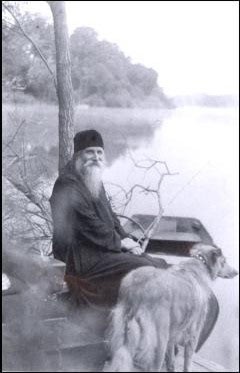
St. Luke Archbishop of Simferopol the Surgeon (1877-1961)
Feastday: June 11th (New Calendar), May 29th (Old Calendar)
(His apolytikion or troparion, as translated from the original Russian and included in the latest addition of the Blessed Surgeon book)
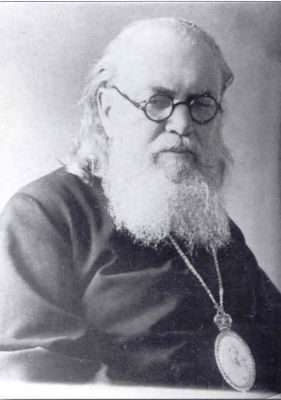
Troparion of St. Luke of Simferopol – Tone 1
O herald of the way of salvation, confessor and archpastor of the Crimean flock, faithful keeper of the traditions of the fathers, unshakeable pillar and teacher of Orthodoxy, pray unceasingly to Christ our Saviour to grant salvation and strong faith to Orthodox Christians, O holy hierarch Luke, physician wise in God.
On Science and Religion
By St. Luke, Archbishop of Crimea
“When we examine contemporary science as developed by scientists such as Lamark and Darwin, we see the antithesis and I would say the complete disagreement that exists between science and religion, on topics that concern the more basic problems of existence and knowledge. For this, an enlightened mind cannot accept at the same time both one and the other and must chose between religion and science”.
A well known German Zoologist, Ernst Haeckel (1834-1919), who was a good follower of Darwin, wrote these words some 65 years ago, in his book, “The Riddle of the Universe” that was very successful and as it seemed, had proved that faith is absurd. So says Haeckel that every enlightened man must chose between science and religion and should follow either one or the other. He considered it necessary that such men should deny religion because a logical man cannot deny science.
Truly, is this necessary? No, not at all, for we know that many and great scientists were at the same time great believers. For example, such was the Polish astronomer Copernicus who laid the foundation of all contemporary astronomy. Copernicus was not only a believer but was also a cleric. Another great scientist, Newton, whenever he mentioned the word God, he removed his hat. He was a great believer. A great bacteriologist of our time and almost a contemporary, Pasteur, who laid the basis of contemporary bacteriology, he would start every scientific work with a prayer to God. Some 10 years ago a great scientist passed away, who was our countryman, physiologist Pavlov, who was the creator of the new physiology of the brain. He too was a great believer. Would Haeckel therefore dare say that these men did not have enlightened mind because they believed in God?
So what happens now? Why even today there are some scientists, professors at Universities whom I personally know and are great believers. Why don’t all the scientists deny religion but only those who think the same as Haeckel? Because these people believe only in materials and deny the spiritual world, they do not believe in the after death life, they do not accept the immortality of the soul and of course they do not accept the resurrection of the dead. They say that science is capable of everything, that there is no secret in nature that science cannot discover. What can we answer to these?
We shall respond to them this way. You are totally right. We cannot limit the human mind that searches nature. We know that today, science knows only a part of the things we have of nature. We also understand that the possibilities of science are great. In this they are right and we don’t doubt it. What then do we doubt? Why don’t we deny religion like them and consider it contrary to scientific knowledge?
Just because we believe wholeheartedly that there is a spiritual world. We are certain that apart from the material world there is an infinite and incomparably superior spiritual world. We believe in the existence of spiritual beings that have higher intellect than us humans. We believe wholeheartedly that above this spiritual and material world there is the Great and Almighty God.
What we doubt is the right of science to research with its methods the spiritual world. Because the spiritual world cannot be researched with the methods used to research the material world. Such methods are totally inappropriate to research the spiritual world.
How do we know that there is a spiritual world? Who told us that it exists? If we are asked by people who do not believe in the Divine revelation, we shall answer them thus: “Our heart told us”. For there are two ways for one to know something, the first is that which is spoken by Haeckel, which is used by science to learn of the material world. There is however another way that is unknown to science, and does not wish to know it. It is the knowledge through the heart. Our heart is not only the central organ of the circulation system, it is an organ with which we know the other world and receive the highest knowledge. It is the organ that gives us the capability to communicate with God and the above world. Only in this we disagree with science.
Praising the great successes and achievements of science, we do not doubt at all its great importance and we do not confine the scientific knowledge. We only tell the scientists “You do not have the capability with your methods to research the spiritual world, we however can with our heart
There are many unexplainable phenomena which concern the spiritual world that are real (as are some type of material phenomena). There are therefore phenomena that science will never be able to explain because it does not use the appropriate methods.
Let science explain how the prophecies appeared on the coming of the Messiah, which were all fulfilled. Could science tell us how the great prophet Isaiah, some 700 years before the birth of Christ, foretold the most important events in His life and for which he was named the evangelist of the Old Testament? To explain the far sighted grace possessed by the saints and to tell us with which physical methods the saints inherited this grace and how they could understand the heart and read the thoughts of a person they had just met for the first time? They would see a person for the first time and they will call him by his name. Without waiting for the visitor to ask, they would answer on what troubled him.
If they can, let them explain it to us. Let them explain with what method the saints foretold the great historical events which were accurately fulfilled as they were prophesied. Let them explain the visitation from the other world and the appearance of the dead to the living.
They shall never explain it to us because they are too far from the basis of religion- from faith. If you read the books of the scientists who try to reconstruct religion, you will see how superficially they look at things. They do not understand the essence of religion yet they criticize it. Their criticism does not touch the essence of faith, since they are unable to understand the types, the expressions of religious feeling. The essence of religion they do not understand. Why not? Because the Lord Jesus Christ says “No one can come to me unless My Father who sent Me draws him to Me.(John 6:44)
So it is necessary that we be drawn by the Heavenly Father, it is necessary that the grace of the Holy Spirit enlighten our heart and our mind. To dwell in our heart and mind through this enlightenment, the Holy Spirit and the ones who were found worthy to receive the gift of the Holy Spirit, those in whose heart lives Christ and His Father, know the essence of faith. The others, outside the faith cannot understand anything.
Let us hear the criticism against Haeckel from a French philosopher Emile Boutroux (1845-1921). So says Boutroux, “The criticisms of Haeckel concern much more the ways, than the essence, which (the ways) he observes with such a materialistic and narrow view, that they cannot be accepted by religious people. Thus the criticism of religion by Haeckel is not referred to, not even in one of the principles that constitutes religion”.
This is therefore our opinion regarding Haeckel’s book “The Riddle of the Universe” which up to day is considered the “Bible” for all those who criticize religion, which they deny and find it contrary to science. Do you see how poor and tasteless arguments they use? Don’t become scandalized when you hear what they say about religion, since they themselves cannot understand its essence. You people, who may not have much of a relationship with science and do not know much about philosophy, remember always the most basic beginning, which was well known by the early Christians. They considered poor, the person who knew all the sciences yet he knew not God. On the other hand, they considered blessed the person who knew God, even if he knew absolutely nothing about the worldly things.
Guard this truth like the best treasure of the heart, walk straight without looking right or left. Let us not bother with what we hear against religion, losing our bearings. Let us hold on to our faith which is the eternal indisputable truth. Amen.
St Luke, Archbishop of Crimea,
Topics and Discussions,
“Orthodox Kypseli” Publications- Thessaloniki
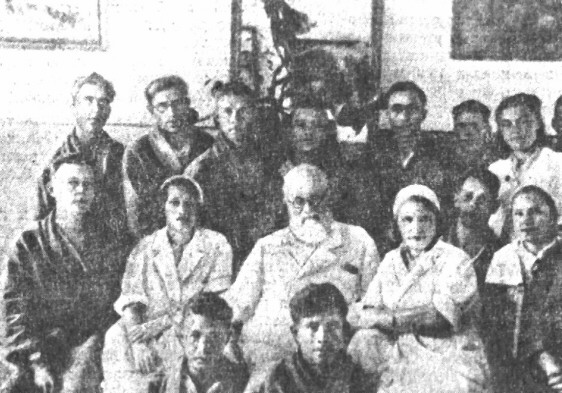
St. Luke Life
St. Luke was born Valentine of Felix Voino-Yassenetsky in Kertz on April 27th 1877. His mother was Orthodox, but later did not attend church, while his father, a Roman Catholic, was deeply pious and influenced Valentine very much. His faith was much influenced by both his proximity to the Holy Lavra of the Kiev Caves (which his family lived near) and a copy of the Holy Bible he received upon graduating High School. He had a great talent for and desire to pursue art, however, his desire to do something to help the poor peasants around him was overriding, and he attended medical school in Kiev, and graduated in 1903.
+
In 1904, the Russo-Japanese War brought Valentine to the Far East as a surgeon, where he met his future wife Anna Vasilievna Lanskaya. They married and had four children. During this time, as a surgeon, Valentine became specially trained in opthamological operations, along with regional anesthesia and the surgery of pyogenic infections (which later became areas of research for him). He also displayed immense faith in those difficult times. The family would entertain a nun from the Fiodorovski monastery once a month, and they would attending church regularly. Valentine also refused to perform an operation without first praying before an icon of the Theotokos in the operating room, and then signing the patient with iodine in the sign of the Cross. In fact, one time the Communist Party officials removed the icon, at which point Valentine refused to return to surgery until it would be returned. Soon, the wife of one of the party officials needed an operation, and specifically requested Valentine. He, however, refused to perform the surgery until the icon of the Panagia was returned. They complied with his request, and he returned to surgery.
+
Valentine’s wife, who came down with tuberculosis, died prematurely. Though Valentine grieved deeply for his wife, he was able to see the hand of the Lord guiding him even through this difficult time, both by Him choosing one of the nurses to help raise his children, and by calling him to the priesthood. In obedience to Archbishop Innocent, Valentine hastily followed Christ’s divine call, and was ordained a deacon on January 26th, and a priest on February 2nd, 1921. In fact, because of the need for a bishop, Fr. Valentine also obeyed the call of the people and underwent the monastic tonsure (being given the name “Luke”, as he resembled the Evangelist in many ways) and was consecrated a bishop.
+
This period of time was extremely difficult for the Russian Orthodox Church, as they were constantely being assulted from the right (zealots and schismatics) and from the left (the athiest government and their heretical “Living Church”). Because of St. Luke’s confessions of faith (and despite his immense medical and scientific achievements), he was imprisoned, tortured, and exiled for 11 years in total, to Siberia, and other trecherous locales. Besides persecution from the government, he had to deal with heretics from the “Living Church” who masqueraded as Orthodoxy and drew people away from the Church, and schismatic individuals who also caused unneeded harm in those turbulent years.
+
St. Luke’s virtues, struggles and achievements are staggering. As a Grace-filled hierarch of the Church, he re-opening many churches that had been closed by the Communists, produced deep theologic works, and supported the faithful while drawing many to Orthodoxy. In addition, his love, skill and devotion to his patients saved thousands, (especially injured soldiers in war), and his research techniques were award-winning, and were thought to still be recognized by his fellow surgeons fifty years later. After a lifetime of such medical accomplishments and spiritual struggles in his confession for the Faith, St. Luke reposed in the Lord as the Archbishop of Simferopol (Crimea) on June 11th (New Calendar) 1961.
+
St. Luke’s incredible virtues, love for the Lord and his fellow men, and accomplishments helped sustain the faithful immensely in those difficult days of the Atheist state. After his death, the Communist Party sought to use propaganda and intimidation to minimize his achievements, but the overwhelming love and devotion of the faithful thwarted their plans. Whereas the funeral procession was supposed to last a few minutes without psalmody or honor, it ended up lasting hours, as the faithful planted themselves around the hurse, and did not let it speed away to the cemetary. Miraculously, a huge flock of doves followed the procession from the church to the cemetary.
+
Later, the remains of St. Luke were disinterred, and it was found that his heart remained incorrupt. What a beautiful reminder of the never-ending love that he showed towards Christ and towards his fellow men, especially the sick and suffering! In November of 1995, he was proclaimed a Saint by the Ukranian Orthodox Church.
+
Besides being beloved in Russia and the Ukraine, St. Luke is also very well-loved in Greece. Specifically, the life of St. Luke, written by Archimandrite and Abbott of the Monastery of Sagmata, Nektarios Antonopoulos, has sold thousands of copies, and is in its 14th edition of printing. Many churches (some of them quite large) have been built in honor of St. Luke of Simferopol in Greece alone in recent years. The Monastery of Sagmata (outside of the city of Thebes in Greece) also houses relics of St. Luke, which there and everywhere continue to work many, many miracles through his intercessions.
+
One incredible miracle involved a young boy who was an excellent piano player. The tips of three of his fingers were cut off accidentally, and he was afraid that he would never be able to play piano again. After he and his grandmother prayed to St. Luke to help him, his fingers began to spontaneously regrow, and in 10 days, were totally normal! Today, the boy plays better with that hand than his other, unaffected hand.
+
May St. Luke, the great defender of Orthodoxy in these latter days, the wondrous healer of souls and bodies, the teacher, the hierarch, and the holy father, intercede with Christ for all of us! Amen!
(Retrieved from Full of Grace and Truth blog: http://full-of-grace-and-truth.blogspot.com/2008/10/st-luke-archbishop-of-simferopol.html)
The Saint’s last words
“My children, very much do I entreat you,
Arm yourselves with the armor that God gives, That you may withstand the devil’s tricks.
You can’t imagine how evil he is.
We don’t have to fight with people but with rulers and powers, in effect the evil spirits.
Take care!
It’s no use to the devil for anyone to think and feel
that he is close to him.
A hidden and unknown enemy is more dangerous than a visible enemy.
O how large and terrible is the army of the demons.
How numberless is their black horde!
Unchanged, untiring, day and night, seeking to push all of us who believe
in the name of Christ, to lure us on the road of unbelief, of evil and of impiety.
These unseen enemies of God have made their sole purpose, day and night to seek our destruction.
But do not be afraid, take power from the name of Jesus.”
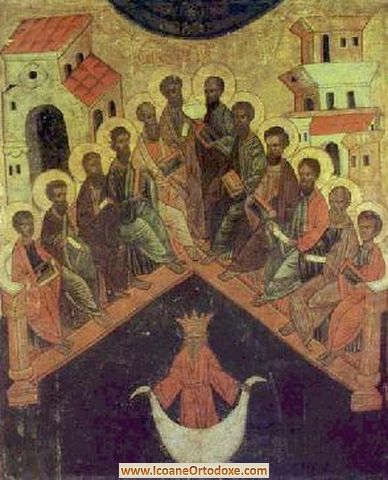
Prayer of the Holy Spirit
“Heavenly King, Comforter, the Spirit of Truth, everywhere present and filling all things, Treasury of blessings and Giver of life: come and abide in us, cleanse us from every impurity and save our souls, O Good One”.
The Feast of Holy Pentecost is celebrated each year on the fiftieth day after the Great and Holy Feast of Pascha (Easter) and ten days after the Feast of the Ascension of Christ. The Feast is always celebrated on a Sunday.
The Feast commemorates the descent of the Holy Spirit upon the Apostles on the day of Pentecost, a feast of the Jewish tradition. It also celebrates the establishment of the Church through the preaching of the Apostles and the baptism of the thousands who on that day believed in the Gospel message of salvation through Jesus Christ. The Feast is also seen as the culmination of the revelation of the Holy Trinity.
The descent of the Holy Spirit on the day of Pentecost brought the Perfect Love that could dwell in the hearts of Christians in the Church that the Holy Spirit founded for them that day. The God, Which had united with mankind in Jesus Christ, united mankind with the God in The Church. According to Saint Irenaeus of Lyons, the new fellowship of man with God was God’s adoption of man. The suffering of Jesus Christ relieved mankind of responsibility for all sins, lifting sinful people from death towards a truly moral and eternal life.
Christ has made possible the gift of these blessings to all men and women without exception. These blessings are not forcible thrust on anyone. But everyone in fellowship with Jesus Christ may have them; that is, everyone who tries to fulfill His commandments and who lives in the Church, nourished by Her holy Mysteries.
Fr. Peter Gilquist, 2008
Acts 2:1-11/John 7:37-52,8:12 Audio: Fr Peter Gilquist on Pentecost Sunday
Acquiring the Holy Spirit
(an excerpt from the Saint Seraphim of Sarov conversation with Motovilov)
“The true goal of our Christian life consists of acquiring God’s Holy Spirit. Fasting and vigil, prayer, mercy, and every other good deed performed for Christ — are means for acquiring the Holy Spirit of God. Only deeds performed for Christ give us the fruits of the Holy Spirit.
Some say that the foolish virgins lacking enough oil in their lamps is meant to be understood as a lack of good deeds (see Mt. 25:1-12). Such an understanding is not completely correct. How could there have been a lack of good deeds when they, though foolish, are still called virgins? For virginity is the highest virtue, as a state equal to the angels, and could by itself serve in place of all other virtues. I, the wretched, think that they did not have enough of the grace of the All-Holy Spirit of God. These virgins, because of their spiritual injudiciousness, supposed in performing good deeds that it is only necessary to do good works to be a Christian: “We performed a good deed and thus did God’s will.” Whether or not they had received the grace of the Holy Spirit, whether they had attained it, they did not even bother to find out … But, this acquiring of the Holy Spirit is in fact that oil which the foolish virgins lacked. They are called foolish because they forgot about the essential fruit of virtue — the grace of the Holy Spirit — without which there is no salvation for anyone and cannot be. For “through the Holy Spirit every soul is quickened, and through its purification, it is exalted and illumined by the Triune Unity in a Holy mystery.” The Holy Spirit Himself settles in our souls, and this occupation of our souls by Him, the All-Ruling, and this coexistence of our spirit with His One Trinity, is granted only through the diligent acquiring, on our part, of the Holy Spirit, which prepares, in our soul and body, the throne for the coexistence of God the All-Creator with our spirit, by the immutable word of God: “And I will walk among you and will be your God, and ye shall be my people” (Lev. 26:12).
This is the very oil in the lamps of the wise virgins, which burned brightly and steadily; the virgins with these burning lamps could await the Groom coming at midnight, and enter the chamber of joy with him. The foolish ones, seeing their lamps going out, though they went to the market to buy oil, did not manage to return in time, for the doors were already locked. The market is our life; the doors of the bridal chamber — locked and not permitting entrance to the Groom — human death, the virgins wise and foolish, Christian souls; the oil, not deeds, but the grace of the All Holy Spirit of God received through them, transforming from decay to incorruption, from emotional death into spiritual life, from darkness to light, from the manger of our existence, where our passions are tied like beasts and animals, into a church of God, into the all-lighted chamber of eternal joy in Jesus Christ.”
(From the book St. Seraphim of Sarov, Life and Teachings by Bishop Alexander (Mileant). Translated by Nicholas and Natalia Semyanko).
 Christian Dogma
 Christian Martyrs
 Christian Orthodox Churches and Monasteries
 Christian Sermons and News
 Church's Teachings on Fasting
 Ecumenism – a Great Heresy
 Father George Calciu
 Life_a Sacred Gift form God
 Orthodox Saints and Church Fathers
 Spiritual Elders
 Daily Bible Readings
 Journey to Orthodoxy
 Listen to Ancient Faith Radio
 Orthodox Calendar of Feasts and Saints
 Orthodox Christian Mission Center
 Orthodox Institute
 OrthodoxChristianNetwork TV


Recent Comments