
You are currently browsing the daily archive for June 14, 2009.
Fast of the Holy Apostles Peter and Paul
(June 15 – June 28)
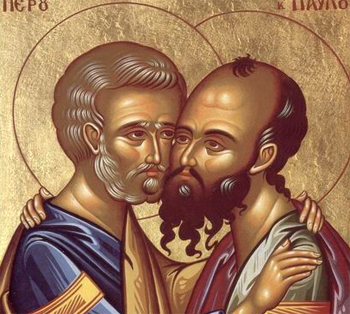
The Podvig of the Apostles’ Fast is less strict than during Great Lent: We abstain from eating meat and dairy products throughout the Fast. The Church ustav also provides that, on Mondays, Wednesdays and Fridays during the Apostles’ Fast, we abstain from consuming fish, wine and oil; on the other days of the week, Tuesday and Thursday, we abstain from eating fish. Eating fish is permitted on Saturdays and Sundays, on days commemorating certain great Saints, and on the Feast of the Nativity of St. John the Baptist (7 July).
Teachings of St. Seraphim of Sarov on Fasting
Fasting consists not just of eating rarely, but also of eating little. And not just in eating only one meal, but in not eating much. Foolish is the faster, who waits for a specific time [to eat a meal], but then at the time of the meal is completely consumed, body and mind, with insatiable eating.
In proportion to how the body of the faster becomes thin and light, so the spiritual life attains perfection and reveals itself in wonderful ways. Then the soul acts as if in an incorporeal body. Carnal feelings are shut off, and the spirit, released from the world, ascends to heaven and completely immerses itself in contemplation of the spiritual world.
Every day one should partake of just enough food to permit the body, being fortified, to be a friend and helper to the soul in performing the virtues. Otherwise, with the body exhausted, the soul may also weaken.
Lessons from the Fathers. Fasting
There is both a physical and a spiritual fast. In the physical fast the body abstains from food and drink. In the spiritual fast, the faster abstains from evil intentions, words and deeds. One who truly fasts abstains from anger, rage, malice, and vengeance. One who truly fasts abstains from idle and foul talk, empty rhetoric, slander, condemnation, flattery, lying and all manner of spiteful talk. In a word, a real faster is one who withdraws from all evil.
As much as you subtract from the body, so much will you add to the strength of the soul.
* * *
By fasting it is possible both to be delivered from future evils and to enjoy the good things to come. We fell into disease through sin; let us receive healing through repentance, which is not fruitful without fasting.
* * *
True fasting lies is rejecting evil, holding one’s tongue, suppressing one’s hatred, and banishing one’s lust, evil words, lying, and betrayal of vows. (Holy Hierarch Basil the Great)
Do you fast? Then feed the hungry, give drink to the thirsty, visit the sick, do not forget the imprisoned, have pity on the tortured, comfort those who grieve and who weep, be merciful, humble, kind, calm, patient, sympathetic, forgiving, reverent, truthful and pious, so that God might accept your fasting and might plentifully grant you the fruits of repentance.
Fasting of the body is food for the soul.
* * *
It is necessary most of all for one who is fasting to curb anger, to accustom himself to meekness and condescension, to have a contrite heart, to repulse impure thoughts and desires, to examine his conscience, to put his mind to the test and to verify what good has been done by us in this or any other week, and which deficiency we have corrected in ourself in the present week. This is true fasting.
* * *
As bodily food fattens the body, so fasting strengthens the soul; imparting it an easy flight, it makes it able to ascend on high, to contemplate lofty things and to put the heavenly higher than the pleasant and pleasurable things of life.
* * *
The point is not only that we should come to church each day, that we should continually listen to one and the same thing, and that we should fast for the whole Forty Days. No! If we, from continually coming here and listening to the teaching, do not acquire anything and do not derive any good for our soul from the time of the fast all this does not procure for us any benefit, but rather serves for our greater condemnation, when despite such concern for us by the Church we remain just the same as before.
Do not say to me that I fasted for so many days, that I did not eat this or that, that I did not drink wine, that I endured want; but show me if thou from an angry man hast become gentle, if thou from a cruel man hast become benevolent. If thou art filled with anger, why oppress thy flesh? If hatred and avarice are within thee, of what benefit is it that thou drinkest water? Do not show forth a useless fast: for fasting alone does not ascend to heaven.
* * *
Fasting is wonderful, because it tramples our sins like a dirty weed, while it cultivates and raises truth like a flower. (Holy Hierarch John Chrysostom)
Whosoever rejects the fasts, deprives himself and others of weapons against his own much-suffering flesh and against the devil, who have power over us especially as the result of our intemperance.
* * *
We are told: It is no big deal to eat non-Lenten food during Lent. It is no big deal if you wear expensive beautiful outfits, go to the theater, to parties, to masquerade balls, use beautiful expensive china, furniture, expensive carriages and dashing steeds, amass and hoard things, etc. Yet what is it that turns our heart away from God, away from the Fountain of Life? Because of what do we lose eternal life? Is it not because of gluttony, of expensive clothing like that of the rich man of the Gospel story, is it not because of theaters and masquerades? What turns us hard-hearted toward the poor and even toward our relatives? Is it not our passion for sweets, for satisfying the belly in general, for clothing, for expensive dishes, furniture, carriages, for money and other things? Is it possible to serve God and mammon, to be a friend to the world and a friend to God, to serve Christ and Belial? That is impossible.
Why did Adam and Eve lose paradise, why did they fall into sin and death? Was it not because of one evil? Let us attentively consider why we do not care about the salvation of our soul, which cost the Son of God so dearly. Why do we compound sin upon sin, fall endlessly into opposing to God, into a life of vanity? Is it not because of a passion for earthly things and especially for earthly pleasures? What makes our hearts become crude? Why do we become flesh and not spirit, perverting our moral nature? Is it not because of a passion for food, drink, and other earthly comforts? How after this can one say that it does not matter whether you eat non-Lenten food during Lent? The fact that we talk this way is in fact pride, idle thought, disobedience, refusal to submit to God, and separation from Him. (Holy Righteous John of Kronstadt)
The greatest of the virtues is prayer, while their foundation is fasting.
* * *
The reason that fasting has an effect on the spirits of evil rests in its powerful effect on our own spirit. A body subdued by fasting brings the human spirit freedom, strength, sobriety, purity, and keen discernment. (Holy Hierarch Ignaty Brianchaninov)
If thou, O man, dost not forgive everyone who has sinned against thee, then do not trouble thyself with fasting. If thou dost not forgive the debt of thy brother, with whom thou art angry for some reason, then thou dost fast in vain God will not accept thee. Fasting will not help thee, until thou wilt become accomplished in love and in the hope of faith. Whoever fasts and becomes angry, and harbors enmity in his heart, such a one hates God and salvation is far from him. (Venerable Ephraim the Syrian)
A excellent faster is he who restrains himself from every impurity, who imposes abstinence on his tongue and restrains it from idle talk, foul language, slander, condemnation, flattery and all manner of evilspeaking, who abstains from anger, rage, malice and vengeance and withdraws from every evil.
* * *
Let thy mind fast from vain thoughts; let thy memory fast from remembering evil; let thy will fast from evil desire; let thine eyes fast from bad sights: turn away thine eyes that thou mayest not see vanity; let thine ears fast from vile songs and slanderous whispers; let thy tongue fast from slander, condemnation, blasphemy, falsehood, deception, foul language and every idle and rotten word; let thy hands fast from killing and from stealing another’s goods; let thy legs fast from going to evil deeds: Turn away from evil, and do good. (Saint Tikhon of Zadonsk)
Seest thou what fasting does: it heals illnesses, drives out demons, removes wicked thoughts, makes the heart pure. If someone has even been seized by an impure spirit, let him know that this kind, according to the word of the Lord, “goeth not out but by prayer and fasting” (Matthew 17:21). (Saint Athanasius the Great)
The strictness of the Quadragesima [the Forty Days] mortifies the passions, extinguishes anger and rage, cools and calms every agitation springing up from gluttony. And just as in the summer, when the burning heat of the sun spreads over the earth, the northern wind renders a benefaction to those who are scorched, by dispersing the sultriness with a tender coolness: so fasting also provides the same, by driving out of bodies the burning which is the result of overeating. (Saint Asterius of Amasia)
Fasting is the mother of health; the friend of chastity; the partner of humblemindedness (illnesses are frequently born in many from a disorderly and irregular diet). (Venerable Simeon, the New Theologian)
Give the body as much food as it needs, and thou shalt receive no harm, even if thou shouldest eat three times a day. If a man eats but once a day, but undiscerningly, what benefit is there to him from that. The warfare of fornication follows excess in eating – and after this the enemy weighs down the body with sleep in order to defile it. (Saints Barsanuphius and John)
As a flame of fire in dry wood, so too is a body with a full belly.(Venerable Isaac the Syrian)
Always establish one and the same hour for taking food, and take it for fortifying the body and not for enjoyment. (Venerable Anthony the Great)
Do not neglect the Forty Days; it constitutes an imitation of Christ’s way of life. (Saint Ignatius the Godbearer)
The holy fasters did not approach strict fasting suddenly, but little by little they became capable of being satisfied by the most meagre food. Despite all this they did not know weakness, but were always hale and ready for action. Among them sickness was rare, and their life was extraordinarily lengthy. To the extent that the flesh of the faster becomes thin and light, spiritual life arrives at perfection and reveals itself through wondrous manifestations, and the spirit performs its actions as if in a bodiless body. External feelings are shut off, and the mind that renounces the earth is raised up to heaven and is wholly immersed in the contemplation of the spiritual world. (Venerable Seraphim of Sarov)
The more days of fasting there are, the better the healing is; the longer the period of abstinence, the more abundant the gain of salvation is. (Blessed Augustine)
Fasts do not shorten a man’s life. Venerable Symeon the Stylite lived for 103 years, Saint Cyril the Anchorite lived 108 years, Saint Alypius the Stylite 118, Venerable John the Silent 104 years, Anthony and Theodosius the Great for 105 years, Venerable Paul of Thebes 113, Paul of Komel 112, Venerable Macarius of Alexandria 100, Venerable Sergius of Radonezh 78, Venerable Cyril Belozersky 90, Macarius Zheltovodsky 95.
Would the good people who are outside the Church be saved?
Question
Just finished reading the article: “The Guru, the youth and Elder Paissios. I had employees who worked for me who were Hindu by birth, and who were good people. I could say I am a greater sinner than them, especially because I am Orthodox. How could such a situation exist, for good and just people due to their place of birth not to have the possibility to get to know Christ? Are they demonized? If they are, then I am afraid I am too, since they are truly better, more humble than me. This puzzle bothers me a lot. I hope you are able to answer me. Forgive me.
Dear Mr…,
Christ is Risen!
We wish you good spiritual and physical health. We are happy for your interest on topics of Faith but also for your obvious love for your fellow man. Your query which you sent through the internet causes puzzlement to many Orthodox. However should it be so? Could it be that the question transcends our level of understanding or perhaps it falls under the transcendent jurisdictions of someone else? Let us make some simple considerations taking advantage of some passages in the Holy Bible, always being based on the Holy Tradition of the Church of Christ, the one and only Orthodox Church.
Some famous teacher of theology was specifically questioned by his students: “Would all those who are outside the Church, not having known Christ but being good people, be saved?” The answer provided was simple, yet it had unrivalled spiritual depth: “We who are in the Church, would we be saved?” naturally meaning, does our work conform to the Will of God? To a similar question by Peter- on what would be the future of John-the Lord responds with the known: “What is it to you? You follow Me (John 21, 20-23). He lets him know directly that it is not his concern what would happen to someone else. This is a topic that without exception belongs to the just Judge Himself. His duty as is of each disciple from the earliest times is to follow Him. To walk always on the road which He traced and to have as his only aim in life the cleansing of his mind and heart of the passions and sins and his enlightenment by the Holy Spirit so that he may become a worthy son of God, to unite with God, to obtain theosis. This is the meaning and aim of the “follow Me”, always going together with the carrying of our cross (Matt 16: 24-25).
The understanding of the distancing from all those things that belong in the sphere of the absolute knowledge of God is a little bit difficult for our curious mind to accept. However, even this can be achieved – as it happens with the acceptance of all the holy dogmas- through the steadfast and at the same time unadulterated faith to the Heavenly Father and provider of everything. This disposition is not a passive and fatalistic stance but a position of life, true life. For the one who follows Christ is not just a follower but an enlightened man (John 8:12) by the true Light.
This Lord therefore, the Truth and the Life (John 14:6) declares to us beyond any doubt that “he who believes and is baptized is saved, he who does not believe will be condemned” (Mark 16: 16). That is what we know, that is what is certain for us His disciples. For the rest it is safer to declare ignorance (we have explained this position in the previous paragraph). Of course we do not condemn someone, wherever he may belong, whatever he may have done. His “I believe” is condemned as false, his action is condemned as unbecoming or sinful but not the person. This is the area of the Judge, of our Lord Jesus Christ.
Also, specific to your question if believers of other religions are demonized, there is no teaching within the Church which states that whoever is heretic or believer of other religions is certainly overcome by unclean spirits. Of course a faith to something foreign to Christ without doubt constitutes the understanding “of the one against” and it is understood that the followers of other religions or dogmas are easily exposed to the influence of the evil spirits. This is inevitable since they do not partake in the One faith of the One Triadic God and have received a baptism (Eph 4:5) which restores and protects man (John 3:5) (in the passages of 1John 4:2-3 and Ps 95:5 you may find what the word of God says of those who do not believe in Him).
The solution to this general puzzlement resides, as was analyzed to the abandoning of this problematic interest for our fellow man. This way we do not suggest indifference but through the warm love for Christ, the total surrender of every one of our brothers to the certain, just and full of loving providence of our Holy God. This is achieved through pure prayer that is realized with faith and longing with restlessness and spiritual suffering not on the if they will be saved or not, all those who ignore the Truth (=Christ) but on the when every man will come to know the Truth and will unite with Him , becoming member of His Church. This way we become imitators of Christ, for He is the first One who desires the salvation of everyone. (“(God) wishes to save all the people and come to the truth” 1Tim 2:4).
The “father of lies” however does not cease setting obstacles, misleading us into false directions which of course do not agree with whatever Christ taught. This view of the “good man” happens unfortunately to be widely spread. Something so relevant – since everyone considers whatever he does is correct- that it whittles away the meaning of the Bible. The goal of the Christian struggle is not for us to become good and moral men, which can also be taught by some man made philosophy, what is required is to become HOLY. Our Christ tells us clearly “become holy as I am holy” 1Pet. 1:16. If goodness was enough, who of us would it not have been necessary for God Himself to be incarnated to save us. We must understand that sin does not mean some sort of deviation from certain rules but exists as a separation and denial of our Heavenly Father. So, therefore, what we all need, whether “good” or “bad”, whether great sinners or small sinners, is for a frank and continuous repentance. Namely, the awareness of our wretchedness, its confession and supplication for forgiveness through the Mystery of Confession and finally our re-unification with the Good Father.
To make it easier to understand the above suffice to think of who was the first resident of Paradise. The robber who was crucified on the right side of Jesus. Was he perhaps a good man? No! He was a violent criminal who however repented! In any case the teaching of the prophets and especially of Christ – and as a result of the whole Church- is an open and continuous invitation to repentance (Matt 4:17)
The good deeds, my brother, do not save. The Grace of our God saves, which acts over us when we draw her through humility (goodness fully tried with repentance) (Prov. 3:34).
Again however, someone may agree with the above but still wonder how those who never heard of Christ know all these. Just earlier we explained that we should act as true Christians for the benefit of all the people. Are things so simple and shallow? Permit me to submit two well known examples from the Holy Bible that have taught a lot on this topic.
The first refers to the turning back of the Apostle to the Nations, Paul (Acts 9:1-18). He not only he did not know who was truly Christ but he so morbidly hated Him that he persecuted with vengeance the Christians. His soul however had a zeal for the true God and whatever he did was through demonic deceit and ignorance. Thus, Christ Himself appeared to him and revealed Himself to him. Immediately, he believed in Him, repented and embraced Him forever. Second similar example consists of the knowledge of the true Faith of the Ethiopian of Candac (Acts8, 26-39). A total stranger to the truth. His wish for the divine led him to embrace the faith of the Jews (the single faith to the true God before the coming of Christ). It would have been easy for him to remain attached there. However, his true zeal was attracted by the Holy Spirit that sent Deacon Philip to catechize and baptize him.
We see therefore that the Ever-loving God does not only set general preachers of His Holy Bible but is involved separately with every soul. He, of course knows the how, the when and the why to act. The word of our God informs us that even the hair of our head are counted (matt 10:30)! Oh! All pure Lord what providence, what love and what condescension and affection! You who are concerned with our useless hair with how much greater care You must envelop our soul!
We hope you were helped with what you read. More will be accomplished with faith and prayer. You may get in touch with us on whatever topic you wish.
May God bless you! Good strength in your struggle for Christ.
With blessings
The Abbot
† Archimandrite Kyrill.
(Retrieved from The Holy Monastery of Pantocrator, Holy Land website: http://www.impantokratoros.gr/E5E9E2B0.en.aspx)
Homily From “The One Thing Needful,” Sermons of Archbishop Andrei (Rymarenko)
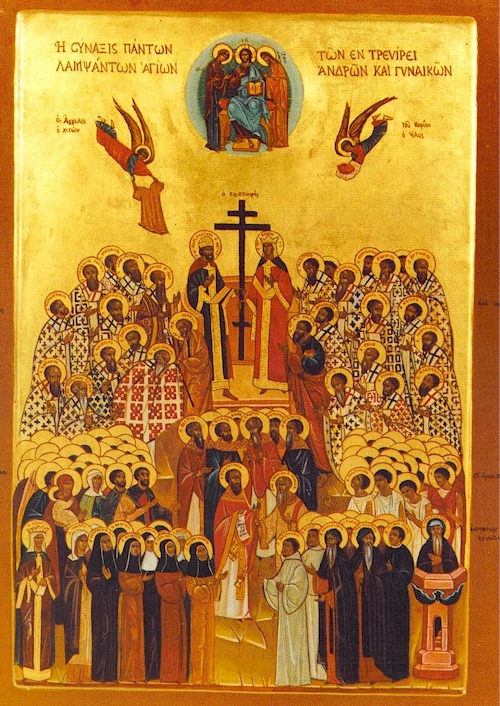
Brothers and sisters! Last week the Holy Church placed flowers in our hands, as if saying to us: See how soulless nature is obedient to its Creator. Starting with the days of Christmas, the earth has been turning toward the sun, which began to bestow upon the earth its life-giving warmth. And nature does not prove itself ungrateful toward its Creator. In answer to His caress, she has produced this glorious beauty, these flowers, and further on, will produce fruits. And what about us? In answer to the spiritual warmth of God’s Grace, so abundantly poured out on us, do we bring to our Creator spiritual beauty, flowers, fruits of virtues? After all, He became Man for our sake, died for us, rose for us, ascended into Heaven in order to send down to us His Holy Spirit. And what about us? Is not this beauty of nature around us a reproach to our conscience? Let us answer honestly. Yes, it is. But more than this, we want to justify our negligence, our ingratitude. The commandments of Christ are wonderful, we say; and if people would begin to fulfill them, then the whole earth would be transformed into a wonderful divine garden. But is this possible for weak human strength? And here this Sunday, the Sunday of All the Saints, answers this question loudly so that the whole world hears: Yes, it is possible.
All the saints being remembered today followed the example of Christ. And all of them in their time, in their circumstances of life, fulfilled God’s commandment of love of God and neighbor. Occasionally their times were difficult, maybe more difficult than ours; and not infrequently their circumstances in life were more dangerous in spiritual terms, and often in worldly terms were worse than ours. But they still proceeded, struggled, and reached the abodes on high where they now triumph.
Just look at the murals of our church and you will see them: martyrs, confessors, ascetics, fools for Christ, educated people, simple people, rich, poor, bishops, monastics, lay people. This is the Heavenly Church. She is all-embracing, and she is filled up by the earthly, Militant Church. There is room for each of us there. This is what today’s Apostle reading tells us: “Wherefore seeing we also are compassed about with so great a cloud of witnesses, let us lay aside every weight, and the sin which doth so easily beset us, and let us run with patience the race that is set before us, looking unto Jesus the author and finisher of our faith” (Heb. 12:1-2). Just think: all of these saints were live people like us. And like us, all of them were different people; and their paths were different. But all of them, absolutely all, had three qualities which they all possessed identically. These qualities are pointed out to us in today’s Gospel. They are obligatory for everyone, and this means for us, too; we cannot escape them. Here they are: ‘Whosoever therefore shall confess Me before men, him will I confess also before My Father, which is in heaven” (Mt. 10:32). This is the first thing. Don’t you feel, brothers, how important this is for us modern-day people? Why, the whole world around us as if asks us: “Are you Christian or one of ours?” We cannot leave this question unanswered. In our speech, our actions, our thoughts and feelings (for our feelings are somehow passed on to the others), we must answer loud and firm: “Yes, I am a Christian!”
Here is the second: “He that loveth father or mother more than Me is not worthy of Me: and he that loveth son or daughter more than Me, is not worthy of Me” (Mt. 10:37). Here and now, the Lord demands from you and me this all-consuming love – to love Him more than everyone and everything. And only through this love for Him will we really be able to love our relatives, strangers, and even our enemies.
Finally the third: “And he that taketh not his cross, and followeth after Me, is not worthy of Me” (Mt. 10:38). This instance does not even require explanation. Each of us has his own sorrows and difficulties in life; they are personal for each of us. It is difficult, burdensome, but such is our life; and this means, such is the Will of God for us.
Let us thank the Lord even for this cross! Without it we cannot be saved. And the Lord wants all of us to be saved, and to be united into one Triumph with all the Saints, whom we are glorifying today.
 Christian Dogma
 Christian Martyrs
 Christian Orthodox Churches and Monasteries
 Christian Sermons and News
 Church's Teachings on Fasting
 Ecumenism – a Great Heresy
 Father George Calciu
 Life_a Sacred Gift form God
 Orthodox Saints and Church Fathers
 Spiritual Elders
 Daily Bible Readings
 Journey to Orthodoxy
 Listen to Ancient Faith Radio
 Orthodox Calendar of Feasts and Saints
 Orthodox Christian Mission Center
 Orthodox Institute
 OrthodoxChristianNetwork TV


Recent Comments