
You are currently browsing the daily archive for June 28, 2009.
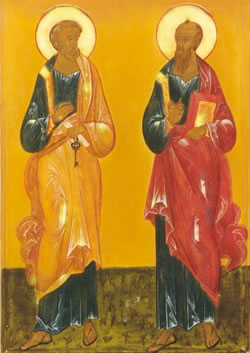
Sts Peter and Paul
With what Crowns of Praise?
Audio links: Ft Hopko – Feast of St Peter and Paul
Keys to the Kingdom – St. Peter
Chosen Instrument of Mine – St. Paul
And a Sermon By His Grace Bishop Joseph of Arianzos
With what crowns of praise Shall we crown Peter and Paul?… The former as the leader of the Apostles the latter as the one who toiled more than the others.
June is always marked by the festive commemoration of the Holy Apostles Peter and Paul which is observed by our Church on the 29th day, and indeed after fasting in honour of the chief Apostles.
The 29th of June, certainly is not the day they suffered martyrdom. Rather it is the day that in 258 AD, Pope Sixtus II transferred their very sacred relics to the catacomb of St. Sebastian in Rome. Since then, this day, as a day of common honour for both Apostles, overshadowed the day of their individual martyrdom and so from ancient times the Church honours Peter and Paul together. Not only with a common feast day but also with a common fasting period for both. Indeed the fasting period -to note as a parenthesis- during which eating fish is also permitted on Saturday and Sunday [according to a stricter tradition] or on all the days of the week except Wednesday and Friday [according to a more lenient tradition], starts on Monday after the Sunday of All Saints and ends on the 28th of June. But if Easter falls on the 3rd of May or later then there is no fast for the feast of the Apostles).
Our Church also honours them with Icons which depict the two together, either embracing themselves in a brotherly love in Christ or holding in their hands the Church in the form of a small Byzantine church so emphasising the unity of the faith and the unity of the Church mainly consisting of two different elements: The old Israel (the Jews) to whom, in the main, the missionary work of Peter was directed at, and the Gentiles (the Pagans) who correspondingly were the objects of Paul’s missionary work. Also they are honoured with common churches named after both of them. And with common hymns like the one of the vespers of their feast which we have placed as the beginning of these humble lines.
*********
With what crowns of praise shall we crown Peter and Paul? What worthy words can one find to laud the chiefs of the Apostles? What forms and ornaments of speech can one employ? What kind of poetic blossom would he gather to dedicate to them?
What can be worthy for Peter, who, when he declared that our Lord is ‘Christ the Son of the Living God” (Matthew l6:16), revealed the unshakeable stone onto which is founded and based the true faith of those who are saved and thus he himself at the same time became the first stone of the spiritual edifice of the Church?
What can stand worthy to praise “the imprisonment in various cities and the af-flictions” of Paul “the hard work and toil, the sleeplessness the sufferings of hunger and thirst, the cold and nakedness, the bas-ket, the beatings with a stick, the stoning, the journeying, the death of the sea, the shipwreck” that he endured “so that he would win people for Christ Jesus his Lord” as the muse of St. Andrew, Archbishop of Crete is wondering?
How can you praise the “Mouth of the Apostles” who “lifted up his voice and said to them” (Acts 2:14) in front of the crowd on the day of Pentecost and as many as heard this first holy divine voiced sermon of his “were pricked in their hearts” (Acts 2:41) and were baptised “and the same day these were added three thousand souls” to the Church? (Acts 2:41).
How can you praise the God-called “Teacher of the Churches who ” made all things to all men that he might by all means save them”? (1 Corinthians 9:22).
What can you first bring to memory about Peter and laud him? The enthusiasm? The humility? The saving and redeeming tears of repentance after that third “I do not know this man”? (Matthew 26:75) After this denial his complete dedication to the Godman and his triple confession of love to Him for which he heard from His mouth “feed my lambs” and “feed my sheep”? (John 21:15-17). His God-wise teaching which is contained in his two General Epistles or his all holy martyrdom for Christ in the “Eternal City” where he irrigated with his scarlet blood the newly grown tree of the Church of Rome?
What can you first call to mind about Paul and praise him? His godly zeal with which he repeatedly travelled round the Mediterranean with infinite dangers, hardships and problems in order to evangelise to its people the salvation in Christ? His patience to the “thorn in the flesh” which God granted to him to buffet him for life? (2 Corinthians 12: 7-10). His courage in front of the rulers of this world?
His politeness which made him respect even the high priest of the Judeans who transgressed the law? (Acts 23:5). The bottomless depth of his humility by reason of which, when he remembers the time that he was an enemy of the Church, he calls him-self “as one born out of due time” (1 Corinthians 15:8) and “least of the Apostles” and he comes to say “I am not great to be called an Apostle because I persecuted the Church of God? (1 Corinthians 15:9). His care and the unquenchable interest and fatherly anxiety for the spiritual development of the faithful and the support of the churches at different places as it is so characteristically evident from “by the space of these years I ceased not to warn everyone night and day with tears (Acts 20:31) and from the most affectionate “my little children of whom I travail in birth again until Christ is formed in you (Galatians 4:19) and the so responsible “that which comes upon me daily, the care of all churches” (2 Corinthians 21:28). His perfect love which compelled him to say that unrepeated “who is weak and I am not weak? Who is offended and I burn not?” (2 Corinthians 21:29). His laboriousness and the refinement of his soul which made him, despite the burden of the Apostolic duties to also pursue the humble craft of the tent maker in order to procure himself “food and clothing” so that he could preach without expense the Gospel “and not to be burden to anybody. His not loving money which made him say with modesty “I have coveted no man’s silver, or gold or apparel (Acts 20:33). Which of his virtues and which of his graces would you first bring to your memory? Only you stop at his last sacrifice, the culmination of all his unrending, unceasing throughout his life sacrifices for Christ, the sacrifice of his blood under the sword of Nero and you stop going any further by respecting the greatness of the all holy man.
With such facts on the one hand and the writer of this not having the necessary prerequisites to attempt to say words worthy of the “holy luminaries of the world” on the other, it naturally follows that the say should be given to the holy hymnographer of the Church, who expresses the voice and the conscience of her holy Body, to conclude these poor and unworthy lines with the idiomelo of Psalm 50 of the Orthros of the feast of the Apostles:
“Peter, the leader of the glorious Apostles the rock of the faith and Paul divine of the holy Church the orator and luminary who stand beside the divine throne, Intercede for us”.
from The Orthodox Messenger, v. 8(7-8)
“The light of the body is the eye: if therefore your eye be single, your whole body shall be full of light. But it your eye be evil, your whole body shall be full of darkness. If therefore the light that is in you be darkness, how great is that darkness!”
(Matthew 6:22-23)
The single eye is the love unfeigned; for when the body is enlightened by it, it sets forth through the medium of the outer members only things which are perfectly correspondent with the inner thoughts. But the evil eye is the pretended love, which is also called hypocrisy, by which the whole body of the man is made darkness. We have to consider that deeds meet only for darkness may be within the man, while through the outer members he may produce words that seem to be of the light: for there are those who are in reality wolves, though they may be covered with sheep’s clothing. Such are they who wash only the outside of the cup and platter, and do not understand that, unless the inside of these things is cleansed, the outside itself cannot be made pure. Wherefore, in manifest confutation of such persons, the Saviour says: If the light that is in you be darkness, how great is that darkness! That is to say, if the love which seems to you to be light is really a work meet for darkness, by reason of some hypocrisy concealed in you, what must be your patent transgressions!
(St. Gregory Thaumaturgus)
“No man can serve two masters: for either he will hate the one, and love the other; or else he will hold to the one, and despise the other. Ye cannot serve God and mammon. Therefore I say unto you, Take no thought for your life, what ye shall eat, or what ye shall drink; nor yet for your body, what ye shall put on. Is not the life more than meat, and the body than raiment? Behold the fowls of the air: for they sow not, neither do they reap, nor gather into barns; yet your heavenly Father feedeth them. Are ye not much better than they? Which of you by taking thought can add one cubit unto his stature? And why take ye thought for raiment? Consider the lilies of the field, how they grow; they toil not, neither do they spin: And yet I say unto you, That even Solomon in all his glory was not arrayed like one of these. Wherefore, if God so clothe the grass of the field, which to day is, and to morrow is cast into the oven, shall he not much more clothe you, O ye of little faith? Therefore take no thought, saying, What shall we eat? or, What shall we drink? or, Wherewithal shall we be clothed? (For after all these things do the Gentiles seek:) for your heavenly Father knoweth that ye have need of all these things. But seek ye first the kingdom of God, and his righteousness; and all these things shall be added unto you.”
Matthew 6:24-33
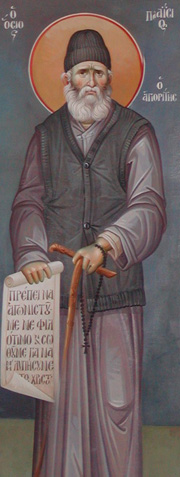
Too Many Worries Make People Forget God
An Excerpt from “With Pain and Love for Contemporary Man”
by Elder Paisios of Mount Athos (Holy Monastery “Evangelist John the Theologion”, 2006)
– Geronda (spiritual elder in Greek), does worrying about too many things take us away from God?
– Look, let me try to explain. When a little child is playing and is all absorbed with his toys, he s not aware that his father may be next to him caressing him. If he interrupts his play a bit, then he will become aware of his father’s caresses. Similarly, when we are preoccupied with too many activities and are anxiously concerned about them, when we worry too much about worldly matters, we cannot become aware of God’s love. God gives but we do not sense it. Be careful not to waste your precious energy on redundant worries and vanities, which will turn to dust one day. When you do this, you not only tire your body, but you also scatter your mind aimlessly, offering God only your fatigue and yawns at the time of prayer – much like the sacrifice offered by Cain. It follows that your inner state will be like that of Cain’s, you will be full of anxiety and sighs provoked by the devil standing by your side.
You must not waste aimlessly the fruit, the inner cure of our power and then leave the shells for God. The many cares of life sap the marrow of our heart and leave nothing for Christ. If you notice that your mind constantly wanders off to various chores that you have to do, you must realize that you are not doing well spiritually, and this should alarm you because you have distanced yourself from God. You must realize that you are closer to material things than you are to God, closer to creation than to Creator. (…)
We must learn to care about things in the right way
If we seek above all the Kingdom of Heaven and that’s all we care for, the rest will be given to us (Cf. Mt 6:33, Lk 12:13). If we become forgetful, then not only do we waste our time but we waste our own self. When we remain mindful and prepare for the next life, than this life too will become meaningful. When we start thinking of the next life, nothing is the same anymore. But if all we think about is how to make this a comfortable life, then not only are we miserable, but we end up weary and condemned.
Do not be overwhelmed with anxiety and be possessed by the thought that, “Now we must do this, next we must do that and so on,” because this way Armageddon (Rev 16:16). Will come and you will still be hard at work. Even doing things with anxiety is demonic. Tune in to Christ! Otherwise, you will appear to be living near Him but inside you will still carry the mindset of this world, and you might and up, I’m afraid like the foolish virgins (Cf. Mt 25:1-13).
The wise virgins did not only had kindness, they also had the right kind of mindfulness, unlike the foolish virgins that were careless, they were on guard and vigilant. This is why the Lord gave them the solemn warning, Be awake and watchful (Mt 25:13). They were virgins but foolish. If someone is born a fool, it is a blessing from God. She enters directly into the next life without having to pass any examinations. But if she is gifted with an intelligent mind and yet lives a foolish life, she will have no excuse on the Day of Judgment.
Can you see in the case of Martha and Mary, mentioned in the Gospel (Cf. Lk 10:38-42), how mindless care for things caused Martha to behave somewhat impudently? It seems that in the beginning Mary was actually helping her, but when she realized that Martha was nowhere near completing her preparations, she went her and went to listen to Jesus. She thought to herself, “Am I to lose time with my Christ for the sake of Martha’s salads and sweets?” As if Christ had come to their home to taste Martha’s salads and foods! It was then that Martha became annoyed and said, Lord, do You not care that my sister has left me to serve alone? (Lk 10:40).
Let us be careful, then, not to behave like Martha. Let us pray that we will become good “Marys”.
 Christian Dogma
 Christian Martyrs
 Christian Orthodox Churches and Monasteries
 Christian Sermons and News
 Church's Teachings on Fasting
 Ecumenism – a Great Heresy
 Father George Calciu
 Life_a Sacred Gift form God
 Orthodox Saints and Church Fathers
 Spiritual Elders
 Daily Bible Readings
 Journey to Orthodoxy
 Listen to Ancient Faith Radio
 Orthodox Calendar of Feasts and Saints
 Orthodox Christian Mission Center
 Orthodox Institute
 OrthodoxChristianNetwork TV


Recent Comments