
You are currently browsing the category archive for the ‘Christian Dogma’ category.
Apolytikion in the Fourth Tone
From the root of Jesse and the loins of David the King, Mariam, the
child of God, is born for our sake this day. Hence, all creation
exulteth on its renewal. Both Heaven and the earth rejoice together now.
Praise her, O ye tribes of nations here below. The righteous Joachim
rejoiceth, and Anna keepeth feast, crying out: The barren beareth the
Theotokos, the nourisher of our life.
Kontakion in the Third Tone
On this day the Virgin and Theotokos Mary, the bridal chamber of the
Heavenly Bridegroom, by the will of God is born of a barren woman. Being
prepared as the chariot of God the Word, she was pre-ordained for this,
since she is the divine gate and the true Mother of Life.
Please see: The Orthodox Veneration of the Mother of God
by St. John Maximovitch,
Archbishop of Shanghai and San Francisco

“DETHRONE MARY? . . . An ORTHODOX RESPONSE”
– by Rev. Fr. Daniel Daly
The following article was written by Rev. Fr. Daniel Daly of St. Nicholas Antiochian Orthodox Church in response to “Dethrone Mary”, an article in “The Messenger Magazine” – June 2002
In the May issue of your magazine (The Messenger), I read the article entitled “Dethrone Mary” by Jean Green. Throughout the Christian world the Roman Catholic Church and the Eastern Orthodo Church both honor Mary the Mother of Jesus Christ. In some of the Reformation Churches, Mary is also honored. Even John Calvin refers to Mary as the “most holy virgin”. However, neither in Catholicism nor in the Eastern Church is Mary regarded as the Redeemer. Christ alone is the Redeemer. Because she was the mother of a Person who was both God and man, Mary was given the title of “Godbearer” by the Council of Ephesus in 431 AD. I do not know who Ms. Green may be referring to when she says “How dare humanity believe that the earthly mother of Jesus can forgive their sins. . .?” Regardless of misunderstandings or misrepresentations of the teaching of the Catholic or any other church, the belief that Mary can “forgive sins” is not held by ANY church.
Ms. Green also states that “no human could endure the agony of the cross as did the Eternal Son of God”. Has she not heard that crucifixion was one of the means of execution used by the Roman Empire? After the revolution of Spartacus, the Apian Way (a Roman road leading out of Rome) was lined with the crosses of thousands of his [Jesus’] followers. They had no choice but to endure the “agony of the cross”.
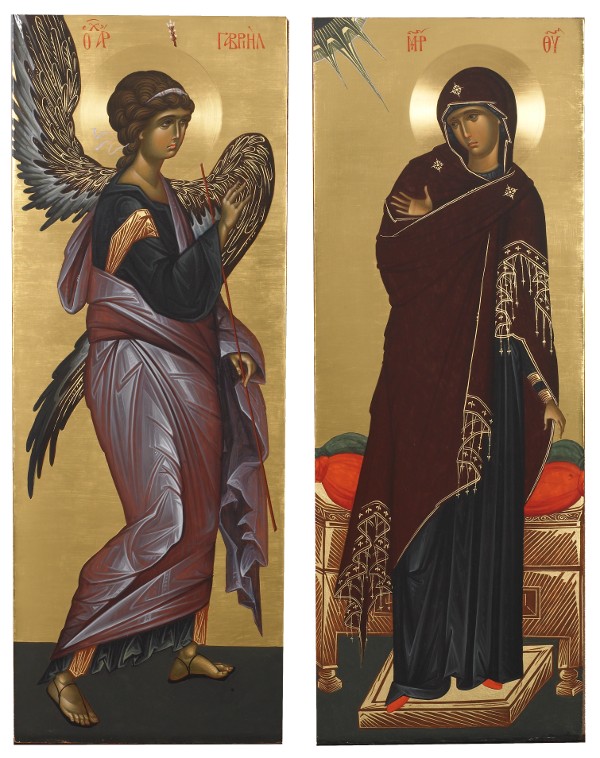
In the first chapter of the Gospel according to St. Luke, the Bible states that Mary was “Blessed among women”. She was told by the angel that she was “highly favored” (in Greek, it is literally “the one receiving grace” – also translated as “full of grace”). She was told that “the Lord was with (her)”. Mary is said to have “found favor with God”. Mary’s soul is said to “magnify the Lord”. She prophesied that “all generations shall call me blessed.” Truly these were inspired and prophetic words. To say that people should “dethrone Mary” is hardly in keeping with what is recorded in the Bible. Rather, we should “call her blessed.” Would not all Bible-believing Christians want to do this? Mary is not the savior. No church teaches that she is. She too is part of the human family. It is fair, nonetheless, to ask what role she played in the saving plan of God.
Adam chose to disobey the command of God. He turned away from God. He and Eve were cast out of Paradise. They no longer lived in union with God. Adam was told that on the day he ate the forbidden fruit he would die! His biological death may have come later, but he did die on that day. Whatever death is, it is our separation from God. It is Paradise Lost. This is that sad inheritance of every person born. To restore that life to man, to bring man back into union with God, man had to be saved. He had to be brought back into union with God. He had to be healed. For that to happen – even before His death on the cross — the divinity of God and the humanity of man had to be brought back together in One person who was both human and divine. If that Person were not both human and divine, he would be powerless to achieve the restoration and the healing of man. And so God became man. The Word became flesh.
If God wished only to forgive man, He could have remained in Heaven. He could have declared our forgiveness from Heaven. But to truly save us, He had to become man. This required more than an attachment to humanity. Wearing our humanity like a cloak would not be enough. God’s Eternal Son, the Divine Word, had to truly become man. Otherwise, the separation between man and God, caused by the sin of Adam, would remain. But for God to become man, one thing was necessary. The only way to be born into this world is through a human mother. Mary of Nazareth, through her Divine motherhood, gave to the Second Person of the Blessed Trinity His humanity. The Second Person of the Trinity did not simply “pass through” Mary. She really was His mother. Because of this role, Christians have loved her and honored her from the earliest days of the church. This is her great honor. She was the woman who said yes to God. Truly we should “call her blessed”.
Reading from the Synaxarion:
On the Sunday that falls from the 13th to the 19th of the present month, we chant the Service to the Holy and God-bearing Fathers who came together in the Seven Ecumenical Councils, that is:
– the First Council, of the 318 Holy Fathers who assembled in Nicaea in 325 to condemn Arius, who denied that the Son of God is consubstantial with the Father; the Fathers of the First Council also ordained that the whole Church should celebrate Pascha according to the same reckoning;
– the Second Council, of the 150 Holy Fathers who assembled in Constantinople in 381 to condemn Macedonius, Patriarch of Constantinople, who denied the Divinity of the Holy Spirit;
– the Third Council, of the 200 Holy Fathers who assembled in Ephesus in 431, to condemn Nestorius, Patriarch of Constantinople, who called Christ a mere man and not God incarnate;
– the Fourth Council, of the 630 Holy Fathers who assembled in Chalcedon in 451, to condemn Eutyches, who taught that there was only one nature, the divine, in Christ after the Incarnation, and Dioscorus, Patriarch of Alexandria, who illegally received Eutyches back into communion and deposed Saint Flavian, Patriarch of Constantinople, who had excommunicated Eutyches;
– the Fifth Council in 535, of the 165 Holy Fathers who assembled in Constantinople for the second time to condemn (which we celebrate on July 25th)
Origen and Theodore of Mopsuestia, the teacher of Nestorius;
– the Sixth Council in 680, of the 170 Holy Fathers who assembled in Constantinople for the third time, to condemn the Monothelite heresy, which taught that there is in Christ but one will, the divine; and
– the Seventh Council in 787, of the 350 Holy Fathers who assembled in Nicaea for the second time to condemn Iconoclasm.
On the Importance of Holy Tradition
By Father George Calciu
Faith has its place in a balanced Orthodox environment, and a natural relationship with the world. What I mean is that we live in the world and must do what it takes to survive in it, but not at the cost of compromises, betrayals, or renouncing Christ. Orthodoxy gives us balance.
We (the cradle Orthodox), possess a very ancient tradition. I look at the American Orthodox. They are very passionate for Orthodoxy, but they’re locking Holy Tradition. So, in a sense, they are streams branching off the Russian, Bulgarian, Serbian, or Romanian tradition, since they do not have that traditional instruction from their ancestors, as we do. We stand on a firm rock: the teachings of the Holy Fathers, the ascetic experience of the desert’ monks, the entire Orthodox Tradition handed to us in patristic books or by Oral tradition; and these, regardless of our sins, constitutes a stone foundation, that unshaken ground where our feet may walk and not sink, like a boat in which Jesus is present. We do not sink because we hold fast to tradition. Yes, we are sinners, but God preserves us when we follow Him and the teachings of the Holy Fathers, even though sometimes we fail… But is there anyone without sin? Is there anyone who has not been tempted? Who does not dirty his soul with evil thoughts, deeds or lust? But aside from all these failings, we have an unshaking ground.
This ground is the Orthodox Church, the tradition of the Holy Fathers, the Seven Ecumenical Councils, the struggle (experience) of the saints in the wilderness of Thebaida, Sinai…,in our country (Father refers here to Romania, his former country – tr.n.), and the monasteries found everywhere. Having this reaches, we do not sink.
“If I keep silent, I’ll be no different from unbelievers”
The following beautiful story is found in the Paterikon (collection of the old sayings of the Desert Fathers – tr.n.): the devil – taking the appearance of a man – came to a very holy monk and asked him: “Are you that monk…I heard off?” “This is him.” “That monk, the liar?” . ” Yes, that’s me.” ” That wicked monk?” “Yes.” “The greedy monk?”. “Yes, indeed.” “The liar who teaches the word of God, but does not live it? ” “Yes , I am one.” “That monk, the heretic?” “No. Such, I am not!”
So here is how far he would go! He accepted everything that demeaned him, but when he was tempted on heresy, he stood fast and said no. This is where the limit of tolerance is. When that tolerance goes beyond God and the Truth of our Christian faith, it becomes a blasphemy to our Lord and our soul.
The Holy Fathers had settled in Councils all aspects of church dogma that nowadays are trampled on. In the decisions of the Holy Synods many things (happening today), were foreseen: from heresies, ecumenism, denying God, public fornication, accepting as virtues: vices and perversions, to the fact of being proud to declare yourself gay. There’s no passion that the Holy Councils have not anticipated or spoken on, as they declared: him who does these is a heretic and a lunatic departed from faith and the Church .
Even (some of) our hierarchs have lost their sense of Christian dignity, which is incalculably greater than any human dignity. They place themselves under the attachment or helm of one or some another powerful elites of the day. I was greatly distressed by that. I had not yet wrote to the Patriarch (the former patriarch of Romania, now with the Lord tr.n), but I ‘ll write him later; for in a discussion I had with His Beatitude, I said:
“Your Holiness, God gave me a gift. He gave me “the gift” of suffering and through it I became wiser. Perhaps not wise enough considering all that I’ve been through (father is referring here to his 21 years of suffering in the communist gulag for having confessed the Christian faith – tr.n.), but the wisdom that God grant me gives me strength to speak up this word for Christ, for the Church and my nation;” and now I have to confess, for if I keep silent I’ll be like everyone else (who does not confesses Christ – tr.n). Because tolerance has a limit: that is not pushing beyond faith, or God. Beyond that, there is no tolerance.
Many hierarchies are silent, because “the time has come” (cf. Apoc) when if you confess (the Truth), will not be accepted in Europe (in the European Union – tr.n)! Such as this Europe means the ultimate paradise!! Will we not be accepted in Europe? (transl. note: the EU). Very good. Then know, we’ll be accepted in heaven. There (is the place), where God receives us. […]
I often wrote against ecumenism. I think I said everything I could have about this “heresy of our century ” as the Greek monks call it. I met many of the leaders of the “Ecumenist Group” and saw their compromised soul for the politics and their irrepressible desire to compromise others, even the Orthodox groups which defend the purity of faith. Whereever I go, the monks are wondering with pain and anxiety: “Where are we going with this? And to what limit shall we accept hierarchical compromise? Should we seek another jurisdiction? Shall we run towards the mountains, the forests and desert in order to be saved and escape this satanic temptation? Will we be hunted like long ago the defenders of icons by the iconoclasts? ” …
What I want to stress here is perhaps not the danger of ecumenism in itself – maybe things are not quite so serious as they may seem – but the distress that Satan is causing in the souls of monks through this ecumenism, and I mean not only in the hearts of monks from Romania, but throughout the orthodox world. This leads to anxieties and fear, and raises concerns for personal salvation from worldly dangers at the expense of sanctity and, the beginning of many compromises that once started, no-one knows where they will stop…
What I wrote here, I wanted to express to the hierarchs. But I think such letter would be doomed to be forgotten due to lack of interest and may be a cause for anger. What remains for us is prayer for the guarding of monasteries, for the inner peace of the monks and for the un-disturbance of the Orthodox life in our country and the world.
(Taken from Fr George’ Living Words, translated by EC, to be continued)
Elder Paisios of the Holy Mountain on “Common prayers”

Today unfortunately, the European courtesy has come in and they try to show themselves as being nice. They wish to show superiority and finally they end up worshipping the two horned devil. “One religion, they tell you, should exist” and they level out everything. Some also come to me and tell me “All of us who believe in Christ should create one religion”. “Now it is as if you are telling me, I told them, about gold and copper, so many carats gold and that much copper, that was separated, to gather them and make them one again. Is it correct to mix them again? Ask a jeweler. Is it proper to mix trash with gold? So much struggle was waged to distil the dogma”. The Holy Fathers must have known something for prohibiting the relationships with the heretics. Today they say: “we should pray together not only with a heretics but also with the Buddhist and with the fire worshipper and the demon worshipper.
Indeed see: ” The World \”Council\” of Churches “
The Orthodox must also be present in common prayers and in their conferences. It is a presence”. What presence? They resolve everything with logic and justify the unjustifiable. The European mind believes that also the spiritual matters can also come into the Common Market. Some of the Orthodox who are shallow and wish to make a promotion, “a mission”, they arrange conferences with the heterodox to cause a sensation, believing this way that they promote Orthodoxy, by becoming so to speak “Hungarian goulash” with the false believers. Then the super-zealots take hold of the other end; they also blaspheme against the Mysteries of the New-Calendarists etc and deeply scandalize the souls who have piety and Orthodox sensitivity. On the other hand, the heterodox come to conferences, act like teachers, take whatever good spiritual thing they find from the Orthodox, they process it, they give it their own colour and mark and they present it as a prototype. And the strange contemporary world becomes touched by such strange things and is spiritually destroyed. The Lord though at the appropriate time will present the Marks, the Eugenikos and the Gregorys Palamas who will assemble all our deeply scandalized brothers, to confess the Orthodox faith and strengthen the traditions of the Church and give great joy to our Mother, the Church”.
(Elder Paisios in: “With anguish and love for the contemporary man”)
Groundless and dangerous are the theological dialogues
Letter by: Mr. Paul Savvidis, Theologian
To the obvious and unrepentant ones, apart from the unnecessary and foolish continuous theological and ecclesiastic dialogues, a clear argument is made of the Papist and Orthodox views below and in fact manifested, the bare faced effort to impose the papist falsehoods.
I believe that the whole process starts not from one simple false theological ecclesiastic basis but from a groundless rationale of an ecclesiastic nature. It is an undeniable truth that the papist theologians never begin the theological dealings with sincere intentions for a complete agreement of compliance on the pure, indissoluble, inseparable and non negotiable positions of the mutual faith of the first eight centuries, of the seven ecumenical Synods until the unlucky day of the 20th July 1054.
All the subsequent convulsive actions of the papists aim at the creation or rather the duel to impress that they wish and are interested in the “union” which they themselves infringed upon and did everything towards the non-union since the omnipotence of a worldly and sole leader ensured fully the essentials for life to the obedient- ‘ferro iniqe” always to the disadvantage of the Orthodox people. The unpleasant historical reference to early and contemporary events cry aloud about the word of truth.

We now come to the essence of our topic. Our holy bishops, the presbyters, theologians and all those who take part- to whom were sent reasonable questions on past roaring improprieties- they know very well, or even faintly, that the Church comes together and is present during the Mystery of the Divine Eucharist. And in return, the Divine Eucharist accordingly unites her members to her Lifegiving Head, Lord Jesus Christ in such a way that to each of us the mystery of the Church is realized, that which Saint Chrysostom so characteristically notes, “We and Christ are one”. Heading this Eucharistic Congregation “of the immortals”, of the people of God, the head of the local Church, is the Bishop (where there is a Bishop, there is the Church) according to the Godbearing and apostolic Father Ignatios, but in his place also the Presbyter, namely the Priest.
The question that is directed to all those involved in the theological dialogue, who willingly or unwillingly missed the mark but who also co-traded with improper papist positions (Balamand agreement, Ravenna etc) can they assure us in an Orthodox and patristic way that the same Mystery of the Divine Eucharist exists and is officiated in Papism and is wholly valid? Even if we accept with impunity the answer YES, then naively and a lot more fruitlessly we “run and fail” to convince the Orthodox and the heterodox to unite since we are exactly of the same Holy Chalice which is also the sign of Union. To what purpose all this continuous theological and ecclesiastic upheaval of so many centuries? It is finally time to hasten with “jubilant feet and burning heart” to exchange the most desired embrace of love! Proper their priesthood, therefore proper also their mysteries…..
Here however we arrived at the Lydian rock of the problem and of our intense Orthodox puzzlement. We the Orthodox, clerics and lay people, believe, confess and declare in all directions “Urbi et Orbi” the ageless words of Saint Cyprianos “outside the Church, there is no salvation”! For in the Church belong the mysteries, the action of the divine Grace, the asceticism and theosis.
But oh nave papists since you do not have a church; you do not have priesthood or valid mysteries (since for you the divine Eucharist is a carrier ……. of germs and you do not offer it to your faithful!) towards what purpose all your eagerness for conferences, dialogues and sensational battles? Is it not enough that you have the visible representative (Vicar) of Christ, in the monstrosity – the Nation of the Vatican?!

Is it not a least indication of lack of fear of God and impudence to maintain that you are a “Church” and at the same time refer to us, the Orthodox, as “deceived brothers” when you cannot show us one saint, martyr or miracle worker, after your unilateral and deliberate departure from the fold of the One, Holy, Catholic and Apostolic Church? You who did not hesitate to downgrade to the point of degrading our magnificent and mutual saints such as Saint George, Saint Barbara and so many other just because they were easterners? I do not wish to be swept away to your slippery slope….
Do you have any blessed Elders with foresight and clear sighted you could point to us, such as the Paisioses, Jameses, Porphyrioses or other speculative souls hidden in the mountains and caves and “cavities of the earth” who have become poles of attraction and admired by so many deteriorated, aching and wounded souls?
Oh papists and all you Orthodox who take part in the conferences, you all well know that we have an amazing inter communion of only Orthodox holy churches in many same faith lands? Thus, Saint Nektarios of Egina travels to Russia and performs the mysteries (!), while Saint Seraphim of Sarov brings together thousands of faithful in Attica, Saint Luke the Physician, Archbishop of Crimea, performs moving miracles in our Country! Truly does the proud Rome, the nation of the Vatican, have to day something corresponding to offer us? Where and who are your saints “corrupted” or not who are miracle workers that the Orthodox may venerate them? Or perhaps is it without reason the three full bodied saints of the Ionion and the Lady Faneromeni are present there, as guarding sentries and protectors from the “western crest” and from the papist absolutism? Could you call your “priest” to make the holy water without salt- and remain unaffected from the corruption of time, or to cite exorcisms on a demoniac and him asking for an Orthodox priest because only he has the Grace of the mystery of Priesthood? The questions must seem to you overly na¨ve but they nevertheless remain unanswered? And about the Holy Light what is your position? And why does it only happens with the Orthodox?

Is the truth not crystal clear that you use an ambiguous language at the theological dialogues that reminds more of tough negotiations for the achievement of more diplomatic objectives and positions? How could you convince us of your sincere and untainted love when on the occasion of the illumined Elder Paisios was asked about the visit of the blessed Patriarch Demetrios to the Vatican with the familiar compliments and common prayers, replied “He was deceived”! How many more testimonies do we need? This is how you acted and will always continue to act.
One other question is directed to those responsible for the selection of the persons for the Orthodox representation. We believe that many occasions not only they do not uphold the word of truth but also sign articles which cry aloud that they contravene pure Orthodox patristic positions. They are neither better nor more qualified. A manifested ecumenical intention, an unprocurable Christianity, an unstable tendency at balancing of the truth and one similar division of the truth in all its twists and turns and selected parts. And at the end of all the deliberations naturally the “god pouring grace did not breathe” but they agreed “to an agreement badly agreed upon”!
On the lips of the pious people of God, the defender of the Orthodox dogma that under no occasion they can be – according to the ever memorable and champion struggler of Orthodoxy professor Mouratodis- “one irresolute, pathetic and externally propelled mass” exists the bitter and often the most bitter complaint, why at those conferences that are called, no matter how they are called, there do not take part people of theological, patristic and of fighting stature from the venerable Hierarchy of Greece? The mention of certain names will clash with their mediocrity. In the garden of our Most Holy Mary could it be possible that there do not exist holy and illumined personalities whose account and testimony of the theological truth is a fruit of purely painful and intense prayers and repentance? Could it be possible that our schools are lacking personalities of Teachers in action and worth who teach and transfuse the pure patristic spirit and the deposition of the greatly honourable Truth, which is the guarantee of the unchanging orthodox teaching? And finally the Orthodox Hierapostolic Brotherhoods do they not have eminent theological personalities whose both oral and especially written word is the guarantee of Orthodoxy and together the heavy artillery of our Church against all sorts of heretical teachings?

Unfortunately most of those who participate are called “Legionaires” namely those who are resident abroad, who are deeply indoctrinated or better grafted by the intense worldly spirit of the West and that is why their theological armor is nowhere to be found, with no backbone and mostly “graceless” and not seldom with negotiated heretical solutions- positions. The testimony and the submission of their written articles, cry for the word of truth! Not few times in their worldly circles what counts for them is not the ascetic spirituality of Orthodoxy, but the “appearance” or rather their civil image, the exterior picture which is backed by titles and civil and philanthropic works!
They are masters of dialogue, inexcusable luxury and much more wasted time for us to try through this type of meetings to convince the inconvincible papists about the treasures of our Church and the correctness of our dogmas. The Union, may I immediately correct, namely the return of the heretics to the Orthodox Church, can happen through contrition, with sincere tears of repentance and confession and above all by the traditional, pure and as such valid Baptism. Everything else is from the evil one…..
The last and most compassionate word is directed with great respect as much to the venerable head as to the Hierarchy of our Most Holy and Martyric Cyprus. Why, honourable fathers so much preparation, so much zeal for one more ecumenical conference- dialogue on your sanctified island? Could it be that the present Attila did not have as ancestor the other “civilized” Frankish Attila that not only did he oppress your island but unblushingly devasted and “sacrificed” with his inhuman bestialities – ferociously and with unabated appetite? Perhaps you should be reminded of the truth when the thirteen holy martyrs of Kantara of Nicosia (Lefkosia) rise from their tombs?
Truly you know of the many steps of the papists towards all of the international organizations with intense protests and balloting resolutions for the invasion of Attila, and what about their results? When did the “Christian” west exert influence on the old and sinful Albion to avert the hangings of the fighters of EOKA? I fear that perhaps like the pope who had sent a disgusting congratulatory telegraph to Kemal Ataturk on the slaughter of the Orthodox population of Smyrna, perhaps again their guilty silence secretly or openly, God knows, contributes to the freeze of the presently existing situation?
And the final word. The Dialogues are rather cosmetic and social meetings- according to the lay expression in other words “to love each other” with the corresponding excessive compliments, the competing bids for the most expensive gifts and the luxurious dinners, the hotel comforts. Truly, perhaps the hospitality of an austere Monastery at least for the Orthodox representatives with some “frugal abundance” would have been the prudent place? And in the present economic crisis how many open wounds could have been patched up if this fruitless and provocative extravagance was invested on families that live at the limits of morbid starvation?
To be sincere and honest with ourselves, the great losers will be the Orthodox who in knowledge or ignorance bargain or compromise positions-eternal truths and imperishable. Having won,the papists who with their known time wasting evasions and tricks, try to convince and pass their obvious anti-ecclesiasticism for “ecclesiology”.
In this chaotic impasse and religious syncretism which is the consequence but also the continuation of an immoral morality which completely nibbles all the spiritual vitality of the land and creates an atrocious hell, sometime sooner or later, like charmingly Elder Paisios used to repeat “The Spiritual Laws shall also work”. Namely, all the entangled parts and the interlaced self interests “will pay the price” painfully on a personal or even social level for all those mostly provocative, ecumenistic fiestas.
Nothing has been lost yet. Glory be to God, there is still adequate time to reverse things through repentance. The Orthodox Church always lived and lives the miracle of the return of the “deceived” and their re-gathering into her Fold.
But all our own who participate in the theological conferences let them know “full well” that the “last word” of all the decisions of a theological mixing of Orthodox and papist “belongs to the people of God” which is again ready but also mature to respond with the timeless word of Joseph Bryenios, “we shall not deny you our friend Orthodoxy”.
Let the papists also hear these.
The present article is also part of the signing of the
A Confession of Faith Against Ecumenism
Paul Savvidis
Teacher of Theology, 5th Gymnasium of Veria
Please also see: Lessons from the Fathers on Fasting

Fast and freedom
What can be more absurd than the fast, in a religion which boasts of having given the man the freedom? How can you name yourself free, when you have to refrain from the things you like, when you must do what you don’t want! The fast is the abstinence not only from the food, but also from the bodily pleasures. How not to see in this an outrage to the noblest instinct that the man has – the freedom?
If the fast is an obligation, than the Gospel is a masterpiece of the absurd’s literature. Understanding this, the Protestants decided to renounce the fast. However, despite the number of quotations brought from the apostle Paul or from the words of the Saviour Himself, the spur to fasting is like a thorn in the flesh of that who at least scarcely knows the Holy Scriptures.
All righteous before Christ fastened. The fast was precursory to the meeting with God or to a revelation. Moses climbed up the mountain after forty days of non-eating and thus spoke with God. The New Testament is not at all different, it begins with a fastener – John the Baptist. Christ Himself had fastened before having begun to preach. Thus, we cannot leave away the fast, departing from some biblical verses, when even those who pronounced them were great fasteners; it seems to me it is more decent to doubt our understanding ability of those verses.
Christ was once asked why his disciples don’t fast (Matthew 9, 14). From this many have understood that the disciples and the Saviour Himself were gluttons (Matthew 11, 19). But this event, actually, discloses us the fact that the disciples and the Saviour were all the time starving. This can be also seen very well from the conflict that they had with the Jews, because the disciples ate some ears on Saturday. The disciples were so busy with the preaching that they used to forget to eat and the fact that they picked ears, shows how hungry they were and that they were wont to eat here and there. The Saviour however did not eat with them, the reproach being only for the disciples; He was the model of fasting.
The fact that the disciples used to eat little, is emerging from the scene of multiplying the bread, where we find out that they had only five loaves of bread and two fish. Although they were far away from the locality, in an impossibility to buy food, they are ready to give this little to the crowd (without knowing that it will be multiplied), which reveal us that they were accustomed with the hunger more than the ordinary men. Hence, the Saviour and the disciples fastened, but they did not count the days as the Pharisees did. To their question though, Christ, tell them “Can you make the guests of the bridegroom fast while he is with them? But the time will come when the bridegroom will be taken from them; in those days they will fast” (Luke 5, 34-35). “Those” days when the bridegroom was taken away, are Wednesday, the day of betrayal and Friday, the day of crucifixion. In the year 50, the apostles convoked a synod in Jerusalem, where they established for the believers the fast in these days.
Thus, the Protestants have understood well that the fast is not an obligation. The forced fast, has no motivation as any gratuitous and meaningless thing. This is not, however, a reason to blame the fast. The fast should be understood in all its nobility, as it is the supreme manifestation of the human freedom. In such a way the first Christians understood the fast, a meaning that is lost nowadays. “To eat – writes St. Ephrem the Syrian in the IV century– belongs to the laws of the nature, but to fast belongs to the freedom”. Who can boast that he is eating only because “he wants this”? No, you eat because you need to eat, a results from the natural instinct, not from freedom. Of course there is neither an evil in this, nor a sin, but there is also no virtue. The virtue is only the fruit of the freedom. “Any labour which is not from a perfect freedom – farther Sofronie Saharov (+ 1993) said – can not have an eternal value”. The fasting is the man’s free choice of a nobler life, which has something in it from the realities of eternal life, where there is no corruption anymore.
See also why in the Orthodox Church the two Holy Apostles Peter and Paul are equals and celebrated together at: Why I abandoned Papism
MATTHEW 10
32 “Therefore whoever confesses Me before men, him I will also confess before My Father who is in heaven. 33 “But whoever denies Me before men, him I will also deny before My Father who is in heaven. 34 “Do not think that I came to bring peace on earth. I did not come to bring peace but a sword. 35 “For I have come to ‘set a man against his father, a daughter against her mother, and a daughter-in-law against her mother-in-law.’ 36 “And ‘a man’s foes will be those of his own household.'”
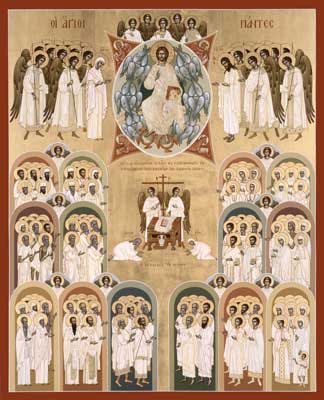
WHOEVER DENIES ME BEFORE MEN, HIM I WILL ALSO DENY BEFORE MY FATHER WHO IS IN HEAVEN
by St. Cyprian of Carthage
At last, dear brethren, peace has been restored to the Church and, though the pessimists thought it improbable and the pagans impossible, we have recovered our liberty … Was it something unheard-of that had happened, something beyond expectation, that made men recklessly break their oath to Christ, as if a situation had arisen which they had not bargained for? Was it not foretold by the prophets before He came, and by His Apostles since? Were they not inspired by the Holy Spirit to predict that the just would always be oppressed and ill-treated by the Gentiles? .. Could a servant of God stand there and speak – and renounce Christ, whereas it was the world and the devil he had renounced before? .. .It is Christ who must not be left; it is giving up one’s salvation and one’s eternal home that must be feared …
Let no man deceive himself, let none be misled. Only the Lord can grant mercy. Sins committed against Him can be cancelled by Him alone who bore our sins and suffered for us, by Him whom God delivered up for our sins. Man cannot be above God, nor can the servant by any indulgence of his own remit or condone the graver sort of crime committed against his Lord, for that would make the lapsed liable to this further charge, that he knows not the words of the prophet: ‘Cursed be the man that putteth his hope in man.’ It is our Lord we must pray to, it is Our Lord we must win over by our satisfaction; for He has said He will deny the man that denies Him, and He alone has received all power of judgment from His Father …
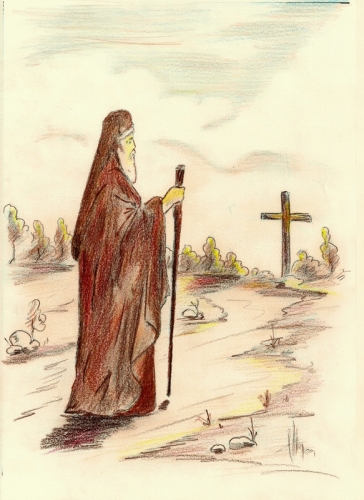
But let none, my dear brethren, let none besmirch the fair name of the martyrs, let none rob them of the glory of their crown. The strength and parity of their faith stands unimpaired: nothing can be said or done against Christ by one whose whole hope and faith, whose whole strength and glory abides in Christ. ..
A [lapsed] man who, in spite of his sin, also presumed secretly to join the rest in receiving of the sacrifice offered by the bishop, was unable to eat or even handle Our Lord’s sacred body; when he opened his hands, he found he was holding nothing but ashes. By this one example it was made manifest that Our Lord removes Himself from one who denies Him, and that what is received brings no blessing to the unworthy, since the Holy One has fled and the saving grace is turned to ashes …
Let each one, I entreat you, brethren, confess his sin while he who has sinned is still in this world, while his confession can still be heard, while satisfaction and forgiveness granted through the priests are pleasing to God. Let us turn back to the Lord with our whole heart and, expressing our repentance in deep sorrow, implore God for His mercy. Let our souls bow before Him, let our sorrow be offered to Him in satisfaction, let our hopes ill rest in Him. He Himself has told us how to ask (Ref. Joel 2:12) … But those among you, my brothers, who are responsive to the fear of God and who despite your fall are conscious of your plight, let the sight of your sins move you to penance and sorrow; acknowledge how grievously your conscience reproaches you, open your soul to the realization of your crime, neither despairing of God’s mercy nor yet claiming instant pardon. While God, in His fatherly affection is ever forgiving and kind, in His majesty as Judge, He deserves our fear.
(St. Cyprian of Carthage. The Lapsed. Texts 1, 7,8,10,17,20,26,29,35.
B#41A pp.13, 18,19,20,27,30,34,36,40).
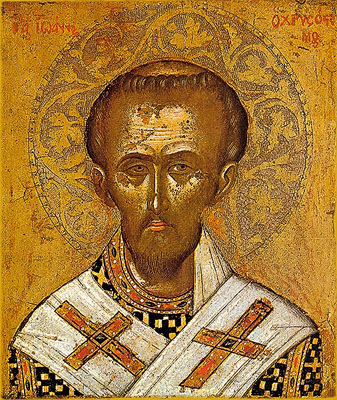
I DID NOT COME TO BRING PEACE BUT A SWORD
How then did He enjoin them to pronounce peace on entering into each house? And again, how did the angels say, ‘Glory to God in the highest, and on earth peace’? (Lk,2:14). And how did all the prophets also come to publish it for good tidings? Because this more than anything is peace: when the diseased is cut off, when the mutinous is removed. For thus it is possible for Heaven to be united to earth … The war is not then the effect of His purpose, but of their temper. For His will indeed was that all should agree in the word of godliness; but because they fall to dissension, war arises … For this cause the prophet admonishes, saying, ‘Trust not in friends, do not have your hope in guides. Yes, beware even of the woman who lies in your bosom, as far as communicating anything to her.’ And remember, ‘A man’s enemies are the men that are in his own house’ (Micah 7:5,6).
(St. John Chrysostom. Homily XXXV on Matthew X, 1,2. B#54, pp. 232-233).
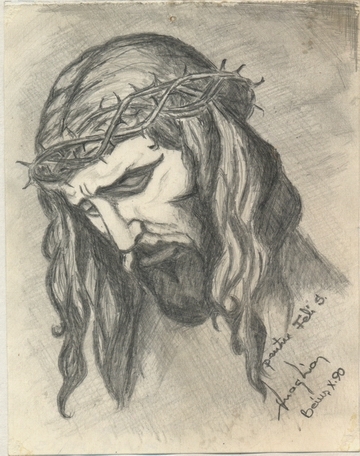
On the Image of Christ
By Fr. Philotheos Faros in Eastern Orthodoxy in a Western Ethos published in the Word Magazine, May 1976
It is amazing how Western Christianity distorted the scriptural image of Christ and presented him as condemning human aggression and as a sickening, soft, and effeminate man with rosy cheeks and blond wavy hair. It is deplorable that so many Orthodox are offended by the strong, powerful, dynamic, scriptural Christ of the Byzantine art although they are infatuated by this nauseating Western Christ. It is amazing how Western Christianity managed to visualize the fiery eyes of Christ which “looked around” at the Pharisees “with anger,” (Mark 3,5) as sweetish and wishy-washy, how it resolved to present as soft and effeminate, the powerful Christ who made “a whip of cords” and drove with it all the merchants “out of the temple” with their sheep and oxen, and “poured out the coins of the money changers and overturned their tables.” (John 2, 13-16) It is amazing how Western Christianity managed to describe as quiet and soft-spoken Him who uttered the dreadful “woes” and called the Scribes and Pharisees “hypocrites,” “blind fools,” “blind guides,” “white-washed tombs,” “serpents” and “brood of vipers” (Matthew 23) and told his tempting disciples “Be gone Satan.” (Matthew 16, 23) It is inconceivable how Christ disintegrated to a eunuch prince of peace although he stated very emphatically, “Do not think that I have come to bring peace on earth; I have not come to bring peace, but a sword. For I have come to set a man against his father, and daughter against her mother, and daughter-in-law against her mother-in-law; and man’s foes will be those of his own household,” (Matthew 10, 34-36) Christ did promise peace but not a hypocritical external peace but a real inner peace. He said, “My peace I give to you; not as the world gives do I give to you.” (John 14,27)
ON ALL SAINTS SUNDAY by Fr Andrew Phillips
(…) Today’s Feast is the result of all that has gone before it. The purpose of all the events in Christ’s life, from His Conception to the Resurrection and the Ascension and Pentecost is to make Saints. That is the purpose of the Church, to make people holy. Today’s Feast is the Feast of the identity of the Church, of Her sacred personality. For a Church that does not make Saints is not a Church, it is merely an institution which abuses the word ‘Church’. What is a Saint? Firstly, we should understand that Saints are not born, they are made. We are all born potentially to become Saints. The only difference between ourselves who are not Saints and the Saints, is that they are people who are continually picking themselves up after sinning, continually repenting until they attain holiness, whereas we give up. We should also say that there are two sorts of Saints – Confessors and Martyrs. Some Martyrs led very bad lives but then, when it came to the ultimate sacrifice, they found Faith in themselves, sufficient for them to prefer to confess Christ rather than live, and so sacrificed everything for Christ. We recognise their sacrifice and honour it. However, in our time, in our land, it would seem that we are not called to be Martyrs, but Confessors. What is a Confessor, how do we recognise a Confessor?
First of all, we could ask people who live near the person whom we believe to be a Confessor. They would know that person’s way of life. But this would not be enough in itself. This would tell us only if the person were righteous or not. And holiness is more than righteousness. Holiness is that utter devotion to God, the confession of Christ before men, the taking up of one’s cross and following, to which Christ will bear witness before His Father in Heaven. It is never denying Christ. It is this devotion of which He speaks in today’s Gospel, which is above devotion to husband or wife, father or mother, brother or sister, son or daughter. And we can be even more precise than this. We have already said that the purpose of the Church is to make Saints. And the characteristics of the Saints are also those of the Church. At every Liturgy and at morning prayers we sing and read the Creed, in which we confess that we believe in the One, Holy, Catholic and Apostolic Church. These words which define the Church, One, Holy, Catholic and Apostolic, are also words that define the Saints. The Saints are One because they are all together. We speak of the communion of the saints. And in today’s Gospel, our Lord speaks of those who have followed Him who will judge the Twelve Tribes of Israel seated on the Twelve Thrones around Him. The Saints are One, they are united. The Saints are also obviously holy. The word Saint means holy. The Saints are also Catholic. This word does not mean Roman Catholic. We mean ‘Catholic’ in the original sense of the word. ‘Catholic’ means the same in all places and at all times. Thus today, on this Feast of All Saints, we commemorate all the Saints of all countries and of all centuries and of all backgrounds. We recall Saints of all ages, of all nationalities, men, women and children, the poor and the rich, the old and the young, the healthy and the sick. They all confessed the same Orthodox Faith. The Saints are universal in time and space; they are ‘Catholic’. Finally, the Saints are Apostolic, for they share in the same Faith and Tradition as the Apostles. (…)
By Father Dumitru Staniloae
(in “Orthodox Spirituality” @St. Tikhon’s Seminary Press)
Orthodox spirituality has as its goal the deification of man and his union with God, without being merged with Him. It has as a basic conviction the existence of a personal God, who is the supreme source of radiating love. He prizes man and doesn’t want to confuse him with Himself, but maintains and raises him to an eternal dialogue of love.
Such a spirituality has no place where an evolutionary progress of man, connected to a divinity conceived as an impersonal essence, is affirmed. This progress can have no result other than man’s disappearance in the impersonal divinity.
But the personal God, and thus the supreme source of love, can’t be conceived of as a single person, but as a community of persons in a perfect unity. You see then why the Christian teaching of a Trinity of Persons in a unity of essence is the only one which can constitute the basis of a perfect spirituality for man, understood as a full communion with God in love, without his being lost in it.
A Roman Catholic theologian, Georg Koepgen has best described the Trinitarian basis of Christian spirituality. [All the references in this chapter to Georg Koepgen are taken from the Introduction to his book, Die Gnosis des Christentums, 1st ed. (Salzburg, 1939)]. At the same time he says that this spirituality has been most faithfully preserved in the Eastern Church, because she alone has kept in the most unchanged way the biblical teaching about the Holy Trinity and its central place in Christian piety. He establishes that, in religions which unilaterally accentuate monotheism, such a spirituality has no place; and in those with a pantheistic tendency, even if the divinity is manifested in a plurality of gods as expressions of the forces of nature, we find a false spirituality, or an illusory perfection, in other words, one which leads basically to man’s meltdown in the so-called divinity.
On the other hand, man’s personal spiritual perfection, by eternal unconfused union with God can’t take place except where an eternal eschatology of man, in blessed union with God, is believed in. But such an eschatology is the result of the Trinitarian God.
Man’s union with God for eternity, however, is guaranteed and mediated only where one of the divine persons takes flesh as a man for eternity, thus showing the eternal love of God for man as man. Koepgen considers that Orthodoxy has maintained the spirituality proper to the Christianity revealed in Christ; it has kept the mystery of the Trinitarian community of persons in God, unweakened by a rationalistic philosophy which, accentuating the unity of God has emphasized His essence. We can add that precisely because of this rational stress on the one essence of God, which tries to avoid its paradoxical combination with the Trinity of Persons, the doctrine of the “Filioque” resulted. According to this teaching the Spirit proceeds from what the Father and the Son have in common, that is from the divine essence; and so the essence is considered to be the cause of the persons, which actually leads to an impersonal god, to a pantheist one.
But let’s give the floor to Koepgen:
Mysticism always has a single goal: man’s deification and union with God, without man’s fusion with Him. And this can’t be understood except by the Trinitarian idea of God. In Christianity the whole is oriented of necessity toward future perfection …. The Church is blamed because it recognizes mysticism, and is also condemned without mercy when it crosses the border into pantheism. But how can mysticism be recognized, if pantheism is rejected? Note our answer: Christian mysticism isn’t based on man’s predisposition, which pushes him into a fusion with the divinity, into a pantheist life of union with it, but it is the actualization of the incarnation of God in the believer. Between the Christian concept of God and the non-Christian, there is a fundamental distinction: Christianity is based on the Trinitarian God [therefore irreducible and eternally personal, or a personal community], not on a philosophical concept of an absolute spirit [and as such so impersonal]. It’s noteworthy that Catholic theology too works almost exclusively with the philosophical concept of God, by which it avoids referring directly to the Trinity [of persons].
The God of the New Testament and of the holy Eastern Fathers is living and irreducibly three in one. The God of scholastic philosophy is impregnated with Aristotelianism or confused with a generally pantheistic one. We would say that the failure of scholastic theologians to make this distinction has led them to use the same name of mysticism to express the union of the Christian with God, a term also employed by pantheist philosophy. So Protestant theologians heap reproach on the notion of mysticism.
Orthodoxy has preferred, especially in the period of the holy Fathers and in the writings of the great saints who experienced union with God, to use the terms “life in Christ,” “life in the Spirit,” “the spiritual life,” and “‘the life in God,” to describe the life of the Christian in union with God regardless of the level of this life. Orthodoxy has followed the example of St. Paul the Apostle (Galatians 3:28; 3:20; 2 Corinthians 4: 11; 1 Corinthians 7:8; 6:19; 3:16; 2:12; Romans 8:15; 8:9-10; Ephesians 3:16-17; Colossians 3:3; John 14: 23; 1 John 3:24, etc.)
But Koepgen continues:
God and divinity aren’t the same thing. When the mystic [the spiritual person] speaks of God, he doesn’t mean a metaphysical divinity (ens a se), but he thinks of God in trinity, who has united in a completely incomprehensible way with men and has saved them. [If Christianity has as its basis faith in the Holy Trinity, spirituality is a part of its very being.] Mysticism [the life in relationship with God, the life which has God in itself, in different degrees, we would say], isn’t an appendix annexed later by Christianity, which is offered as a new possibility to some specially endowed souls; it belongs to the very act of faith” [which is an act of entering into a relationship with God, but which can be developed by the purification from the passions, we would say.]
Due to its rational philosophic conception of God, which introduces a distance between God and man, “the connection of Catholic theology with mysticism [with spirituality, we would say] is very unclear.” Orthodox teaching, however, remains faithful to the New Testament: It doesn’t rationalize the mystery of God in Trinity. It bases itself on the experience of God who communicates Himself to us through love, in the Spirit, by uncreated energies. It neither holds God at a distance from us as in the rationalist monotheistic religions (Judaism and Islam) nor does it bring us into fusion with Him, as in the pantheist and philosophic religions which recognize as the one reality an essence of one kind or another.
As an example of a false or seductive spirituality, or a mysticism proper to pantheist philosophy, which doesn’t promise human nature anything but fusion with an impersonal divinity, Koepgen gives the following quotation from Plotinus:
He [the mystic] doesn’t see two, and the seer [contemplative] doesn’t distinguish two, nor represent two to himself, but he becomes another and is no longer himself; and arriving there he no longer belongs to himself, but he belongs to the one there, and is one with him. The central point is united to the central point.”46 [And Koepgen commenting on this passage says:] Plotinus shows us here the essence of neo-Platonic mysticism, the basis of which is incontestable, because the essence of God is conceived as pure idea and is put on the same level with the categories of the human spirit and in relationship with him.
Further on Koepgen cites St. Simeon the New Theologian, who keeps the spiritual person distinct in the act of seeing (contemplating) the Holy Trinity:
What lips could describe what has happened to me and what happens everyday? Even at night and in the midst of darkness I see, trembling, Christ opening heaven for me and I behold how He himself beholds me from there and He sees me here below together with the Father and with the Spirit in the thrice holy light. Because I his is one and nevertheless it is found to be in three. And the light is one and the same nevertheless in three images, although it is only one. And it illuminates my soul brighter than the sun and floods my spirit covered with gloom …. And this miracle was even the more astonishing because it opened my eyes and helped me to see, and that which I saw is He himself. Because this light helped those who behold to know themselves in light and those who see in light see Him again. For they see the light of the Spirit and in as much as they see Him, they see the Son. Now he who has been made worthy to see the Son, sees the Father too.
In opposition to St. Simeon, Koepgen shows how the turn-about of the Western Christian to the rationalist concept of God – weakening the accent put on the Holy Trinity, thus on the personalistic-communitarian character of God – brought him to the renewal of false mysticism, the fusion of the contemplative with the impersonal divinity. “In St. Simeon,” according to Koepgen, “we have the case of a mysticism [or spirituality, we would say] explicitly Trinitarian. On the contrary, Western mysticism, under the influence of neo-Platonism has given Trinitarian mysticism [spirituality] a secondary place, at least in expression. Simeon is a Trinitarian mystic [a spiritual person] because he stands in the tradition of the Eastern Church.”
Western mystical theology, to its detriment, has almost entirely overlooked ked its ties with this tradition and has seen in Eckhart or in Spanish mysticism the culminating point of mystical thought in general. Here the thought of the Holy Trinity is put in the background. When Eckhart ‘ says, “If I want to know God without mediation, I must become Him, and He must become me,” the influence of Plotinus is incontestable.
Koepgen asks once again:
What is the difference between Eckhart’s mysticism and that of Simeon’s? For Eckhart, the Trinity exists as a unity of Persons; he sees just one thing: divinity. On the contrary, Simeon sees the Persons in their differentiation. He sees the Father, first of all as Father, and the Son, as Son. Here is the great difference between Eastern mysticism [spiritual life] and the Western. Western mysticism is under the influence of Plotinus, and is monotheistic in the strict sense of the word; it sees the Trinity as a matter of fact, but only as a unity of persons in divinity. Even our modern Catholic mysticism preoccupied with Christ speaks, as we know, almost entirely of the ‘Divine Savior,’ which means that it sees in Christ only God in His divinity. The Church from the beginning- and Simeon with heron the contrary, saw something much greater in Christ: They saw in Him the Son …. We have closed our minds to a fact that was decisive for the Church from the beginning, and by which it was distinguishable from Judaic monotheism: We have lost the feeling for the Trinitarian life of God, for the reciprocal interpenetration and for the reference of the divine persons one for the other. For the Old Testament, God was in any case at least Jehovah the Lord of Hosts, the Almighty Master. For us, on the other hand, God has become also a spiritual concept empty of content …. He who wants to enclose the divine problem in a rigid plan of a doctrine of categories ends up after all in pantheism ….
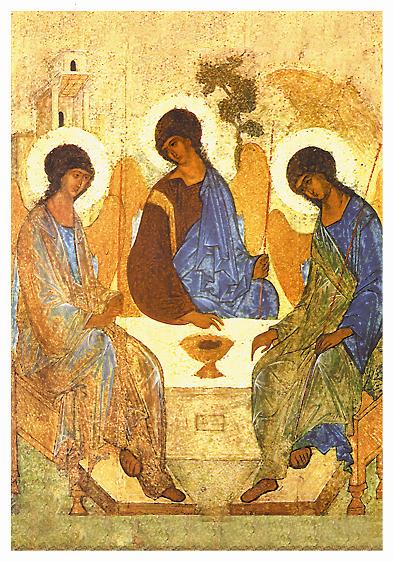 This is so because it makes God into an essence, and the essence, in submission to laws known by us, is no longer distinguishable from the general essence of a unique reality. Koepgen continues:
The dogma of the Trinity, however, is found outside the categorical forms of thought. It is surpassed in the attitude and knowledge of faith, [which opens itself to the mystery of reality, beyond any simplifying logic]. Thus the Trinitarian mystic [the spiritual person who believes in the Holy Trinity and who is found in a living, personal relationship with It] is also beyond the danger of falling into pantheism. The dogma of the Trinity itself elevates the thinker into another spiritual order, which from the beginning protects him from this pantheist conception. The dogma of the Trinity raises the believer into a living relationship with the tri-personal divine community; even by this it also keeps him as a person unconfused in the divinity, but strengthened and preserved forever, by love, by its character of person.
But there also exists another alternative for Western mysticism, devoid of a living relationship with the persons of the Holy Trinity. It bases itself on mostly rational arguments – Koepgen says in the same’ pages – and therefore on considerations from a distance that God must be a God of love and that He must in turn be loved; so it becomes <In experience shut up in subjectivism, a sentimentalism unanchored in the’ direct experience of God. This leads to the absence, in Western theology, of the doctrine of uncreated energies which come into us, an absence which is connected to the concept of God more as essence than as a loving communion of Persons.
Georg Koepgen doesn’t shrink from finding the fully systematized beginning of this philosophical, unbiblical, essentialist and impersonal or non-Trinitarian understanding of God even at the door of Thomas Aquinas, who according to the affirmations of the author:
… suffered a severe breakdown at the end of his life, due to the fact that everything he had written previously now seemed unsatisfactory, Maybe the day will come – and we would like to see it as soon as possible – when theology will take this event in the life of Aquinas just as seriously as anything else in it. In any case this would contribute in an essential way to bringing this frightful thing into the scientific-theological realm, which is connected with the very best tradition of a Paul, Augustine, Pascal or Newman.
For this change, Koepgen considers necessary the return to a knowledge of God based not on the laws of deductive reason, but on a real experience of Him, or of His power working in us. This is Christian “gnosis” distinct from pagan “gnosticism,” which in fact is pantheism and doesn’t know God the transcendent One, who comes to us by the grace of His love, by experience. Koepgen says:
Our thought today is so used to identifying ‘logic’ with ‘reason,’ that it judges the correctness of any thought by the measure in which it corresponds to the laws of ‘logic.’ In reality, however, logic presupposes Plato’s doctrine of ideas, or Aristotle’s unity of concept. However, there is no place for this doctrine of ideas in the Bible, because here every thought is preoccupied not with idea but with person: It is existential.
But the person is infinitely more than ideas; his character is indefinable, alive, passionate, always new and thirsting for a living and loving relationship with other persons. Only a person truly warms me. Ideas are but some partial products of the person, incomplete means of communication between persons. And the thirst of the person for unending relationships with other persons implicates both the eternity of persons, and the source of this eternity of theirs in a supreme community of persons.

We can systematize, complete and deepen what Koepgen has said as follows:
1. Only a perfect community of supreme persons can nourish, with its unending and perfect love, our thirst for love in relation to it and betweeen ourselves. This nourishing can’t only be theory, but it must be lived too. This is so because love isn’t satisfied with only being theory, but wants to give itself, to welcome and be welcomed. A monotheistic god in a strict sense must be considered as enclosed and self-satisfied, a fact which would correspond with a perfection, which we, however, can’t understand, once it is lacking in love. A pantheist essence is poured out, or evolves into more and more forms, in an involuntary way; more precisely, it isn’t poured out and it doesn’t evolve; strictly speaking, because it can’t go out of itself, or from the essential, monotone and involuntary forms which belong to it. In the pantheist conception, persons, if they too appear, don’t have a supreme and permanent value, thus neither love between them
[Pantheist] essence in itself lacks love, while love means conscious and voluntary self-sacrifice among persons, or the sacrifice of one person for another; [so pantheist] essence couldn’t somehow produce love later, thus neither persons. Love, without beginning, eternal, presupposes that God is a perfect unity of the Divine Being, but at the same time it is a Trinity of Persons, from the same eternity. And as perfect love, the Divine Trinity can also give itself to other persons; however, only if they want it. It isn’t forced to change itself into fleeting and passing alterations, which would have no purpose, lacking in real and permanent value. But for its free overflowing it creates other persons, not infinite in essence, because this would mean its infinite overflow in the form of these persons; but in another way, it can gradually share with them from the infinity of its life and love, deifying them. Now the only way it can do this is by really uniting them with itself by love, enabling them to experience in a real way its love. Only so are freedom and love manifested in existence, without which everything would seem without any purpose whatsoever. Love from the supreme community thus produces a new form of its manifestation. So, on the one hand, it isn’t totally one in existence, but neither are [the persons] unsurpassably separated in it.
Created and thus finite persons can enjoy the infinity of divine love and life, or the one and supreme source of life and love- in other words the infnity of this source- in their infinite progress in deification; without it their unending existence and longing would have no purpose. They become partakers of that infinite life and love, gradually, because the infinity of divine love and life is communicated to them. At the same time the freedom of both sides is respected. This means that the finite beings can make their contribution too, to a personal effort for their growth, that this growth might be real.
2. So the Trinity, radiated by the love which is proper to it, can’t be lived and conceived without its uncreated energies in ever increasing levels. Love is characterized by this paradox: On the one hand it unites subjects who love each other, on the other, it doesn’t confuse their identity.
Love brings one subject to another, without merging their identities, because in this case love would cease. It would kill the persons who love each other; it wouldn’t assure them of a permanent existence. This paradox can be explained by the radiation of love, as energy which is communicated from one person to another without them being depleted in this communication. Uncreated and unending love of the uncreated source of love, can’t be communicated except as uncreated energy. But in the eternal and perfect community of love, subjects communicate their own being to each other, without they themselves blending together. This proves that the subjects are, on the highest level, just is valuable and as indestructible as their natures. Only in this way is love truly perfect. An eternal nature, which would give birth later to other persons, would reduce the value of the persons and would give them a passing existence, and this would make of love itself something secondary, something obedient to certain laws of evolution to which it would be superior. On the other hand some persons existing eternally, with a unity of nature, would again be subject to an evolutionary love, so, it would be second rate, which would leave these persons without a supreme purpose.
On the highest, divine level, the difference between nature and energy is surpassed in a way incomprehensible to us. The divine nature itself is energy, without ceasing to be an undepletable nature; the nature itself is communicating energy. But it is so because it is of the Supreme persons. The Persons communicate their nature as an energy. Everything is an energy which is communicated from one person to another. Their love is perfect; they radiate their whole nature from one to the other. We can’t live the whole divine nature in the energy given to us from God. It is undepletable, from an infinite source, and from a plane transcendent to us. We are beings brought into existence in time, and therefore finite, by a creative act of God.
3 But the Trinitarian community of Divine Persons, a dynamic structure of unending love, isn’t a uniform love of the three Persons between themselves, but a love of Father, of Son and of a hypostasized communication between them, in the person of the Holy Spirit. The love isn’t uniform. If I didn’t have somebody else than me, if I weren’t pen a love other than mine, it wouldn’t interest me very much. Without these distinct qualities, divine love, and thus infinite, would have something monotonous in it. The affection of a perfect Father for a perfect Son is something other than an affection, pure and simple, between just any two persons. Monotone and uniform affection doesn’t exist, because people themselves aren’t uniform. The Father loves the Son with an infinite parental sense/feeling (simtire), comforting Him with the unending sensitivity (sensibilitatea) of a perfect Father, and the Son responds to this parental love with the filial sense/feeling (simtire) of one who feels (simte) comforted by a perfect Father. We don’t know if two uniform loves would still be love. However, the sensitivity (sensibilitatea) of the Father for the Son assumes the hypostatical and comforting image of the Holy Spirit. The Father rejoices together with the Spirit for the Son. But this hypostatic comforting of the Father, directed toward the Son also makes the Son respond with an intensified sense (simtire) of the Father’s love for Him, without the comforting sensitivity (sensibilitatea) of the Father for the Son becoming proper to the Son, because in this case He too would be conscious of (simti) a paternal love for the Father, becoming fused with Him. He responds with His filial sensitivity (sensibilitatea), stimulated also by the Holy Spirit, but without His filial sensitiveness (sensibilitatea) being confused with the paternal sensitivity (sensibilitatea), or of taking the form of a fourth hypostasis, since this would open up a series of infinite multiplications of the divine hypostasis.
4. God wants to gradually extend the gift of His infinite love to another order of conscious subjects and namely to created ones. He wants to extend this love in its paternal form, as toward other sons, united with His Son. So after the creation of man, He wanted His Son to become man so that His love for His Son, made man, would be a love which is directed toward any human face, like that of His Son. In the Son made flesh we are all adopted by the Father. Strictly speaking, even by creation God made man as an image of His Son or so that His Son could become man too. The Father loves all of us in His Son, because the Son was made our brother. God the Son, too, thus shows us His love as a supreme brother. It is a new form of the love of God for us. But the Son’s love for us isn’t separated from the Father’s love for us, but in His love as a brother He makes the Father’s love, and also His love for the Father, engulf us. In us the Father welcomes other loving and loved sons because His Son was made our beloved brother.
However, along with the love of the Father for us and with our love for the Father in Christ the paternal love is poured out on us in the form of the Holy Spirit flooding His Son. We respond to this love of the Father, stimulated by the same comforting sensitivity of the Spirit, along with the Son.
If the Son would not have become man, the Father’s love would not have been poured out on us; in Christ as man it reaches us too. By the incarnate Son the Holy Spirit radiates within humanity and the world, as the love of God for us and of ours for God.
The Spirit brings into creation inter -Trinitarian life and love. He raises creation to the level of inter -Trinitarian love and deification. The epiclesis, the calling down of the Holy Spirit in the Eucharist, says Koepgen, hasn’t only the purpose of changing exteriorly the bread and the wine to the Body and Blood of Christ, but of bringing divine life into creation:
The Eastern Church doesn’t see the concept, but the process itself, the religious reality. What is the Eucharist for her? The change of the bread and wine into the Body and Blood of Christ? Certainly it is that too, but on the level right there, for her, not the change but the deif1cat1on of the creature is present. In the depths of the Spirit the union between God and man is carried out. The sacrament is the point where the other world penetrates ours. And this is the work of the Holy Spirit (p. 241).
This is why the Church, in all her sanctifying services, invokes the Holy Spirit. By the Holy Spirit we are raised up to the divine world, or the divine world penetrates us. This changes us, with this our deification starts. This is what Orthodox spirituality, or our spiritual life, consists of.
(Taken from the Holy Monastery of ImPantokratoros website)

CONCLUSIONS
of the Conference of the Holy Metropolis of Piraeus
Topic: “Primacy,” Synodicality and Unity of the Church
Peace and Friendship Stadium, 28 April 2010
“Papal ‘primacy’ has no theological foundation, no legitimacy from the Holy Spirit and no ecclesiological legitimacy. It is clearly based on a worldly understanding of authority.” This, among other things, was the conclusion of the theological conference which was organized by the Holy Metropolis of Piraeus in the Peace and Friendship Stadium (Melina Mercouri Hall) on 28 April 2010, and which was a success with many clergy and laity present.
The conference was also honored by the presence of His Beatitude Hieronymos, Archbishop of Athens and All Greece, who also started the conference off. Also present were: His Eminence Seraphim, Metropolitan of Kythira; Pavlos, Metropolitan of Glyfada; and Melito, Bishop of Marathon.
The topic “Primacy,” Synodicality and Unity of the Church was expounded upon in two sessions with seven speakers: His Eminence Seraphim, Metropolitan of Piraeus, Hieromonk Luke Grigoriatis, Prof. Aristidis Papadakis (University of Maryland), Protopresbyter George Metallinos, Protopresbyter Theodore Zisis, Protopresbyter Anastasios Gotsopoulos and Prof. Dimitrios Tselengidis.
From the presentations and the discussion that followed, it was concluded that: unity belongs to the nature of the Church as it is the body of Christ and communion in Him. The true Church is one. The unity of the Church in all its interpretations – structural or charismatic (grace-bearing) – clearly has its foundation in the Holy Spirit. It is extended mystically, but is maintained, fostered and apparent chiefly through holy communion.
According to the “Confession of Faith” of the Synod of Constantinople in 1727, “Therefore no other head whatsoever is accepted in this Eastern Church, save only our Lord Jesus Christ, from the Father given to the whole Church and its foundation.” According to Orthodox ecclesiology, “primate” is not meant generally and indefinitely without the presence of the particular synod of a region.
The concept of a rank of honor (that is the term which Orthodox ecclesiastical tradition uses opposed to the subsequent term “primacy” that the papists use) expresses and ensures the unity and the synodicality of the Orthodox Catholic Church. The pentarchy of the patriarchal thrones is the form which the Church gave to the concept of a rank of honor during the first millennium.
The authority of the “primate,” which derives from the rank of honor, is a fruit of synodicality, while the authority the bishop of Rome had already started to appropriate during the first millennium is a result of the abolition of the synodical organization of the Church.
In the Church of the first millennium there was no papal primacy “by divine right” in jurisdiction or authority over the whole Church. On the contrary, the Church had the right to make decisions about its administration without the Pope, even in spite of his strong opposition, and these decisions were universally valid.
After the schism of 1054, the increasing claim of the popes for primacy of authority over the whole Church completely subverted the structure of the mystical body of the Church inspired by the Holy Spirit. It makes synodicality (as a function of this body inspired by the Holy Spirit) relative – practically abolishing it – and introduces the worldly mindset to it. It nullifies the equality of bishops, misappropriates the complete administrative authority of the whole Church, essentially setting aside the Theanthropos (the God-Man) and making a man the visible head of the Church. In this way the ancestral sin is repeated in this institution.
True unity takes place when there is unity in faith, in worship, and administration. This is the model of unity in the ancient Church, which the universal Orthodox Church continues unchanged. Unia introduces a false unity and is based on a heretical ecclesiology, since it allows different forms of the faith and worship, and makes unity contingent on the recognition of the primacy of the pope, which is an institution of human justice, and undermines the synodical structure of the administration of the Church, which is an institution of divine justice. Multiformity is only acceptable in secondary matters of local traditions and customs.
After the First Vatican Council (1870) and especially the Second Vatican Council (1962-1964) papal primacy does not comprise a simple administrative assertion, but an essential dogma of faith absolutely necessary for the salvation of the faithful. Its denial incurs the anathema of the First Vatican Council, whose validity remains still after the Second Vatican Council.
As the host of the conference Metropolitan Seraphim of Piraeus emphasized in his introduction, “Due to the heretical and blasphemous doctrine of the primacy of the bishop of Rome and the spiritual ramifications which come from it (such as the “infallibility” of the Pope and his autocratic-monarchic despotism over the whole body of the religious community under him), Papism has developed into an autocratic-monarchic system of mystic ideology and perversion of the meaning of the Church. It has proven to be modern Roman-Frank ethnicism (paganismus) in a spiritual disguise, has taken away the mystical freedom in Christ of each of [the Church’s] members and has turned out to be the inevitable and fateful cause of the falling away from the one, holy, catholic and apostolic Church into hundreds of different heresies, and an insurmountable obstacle to their possible return.”
At the assessment of the participants of the current theological dialogue between Orthodox and Roman-Catholics, its attempt at the restoration of ecclesiastical communion must somehow – beyond the elimination of the heretical teachings of Rome (Filioque, created grace, infallibility, purgatory, etc.) – aim also at the definite elimination of papal primacy and not at some commonly acceptable interpretation of it.
Finally, the syncretistic framework of “unity in diversity” is considered unacceptable and cannot become acceptable as “a model for the restoration of full communion.”
Please also see: The talk of Abbot of the Holy Monastery of Great Meteoron
Why I abandoned Papism by a former franciscan monk Hierodeacon Paul Ballester-Convolier

Motto:
“We refuse to take on the idea that any of the Church’ canons are obsolete or subject to review …
To think otherwise, it means to place yourself above the Church and to oppose with your own limited experience, the eternal and infallible experience of the Church guided by the Holy Spirit. Never had any Holy Ecumenical Council claimed that the previous canons of the Church were obsolete!
Some are seeking to substitute the tradition of the Church to their personal experience, instead of submitting their experience to the Church’ teachings, thus placing themselves outside it, they ceased to participate in the life of the Church.”
by Blessed Titus Smedrea
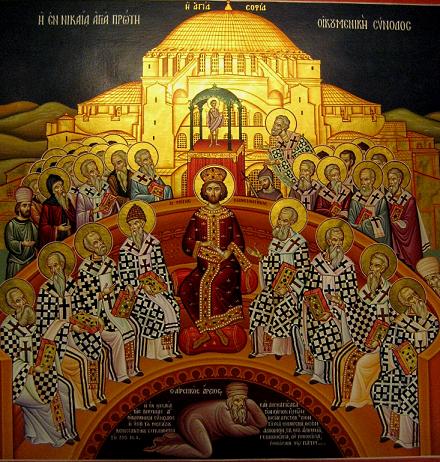
The First Ecumenical Council of Nicaea (325)
On the divinity of our Lord and Saviour Jesus Christ
Against Aryan heresy!
(The First Ecumenical Council was held in 325 A. D. in the city of Nicaea. This Council condemned the heresy of Arius, who denied the divinity of Jesus Christ and was teaching that our Lord was a God’s creature. This heresy provoked much unrest in the Church. Besides proclaiming true teaching concerning God Father and God Son, Jesus Christ, as it is presented in the first seven articles of the Creed, the Council made some canons, regulating the life of the Church).
„We believe in one God, the Father Almighty (all powerful), Maker of all things visible and invisible. And in one Lord Jesus Christ, the Son of God, the only-begotten begotten from the Father, that is from the substance [Gr. ousias, Lat. substantia] of the Father, God from God, light from light, true God from true God, begotten [Gr. gennethenta, Lat. natum] not made [Gr. poethenta, Lat. factum], CONSUBSTANTIAL [Gr. homoousion, Lat. unius substantiae (quod Graeci dicunt homousion)] with the Father, through Whom all things came to be, both those in heaven and those in earth; for us humans and for our salvation he came down and became incarnate, became man, suffered and rose up on the third day, went up (ascended) into the heavens, is coming to judge the living and the dead. And in the Holy Spirit.
And those who say that: “there once was (a time) when He was not”, and “before He was begotten He was not”, and that: He came to be from things that were not, or from another hypostasis [Gr. hypostaseos] or substance [Gr. ousias, Lat. substantia], affirming that the Son of God is subject to change or alteration; these the Catholic and Apostolic church anathematises”.
*
For a more in-depth description of this Holy Council, please also see: Sunday of the Fathers of the First Ecumenical Council
For all the Seven Ecumenical Councils of the One Catholic (Universal and Unchanged in Dogma!) and Apostolic Church, please see:
The Seven Ecumenical Councils of the Orthodox Church
Holy Fathers of the First Ecumenical Council of Nicaea (325)
During the time of the Ecumenical Councils many pious Bishops were recognized as great teachers and defenders of the faith and were glorified by the Church as saints.
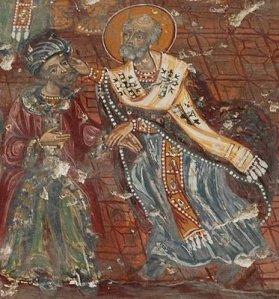
St. Nicholas, Archbishop of Myra in Licea, was known for his zeal, wisdom, humbleness and charity. He assisted the poor, quickly protected unjustly condemned or any one suffering from abuses of the rulers of those days. His noblest act, the conviction of Arius at the first Ecumenical Council, brought him an eternal glory and was marked by special acknowledgement of the fathers of the Council. He died December 6, 343 A. D. When the Saratzins were threatening the city of Myra, his relics were removed to Italy, where they repose to the present time in the city of Bahr.
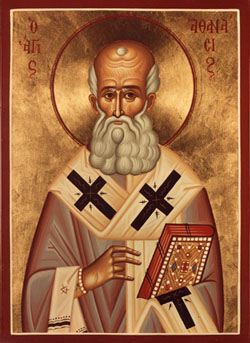
St. Athanasius the Great, of Alexandria, belongs to the school of the Apologets of the Church. When a deacon on the First Ecumenical Council, St. Athanasius was superior in his defence of the true faith against Arius’ heresy and as Archbishop of Alexandria during 46 years, proved to be steadfast pillar of the Church. He was accused by the heretics then in all kinds of crimes, including a treason, was exiled five times from Alexandria and only the last six years of his life he spent in the Cathedral city, arduously working for the peace and glory of the Church. He wrote many apologetics on behalf of the Church and died peacefully in 373 A. D., being 75 years old, and was given by the Church the title of “The Great.”
In the fourth century a most trying time for the Church, lived and worked the other three Ecumenical hierarchs and teachers – Basil the Great, Gregory the Theologian, and John Chrysostom.

St. Basil the Great, Archbishop of Cesaria of Capadocia (330-379 A. D.) was a native of that city. He was brought up in a very pious Christian family, his mother, grandmother; sisters and brother are among the saints of the Church. His father was a very prominent attorney and teacher of rhetoric. He received the best education of his time, finishing it in Athens. He was high in theology, philosophy and history, but highest in the faith and charity. As Church orator he gave to the Church the glorious “homilies on six days” of the creation where he appears to be a great scientist also. St. Basil is almost glorified for his defence of the Church against Arians. Heavy labor and religious disturbances of the time, many deprivations and ascetic life broke his health and he died in the fiftieth year of his life. He wrote Divine Liturgy that bears his name.
St. Gregory the Theologian, (326-389 A. D.) is known by this name in the Church as the greatest interpreter of the Holy Scriptures, especially on the personality of God, and his five sermons on God the Word, brought him this glorious title. He received his instructions from his mother, St. Nonna, and considered her instructions as the most valuable he had for his future.

St. Gregory was a friend of St. Basil; was in schools together with him, after in the monastery, and was consecrated as Bishop by his friend. He was elected archbishop of Constantinople when practically all Churches were taken there by the Arians, but he accepted the call and started the services in a little room and succeeded so much that the Arians were expelled from all the churches and the Orthodox Christians were admitted to the use of them. He took very prominent part at the Second Ecumenical Council against the heresy of Macedonius. After accomplishing this work St. Gregory retired to his native city of Nazians, where he spent his last years in ascetic life.
St. John Chrysostom (the Golden Mouth) is the most eloquent teacher of the Christian Church and at the same time most ardent defender of the rights and privileges of the Church. He lost his father when a child and was brought up by his pious mother Anfusa. He was a brilliant student and when his teacher, philosopher Licineus, was asked as to whom he would like to succeed him, he answered “of course John, if the Christians will not steal him from us.” About Anfusa, St. John’s mother, Licineus said: “What dignified women there are among the Christians.” After his mother’s death, St. John spent six years in seclusion and then came to the city of Antioch where he served for twelve years as a priest. Against his wish and under some pretense he was taken from Antioch and was consecrated as the Archbishop of Constantinople. First year of the service there was of much success and benefit to the Church. Nevertheless, his zeal and endeavors to correct the evils of the life among high officials and in the palace brought upon St. John displeasure and wrath of the Empress Evdoksia, and his enemies from the clergy succeeded in depriving him of his See and he was exiled.
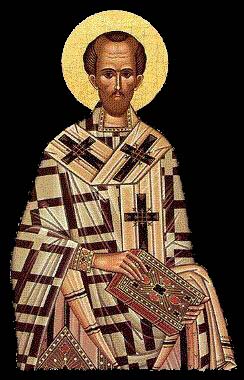
When he left the capital city, the earthquake of that night made the Empress to repent and to ask St. John to return, but her repentance were not sincere; in about two months St. John was exiled again for preaching to correct morals.
“The Church of Christ did not begin with me and will not end without me,” said the great teacher before going to his exile, which was a very severe one. On his way from Armenian city of Kukuza to Abkhazian city of Pitziunt on the north-eastern shores of the Black Sea, St. John stopped in a little village of Komani, being very weak and sick. Here in a dream appeared to him St. Vasilisk, whose relics were in this place reposing, and told him “Do not be discouraged, Brother John, tomorrow we will be together.” St. John in the morning took Holy Communion and peacefully died with the words as his last: “Glory be to God for everything.” St. John wrote Divine Liturgy that retains his name, and was anxious to bring to Christianity the people who lived then in Skiphia or present Southern Russia. He lived from 347 to 407 A.D. and is always looked upon as one of the famous fathers of our Orthodox Church_ His writings have even now a high value to the Church and serve to prove its dogmatical and historical truth.
We should be mindful of many equally saintly fathers, who rendered most useful service to the defence and expansion of the Church like Irineus of Lyon, Cyprian of Carthage, Blessed Augustin, Ambrose of Mediolan, Heronimus, Cyril of Alexandria, Cyril of Jerusalem, Gregory of Nissa, Gregory of Neocesaria and others, whose names even if we wished only to list would take many chapters of this brief historical account. But their lives, their work, their writings are most helpful for Christians to form their conceptions on different subjects related to the faith and teaching of the Church and we wish we could present them to our readers more fully but as it is, we desire very much that they study “the Fathers of the Church” with every possible opportunity.
Source: http://www.sthermansoca.org/page/christian-persecution
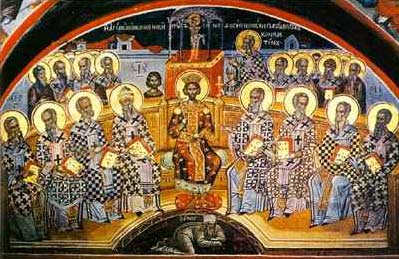
This council opened on 19 June in the presence of the emperor, but it is uncertain who presided over the sessions. In the extant lists of bishops present, Ossius of Cordova, and the presbyters Vitus and Vincentius are listed before the other names, but it is more likely that Eustathius of Antioch or Alexander of Alexandria presided. (see Decrees of the Ecumenical Councils, ed. Norman P. Tanner S.J.)
The bold text in the profession of faith of the 318 fathers constitutes, according to Tanner “The additions made by the council to an underlying form of the creed”, and that the underlying creed was most likely “derived from the baptismal formula of Caesarea put forward by the bishop of that city Eusebius” or that it “developed from an original form which existed in Jerusalem or at any rate Palestine”. “A direct descent from the creed of Eusebius of Caesarea is manifestly out of the question.” Vol 1, p2)
The holy synod of Nicaea proclaimed the first 7 verses of the Christian Creed.
2nd Ecumenical Council of Constantinople – 381 AD = proclaimed the last 5 verses of the Christian Creed, thus clarifying against the heretical remains of Arians regarding the Holy Spirit.
3rd Ecumenical Council of Ephesus – 431 AD = against Nestorian heretics. The Council proclaimed the two natures united in one person of Christ, and the holy virgin Mary is called by the holy fathers: the mother of our Lord Jesus Christ or Theothokos.
4th Ecumenical Council of Chalcedony – 451 AD = where the holy fathers condemned the heresy of the monophysites and all those sustaining that Christ had only one nature – the divine one.
5th Ecumenical Council was in Constantinople – 553 AD = the king Justinian tried to reconcile with the monophysites. The fathers clarified the doctrine from Chalcedony against 3 priests that appeared to be monophysites.
6th Ecumenical Council of Constantinople – 680 AD, clarified again against the heretics who sustained only one (the divine) nature of Christ.
7th and Last Ecumenical Council of Nicaea – 787 AD, when it was affirmed once and for last the supra-veneration of virgin Mary, the mother of God, the veneration of the saints and their holy relics, the veneration of the holy icons and the holy cross.
One is the Church, catholic and apostolic, maintaining the holy tradition and cannons from the apostles, unchanged in dogma and untouched in sanctity by any heretical theories; one is the Faith in Lord Jesus Christ, the Orthodox (“the right way” of worship) Faith. Today many churches are trying to reform their unity. This is the scope of the contemporary Ecumenical movement. They desire the “reforming” or perhaps “deforming” of the body of Christ.
The figure of 318 given in the heading below is from Hilary of Poitier and is the traditional one.
THE PROFESSION OF FAITH OF THE 318 FATHERS
- We believe in one God the Father all powerful, maker of all things both seen and unseen. And in one Lord Jesus Christ, the Son of God, the only-begotten begotten from the Father, that is from the substance [Gr. ousias, Lat. substantia] of the Father, God from God, light from light, true God from true God, begotten [Gr. gennethenta, Lat. natum] not made [Gr. poethenta, Lat. factum], CONSUBSTANTIAL [Gr. homoousion, Lat. unius substantiae (quod Graeci dicunt homousion)] with the Father, through whom all things came to be, both those in heaven and those in earth; for us humans and for our salvation he came down and became incarnate, became human, suffered and rose up on the third day, went up into the heavens, is coming to judge the living and the dead. And in the holy Spirit.
- And those who say
- “there once was when he was not”, and “before he was begotten he was not”, and that
- he came to be from
- things that were not, or
- from another hypostasis [Gr. hypostaseos] or substance [Gr. ousias, Lat. substantia], affirming that the Son of God is subject to change or alteration these the catholic and apostolic church anathematises.
3. CANONS
- If anyone in sickness has undergone surgery at the hands of physicians or has been castrated by barbarians, let him remain among the clergy. But if anyone in good health has castrated himself, if he is enrolled among the clergy he should be suspended, and in future no such man should be promoted. But, as it is evident that this refers to those who are responsible for the condition and presume to castrate themselves, so too if any have been made eunuchs by barbarians or by their masters, but have been found worthy, the canon admits such men to the clergy.
- Since, either through necessity or through the importunate demands of certain individuals, there have been many breaches of the church’s canon, with the result that men who have recently come from a pagan life to the faith after a short catechumenate have been admitted at once to the spiritual washing, and at the same time as their baptism have been promoted to the episcopate or the presbyterate, it is agreed that it would be well for nothing of the kind to occur in the future. For a catechumen needs time and further probation after baptism, for the apostle’s words are clear: “Not a recent convert, or he may be puffed up and fall into the condemnation and the snare of the devil”. But if with the passage of time some sin of sensuality is discovered with regard to the person and he is convicted by two or three witnesses, such a one will be suspended from the clergy. If anyone contravenes these regulations, he will be liable to forfeit his clerical status for acting in defiance of this great synod.
- This great synod absolutely forbids a bishop, presbyter, deacon or any of the clergy to keep a woman who has been brought in to live with him, with the exception of course of his mother or sister or aunt, or of any person who is above suspicion.
- It is by all means desirable that a bishop should be appointed by all the bishops of the province. But if this is difficult because of some pressing necessity or the length of the journey involved, let at least three come together and perform the ordination, but only after the absent bishops have taken part in the vote and given their written consent. But in each province the right of confirming the proceedings belongs to the metropolitan bishop.
- Concerning those, whether of the clergy or the laity, who have been excommunicated, the sentence is to be respected by the bishops of each province according to the canon which forbids those expelled by some to be admitted by others. But let an inquiry be held to ascertain whether anyone has been expelled from the community because of pettiness or quarrelsomeness or any such ill nature on the part of the bishop. Accordingly, in order that there may be proper opportunity for inquiry into the matter, it is agreed that it would be well for synods to be held each year in each province twice a year, so that these inquiries may be conducted by all the bishops of the province assembled together, and in this way by general consent those who have offended against their own bishop may be recognised by all to be reasonably excommunicated, until all the bishops in common may decide to pronounce a more lenient sentence on these persons. The synods shall be held at the following times: one before Lent, so that, all pettiness being set aside, the gift offered to God may be unblemished; the second after the season of autumn.
- The ancient customs of Egypt, Libya and Pentapolis shall be maintained, according to which the bishop of Alexandria has authority over all these places since a similar custom exists with reference to the bishop of Rome. Similarly in Antioch and the other provinces the prerogatives of the churches are to be preserved. In general the following principle is evident: if anyone is made bishop without the consent of the metropolitan, this great synod determines that such a one shall not be a bishop. If however two or three by reason of personal rivalry dissent from the common vote of all, provided it is reasonable and in accordance with the church’s canon, the vote of the majority shall prevail.
- Since there prevails a custom and ancient tradition to the effect that the bishop of Aelia is to be honoured, let him be granted everything consequent upon this honour, saving the dignity proper to the metropolitan.
- Concerning those who have given themselves the name of Cathars, and who from time to time come over publicly to the catholic and apostolic church, this holy and great synod decrees that they may remain among the clergy after receiving an imposition of hands. But before all this it is fitting that they give a written undertaking that they will accept and follow the decrees of the catholic church, namely that they will be in communion with those who have entered into a second marriage and with those who have lapsed in time of persecution and for whom a period [of penance] has been fixed and an occasion [for reconciliation] allotted, so as in all things to follow the decrees of the catholic and apostolic church. Accordingly, where all the ordained in villages or cities have been found to be men of this kind alone, those who are so found will remain in the clergy in the same rank; but when some come over in places where there is a bishop or presbyter belonging to the catholic church, it is evident that the bishop of the church will hold the bishop’s dignity, and that the one given the title and name of bishop among the so-called Cathars will have the rank of presbyter, unless the bishop thinks fit to let him share in the honour of the title. But if this does not meet with his approval, the bishop will provide for him a place as chorepiscopus or presbyter, so as to make his ordinary clerical status evident and so prevent there being two bishops in the city.
- If any have been promoted presbyters without examination, and then upon investigation have confessed their sins, and if after their confession men have imposed hands upon such people, being moved to act against the canon, the canon does not admit these people, for the catholic church vindicates only what is above reproach.
10. If any have been promoted to ordination through the ignorance of their promoters or even with their connivance, this fact does not prejudice the church’s canon; for once discovered they are to be deposed.
11. Concerning those who have transgressed without necessity or the confiscation of their property or without danger or anything of this nature, as happened under the tyranny of Licinius, this holy synod decrees that, though they do not deserve leniency, nevertheless they should be treated mercifully. Those therefore among the faithful who genuinely repent shall spend three years among the hearers, for seven years they shall be prostrators, and for two years they shall take part with the people in the prayers, though not in the offering.
12. Those who have been called by grace, have given evidence of first fervour and have cast off their [military] belts, and afterwards have run back like dogs to their own vomit, so that some have even paid money and recovered their military status by bribes — such persons shall spend ten years as prostrators after a period of three years as hearers. In every case, however, their disposition and the nature of their penitence should be examined. For those who through their fear and tears and perseverance and good works give evidence of their conversion by deeds and not by outward show, when they have completed their appointed term as hearers, may properly take part in the prayers, and the bishop is competent to decide even more favourably in their regard. But those who have taken the matter lightly, and have thought that the outward form of entering the church is all that is required for their conversion, must complete their term to the full.
13. Concerning the departing, the ancient canon law is still to be maintained namely that those who are departing are not to be deprived of their last, most necessary viaticum. But if one whose life has been despaired of has been admitted to communion and has shared in the offering and is found to be numbered again among the living, he shall be among those who take part in prayer only [here a variant reading in Les canons des conciles oecumeniques adds “until the term fixed by this great ecumenical synod has been completed”]. But as a general rule, in the case of anyone whatsoever who is departing and seeks to share in the eucharist, the bishop upon examining the matter shall give him a share in the offering.
14. Concerning catechumens who have lapsed, this holy and great synod decrees that, after they have spent three years as hearers only, they shall then be allowed to pray with the catechumens.
15. On account of the great disturbance and the factions which are caused, it is decreed that the custom, if it is found to exist in some parts contrary to the canon, shall be totally suppressed, so that neither bishops nor presbyters nor deacons shall transfer from city to city. If after this decision of this holy and great synod anyone shall attempt such a thing, or shall lend himself to such a proceeding, the arrangement shall be totally annulled, and he shall be restored to the church of which he was ordained bishop or presbyter or deacon.
16. Any presbyters or deacons or in general anyone enrolled in any rank of the clergy who depart from their church recklessly and without the fear of God before their eyes or in ignorance of the church’s canon, ought not by any means to be received in another church, but all pressure must be applied to them to induce them to return to their own dioceses, or if they remain it is right that they should be excommunicated. But if anyone dares to steal away one who belongs to another and to ordain him in his church without the consent of the other’s own bishop among whose clergy he was enrolled before he departed, the ordination is to be null.
17. Since many enrolled [among the clergy] have been induced by greed and avarice to forget the sacred text, “who does not put out his money at interest”, and to charge one per cent [a month] on loans, this holy and great synod judges that if any are found after this decision to receive interest by contract or to transact the business in any other way or to charge [a flat rate of] fifty per cent or in general to devise any other contrivance for the sake of dishonourable gain, they shall be deposed from the clergy and their names struck from the roll.
18. It has come to the attention of this holy and great synod that in some places and cities deacons give communion to presbyters, although neither canon nor custom allows this, namely that those who have no authority to offer should give the body of Christ to those who do offer. Moreover it has become known that some of the deacons now receive the eucharist even before the bishops. All these practices must be suppressed. Deacons must remain within their own limits, knowing that they are the ministers of the bishop and subordinate to the presbyters. Let them receive the eucharist according to their order after the presbyters from the hands of the bishop or the presbyter. Nor shall permission be given for the deacons to sit among the presbyters, for such an arrangement is contrary to the canon and to rank. If anyone refuses to comply even after these decrees, he is to be suspended from the diaconate.
19. Concerning the former Paulinists who seek refuge in the catholic church, it is determined that they must be rebaptised unconditionally. Those who in the past have been enrolled among the clergy, if they appear to be blameless and irreproachable, are to be rebaptised and ordained by the bishop of the catholic church. But if on inquiry they are shown to be unsuitable, it is right that they should be deposed. Similarly with regard to deaconesses and all in general whose names have been included in the roll, the same form shall be observed. We refer to deaconesses who have been granted this status, for they do not receive any imposition of hands, so that they are in all respects to be numbered among the laity.
20. Since there are some who kneel on Sunday and during the season of Pentecost, this holy synod decrees that, so that the same observances may be maintained in every diocese, one should offer one’s prayers to the Lord standing.
THE LETTER OF THE SYNOD IN NICAEA TO THE EGYPTIANS
The bishops assembled at Nicaea, who constitute the great and holy synod, greet the church of the Alexandrians, by the grace of God holy and great, and the beloved brethren in Egypt, Libya and Pentapolis.
Since the grace of God and the most pious emperor Constantine have called us together from different provinces and cities to constitute the great and holy synod in Nicaea, it seemed absolutely necessary that the holy synod should send you a letter so that you may know what was proposed and discussed, and what was decided and enacted.
- First of all the affair of the impiety and lawlessness of Arius and his followers was discussed in the presence of the most pious emperor Constantine. It was unanimously agreed that anathemas should be pronounced against his impious opinion and his blasphemous terms and expressions which he has blasphemously applied to the Son of God,
-
- saying
- “he is from things that are not”, and
- “before he was begotten he was not”, and
- “there once was when he was not”,
- saying too that
- by his own power the Son of God is capable of
- evil and
- goodness,
- by his own power the Son of God is capable of
- and calling him
- a creature and a work.
- saying
Against all this the holy synod pronounced anathemas, and did not allow this impious and abandoned opinion and these blasphemous words even to be heard.
Of that man and the fate which befell him, you have doubtless heard or will hear, lest we should seem to trample upon one who has already received a fitting reward because of his own sin. Such indeed was the power of his impiety that Theonas of Marmarica and Secundus of Ptolemais shared in the consequences, for they too suffered the same fate.
But since, when the grace of God had freed Egypt from this evil and blasphemous opinion, and from the persons who had dared to create a schism and a separation in a people which up to now had lived in peace, there remained the question of the presumption of Meletius and the men whom he had ordained, we shall explain to you, beloved brethren, the synod’s decisions on this subject too. The synod was moved to incline towards mildness in its treatment of Meletius for strictly speaking he deserved no mercy. It decreed that that he might remain in his own city without any authority to nominate or ordain, and that he was not to show himself for this purpose in the country or in another city, and that he was to retain the bare name of his office.
It was further decreed that those whom he had ordained, when they had been validated by a more spiritual ordination, were to be admitted to communion on condition that they would retain their rank and exercise their ministry, but in every respect were to be second to all the clergy in each diocese and church who had been nominated under our most honoured brother and fellow minister Alexander; they were to have no authority to appoint candidates of their choice or to put forward names or to do anything at all without the consent of the bishop of the catholic church, namely the bishop of those who are under Alexander. But those who by the grace of God and by our prayers have not been detected in any schism, and are spotless in the catholic and apostolic church, are to have authority to appoint and to put forward the names of men of the clergy who are worthy, and in general to do everything according to the law and rule of the church.
In the event of the death of any in the church, those who have recently been accepted are thereupon to succeed to the office of the deceased, provided that they appear worthy and are chosen by the people; the bishop of Alexandria is to take part in the vote and confirm the election. This privilege, which has been granted to all others, does not apply to the person of Meletius because of his inveterate seditiousness and his mercurial and rash disposition, lest any authority or responsibility should be given to one who is capable of returning to his seditious practices.
These are the chief and most important decrees as far as concerns Egypt and the most holy church of the Alexandrians. Whatever other canons and decrees were enacted in the presence of our lord and most honoured fellow minister and brother Alexander, he will himself report them to you in greater detail when he comes, for he was himself a leader as well as a participant in the events.
The following is not found in the latin text, but is found in the greek text :
We also send you the good news of the settlement concerning the holy pasch, namely that in answer to your prayers this question also has been resolved. All the brethren in the East who have hitherto followed the Jewish practice will henceforth observe the custom of the Romans and of yourselves and of all of us who from ancient times have kept Easter together with you. Rejoicing then in these successes and in the common peace and harmony and in the cutting off of all heresy, welcome our fellow minister, your bishop Alexander, with all the greater honour and love. He has made us happy by his presence, and despite his advanced age has undertaken such great labour in order that you too may enjoy peace.
Pray for us all that our decisions may remain secure through almighty God and our lord Jesus Christ in the holy Spirit, to whom is the glory for ever and ever. Amen.
Translation taken from Decrees of the Ecumenical Councils, ed. Norman P. Tanner
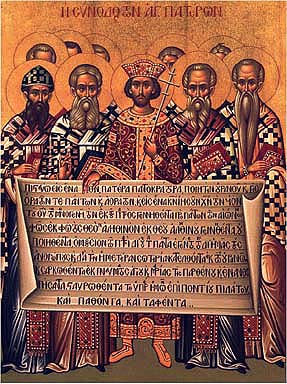
Briefly in the other Councils:
The Second Ecumenical Council of Constantinople (381)
On the Holy Spirit
(The Second Ecumenical Council was held in 381 A. D., at Constantinople and was convoked to judge Macedonius, who was spreading heretical teaching about the Holy Spirit. Macedonius was teaching that the Holy Spirit was created by God like angels were, only he was a spirit of higher type and order. The fathers of this Council rejected Macedonius’ teaching and condemned it as a heresy against the Holy Ghost and composed the last five articles of the Creed, in which they expounded the true teaching about the Holy Ghost and other dogmas of the Church. The Creed (Symvol Veri) of the First and Second Ecumenical Councils is called the Nicene Creed).
(Today the „Catholic” Church of Rome-Vatican still shares this heresy- when they declare that the „Holy Spirit, the Lord and giver of life, proceeds from the Father and the Son, thus blasphemysing the Holy Spirit!) see bellow…
„We believe in one God, the Father Almighty, Maker of all things visible and invisible. And in one Lord Jesus Christ, the Son of God, begotten of the Father, the only begotten before all ages, Light from Light, true God from true God, begooten and not made, One in essence with the Father, through Whom all things were made, Who for us men and for our salvation came down from heaven and was incarnate of the Holy Spirit and the Virgin Mary and became man; and He was crucified for us in the day of Pontius Pilate, He suffered and was buried, and He rose on the third day according to the Scriptures, and ascended into heaven, and sits on the right hand of the Father, and will come again to judge the living and the dead, Whose kingdom will never end. And in the Holy Spirit, the Lord and Giver of life, Who proceeds from the Father, Who with the Father and the Son is worshiped and glorified, Who was spoken by the Prophets. And in the one Holy, Catholic and Apostolic Church. We confess one [single] baptism for the forgiveness of sins. We wait for the resurrection of the dead and the life of the world (waiting) to come. Amen!”
*
The Third Ecumenical Council of Ephesus (431)
On the Virgin Mary and,
Against Nestorian Heresy!
(The Third Ecumenical Council was held in Ephesus, 431 A. D., it condemned the heresy of Nestorius, who taught that our Lord was only a man, in whom the divinity was abiding like in a temple. He called the Blessed Virgin Mary the Mother of Christ and not the Mother of God. This heresy survives in Persia and in many other „Protestant” Churchs, thus brigning blasphemy to the Most Pure among Women, the Virgin Mary who the Father chose to bare the Son).
The Holy Ecumenical Council of Nicea made this confession of faith (what it followed was the Creed of the 318 Holy Fathers from Nicea united in the First Ecumenical Council): We believe (see above)…
This Holy Synod gathered in the third Ecumenical Council, had decided that all shall receive this holy cofession of faith (of the 1st Council), because it is right and enough for the salvation of man. Although some pretended (still holds true today) that they confessed it and received it, they twised the meaning, so a 3rd Council was needed as a clear testimony of the unblemished Truth.
The Holy Synod decided that noone is allowed to preach, write or compose another confession of faith other than what was settled by the Holy Fathers gathered n Nicea under the Holy Spirit.
And, those composing another cofession of faith either as the pagan Greeks [the old paganism] or as the jews (non-Christians) or of any other heresy, [those], if they are bishops or clergymen are to be defrocked (removed), or if they are laymen, anathematised.
*
The Fourth Ecumenical Council of Chalcedon (451)
On the two natures of Christ
Against the Monophisites Heresy (today the „Coptic” Church still shares this heresy!)
(The Fourth Ecumenical Council was held at Chalcedon in the year of our Lord 451. This Council condemned the heresy of Eutychius, who was teaching that our Lord was only God, that His divine nature absorbed the human one. At the present time to this doctrine adders the Armenian Church).
*
The Fifth Ecumenical Council of Constantinople (553)
Aganst the previous Nestorian and the Monophisites’ Heresy
(The Fifth Ecumenical Council was held in Constantinople, 553 A. D. By this Council were excommunicated the followers of Nestorius and their writings were condemned as heretical).
*
The Sixth Ecumenical Council of Constantinople (680-681)
On whether the two natures of Jesus Christ (God and man) had two separate wills.
Against Monothelites Heresy
(The Sixth Ecumenical Council was called in 680 A. D., at Constantinople against the heresy of Monothelists, who acknowledged in our Lord only one divine will, denying the human one in Him. The Abyssinian Church (Copts of Egypt) adheres to this teaching. This Council resumed its seating in 691 A. D., at the Trula palace and approved the canons of the proceeding Councils).
*
The Seventh Ecumenical Council of Nicaea (787)
On the veneration of the holy icons
Against the Iconoclats (today many „Protestant” Churches still share this heresy, blasphemyzing the Image of Christ, His Mother and of the Saints by calling them, without discernment, idols; however ignoring the true idols: money, power, fame, wordly models of decadence, and so on…)
(The Seventh Ecumenical Council was called in 787 A. D., against the heresy of iconoclasts. It restored the veneration of the holy icons. When finally the peace in the Church life was restored by the victory over all heresies the Sunday of Orthodoxy was decreed in the year of 878, as an annual festival, and thereafter it is observed by the Eastern Church up to the present time on the first Sunday of Great Lent).
After receiving the freedom of teaching and worship, the Christian Church was able to put all her doctrines in a system, to make necessary rules of church discipline and to defend and proclaim the truth it was holding from the time of Christ. The rules and regulations of the Church which have the power of the law for the whole Church are known as the canons of the Church, and were composed and enacted by the Ecumenical Councils. There were seven Ecumenical and nine Provincial Councils of the Undivided Church, canons of which comprise the Church law. To this day the Christian Orthodox Church holds decisions of the Seven Ecumenical Councils as highest authority on matters of dogma and faith. The canon law can not be changed without convoking next Ecumenical Council.
 Christian Dogma
 Christian Martyrs
 Christian Orthodox Churches and Monasteries
 Christian Sermons and News
 Church's Teachings on Fasting
 Ecumenism – a Great Heresy
 Father George Calciu
 Life_a Sacred Gift form God
 Orthodox Saints and Church Fathers
 Spiritual Elders
 Daily Bible Readings
 Journey to Orthodoxy
 Listen to Ancient Faith Radio
 Orthodox Calendar of Feasts and Saints
 Orthodox Christian Mission Center
 Orthodox Institute
 OrthodoxChristianNetwork TV


Recent Comments