
You are currently browsing the category archive for the ‘Ecumenism – a Great Heresy’ category.
Motto: “The line of demarcation separating good and evil runs through the middle of every human heart”
(Alexander Solzenitsyn in The Gulag Archipelago)
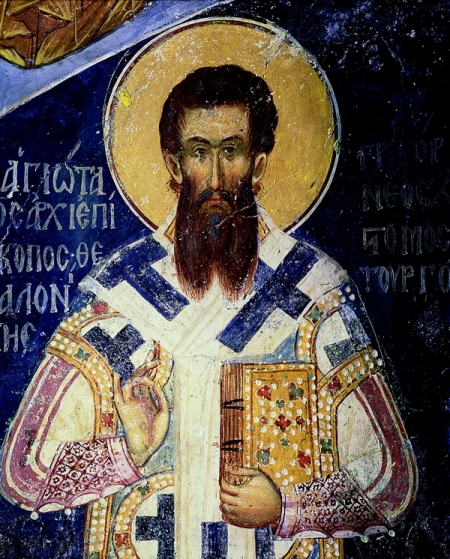
Saint Gregory Palamas, Archbishop of Thessalonica
A link with:
The life of St. Gregory (video) of the Monastery of Pantokrator website
This divine Father, who was from Asia Minor, was from childhood reared in the royal court of Constantinople, where he was instructed in both religious and secular wisdom. Later, while still a youth, he left the imperial court and struggled in asceticism on Mount Athos, and in the Skete at Beroea. He spent some time in Thessalonica being treated for an illness that came from his harsh manner of life. He was present in Constantinople at the Council that was con¬vened in 1341 against Barlaam of Calabria, and at the Council of 1347 against Acindynus, who was of like mind with Barlaam; Barlaam and Acindynus claimed that the grace of God is created. At both these Councils, the Saint contended courageously for the true dogmas of the Church of Christ, teaching in particular that divine grace is not created, but is the uncreated energies of God which are poured forth throughout creation: otherwise it would be impossi¬ble, if grace were created, for man to have genuine communion with the uncreated God. In 1347 he was appointed Metropolitan of Thessalonica. He tended his flock in an apostolic man¬ner for some twelve years, and wrote many books and treatises on the most exalted doctrines of our Faith; and having lived for a total of sixty-three years, he reposed in the Lord in 1359. His holy relics are kept in the Cathedral of Thessalonica. A full service was composed for his feast day by the Patriarch Philotheus in 1368, when it was, established that his feast be cele¬brated on this day. Since works without right faith avail nothing, we set Orthodoxy of faith as the foundation of all that we accomplish during the Fast, by celebrating the Triumph of Ortho¬doxy the Sunday before, and the great defender of the teachings of the holy Fathers today. His Feast day is celebrated November 27 / 14 and on the Second Sunday of Great Lent.
Excerpt from the book: “Lives of the Three Pillars of Orthodoxy: Saint Gregory Palamas, Archbishop of Thessalonica; Saint Photius the Great, Patriarch of Constantinople and Saint Mark Eugenicus, Metropolitan of Ephesus”

Troparia for Saint Gregory Palamas:
O light of Orthodoxy, pillar and teacher of the Church,
ideal of monastics and invincible champion theologian,
O wonder-working Gregory, boast of Thessalonica and herald of grace,
Forever pray to the Lord that our souls be saved.
Please also see: A Sermon on the Sunday of St. Gregory Palamas By Archbishop Chrysostomos of Etna
Fr. Bassam A. Nassif: St. Gregory – a Light to the World
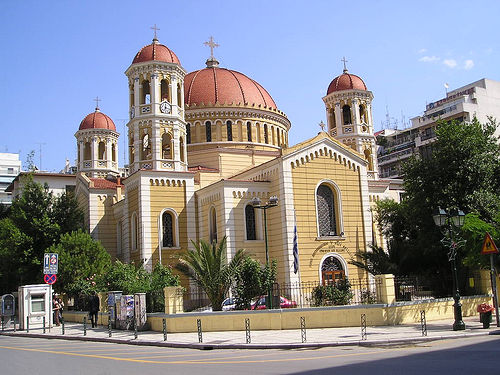
On the second Sunday of Great Lent, there is a great feast in the blessed city of Thessalonika, Greece. It is the feast of St. Gregory Palamas. On this day, the holy relics of the saint are taken from the Church of St. Gregory in a procession throughout the city, escorted by bishops, priests, sailors, policemen, and thousands of faithful. One wonders why his earthly remains are still held in such great veneration. How could his bones remain incorruptible more than six hundred years after his death? Indeed, St. Gregory’s life clearly explains these wondrous facts. It illustrates the inspired words of the apostles that our bodies are temples of the Holy Spirit (see 1 Corinthians 6:19) and that we are “partakers of the divine nature” (2 Peter 1:4).
A Childhood Passion for the Eternal
St. Gregory Palamas was born in the year 1296. He grew up in Constantinople (now Istanbul, Turkey) in a critical time of political and religious unrest. Constantinople was slowly recovering from the devastating invasion of the Crusades. It was a city under attack from all sides. From the west, it was infiltrated by Western philosophies of rationalism and scholasticism and by many attempts at Latinization. From the east, it was threatened by Muslim Turkish military invaders. The peace and faith of its citizens were at stake.
Gregory’s family was wealthy. His father was a member of the senate. Upon his father’s sudden death, Byzantine Emperor Andronikos II Paleologos (1282–1328), who was a close friend of the family, gave it his full financial support. He especially admired Gregory for his fine abilities and talents, hoping that the brilliant young man would one day become a fine assistant. However, instead of accepting a high office in the secular world, Gregory sought “that good part, which will not be taken away” from him (Luke 10:42).
Upon finishing his studies in Greek philosophy, rhetoric, poetry, and grammar, Gregory, at only twenty or twenty-two years of age, followed a burning passion in his heart. Like a lover who strives to stay alone forever with his loved one, Gregory was thirsty for this living water (see Revelation 22:17). Therefore, no created thing could separate him from the love of God (see Romans 8:39). He simply withdrew to Mount Athos, an already established community of monasticism. He first stayed at the Vatopedi Monastery, and then moved to the Great Lavra.
Gregory’s departure was not a surprise to the rest of his family. Many priests and monks, friends of the family, frequently visited the family home. The parents were careful to pass on to their children the “pearl of great price” (Matthew 13:46). Great wealth and high education were not a hindrance, but an excellent tool in their pursuit of salvation. As a result of their way of life and belief, Gregory’s mother, two brothers, and two sisters soon distributed all their earthly possessions to the poor and entered different monasteries.
On St Gregory Palamas and the Divine Energies
Living the Spiritual Experience of the Church
In Athos, the novice Gregory took as his spiritual guide St. Nicodemos of Vatopedi Monastery. This holy man of prayer guided Gregory on the path of ascetic labor: prayers, vigils, fasting, continuous repentance, and monastic obedience. The young novice Gregory was especially attached to the prayer of the heart, also known as the Jesus Prayer: “Lord Jesus Christ, Son of God, have mercy on me, a sinner” (see Luke 18:38).
The experienced practice of the Jesus Prayer, requiring solitude and silence combined with physical exercises and breathing methods, is called “hesychasm” (from the Greek hesychos, meaning inner stillness, peace, or silence). Those practicing it are called “hesychasts.” Inner silence of this kind makes us capable of listening to the whispers of the divine within us. “The kingdom of God is within you” (Luke 17:21). Therefore, the Jesus Prayer is the prayer of the whole person, involving the human body, mind, soul, and heart.
The hesychasts spoke and wrote about their unique experience. They taught people to pray without ceasing, as the Apostle Paul commands all Christians to do (1 Thessalonians 5:17). They explained that in prayer, man is filled from within with the eternal glory, with the divine light beheld at the Transfiguration of Christ on Mount Tabor. The hesychast Gregory explains:
For, on the day of the Transfiguration, that Body, source of the light of grace, was not yet united with our bodies; it illuminated from outside those who worthily approached it, and sent the illumination into the soul by the intermediary of the physical eyes; but now, since it is mingled with us and exists in us, it illuminates the soul from within. (Triads I. 3.38)
The Jesus Prayer is not a mantra, as in Eastern religions, and it cannot be taken as such. The prayer’s call for “mercy” involves inner repentance and change. It is also a prayer practiced within the sacramental life of the Church, a prayer combined with Holy Communion, confession, reading the Word of God, fasting, loving one’s neighbor, and so forth. Finally, it is not a prayer using “vain repetitions” or babble, but a prayer recited again and again, in persistence (Luke 18:1), from the inner heart of man reaching the divine heights of glory, confessing Christ as the Lord and Savior, in sincerity, humility, and faith.
For that prayer (the Jesus Prayer) is true and perfect. It fills the soul with Divine grace and spiritual gifts. As chrism perfumes the jar the more strongly the tighter it is closed, so prayer, the more fast it is imprisoned in the heart, abounds the more in Divine grace. . . . By this prayer the dew of the Holy Spirit is brought down upon the heart, as Elijah brought down rain on Mount Carmel. This mental prayer reaches to the very throne of God and is preserved in golden vials. . . . This mental prayer is the light which illumines man’s soul and inflames his heart with the fire of love of God. It is the chain linking God with man and man with God. (Palamas, “Homily on how all Christians in general must pray without ceasing,” in E. Kadloubovsky and G. E. H. Palmer, Early Fathers of the Philokalia, London: Faber and Faber, 1981, pp. 412–415)
See also: Knowledge of God according to St. Gregory Palamas
Such prayer was practiced from the early Christian period. The hesychasts were drawn by God’s unconditional graceful love (Romans 5:15) to fill a certain human need around them. Many hesychasts abandoned their solitude to serve their brothers, “since he who loves God must love his brother also” (1 John 4:21). Some cared for the sick in hospitals, like St. Basil the Great in Caesarea; others helped the poor, like St. John the Almsgiver in Alexandria; and yet others welcomed the faithful for confession. Nevertheless, they did not abandon the Jesus Prayer and their inner silence. In this sense, all Christians are called to follow this hesychast way leading to salvation.
Let no one think, my brother Christians, that it is the duty only of priests and monks to pray without ceasing, and not of laymen. No, no; it is the duty of all of us Christians to remain always in prayer . . . every Christian in general should strive to pray always, and to pray without ceasing . . . this very name of our Lord Jesus Christ, constantly invoked by you, will help you to overcome all difficulties, and in the course of time you will become used to this practice and will taste how sweet is the name of the Lord. . . . For when we sit down to work with our hands, when we walk, when we eat, when we drink we can always pray mentally and practice this mental prayer—the true prayer pleasing to God. (“Homily on how all Christians in general must pray without ceasing”)
In addition to his spiritual practice and daily scriptural readings, St. Gregory studied the works of the great Fathers, theologians, and ascetics of the Church. Just as a scientist builds on the evidence and data provided to him by his predecessors, Gregory made a fascinating synthesis of the scriptural and patristic teaching on the prayer of the heart, combined with his personal experience.
Although the monk Gregory in his youth had diligently studied Greek philosophy, he was not influenced by its views on matter. Ancient Greek philosophy believes that the body imprisons the soul, and thus it detests matter. Christians respect the body, since Christ made the flesh a source of sanctification, and matter (water, oil, etc.) a channel of divine grace. In his writings, St. Gregory affirmed that man, united in body and soul, is sanctified by Jesus Christ, who took a human body at the Incarnation. “When God is said to have made man according to His image,” wrote St. Gregory, “the word man means neither the soul by itself nor the body by itself, but the two together.” In another place, he added:
Also see: Two brilliant and lengthy articles on the “Palamite Controversy” and the big differences between the Orthodox and Latin understanding of the spiritual life
Thus the Word of God took up His dwelling in the Theotokos in an inexpressible manner and proceeded from her, bearing flesh. He appeared upon the earth and lived among men, deifying our nature and granting us, after the words of the divine Apostle, “things which angels desire to look into” (1 Peter 1:12). (A Homily on the Dormition of the Theotokos and Ever-Virgin Mary)
Father Gregory, Teacher
His unquenched thirst for God’s sweetness experienced in prayer moved the righteous Gregory to live as a hermit in a cell outside the monastery. In the year 1326, the threat of Turkish invasions forced him, along with his Athonite brothers, to retreat to Thessalonika. There he was ordained to the holy priesthood.
As a priest, Gregory did not abandon his spiritual labor and hesychasm. He spent most of the week alone in prayer. On the weekends, he celebrated divine services and preached sermons. He cared for the youth, calling them to discuss religious issues with him. Father Gregory was not concerned about abstract problems of philosophy, but about Christian faith experienced in prayer. He wanted to preach solely about problems of Christian existence, which are more attractive and meaningful to the young.
Soon, many of his spiritual sons expressed their desire to live in a monastic setting. So in the serene area of Vereia, near Thessalonika, he established a small community of monks, which he guided for five years. In 1331 the saint withdrew to Mt. Athos and lived in solitude at the Skete of St. Sabbas. In 1333 he was appointed abbot of the Esphigmenou Monastery in the northern part of the Holy Mountain. In 1336 he returned to the Skete of St. Sabbas, where he devoted himself to theological writing, continuing with this work until the end of his life.
But amidst all this, in the 1330s events took place in the life of the Eastern Church that placed St. Gregory among the most prominent teachers of Orthodox spirituality.
The Challenge of Rationalism
Around the year 1330, a certain monk Barlaam arrived in Constantinople from Calabria, Italy. He was a famous scholar, a skilled orator, and an acclaimed Christian teacher. Barlaam visited Mt. Athos and became acquainted with hesychasm.
Barlaam valued education and learning much more than contemplative prayer. Therefore, he believed the monks on Mount Athos were wasting their time in contemplative prayer when they should be studying. He ridiculed the ascetic labor and life of the monks, their methods of prayer, and their teachings about the uncreated light experienced by the hesychasts. Countering the traditional stance of the Church that “the theologian is the one who prays,” Barlaam asked: “How can an intimate communion of man with the Divine be achievable through prayer, since the Divine is transcendent and ‘dwelling in unapproachable light’ (1 Timothy 5:16)? No one can apprehend the essential being of God!” Barlaam was convinced that God can be reached only through philosophical, mental knowledge—in other words, through rationalism.
The words of Barlaam were not merely a challenge to a few monks. They defied the experience of the Church as a whole. The West, with its rationalistic tendencies, has associated the image of God with man’s intellect. Barlaam’s mind was full of rational arguments, but his heart was cold. Certainly, life with God is not just information, but also experience. Our living God cannot be conceived and described only by study, but must be spoken about from experience. “Did not our heart burn within us while He talked with us on the road, and while He opened the Scriptures to us?” (Luke 24:32).
Journeying from Mt. Athos to Thessalonika and Constantinople, Barlaam clashed with the monks, refusing to test their way of vigils, prayer, and fasting, or to accept their spiritual experience. Unfortunately, many monks were swayed by his arguments and stood by his side. Deceived by considering the living faith as mere rational knowledge, Barlaam waged a war against the ascetics.
At the request of the Athonite monks, St. Gregory countered at first with verbal admonitions. But seeing the futility of such efforts, he put his theological arguments in writing. Thus appeared the Triads in Defense of the Holy Hesychasts in the year 1338.
The Presence of God in Prayer
In his Triads, Palamas interpreted the experience of the Church by presenting logical arguments, based on the Scripture and the writings of the Fathers. Addressing the question of how it is possible for humans to have knowledge of a transcendent and unknowable God, he drew a distinction between knowing God in His essence, or nature, and knowing God in His energies, actions, or the means by which He acts.
To elaborate more, he made a comparison between God and the sun. The sun has its rays, God has His energies (among them, grace and light). By His energies, God creates, sustains, and governs the universe. By His energies, He transforms creation and deifies it, that is, He fills the new creation with His energies as water fills a sponge. These actions or energies of God are the true revelation of God Himself to humanity. So God is incomprehensible and unknowable in His nature or essence, but knowable in His energies. It is through His actions out of His love to the whole creation that God enters into a direct and immediate relationship with mankind, a personal confrontation between creature and Creator.
Towards the year 1340 the Athonite ascetics, with St. Gregory’s assistance, compiled a general reply to the attacks of Barlaam, the so-called Hagiorite Tome. Since the heated arguments flared everywhere in the churches, a general council was held at Constantinople in the year 1341. In front of hundreds of bishops and monastics, St. Gregory Palamas held an open debate with Barlaam in the halls of the Great Church of Hagia Sophia. On May 27, 1341, the council accepted the position of St. Gregory Palamas that God, unapproachable in His essence, reveals Himself through His energies, which are directed towards the world and are able to be perceived, like the light of Tabor, but which are neither material nor created. The teachings of Barlaam were condemned as heresy, and he himself was anathematized and returned to Calabria.
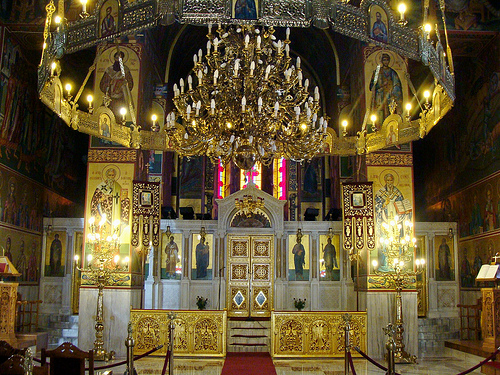
Second Triumph of Orthodoxy
But the dispute between the Palamites and the Barlaamites was far from finished. Politics came into play, and the politicians used the disputed religious issue as a threatening tool against those who supported Palamas. The great turmoil led to five consecutive church councils. One of the many scholars who advocated Barlaam’s position was the Bulgarian monk Akyndinos, who wrote a series of tracts against St. Gregory. Emperor Andronikos III Paleologos (1328–1341) was Akyndinos’s friend. Fearing the emperor, Patriarch John XIV Kalekos (1341–1347) backed Akyndinos, calling St. Gregory the cause of all disorders and disturbances in the Church (1344). He had St. Gregory locked up in prison for four years. In 1347, John XIV was replaced on the patriarchal throne by Isidore (1347–1349), a friend of St. Gregory. He set St. Gregory free and ordained him archbishop of Thessalonika.
In 1351, a sixth and final council was held to settle the heated controversial issues in the church. The Council of Blachernae solemnly upheld the orthodoxy of Palamas’ teachings and anathematized and excommunicated those who refused them. The anathemas of the council of 1351 were included in the rite for the Sunday of Orthodoxy in the Triodion. This council was considered the second triumph of Orthodoxy (the first being the restoration of icons). Later on, the memory of St. Gregory Palamas came to be celebrated in the Church on the second Sunday of Great Lent.
Imprisoned by Muslims
Gregory’s suffering for Christ did not end here. Again, because of the political influence of the West in Thessalonika, its citizens were divided upon the issue proclaimed by the councils. They did not immediately accept St. Gregory as archbishop, so that he was compelled to live in various places. On one of his travels to Constantinople, the Byzantine ship on which he was sailing fell into the hands of the Turkish Muslims. They took Archbishop Gregory as a prisoner, but displayed tolerance toward him. Even in captivity, St. Gregory preached to Christian prisoners and even held many debates with his Moslem captors. His love and respect for all men made his captors admire him and treat him with reverence. A year later, St. Gregory was ransomed and returned to Thessalonika.
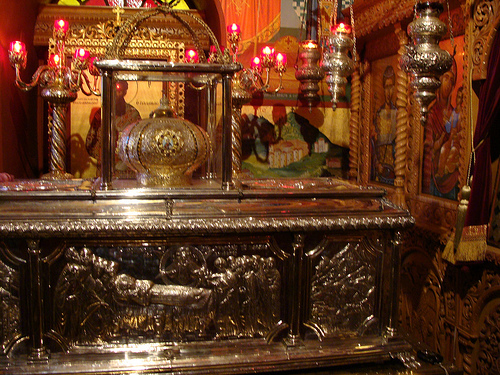
The Proclamation of His Sainthood
St. Gregory was a living Gospel. God gave him the gift of healing, especially in the last three years before his death. On the eve of his repose, St. John Chrysostom appeared to him in a vision. St. Gregory Palamas fell asleep in the Lord on November 14, 1359. The Virgin Mary, the Apostle John, St. Dimitrios, St. Antony the Great, St. John Chrysostom, and angels of God all appeared to him at different times. Nine years after his repose, a council in Constantinople headed by Patriarch Philotheos (1354–1355, 1362–1376) proclaimed the sainthood of Gregory Palamas. Patriarch Philotheos himself compiled the life and services for the saint.
When we hear in the Lenten Liturgy of the Presanctified Gifts, “The Light of Christ illumines all,” may we remember the call of the illumined Gregory for unceasing prayer and ascetic labor, that we be truly illumined by the light of the Resurrection.
This article originally appeared in AGAIN Vol. 27 No. 1.
Bishop Kallistos Ware speaks about St Gregory to a non-orthodox audience
“Intercommunion, that is to say participating with heretics in the Holy Sacraments, and especially of our Holy Eucharist, is the most shameful betrayal of our Lord Jesus Christ.”
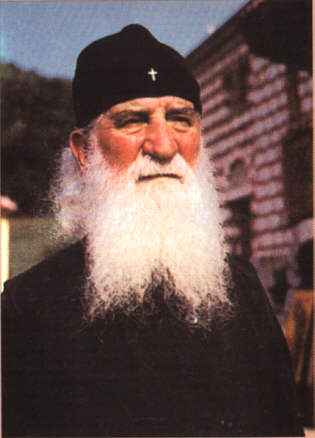
(From the book Orthodox Faith and Life in Christ by St. Justin Popovich)
Ecumenism and the Ecclesiology of Saint Cyprian of Carthage
by Fr. Daniel Degyansky
Saint Cyprian of Carthage developed with fearless consistency a doctrine of the complete absence of Grace in every sect which had separated itself from the True Church. His doctrine is one of the basic foundation blocks of Orthodox ecclesiology and it stands in direct opposition to the presuppositions of the ecumenical movement. Moreover, his warnings about the enemies of the Church have traditionally guided Orthodox in their response to those outside Her fold:
Not only must we beware of what is open and manifest, but also what deceives by the craft of subtle fraud. And what can be more crafty, or what more subtle, than for this enemy…to devise a new fraud, and under the very title of the Christian name to deceive the incautious. [139]
Saint Cyprian’s warnings about enemies of the Church who call themselves “Christians” in order to destroy the Faith can be applied to many of those who support unity through the contemporary ecumenical movement. The fact that such application is seldom made gives us evidence of just how far contemporary ecumenism has removed some Orthodox from the criterion of truth that is their Faith.
The essence of Saint Cyprian’s reasoning lay “in the conviction that the sacraments are established in the Church.” That is to say, they are effected and can be effected only in the Church, in communion and in communality. Therefore, every violation of communality and unity in itself leads immediately beyond the last barrier into some decisive outside. To Saint Cyprian every schism was a departure out of the Church, out of that sanctified and holy land “where alone rises the baptismal spring, the waters of salvation.” [140] Saint Cyprian was adamant in his position with regard to the Church’s rejection of the validity of an heretical sacrament:
For it is no small and insignificant matter which is conceded to heretics, when their baptism is recognized by us; since thence springs the whole origin of faith and the saving access to the hope of life eternal. And the divine condescension for purifying and quickening the servants of God. For if any one could be baptized among heretics, certainly he could also obtain remission of sins. If he attained remission of sins, he was also sanctified.[141]
Saint Cyprian felt that if the True Church recognizes the sacraments of those outside of Her realm, She gives credibility to heretics and schismatics:
For if they shall see that it is determined and decreed by our judgement and sentence, that the baptism wherewith they are there baptized is considered just and legitimately in possession of the Church also, and the other gifts of the Church; nor will there be any reason for their coming to us, when, as they have baptism, they seem also to have the rest. But further, when they know that there is no baptism without, and that no remission of sins can be given outside of the Church, they more eagerly and readily hasten to us, and implore the gifts and benefits of the Church, our Mother, assured that they can in no wise attain to the true promise of divine grace unless they first come to the Truth of the Church.[142]
The teaching of Saint Cyprian on the Gracelessness of those outside the True Church is directly related to his teaching on unity and communality: “Therefore, we ought to consider their faith who believe without, whether in respect of the same faith they can obtain by grace, for if we and the heretics have one faith, we may also have one grace.” [143] Strictly speaking, the theological premises of Saint Cyprian’s teaching have never been rejected. At the same time, neither has the Orthodox Church ever unequivocally applied Saint Cyprian’s conclusions. In fact, the First Canon of Saint Basil, if carefully analyzed, suggests that the issue of schism and heresy is more complex, in practical terms, than the theory of Saint Cyprian would suggest. Thus the canonical norms of the Orthodox Church do not state that schismatics are in all circumstances without Grace. Ecumenists have used Saint Basil’s position, at times, to defend their activities (though in the course of deviation from correct Orthodox teaching, it must be noted, many Orthodox ecumenists have come to believe that “schism” and “heresy” are terms without meaning, except when they can be used to berate those Orthodox who oppose the ecumenical movement). In fact, however, the ecclesiological teachings of Saint Cyprian complement and stand side by side with those of Saint Basil, since they are unified by the function of “economy,” by which the theoretical exactness of Saint Cyprian’s teaching is rendered effective in the oikonomia of practical application.
Thus, there are those who quite wrongly think that the Church has in some instances acknowledged that the sacraments of sectarians, and even of heretics, are valid. They wrongly assume that the Church admits that sacraments can be celebrated outside of the strict canonical limits of the Church—a perilous assumption, indeed. The Church, for example, may under extraordinary circumstances accept adherents from sects, and even from heresies, not by way of Baptism, but rather by Chrismation or even by their simple profession of our Orthodox Faith. But in so doing, She does not recognize, as some theologians incorrectly assert, what is outside Her domain; rather, by “economy,” the Church, being the Pan–Mystery, as Archimandrite Justin expresses it, creates Grace where there was no Grace, filling the empty form of a mystery (sacrament) unknown to Her. At the same time, before the emergence of whole bodies of Christians separated from the historical Orthodox Church, there were times when those who had lapsed in their Faith even for a generation were received back into the Church without being Baptized. But here, too, it was the correct form of their empty mysteries which the Church accepted, not the validity of their sacraments. By “economy,” then, the primacy of the Church was extended beyond Herself to create Grace in what was done outside Her boundaries. But in so doing, in no way whatsoever did She accept what was beyond Her boundaries. She acted beyond the Canons, but not in violation of them:
As a mystical organism, as the sacramental Body of Christ, the Church cannot be adequately described in canonical terms or categories alone. It is impossible to state or discern the true limits of the Church simply by canonical signs or marks…. In her sacramental, mysterious existence the Church surpasses canonical measurements. For that reason a canonical cleavage does not immediately signify mystical impoverishment and desolation. All that Saint Cyprian said about the unity of the Church and the sacraments can be and must be accepted. But it is not necessary, as he did, to draw the final boundary around the body of the Church by canonical points alone.[144 ]
Saint Augustine of Hippo, espousing opinions clearly outside the consensus of the Church Fathers, wrote that within the sects and divisions of Christianity the “union of peace” had been broken and torn asunder, but in their mysteries the “unity of the Spirit” had not been terminated. This shows, as Father Florovsky observes, “the unique paradox of sectarian existence: the sect remains united with the Church in the grace of the sacraments, and this becomes a condemnation once love and communal mutuality have withered.” [145] Thus, Saint Augustine directly affirmed “that in the sacraments of sectarians, the Church is active; some she engenders of herself, others she engenders outside, of her maid–servant, and schismatic baptism is valid for this very reason, that it is performed by the Church.” [146] According to Saint Augustine, then, “the Holy and Sanctifying Spirit still breathes in the sects, but in the stubbornness and powerlessness of schism healing is not accomplished.” [147]
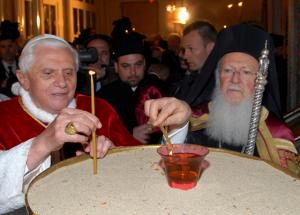
Ecumenists have used Saint Augustine’s thought to confirm that there are valid sacraments outside the Orthodox Church. By the same token, those opposed to ecumenism have concluded from the same thought that the rites of the schismatics are not sacraments, but a blasphemous caricature thereof. Some Orthodox conservatives affirm, indeed, that salvation can be found only within the confines of the Orthodox Church, thus arguing that all schismatics are condemned to damnation. The conclusions of the ecumenists are absolutely incorrect. The Orthodox Church accepts no sacrament outside of Her boundaries except, again, as empty forms. Moreover, Saint Augustine is writing about the undivided Christianity of an age which knew nothing of the hundreds of sects which constitute the Christian world of our day, many of them so far removed from the historical Church and Her rich doctrines that only by their belief in Christ can they be defined as Christians. It is an act of intellectual dishonesty to use his words about sects and heresies in the ancient Church as though they applied clearly to contemporary times. Nor, as we have pointed out, is the thinking of Saint Augustine about the validity of the sacraments of heretics and sectarians in agreement with the Patristic consensus or internally consistent.
At the same time, it is wrong for “conservatives” to interpret the words of Saint Augustine in such a way as to suggest that the Orthodox Church compromises the Providence of God. The Church has always affirmed the dominance of love within the confines of Her exclusive claims that only in Her bosom does salvation rest. Because of God’s love, the Orthodox Church can at once proclaim that salvation is possible only for Orthodox Christians and, at the same time, refuse to compromise Divine Providence by condemning all others to damnation. And because of the love which prompts the Church in Her mission, She at times reaches out in the spirit of “economy” to fill with Her exclusive Grace the empty forms of non–Orthodox religious acts. In so doing, however, the Orthodox Church never, until the advent of ecumenism, acknowledged the validity of any sacrament outside Her boundaries.
In many ways, the Orthodox Church cannot accept the precepts of modern ecumenism because they also violate the spiritual teachings of the Fathers about personal integrity as a foundation for ecclesiastical validity. In the fourth century, Saint Ephraim the Syrian said, “Pride does not permit a man to accept the teachings handed down by Tradition.” [148] The Orthodox tend to see separation and disunity in Christianity not as the result of a tragic process of mutual alienation, but of pride and sin. Thus, the second major schism in Christianity, the Great Schism of 1054, can be seen in the following way:
By the anathema against papism the Church proclaimed that the pope and his followers abandoned the Church, lost the Truth (which is Christ), and were submerged in the depths of error from which Christ came to free them. Their teachings were declared a delusion of the Evil One, and a poison to the souls of men, and any communication with them makes us like them by cutting us off from the Grace of God, from His Holy Church, and estranges us from the path of salvation, placing us rather on the road to perdition.[149]
The root causes of heresy and schism, then, are the intransigence and sin of prideful men. Heresy and schism do not just happen; they are caused. They rise out of spiritual delusion, spiritual disease, and alienation from the ways of God and His Church. Deviation from Orthodox Truth in the form of ecumenical activities has had a negative effect on the Church, as though to prove that schism and heresy are not the products of misunderstanding, but of the willful deviation of wrong believers from the True Church. For instance, Orthodox theologians have come to reject the Canons of the Church, so that they can justify their ecumenism. Thus the late Archpriest John Meyendorff, a well–known spokesman for Orthodox in America, dismisses the Canons which forbid joint prayer with heretics as archaic and no longer applicable to the Church. He claims that these Canons were intended to apply to prayer with conscious apostates from the True Church, “and not sincere Christians who never personally left it.” [150] Thus individual responsibility for wrong belief becomes an inessential part of Christian confession—a novel idea, indeed. By the same token, not a few Orthodox theologians and Hierarchs are beginning to see a place for Orthodoxy in the ecumenical “branch theory.”
While claiming to love the Orthodox Faith, they violate their promises at Ordination to defend the Truth and instead openly state that the Orthodox Church is just as guilty of divisiveness as the heretics and schismatics who separated themselves from the Church of their own free will. Again, to hold such views or to participate in ecumenical activities which champion such ideas is to deny the existence of the True Church and Christ’s earthly presence. Thus one who participates in such ecumenism perforce denies Christ.[151] Ecumenism, in short, has led many Orthodox to deny the very existence of Christ as we Orthodox understand Him.
Endnotes
139. St. Cyprian of Carthage, The Unity of the Church (Mahopac, NY: Kursk–Root Icon Hermitage, n.d.), p. 3.
140. Florovsky, Ecumenism I , p. 36.
141. St. Cyprian of Carthage, “Epistle to Jubianus,” in Vol. 5 of The Ante–Nicene Fathers, ed. Alexander Roberts and James Donaldson (Grand Rapids, MI:Eerdmans Publishing Co., 1986), p. 382.
142. Ibid., p. 385.
143. Ibid., p. 380.
144. Florovsky, Ecumenism I , p. 37.
145. Ibid., p. 42.
146. Ibid., p. 41–42.
147. Ibid., p. 42.
148. “Stolen Doctrines,” The Orthodox Christian Witness, Vol. 19, No. 29 (17/30 March 1986), p. 3.
149. Alexander Kalomiros, “The Anathema of 1054” (Seattle: St. Nectarios Educational Series, No. 69).
150. Meyendorff, Witness, p. 46.
151. Lev [Archbishop Lazar] Puhalo, “Can One be an Ecumenist without Denying Christ?,” Orthodox Life, Vol. 24, No. 3 (May–June 1974), p. 33.
From Orthodox Christianity and the Spirit of Contemporary Ecumenism, by Fr. Daniel Degyansky. (Etna: CA, The Center for Traditionalist Orthodox Studies, 1997 [1992]), pp. 76-83. Fr. Daniel is a Priest in the Orthodox Church in America (OCA).
MP3 with Fr. Seraphim Rose:
On The Ecumenical Movement_Signs of the Times I
On the Apostasy of the Church_Signs of the Times II
On the Antichrist
Metropolitan Cyprian (from the Holy Synod of Ressistance)’ sermon (fragments) on The Sunday of Orthodoxy, Greece, 1995
“You see that apostasy, as it goes on and advances, as we read in the books of our church, must reach its peak – the Antichrist to come. From the signs of the time, we see how Christ is approaching, Christ is coming, and we MUST be prepared! – as Christians that we are called and named, if we want to go forth and meet Him, if we want to be united with Him and rejoice with Him eternally.
We SHOULD hold two things dearer than our sight, dearer than our eyes.
First – the genuineness of Orthodoxy, and I stress this word genuineness because today even the ecumenists want to be called Orthodox!
But this along is not sufficient, just as a bird does not fly with one wing but with two wings. The second wing is Ortho-practcy – correct practice. The first then, is the correct faith, and the second is the correct life so we might be able to say to men who are far removed from the church, what Philip said to Nathaniel: “Come and see”.
I pray that in this difficult time we are passing through, I stress, I repeat, and the difficult times that are await us, Christ may maintain us to the end of our lives, to the final heartbeat, in the correct faith, in the correct life. Amen!”
Please sign:
A CONFESSION OF FAITH Against Ecumenism (English)
ΟΜΟΛΟΓΙΑ ΠΙΣΤΕΩΣ Κατά του Οικουμενισμού (Greek)
ИСПОВЕДАЊЕ ВЕРЕ (Russian)
Mărturisirea de credinţă împotriva ecumenismului (Romanian)

Rarely does a documentary film about Medieval history evoke such heated discussion and growing polemic in society as did the film, The Fall of an Empire—the Lesson of Byzantium, the latest work by Archimandrite Tikhon (Shevkunov), the Superior of Moscow’s Sretensky Monastery.
The film is very aptly named—this is truly a lesson, a warning. Anyone who was looking for a video illustration of a history textbook was no doubt disappointed; anyone who dreamed of finally hearing a truthful word on Byzantium, the cradle of our Orthodox civilization, was probably also disappointed—a film on the true history of the Byzantine Empire and its place in the development of world civilization still awaits its historical hour. We are in great need of such a documentary today—a detailed, concerned history of the fate of Byzantium and its inheritance. Fr. Tikhon’s work has made us feel this need even more acutely.
The authors’ intention was not to “rehabilitate Byzantium” or give a lecture, but to break through our routine perceptions and awaken our thoughts. They undoubtedly succeeded in their aim. The unusual historical fate of an Empire that existed on one-sixth of the inhabited world for nearly ten centuries is definitely instructive. Even more instructive to those who live in Russia at the beginning of the 21st century is the history of that Empire’s collapse.
For Commentaries on this documentary please also see:
– Byzantium was Intentionally Removed from European Historical Consciousness at: http://vizantia.info/docs/163.htm
– http://vizantia.info/docs/164.htm
– An Interview with Archimandrite Tikhon at: http://vizantia.info/docs/183.htm
Fr. Peter Gilquist at St. Elijah
“Why Protestant Clergy are coming to the Orthodox Church.”
On the Infallibility of the Pope
For Roman Catholics
Fr. Daniel Byantoro was a Muslim boy who lived with his grandfather and began attending the Mosque at 5 years of age. As the boy grew older, he searched for a deeper certainty of God. In High School he met a former schoolteacher’s husband who had converted to Christianity. The young man debated the convert regarding the Trinity, the Divinity of Jesus Christ, His Incarnation and His being the Son of God. The young Muslim man won the debate, and remained unconvinced of the gospel’s truth. One night after reciting prayers and reading the Qur’an, the young man saw a “vision” that frightened him. He encountered Christ for the first time in the form of light. Confused and trembling but with unspeakable joy, the young man began to ask such questions as “Who is Jesus Christ? What is he about?” Looking to the Qur’an, he stumbled in verse 45, chapter 3 the story of the annunciation which states, Remember when the angels said: O Maryam, surely Allah glad tidings with a Word from Himself, His Name will be the Messiah, Isa, the Son of Maryam. He is great in this world and hereafter, and he is among those who are near to Allah. He had read this passage many times before but this time he felt it was illumined in a manner that could only have been accomplished by Christ. He began to see Christianity differently through the Qur’an itself, which, although denying that Christ is God, treats many points of Biblical history with reverence.
This video (fragment) lecture given by father Daniel was filmed at St Mary Orthodox Church in Falls Church, VA (01/2010), on the feast of St. Maximus the Great Confessor of Orthodoxy
(Fr. Daniel Byantoro was the first Indonesian Orthodox Christian in the current era. He has converted over 2,000 to Christianity. Gordon Walker has said of him: “He is truly gifted by God to be an Apostle to Indonesia).
Other audio talks, pl. see St Timoty website: http://sttimothy-toccoa.org/
The phrase a Word from Himself, His Name will be the Messiah made the biggest impression. So the Messiah, Isa (Jesus) is the the Word from God, he said to himself. God seemed a mystery in the mind of this young man. He began to ponder the meaning of the “Word” through an inner dialogue of questions and answers, beginning with, “What is a word?” and finally arriving at the conclusion, God, His Word who is called His Son, and His Spirit are not three different Gods, but the reality within the One God. Without Spirit God is dead, without Word or Mind God is an idiot. So, a One -Personed-God, without a Spirit and a Word is no God at all, rather wood and stone. These discoveries were astonishing and he thought to himself:
“If among human beings, communication is accomplished with words and impossible without them. How much more with God. God has Only One Word, Jesus Christ. In order to know God and have a relationship with Him, one has to know His Word Jesus Christ. Now I know why I did not know who God is, because I did not know His Word. Jesus Christ. I have to believe in Him!” The young man cried and said to God: “Oh Allah, yes I believe in Your Word Jesus Christ, and I will become a Christian.”
The young man invited Christ into his heart at that very moment. The young man was baptized into Dutch Reformed Protestant Christianity – the only Church he knew at this time – where his former debating opponent was an elder. He took the baptismal name of Daniel.
In 1974 while at a house prayer meeting, Daniel received the so-called “baptism of the Holy Spirit” complete with “speaking in tongues” and “prophesying” and became active in Charismatic Movement. Before this time he knew nothing on the existence of hundreds of denominations in Protestant Christianity or the difference between Protestantism and Roman Catholicism, and nothing at all of the Orthodox Church.
Witnessing Activities
The young man Daniel was very active in witnessing for Christ among the young people, even while continuing his schooling. Many were converted several prayer meeting groups were founded. After high school, Daniel wanted to be an evangelist or missionary. Further, her desired to make the Gospel known to his own people, within the context of their culture, not as a “western-religion,” but the truth of God that originated in the Middle East/Israel, the land of all the prophets. Later as he was invited to preach among many different protestant churches, the young Daniel was bewildered by the plethora of groups and denominations with differing and opposing theological thoughts, traditions and practices. He also began to miss liturgical rhythm of life which he was used to in Islam and set his heart searching towards the ancient Christianity of the East. He knew nothing of Eastern Orthodox Christianity, rather his intuition told him that Christianity was born in the same Middle Eastern milieu as Islam.
(Taken from the website: http://friendsofindonesia.org/about/fr_daniel/)
Also please Listen to Fr. Daniel’s podcast “Christ the Eternal Kalimat” at: http://friendsofindonesia.org/news/podcast/
„Every bit of Church dogma was imposed through the blood of those ready to give their life to defend it; being a matter of life – not merely a theoretical speculation”
(Theologian Fr Dumitru Staniloae)
“Even if all the world shall enter into communion with the (heretical) Patriarch, I will not!”
(St. Maximus the Confessor)
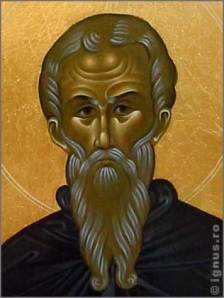
St Maximus the Confessor, the greatest of Byzantine theologians, lived through the most catastrophic period the Byzantine Empire was to experience before the Crusades.
“By birth a citizen of Constantinople and at first a high-ranking courtier at the court of the Emperor Heraclius, he then became a monk and the abbot of a monastery not far from the capital. He was the greatest defender of Orthodoxy against the so-called Monothelite heresy, which developed from the heresy of Eutyches. That is to say: as Eutyches asserted that there is in Christ only one nature, so the Monothelites asserted that there is in Him only one will. Maximus resisted this assertion and found himself in opposition to both the Emperor and the Patriarch. But he was unafraid, and persevered to the end in proving that there are in the Lord two natures and therefore also two wills. By his efforts, one Council in Carthage and one in Rome stood firm, and both these Councils anathematized the Monothelite teaching. Maximus’s sufferings for Orthodoxy cannot be fully described: tortured by hierarchs, spat upon by the mass of the people, beaten by soldiers, persecuted, imprisoned; until finally, with his tongue cut out and one hand cut off, he was condemned to exile for life in Skhimaris, where he gave his soul into God’s hands in the year 662.”
Bishop Nikolai Velimirovich in “The Prologue from Ochrid”
See also: The Life of St. Maximus

Troparion of St Maximos Tone 3
By an outpouring of the Holy Spirit/ thou didst pour forth Christ’s sacred teachings./ Thou didst expound with divine authority the self-emptying of God the Word/ and wast radiant in thy confession of the True Faith./ Glorious Father Maximos, pray to Christ our God to grant us His great mercy.
Kontakion of St Maximos Tone 2
O Maximos divinely inspired champion of the Church,/ sure and illumined exponent of Orthodoxy,/ thou harp and trumpet of godliness,/ divine and holy adornment of monks:/ cease not to intercede for us all.
TEACHERS OF THE CLEAN MIND
(from the Speech On Love)
3.93 & 27: HE clean mind sometimes God himself comes into and teaches, sometimes the holy angelic powers suggest the right things, sometimes the vision of the nature of things. … But to participate or not in His goodness and wisdom, depends to the will of the creatures who have reason.
3.79: Do not dishonor your conscience, perfectly instructing you always. Because she suggests you the divine and angelic opinion, she sets you free from the hidden infections of the heart and she gives you uprightness before God when you depart.
3.80: If you’ve known yourself, you will understand many, great and wonderful things. Because, thinking that you know doesn’t let you progress in knowing.
1.95: The sun of justice, rising into the clean mind, reveals himself and the reasons of all that He created and will create.
4.61: Love defeats those three, self-deception, because she is not proud. Interior envy, because she is not jealous. Exterior envy, because she is generous and serene.
1.70: All the treasures of wisdom and knowledge are inside our hearts hidden.
1.31: Faith without love does not act in the soul the illumination of the divine knowledge.
3.97: When the mind receives the ideas of things, by its nature is transformed according to each and every idea. If it sees the things spiritually, is transfigured in many ways according to each vision. But if the mind becomes in God, then it becomes totally shapeless and formless, because seeing Him who has one face it comes to have one face and then the whole mind becomes a face of light.
Translated by Elpenor (The Greek Word): http://www.ellopos.net/elpenor/default.asp
Other Quotes from St. Maximus on Love
Letter 2: On Love
Louth: At one pole is self-love at the other is deifying love
Divine love…in its power is beyond circumspection or definition (L 2:85)
Nothing is more truly Godlike than divine love, nothing more mysterious, nothing more apt to raise up human beings to deification (85)
The mystery of love which out of human beings makes us gods (85)
Everything is circumscribed by love according to God‟s good pleasure…for what form of good things does love not possess?—faith, hope humility, meekness, gentleness, mercy, self-control, patience, long-suffering, kindness, peace and joy (86)
Love is the goal of every good, being the highest of goods with God, and source of every good (86)
Love alone…proves that the human person is in the image of the Creator…persuading the inclination to follow nature (86-7)
The divine and blessed love…will embrace God and manifest the one who loves God to be God himself (87)
The power of love [is] the adversary of self-love (88)
Self-love is…the first sin, the first progeny of the devil, and the mother of the passions…the beginning and mother of all evils (88)
Love gathers together what has been separated (88)
God takes form in each through his great love for mankind out of the virtue that is present in each through the ascetic struggle (90)
Love is therefore a great good, and of goods the first and most excellent good since through it God and man are drawn together in a single embrace (90)
Love is…in a definition: the inward universal relationship to the first good connected with the universal purpose of our natural kind…there is nothing that can make the human being who loves God ascend any higher (90)
[We do] not divisively [assign] one form of love to God and another to human beings, for it is one and the same and universal: owed to God and attaching human beings to each other (90)
For the activity and clear proof of perfect love towards God is a genuine disposition of voluntary goodwill toward one‟s neighbor (90)
The all glorious way of love…is truly divine and deifying and leads to God (91)
Love is said to be God Himself which from the beginning the thorns of self love have covered up (91)
For the sake of love the saints all resist sin continually finding no meaning in this present life (91)
Love…binds human beings to God and one another (91)
The grace of love…leads one to God who deifies the human being that He himself has fashioned (92)
Love “never fails” since it possesses God who is alone unfailing and unalterable (92)
(Other texts taken from the book “Maximus the Confessor” by Andrew Louth)
Contemplation of the end of the world
Those who look carefully at the present world, making the most of their learning, and wisely tease out with their mind the logos that folds together the bodies that harmoniously constitute it in various ways—they discover what is perceived through the senses, and what is understood and what is universal, everything contained in everything and turning by the exchange of the individual qualities of each. For by nature the senses are contained by what is perceived through the senses, and what is perceived through the senses is contained by the senses through sensation, as being understood. And again the universal is corrupted by change into the particular, and the particular, turned into the universal by reduction, also suffers corruption. And there comes about the corruption of everything that owes its coming to be to others. For the union of universals with one another, which causes the coming to be of particulars, is the corruption of one another by change, and the reduction of particulars to universals by the dissolution of their being bound together, leading to corruption, is the continuance and coming to be of the universals. And learning that this is the constitution of the world of the senses—the change and corruption of the bodies through which and in which it consists, one into another—we come to understand that it follows from the natural property of the bodies in which it consists—their instability and changeability and their chameleon-like alteration of universal qualities—that it is not possible for the world to have a necessary consummation. Nor can it be rightly thought that what does not possess eternity should appear to any rational understanding as eternal, separate from change and alteration, and not rather scattered and changing in a myriad of ways.
Contemplation of the virtues
Consequently a human being is blessed who has virtues, whether or not he has any other blessings besides. If he has virtues and other advantages too, he is blessed in a general sense, as one said who was wise in divine matters. If he has virtues alone and for their own sake, he is blessed in a more circumscribed sense. For some things are thought of in a more circumscribed way, as when we think of two cubits, others in a
more general way, as when we think of a heap. For you can take away two measures from a heap, and will be left with a heap. If you take away all bodily and external advantages from the condition of general blessedness, and leave nothing whatever but the virtues, it remains a state of blessedness.
For virtue, by itself, is sufficient for happiness. Therefore every bad person is wretched, even if he has all the so-called blessings of the earth, if he is deprived of the virtues. And every good person is blessed, even if he is deprived of all earthly blessings, since he has the radiance of virtue. It is because of this that Lazarus rejoiced, at rest in the bosom of Abraham.
Contemplation of how God is understood from Creation
So therefore when the Saints behold the creation, and its fine order and proportion and the need that each part has of the whole, and how all the perfect parts have been fashioned wisely and with providence in accordance with reason that fashioned them, and how what has come to be is found to be not otherwise than good beside what now is, and is in need of no addition or subtraction in order to be otherwise good, they
are taught from the things he has made that there is One who fashioned them. So,95 too, when they see the permanence, the order and position of what has come to be, and its manner of being, in accordance with which each being, according to its proper form, is preserved unconfused and without any disorder; and the course of the stars proceeding in the same way, with no alteration of any kind, and the circle of the year
proceeding in an orderly manner according to the periodic return of the [heavenly bodies] from and to their own place, and the equal yearly proportion of the nights and days, with their mutual increase and decrease, taking place according to a measure that is neither too small nor too great, they understand that behind everything there is providence, an this they acknowledge as God, the fashioner of all.
Contemplation of divine providence
Anyone who is convinced that God exercises providence over the things that are, from which he has learnt that he exists, will judge it right and reasonable that he is none other than the guardian of the things that are and cares for them and that he alone is the fashioner of what is. For the permanence of what is, and its order and position and movement,111 and the consonance of the extremities with the middle, the agreement of the parts with the wholes, and the union throughout of the wholes with the parts, and the unblurred distinction of the parts one from another in accordance with the individuating difference of each, and the unconfused union in accordance with the indistinguishable sameness in the wholes, and the combination and distinction of everything with everything else (not to limit myself to particulars), and the eternally preserved succession of everything and each one according to form, so that the logos of each nature is not corrupted by confusion or blurring—all this shows clearly that everything is held together by the providence of the Creator God. For it is not the case that God is good but not beneficent, or beneficent but without providence, and therefore he cares wisely for the things that are and in a way befitting God, so that they are favoured with existence and care. Providence is, then, according to the God- bearing Fathers,112 the care that comes from God to the things that are. They also define it thus: providence is the will of God through which everything that is receives suitable direction. If this will is God’s, if I may use the very words of my teachers, then it necessarily follows that what happens happens in accordance with right reason, and so no better disposition could be looked for. One who has chosen to take truth as his guide is therefore led to say that providence is either the one who is truly known to be the Creator or is a power exercised by the Creator of all things. And with animals, if we approach them in a rational way we shall find a trace of the intelligible in them which is a not unworthy imitation of what is above reason. For if we look at those beings that naturally care for their offspring, we are encouraged to define for ourselves reverently and with godly boldness that God exercises providence in his sovereign uniqueness over all beings, and not over some beings but not others, as some of the adepts of the ‘outer learning’113 have it, but of absolutely everything, in accordance with the one and indistinguishable will of goodness, and indeed of both universals and particulars, for we know that if particulars can perish because they are not within the remit of providence and fitting protection, then universals will perish with them (for universals consist of particulars), in this way propounding a rational demonstration that rightly leads by a reasonable retort to the truth. For if universals consist of particulars, then if the particular examples of any logos in accordance with which things exist and consist should perish, then it is quite clear that the corresponding universals will not continue to be. For the parts exist and subsist in the wholes, and the wholes in the parts. No reason can gainsay it. But there are those who are, as it were, unwillingly bound by the truth and betray the power of providence, arguing that it only pervades what is important to them. For they say that only universals are governed by providence,114 and that particulars are hidden from providence, being led by necessity towards the truth that they are anxious to flee. For if they say that it is because of permanence that universals are worthy of providence, they admit even more strongly that those particulars are worthy, in which the permanence and stability of the universals consist. These are admitted together through the indissoluble natural relationship that they have with each other, and both conserve permanence, nor can one be said to be foreign to the protection of the other, and again if they admit the protection of the one with respect of permanence, they have to grant the other too. Apart from that there are three ways in which the providence of God is denied.115 Some say that God does not understand the method of providence, others that he cannot will it, others that he has not the power. But it follows from the common notions that God is good and beyond goodness and eternally wills what is good for everything, and that he is wise and beyond wisdom, or rather the source of all wisdom, and certainly knows everything that is going to happen, and that he is powerful, or rather infinitely powerful, and certainly brings about in a divinely fitting way in everything what is known to him and what he wills for the good and what is fitting. For God is good and wise and powerful, and pervades everything visible and invisible, both universals and particulars, both small and great, indeed everything that possesses existence in any way whatever. He is not diminished by the boundlessness of his goodness and wisdom and power, and conserves everything in accordance with the logos of its being, both in relation to themselves and to others, and in accordance with the indissoluble harmony and permanence that relates everything one to another. Why then can we not understand that natureitself teaches us clearly about the existence of God’s providence over everything? For nature itself gives us no small proof that the knowledge of providence is naturally implanted within us, whenever it prepares us to seek salvation through prayers in sudden emergencies, as if pushing us towards God in an untaught way.117 For seized by necessity, all unawares, without choice, before we have had a chance to think of anything, as if providence itself led us to itself without any thought, faster than any mental power within ourselves, placing before us the divine help as stronger than anything else. Not that nature leads us to the possession of something unnatural. Whatever happens naturally, even if it is obscure to all, possesses the strong and unconquerable power of the demonstration of the truth. If it is the case that the reason for providence as it affects particulars is incomprehensible to us, as in accordance with the verse, his judgments are unsearchable and his ways past finding out (Rom. 11:33), then in my view they are not right who say that it shows that there is no such providence.118 For if the difference and variation between different human beings is great and incomprehensible, in ways of life and customs and opinions and choices and desires, in what they know, and their needs and pursuits, and the almost countless thoughts in their minds, and in everything that happens to them in each day and hour (for this animal, man, is changeable, sharp on occasions and changing with need), it is absolutely necessary that providence, comprehending everything with foresight in the circumscription of its individuality, should be manifest as different and manifold and complex, and should achieve harmony as it extends into the incomprehensibility of the multitudinous, in a way suitable to each individual, whether thing or thought, reaching as far as the least movement of mind or body. If therefore the difference of particulars is incomprehensible, then likewise is the infinite meaning of providence that draws them into harmony, but it should not follow that, since themeaning of particular providence happens to be infinite and unknowable to us, we should make our ignorance a ground for denying the all-wise care for the things that are, but we should receive and hymn all the works of providence simply and without examination, as divinely fitting and suitable, and believe that what happens happens well, even if the reason is beyond our grasp. And I mean all the works of providence, not what happens by our agency in accordance with our reason, for these are quite different from the logos of providence. For the manner indicated by the great teacher of the power and grace of the Saints, according to reason and contemplation, is conjectural rather than categorical (for our mind is very far from truth itself), but trying to get hold of what has been said with the reason, and as it were tracking it down, I have done nothing more than make suggestions.
The great teacher and invincible defender of the One, Holy, Catholic, and Apostolic I. Church, Saint Mark, was the offspring and scion of the imperial city, Constantinople. Reared by most pious parents, and instructed in secular and spiritual wisdom, he became pre-eminent in both. Saint Mark lived as an ascetic on the Princes’ Islands and later in the monastery of Saint George Magana in Constantinople. He passed through all the degrees of the priesthood, and was finally advanced to the dignity of Archbishop and the lofty throne of the Metropoly of Ephesus. At the insistence of Emperor John Paleologus, the Saint was sent to the council of the Latins in Florence, to unite the churches that had been divided for so many years. He astounded the papal teachers with the divine wisdom of his words, and was the only one who did not sign the blasphemous decree of that false council. Because of this, the holy Church of Christ has ever honored this great man as a benefactor, teacher, sole defender, and invincible champion of the Apostolic Confession. He reposed in 1443. His Feast day is celebrated on January 19/ February 1.

Ecumenical means “belonging to or accepted by the Christian Church throughout the word; as such, this term reflects the rule of faith given by St. Vincent of Lerins: Christian truth is that “which has been believed everywhere, always, and by all .” Thus is the correct dictionary definition of the word and the only patristic definition of it. Unfortunately, ‘ecumenical” has come to mean something quite different in the latter part of the 20th century. Under the influence of the World Council of Churches and the policy of aggioramento in the Church of Rome. “ecumenical” has come to mean the following: the unity of Christ’s Church has been shattered through the centuries; all Christian Churches are pretty much equal, and each has a “share” of the truth; therefore, all denominations must be united in order to recapture the “whole- ness” that once existed. This is modern-day ecumenism.
A superb example of the first and original kind of ecumenist is St. Mark of Ephesus, a 15th century champion of orthodoxy, sometimes called “The conscience of Orthodoxy.” The following information is condensed from a series of three articles in “The Orthodox Word” (1967), written by Archimandrite Amvrossy Pogodin:
When the foundations of Byzantium were crumbling, diplomats redoubled their efforts to find a possibility of union with Western powers for a battle against the common adversary of Christianity, Islam. Attempts were made to conclude treaties with the Turks, but these were unsuccessful. The only hope lay in the West. For this it was necessary above all to make peace with the Vatican.
A Council was convened in 1437, which established a committee of Latin and Greek theologians with the Pope and the Byzantine Emperor acting as heads. The Pope, Eugenius IV, had a very exalted idea of the papacy and aimed at subjecting the Orthodox Church to himself. Prompted by the straitened circumstances of Byzantium, the Emperor pursued his aim: to conclude an agreement profitable for his country. Few gave thought to the spiritual consequences of such a union. Only one delegate, the Metropolitan of Ephesus, St. Mark, stood in firm opposition.
In his address to the Pope at the opening of the Council, St. Mark explained how ardently he desired this union with the Latins- but a genuine union, he explained, based upon unity of faith and ancient Liturgical practice. He also informed the Pope that he and the other Orthodox bishops had come to the Council not to sign a capitulation, and not to sell Orthodoxy for the benefit of their government, but in order to confirm true and pure doctrine.
Many of the Greek delegates, however, thought that the salvation of Byzantium could be attained only through union with Rome. More and more became willing to compromise the eternal Truth for the sake of preserving a temporal kingdom. Furthermore, the negotiations were of such unexpectedly long duration that the Greek delegates no longer had means to support themselves; they began to suffer from hunger and were anxious to return home. The Pope, however, refused to give them any support until a “Union” had been concluded. Taking advantage of the Situation and realizing the futility of further debates, the Latins used their economic and political advantage to bring pressure on the Orthodox delegation, demanding that they capitulate to the Roman Church and accept all her doctrines and administrative control.
St. Mark stood alone against the rising tide which threatened to overturn the ark of the true Church. He was pressured on all sides, not only by the Latins, but by his fellow Greeks and the Patriarch of Constantinople himself. Seeing his persistent and stouthearted refusal to sign any kind of accord with Rome under the given conditions, the Emperor dismissed him from all further debates with the Latins and placed him under house arrest. By this time St. Mark had fallen very ill (apparently suffering from cancer of the intestine). But this exhausted, fatally ill man, who found himself persecuted and in disgrace, represented in his per son the Orthodox Church; he was a spiritual giant with whom there is none to compare.
Events followed in rapid succession. The aged Patriarch Joseph of Constantinople died; a forged document of submission to Rome was produced; Emperor John Paleologos took the direction of the Church into his own hands, and the Orthodox were obliged. to renounce their Orthodoxy and to accept all of the Latin errors, novelties, and innovations on all counts, including complete acceptance of the Pope as having “a primacy over the whole earth.” During a triumphant service following the signing of the Union on July 5, 1439, the Greek delegates solemnly kissed the Pope’s knee. Orthodoxy had been sold, and not merely betrayed, for in return for submission, the Pope agreed to provide money and soldiers for the defense of Constantinople against the Turks. But one bishop still had not signed. When Pope Eugenius saw that St. Mark’s signature was not on the Act of Union, he exclaimed, “And so, we have accomplished nothing!”
The delegates returned home ashamed of their submission to Rome. They admitted to the people: “We sold our faith; we bartered piety for impiety!” As St. Mark wrote: “The night of Union encompassed the Church.” He alone was accorded respect by the people who greeted him with universal enthusiasm when he was finally allowed to return to Constantinople in 1440. But even then the authorities continued to persecute him. At length he was arrested and imprisoned. But whatever his condition a n d circum stances, he continued to burn in spirit and to battle for the Church.
Finally he was liberated and, following his example, the Eastern Patriarchs condemned the False Union and refused to recognize it. The triumph of the Church was accomplished-through a man exhausted bydisease and harassed by the wiles of men, but strong in the knowledge of our Saviour’s promise: “…I will Build My Church; and the gates of hell shall not prevail against it. (Matt. 16:18)
St. Mark died on June 23, 1444, at the age of 52. This great pillar of the Church was a true ecumenist, for he did not fear to journey to Italy to talk with the Roman Catholics, but more importantly, neither did he fear to confess the fullness of the truth when the time came
The following is the concluding section of the Saint’s encyclical letter on the subject of the false union. It is as meaningful and vital today as it was 500 years ago: “Therefore,” St. Mark writes, “in so far as this is what has been commanded you by the Holy Apostles,-stand aright, hold firmly to the traditions which you have received, both written and by word of mouth, that you be not deprived of your firmness if you become led away by the delusions of the lawless. May God, Who is All-powerful, make them also to know their delusion; and having delivered us from them as from evil tares, may He gather us into His granaries like pure and useful wheat, in Jesus Christ our Lord, to Whom belongs all glory, honor, and worship, with His Father Who is without beginning, and His All-holy and Good and Life- giving Spirit, now and ever and unto the ages of ages. Amen.”
By the prayers of St. Mark, O Christ our God, and all Thy Holy Fathers, Teachers and Theologians, preserve Thy Church in Orthodox confession and lead many into a knowledge of the Truth, unto the ages!
(An excerpt from the [forthcoming] book, Winds of Change in Roman Catholicism, by Fr. Alexey Young)
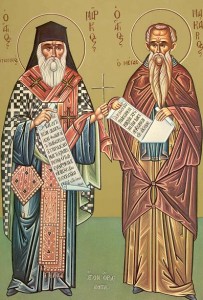
Troparian, tone 3
Holy Mark, in thee the Church has found a zealot by thy confession of the sacred Faith;/ for thou didst champion the Fathers’ doctrine/ and cast down the pride of boastful darkness./ Pray to Christ our God for those who honour thee, that we may be granted the forgiveness of sins.
Kontakion, tone 3
As one clad in invincible armour,/ thou didst cast down the pride of the Western rebellion;/ thou didst become an instrument of, the Comforter/ and shine Forth as Orthodoxy’s defender./ Therefore we cry to thee: Rejoice, O Mark, boast of the Orthodox.
Quotes by St Mark
“It is impossible to recall peace without dissolving the cause of the schism— the primacy of the Pope exalting himself equal to God.”
“The Latins are not only schismatics but heretics… we did not separate from them for any other reason other than the fact that they are heretics. This is precisely why we must not unite with them unless they dismiss the addition from the Creed filioque and confess the Creed as we do.”
“Our Head, Christ our God… does not tolerate that the bond of love be taken from us entirely.”
“We seek and we pray for our return to that time when, being united, we spoke the same things and there was no schism between us.”
St. Mark of Ephesus and the False Union of Florence
On Middle Doctrine
‘Many were tempted by the idea,’ [St.] Mark [of Ephesus] continued, ‘that one can find a medium between two doctrines. True: one can find such expressions which, having a double meaning, could at the same time express something between the two doctrines. But a doctrine midway between two contrary doctrines on the same subject is impossible; for in this case it must be something between truth and falsehood, between an affirmation and a negation. Thus, if the Latin doctrine of the Spirit’s procession from the Son is just, then ours is false. What middle doctrine can there be here?’
We see from all this that we teach conformably with Holy Scripture, and the holy Fathers, and Teachers, nothing changing or misrepresenting in the dogmas handed down to us, nothing adding to them, or taking from them, and adding nothing new.
From the interview of St. Mark with Pope Eugenius:
The Councils of the Church have condemned as rebels those who have transgressed against some dogma and have preached thus and fought for this, for which reason also they are called ‘heretics’; and from the beginning the Church has condemned the heresy itself, and only then has it condemned the leaders of the heresy and its defenders. But I have by no means preached my own teaching, nor have I introduced anything new in the Church, nor defended any foreign and false doctrine; but I have held only that teaching which the Church received in perfect form from our Saviour, and in which it has steadfastly remained to this day: the teaching which the Holy Church of Rome, before the schism that occurred between us, possessed no less than our Eastern Church; the teaching which, as holy, you formerly were wont to praise, and often at this very Council you mentioned with respect and honor, and which no one could reproach or dispute. And if I hold it and do not allow myself to depart from it, what Council will subject me to the interdiction to which heretics are subject? What sound and pious mind will act thus with me? For first of all one must condemn the teaching which I hold; but if you acknowledge it as pious and Orthodox, then why am I deserving of punishment?
Father Cyprian speaks of the frightening reality of the world we live in and the look-warm Christianity of our days. The images below speak on their own – for those who still have eyes to see and ears to listen…In the midst of this reality, there are still some who take their life in Christ seriously.
An Orthodox missionary priest (Fr. Daniel Sisoev) preaching “the Word of Truth” to the Muslim world, killed at the age 35 in Russia. May Christ our Savior rest him with his saints. Amen!
“THE BLOOD OF THE MARTYRS IS THE SEED OF THE CHURCH!”
Father Cyprian: “You see that apostasy, as it goes on and advances, as we read in the books of our church, must reach its peak – the Antichrist to come. From the signs of the time, we see how Christ is approaching, Christ is coming, and we MUST be prepared! – as Christians that we are called and named, if we want to go forth and meet Him, if we want to be united with Him and rejoice with Him eternally.
We SHOULD hold two things dearer than our sight, dearer than our eyes:
First – the genuineness of Orthodoxy, and I stress this word genuineness because today even the ecumenists want to be called Orthodox!
But this along is not sufficient, just as a bird does not fly with one wing but with two wings. The second wing is Ortho-practcy – correct practice. The first then, is the correct faith, and the second is the correct life so we might be able to say to men who are far removed from the church, what Philip said to Nathaniel: “Come and see”.
Come and see what Orthodoxy means…
I pray that in this difficult time we are passing through, I stress, I repeat, and the difficult times that are await us, Christ may maintain us to the end of our lives, to the final heartbeat, in the correct faith, in the correct life. Amen!”
– Metropolitan Cyprian –
Ecumenism – a great temptation
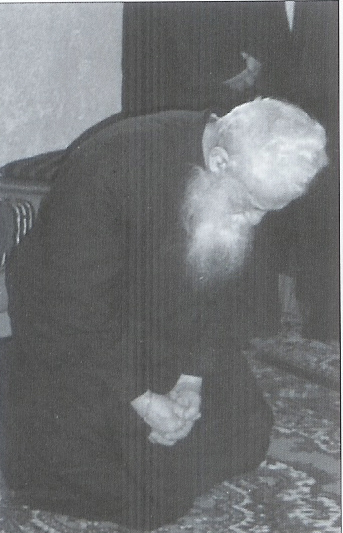
– Regarding the compromises within the church, it is very much conveyed today the idea that ecumenism is a necessity in ecclesiastical space. What are your thoughts on this?
Fr. George: – If we submit to the devil, that means a necessity? This is not a need, but a sin, a great temptation, a heresy. I think that the Orthodox Church should mind its own activity, not the interest in ecumenism and so on. The (Orthodox) Church should live in Christ as she lived until now.
– What do you think the strength of Orthodoxy consist in?
Fr. George: – The power of Orthodoxy is that, she had not changed anything in the canons set by the Holy Ecumenical Councils after its separation from Catholics, while Catholicism consists in number and organization. The power of Catholicism wears out today, the strength of Orthodoxy remains. If Orthodoxy falls, it’s through the sins of the people inside her, not by other means. Because Orthodoxy in itself is unbeatable.
– So we wear down from the inside …
Fr. George: – Yes. The problem is that we – ourselves have become corrupted, not by been influenced by others. Even now, in the European community, each church could keep its full identity, without compromise or breaking its religious doctrine, if she’ll have the awareness that she (the church) must keep her identity.
– So, we have to work on the mentality …
Fr. George: – Well, that’s the problem. If we lose our attachment to the Orthodox tradition and start to dilute ourselves in this absurd and criminal movement of ecumenism – and if it’s not criminal, it’s at least anti-Christian – then we’ll certainly be lost. It’s a great tragedy! I wonder if they really don’t understand its danger? Or perhaps they are bribed? I do not know, I do not get it …
Papocentric Globalism and the Alienation of Orthodox Ecumenists (an Orthodox awarness film)
Error
This video doesn’t exist
– What is the relationship between hierarchy and the monasteries?
Fr. George: – Generally the monasteries obey their hierarch. But only to the limit of heresy. Because of this, the hierarchy, especially in some areas, is upset. It persecutes monks, invents all sorts of things about them, all sorts of lies such as the one that they obey to the Russians, etc,. all aimed to motivate their ecumenist actions…
– If you would meet the Patriarch of Romania, Teoctist, what would you say to him?
Fr. George: – I met him many times. And I confessed everything that I thought. And I was surprised that he was opened to listen, to relay to me many things and, to not get offended. He has a balance! I am a little worried and troubled at the thought that the patriarch will die. For he maintains a balance where he is.
– How do you see the current state of our Church?
Fr. George: – As in that story that my mother used to tell us children…with the legion of devils gathered to the house of the widow who had seven children and all were praying. Even today, the Church is surrounded by legions of devils. I mean not only our own but every Orthodox Church in the world: millions of devils surrounding them.
Tribulations took place at all times, but now they seem to multiply. There are many disobedient priests and many monks wandering, which should not go in such way. Many monks are wondering to the West. Why?! They should remain in the monastery. If they do not like their monastery, that is ecumenist and so on, they should choose another monastery, because they can do so.
I mean we have to impose ourselves a discipline to respect the Church’s authority, so far as it is worthy of Christ to respected it. But you must steadfast in front of Satan! Steadfast as a pillar! to know when he faces a monk, a priest, a bishop and he will be defeated!.
(Excerpt from the book” The Life of Father George Calciu – Christiana Press, P.131/132, translated from Romanian by EC)
 Christian Dogma
 Christian Martyrs
 Christian Orthodox Churches and Monasteries
 Christian Sermons and News
 Church's Teachings on Fasting
 Ecumenism – a Great Heresy
 Father George Calciu
 Life_a Sacred Gift form God
 Orthodox Saints and Church Fathers
 Spiritual Elders
 Daily Bible Readings
 Journey to Orthodoxy
 Listen to Ancient Faith Radio
 Orthodox Calendar of Feasts and Saints
 Orthodox Christian Mission Center
 Orthodox Institute
 OrthodoxChristianNetwork TV


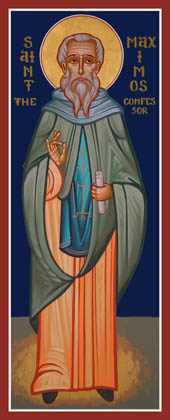
Recent Comments