
You are currently browsing the category archive for the ‘Orthodox Saints and Church Fathers’ category.
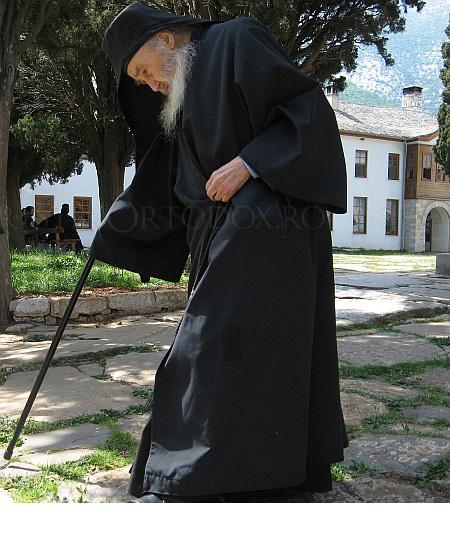
Elder Petroniu Tanase, former abbot of Prodromu Romanian Monastery from Mount Athos has followed sleep in the Lord, Tuesday, February 22.
May his memory be eternal!
On watching over the five senses
(With Elder Petroniu)
When man withdraws from the world escapes the temptation of sinful words and worldly images. By living in the world, man unwittingly hears and sees things that dirty his soul through his senses. And all these impressions and things of the world that enter his soul carry with them, a psychological and spiritual load. They awake memories you no longer want to remember, create undue spiritual tensions and leave fingerprints – as one may say – or dirty marks in the spiritual life of man. A man living in the world assimilates – even if it’s only in part, some of the sins of the world. As the old saying states that “man is what he eats”, we can also say that man is what he lives in the city, in his village or in his house. And as his body physiological composition is dependent of the materials contained in food that contribute to his good health, so the spiritual state of man becomes dependent on all these images and thoughts that penetrate through his five senses.
St. Nicodemus of the Holy Mountain has written a special work on this subject, “Guarding the five senses.”
Man must guard his senses as he would his gateways where friends but especially enemies could enter. Through these windows, dark impressions can penetrate into his soul.
These fingerprints can gradually shape the whole structure of man. During our lifetime, many impressions and deeds are recorded in one’ soul like in a book. … And these are the “books” that will be open at the Dreadful (Last) Judgment.
Man, until the end his life, is in a permanent transformation through what he hears, what he sees and what he lives. He is like a sculptor carving the wood, a piece here, a piece there… A chip on this side, a splinter on the other side and, little by little, the figure/sculpture appears. At the end of his life, man appears in his final form, modeled by everything he hears and does. And this transformation is noticed sometimes on his face. A wicket or a drunken man who lived a sinful life will show this. His figure acquires a certain appearance, connected to the sins he committed. And we elders can sense this.

But these evil fingerprints do not remain at the level of external appearance as we are accustomed to notice, but they will be engraved in man soul. Then at the Dreadful Judgment, when the books will be opened, that man will appear – though the great mystery of God – modeled by everything he did and thought. The Holy Fathers and especially of St. Niphon of the Danube says that people who have committed grievous sins, and have not change or repent, will remain distorted for eternity – a reflection of their soul, which after death will become a tangible reality. At the Last Judgment the state of man soul, more visible than his body, will portray everything man did. Sinners will have distorted figures and every grimace will reflect the sins they committed. Then – as St. Niphon says – everyone will see the sins we committed in our lifetime for they will be engraved in my personal appearance, they will express like a mirror, the structure of my soul irreparably damaged by sins. All our sins will be expressed and everyone will see our corruption.
And what is it said, in our church services, about the Dreadful Judgment? “Oh, who can suffer this scenery?” If now I’m ashamed to visibly sin against my neighbor, how will I look when everyone will see all the sins I have done?
On the Orthodox Church
1. The Orthodox Church is and must remain holy. There exists not one thing that can be accomplished without the power of the Holy Spirit. Today the spirit of the world penetrates everywhere, even in the life of the Church, in parishes and monasteries. With the help of the spiritual father, man is called to become holy through Christ who died and rose from the dead in order to deify human nature and to lift it up to heaven to the throne of the Holy Trinity.
2. The monastery ought to be far from the spirit of worldliness. According to St. Maximus the Confessor, a monk must constantly renounce the world and he will gain heavenly treasures.
3. Monasticism resembles martyrdom. Most saints mentioned in the Church ‘calendar are martyrs, and are followed by the monastics.
4. The monks have been entrusted with the liturgical treasure of the Church. A monk is called to maintain lit the lamp of liturgical life. First of all, he must attend all the daily liturgical services from his monastery.
5. The abbot has to be the spiritual father of the monastic community.
6. In his ministry, the Bishop is called to show firmness in defending the true faith before the heterodox and to promote the purity of life. The lives of St. John Chrysostom and St. Basil the Great ought to be eloquent examples to every bishop. The clergy and the faithful’ confidence in their hierarch is maintain when he remains steadfast in defending the Christian truth and in preserving the purity of life.
7. Gluttony, immorality and the love of money enslaves our world today.
Today, many sins are enacted by the so-called “human rights”. But according to the Christian teaching, man has only duties: towards God, his neighbor and God’ creation.
(Taken from the site “Friends of Mt. Athos”, translated by blog’author)
More about Elder Petroniu at:
The ABBOT OF THE ROMANIAN SKETE of MT. ATHOS, REPOSES IN THE LORD
Valeriu Gafencu, blessed memory (59 years with the saints) !
Motto: “A man, as well as a people, has value to the degree to which he has understood the Gospel and can follow the teaching of Christ”
– scholar Simion Mehedinti

The following excerpt is taken from the book “The Saint of the Prison”
The Romanian people – situated, according to historical chronicles, “in the path of all evils” – were destined to pass through many trials. The latest was the worst: the Communist steamroller. This demonic ideology, nothing other than the religion of Satan on earth, as someone who passed through Communist prisons called it, claimed hundreds of thousands of victims among us. It did not succeed, however, in breaking those who, not wanting to lose their souls held steadfast with all their being to Christ. Enduring horrible suffering and finally dying at the hands of Communists, they acquired the crown of sainthood.
“Communism filled heaven with saints,” said Father Arsenie Papacioc. If one could somehow come to know all those of our people who passed the threshold of sainthood during the Communist persecution, he would also understand the words spoken in the 17th century by the holy Metropolitan Dosoftei of Moldavia:“Therefore also among the Romanians are many saints…. but no one has sought them out.” […]
Nevertheless, it would be of no small benefit to anyone to devote oneself to reading testimonies of those who passed through these prisons. In them, one would find such valuables which can rightly be compared to those found in a Paterikon or in the lives of the saints.
Among the many portraits of the confessors, one will be found in particular that is recalled with reverence by all and is considered a saint: Valeriu Gafencu. Nicknamed “the saint of the prisons” by Father Nicolae Steinhardt in a truly inspired moment, Valeriu Gafencu was one of the more impressive figures who lived an admirable spiritual life amidst prison conditions.
Through his sacrificial love springing from a perfect dedication of his life to Christ, he remains painted in the most luminous of colors in the hearts of those who knew him. Father Gheorghe Calciu wrote, “I have no doubt that he is a saint. He lived the word of God to such a level that it was incomprehensible for us.” […]
Devoting themselves to the prayer of Jesus, studying and learning texts from the Holy Scripture, the Philokalia, and other patristic writings, these prisoners were to form, in the Communist prisons, a philocalic way of life. United in their desire to sacrifice themselves for Christ, these monks in spirit – for as we shall see, they lived a high level of asceticism at Aiud – supported each other, preparing themselves for the difficult trials which were yet to come. […]
Looking back on these long and hard years of imprisonment, Elder Arsenie Papcioc sees them as a blessed opportunity for strengthening his faith. “There were no other means of preparation that could offer such possibilities for growing in one’s faith, for a spiritual deepening, for a living relationship with God as were offered by the tribulations of imprisonment. I bless that period of time. I spent years in the wilderness without coming upon the possibility to deepen my thoughts of eternity, of the divine nature; this possibility was accorded me by way of the torturous dailiness [of life in a Communist prison]. Suffering also united us. Those of us who succeeded in knowing each other on the cross, so to speak, remained united.”
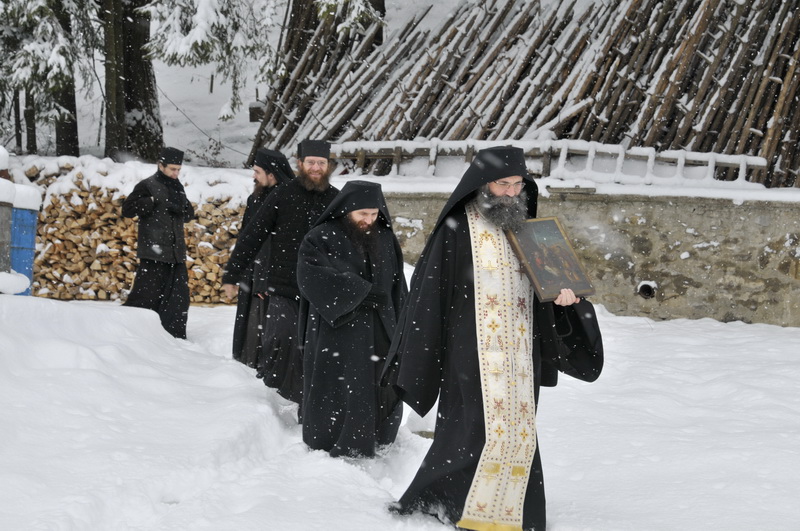
These prisoners who were monks at heart, clothed the conditions of prison life in monastic garb.
“Prison created special conditions for you,” says Virgil Maxim. “Your cell became a sanctuary of prayer, of nourishment, an opportunity for ascesis, solitude, renunciation of the material goods and joys of life, an opportunity to live as paupers, in purity and chastity. The chronic uncertainty of our situation enabled us to put our trust in the will and providence of God. Obedience requires a superior – a father confessor – to whom one submits, and God also offered us this gift through the presence of our priests. We were also obedient to the program imposed by worldly authority, as an act of divine pedagogy, in which your will enters consciously in submission to the divine will.”
The Way of Blessedness
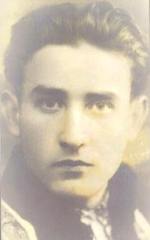
Weak in faith and spiritually impoverished by a lifestyle full of comforts, modern man understands only partially and not without difficulty the sufferings of those who endured life in prison. Many testimonies seem unbelievable to those of us who, as one poet has said, were not with them in the prison cell and do not know the life of darkness. We cannot imagine how they endured so much suffering. But what is even more difficult for us to understand, if not beyond our comprehension, is the nostalgia felt by prisoners when they look back at the time spent in prison.
“It is impossible for someone [free], outside of prison, to understand”, Father Gheorghe Calciu tells us.
“We [who were in prison] are [now] free and we are very happy that we are free, but we have a kind of nostalgia for prison. And we can’t explain it to anyone else. They say we’re crazy. How can you miss prison?
Because in prison I lived the most spiritual life. I attained to spiritual heights that I am not capable of reaching in freedom. Isolated, anchored in Jesus Christ, I had a joy and an enlightenment that the world cannot offer. I can’t find the words to express with precision the feeling that I had there. Those that did not live this experience cannot understand how we could be happy in prison.”
Valeriu Gafencu lived such happiness – beyond our understanding – in spite of suffering. Virgil Ioanid remembers how, on the road between two prisons, in a police van, laid low by tuberculosis, his cheeks bright red with fever, Valeriu spoke of “the happiness of suffering for Christ and of enduring, like the first martyrs, the persecution unleashed by the enemies of the faith.” Likewise, in a letter sent to his family, he confessed, “Today I am happy. Through Christ I love everyone.” […]
After arriving at Aiud, Valeriu lived under a harsh regime. For a long time, as he later confessed, he spent much time in isolation, being taken out for a walk only an hour and a half per day. The beginning was not at all easy. “And, dear Mama,” he said in a letter, “I’d like you to know that I suffered very much. During the first winter I would wake up at night and in the solitude of my cell, in cold and in hunger, I looked into the darkness and whispered quietly, so that only I would hear, but loud enough for God to hear, ‘Mama, I’m cold and I’m hungry.’ At the beginning it was very hard.”
The suffering was all the more oppressive because believing in his innocence, he didn’t understand his imprisonment. “From the very beginning, I wondered why I was locked up. In my former social life, in my relationships with people, I was considered a very good person, an example of moral conduct. If I entered into conflict with anybody, it was for the sake of Truth.”
In the midst of this spiritual grinding, he sought an answer in the books that were circulating in prison.
At the beginning, he studied and read very much, but soon his attention was drawn to Christianity, which appeared to him in its true light, in its spiritual intent. Valeriu dedicated himself to intense theological study, undertaking a careful examination of Orthodox spirituality. Among the books he read were the Paterikon, The Salvation of Sinners, The Lives of the Saints, Imitation of Christ. He read St. John Chrysostom, St. Basil the Great, St. Gregory Palamas, St. Gregory Nazianzen, St. Ephrem the Syrian, St. John Damascene. He also studied Pascal, Bulgakov, Berdyaev, Papini, as well as all the courses offered at the School of Theology. His reading concentrated especially on Holy Scripture.
Spiritual books helped him see things more deeply and turn more toward his inner self. In the solitude of his cell he prayed very much, seeking to understand the meaning of suffering. After a time of tormenting unrest and struggle, he experienced through the grace of God a state of enlightenment in which he saw his soul full of sins.
“After a time of much uneasiness, after experiencing a great deal of pain, when the cup of suffering had filled up, there came a holy day, in June 1943, when I fell to the ground, on my knees, my head bent, my heart shattered, in a burst of tears. I prayed to God that He grant me light. At that point I had lost all faith in people. I realized perfectly well that I was in truth, but then why was I suffering? Within my zealous soul only love had remained. No one understood me.
“During this long period of weeping I began to do prostrations. And suddenly – O Lord! How great art thou, Lord! – I saw my soul full of sins, I found within myself the root of all the sins of mankind. Alas, so many sins, and the eyes of my soul, hardened by pride, had not seen them. How great is God!
“Seeing all my sins, I felt the need to shout them forth and cast them away from me. And a deep peace, a deep wave of light and love poured into my heart. As soon as the door opened, I left my cell and went to those whom I knew to love me and to those who hated me and to those who had most wronged me and I confessed to them openly, ‘I am the most sinful man. I do not deserve the trust of even the last among men. I am blessed!’
“Everyone was astounded. Some looked at me with disdain, others with indifference. Some looked at me with a love that they themselves could not have explained. A single person said to me, ‘You deserve to be kissed.’ But I fled quickly back to my cell, threw my head into my pillow and continued my weeping, thanking and glorifying God.”
This moment of enlightenment was a true rebirth for Valeriu. The most immediate benefit of the awareness of sins is the understanding of the meaning of suffering.
“Suffering, no matter how difficult it may be, has no other meaning than the cleansing of souls thirsting for salvation.”
[…] From day to day he created order in his soul, he became a new person, he accustomed himself to life in the Spirit in accordance with Christian teaching. His progress was harmonious, seeking to realize the new man. Through the grace of God, he went down the path of the most authentic Orthodox spirituality.
“When he was feeling better,” continues Ianolide, “Valeriu spoke beautifully and with fervor, focusing mainly on his favorite subject: interior purification and union with Christ.
“Through baptism, we received purifying grace, while being anointed with Holy Chrism, we have been adorned with all the gifts of the Holy Spirit. But this blessed internal state is ineffective within us, we are Christians in name only. We live in a world of confusion, of loose morals, of sin. It’s considered shameful to be a believer, and old-fashioned to be moral. The baptized man, in order to be saved, has to live all his life in the Holy Spirit, but we haven’t succeeded in doing this. We have believed, we have prayed, we have kept the faith, we have suffered, but in order to be united with Christ, one must purify oneself inwardly through confession and renew oneself through Holy Communion. Therefore unite yourself to Christ conscientiously and with great steadfastness, making yourself a bearer of His holiness, His power, His love, His light, His immortality. You must oppose sin mercilessly. Then you will be born anew. There is no path of compromise.’
Another time he said to us, “The teaching of Christ is so wonderful, so consummate, that if we understand it, we have the most powerful argument possible for the existence of God. When I had this revelation, I wept from pain and from happiness! Those who believe in Him must bear witness to this truth even if it means being martyred. Wasn’t the Son of God killed as an enemy of His people?’ […]
One day Valeriu was feeling so bad that we thought he was going to die. In addition to all the other illnesses he suffered from, he also developed acute appendicitis. He could have been left to die, but that would not have been ‘humanitarian.’ Humanitarianism is the hypocrisy of cruelty, it brings to light the poisonous and lamentable domain of the Communist revolution, with its slogans and beautiful vestments. So the doctor sent a report to prison administration so that he could be transported to the hospital in town for an operation.
The penitentiary agent came to him and said:
’Your life is in my hands. If you don’t have this operation, you will die.’
Valeriu smiled indulgently and answered:
‘If one man’s life depends on another, then this man indeed has great responsibility! But if everyone would realize that their lives depend on God, then everyone would value the life of his neighbor!’
’You’re crazy,’ the agent said to him, and sent him to the operating room under strict guard.
When he came back to the sanatorium, the agent said to him:
‘Look, you were face to face with death! You see, we wanted to show you that your life is in our hands. Maybe now you’ve changed your mind and
you’ll cooperate with us. We’ll give you streptomycin141! You’ll also get packages from your family. And you know what might happen later?… You’re an intelligent man and you could be useful to us. We know that you’re not interested in politics, but in religion, but isn’t the patriarch and all of his priests on our side now? Why don’t you join our side too? You have a lot to gain!’
’I thank you for allowing me to have an operation. From now on, my torments will go on even longer…. As for the rest, between you and me, there is a matter of conscience. For the sake of my spiritual freedom I have decided to die. It is good that the truth be told plainly, and I serve the truth. I am not the judge of others, but a confessor of God. There is nothing under the sun that can survive without God. You cannot accept Christ. I cannot accept spiritual death.’
’I told you already that you are crazy!’ shouted the agent. ‘I’m going to file a report. You are a reactionary, a fascist, an enemy of the people, in the service of American bandits! We know how to deal with people like you! You’re only fit to die! Go and die with your Christ! I won’t try to stop either Him or somebody like you!’
’You can kill me now, but no one can kill Him any longer. He is a stumbling block for all kinds of pride. Understand well that Christ is the only power that can deliver mankind from suffering and sin.’
’Give up all this nonsense. The truth is on our side!’
’The truth is love that sacrifices itself for the poor and the persecuted!’
’Look here, you’re staring death straight in the face and you’re giving me mystical sermons?! You want to convince me too? See, now you’ve gone too far! You’ve spread yourself too thin.’
Valeriu struggled to keep looking at him, because his eyelids had grown heavy. He felt worn out physically, but an internal joy compelled him to speak about faith in order to leave an eternal testimony. The smile of his measureless love blossomed on his cheeks. He prayed in secret for this unhappy man and for God to deliver the world from leaders like him.
The agent was confused, muddled. He swore a blue streak and then ordered that Valeriu be taken back to his room. […]
I Saw the Mother of God

During the night of his last Christmas, toward dawn, Valeriu testified to his friend Ioan Ianolide:
“This night, I kept vigil. I was waiting for my carol to come. I wanted it to be very beautiful. I sang it in my head. I heard it in the high heavens, from where it descended. Rather difficult for me, since I don’t know musical notes and I have to sing by ear. So I was awake, lucid and serene, when, all of a sudden, I noticed a photograph of Seta – the girl he had loved – in my hand. Amazed by this, I lifted my gaze and at the head of my bed I saw the Mother of God, clothed in white, vivid, real. She was without her child. Her presence seemed material to me. The Mother of God was actually beside me. I was happy. I forgot everything. Time seemed endless. Then she said to me:
‘I am your love! Don’t be afraid. Don’t doubt. My Son will be victorious. He has sanctified this place now for future life. The powers of darkness are growing and will frighten the world still more, but they will be scattered. My Son is waiting for people to return to the faith. Today, the sons of darkness are bolder than the sons of light. Even though it may seem to you that there is no more faith left on earth, nevertheless, know that deliverance will come, albeit through fire and devastation. The world still has to suffer. Here, however, there is still much faith and I have come to encourage you. Be bold, the world belongs to Christ!’
“Then the Mother of God disappeared and I remained overwhelmed with happiness. I looked at my hand, but the photograph was no longer there.” […]
Not long afterward, he related to Ianolide:
’Late last night I was praying. I felt comforted by the grace of God and I secretly rejoiced in the gift that I had been given. I was awake, conscious, and happy. Suddenly I felt that something odd was happening to me, something apart from my own will. Beginning with the extremities of my body, my soul began to desert me. Not only was I not afraid, but I knew that I was not dying, and the more my soul left my body, the more my interior life grew. My soul ascended easily toward my chest, toward my neck, toward my head. I felt happy, pure, illuminated by a holy light. My mind has never been as lucid as it was then. I knew that the Lord was with me. I was happy to be in His power. Time seemed to expand. I no longer felt pain in my body. I looked at my body without wanting it or rejecting it. Life and matter seemed to me to be miracles. My soul quickly drew up to my mouth and left my body. I realized then that I could go anywhere I wanted without being obstructed by matter. It was wonderful! An unspeakable joy overwhelmed me. My first thought was to go see my family, but I remembered the Fathers in the Paterikon that counsel you not to entrust yourself to the workings of spirits unless you are under obedience, lest the devil deceive you and you be lost. The thought appeared in my mind of the old hermit to whom the devil appeared as an angel of light. The old man had departed from his obedience to the abbot and the monastery and he considered himself guided by God Himself and thought that the others were jealous of him. Then the ‘angel’ came to him and told him to call all the brothers to the well in the courtyard of the monastery in order that the power of God be shown to them. They went to the well in the middle of the night. The bright angel appeared and, entering the well, said to the hermit, ‘Throw yourself into the well and I will pull you out unhurt in front of everyone so that they may see that you are a saint.’ The old man threw himself in and died like a wretch. Reminding myself of this, I was careful not to fall into temptation and I decided to return to my body. Now, you see, I submit to obedience. Tell me what to do and I will do it!’ […]
A letter from Aiud (29 January 1946), Valeriu sent to his family
“Life is something other than what people imagine. Man himself is something other than what he imagines himself to be. The Truth is something other than what the human mind imagines. I want to be sincere and open, down to the deepest fibers of my soul. From the very moment in which I first set foot in prison, I wondered why I was locked up. In the realm of social life, regarding my relations with the world in which I lived, I was always considered to be someone very good, an example of moral conduct. If I entered into conflict with anyone, it was only for the sake of Truth. After much struggle and unrest, after much pain, when the cup of suffering had filled up, there came a holy day, in June 1943, when I fell to the ground, on my knees, my forehead to the floor, my heart crushed, in an outburst of tears. I asked God to grant me light. On that day, I had lost all confidence in Man. I realized perfectly well that I was in truth, so why then was I suffering? In all my soul full of spirited self-assurance there had remained only love. No one understood me.
In my prolonged weeping I started to do prostrations. And suddenly – O, Lord! How great art Thou, O Lord! – I saw my entire soul filled with sins. I found within myself the root of all human sins. Oh, so many sins, and the eyes of my soul hardened by pride had not seen them! How great is God! Seeing all my sins, I felt the need to shout them out loud, to cast them away from me. And a deep peace, a deep wave of light and love poured into my heart. As soon as the door opened, I left my cell and I went to those whom I knew loved me the most and to those who hated me and had sinned the most against me and I confessed to them openly and plainly, “I am the most sinful man. I don’t deserve the trust of even the lowliest of men. I am blessed!” Everyone was dumbfounded. Some of them looked at me with contempt, others with indifference, and some looked at me with a love that they themselves would not have been able to explain. Only one single person said to me, “You deserve to be kissed!” But I fled back quickly to my cell, buried my head in my pillow and continued weeping while thanking and glorifying God.
On that day, I began a conscientious struggle with sin. If you could only know how difficult the war with sin is! I want you to know that I struggled very much with sin not only here, but also when I was free. [Here he testifies that, although he was tempted physically, he did not fall, but remained pure.] In prison, I examined my soul and I realized that, even though I had not sinned in deed, I had sinned in word and especially in thought. After a deep examination of conscience, I went to a priest and confessed. My confession unburdened me. And I carry on a continuous struggle. The struggle does not cease with death. Without repentance no one can take even one step forward. Anyone who flees from the reality of his own soul is a liar. What is life? It is a gift from God that is given to us in order to purify our souls from sin and to prepare ourselves, through Christ, to receive eternal life. What is Man? A being created through the limitless love of God and to whom God gave the choice between holiness and death. Be very careful! In social life, people regard each other and judge each other not according to what they are in essence, but according to what they seem to be in form. Have no illusions about Man – anyone who does will suffer bitterly – but love Him. Only one is perfect, only one is good, only one is pure: Christ-God! And now: What is the Truth? The Truth is Christ, the Word of God. Seek to draw near to Christ sincerely and leave the world and its sins in peace!”
(To be continued)
Please see also:
A Guide to Confession (I) at the beginning of Great Lent
written by Valeriu while imprisoned…
 Valentine day: “A Pink Holiday”
Red hearts, pink ribbons, candy packaged in purple, “angels” suspended in fluffy and blue clouds, among other sweet things that feel “good” – to the soul eager for “cute happenings” – are just some of the elements of Valentine’s Day.
Every February 14th – the day of St. Valentine in the West – is celebrated with great fast, and this “holiday” had penetrated so deeply into the mind of modern man, for if you ask what greater holiday is to be celebrate in February, you are been answered without hesitation: Valentine’s Day! This day becoming a clear marking on the twisted map of consumerism.
Valentine’s day – a business under the mask of a “holiday”
Absolutely all traders are trying to profit from this; in fact, this commercial love lasts only for a day. A day in which most business are trying hard to give “deals”: a bouquet of flowers – 40 dollars, a puffy heart – only for few dollar, a candle shaped as a heart to burn just for one hour – few dollars. Everything that you may want…ceramic vases, underwear, monkeys, jewelry, books, and why not, slippers and bath towels so naturally, as long as there is a demand, these toys will continue to sell.
All like in the real story of the Tower of Babel …
Valentine’s Day – the invasion of red hearts
Almost all the products that vendors offer for the so-called day of love, have at least one red heart. Obviously, these offers are designed for every budget, so that anyone by spending a small or great amount, may get into the “spirit” of the American celebration of St. Valentine.
Valentine’s Day – Origin!
The Valentine’s Day has its origins in the tradition of ancient Rome, when festivities were organized on February 15, in the honor of the pagan gods Juno and Pan. Because it was also a celebration of fertility, the pagan practice required that the unmarried young girls may write love notes, and these messages were placed in an basket for the boys to extract one randomly. According to that tradition, the participants were obliged to court primarily the one “elected” based on the message written on that note, and of course, this started all sorts of stories …
Valentine’s day was also called long ago, the Birds Wedding Day, because it was thought that the birds choose their mate on this very day.
With time, these pagan Roman habits acquired a Christian character becoming falsely a celebration of fertility attributed to St Valentine.
Be my Valentine?!
The day of Saint Valentine, the “patron of lovers”, had lost its meaning in legends and the history of the Roman Empire. Today, the Catholic Church recognizes at least three different saints all martyred, called Valentine or Valentinus, but not on this day.
 One legend says that Valentine was a priest who served the III-rd century in Rome. When Emperor Claudius the II-nd decided that unmarried men were better soldiers than those with wives and families, outlawed marriage for young people. The Emperor wanted to form a “real team” of unmarried men as potential soldiers. Valentine, realizing the injustice of this decree, continued to officiate marriages for young lovers in secret. When his work was discovered, the king sentenced him to death. Other traditions say that Valentine was killed for attempting to help Christians to escape from the terrible prisons where Christians were beaten and tortured.
According to another legend, Valentine is the one who sent the first valentine greeting while in prison, after he fell in love with the daughter of a prison guard and, before he died, it is said that he wrote a letter which he signed it “from your Valentine”.
St. Valentine in the Orhodox Church

Every year, on February 14, Orthodox Christians are facing a double paradox. First, everyone heard of Valentine’s Day, so in a sense, anyone can define briefly this “holiday” while not many seem to know who is Saint Valentine.
On the other hand, many are annoyed by the fact that on this day in the Orthodox calendar, we do not see any saint to bear this name. Another intersting fact is that even the Roman Catholic calendar doesn’t post a saint with this name on this day. St. Valentine mentioned in one of the legend above, was removed from the Roman Catholic calendar in 1969 due to ambiguity of this man life that wound lead to his consecration. Currently, on February 14, the Roman church comemorates Saints Cyril and Methodius.
So from a Christian view, we are not mastaken to say that Valentine’s Day, dispite all “marketing” is a “holiday” when we remember no one! Saint Valentine been commemorated by the Orthodox Church on July 30th.
Saint Valentine the Bishop was born in 175, in Interamna (an italian region called today Umbria). He was ordained priest by St. Feliciano of Foligno, and Bishop of Interamna by Pope Victor the Ist, in 197.
An outstanding preacher of Christ Gospel, a wonder-worker and healer, St Valentine was much loved by his followers. He healed Frontanus, the brother of a Roman governor, from a very difficult disease. When Cherimon the son of the famous philosopher Craton, got sik, under Frontanus’s instructions, called Bishop Valentine of Rome for councel. Cherimon suffered from a debilitating disease that contorted his whole body. After St. Valentine spent a night in prayer, Cherimon was completely healed. After showing himself to his father Craton, the philosopher decided to be baptized and his whole family embraced Christianity along with his three disciples.
Saint Valentine was arrested, tortured and beheaded in Rome, at the age close to one hundred years, from the order of governor Furius Placid, during the persecution of Emperor Marcus Aurelius. Saint Valentine was murdered in secret, at night, to avoid any rebellion form the people of Terni. His holy relics are found today in the church of Terni, Italy.
The three baptized disciples of Craton: Procus, Ephiv and Apollo, were murdered together with St. Valentine in 273.
In the Orthodox calendar, the Holy Martyr and Bishop Valentine, is commemorated on July 30. In the Orthodox Church. there are many martyrs who bared his name: Holy Martyrs Mark Sotirih and Valentine – October 24, Holy Martyr Valentina – February 10, St. Valentine the Martyr – April 24, St. Valentine the priest – July 06, and Holy Martyr Valentina – July 18.
(Life of the Saint – translated by blog’author)
“Repent, for the kingdom of heaven is at hand.”
(Matthew 4:17)

Repentance: Life’s Continual Effort
by Archpriest Victor Potapov
Bishop Ignaty Brianchaninov left us the following precious instruction: “In order to live spiritually and draw breath from grace, we must continually exhale the ashes of sin.” We sin almost constantly, if not in our deeds, then in our thoughts and feelings. Therefore it is essential to continually cleanse our souls. In the language of asceticism (teaching on religious struggle) it is known as “internal activity” or “attentiveness.” To continually repent is to pay unceasing attention to one’s spiritual life, to assess and remove from it all that is questionable and foolish. Bishop Theophanes the Recluse teaches us that one should do battle with sin at the moment it is born, i.e. when it is only in one’s thoughts. This is true battle, the ” invisible warfare” as it is called by the Athonite struggler Nicodemus of the Holy Mountain. This spiritual battle requires ability, God’s assistance, and constant prayer. As the holy Fathers of the Church write ” It is pointless to weep over the sins of the past if we do not struggle with them in the present.” Continual repentance or attentiveness is that poverty of spirit of which Christ speaks in the first Beatitude in His sermon on the mount. The call to such repentance is found throughout the Word of God and the texts of Orthodox worship.
In a sense, all of the teaching of the Church is a single call to repentance in the most profound sense of that term, i.e. it is a call to rebirth, to a complete reassessment of all values, to a new understanding and vision of life in the light of Christ.
It was not coincidentally that St. John the Baptist often repeated the words “Repent, for the Kingdom of Heaven is at hand.” The Christ began His sermon with these same words. According to the Venerable St. Ephraim the Syrian, “repentance is a field to be cultivated at all times. “Repentance is the tree of life, resurrecting those dead in sin.” Elsewhere he states, “Through repentance, earth has become heaven, for it has become filled with saints.”

In his book A Priest’s Observations, Fr. Alexander Elchaninov, an experienced spiritual director, writes, “Without our constant control over the spirit, confession, which takes place occasionally, is not successful”. The eye of the spirit, conscience, demands exercise, and without it you will see neither yourself nor your sins. According to the Venerable St. Isaac of Syria, ” He who has been able to see himself has accomplished more than one who has seen the angels.” He also wrote “One who apprehends his sin is better than one who through his prayers raises the dead.”
Sts. Ephraim and Isaac, and other spiritual strugglers after piety all recommend that in doing battle with sin, it is best to begin with the sin which most grievously attacks us. To the extent that we are rid of it, our conscience will see all the more. Moreover, it always behooves Christians to do battle against those sins which directly oppose love. The holy fathers of the Church teach that hatred, enmity, and condemnation utterly seal shut the gates of the Kingdom of God, the Kingdom of love. Thus, the first condition of true repentance is reconciliation with everyone. This is why in the Lord’s Prayer, the Christ included the words “forgive us our debts as we forgive our debtors.” This is why the Orthodox Church begins Great Lent with Forgiveness Sunday, when believers ask forgiveness of one another for personal insults and offenses, so that with a clear conscience they might begin Lent, their “invisible warfare.” The Church teaches that true love is indivisible, and that dislike for a single person will ultimately poison all love. Theophanes the Recluse writes: “In one who is at odds with anyone else, all friendship is fragile, and easily turns into enmity; of course, by bearing enmity, one cannot really love God. God is complete love, and tolerates nothing that is opposed to love.”
The commandments in the Gospel, while easy, appear difficult, for human consciousness, having fallen out of synch with life and harmony, is clouded. For example, people consider the Gospel commandment to love friend and enemy alike, to be difficult. In the sermon on the mount, the Lord says: “Love your enemies, bless them that curse you , do good to them that hate you, and pray for them which despitefully use you and persecute you” (Matt. 5:44). We see that no limits to good are imposed upon man in this commandment, one given to those who wish to rise above both their own and mankind’s selfishness, to be healed, and to depart from the state of sin.

Let us try to list those who have caused us some annoyance or insult, who have dealt with us poorly or spoken ill of us. In other words, let us recall those who are “not to our liking” and, forgiving each of them, let us sincerely pray for these souls. Let us drive out any grudge or irritation we bear them, and wish them well. Given the opportunity, let us say something nice about them to others. At every opportunity, let us help them.
Thus, as we will see for ourselves, fulfilling the commandment of love will engender a joyous feeling of spiritual freedom and profound peace. Many internal difficulties will depart from us, for we will have fulfilled the Christ’s words, believed in God, and given Him heed. The power of good will rejoice within us. Even if we do not immediately notice this peace within ourselves, it will certainly come to us as a reflection of our charity.
That a person is kind, honest, and generous always seems miraculous. Yes, it is a miracle, and a miracle far greater than moving a mountain. Something greater than a mountain is being moved – human selfishness. Such is the effect on man of our faith in God , our trust in the Lord, our repentance before Christ. When one who hates becomes one who loves, when a liar becomes truthful, when a vain person becomes modest, it is truly a miracle. Charity emanating from us first of all liberates us from our own evil; it opens within us the doors and windows through which flows the pure air of heaven. This is the rebirth born of repentance.
In repentance we see the operation not of natural forces but of supernatural grace-filled ones. And only one who believes in the Light can take into himself true love. According to biological law, men engag only in a “struggle for survival.” But according to the law of the Spirit, the battle is for the resurrection of the world, a spiritual battle which conquers selfishness, spiritual death. The Christ calls us to overcome our evil will and animal nature, to become human in the full spiritual sense of the term. The human soul is immeasurably greater than matter. As the Apostle Paul tells the Philippians, “I can do all things through Christ which strengtheneth me.” Such great, marvelous words: “I can do all things through Christ which strengtheneth me.” Through the faith granted us, we are called to be centered internally, mentally, not on our little selfish personality, but on the power of the Living God, the True Christ Jesus Who dwells in us.
The Creator and Father who brought us into being granted to our souls the freedom to make a free moral choice, to turn to Him and to repent of our sins, which constitute a betrayal of God’s truth. Yes, man is sometimes unfaithful to God; even if we do not frankly renounce God, we sometimes obliquely become betrayers of Christ, of His love and truth. Let us all repent of that.
Let us reflect upon how imperfect is our consciousness, and let us repent before God. Through repentance, the pure path to God is opened. Moreover, let us not tarry, for no one knows when his final hour will come. There is nothing more important and more needed than repentance and God’s saving forgiveness.
See Also: Many Confess, Few Repent
by Monk Moses of the Holy Mountain

The Holy Martyrs of Mount Athos (January 4th)
(murdered by the papists)
by Archimandrite Ghervasios Paraschevopoulos
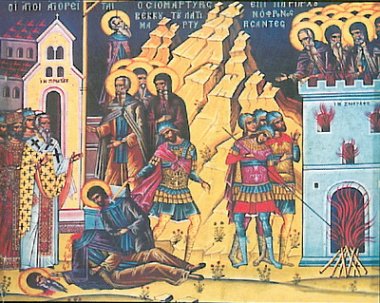
“There was a time when the Byzantine emperor of Constantinople – Michael the VIII-th, Palaeologus (1259-1282), seeking the political help of Pope Urban the IV (1261-1264), promissed to cooperate towards “the unification” of the Eastern Orthodox Church with the heretical Pope of Rome.
The king’ attempt however, met the steadfast opposition of the patriarch Joseph the Ist (1267-1275). If under differenet circumstances the patriarch would be very faithful to the king, when the king asked for “the union”, the patriarch refused and took the oath that “under no circumstances he may sign a union with the heretical pope.” Nor that he will ever acknowledge the papal authority which is contrary to the Gospel, the Holy Canons and the Holy Tradition.
The Pope’s claims with regard to the union were:
– an oath of allegiance to the pope by all clergy,
– the catechization of people should be in accordance with the faith of the pope of Rome and especially with the addition of “Filioque” in the Symbol of Faith (the Creed) by teaching that the Holy Spirit proceeds not only from the Father but also “from the Son”;
– the Pope should be considered “appointed by God” (infailible) to judge and decide irrevocably and without appeal in any dogmatic matter. “That is to say he should be the supreme authority in the Church”
Then, where are we to place the local and Holy Ecumenical Church Synods (Councils)?! Well, they must be vented, because – according to the catholic dogma – the Pope is above all the Ecumenical Councils.
Oh my Lord, such a devilish exaltation!!! Pope Clement the IV (1265-1268), successor of Pope Urban the IV cherished the same thought and the same hope. The same can be said about Pope Gregory the X (1271-1276), the follower of Clement. A steadfast “creed” and claims for all Popes and almost the same conditions for the union that the king had asked insistently!
Many theologians and later the whole church, had joined the patriarch Joseph in his resistance. This opposition had angried the king to such a degree that the persecution of faithfull began.
Some of them were tortured; others were deprived of their properties. Although the whole city of Constantinople was against this union, the emperor, blinded by envy and hate, asked the inhabitants of the imperial city to pay him the taxes for the previous 10 years! How can this be? For the king regained Constantinople from the Franks 10 years back, so for this he regarded himself as the “owner of the city!”
Even more, his delegation left for Lyon (1274), France where the pope convened a “unionist” synod, bringing back with them the proposal on the union already signed by the pope.
And what were these signed proposals? The same as those each pope had always asked of: the addition of “Filioque” to the Creed, the recognition of pope’s supremacy, and the pope’s right to be mentioned by the patriarchs during Divine Liturgy!
And the result? The agreement in question stirred new wave of indignation and revolt among all Orthodox faithful. Almost everyone opposed it and bacause the patriarch Joseph openly opposed the agreenment, he was banished from the Patriarchal Throne. What then? Oh, the heretical patriarch John Beccus the XI (1275-1282) was elected!
Soon the opposition arouse from all orthodox ranks: the clergy and the people. Among them: Evlogia, the emperor’s sister, Andronicus Paleologus, John Paleologus, Manuel Paleologus (three of the king’ family) and Isaac Raul were against his position.
The Emperor and the new “Patriarch” began to use the most tyrannical means to compel everyone to accept the falls union: fearful martyrdoms, enprisonment, tortures, blindness, the cutting of one’ tongue, killings … A physical author of these tortures was the patriarch Beccus himself!
But let us now get back to the subject! In this context, we can understand the persecution of our athonite fathers from the Holy Mt. Athos. When the king and the patriarch have heard of their opposition, they became enraged and overshadowed by the blind passion of revenge: How dare they (some monks) oppose the royal order! How dare these simple monks of Mount Athos will disregard the patriarchal mitre! Let them be persecuted. Because they proved “arongants” and had disconsidered the “unity” with the heretical pope, so they deserve to be subjected to cruel tortures and pay with their blood.
Thus the king’s messengers and the fanaticals latins, armed with stringent provisions and powerful gards, came to the Holy Mountain and began the cruel martyrdom and executions of the “reactionaries ” athonite fathers and Starets (abbots/ Elders). When in the Holy Monastery of Vatopedi at their proposal to join the “union”, the latins encounterd the resistance of the monks, they began torturing the monastics fathers. Detachment of soldiers resorted without hesitation to unimaginable tortures to fulfill the imperial orders.
Oh, worthy servants of the Master! It was for your Orthodox faith that you considered this unhuman martyrdom a crown! What a grear honor was to shed their blood for Holy Orthodoxy! Twelve monks, brave witnesses of Christ, heroes and defenders of the purity of faith, fighting with great courage against the betrayal of our Lord Jesus Christ, were led on a hill side near the monastery. It was there (on the hill), that the latins raised gallows/scatffolds, and one by one the brave monks were hanged (as we see on the icon painted in memory of their martyrdom). Bidding each other farewell they were raised on the scaffold and from there to heaven, in the sweetness and delight of the Heavenly Kingdom, where their souls will rest with the righteous.
As for the Elder, they reserved other form of martyrdom. Another type of suffering, because according to the Latin thinkers, death on the scaffold was too mild for him.

The more Elder Euthymios (Righteous Euthymios of Vatopedi) showed his steadfast contempt and protest towards unification with the heretic pope, the more the emperor as well as pope’s “well-doers” were filed with grey shadows and contempt towards the one who just witnessed the death of his monks. Sparkled by rage… how will they seek revenge? What kind of death are they reserving for him? Near the monastery was the sea. The executors took him on the boat far into the sea and there, bounded in chains, the Elder was thrown at the bottom of the sea. So “their mission” with this monastery was accomplished!
Other monasteries were next (in line). The Latin troops as well as the Latin thinkers, adhering to the emperor’ orders, summoned an assembly of all monks living in monastic cells neighboring Kareem.
The purpose of the meeting was to compel the Athonite monks and their primate – St. Cosmas, Protos Of Mt. Athos – to approve the union with the “church” of the pope. They had to “think with the Latin mind” and adopt the Latin dogmas. However, all – the Protos and the monks – opposed the proposal of such betrayal. In a single voice and one heart, they were ready to die for the Orthodox faith, the only truthful one. It was in vain that the king’s representatives have threatened the monks by death, and the Protos with the scaffold. With courage and determination to die for their faith, they spoke against the falls union with the pope. You can not reconcile – they confessed – things that are irreconcilable. Can Christ be reconciled with Belial, or with the devil? “What agreement is between Christ and Belial” (II Cor. 6.15). There can be no communion between the East and the West. From the East came illumination and from the West, darkness.
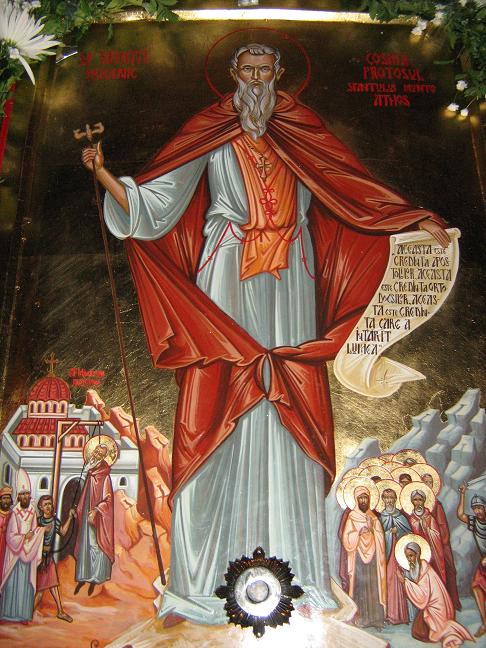
So the dialogue was deemed meaningless. In Kareem, the athonite monks remained imperturbable, firm as a rock. And the enemies began their “work”. But the more they were tortured, the more they confessed the Orthodox faith. For this they were put to death. A cruel death: to be hanged and slained. The scatfold for the Protos and decapitation for the monks. The holy land of Kareem was sucked in their precioss blood.
In the Holy Monastery of Iveron, one of the biggest on Mount Athos (with a large number of monks), the Latins had used at first peaceful means. They seemed kind and amiable at first sight. They made used of all “opportunities” to convince them to join “the papal Church”. That is what God wants, they would say. It is His will that: “they all be one” (John 17:21). But neither the courtesy, nor the flattery arguments could tempt the monks. The Iveron monks knew very well who the pope was. They knew the history and did not want to make the same mistakes.
“Unification” with the pope would mean the greatest betrayal ever made. And they would never commit such betrayal that might hold one smirched with dishonor on earth and in heaven.
As for the other athonite monasteries, they shared the same fate. It was blood, martyrdom, and death.
And … what else did latins do, “in the name of Christ”?! They commanded the soldiers to gather all the monks. The order was immediately executed and, of course, in a brutal, barbaric, and savaged way. All for the sake of the “Holy Father of Rome”. “The purpose sanctifies the means?!” they said. And the means of arrestment in question was intended to achieve unification only. Will they ever put an end to injustice?! Of course, it could not be so. Other monks shared the same fate.
Those who had their origin in Georgia (Iviria) were taken slaves in Italy or, as others relate, they were banished in Italy. The other monastics and fathers – were taken by the military guards, to the quay of Iveron Monastery.
Then, they were embarked into a broached boat intended to be sank into the sea. So it happened. All the Holy Martyrs – the priests and the brothers from Iveron monastery – were sent to the bottom of the sea yielding their soul to Him who spoke through the mouth of the Evangelist John: “Thou be faithful unto death: and I will give thee the crown of life” (Apocalypse, 2:10). In that very moment, they were crown by the angels with the crown of the rightouss martyrs for the one Holy Apostolic Church. They are commemorated every year on May, 13th.
In the Holy Monastery Zographou, the papists uses their first weapon to “burn” the Orthodox Creed of the Holy Fathers. And what weapon… the rhetorical art! The athonite fathers were called to recognize the pope as the head of the universal Church in exchange for gold and “papal mercy”.
And what remark did the Latins receive from the priests? Their reply was a testimony of the Orthodox Faith. “And who told you that the pope is the head of the Church? Who handed you such teaching? As for us, the Head of the Church is Christ! We will better die than surrender and defile this holy place by your tyranny! We will not open the gates of the monastery! Go along /away! ”
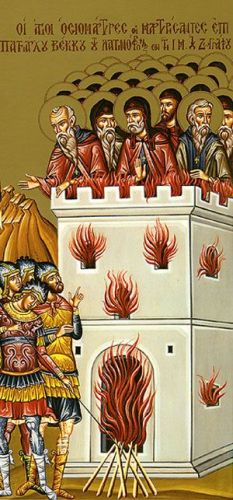
Then the enraged papists used a second weapon to teach the monks a lesson. You wonder what weapon they used?! They used fire, the stake. Dying at a stake has always been a good instrument for the pope to achieve his goals. How many people died at a stake? Christ’s “representative” on earth, always used fire for those who did not obey or worship him. The fire to burn! According to their testimony: “If you do not wish to share the same faith with us, then die!”
[…] The fathers preferred to give their lives than to abandon the faith. Our church commemorates them every year on the 22nd of September.
Dear Brothers,
No true Orthodox will ever accept the unification with the heretical pope because the unification in question means obeying the papist rules. The consequences of such obedience will be disastrous and will have a negative impact on the whole Orthodox Church. Today, defenders of orthodoxy stand as guarantors for its safety. Both our Orthodox people and Orthodox monastics living around the Holy Mount Athos always stood as a protective shield against the enemy. This protective shield is alive even today. None of the Orthodox fathers living around the Holy Mount Athos will ever accept such disastrous unification.
Archimandrite Ghervasios PARASCHEVOPOULOS
(Translated by blog’author)
Disclaimer: This article is not a call to hatred against the pope, as it may seem, but the history has to be revealed in its clarity for us to reflect on the deceit (of Satan) and the darkness one can encounter when it departs from the true faith of Christ and start calling/seeing himself infallible!
“The blood of the martyrs is the seed of the Church”, of the true Church of Christ, and their blood is a testimony of how we ought to live our lives following our Master on the cross in order that we might be resurrected with Him. Because when man no longer cares to speak the Truth, then the rocks will (the nature will start fighting against man)….
A wish for the New Year: towards eternity…

[…] Towards the eternity we step, my brothers. And now, another year had passed. We welcome a new year. What will it bring us? We do not know.
As for us been dull, we do not know if we will live tomorrow. Unceasingly one has to wait his departure, especially us elders, reaching the sunset of life. But also the young. We do not know “What the present moment will offer “. And I wonder next year, in a day like this, how many of us will still be here living? And what events await our people in the New Year? What will it happen in the Balkans, the Mediterranean and the world? … Are you imagining dreams and envision an endless life? But eternity is approaching my dear; the biggest moment is waiting to rise.
What should I wish you, my dear? Wealth, glory, honors, delights, pleasures? … How meaningless is everything. “Vanity of vanities, all is vanity“ (Ecclesiastes 1, 2). Only one thing remains: your belief in Christ. There is no other name that can give us joy and hope during this coming year, of Whom, children praise and exalt into the ages of ages. Amen!
+ Bishop Augustine
(Fragment of a Homily delivered by Metropolitan Augustine of Florida in the Church of St. Panteleimon, Florida, 31.12.1974, during the New Year’ Eve services)
Fragments from a Sermon delivered by Fr. George Calciu on January 1st 2000!

This end of the year – the New Year’ Eve that the world celebrates – not been established or sanctified by the church, cannot be considered sacred, but only a human invention. Do we (Christians) have to celebrate it? Are we to attend the fireworks, the songs and all sorts of scandals, parties? … No.
We praise our Lord in the church. For it is in the church we’re awaiting “the end”. If God would have ordained the end of times tonight, He wouldn’t made His Son’ Nativity at Christmas!
What is the relation between a sacred event and the first of January? Absolutely no connection. And why some say that the end (of the world) is when the world decides – as a new millennium begins – and not when Christ will come? Or at least at the Annunciation!
All these are for the devil’ deceit. The overcrowding of people, the delirium seizing all, the craziness, the fireworks, the drinks, the champagne flowing … I was watching last night what happened in Paris. Someone said that in Rome, where the congregation of the Pope gathered (and I could not understand why he gave blessing to the world and the city on January 1st 2000 when there is no sacred event to celebrate)… we do not know how many millions of bottles of champagne flowed…. And someone else wound announce: more champagne in Paris! Then, more beer in Germany! So, this is the measure of “sanctity” for the New Year!
In general, the beginning of the mundane New Year is something diabolical. It was established by the servants of Satan, to tempt us from the Christian path and the truth of the faith. And our Lord revealed the lies of all. God uncovered the sham of those that wanted to murder a mass crowd of people – I’m referring to the Muslim attacks. God proved the delusion of those who would say Jesus will come tonight so we have to commit murder, suicide, to increase the world’ suffering so God will have “pity on us” and come to end it!
So for the sake of Satan, they proved the deceit. For their inspiration came not from God but from the evil one.
The truth was (here), in the church. Last night we observed Vespers and prayed to the Lord, today we celebrated Divine Liturgy. All those who choose otherwise are far from the Christian truth.

There are people who bare the name of St. Basil the Great and they knew that today is his feast but did not come. We’ve prayed for them, that God will turn their path away from drunkenness and parties and towards Christ, so they may come and celebrate their name in the church. We prayed for those present and those absent for good reasons.
My beloved, I’d like you to know that the life of the church was so striked by worldly prejudices and satanic influences, so as the saints have profesized, there will come a time when churches will be everywhere you look, when the name of Christ will be on everyone’s lips, some churches will even be full, but the true faith and sanctity will be lacking. It will be a false, a deception of Satan. And we live those times […]
(Translation by EC)
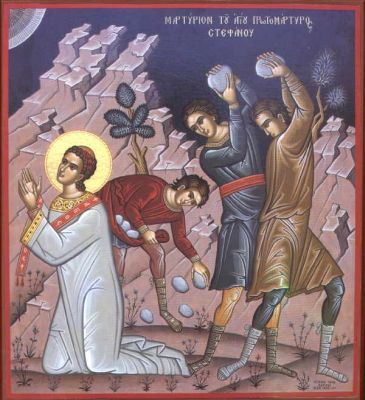
Sermons at the Feast of Archdeacon Stephen the First Martyr
(by Fr George Calciu – 2005)
The Holy Scripture teastifies: “And as they were stoning Stephen, he prayed, “Lord Jesus, receive my spirit.” And he knelt down and cried with a loud voice, “Lord, do not hold this sin against them.” And when he had said this, he fell asleep”(Acts 7, 59-60).
According to the Jewish law of the time, if someone was accused, those witnesses testifying against him had to also be the executors, if a death sentence was set. So, there wasn’t just an outside executioner with no conscience whatsoever and paid for such. In the case of Stephen, the accusers that most likely made use of their Jewish law, had to strip off their clothes, and place them at the feet of a very zealous young Jew, who by being a minor, could not take part in the execution. This young man was named Saul and would later become the Apostle Paul, through conversion. Saul was a persecutor of Christians. And because he could not participate in the stoning of Stephen, he was happy at least to watch the clothes of those who killed Stephen.
I was reflecting on this, making a parallel with what is happening today. If in times of persecution under communism and even in our times, when Christians were denounced to the authorities that convicted and inprisoned them, I thought that those who testified against them were not the executors. If they would have kept the Jewish law – “Those who have testified against him, kill him!” – I think that many would have been hesitat and would avoid to condemn. But because their denouncement was kept anounimously, they seemed to bare no responsibility; and because of this, the human villains and wickedness have multiplied. In this sense, I think that the Jewish law was better: You’ve testified against him, you will be responsible…! And perhaps many people would have given back.
Let us be attentive!
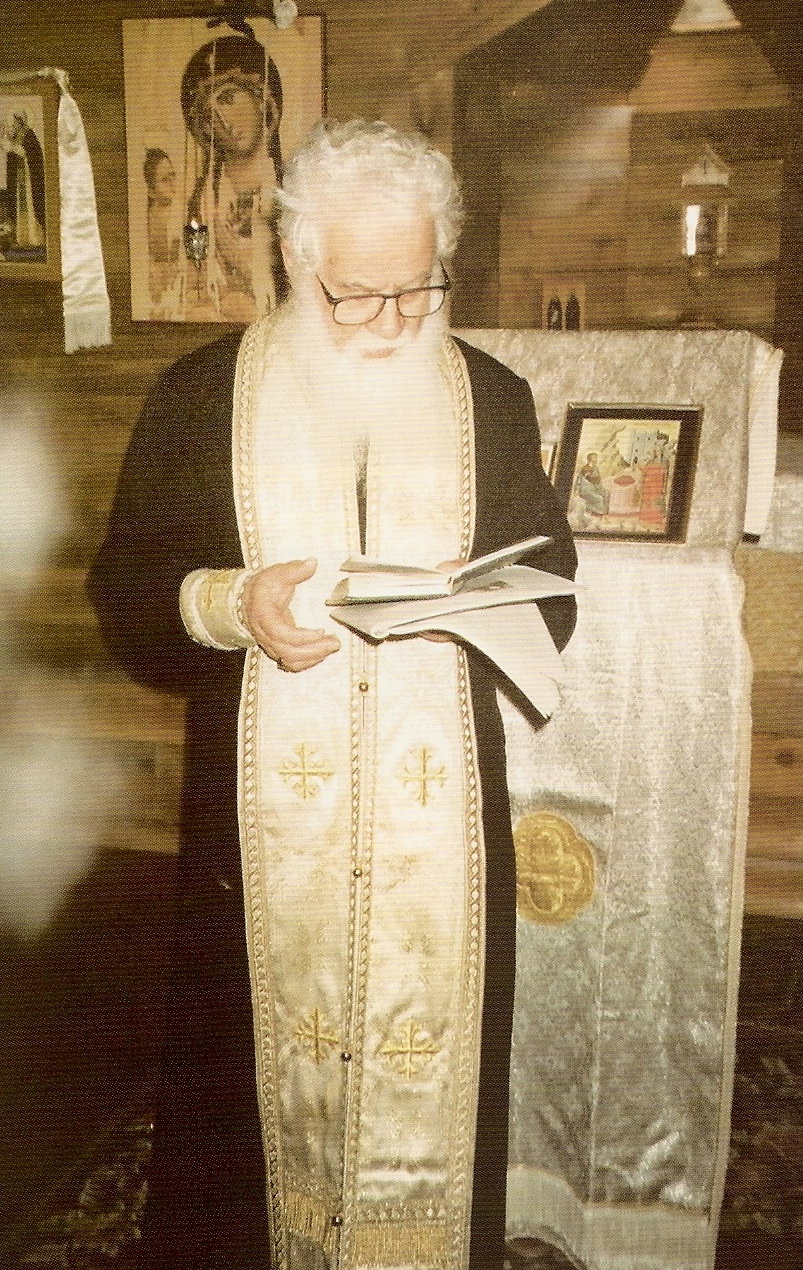
(Fragment from a Sermon delivered by Fr. George in 1999)
Throughout Christian history and its martyrdom either earlier in the Roman times or later in the modern times, this martyrdom takes sometimes violent and other times less violent forms: trials, falsifying the truth, mockery and so on. All these take part in the string of Christian suffering.
We live in a world where Christianity is not too applauded or loved. We live in a world in which modernism, science, libertinism (…) mock (in) Christianity and us. They say that to believe in God means to be mentally retarded, for indeed, those so called semi- docts (and when I say semi-docts I mean people who read a lot… scientists) fail to raise themselves outside the boundaries of intellectual, physical or sensual knowledge. For beyond all these, you ask yourself, is there something else? And they do not ask and know only in part.
Peter Tutea (a Christian philosopher) used to say “all sciences including mathematics reached a high school level, only theology goes beyond and has achieved a license,”… because theology works with things beyond the cognitive and sensory knowledge, it works with the absolute elements of the faith. And I agree with him. That is why, symbolically, he called those people who stayed at the “high school level”: “semi- docts”, because they have no power to know more.
And they do not wish to raise themselves outside this box, because they are the prisoners of their intellect and senses, and the devil holds them back not allowing them to reach God, and because they feared nothing.
It’s not so easy to deny one self and to ascend into the Divine. It is not simple for us to give up some things, (right?): to give up pride, your position, your economic status and to say, “today is Sunday, I will not work and I will go to church; today is a feast day, I’m not going to attend a party, I will go to church, to glorify God” – I can do the rest other days. It’s hard to do these things. (…)
So I am very glad to see you here (in church) and I pray God to keep your heart clean and grounded in faith and despite our infirmities, to be numbered among those who renounce at least a part – of this world so we may receive Christ, to be near Him, to follow the example of St. Stephen and all the great martyrs and in a world where martyrdom is no longer asked of us, we are required at least the courage to confess Christ, to bear the scorn of those who know nothing but what they comprehend with the mind, to bear their shame because we know through faith more than anything: we know God and know Jesus Christ, in our hearts we caved the manger where He was born at Christmas, and we are ready to follow Him to His baptism (Theophany) and beyond, to death on the cross, that we may die with Him and be resurrected with Him! Amen. “
(Translations by EC)
(an OCN radio production)

Inviting Saint Nicholas Into Our Christmas
by Daria Gray and Jan Bear
Every year, Christian parents face a dilemma: what to do about Santa Claus.
He’s everywhere, that “jolly old elf,” hawking tires, toys, and Playboy magazine, sitting in shopping malls taking orders for the latest batteries-not-included whizbang. Although movies about him portray him as someone concerned about the left-out child, his hymnography (think about the words to “Santa Claus Is Coming to Town!”) carries a theology of vengeful justice that is strange to be associated with One who said, “I have not come to call the righteous, but sinners, to repentance” (Luke 5:32).
As a matter of fact, this Santa Claus is not associated with Christ. He may be appropriate to affluent Victorian Christmases with huge candle-laden Christmas trees and middle-class American living rooms (with or without chimneys) where a snack awaits near the comfy chair. But in a stable with the Infant Jesus? They’re from different worlds.
Even the Supreme Court acknowledged the anomaly in Lynch vs. Donnelly (1984), when it ruled that Santa Claus and other secular symbols overcome the religious connection of a crèche in a public display. Santa may have his good points, but he has become our society’s way of keeping a happy winter holiday without facing up to the reality of Christ. So, cut off from the Triune God, the basis of all good, the “good” of Santa is defined by the movies, books, and advertisements that characterize him, and this good is ultimately answerable only to conventional morality. In a commercial society, it’s a commercial “good.”
Another dilemma that parents may find more immediately painful is that every year brings a new decision – whether to maintain the lie of Santa’s existence or to tell children the truth, at the risk of imitating that bah-humbugging (and also fictional) Christmas character, Scrooge.
There is an answer, though: Saint Nicholas, the real Saint Nicholas, a bishop of Myra in Lycea, who died around AD 350.
Romanian Byzantine Christmas Carol
South of the North Pole
No, Myra wasn’t located at the North Pole. It was an important seaport of the early Christian centuries, situated in what is now known as Turkey. Nicholas, a wealthy young man brought up in a godly home, gave away his inheritance to the needy. The young Bishop Nicholas was imprisoned for his faith during the persecutions under the Roman emperor Diocletian, and he was set free when Constantine released the religious prisoners.
One of the most famous legends about his life tells of a poor man who was unable to provide dowries for his three daughters. If he couldn’t get them married, he’d have to sell them into slavery. Hearing of the family’s predicament, Nicholas took a bag (or a sock, as some versions have it) of gold, enough for a dowry, and tossed it into the family’s house through the window (or down the chimney). He repeated his anonymous gift for each of the daughters, enabling the girls to marry.
Another legend says that Saint Nicholas participated in the First Ecumenical Council at Nicea. He was so incensed at some remark of the heretic Arius about Christ and the Theotokos that he punched Arius in the nose. That was considered an inappropriate debating technique, even in that distant time when theology was important enough to fight about, and the leaders of the council took away Nicholas’ bishopric and put him in prison.
Christ and His mother appeared to those leaders, one bearing Nicholas’ omophorion (the stole marked with crosses that he and other bishops of that period wear in iconographic depictions), and the other the book of the Gospel. Taking their meaning, Nicholas’ fellow bishops set him free and returned him to office.
Serbian Christmas Song – Angels are Singing,
verses by Serbian Saint Nikolai Velimirovich
“Saint Nicholas, Hold the Tiller!”
There are many early legends about the miraculous interventions of Saint Nicholas in the lives of those in peril. In one, Bishop Nicholas helped three prisoners wrongly condemned to death. Coming to the scene of their execution, he stopped the executioner and berated the governor until he repented of having taken a bribe to have them killed. Three imperial officers passing through the area learned of these events.
Later, back in Constantinople, these three officers were themselves imprisoned and sentenced to death because of the intrigues of an official in Constantine’s court. Remembering Nicholas’ mercy, the officers prayed to God that through the bishop’s intercession they might be saved. That night, both the unjust official and Constantine himself received a very early visit from Bishop Nicholas, in a dream. The next morning, Constantine and the official agreed to set the officers free.
When sailors in the Christian East bless each other with the words, “May Saint Nicholas hold the tiller!” they are alluding to a story of sailors caught in a terrible storm. Having heard of the holiness and power of the bishop of Myra, these sailors called on his intercession. Nicholas came to them in a vision and took the helm himself and guided the ship into port. When the sailors reached Myra, they went to the Church, where they recognized their mysterious pilot.
Another time, a famine hit Lycea, and ships loaded with wheat came into the harbor on the way from Alexandria to Constantinople. Bishop Nicholas asked the crews to leave some of the wheat for his starving people. The sailors refused at first, afraid of arriving at their destination with less than a full load. At Nicholas’ promise that there would be no trouble, the sailors relented. And even though they left two years’ supply in Myra, the ships were full when they arrived in Constantinople.
Greek Christmas songs
Christmas Carryovers
These and many other acts of virtue (some, indeed, more credible than others) have become Saint Nicholas’ legacy to the Church. His feast day, December 6, goes far back in Christian history – at least to the ninth century, and very likely further than that. And the Church has celebrated his memory in many ways: in processions, in pageants, with special foods – some of which have become American Christmas customs without our even realizing it.
Many of the fun activities that we now associate with the holidays arise from commemorations of Saint Nicholas. Our practice of giving gifts at Christmas time came from the commemoration of the dowries, as well as the gifts of the Magi. The foil-covered chocolate coins that find their way into Christmas stockings are reminiscent of the dowries, as are the stockings themselves. And when we awake to find gifts that arrived anonymously in the night, we can recall the socks full of gold that came through the chimney (or the window) to save the lives of the three young women.
Our hooked candy canes are symbols of the bishop’s crosier. And, early in their history, gingerbread men wore bishops’ robes. The image of Saint Nicholas appeared on Byzantine seals more often than the image of any other person, and stamps are still available to imprint the seal of Saint Nicholas on cookies and other baked goods.
The Spirit of Saint Nicholas
These merriments can save our religious life from a dreary solemnity, but if they’re the whole focus, we’ve missed the point. The more important lesson of Saint Nicholas’ miracles is that he sacrificed to help people in need. And if we look carefully at those miracles, we see that people like the ones he helped are still with us today: The young women about to be sold into slavery? Our cities are full of young people enslaved to drugs, prostitution, and violence. The prisoners? Penitentiary inmates and their families have many needs, which translate into opportunities to serve. The drowning sailors? In many parts of the country, nonprofit organizations provide equipment and rescue teams to save drowning boaters, lost hikers, and snowed-in skiers. The famine in Lycea? We can find hungry people from the downtown of our nearest city to the most remote place in the world.
The more we understand the spirit of Saint Nicholas – the real man behind the myth – the more we can begin to pattern our lives after his godly example. Why should our children’s only glimpse of this saint be that of a phony dime-store Santa with a fake beard, before whom they must wait in line for the opportunity to rehearse their list of Christmas “gimmees”? The real Saint Nicholas has so many wonderful traits around which we all could be patterning our lives.
Instead of spending hours thinking up new and expensive gifts for “Santa” to bring them, many children could clean out their closets of toys they’ve outgrown or grown tired of, passing them on to other children who would be overjoyed to get them. Many adults could do the same with coats and clothes and blankets, sporting goods and books.
Some families might want to return to the ancient practice of giving modest gifts on Saint Nicholas’ feast day, and celebrating Christmas in ways that don’t require a garbage-truckload of wrapping paper. One family we know of anonymously gives five percent of their December income to a needy family. To make the feast of Saint Nicholas a special day, their children give puppet shows with home-made stocking puppets. The parents tell stories about Saint Nicholas to the children and discuss why he is worth imitating. They celebrate December 6 with a festive dinner and decorations.
Some families may wish to give up giving each other gifts altogether for Christmas. Others, though, remembering the model of the Magi and Saint Nicholas, may want to continue to give Christmas gifts, to honor the image of Christ that everyone bears. Remembrance is the key.
Russian Christian Song; Ты с нами Бог – Молодёжный хор
Teaching Our Children
We Americans often lament our lack of roots, the absence of tradition in our lives. And it’s truly a poverty – but it can also be an opportunity. We can look at Saint Nicholas (and other heroes of the faith) and ask, “How can we make this image of Christ tangible to ourselves and our children?” A suburban family will find a different answer than a rural one.
It will take creativity to bring Saint Nicholas to our time, but that can be fun. With a little imagination (and the help of someone who can sew), Dad can trade in that moth-eaten Santa suit for a Saint Nicholas outfit. Families in some places may be able to take a boat ride on the ocean, where the salt air and the swells, even on a calm day, can make it easy to imagine being a frightened sailor with a worthy pilot at the helm. Families or church youth groups can put on plays to illustrate stories of Saint Nicholas’ life.
Children can make a Saint Nicholas bank on his feast day, then collect coins throughout the Nativity fast and feast and give the money to charity.
Or they can make a “wheat candle,” a candle set in a tiny wheat field in a margarine tub, which grows up during the Nativity fast. This little garden commemorates both Saint Nicholas’ response to the famine in Myra and the light and new life in Christ.
These crafts link the Feast of Saint Nicholas and the Nativity of Christ in such a way that each infuses the other with meaning. The ways we find to kindle our children’s imagination today are tomorrow’s traditions – as today’s children, in turn, call the Wonderworker of Myra in Lycea to remembrance for their children.
Choosing the Real Santa
Saint Nicholas models obedience to Christ by feeding the hungry, helping strangers, and caring for prisoners (Matthew 25:34-36). He is an image, an icon, of the Triune God, and that gives his goodness a foundation that challenges every culture. It is not merely the whim of this year’s fashion.
Unlike the mythical Santa running a toy shop far off at the North Pole, Saint Nicholas presents us with an authentic witness of Christian virtue. Instead of beckoning us to join the holiday rat-race, Saint Nicholas calls us to run the great race of faith (II Timothy 4:7). The Church’s traditions can make us aware of this reality by making it tangible, like the twelve stones of Joshua, pointing to the power of God (Joshua 4).
So it’s appropriate, in a way, that the Feast of Saint Nicholas and the Feast of the Nativity have come together in our culture. The Incarnation was God’s arrival among humanity, and Saint Nicholas witnesses to His continued presence among us.
Note from the Authors
For more information about alternative Christmas traditions, read the Sherer family’s Christmas without Santa, available through Alternatives. [See In the Spirit of Saint Nicholas by Mike & Kathe Sherer in OFL! Ed.]
Jan Bear, a news editor and freelance writer, and Matushka Daria Gray, are both members of St. Nicholas Orthodox Church, Portland, OR. Reprinted from …Again, Vol. 13, Iss. 4, pages 13-15.
English: “A Child Was Born”
 Christian Dogma
 Christian Martyrs
 Christian Orthodox Churches and Monasteries
 Christian Sermons and News
 Church's Teachings on Fasting
 Ecumenism – a Great Heresy
 Father George Calciu
 Life_a Sacred Gift form God
 Orthodox Saints and Church Fathers
 Spiritual Elders
 Daily Bible Readings
 Journey to Orthodoxy
 Listen to Ancient Faith Radio
 Orthodox Calendar of Feasts and Saints
 Orthodox Christian Mission Center
 Orthodox Institute
 OrthodoxChristianNetwork TV


Recent Comments