
You are currently browsing the category archive for the ‘Spiritual Elders’ category.
A wish for the New Year: towards eternity…

[…] Towards the eternity we step, my brothers. And now, another year had passed. We welcome a new year. What will it bring us? We do not know.
As for us been dull, we do not know if we will live tomorrow. Unceasingly one has to wait his departure, especially us elders, reaching the sunset of life. But also the young. We do not know “What the present moment will offer “. And I wonder next year, in a day like this, how many of us will still be here living? And what events await our people in the New Year? What will it happen in the Balkans, the Mediterranean and the world? … Are you imagining dreams and envision an endless life? But eternity is approaching my dear; the biggest moment is waiting to rise.
What should I wish you, my dear? Wealth, glory, honors, delights, pleasures? … How meaningless is everything. “Vanity of vanities, all is vanity“ (Ecclesiastes 1, 2). Only one thing remains: your belief in Christ. There is no other name that can give us joy and hope during this coming year, of Whom, children praise and exalt into the ages of ages. Amen!
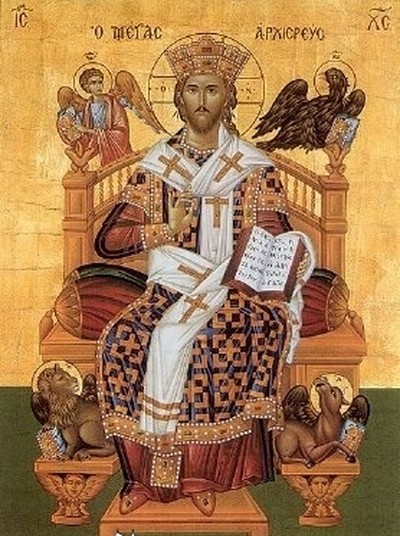
+ Bishop Augustine
(Fragment of a Homily delivered by Metropolitan Augustine of Florida in the Church of St. Panteleimon, Florida, 31.12.1974, during the New Year’ Eve services)
Fragments from a Sermon delivered by Fr. George Calciu on January 1st 2000!

This end of the year – the New Year’ Eve that the world celebrates – not been established or sanctified by the church, cannot be considered sacred, but only a human invention. Do we (Christians) have to celebrate it? Are we to attend the fireworks, the songs and all sorts of scandals, parties? … No.
We praise our Lord in the church. For it is in the church we’re awaiting “the end”. If God would have ordained the end of times tonight, He wouldn’t made His Son’ Nativity at Christmas!
What is the relation between a sacred event and the first of January? Absolutely no connection. And why some say that the end (of the world) is when the world decides – as a new millennium begins – and not when Christ will come? Or at least at the Annunciation!
All these are for the devil’ deceit. The overcrowding of people, the delirium seizing all, the craziness, the fireworks, the drinks, the champagne flowing … I was watching last night what happened in Paris. Someone said that in Rome, where the congregation of the Pope gathered (and I could not understand why he gave blessing to the world and the city on January 1st 2000 when there is no sacred event to celebrate)… we do not know how many millions of bottles of champagne flowed…. And someone else wound announce: more champagne in Paris! Then, more beer in Germany! So, this is the measure of “sanctity” for the New Year!
In general, the beginning of the mundane New Year is something diabolical. It was established by the servants of Satan, to tempt us from the Christian path and the truth of the faith. And our Lord revealed the lies of all. God uncovered the sham of those that wanted to murder a mass crowd of people – I’m referring to the Muslim attacks. God proved the delusion of those who would say Jesus will come tonight so we have to commit murder, suicide, to increase the world’ suffering so God will have “pity on us” and come to end it!
So for the sake of Satan, they proved the deceit. For their inspiration came not from God but from the evil one.
The truth was (here), in the church. Last night we observed Vespers and prayed to the Lord, today we celebrated Divine Liturgy. All those who choose otherwise are far from the Christian truth.

There are people who bare the name of St. Basil the Great and they knew that today is his feast but did not come. We’ve prayed for them, that God will turn their path away from drunkenness and parties and towards Christ, so they may come and celebrate their name in the church. We prayed for those present and those absent for good reasons.
My beloved, I’d like you to know that the life of the church was so striked by worldly prejudices and satanic influences, so as the saints have profesized, there will come a time when churches will be everywhere you look, when the name of Christ will be on everyone’s lips, some churches will even be full, but the true faith and sanctity will be lacking. It will be a false, a deception of Satan. And we live those times […]
(Translation by EC)
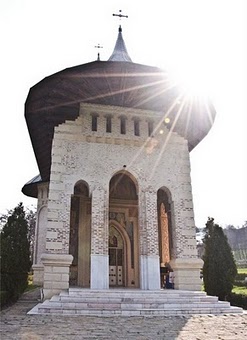
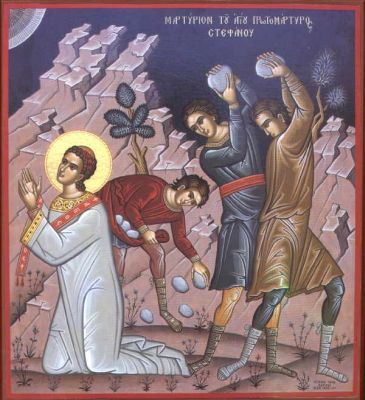
Sermons at the Feast of Archdeacon Stephen the First Martyr
(by Fr George Calciu – 2005)
The Holy Scripture teastifies: “And as they were stoning Stephen, he prayed, “Lord Jesus, receive my spirit.” And he knelt down and cried with a loud voice, “Lord, do not hold this sin against them.” And when he had said this, he fell asleep”(Acts 7, 59-60).
According to the Jewish law of the time, if someone was accused, those witnesses testifying against him had to also be the executors, if a death sentence was set. So, there wasn’t just an outside executioner with no conscience whatsoever and paid for such. In the case of Stephen, the accusers that most likely made use of their Jewish law, had to strip off their clothes, and place them at the feet of a very zealous young Jew, who by being a minor, could not take part in the execution. This young man was named Saul and would later become the Apostle Paul, through conversion. Saul was a persecutor of Christians. And because he could not participate in the stoning of Stephen, he was happy at least to watch the clothes of those who killed Stephen.
I was reflecting on this, making a parallel with what is happening today. If in times of persecution under communism and even in our times, when Christians were denounced to the authorities that convicted and inprisoned them, I thought that those who testified against them were not the executors. If they would have kept the Jewish law – “Those who have testified against him, kill him!” – I think that many would have been hesitat and would avoid to condemn. But because their denouncement was kept anounimously, they seemed to bare no responsibility; and because of this, the human villains and wickedness have multiplied. In this sense, I think that the Jewish law was better: You’ve testified against him, you will be responsible…! And perhaps many people would have given back.
Let us be attentive!
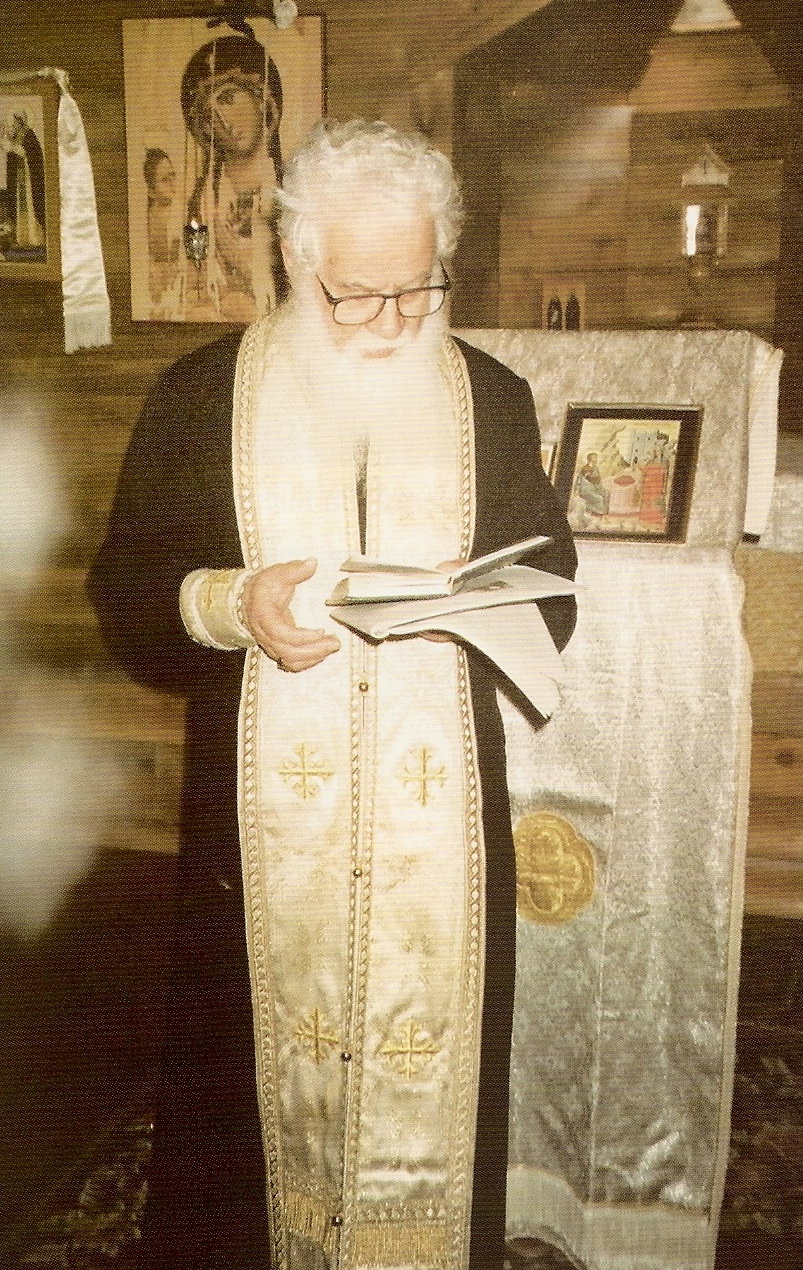
(Fragment from a Sermon delivered by Fr. George in 1999)
Throughout Christian history and its martyrdom either earlier in the Roman times or later in the modern times, this martyrdom takes sometimes violent and other times less violent forms: trials, falsifying the truth, mockery and so on. All these take part in the string of Christian suffering.
We live in a world where Christianity is not too applauded or loved. We live in a world in which modernism, science, libertinism (…) mock (in) Christianity and us. They say that to believe in God means to be mentally retarded, for indeed, those so called semi- docts (and when I say semi-docts I mean people who read a lot… scientists) fail to raise themselves outside the boundaries of intellectual, physical or sensual knowledge. For beyond all these, you ask yourself, is there something else? And they do not ask and know only in part.
Peter Tutea (a Christian philosopher) used to say “all sciences including mathematics reached a high school level, only theology goes beyond and has achieved a license,”… because theology works with things beyond the cognitive and sensory knowledge, it works with the absolute elements of the faith. And I agree with him. That is why, symbolically, he called those people who stayed at the “high school level”: “semi- docts”, because they have no power to know more.
And they do not wish to raise themselves outside this box, because they are the prisoners of their intellect and senses, and the devil holds them back not allowing them to reach God, and because they feared nothing.
It’s not so easy to deny one self and to ascend into the Divine. It is not simple for us to give up some things, (right?): to give up pride, your position, your economic status and to say, “today is Sunday, I will not work and I will go to church; today is a feast day, I’m not going to attend a party, I will go to church, to glorify God” – I can do the rest other days. It’s hard to do these things. (…)
So I am very glad to see you here (in church) and I pray God to keep your heart clean and grounded in faith and despite our infirmities, to be numbered among those who renounce at least a part – of this world so we may receive Christ, to be near Him, to follow the example of St. Stephen and all the great martyrs and in a world where martyrdom is no longer asked of us, we are required at least the courage to confess Christ, to bear the scorn of those who know nothing but what they comprehend with the mind, to bear their shame because we know through faith more than anything: we know God and know Jesus Christ, in our hearts we caved the manger where He was born at Christmas, and we are ready to follow Him to His baptism (Theophany) and beyond, to death on the cross, that we may die with Him and be resurrected with Him! Amen. “
(Translations by EC)
One thing is truthful!
(My beloved) know that our relationship with God is not a joke; know that this whole world with all its civilization is a fad. You closed your eyes forever (when you die – transl. note) and will no longer know about civilization or the endeavors to the Moon or Mars, and so on … All are shadows/hollows; only one thing is truthful: our relationship with Christ, the immortality of our soul and what awaits us beyond death, aiming an eternal torment or the eternal life.
Father George Calciu
On the Priesthood
“What does the priesthood mean? It means to be an enduring witness to human suffering and to take it upon your own shoulders. To be the one who warms the leper at his own breast, the one who gives life to the miserable through the breath from his own mouth. To be a strong comfort to every unfortunate one, even when you yourself are overwhelmed with weakness. To be a ray of shining light to unhappy hearts when your own eyes long ago ceased to see any light. To carry mountains of others’ sufferings on your shoulders, while your own being screams out with the weight of its own suffering. Your flesh will rebel and say, ‘This heroism is absurd, impossible! Where is such a man, where is the priest you describe so that I may put my own suffering on his shoulders?’ Yes, nevertheless, he does exist! From time to time there awakens within us the priest of Christ who, like the Good Samaritan, will kneel down by the side of the man fallen among thieves and, putting him upon his own donkey, will bring him to the Church of Christ for healing. And he will forget himself and comfort you, O man of suffering!”
Father George Calciu
May His Memory Be Eternal!
From the Counsels of Blessed Epiphanios (Theodoropoulos)
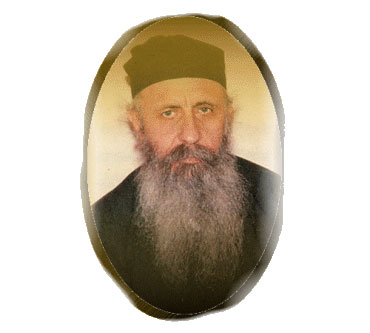
True love is like the flame of a candle. However many candles you light from the flame, the initial flame remains unaffected. It doesn’t lessen at all. And every freshly lit candle has as much flame as the others do.
I want whoever is near me to feel that he has room to breathe, not that he is suffocated. I don’t call anyone to me. I don’t hold onto anyone. I don’t chase anyone away. Whoever wants comes, whoever wants stays, whoever wants leaves. I don’t consider anyone a supporter or a follower.
I am not afraid of death. Not, of course, because of my works, but because I believe in God’s mercy.
Speak more to God about your children than to your children about God…. The soul of the teenager is in a state of an explosion of freedom. For this reason he has a hard time accepting various counsels. So, rather than counseling him continuously and reproaching him now and again, leave the situation to Christ, to the Panaghia (Greek word meaning “All-Holy”. It is perhaps the most beloved term of endearment for the Mother of God in the Greek language) and to the Saints, asking them to bring him to reason.
Don’t be neglectful of prayer! At table, in the morning, afternoon and evening. In particular don’t miss Small Compline for any reason, tired though you may be. It’s a question of self-sacrifice and, in particular, of love. When a beloved person calls you very late at night, how are you able to speak sometimes for a few hours, despite your fatigue, without being put out, but being, rather, pleased?
———-
Deal with your children as with colts, sometimes tightening and other times loosening the bit. When the colt kicks, without abandoning the bit, we loosen it, otherwise it will break. When, however, it is peaceful, then we tighten the bit and take the colt where we like.
———-
Parents should love their children as their children and not as their idols. That is to say, they should love their children as they are and not how they would like them to be-to be like them.
———-
Whoever fears God doesn’t fear anything else.
———-
I am in pain and agonize over the path of the Greek people who are constantly being de-Hellenized, de-Christianized, de-colorized and cut off from their roots, and are losing their identity.
———-
In marriage, abstention solely out of love for God is perfect, “the greatest.”(Elder Epiphanios uses terminology from the grading system at school to make his point. “The greatest” is an “A,” “very good,” is a “B,” etc). When the couple comes together, not obstructing the procreation of children, it is at the level of “very good.” And when they abstain solely to avoid the procreation of children, they are on the level of “good.” In any case all of these categories are above average and are only legitimate with the presupposition that they have been agreed upon by both spouses and not just one. Otherwise it is a sin.
———-
God appointed the salvation of the world to His Son and not to us…. We must first look at our soul and if we can, let’s help five or six people around us.
———-
When someone is free, he has rights and responsibilities. When he marries, he has few rights and very many responsibilities. When, however, he has children, he doesn’t have any rights at all, but only responsibilities.
———-
Why do they put rubber tires with inner tubes on cars? So that they give in, to collapse a little with every little stone or pothole on the road, and in this way they pass obstacles. If the wheels were firm and unyielding, the car wouldn’t be able to move forward. It would fall apart after a short distance because of the vibration from the small inconsistencies of terrain. The same thing happens with yielding to others in the family. In this way many problems are surpassed and continuous spiritual progress is assured.
———-
When people treat us unjustly, God justifies us.
———-
[God allows virtuous people to suffer] so that they might be purified from even the slightest traces of their passions and so that they might receive an even greater crown in Heaven. Furthermore, as He allowed His beloved Son to suffer and to die on the Cross, what can we say for those people who, as holy as they may be, have filth and stains from sin?
———-
Sadness purifies us. Man is truly man in sadness. In joy he is changed, he becomes someone else. In sadness he becomes that which he truly is. And this is the way, par excellence, that he approaches God. He senses his weakness. Many times, when he is in glory and joy, he feels that he is the “eye of the earth” or, if you prefer, the center of the universe: “I am, and nobody else!”
In pain and sadness he feels like an insignificant ant in the universe, that he is completely dependent, and he seeks the help and companionship of God. Those of us who have passed through pains, either psychical or physical, know that we never prayed as hard and with such quality and length, as we did when we were in the bed of pain or when some heavy psychical sadness tested us. While, when we have everything, we forget prayer and fasting, and many things. It is for this reason that God allows pain.
———-
Don’t sit, glued to the television…. Guard yourselves from the means of mass blinding.
We didn’t come here [to the monastery] mainly for handiwork, or for the gardens or for the buildings. For even without these things we can save our soul. We came here primarily for the soul. And in order to save the soul, we must pass the day without sin, with meekness, canon (In this case, the daily rule of prayer, reading, prostrations, and so on, that a monk keeps in his room) and prayer.
———-
I sacrificed everything even before I had anything. I sacrificed a place at the university as a professor. I sacrificed the position of first secretary of the Holy Synod. I sacrificed the position of director of a missionary brotherhood. I sacrificed the position of first priest of a large church. I sacrificed Episcopal (That is, the position of bishop) thrones…. All I have is a little epilrahili (In Greek, literally, “upon the neck.” It is the stole that the priest or bishop wears around his neck when hearing confession (hereafter, “stole”) so as to confess ten souls. Nothing else!
———-
There is no greater satisfaction for me than to remain for hours in the seat of the confessional and to reconcile man to God.
———-
Married and unmarried priests, let us not forget that we are representatives of the gentle and humble-hearted Jesus. We were called to progress in humility and not to quarrel in the holy altar for priority of honor.
Clerics and, in particular, celibate clerics must be chosen from those of a mature age, with excellent education, extreme piety, shining ethos, sterling character and complete spiritual formation: all those things that are acquired with labors and struggles, prayer and study, fasting and vigils, with voluntary poverty and hardships, and through various deprivations. For asceticism is not the privilege or responsibility of monastics alone, but of all the faithful and particularly of clerics, and especially of unmarried clerics. The Orthodox Church is deeply ascetic and those who don’t love asceticism and who are friends of luxury and comfort don’t have a place within Her.
———-
The priest is the incarnation of the absolute, the expression of the constant, stable and unshakeable, the trumpet of Heaven, the image of incorruption, the mile-marker of eternity. May he remain forever unchanged, even in his external appearance, as a reminder and symbol of the ages and of the unchanging truths that he represents.
The priesthood is a very great gift of God toward mankind. It is the conduit of the grace of God.
———-
It seems a blasphemy to me [an archimandrite’s sadness at not having been elected bishop]. If you consider that your shell of a body can take bread and wine and, with the Holy Spirit’s consecration, transform it into the Body and Blood of Christ; that you have been given the power to make the children of Adam partakers of the Cross and resurrection of Christ through baptism, and how you have been given the power to place your hands and your stole over the head of the greatest sinner and to bring him out of confession with a pure and whitened soul, how can you then consider yourself unsuccessful? Because you haven’t put on a mitre? ( ). May God have mercy on us!
———-
I have made an agreement with God: I will empty my pockets in almsgiving and He will fill them. He has never violated our agreement. Will I violate it? May it never happen!
———-
Ah! My fathers, know how much I have ground down my will! I have loved two things in my life: reading and writing, both of which I have been deprived of, and the deprivation of which is as great for me as for him who loses the greatest joy in this world. When I study the Holy Scripture and patristic books, I leave the earth and go to Heaven. As for my own writing, forgive me for what I’m about to say … I get drunk. I see how others desire to write some text, and they erase, write, erase again, write again….
———-
I don’t manage to write my thoughts in time, for I am flooded as with flakes of snow. I feel as though my pen has wings. However, in spite of my writing ability and my desire for study, I deprive myself and sit and pick up the telephone, which rings cons tandy, so as to find a solution to some problem or other. Or else I see people for confession for hours without end, and not only scholars, but also simple and unlettered people. In saying this I don’t undervalue the Mystery of confession as opposed to the work of writing. But the will of God was that I confess people and not that I study and write, though they much enchant me.
———-
How crafty the devil is! To young people who managed to unite in Christian marriage he whispers, “How much better you would be if you went to the monastery and lived the heavenly spiritual pleasures, far from the cares of family life which sever you and keep you down!” While to those who went to the monastery, as they desired the life of virginity in Christ, he whispers, “How much better you would be, if you got married and made your home a temple of God, living the joys of marital life, far from ascetic mortification and the loneliness which depresses you!” And if the married one became a monk and the monk married, he would tell them the opposite. All this to throw the person into despair and to pull him from the path of salvation. For the path of salvation is both blessed marriage and virginity in Christ
———-
The mathematics of God is completely different from the mathematics of humans. For us two and two equal four. For God two and two can make five or fifteen or anyd1ing else.
———-
My heart only has entrances. It doesn’t have exits. Whoever enters remains there. Whatever he may do, I love him the same as I loved him when he first entered into my heart. I pray for him and seek his salvation.
———-
My worst hell is to realize that I have saddened a beloved person.
(Taken from Elder Epiphanios in “Precious Vessels of the Holy Spirit”, Protecting Veil Press)
See Also:
Concerning Miracles
With miracles, the Lord does not give a certificate of correctness of people’s faith. He does them out of love for his creatures.
Οn account of all those who have difficulties with the matter of the Lord’s miracles, Father stressed: When someone accepts the Resurrection of Christ–in other words, that Christ is God-then he can easily explain all the miracles.
Natural Sciences
Natural sciences ί n essence describe and certify. They don’t explain.
The Foolishness is Innumerable
For all the foolishness to be refuted, which is written against Christίanity, the mountains would have to be minds, the trees, pen holders, the sea, ink, and the fields, paper!
Many people write as they smoke and smoke as they write and write whatever the smoke blows.
The Law of Reserves
When you write, my child, do not present all your arguments at first. Keep a few ί n reserves, so that, if there is someone who answers, you can implement the golden «law of reserves. » Thus, you support your positions better.
Bosses
We always have a boss: Either God, or the devil and our passions.
Man has freedom only as regards his choices: Το choose as a boss either Christ or the devil. From there on, the obligations begin both ί n the one case and ί n the other. Many call oppression the obligations of Christianity. We Christίans speak of struggle.
Sin and disbelief
Sin is that which prevents us from believing. Not logic. For this reason, if you tell an unbeliever to live for six months according to the ethics of the Gospel, and he does it, he will become a believer without even realizing it
«God does not exist» is usually said by people who are lewd and unethical. There has not been found nor will there be found an ethical, continent, virtuous, etc. man who will rather easily say: «God does not exist! »
What is Faith?
Faith and trust ί n God are not for you to say in the morning, « Ι believe that ί n a little while the sun will dawn. »
That is merely trust ί n the functioning of natural law and not ί n God. Faith is when, at a time when everything shows that the sun is being led to its setting, you say, « Α little more and the sun will be ί n the middle of the sky, » if the Lord has thus promised.
A Silencing Answer
Once, Father mentioned the following anecdote:
Α certain scholar, after quite a bit of argumentation to prove that God does not exist, said:
«If God exists, let him kill me this instant! » And because, of course, nothing happened, he continued: « You see? If He existed he would have killed me. » Then, an elderly lady told him: «Do you have children? » « Υes, » he answered. «How many? » «Three. » «Are they well behaved? » «Well, not all of them . . . the two listen to me, but the third . . . . » « Ιn other words? » asked the lady. «Well, » said the scholar, «he talks back to me; he doesn’t listen to what Ι tell him, he acts wayward . . . . » «Well then, you should kill him! » the lady told him. « My child? » the scholar said, amazed. «Oh, so there, hah! So, if you do not want to kill your child, how then do you imagine that God would kill you who loves you incomparably more than you love your child? »
He Would Sell Lemons!
Once, a certain father (who was strongly materialistίc) of one of the Elder’s spiritual children visited him to complain that he was exerting an «unacceptable» influence up ο n his son. At one moment, furthermore, he said, smiling mockingly at the Elder: «And don’t tell me, Father Epiphanios, that you, such a smart man, believe the things about Christ, Paradise, Hell, etc. » Then, the Elder got up automatically, set his politeness and meekness aside and, with a loud voice, told him: «Listen, Mister! If Ι did not believe all these things, Ι would prefer to be selling lemons at Omonia, rather than to be fooling you! Ι would prefer to be a completely illiterate labourer, rather than a lettered liar! » After this, the visitor departed with his head bowed . . . .
«God come to find me! »
Once, the Elder visited a certain, Spίritual child of his who was ί ll. There were also some other visitors, among whom was also a certain atheist doctor. After a little while, the conversation turned to religious topics and lasted quite a while. Ι n the end, the Elder addressed the doctor: « My doctor, despite your objections, Ι discern in the depth of your soul a good will and disposition. Without being a prophet, Ι believe that God will not leave you. Ι would like to submit to you one request. Would it be difficult, once a day, to say the following small expression: ‘God, if you exist, come to find me!’? Ι think it will not cost you anything nor does it clash with your conscience. » He accepted. Α few months later, the doctor diagnosed ίn himself neoplasm of the bones, in other words: cancer. He departed abroad. There, the doctors advised him to return to Greece, because it was a rapidly spreading form of cancer and he was quickly approaching his end. Before taking the return road home, he asked to confess and commune. He died ί n repentance a little whίle after his return to Greece.
Nature Doesn’t Recognize Justice
The Elder said: Professor Louvaris formulated ίn a first form the following argument, whose strength Ι have experienced ίn conversations: Marxists proclaim that there exists nothing beyond matter, and natural laws govern everything. However, nature knows οnly the law of strength. The laws of love, compassion and justice are unknown to it. Based ο n this logic, the fate of the lamb is for the wolf to eat it and for the rich person to oppress the poor person without ethical responsibility. Οnly the acceptance of ethical laws, after the rejection of materialίsm can justify the demand for social justice.
There Exists a Solution and You Foolishly Reject It!
Once, a lawyer who met the Elder for the first time asked him about reincarnation. Father Epiphanios answered him. After a lengthy Ρeriοd of discussion, the lawyer insisted on contίnuing on the same subject. So, the Elder said to him: « All right, but don’t you pity your time dealίng with these things? ». «Is it evil, Father? » « Νο, my lίttle child, it is not evil in the sense that you are researching a topic, but you are wasting your time in vain. » « Ι like searching. » «How old are you? » «About forty. » «So, you are forty years and you are still searching? And when will you settle? And after you settle, will you then have years before you ί n which to regulate your life ί n accordance with your settled convictions? Life is very short and leaves quickly! Υou can’t make searching the aim of your life. Υou must, of course, settle somewhere. » «Father, Ι don’t accept the approach ‘believe and don’t research’! » «But Ι am not telling you not to research. Ι am simply telling you that sometime you have to settle somewhere. Υou are already late. » After a little while, the lawyer departed and the Elder commented: «Do you know what it is for your tongue to have dried up from thirst, to have a little spring next to you and yet not approach it to be refreshed, but instead settle for swampy waters? Do you know what it is to tremble from the cold, for the fire to be next to you and for you not to extend your hands to get warm? Miserable people! »
(From the Life and Teachings of Father Epiphanios; taken from «ORHODOX KYPSELI » Publications)
Elder Paisie of Sihastria, a Testament of Divine Love

See also: The Life Of Elder Paisios of Sihastria and of Sihla
From the teachings of Elder Paisius
(Taken from “The Orthodox Word” No. 272, 2010)
ON PRAYER
(The first eleven sections of these teachings have been transcribed from a recording of a talk that Elder Paisius had with a nun, at which other women were present. For this reason the elder sometimes uses a singular address and sometimes a plural)
Any prayer is a gift from God. And we, the weakest, have prayer of the lips. For the time being, we fulfill this, my dear. The well is deep, but the rope is short and the bucket is small. In the morning read the Akathist to the Mother of God and in the evening read her Paraclesis (a supplicatory service to the Mother of God, including the canon to her) the Creed-unfailingly, at least once a day-and Psalm So, two to three times a day. Of course, this rule is voluntary. “Our Father” -without number. “Lord Jesus” (the Jesus Prayer: “Lord Jesus Christ, Son of God, have mercy on me, a sinner) without number. Prostrations-without number. Each one does what he can, just as the bee does not take all the nectar from the flower. But it’s very good if you do a little rule. I know this myself: if! get up and do a little of my rule, it seems as if I’m a different man all day long. But if you get up in the morning and you whirl around the house-because you have this and that to do-then your whole day goes poorly. So do a little of your rule every day, like the righteous Job, who offered sacrifice every day for his children in case they had sinned in their thoughts (cf Job 1:5).
Every day you should do as many prostrations to the Mother of God as you can-at least twelve prostrations-and at each prostration say this, like an old woman: “Mother of God, do not leave me … do not leave me, Sweet Mother of God.” Do not forget the Mother of God, my dear, do not forget her, because our dear Mother is so very good. So, my dear, don’t abandon prayer.. .. Do one more prostration, read one more psalm, say another “Lord Jesus” …. You must do a little bit of a rule, because a dirty shirt is not washed only with water-you must also have soap and something stronger to clean it.
And if you say the Jesus Prayer one hundred times, at least ten times out of the hundred it will be said with real meaning. When you talk with someone, you do not speak without your mind. It should be even more so when you speak with God! That’s what Fr. Daniel taught me: “0 Paisius, brother, don’t let your thoughts leave your cell!”
Thoughts will still come, but don’t talk with them. Don’t pay heed to them. Seek to have your mind occupied with prayer all the time; say “Lord Jesus” all the time. Become accustomed to saying this prayer all the time, and for every Akathist or Paraclesis unread every day, do twenty-four prostrations-at least that many …. Now, at midnight, here at Sihla (and at Sihastria) there is vigil. Try to get up, make the sign of the Cross three times, say “0 Heavenly King;’ “Our Father;’ and whatever else you know, do twenty-four prostrations-and it will count as if you had attended the whole vigil.
When we cannot weep in prayer, this is also for our humility, my dear, so that we will humble ourselves. We do not necessarily need to sob. A sacrifice unto God is a broken spirit; a heart that is broken and humbled God will not despise. (Ps. 50:17)
The devil too can sometimes help you weep, so that afterwards you’ll become prideful and be lost. A woman came here once and said to me, “Father, I do one hundred prostrations every day.” But she had been doing it without a blessing. And so I said to her, “From now on, don’t do one hundred but do only twenty-four prostrations each day. You have a blessing only for that.” And she came to me a month later, crying, and said to me, “Father, I was not able to do those twenty-four prostrations each day. I don’t know what happened, but I can’t do them-I, who had been doing one hundred prostrations, which were very easy for me to do, was not able even for one day to do the twenty-four prostrations that you gave me to do.” Do you see? A fight with the enemy occurred, because these were done with a blessing. When she had done the one hundred, she was doing them with a little pride.
Thus, do everything with the blessing of your spiritual father. Go to your spiritual father where you live and ask him to give you a rule of prayer. He will then know your rule of prayer and how much he has blessed you to do. Do what he gives you, as you have a blessing for that. It’s also good to ask for counsel and a blessing for any good deed you wish to do, such as fasting for a day. Everything you do, perform with the blessing of your spiritual father, my dear, so that the enemy may not gain power over your labor.
On Unbelief and Doubt
What do you mean you don’t believe? Hold your tongue! Who is it that brought you to the monastery? These are the thoughts of the devil. Why do you listen to what the enemy says? The devil’s aim is to make people doubt and believe that there is no God. Because if there is no God, then neither is there any sin, and people can do anything. Doubt is halfway to the renunciation of God; that is why the devil tempts us. The Savior says that the days will come-and, look, they have come (cf Luke 18:8). Some people say that man was made from an ape. It was a madman who said this; man is the image and likeness of God.
Even Jesus was tempted. Satan first said to him thus, Command that these stones be made bread (Matt, 4:3). The Scripture says: “bread” [plural], and not “bread” [singular] in order to show the first temptation of the devil is the temptation of the belly-of luxury, clothes, etc. Then he said to Him: Cast Thyself down [from the temple] for it is written, He shall give His angels charge concerning Thee and in their hands they shall bear Thee up (Matt. 4:6). This is sectarian pride, because the sectarians are constantly saying, “It is written …. ” And the third temptation was, All these things will I give Thee, if Thou wilt fill down and worship me (Matt. 4:9). This is the temptation that the atheists fall into; this is atheism. But Christ was victorious over all these temptations, in order to show us that we too can be victorious.
Don’t allow yourself to be tempted, my dear, since this is from the devil. So what if you don’t sense the fragrance from the holy relics? Ponder upon the deeds of the saint, on his life. Sometimes when I have received the great and holy Chrism (Holy Chrism is made from a special recipe that includes numerous fragrances. It is consecrated on Great Thursday by the Patriarch or chief hierarch of a Local Church, and is used by priests in the Sacrament of Chrismation.- TRANS), it didn’t have a fragrance. Have faith, my dear.
Once there were two old men, and they wanted to go to Jerusalem.
One became sick on the road and went back. The other went further on, but the ship broke into pieces and he lost everything, and so he too had to return. But he remembered that his companion had strongly entreated him to bring him a piece of wood from the Holy Cross. Then, out of love for the sick man, he tore a piece of wood from the ship and returned home with it. He went to the house of the sick man, and he didn’t tell him what had happened to him or that he hadn’t made it to Jerusalem. And that one asked him, “Did you bring me a piece of wood from the Holy Cross?” “Yes.” And he gave him the piece of wood from the ship. And the sick man venerated and kissed it with so much faith that he was made welL And many miracles were performed with that little piece of wood from the ship on all who thought it was wood from the Holy Cross. Look at what faith does. He who has undoubting faith has been saved, is being saved, and will be saved!
ON DESPONDENCY
What is this about despair and despondency? Despondency, despair-this is the greatest sin. Don’t say, “I won’t be saved, I’m praying in vain.” No, say, “Where are these thoughts coming from? Oh, no.
With the help of our dear Mother of God, I will be saved.” The door of Paradise is open, my dear, if we want to enter; God does not force anyone. He may sometimes drag someone in-by sending an illness or a difficulty, but God loves him who gives willingly.
Perhaps it is written somewhere: “Any sin is forgiven, but blasphemy against the Holy Spirit is never forgiven” (cf Matt. 12:31). But, is it your thought? No! It’s his blasphemy, the enemy’s. (St. John Climacus writes concerning blasphemous thoughts, i.e., thoughts against that which is holy: “If you have blasphemous thoughts, do not think that you are to blame. God knows what is in our hearts and He knows that ideas of this kind come not from us but from our enemies [the demons]” (Ladder of Divine Ascent, step 23)·-ED). The devil does this-he gives you blasphemous thoughts in order to bring you to despair, and then he also reminds you that blasphemy against the Holy Spirit is never forgiven. No, my dear, it’s his blasphemy. And you come to Confession and tell what came into your mind: “Father, I have blasphemous thoughts, I have profane thoughts about the Mother of God, about God, about icons, about monks, about priests …. ” Thoughts must be revealed in a timely manner. What is this despair? Come, reveal it and raise yourself again. Confession is a second baptism. Through the mystery of Confession we raise ourselves again. And do this all the time: fall and get up …. Don’t let yourself stay in despair.
How is it possible that you don’t love God? These are thoughts of the devil. Be quiet! What do you mean you don’t believe? Who brought you here to the monastery? Why do you listen to what the enemy says? And why will you not be saved? No, my dear, stop it-with the help of the Mother of God, we will be saved. Because if we were able to accomplish everything [on our own], we’d become prideful and would be even worse: “I have mental prayer, I give alms …. ” But if you see that you can’t do it, then you humble yourself more. The power of God is perfected in weakness (cf. II Cor. 12:9). Do everything that depends on you. Pray more, confess more, go to church more often, partake of Holy Communion more often, at least every month …. And do not be afraid, because you will not go to hell. Fast on Fridays until you are hungry. Read another [spiritual] book. Always say the Jesus Prayer and don’t forget the Mother of God. And take this notebook of mine that I compiled for the benefit of him who wants to imitate Christ. Examine it, study it. It’s like a confession. It teaches you what to do and how to do it. And do everything that depends on you.
So, my dear, let us from now on make a good beginning. We live with hope in the life beyond the grave. When I was a child, my mother would tell me, “We will fast, my dear child, and after the fast is ended, you’ll see red eggs and cheese and stuffed cabbage leaves …. ” It’s still like that. We fast while contemplating what we will eat after the fast has ended.
Sihastria Monastery
On NOT CONDEMNING OUR NEIGHBOR
May you not judge anyone, my dear. It’s a great sin for you to judge.
When you see someone that has sinned, be merciful to him: “0 Lord, the poor thing, look what the devil did to him;’ … and don’t judge anyone. And see everyone the same-don’t say that one is better and another is not as good. Don’t condemn anyone. See everyone as better than yourself And don’t care what others do; take heed to what you do.
There was a brother named Coprius who, seeing that he was unable to fight with heretics, began to pray: “Lord, take so and so from off the earth, because, look, he does so much evil; he is a stumbling block to so many people.” And thus he would pray continually. And one night he dreamt that Jesus descended from the Cross and turned His cheek toward Coprius and said to him, “Strike me, Coprius, strike me …. If I am ready to crucify Myself a second time for this soul, why are you praying for Me to kill him?” So, do you see how things are, my dear?
ON ALMSIVING
Do you have compassion for the poor? Don’t pass judgment on them, my dear. If you can, help them. And even if you don’t give them money, have pity on them. But if you have it, give it. Give alms by works or by word. Do both if you can. Don’t give them too much, so that you end up regretting it. But don’t ever judge them: “If I give to them, do you think I give to them out of compassion? I give to them in order to get rid of them.” And if you give, flee as much as you can from pride. Don’t think: “Well, isn’t my deed great?” There were saints who gave even the clothes off their backs. So we really never do anything great.
Almsgiving must be done in secret. You can also go about in luxurious clothing and give alms so that no one knows.
There are saints in our days who did their good deeds without others knowing. They made St. Jacob (Elder Paisius is speaking of St. John Jacob the Romanian of the Holy Land. He was a monk of Neamts Monastery who went to the Holy Land in 1936 and remained there for the rest of his life. For the last eight years of his life, he labored in the cave of St. Anna, together with one disciple, and reposed on August 5/18, 1960. Twenty years later his relics were found to be incorrupt and he was glorified as a saint. His relics were then brought to the Monastery of St. George the Chozebite, where pilgrims frequently come to venerate them.-ED) sell wine in a tavern, and when someone would come in to buy a drink, the saint would say to him, “Don’t buy so much-buy a little less; you have children waiting for you at home.” Twenty years after his repose, when they dug him up, his clothes and footwear were just as they were when they had buried him. His beard and hair were the same; they even combed it. And no one had known until then. Do you understand? …
Of course, those who have husbands, families, and children must first take care of their own household, and only after they have provided for them should they give alms. The one who gives alms to others-to strangers-and lets his own children go hungry and shiver from the cold, that one does not give alms for God, but for human glory so that people will say, “Why, look how compassionate he is! Look-he gave everything, he sold everything!” Take care of your own family first, and then take care of others. Thus say the canons, thus says the Bible.
ON HUMILITY
An old man once asked me, “Fr. Paisius, what is pride, and how does it come?” (This man wandered about in winter, barefoot in the snow with his head uncovered.) “Brother George, pride is when you consider yourself something more than another, that you are better, nicer than another.. .. ” “Poor me, Fr. Paisius, do I have anything good?” He stayed eight years with me … Fr. Gennadius Avatamanitei. And he had poor eyesight, like me.
Look, this is pride: when you consider that you know more than another, that you can do something better than another. This is pride. And it’s very dangerous, because God does not like this pride. If you consider that you know more, that you’re more capable, that you can do more, take care that you don’t become like the man who pondered on all that he was able to accomplish, on the things that he could set aright, and on his fasting, while the one near the door wept and beat his chest because he had done nothing good. That one near the door obtained more than the one who thought to himself that he was something. This is the story of the Publican and the Pharisee (cf. Luke 18:10-14).
For the Savior says, When ye shall have done all those things which are commanded you, say, we are unprofitable servants: we have done that which was our duty to do (Luke 10:17).
No matter how many times you get angry, anger will not bring about God’s righteousness. When you get angry, know that there is the spirit of rebellion, the spirit of pride, and the spirit of vainglory. It urges you not to humble yourself but to think: “Why, I’m not so bad after all!”
You see, I can say about myself: “Listen, my good men, I am more sinful, stupid, and wicked than any other person.” But if someone starts to call me stupid and ugly, just see how puffed up and angry with him I become. “What is that to you? Why are you concerned with me?” And so on. So, is this humility? When another person insults you and humbles you against your will, then see if you can say: “He had to do this to me-he had to-God commanded him to do this because I have insulted someone else.” This is true humility; not when I myself say that I’m stupid. When another person insults you, then prove your humility and quickly say, “God commanded him to insult me.” When someone takes something from you by force, say, “God commanded him to take it from me because I have also taken from someone else.” When someone forces you to move from one place to another, say, “God has changed my location in order to change my bad habits and ways.” This would be true humility. If someone asks for your coat, give him also your shirt. If someone hits you on your right side, turn to him the other also (cf. Matt. 5:39-40, Luke 6:29). See if you can do this, because we must follow the commandments of Christ. But if someone hits us across the face and we turn around and hit him back four times, we have returned to him fourfold, and we have not followed Christ’s commandment.
When I was younger, the abbot put me to the test. Once he kicked me out of the church. I had been singing in the choir, and I had sung in my own way, “Jesus, Son of God, have mercy on me;’ and it seemed to me that I sang so beautifully. I had become prideful in my heart. And one time the abbot came in, and when he heard me he gave me a jab in the ribs and said: “Get outside! Get out, you donkey, what is this bellowing?” I thought I was singing so nicely, and then look what I experienced. And I think to myself even now: 0 insidious pride, how it clings to all the seams!
A young man once came to me here. He was of a somewhat delicate appearance. He had come from Bucharest to ask me, “Are you Fr. Paisius?” Well, I answered him, “There may be others, too-I can’t be the only one.” And he said: “I have heard about you, and I came to see you.” Then I said to him this word:
Do not believe all that you hear.
Do not do all that you can.
Do not say all that you know.
Do not give all that you have.
Woe to that man who receives praise that exceeds his life and deeds.
Humility springs forth out of love, because if you love someone you don’t upbraid him so that he’s disgusted with himself. You don’t get angry with him so that he languishes, because if you get someone angry, the poor thing can’t even eat, pray, or sleep. Therefore, make sure that in no way do you anger anyone. But it’s impossible to never anger anyone! Perhaps without realizing it, you’ve said a troubling word. So, when you meet the one you’ve angered, immediately make a bow to him, “Forgive me, my dear, for angering you.” And when you’ve said, “Forgive me;’ all the anger goes away at once. It’s completely broken, nothing at all remains. And when the devil looks there, he sees that he was fooled. There’s nothing written there anymore.
Never even think of pleasing men. To be dishonored by men-this is good. And what if people say that you have sins? Don’t you? We must endure insults, my dear, because the Savior Christ praised us for this:
Blessed are ye) when men shall revile you) and persecute you) and shall say all manner of evil against you falsely for My sake (Matt. 5:11). We must endure everything with humility, my dear, endure with humility for the love of Christ, so we can just win not all of Paradise but only a little corner, however small.
Humility seems difficult to you, my dear. But try to lift the rock first and only then say, “I can’t.” Humility of heart springs forth from the love for God, my dear.
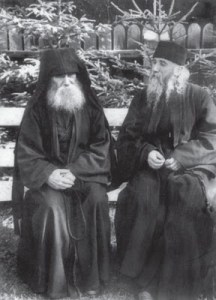
[Elder Paisius (Olaru) with Elder Cleopa (Ilie) on right]
ON OBEDIENCE AND LOVE
Obedience-this is of great benefit, my dear. That is, it’s of great benefit not to do your own will. In a monastery you must never do your own will. Say, for example, that you want to rest a little, but it’s not possible-just then you’re called to an obedience. You want to pray, but you’re called to leave your prayer and go. So you have to cut off your own will. But if you go to your obedience and say in your mind, “My, my, see how the enemy put it into his mind to call me, just as I wanted to pray a little-and it just wasn’t possible;’ then He does not receive your prayer, because you reproached the one who called you.
Obedience with love, my dear.
Come to me occasionally, when you’re in the neighborhood. But you should have your regular confessor there, so you can confess more often and partake of Holy Communion as often as he allows you. Heed your confessor, my dear. Follow where he leads you. And don’t go about from confessor to confessor, because what one gives you, the other will take away. But obey your confessor as if he were God.
Oh, how much the abbot tested me to see ifI would obey. Sometimes he would confuse me as only he knew how. I didn’t know what work to do, and he said, “Do this;’ and so I did it. Then he said to me, “Now, this isn’t good. Why did you do it?” He had asked me to do it, and then he asked me why I had done it! Indeed, he would sometimes pick at me, give me a little poke in the ribs ….
ON DEATH
The best teacher for us is death. There was a song: “The Song of the Blind Man.” A blind man would play on the fiddle and sing. He was from Pipirig,7 but he has since died. I heard him sing the song, and I liked it. Would you also consider my song? Here it is:
Death, pitiless death,
You take all from the house,
Whether they be young or old,
Whether they be servant or master,
Whether they be masters of the earth,
You prepare them for the tomb.
Even if he lives quite well,
No one escapes you.
To some you come while they are riding in their car,
To others while weeding the garden,
And to some you come
And stop their heart.
After all,
You come to all for a reason,
And sometimes even without a reason.
You just come and take
Whomever and however you please.
O death, I beg you with tears,
If you are to come to me soon,
Please do not come angrily,
To cut me with your scythe,
Nor put in my glass
Some of your bitter medicine,
But come with a little hammer
And sever me slowly
From head to toe,
So as to heal the wound that hurts.
For your medicine is good,
Too good for words to say.
And your little hammer is holy,
Because it parts me from this earth.
So, death, be good
And comfort me with your hand,
And your mouth, which is forever sweet.
Allow me to sign myself with the sign of the Cross,
So that with my lips I can say
My last prayer,
And with my eyes
Shed many tears,
So as to wet my cheeks
And wash away my sins
With which I have angered the Lord.
And so, with many tears I ask,
Mother of God, help me
To separate myself easily from my body
And to die in peace.
And may the angel of Christ
Show himself joyfully to me
And say, “Come, my dear,
Let me take you to God.” Amen.
Well, now, all of this is my song. I’d like it to be remembered, for it’s not at all easy to live, and it’s so very difficult to die. Those who have died forgot their whole life, and at the hour of death they only remembered what they had done wrong. This was all that remained before their eyes.
There was a man who was hiding under the table, under the bed.
He kept saying, “Don’t leave me, Fr. Paisius, don’t leave me!” “What can I do for you, my dear?” I would say. When I tried to take him out from under there, he would move to the other side. “Don’t leave me, Fr. Paisius!” he kept saying. “What can I give you, my dear-a little piece of sugar?” “No.” “Some candy?” “No.” “Some medicine?” “No.” He was asking for something else. He was asking for something that he should have prepared during his life. And when he died-God forgive him-it wasn’t even warm weather, bur we weren’t able to keep his body in church. They took him outside. They said the prayers for the dead outside. He stayed outside for three days. All the fluids flowed out from his body. Everything, everything flowed out, and it smelled from far away …. There you have it.
My dear daughter, it’s no joke. If we had the fear of death always in our mind, that is, the awareness that at any moment we could die, we would not be able to sin so easily. When the thought of something foolish would come into your mind, by remembering your death you would stop yourself immediately, saying: “God forbid-what if death should take me right now? What would I do?” You’ve seen what the Savior Christ says: “In whatever state I find you when your end comes, in that I will judge you.”(This quotation is taken from the Conversation with Trypho, a ]ew, chap. 47, by St. Justin Mart yr.-ED). If you ponder your death, you’ll immediately stop any sin that comes into your mind. Has it come into your mind to steal? Say to yourself, “No, this is a sin; what if death were to come now?” If you are about to hit someone, say to yourself, “No, it will hurt him, and that’s a sin. What if the Lord calls me now, and I don’t have time to reconcile myself?” It’s said that death is the best teacher, which stops you from all sins.
For this, dear brother,
Whether you will live a long or short life,
Throughout your life never forget,
Do not forget that you will die.
“Do not forget that you will die.” “What if death finds me now when I’ve done something foolish, or thought or said something bad, or am in a quarrel with someone?” And so it is. The immediate thought of death restrains you. “Oh my, if I die in that state …. I’ll certainly no longer steal and no longer quarrel, so that I won’t die in enmity:’ Because however death finds you, that’s how you’ll be judged …
The old blind man continues to sing:
Death knocks at the window,
And I am not prepared.
Even from their swaddling bands,
Babes are destined to die.
After they grow a little,
They are even more comely,
But they are not spared from death.
Youth is also like a Bower
That soon falls onto the road,
Young today, and tomorrow he dies
From a merciless illness.
And old age, my dear brother,
Like a hoarfrost from the east, Always ready to die
And to breathe his last.
For this, dear brother,
Whether you live a long or short life,
Never forget that you will die.
The idea is this: We’re all subject to sin, and if we have a healthy conscience, the moment we bring to mind that we’ve done something bad, immediately our conscience reproaches us. Or, when the enemy puts it into your mind to do something foolish, a healthy conscience immediately brings to your mind that you will die and you stop yourself:
“I may die this very hour … ”
Therefore, being subject to sin and death, we know that we must give up our life immediately whenever the Lord asks it of us, and then the end will come. And if our end is unforeseen, then we should be ready for it all the time. We should have just confessed, and we should be at peace with everyone. We should not somehow pass through life without thinking of death, and then allow death to find us unprepared. Because if you remember your death, you’ll receive much greater benefit, and you’ll humble yourself, thinking to yourself that you’re not eternal on earth, but quickly passing ….
It’s very difficult for a person who avoids Confession until the end of his life, until the moment of death. What can you say when death comes? What can you take with you? Because you don’t have anything you can take ….
When the Russians came in 1944, I was home at Cozancea Skete, and suddenly I heard someone yell, “Oh dear! The Russians are coming!” We couldn’t believe it. We thought to ourselves: “Well then, good men, aren’t these Romanians of ours awfully stupid, letting them come freely here from the Nistru9 River? Isn’t our border on the Nistru? And they couldn’t stop them?” Well, just as I went out to get water, I met the army which had come from the Prut River. “Well, ‘priest: why haven’t you left? We’ll put your head on a stick, ‘priest.'”
Good people, what was I to do? I was about twenty kilometers from the Nistru. I took the pail of water, and I quickly went home. What should I take with me? How should I depart? I needed one change of clothes … I needed a book … I needed the Psalter … I needed the Horologian. I had already filled a shepherd’s bag, but I also needed a blanket. What would I do if I had to sleep on the road? So I put a blanket in the bag. After I had filled two shepherd’s bags the old man, Gennadius, who was staying with me, was watching me prepare to depart, but he didn’t know where I was going. Suddenly I hurled both bags into a corner and, that’s it, I calmed down. I decided not to go. Others left, scattering to the four winds, but Gennadius and I remained. By the next morning, the Russians had filled the whole courtyard. When I came with the key to the church, they were standing there in front of it. They had built a big fire. They had put a cauldron on the fire and a cow into the cauldron, and they were all standing around it. They were all ripping off pieces of the cow and eating it, but most of it was still raw meat. They got hold of me and asked me for vodka. They’d go about looking for women and drink. They would do whatever they pleased. I said to them, “There are no women here. There are only monks here.” They asked, “What are monks?” I said, “This is a monastery.” I also began to tell some lies. I said, “This is a collective farm; here everyone eats together at one table.” Then they asked me, “So, where is the boss?” I said, “He ran away.” They said, “Don’t worry, we’ll catch him.”
They were there for almost a half a year. We submitted to them, and for a time they also learned from us. We also learned from them. Then they took everything that they liked and left. They were planning to go to Berlin.
There you have it, dear one. That’s how it was, my dear.
So, my daughter, for the man who leaves Confession to the moment of his death, it’s like this: “I’m now on the brink of departure and I look here and there to see what I can take with me. Look, I hardly have anything to take.” We must confess and prepare ourselves at all times and in good time, so when the hour comes for us to die we may have our bags packed and ready, tied up at the door. We must be ready to just snatch them and go when our time unexpectedly comes. There is no time for packing when death comes, dear, just as there wasn’t any time for us when the Russians were at the door back in 1944. At the moment of death, you can no longer do it, my dear. Then it’s no longer possible for anybody to prepare. No, my dear, no packing is possible then.
There was an old woman – Catrina was her name. And she would talk about death like we’re talking now, “Holy Death, please tell me when you’ll take me, so that I can prepare myself, Holy Death.” She was always talking like that. One day you would hear her addressing Holy Death, and the next day as well. She would always be speaking about death, but she didn’t see it coming. Then one day, death appeared, saying, “Come on, Catrina. Are you ready? Come on, because I’ve come to take you:’ “Oh, poor me! 0 Holy Death, I’ve asked you for such a long time now to come and tell me when you wanted to take me! I wanted to be told in advance. Why didn’t you come, Holy Death, to tell me?” And death replied, “What do you mean I didn’t come, Catrina? Wasn’t your ear hurting you for a while?” “Well, yes, it hurt me … ” “Wasn’t your head aching, Catrina?” “Why, yes!” “And what about you heart and your feet, Catrina?” “Yes, they hurt me, too.” “Well, that pain was me, Catrina, telling you to prepare yourself, that I would come soon to take you.” “Yes, well, is that the way you were speaking to me, Holy Death?” “That’s the way I know how to speak, Catrina … ” And he took Catrina. So you see, that’s how death speaks with us. It’s just like when you’re guilty of a crime-you’ve committed some foolish act. Before you’re taken to prison, a summons is first sent to you and, after that, a citation, and then follows a warrant-and then, that’s it.. .. It takes you, and it no longer leaves you alone. The summons is a twinge in the side so that you’ll prepare yourself to go confess to a spiritual father. The citation is another pain, so that you’ll receive Communion. And when the warrant comes, it won’t let you go …. That’s it! ”I’m taking you whether you’re ready or not!” “God reward you that I was made ready …. I’m finished. Come on …. ” That’s it, my daughter. I don’t want you to get confused by my crazy talk.
It is said that Alexander the Macedonian, after he had conquered the whole world, said, “When I die, bury me in a coffin with holes for me to extend my hands outside, empty, so that the whole world can see that Alexander the Macedonian, he who conquered the world, took nothing with him to the tomb.” And they buried him just as he desired-with his hands empty, left outside. Do you see? He wasn’t a stupid man; in that era he was a man of great valor. All those who have gone after human glory-which is usually what the whole world goes after-have regretted it in the end, because they tired themselves in vain.
Therefore, it would be very good if, from this moment on, we made a good beginning, my daughter. Things pass, they move downwards, and the moment will come when God will arrange that you take the final exam …. Oh my … that last one is the exam, no joke. Let us pass that one, dear daughter, because then there are no intercessions, no advocates, nor any other studies, but only deeds, if you’ve done them. That’s all that remains: that which you promised at your tonsure.
ON HAPPINESS
So, my daughter, since you happen to be here on these feast days, I wish you many years-but not for them to be too happy, because happiness in this world isn’t really so healthy. When a man is too happy in this world, he forgets God and forgets death.
Do you remember what St. Paul said? “I will not glory but in my infirmities and my weaknesses” (cf. II Cor. 12:5). A night and a day 1 have been in the deep [of the sea] (II Cor. 11:25). He didn’t know where he was for three days. Once they let him down in a basket; he was beaten with rods; he was stoned. Look at what he gloried in. He didn’t rejoice that he performed miracles, that he was educated, that he did something, that he set things right. And when he said: 1 knew a man in Christ above fourteen years ago … such as one caught up to the third heaven) … whether in the body or out of the body) 1 cannot tell… (II Cor. 12:2-3), he knew very well who it was-himself-but he didn’t want to put himself forward thus. And what he saw there … it’s not for us to know; for he was not a man to spend his life scratching his head like I do. For what he saw, what he heard, the mind and tongue of man cannot speak …. Further on, he gives himself away: Through the abundance of the revelations God allowed the messenger of Satan to buffet me (II Cor. 12:7). Here you are! It’s obvious. It was he himself Don’t you see? Lest I be exalted …. For this thing I besought the Lord thrice) that it might depart from me (II Cor. 12:7-8). And He said NO! He said, NO! Because in weakness God works miracles. So that’s how it was for St. Paul in order for him to be a chosen vessel. Therefore, from the great persecutor that he was, he became the most burning zealot, the most devoted, the most chosen vessel among all. He said many times: I am not meet to be called an apostle (I Cor. 15:9), and I am the least of the apostles (I Cor. 15:9). From a persecutor, from a vessel of dishonor, he became a vessel of honor. This is how God works. He can make a sinful man, through repentance and tears, into a believing man, a man who can be of benefit to himself and to others. So, this is how God helps you, dear daughter: from a dirty vessel-like me, my dear, tried by all sorts of lowly misfortunes, sins, and corruption-God makes you a pure vessel, a vessel of honor, in order to serve Him at His table of honor.
I don’t want either wealth or glory or riches for you here, because I know that from these come other troublesome things. If you have, by the grace of God, love and holy desire, then there, beyond the grave, will our future be. And doing God’s will, you’ll have much gain here as well, and beyond the grave you’ll have eternal blessedness, unto the ages of ages. And beyond, we’ll rejoice, where there are neither tears, nor sorrow, nor sighing, but life everlasting. Amen.
We cannot be saved if we love the pleasures of the world.
ON LOVE
Love helps a lot, my dear daughter. “Love with brotherhood surpasses great wealth.” 10 Have love one for another, because from love springs forth mercy. Love suffereth long and is kind … love vaunteth not itself: is not puffed up … seeketh not her own, is not easily provoked, thinketh no evil, rejoiceth not in iniquity …. Love never faileth (cf. I Cor. 13:4-8). If only we had this, then we would have genuine spiritual love! If we have love, we have all of these. Love makes you endure illness and even makes it dear to you, because it cleanses you of all filth. And if you have love for Christ, you’ll endure everything, both abuse and mockery. From love also comes patience. Then you’ll no longer be disgusted by someone who’s sick; it will seem to you that he smells like perfume. The greatest act of love is to take care of a sick person. If you take care of him with love and patience, he’s saved through you, and you’re saved through him.
It’s an impure act when you become angry. Anger does not do the work of God and does not bear the fruit of love. When you’re angry, the Spirit of God is not present, neither is the spirit of love; it’s the spirit of pride and vainglory that’s present.
WORDS ON FAREWELL ADDRESSED TO VICTORIA
Be like the little bees that go about from flower to flower and gather only the juice from which they can make honey. A bee flies from flower to flower-to many flowers. But they don’t stay where there’s no nectar from which they can make honey-they flee. So, may you collect from all only what is good and beneficial to you. Let the rest just slip by, as though through raindrops.
Let me tell you a story: A gypsy was walking along the road. He was very well dressed. He was carrying a tin bucket. There were also a lot of other people traveling on the same road. It began to rain heavily, and everyone took shelter wherever they could, but the gypsy did not have anywhere to hide. What did he decide to do? He took off his clothes and put them in the bucket, turned it upside down and then sat on it until the rain stopped. When the rain ended, he put his clothes back on. The people asked him, “How did you manage to stay dry? How is it that you didn’t get rained on? How did you not get wet?”
And he said, “Through the raindrops-I simply squeezed myself between the raindrops.” So, you, too, must squeeze yourself between the raindrops so that you don’t get wet from the rain of sin ….
What day is it today? August 9, 1981. Let the memory of these places remain with you-the springs, the mountains, and the fir trees-and next year at this time recall: “Hmm, last year at about this time we found ourselves up there at Sihla, talking with an almost completely mute old man (because I didn’t have anything to say), almost completely deaf (because I don’t hear well); a blind old man who tells us some fancies of his while weaving together two pieces of straw:’ and, “I wonder if he’s still alive?” Yes, next year-there’s a long time until next year. At least those who live close by-you’ll wonder, you’ll ask about me-and if love persuades you, don’t forget these places, stop by here again. I believe that there’s no telling whether we will meet again when you return. But I would like for all of you who were here to forgive me, because perhaps some of you may have been offended. Don’t be scandalized by what you’ve seen and heard, for what’s heard is one thing and what’s seen is another. Woe to that man who receives praise that exceeds his life and deeds. You who have benefited-if any of you have benefited from coming here-commemorate me. Commemorate me at least in this way: “Friends, that man wasn’t learned, but he did have a desire, a certain zeal to help us. And he wove together two pieces of straw in order to benefit us by any means-such was his wish. And we-some of us profited and others were offended.”
I think to myself that if I have a few more days to live, these were granted to me because there’s still some rust left that must be scraped off with whatever God deems useful to cleanse me. Everything granted by God is useful, and we must be satisfied with whatever God has in store for us-He knows how much time is still necessary for our cleansing. For example, God calls some youths to Him in heaven so that they may no longer sin; while, on the other hand, He leaves some of the elderly on earth to repent. See God’s judgments? They’re marvelous! Therefore, may God be praised that He is still patient with us, while 1, instead of repenting, continue accruing sins. I still scold people, “Hey, why are you doing this?” “What kind of person would … ?” “What do you think you’re doing?” I’ve blamed people this way, and even though I’ve consoled them afterwards in some way or another, it’s still not a righteous thing to get angry, for wrath doesn’t work the righteousness of God.
1here was a young novice who died on Saturday, after I had tonsured him a monk on Thursday. His name was Gervasius. Before dying, he addressed me, “Father, bring my spiritual father here so I can receive Communion.” After I had carried out all his requests, he said, “Light the candle at once, Father!” I put the lit candle into his hand and decided to help him hold it, but he said, “Let go, Father, I can hold it.” “All right, if you can hold it, then go ahead.” He held the candle for about two minutes. He then looked up, first to the right and then to the left. When he looked to the left, his face darkened, but when he looked to the right, he became slightly joyful. “Father, extinguish it- I still have a bit of time.” After that, he again said, “Fr. Paisius, go tell my spiritual father to come and read the prayers for the departure of the soul for me.” When I heard this, I exclaimed, “You want this, too?” I then went back to the spiritual father and recounted the whole matter. “Father, he’s asking that you come and read the prayers for the departure of the soul.” Gideon, the poor father, was furious. “What are you trying to do, force people to die quicker? No, I’m not coming!” I persisted, and after he gave me a good scolding, I hurried back. Gervasius was waiting for him. “Is that father coming?” “He is.” The father came. “What do you want, Gervasius?” “Father, I want you to read the prayers for the departure of the soul for me.” So he read the prayers and left. By this time, the other fathers of the monastery, who heard what was going on, had come, since by now it was already morning. So I pulled the bed into the middle of the room and we gathered around his bed, looking at the young monk. He was saying, “I hear you but I can no longer see you.” He was seeing something else now. Suddenly he said, “Forgive me.” “May God forgive you;’ we replied. He then appeared to swallow something, took a deep breath, then a short one, and then another lengthy one, and reposed. A monk for three days-and I have been a monk for sixty-some years, and I still haven’t made a good beginning. I still haven’t prepared myself for death. “Hmm, I should add another layer here, maybe another rock, this one is not really suitable here … ” See how the wicked one deceives us? That nineteen-year-old died, after being a monk for three days; as they say in the books: He was an “old youth” and a “young elder.” Early in their lives, God takes to Himself those youths that are good because they haven’t sinned, and He leaves the elderly so that they may repent.
That’s how it is, my dear. May God strengthen you, unite you, and give you wisdom, so that you’ll endure in the monastic life. Carry your cross of suffering to the end through patience, meekness, and obedience, and you’ll be saved. May the good God grant many years to those who are healthy and much patience to those who are sick. May God grant great patience to those in need of it and spiritual joy of soul for the man who is diligent. May you live and labor in obedience, in that which is profitable for salvation. God grant you patience, love, and good hope, and don’t forget the decision that you’ve made-stand by it until the end. Let us pray more, so that God may grant us patience, meekness, and love-because if we have love, we have everything. Let us even endure insults, because this is how the Savior praises us: Blessed are they who are persecuted for righteousness’sake (Matt. 5:10). We will endure all for His love, my dear one, so that we can win, not all of Paradise, but a little corner, however small.
All of you-make a good beginning for yourselves. You who have limped, straighten yourselves; and those of you who haven’t, take charge of yourselves. Never put your faith in people, because man is subject to change-today he gives to you and tomorrow he asks from you; today he praises you and tomorrow he insults you. However, if you place your hope in God’s mercy, you will never encounter failure.
That’s it-that’s about all I’m able to do, because I’m overwhelmed by things which are unseen and which only I feel.
What can I say about myself? Because I can’t see well, I always break something. I put a needle here and it falls down: “Oh, no, where is it? I put it here. Did someone steal it?” And, look here … ! Look how I make mistakes and become suspicious of others. Oh, well! I sin profusely just because I can neither see nor hear, and I suspect others. See how the enemy deceives us?
Yes, that’s how it is, my dear …. Peace in the country, peace in the world, peace in the monastery, peace in your homes. Maybe you’ll no longer find me tomorrow, because it’s already time for me to depart. But you’ll remember these places and long to see these stones. However, with God’s mercy, if we’re still alive next year, remember that last year, a stupid, blind old man wished you well. I am old and will depart when God wills, but we’ll meet again, no doubt, here or there, at the gates of Paradise … not in any other place. May God strengthen you, unite you, and give you wisdom, because there are only two roads: to Paradise or to hell. We must decide which to follow and, until the end, carry our cross of suffering through patience, meekness, love, and obedience-and we’ll be saved.
My dear, I will leave … and I would like everything that you have seen and heard from me to remain in your memory-that it be unto your salvation. Yes, dear one, and commemorate me when you remember, without any obligation. Amen.
On the Passions
(The remaining sections of Elder Paisius’ teachings were addressed to a group of women)
My dear ones, this life is very difficult; you have to fight until death against your nature’s passions. Fire, hell, and fornication-they never say they’ve had enough and are satisfied. There are old men who don’t break free from this passion [fornication]. Don’t you know how terribly tempted the saints were? But the Mother of God watches over you. If you have faith and the fear of God, the Mother of God will also protect you. You’ve seen some of her miracles. But don’t enter into conversation with the thoughts. If you don’t consent to them, you haven’t sinned. The thoughts will come, but don’t talk with them; pay them no heed. So, thoughts and temptations perhaps come to us also; perhaps some thoughts among these have come also to me. But if you take no notice of them, they depart.. .. But they’ll come even more often to those who rarely go to church and forget to pray!
Let us guard our five senses, dear one. May you preserve purity, but not just bodily purity. Purity is also of the heart and of the thoughts. Pray always. And, God forbid, don’t agree with what your thoughts tell you. And when you do have thoughts and passions and temptations, think of the Mother of God and try to sing to her “It is truly meet;’ because the Mother of God protects you. If she has watched over you until now, I believe that she will also watch over you from now on. You must make your way through life like the gypsy through the rain drops. That is how we must go through this life. The body and the devil must be deceived. Say to them, “Leave me alone, leave me alone this year.” And by the following year who knows what will happen? So, my dear, don’t speak with thoughts. Tell them: “Flee from here!” You sin only when you stop and think: “How can I do this, how can I manage to do that…?”
May you keep away from boys like fire. When you see a boy or a man, let it be as if you had seen a rock. And keep away from your imagination. Don’t ever think about a man’s body, or a woman’s body, or anything like this. Let it not interest you, because other thoughts begin from these. For me, thoughts like these perhaps flash through my mind, but they pass by, fly over, like a flock of birds. Now they no longer come to me. Because I neither know about them, nor do they interest me, nor do I want to know them-God forbid! They pass through my head like a lightening flash, like a gleam. Just pray that the thought be sent somewhere else. Don’t talk with it.
You must tell your thoughts in good time to your confessor, my dear.
And at Confession don’t vulgarly say whatever comes into your mind, but say, “Father, I have blasphemous thoughts, I have defiling thoughts, I have passions and desires;’ or, “I have evil and blasphemous thoughts about monastics, about priests; I have dirty passions …. ” So from now on keep away from all the desires and passions that you’ve had. And don’t forget this either: a kiss is the first chapter of sin.
If you want to spend your life in purity, never even consider pleasing people. To be as despised by them as possible-yes, that’s right. And never enjoy being praised, my dear-that too is a form of pride. And when the thought comes into your head that you’re better than others and that you’re worthy of being praised, say this to yourself: “Who has committed more shameful sins than I have?” Because this sin is not a small thing, dear one ….
If you are resolute in living in purity and banish idle thoughts and make the resolve that “I will not do this until I die;’ then the idle thoughts will depart, and they will assault you less.
So, my dear, from these three paths, you must choose one: to marry, to enter a monastery, or stay as you are and preserve your virginity in the world, doing God’s will as you’re able without anyone knowing. In the monastery you’re under a rule of life with vows. If you’re not in a monastery, you’re acting according to your free will, without making vows. There are many who have kept their virginity in the world and did not manage to come to the monastery, and they are reckoned in the ranks of monastics. If you die in the world with your mind in the monastery, then you’re in the ranks of the nuns. The man sanctifies the place; the place doesn’t sanctify the man. You can be saved anywhere in Bucharest or somewhere else. The most important thing is to have sobriety.
Did you make an oath that you’ll go to a monastery? My dear, don’t make any more oaths about this. You must not swear. If you want to go to the monastery, see how the Mother of God draws you, step by step. But don’t swear anymore, my dear. Always say, “Look, if it will lie in my power and if God will help me, I’ll do such and such.” Okay, my dear. Do not lose your good disposition. And if you pray, the Mother of God will enlighten you, my little lamb. You have my complete blessing to love the life of purity. Yes, you made an oath; you made oaths many times that you’ll go to a monastery. If it’s meant to be, you’ll be His bride. It’s much easier in the monastery than in the world, my dear. No one compels you to get married. Know that few have regretted that they entered a monastery, but many more have wept because they regretted marrying. (I’m referring to those who are seeking their salvation.) You can’t take a husband simply in order to look at him. You have obligations, and it’s quite difficult. Then come the children. Little lamb, for the time being, remain in the world with your thoughts in the monastery. Many young people wanted to go to the monastery but have died in the world, and they attained to the monastic ranks. And many monks have lived in the monastery with their mind in the world, and they attained to the ranks of the laity. Have fear of God, be good, and avoid the passions. Don’t forget that indulgence in passions constitutes a kind of suicide. 50 do this, my dear, and the Mother of God will protect you.

Sunday of Luke 8:5-15
and of Holy Fathers from the 7th Ecumenical Council of Nicaea
350 holy Fathers of the Seventh Ecumenical Council, which gathered in Nicaea in 787 under the holy Patriarch Tarasius and during the reign of the Empress Irene and her son, Constantine Porphyrogenitus, to refute the Iconoclast heresy, which had received imperial support beginning with the Edict issued in 726 by Emperor Leo the Isaurian. Many of the holy Fathers who condemned Iconoclasm at this holy Council later died as Confessors and Martyrs for the holy Icons during the second assault of Iconoclasm in the ninth century, especially during the reigns of Leo the Armenian and Theophilus.
“In this parable, our Savior creates four human typology. The first one represents the careless man. A mystical author and philosopher Sir Kierkegaard, called this type the wing man, or the taster understanding those wondering from flower to flower, seeking the joy of this earthy life and ending with their wings broken and trapped into the dust. These are people who reject God’s word but allow themselves to be dragged by all sorts of ideological, Gnostic or philosophical ideas. They have no stability and are berried by all the wrong teachings of this world; like a wall on which is written all the false ideas of the present and past times. Let us be attentive and reflect who among us is like the earth in which the seed falls but bear no fruit?
The second category is (represented by) those who hear the word of God, receive it with joy, but it is enough for one shadow to overcome them. It is sufficient for one disaster to strike, one persecution as it took place and it is still unfolding in our world today – especially in America where the persecution is very subtle and insidious – for them to be lost. And in many aspects, this is perhaps more dangerous than communism, when we knew who was (doing) good and whom evil. It was as the white and black. Now, we do not know where good and wrong is. Everything is gray shaded. So it is Europe, the “United Europe”. And we identify with those who hear the word of God, receive It and are joyful, then a tribulation strikes, or the hot sun… (cf. Luke. 8: 6) as the parable says. The hot sun warms and dries the soil and the seed from our soul, dies.
You know that in communism, during the religious persecution, those who were patriots had separated easily from the traitors. Some had failed, others had compromised or committed evil, while others had suffered and if they haven’t been arrested, they resisted silently under grounds, praising God to help them in this troubled life. I wondered sometime: … how many people back then, had not compromise religiously?
And I was moved to see in the church, how people raised their arms to God screaming loudly Lord, have mercy on me! while I was reading the prayers for forgiveness and I was saying out loudly every name so that the Lord God may hear their prayers and send His mercy.
I was impressed to see such faith, which you do not find in the West. These spontaneous manifestations of the soul crying out to God.
But I was even more troubled when I saw that many of these people have a dual personality: in the church they are believers, they lit candles, they come and may or may not attend the whole service, but when they leave the church they become like beasts. Brother rises against his brother to fight for a piece of land… they deceive each other in many ways. This is a kind of doubled spirit.
In communism, this kind of duality was very different. Beck then many would listen to the Voice of Europe, went to church, but in public will cry that they do not believe and praised Ceausescu or others. This lie has been perpetuated for a long time.
Nowadays, a new form, more dangerous than before is being perpetuated in our country, because now we no longer fear any religious threat. Now, under the pressure of the times, or under the influence of many theories, or simply because it is convenient, some of us deny God and bring no fruit. Reflect on which one of us fit in this category, or we did not so long ago.
A third category of people are those dominated by passions. And they bear many, all sorts of human passions: fornication, drunkenness, greed, all those passions that make our heart a land filled with weeds, thorns and brambles. And even if the word of God touches us, even if we turn back to Him with love, our passions which we bared for sometime, are stronger than us. And this is because our repentance is not genuine! It’s just a moment of openness towards God which we do not immerse our heart in, we do not make of it the healing source for our soul, we opened for a time then we forget.
Our passions had flared within us stronger than the Call (to Christ) and the virtues that God sows into our heart. And we do not bring forth any fruit, and without fruit we are deemed for eternal punishment. Who among us can identify himself here?
The fourth category of people are those who hear the Word, endeavor in struggle, serving the Lord with joy, are looking to fertilize their spiritual soil, to understand more deeply the word of God; they come to church to confess and commune and do good to those around them, and become a light for the world. Some may struggle less, others more. God has given everyone a talent: to some He gave one talent, to other He gave three talents, and to another He gave five talents. Everyone got something and each of us must bring forth to God a gift equal to the gift he received. Him who got a talent, needs to bring one more. Him who received two talents, let him brings two more, and him who were given five, let him brings five more. He, who bears fruit this way, is truly one who heard the word of God and was fruitful.
And the Lord said also: “He who has ears to hear, let him hear.”
Look around you and within yourself and sincerely see where you are. If you have good intention and do not try to deceive yourself or others, acknowledge exactly where you stand. Then truly, when our Savior had said “He who has ears to hear”, you are those who properly understood.
And your sincere look of where you stand – in this typology that our Savior had created – will convinces me that from now on you will truly begin to serve Christ and to bring forth fruit. Even thought it may seem small, let us strive for it.”
(Taken from: Father George Calciu: “To serve Christ means suffering”, translated by EC)
Motto: (Lk. 6:24-30)
The Lord said to the Jews who had come to him, “But woe to you that
are rich, for you have received your consolation.
“Woe to you that are full now, for you shall hunger.
“Woe to you that laugh now, for you shall mourn and weep.
“Woe to you, when all men speak well of you, for so their fathers did
to the false prophets…

“The Beatitudes” with Elder Paisios of the Holy Mountain
(Taken from the Elder’ Sixth Epistle)
Sister Abbess Philothei, Your blessing,
Today, a kind of craziness took hold of me and I took the pencil, as does the madman who writes his outbursts on the wall with charcoal, and I sat down to write my own things on paper like one crazed, and, again, like a lunatic, to send them to you in writing. I am doing this latter craziness out of much love for my Sisters, that they might be edified, even if only a little.
The reason for the initial craziness was five letters, one after the other, from various parts of Greece on a variety of subjects. While the events described were great blessings of God, those who wrote to me had fallen into despair because they dealt with them in a worldly way.
After replying accordingly to their letters, I took the pencil like a madman, as I have said, and wrote this epistle. I believe that even a fifty-cent piece from your journeying brother will be something toward a flint for each one of the Sisters so as to light a little candle in her cell and offer her doxology to our Good God.
I feel great joy when every Sister, with her particular cross carries out the equivalent struggle with philotimo.
It is a small thing to give to Christ a heart equal in size and as luminous as the sun out of gratitude for His great gifts, and especially for the particular honour He showed us monks by conscripting us with personal summons to His Angelic Order.
A great honour also belongs to the parents who were thus made worthy of becoming related to God. Unfortunately, however, most parents do not realize this and, instead of being grateful to God, are infuriated etc., for they see everything in a worldly way, like those people I mentioned earlier, who became the reason for me to take the pencil and write everything that follows.

1. Blessed are those who loved Christ more than all the worldly things and live far from the world and near God, with heavenly joys upon the earth.
2. Blessed are those who managed to live in obscurity and acquired great virtues but did not acquire even a small name for themselves.
3. Blessed are those who managed to act the fool and, in this way, protected their spiritual wealth.
4. Blessed are those who do not preach the Gospel with words, but live it and preach it with their silence, with the Grace of God, which betrays them.
5. Blessed are those who rejoice when unjustly accused, rather than when they are justly praised for their virtuous life. Here are the signs of holiness, not in the dry exertion of bodily asceticism and the great number of struggles, which, when not carried out with humility and the aim to put off the old man, create only illusions.
6. Blessed are those who prefer to be wronged rather than to wrong others and accept serenely and silently injustices. In this way, they reveal in practice that they believe in “one God, the Father Almighty” and expect to be vindicated by Him and not by human beings who repay in this life with vanity.
7. Blessed are those who have been born crippled or became so due to their own carelessness, yet do not grumble but glorify God. They will hold the best place in Paradise along with the Confessors and Martyrs, who gave their hands and feet for the love of Christ and now constantly kiss with devoutness the hands and feet of Christ in Paradise.
8. Blessed are those who were born ugly and are despised here on earth, because they are entitled to the most beautiful place in Paradise, provided they glorify God and do not grumble.
9.Blessed are those widows who wear black in this life, even unwillingly, but live a white spiritual life and glorify God without complaining rather than the miserable ones who wear assorted clothes and live a spotted life.

10. Blessed and thrice blessed are the orphans who have been deprived of their parents’ great affection, for they managed to have God as their Father already from this life. At the same time, they have the affection they were deprived of from their parents in God’s savings bank “with interest”.
11. Blessed are those parents who avoid the use of the word “don’t” with their children, instead restraining them from evil through their holy life – a life which children imitate, joyfully following Christ with spiritual bravery.
12. Blessed are those children who have been born “from their mother’s womb” (Mt. 19:12) holy, but even more blessed are those who were born with all the inherited passions of the world, struggled with sweat and uprooted them and inherited the Kingdom of God in the sweat of their face (Cf. Gen. 3:19).
13. Blessed are those children who lived from infancy in a spiritual environment and, thus, tirelessly advanced in the spiritual life.
Thrice blessed, however, are the mistreated ones who were not helped at all (on the contrary, they were pushed towards evil), but as soon as they heard of Christ, their eyes glistened, and with a one hundred and eighty degree turn they suddenly made their soul to shine as well. They departed from the attraction of earth and moved into the spiritual sphere.
14. Fortunate, worldly people say, are the astronauts who are able to spin in the air, orbit the moon or even walk on the moon.
Blessed, however, are the immaterial “Paradise-nauts”, who ascend often to God and travel about Paradise, their place of permanent abode, with the quickest of means and without much fuel, besides one crust of bread.
15. Blessed are those who glorify God for the moon that glimmers that they might walk at night.
More blessed, however, are those who have come to understand that neither the light of the moon is of the moon, nor the spiritual light of their soul of themselves, but both are of God. Whether they can shine like a mirror, a pane of glass or the lid of a tin can, if the rays of the sun do not fall on them it is impossible for them to shine.
16. Fortunate, worldly people tell us, are those who live in crystal palaces and have all kinds of convenIences.
Blessed, however, are those who’ve managed to simplify their life and become liberated from the web of this world’s development of numerous conveniences (i.e. many inconveniences), and were released from the frightening stress of our present age.

17. Fortunate, worldly people say, are those who can enjoy the goods of the world.
Blessed, however, are those who give away everything for Christ and are deprived even of every human consolation for Christ. Thus it is that they manage to be found night and day near Christ and His divine consolation, which many times is so much that they say to God: “My God, Thy love cannot be endured, for it is great and cannot be fit within my small heart”.
18. Fortunate, worldly people say, are those who have the greatest jobs and the largest mansions, since they possess all possibilities and live comfortably.
Blessed, however, according to the divine Paul, are those who have but a nest to perch in, a little food and some coverings99• For, in this way, they’ve managed to become estranged from the vain world, using the earth as a footstool, as children of God, and their mind is constantly found close to God, their Good Father.
19. Fortunate are those who become generals and government ministers in their head by way of heavy drinking (even if just for a few hours), with the worldly rejoicing over it.
Blessed, however, are those who have put off the old man and have become incorporeal, managing to be earthly angels with the Holy Spirit. They have found Paradise’s divine faucet and drink from it and are continually inebriated from the heavenly wine.
20. Blessed are those who were born crazy and will be judged as crazy, and, in this way, will enter Paradise without a passport.
Blessed and thrice blessed, however, are the very wise who feign foolishness for the love of Christ and mock all the vanity of the world. This foolishness for Christ’s sake is worth more than all the knowledge and wisdom of the wise of this world.
I beg all the Sisters to pray for God to give me, or rather take from me my little mind, and, in this way, secure Paradise for me by considering me a fool. Or, make me crazy with His love so I go out my self, outside of the earth and its pull, for, otherwise my life as a monk has no meaning. I became externally white as a monk. As I go I become internally black by being a negligent monk, but I justify myself as one unhealthy, when I happen to be so; other times, I excuse myself again for being ill, even though I am well, and so I deserve to be thoroughly thrashed. Pray for me.

May Christ and Panagia be with you,
With love of Christ, Your Brother, Monk Paisios
(“Precious Cross”, December 2, 1972).

Its image is gentle but its intent, perfidious
There is a “spirit” unveiling in Europe and the world in general, a (proteic) New-Age kind of spirit that frequently changes its appearance and speech, striking the Christian world from all sides. Its image is generally gentle, its discourse attractive, but its intent perfidious. This spirit can speak in beautiful words about family, but its intent is to annihilate it. It can also sermonize on the Church, full of “love” for all, a sort of religious syncretism, but its urge is primarily to dispel Orthodoxy. It can speak about nations and their homelands as something that it tries to support, but its intent is to destroy both the Church and the nations. This spirit is called ecumenism.
And this whole “beautiful” discourse, which takes on many faces, has only one purpose: the destruction of nations, the abolition of the Orthodox Church in particular and the establishment of a group of leaders, anointed by I do not know whom… to win over all nations to their spirit, to initiate them into certain social, political and religious orders, so that those leaders may always direct [world events]. Let us not be deceived! I live among these “speaders” of prolific and protean discourses that cover the world. And I know their hearts. They have no good intention for our Church! Under the guise of Christian love, of Christian peace, they hide their perfidious intent. And I came here to say: Do not get allured by it! …
In this “New Age” spirit I’m referring to, nothing exists with an absolute value.
For their intent is to destroy all the elements of the Faith, the moral elemets, the elements of kinship on which we have relied, since – so to say – there is no absolute truth. The truth, according to them, is that which I possess [i.e. subjective truth]. And therefore, when my neighbor is wrong, I cannot tell him: “You’re deceived!” Nor can he tell me that I have erred, because we are absolute entities [onto ourselves]. We have our opinions which are absolute, but before others, they hold no value! This game of hiding the truth is an insidious invention of Satan.
On the True face of Ecumenism
(An interview taken by a reporter in 2005)
Interviewer: – Father, can a Christian, a Muslim and a Jew live together in peace and harmony and what would be the secret?
Fr. George: – Their mutual respect; this is the only manifestation of good harmony. In no case, the participation in common prayer or services. These are things that break the elements of dogma of different religions.
Interviewer: – Does everyone worship in the same God?
Fr. George: – Not always… We only know One (Trinitarian) God, Who reveals Himself to us and we worship Him. Other forms of gods are distorted or false.
Interviewer: – What do you believe to be the greatest temptation that an orthodox faithful faces today?
Fr. George: – Ecumenism.
Interviewer: – …My next question was if you agreed with the existence of the ecumenical dialogue, but…
Fr. George: – No. Absolutely not. For that ecumenism is a more subtle form of masonry. Masonry tries to destroy the Orthodox faith and the Christian faith in general. Ecumenism is trying to cling on few ideas that seem very generous: why shall we argue among ourselves, let us live like brothers, let us love one another, we can worship together and pray together … things that are not allowed in Orthodoxy. All the 7 Ecumenical Councils forbid the co-prayer with those apart from Orthodoxy. If we do not obey these canons, and become subject to ecumenism and the pressures and promises of the West, which are all vein lies, it means that we violate all canons of the Orthodox Church, the only true ecumenical one.
Interviewer: – Under the current state of the media when Masonry is so publicized, please underline few elements as of what this anti – Christian movement means!
Fr. George: – Masonry is a demonic organization that worships Lucifer, has some secrets and keeps them firmly, but reveals itself to the world as a charitable organization that takes care of the poor. Every Masonic Lodge deals with Unitarianism or an order, but beyond these facts, the Spirit of God is absent and all these are made up for deceit. So (my child), do not be fooled by it. Not everyone who speaks promptly in the name of God has Him in his heart, and they have Him the least. The greatest danger is this process of globalization and the anointing of some individuals entitled to lead mankind. Who is anointing them? They are the anointed sons of Satan and not sons of the living God.
As for us been “small” and having no “powerful speech”, let’s keep our faith and let us not forget that we represent the true faith that saves, and lets strive with all out power to fulfill the duties to our nations and our Church.
(Taken from Fr George’ Living Words, translated by EC, to be continued)
Reading from the Synaxarion:
On the Sunday that falls from the 13th to the 19th of the present month, we chant the Service to the Holy and God-bearing Fathers who came together in the Seven Ecumenical Councils, that is:
– the First Council, of the 318 Holy Fathers who assembled in Nicaea in 325 to condemn Arius, who denied that the Son of God is consubstantial with the Father; the Fathers of the First Council also ordained that the whole Church should celebrate Pascha according to the same reckoning;
– the Second Council, of the 150 Holy Fathers who assembled in Constantinople in 381 to condemn Macedonius, Patriarch of Constantinople, who denied the Divinity of the Holy Spirit;
– the Third Council, of the 200 Holy Fathers who assembled in Ephesus in 431, to condemn Nestorius, Patriarch of Constantinople, who called Christ a mere man and not God incarnate;
– the Fourth Council, of the 630 Holy Fathers who assembled in Chalcedon in 451, to condemn Eutyches, who taught that there was only one nature, the divine, in Christ after the Incarnation, and Dioscorus, Patriarch of Alexandria, who illegally received Eutyches back into communion and deposed Saint Flavian, Patriarch of Constantinople, who had excommunicated Eutyches;
– the Fifth Council in 535, of the 165 Holy Fathers who assembled in Constantinople for the second time to condemn (which we celebrate on July 25th)
Origen and Theodore of Mopsuestia, the teacher of Nestorius;
– the Sixth Council in 680, of the 170 Holy Fathers who assembled in Constantinople for the third time, to condemn the Monothelite heresy, which taught that there is in Christ but one will, the divine; and
– the Seventh Council in 787, of the 350 Holy Fathers who assembled in Nicaea for the second time to condemn Iconoclasm.
On the Importance of Holy Tradition
By Father George Calciu
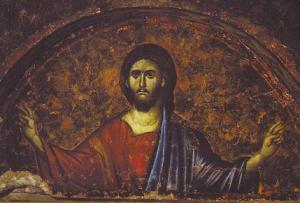
Faith has its place in a balanced Orthodox environment, and a natural relationship with the world. What I mean is that we live in the world and must do what it takes to survive in it, but not at the cost of compromises, betrayals, or renouncing Christ. Orthodoxy gives us balance.
We (the cradle Orthodox), possess a very ancient tradition. I look at the American Orthodox. They are very passionate for Orthodoxy, but they’re locking Holy Tradition. So, in a sense, they are streams branching off the Russian, Bulgarian, Serbian, or Romanian tradition, since they do not have that traditional instruction from their ancestors, as we do. We stand on a firm rock: the teachings of the Holy Fathers, the ascetic experience of the desert’ monks, the entire Orthodox Tradition handed to us in patristic books or by Oral tradition; and these, regardless of our sins, constitutes a stone foundation, that unshaken ground where our feet may walk and not sink, like a boat in which Jesus is present. We do not sink because we hold fast to tradition. Yes, we are sinners, but God preserves us when we follow Him and the teachings of the Holy Fathers, even though sometimes we fail… But is there anyone without sin? Is there anyone who has not been tempted? Who does not dirty his soul with evil thoughts, deeds or lust? But aside from all these failings, we have an unshaking ground.
This ground is the Orthodox Church, the tradition of the Holy Fathers, the Seven Ecumenical Councils, the struggle (experience) of the saints in the wilderness of Thebaida, Sinai…,in our country (Father refers here to Romania, his former country – tr.n.), and the monasteries found everywhere. Having this reaches, we do not sink.
“If I keep silent, I’ll be no different from unbelievers”
The following beautiful story is found in the Paterikon (collection of the old sayings of the Desert Fathers – tr.n.): the devil – taking the appearance of a man – came to a very holy monk and asked him: “Are you that monk…I heard off?” “This is him.” “That monk, the liar?” . ” Yes, that’s me.” ” That wicked monk?” “Yes.” “The greedy monk?”. “Yes, indeed.” “The liar who teaches the word of God, but does not live it? ” “Yes , I am one.” “That monk, the heretic?” “No. Such, I am not!”
So here is how far he would go! He accepted everything that demeaned him, but when he was tempted on heresy, he stood fast and said no. This is where the limit of tolerance is. When that tolerance goes beyond God and the Truth of our Christian faith, it becomes a blasphemy to our Lord and our soul.
The Holy Fathers had settled in Councils all aspects of church dogma that nowadays are trampled on. In the decisions of the Holy Synods many things (happening today), were foreseen: from heresies, ecumenism, denying God, public fornication, accepting as virtues: vices and perversions, to the fact of being proud to declare yourself gay. There’s no passion that the Holy Councils have not anticipated or spoken on, as they declared: him who does these is a heretic and a lunatic departed from faith and the Church .
Even (some of) our hierarchs have lost their sense of Christian dignity, which is incalculably greater than any human dignity. They place themselves under the attachment or helm of one or some another powerful elites of the day. I was greatly distressed by that. I had not yet wrote to the Patriarch (the former patriarch of Romania, now with the Lord tr.n), but I ‘ll write him later; for in a discussion I had with His Beatitude, I said:
“Your Holiness, God gave me a gift. He gave me “the gift” of suffering and through it I became wiser. Perhaps not wise enough considering all that I’ve been through (father is referring here to his 21 years of suffering in the communist gulag for having confessed the Christian faith – tr.n.), but the wisdom that God grant me gives me strength to speak up this word for Christ, for the Church and my nation;” and now I have to confess, for if I keep silent I’ll be like everyone else (who does not confesses Christ – tr.n). Because tolerance has a limit: that is not pushing beyond faith, or God. Beyond that, there is no tolerance.
Many hierarchies are silent, because “the time has come” (cf. Apoc) when if you confess (the Truth), will not be accepted in Europe (in the European Union – tr.n)! Such as this Europe means the ultimate paradise!! Will we not be accepted in Europe? (transl. note: the EU). Very good. Then know, we’ll be accepted in heaven. There (is the place), where God receives us. […]
I often wrote against ecumenism. I think I said everything I could have about this “heresy of our century ” as the Greek monks call it. I met many of the leaders of the “Ecumenist Group” and saw their compromised soul for the politics and their irrepressible desire to compromise others, even the Orthodox groups which defend the purity of faith. Whereever I go, the monks are wondering with pain and anxiety: “Where are we going with this? And to what limit shall we accept hierarchical compromise? Should we seek another jurisdiction? Shall we run towards the mountains, the forests and desert in order to be saved and escape this satanic temptation? Will we be hunted like long ago the defenders of icons by the iconoclasts? ” …
What I want to stress here is perhaps not the danger of ecumenism in itself – maybe things are not quite so serious as they may seem – but the distress that Satan is causing in the souls of monks through this ecumenism, and I mean not only in the hearts of monks from Romania, but throughout the orthodox world. This leads to anxieties and fear, and raises concerns for personal salvation from worldly dangers at the expense of sanctity and, the beginning of many compromises that once started, no-one knows where they will stop…
What I wrote here, I wanted to express to the hierarchs. But I think such letter would be doomed to be forgotten due to lack of interest and may be a cause for anger. What remains for us is prayer for the guarding of monasteries, for the inner peace of the monks and for the un-disturbance of the Orthodox life in our country and the world.
(Taken from Fr George’ Living Words, translated by EC, to be continued)
 Christian Dogma
 Christian Martyrs
 Christian Orthodox Churches and Monasteries
 Christian Sermons and News
 Church's Teachings on Fasting
 Ecumenism – a Great Heresy
 Father George Calciu
 Life_a Sacred Gift form God
 Orthodox Saints and Church Fathers
 Spiritual Elders
 Daily Bible Readings
 Journey to Orthodoxy
 Listen to Ancient Faith Radio
 Orthodox Calendar of Feasts and Saints
 Orthodox Christian Mission Center
 Orthodox Institute
 OrthodoxChristianNetwork TV


Recent Comments