
You are currently browsing the category archive for the ‘Spiritual Elders’ category.
A documentary on the Mysteries of the Jesus Prayer
One correction to the narrator remark comparing the Patriarch with the Pope of Rome;
– In the Orthodox Church the Patriarchs are the ‘First Among Equals’, not above the others. In the early history of Christianity, before the Schism in 1054, there was no “Pope of Rome” (to the rang he elevates himself today) but only Patriarchs of local Orthodox Christian Churches, which they all were “First Among Equals”. The Pope of the Christian Church of Rome (the Western Christian Church) before the Schism had the same status with the rest of the Patriarchs of the Christian East.
(The Jesus Prayer in Greek recited by Elder Ephrem Phyloteuos)
More on The Jesus Prayer from the Wisdom of Greek Elders
(more on youtube)
More from the wisdom of the Orthodox Elders (Elder Ephrem) on “Vain Glory and Emptiness”
Simonopetra Monastery, Mount Athos

The Enemy Within
(an interview with Archimandrite Dionysios taken from the Enlighten Magazine)
Elder Dionysois spent many years in Simonopetra Monastery of Mt. Athos and is now a much loved Elder and the Archimandrite of an Orthodox Monastery in Greece – northern Athens
[…] As the fourth-century desert father St. John Cassian writes in The Philokalia, perhaps the most celebrated of all Orthodox sacred texts, “[The ego] is difficult to fight against, because it has many forms and appears in all our activities. . . . When it cannot seduce a man with extravagant clothes, it tries to tempt him by means of shabby ones. When it cannot flatter him with honor, it inflates him by causing him to endure what seems to be dishonor. When it cannot persuade him to feel proud of his display of eloquence, it entices him through silence into thinking he has achieved stillness. . . . In short, every task, every activity, gives this malicious demon a chance for battle.” […]
WIE: Father, what is the ego?
Archimandrite Dionysios: When Satan, who was the first and highest angel, looked away from God and turned his attention to himself, there we had the first seed of ego. He took his spiritual eyes from the view of the Holy Trinity, the view of the Lord, and he looked at himself and started to think about himself. And he said, “I want to put my throne in the highest place, and to be like Him.” That moment started the history, the reality and the existence of ego—which is not in fact a reality, but the refusal of reality. Ego is the flower that comes out from the death of love. When we kill love, the result is the ego.
WIE: What is the character of the ego? How does it manifest within a human being?
Dionysios: When we don’t trust. Ego is born when we don’t trust others. When we’re afraid of others, when we need guns against others, then we need to have an ego because we are in the wrong way of life. We think only of ourselves, and we see only our ego. But when we see each other, when we trust each other, there is no need for ego, no reason for ego, no possibility for ego.
WIE: So in the way you’re speaking about it then, ego is the insistence on our separation, our independence?
Dionysios: Yes, on our solitude. Our need to be alone, to have our own way of thinking that satisfies us and preserves our personality in the wrong way.
WIE: Putting ourselves first and foremost?
Dionysios: Yes. And Christ said, “The last is the first.” Because when you want to be the last and you choose the last seat, only then may you call the others friends of yours.
WIE: The ego, this sense of self-importance you’ve been speaking about, is often described in The Philokalia and other writings of the Christian mystics as the primary enemy with which the spiritual aspirant must wrestle in their quest for union with God. Why is the ego considered to be such a formidable adversary on the path?
Dionysios: It is such a powerful enemy because it is the enemy within us. We are enemies to ourselves, like Adam and Eve in paradise. Of course, the snake talked to Eve. But she could have avoided him. The snake said to her, “The Lord lied to you,” but if she would have trusted the Lord, she would not have started to talk to the snake. And Adam, too, lost his communication with the Lord and stayed with his ego. And the two egos worked together, Adam and Eve.
The real enemy is the ego. It is the enemy because it is against love. When I look at myself, I don’t love others. When I want to occupy for myself what is yours, I become the killer of my brother, like Cain killed Abel. When I want to satisfy myself, this satisfaction is gained through sacrificing the freedom of the other. Then my ego becomes my lord, my god, and there is no stronger temptation than this. Because to us, this ego may seem like a diamond. It has a shine like gold. But whatever is shining is not gold. The ego is just like a fire without light, a fire without warmth, a fire without life. It seems that it has many sides and many possibilities—but what is this possibility? What is ego? Only the means by which I protect myself as if I were in a battle, as if every other person is my enemy, and the only thing I care about is winning the victory.

WIE: It has been said by some of the greatest spiritual luminaries that when one takes up the spiritual path in earnest, one often comes face-to-face with the ego in a way that one never could have imagined previously. In describing their encounters with the ego, many saints have characterized it as an almost diabolical force within that does not want the spiritual life, that does not want God, but that wants to do everything it can to obstruct our illumination, to undermine our firm resolve to stay on the path.
Dionysios: Saint Paul writes beautifully about this event, this struggle inside the human heart. He says, “There is another law inside me telling me to refuse the will of God, to do things against Him, to refuse the grace. It tries to keep me in my past, in my old life, to take me far away from the Lord, to prevent me from following the Lord.” This is why I said that the biggest problem in mankind is in each person, not outside of him. For this we need spiritual fathers. For this we need spiritual doctors. We need surgery; we need an operation; we need something to be cut in our heart.
We don’t understand that this enemy that we have inside us is not our self; it’s not our personality. It’s only a temptation. This is the seed of the problem of the ego. We unite our personality, which is a priceless event, with our faults. We confuse our personality with our sin; we marry these two things, and we have a wrong impression of what we are. We don’t know what we are, and we need someone to show us who we are; we need someone to open our eyes so that we can at least see our darkness.
There’s a mystic, the greatest of the mystics, Saint Gregory Palamas. For thirty years, he was praying only this prayer: “Enlighten my darkness. Enlighten my darkness.” He did not name the Lord because he did not feel worthy to name him. He did not address it to anyone, but he said this prayer day and night, more than he was breathing. Because all he knew in himself was his darkness. And he was talking to someone—to whom else?—to Christ, who said, “I am the Light.” But he said only, “Enlighten my darkness.”
WIE: Show me my faults?
Dionysios: Or come to my darkness and burn it. Make fire in it and make light in it. The greatest thing we can do in our lives is to discover that by ourselves we are nothing. We are darkness. We are dust.
WIE: The ego is often characterized in the spiritual literature as a cunning and opportunistic adversary, capable of turning any situation to its advantage in its attempt to obstruct our spiritual progress. What do you feel is the most important quality within the individual that can help us to win the fight against the clever and ever-changing ego?
Dionysios: Repentance. Recognizing our mistakes and our sins, this is the highest thing that we can do. And not to recognize our sins in order to succeed at something else, but just to see the truth about ourselves. Saint Isaac, the great mystic of the Church, says that one who accepts, who understands, who recognizes his sin in front of the Lord, in reality, he is the highest. He is greater than one who has gained all the world, who feeds all the people, who makes miracles, who resurrects the dead. This man, the first one, is bigger because he can never fall down. He has a stability, a level, a place where he can talk to the Lord. He has a place where he can invite the Lord with his tears, with his repentance, with the understanding that he has done wrong. And straightaway he becomes clear. The light comes from him. He becomes a spiritual doctor, a teacher or father, because he’s not afraid to recognize sins. It is not a problem for him to say, “Excuse me, it was my fault.” This is the key to escape from all the drops of the devil.
WIE: Would it be accurate to characterize this quality you’re describing—this willingness to face oneself honestly—as humility?
Dionysios: Not humility. Humility is the result. It would be better to say “wisdom.” We press ourselves to be humble. But to recognize my faults—what does that have to do with humility? I have to be humble in order to recognize my faults? No. I have to see them. It’s an emergency. It’s my way to exist for the next second. How can I exist with my faults for one second? In front of whom? In front of myself—how can I be with my faults, with my sins? I have to say, “I did it!”
Dostoyevsky expresses this so beautifully in Crime and Punishment. The main character, Raskolnikov, kills someone, and almost immediately he understands what he did. He doesn’t recognize it by himself, but with the help of the strict hard words of a prostitute, Sonya, who says to him, “Look what you did.” She guides him to go into the middle of the plaza, in front of all the people, to say what he did. And he does it. He confesses. He says that otherwise he could not exist, that he would have to commit more and more and more crimes. And he accepts the sentence of the court to go for at least twenty years to the hardest prison. And he goes, and there he feels the medicine of his heart. And he takes this medicine. We have problems in life because we don’t want to accept or recognize our sins. And this is the key. What else do we have to offer to each other? Gold, money, lust, food? Long life? No. Only to recognize our sins and straightaway we have a new world.
WIE: You seem to be speaking about a kind of deep conscience that stirs when we face ourselves.
Dionysios: It’s love. Love is more than conscience. Conscience is something that says to you, “You do this, you do this, you do this.” It’s like we’re under our own personal court. But love is something much more. Love makes us ready to pay for the sins of others. It’s a much higher step. Not only to recognize our sins but also to be able to pay for sins for which we are not responsible, as Christ did. This is love.
WIE: The writings of the Christian fathers speak of the goal of the spiritual journey as a transfiguration of the human being into an entirely different order of human existence—one in which the ego is killed and we are, in a sense, reborn. What does it mean for the ego to die? And in what sense are we reborn?
Dionysios: The Lord calls us to transform. He wants to give us our reality, our real self, which we have lost. And in spiritual life, especially in the monastic life, this ego really can transform, just as when the disciples, having followed Christ to the top of Mount Tabor, witnessed his body transformed into light. Many fathers used to explain that the transfiguration didn’t actually happen to the body of Christ but to the eyes of his students. Because at that moment, their eyes transformed and they could see what Christ had always been—shining, full of light. Through their humility, through following Christ, they were brought to the top of this mountain to enjoy this reality. And every one of us can receive this blessing. Our nature can be transformed.
This transfiguration is our real progress, our real growth. It’s not a matter of using our spiritual life in Christ to become better, to become more clever, to know more things, to have more friends, to influence others, to have authority and power, to have money, good health, a good name, and a good face. It’s only a matter of what’s inside our heart. The important thing is that in daily practice there cannot be any seed of ego in the field of our heart. Because when temptation comes, it can destroy the quality of life and of the relationships between people. The Lord taught us to be awake all the time and to pray to him, to say, “Protect us and don’t let us enter into temptation.” Through this protection from temptation, we can come to see very clearly into our hearts. And by following the simplest, normal life, we can purify ourselves, our spirit and our mind. It’s very easy after that for the Holy Spirit to come. It’s like in the Eucharist, we are ready all together in the church with the bread and the wine. We pray, and the Holy Spirit comes and makes the bread and the wine into the body and blood of Christ. In the same way, we can purify ourselves, and the Holy Spirit comes and transforms us in all the ways we have read about in books and brings us many more experiences that all the books of the world cannot contain.
WIE: In the Orthodox tradition there has been a long-standing lineage of illumined spiritual fathers, great individuals who have demonstrated with their own lives the possibility of destroying the ego and discovering a new life in God. What are the marks of one who has won the spiritual battle? How does the expression of the personality change in one who has truly gone beyond the ego?
Dionysios: He’s ready for everything always. He never is or says or feels that he’s tired. He has joy. He’s always ready to give. He exists only for others. He’s ready to serve everybody. He does not judge anybody, including the deepest sinner. He’s there as a child, but as a child of a king. Who can touch the son of a king? Who can touch a newborn lion knowing that the mother lion is nearby? Being this way, you’re like a small lamb among the wolves, but you’re not afraid. You’re there offering, receiving everybody, loving, serving, praying for everybody and being ready to die in each moment, and in that, you’re totally and completely free. All these are fruits of love because we become the source of love. So is a man without ego. This is the transformation. It’s like we are a wild old tree and we need something to come into us and transform this tree into a good fruitful tree. A man without ego is a man with God, is a man with the Holy Spirit.
When you are ready to die for everybody in each moment, when you love, when you respect, when you prostrate to the other, it’s like you prepare him to be ready for an operation; but it’s not that you judge the other or feel that he needs something from you. When you are perfect before Him—and we can be perfect; in fact, we have to be perfect; it’s the principal need—then right away people need it, know it, understand it. Very quickly everybody comes to take a seat in front of such a person, in front of a spiritual son or a spiritual father.

WIE: Is it also your experience that a spiritual father who has truly gone beyond the ego not only inspires people to reach for their highest potential but also presents the ultimate challenge to the ego of those who come to see him?
Dionysios: Absolutely. In fact, in the presence of such a person, the devil comes out straightaway. And you can see very clearly how the devil makes people crazy or angry or disrespectful when you haven’t even said anything. Just because you are there, they explode. And you can see terrible things in people where otherwise you would see only kind people with ties and gold jewelry. When someone appears who embodies the spirit of God, there you can see what you could see when Jesus was walking in the streets. The devils who were in the people said, “Whoa, who are you? You came here to put us in trouble.” Some were scandalized by him, others were thinking about how to kill him, and still others were thinking things against him. He was speaking not to what they said but to what they were thinking. And the same Holy Spirit exists in the spiritual fathers, and it can also create this kind of confrontation. This happens because the other person understands that he cannot play with this man. He cannot hide from this man.
WIE: In Christian writings, the enemy of the spiritual path is often referred to in dramatic terms as Satan, Lucifer, the devil. Is Satan simply a metaphor for the human ego? Or is it something independent of us?
Dionysios: Satan is the teacher. And the ego is the means by which we fulfill his theory. Living from our ego is like burning incense to him. When he smells it, he comes. It is familiar to him; it’s his relative, his tongue, his dialect. He likes it. So he comes, and then he starts to open company with our ego. Then he starts to be related to us.
WIE: So would you say that Satan exists in this sense as an impersonal force of evil that operates within each of us as the ego? Or would it be more accurate to say that the ego is already there in us and Satan is the voice of temptation to which the ego listens?
Dionysios: The second. He doesn’t have the authority to work through our ego. We’re free all the time to decide.
WIE: There are many spiritual authorities in the modern West who are attempting to bring the ideas of Western psychology to bear on the spiritual path. In fact, it is now commonly held that in order to withstand the difficulties of the spiritual path, one has to first develop a strong ego, a strong sense of self. One statement that has become almost a credo in many spiritual circles is: “You have to become somebody before you can be nobody.” What do you think of this idea?
Dionysios: That’s like saying, “We first have to be the head of the Mafia and then we can become president.” Or, “I will first work together with the devil; I shall make common company with him so that he will give me whatever I need, but because I am more clever than he is, I will then use my power for good.”
It’s good to send children out to study, to learn to sing, to learn athletics, to be well educated, to have an economic basis from which to start their life. But how often do we see that the dreams of all the rich men and their children are broken? The Bible says that “if the builders are working very hard to build a tower that the Lord does not bless, they have worked for nothing.”
This ego is the modern god of the twentieth century and the twenty-first century. And the idea you referred to in your question is the modern religion. But we know this temptation. Ego means, “I don’t believe in the existence of the Holy Spirit; the Holy Spirit does not exist.” But this is a lie. The Holy Spirit guides the world and blessed are they who want it, who see it, who breathe in it, who move in it, who inspire through it, who love it, who are uniting with it.
WIE: There are also many spiritual authorities today who insist that the ego is an inherent and irreversible fact of our humanity and that any attempt to give up the ego, to transcend our lower nature in pursuit of perfection, is itself an expression of the greatest hubris. Jungian psychologist Marion Woodman goes so far as to say that the very notion of perfection “rapes the soul.” How would you respond to those who assert that we are, by nature, flawed and incapable of reaching perfection?
Dionysios: Christ said, “Be perfect. Become perfect. And when you will be and you will do everything perfectly, saying within yourself and believing that you are miserable, terrible lost sinners, servants, there you will find humility and glory.” It’s possible to be perfect because He is perfect, because He received our nature. So if He did this, we can do it; we can be with Him. It’s possible to be perfect because of this gift. And it’s possible to not be perfect because we have the authority to refuse the gift, to refuse the love. And when we refuse it, then we need theology, then we need philosophy, then we need to create new books and new theories that say that the ego cannot be transcended.
It is possible to be free of the ego. It has to be. It’s necessary. It’s only because people don’t know of this possibility, don’t want this possibility, and don’t permit this possibility to exist that they need to create all these ideas. But they know that they are speaking lies. This is the craziest thing we can hear. What doctor says to a sick man, “Look, sickness is a part of our nature. We have to be with it. So we don’t have to cut our nails. We don’t need to wash our face, because we shall be dead tomorrow anyway”? What kind of teaching is this? Yes, it is possible to be free of the ego, but it’s a mystery.
WIE: The ascetic practices of Orthodoxy place a strong emphasis on the need to suppress our instinctual drives. Impulses like lust, hunger, thirst, and even the desire for sleep are often held at bay for long periods in extreme acts of renunciation. What is the role of ascetic practice in attaining freedom from the ego?
Dionysios: Asceticism is a means to get where we want to go. It is a railway on which the train can run. Many people feel that asceticism means following a set of rules, but it’s not a law that is imposed on us. In football, for example, it’s not that the rules of the game are hard, but that they help the game to come out perfectly. And so it is with ascetic life. The special periods and rules of fasting, vigil, and prayer serve as mystical ways or means. We follow these mystery ways, these divine commitments, these divine orders. And outside of the general rules, there are also personal rules that are given in the communication between spiritual father and son, special vocations for each individual. We see saints who spend much time in the caves or in the forest or in the desert. And they don’t go there with plans to come back; when they go there, they go forever. And the Lord guides them then.
When Christ went to the desert after his baptism, he went to face the devil. He didn’t think in his mind, “After forty days I will return.” He just went there. He came out of the Jordan River, baptized by Saint John the Baptist, and he went to the desert. From one point of view, he lost time being alone there. He didn’t go to his people to give them food, to bless them, to guide them, to give the Holy Spirit to them. No. He went to the desert. And he said to the devil, “My friend, look, until now you were playing with the people. You started with Eve in paradise, and now you are finishing with me. I am here alone. I’m not eating. I’m not drinking. And the cold in my bones in the night in the desert is terrible. I suffer. But I don’t play games. I’m here. Alone. And you come to me and you tell me to turn stones into bread. You tell me to prostrate to you. You? To give you the authority of my people? Go now. We have seen each other. I know who you are and you know who I am.” And in that moment the devil gave up everything.
So the ascetic life is necessary. To be ready in each moment to die, in front of everybody for everything—this is the desert, this is the ascetic life. And it brings the Holy Spirit. And if we go, the Lord will guide us.
–An Interview by Craig Hamilton

Prayer for the Enemies
by St. Nikolai Velimirovic
Bless my enemies, O Lord. Even I bless them and do not curse them. Enemies have driven me into Your embrace more than friends have. Friends have bound me to earth, enemies have loosed me from earth and have demolished all my aspirations in the world. Enemies have made me a stranger in worldly realms and an extraneous inhabitant of the world. Just as a hunted animal found its safe shelter, so have I, persecuted by enemies, found the safest sanctuary, having ensconced myself beneath Your tabernacle, where neither friends nor enemies can slay my soul.
Bless my enemies, O Lord.
Even I bless them and do not curse them.
They, rather than I, have confessed my sins before the world.
They have punished me, whenever I have hesitated to punish myself
They have tormented me, whenever I have tried to flee torments.
They have scolded me, whenever I have flattered myself
They have spat upon me, whenever I have filled myself with arrogance.
Bless my enemies, O Lord. Even I bless them and do not curse them.
Whenever I have made myself wise, they have called me foolish.
Whenever I have made myself mighty, they have mocked me as though I were a dwarf.
Whenever I have wanted to lead people, they have shoved me into the background.
Whenever I have rushed to enrich myself, they have prevented me with an iron hand.
Whenever I thought that I would sleep peacefully, they have wakened me from sleep.
Whenever I have tried to build a home for a long and tranquil life, they have demolished it and driven me out.
Truly, the enemies have cut me loose from the world and have stretched out my hands to the hem of Your garment.
Bless my enemies, O Lord.
Even I bless them and do not curse them.
Bless them and multiply them; multiply them and make them even more bitterly against me: so that my fleeing to You may have no return; so that all hope in men may be scattered like cobwebs; so that absolute serenity may begin to reign in my soul; so that my heart may become the grave of my two evil twins: arrogance and anger; so that I might amass all my treasure in heaven;
Ah, so that I may for once be freed from self-deception, which has entangled me in the dreadful web of illusory life.
My enemies have taught me to know what hardly anyone knows, that a person has no enemies in the world except himself.
One hates his enemies only when he fails to realize that they are not enemies, but cruel friends.
It is truly difficult for me to say who has done me more good and who has done me more evil in the world: friends or enemies.
Therefore bless, O Lord, both my friends and my enemies.
A slave curses his enemies, for he does not understand.
But a son blesses them, for he understands.
For a son knows that his enemies cannot touch his life.
Therefore he freely steps among them and prays to God for them.
Bless my enemies, O Lord.
Even I bless them and do not curse them.
(St. Nikolai Velimirovic, was a Twentieth Century Serbian Orthodox bishop who opposed Nazism and was eventually taken to Dachau. In this prayer he no doubt has in mind personal enemies, rather than national ones; the prayer is not intended as a guide for political and military decisions. But in thinking through such words we may be more able to act justly rather than rashly and in hatred or bloodlust).

On the 11 Sunday of Mathew 18:23-35
with Elder Sofian

Beloved brothers in Christ,
Today’s Gospel begins with the exhortation of forgiving those who wrong us, as we find in the (prayer) “Our Father”. There are other places in the Holy Scripture where our sweet Jesus insists on forgiveness and a state of peace among us. For example when our Savior said: “When thou bring thy gift to the altar, and there rememberest that thy brother hath aught a complaint against thee, leave thy gift before the altar, and go thy way; first be reconciled to thy brother – for neither thy gift nor thy prayer will be received. ” (cf. Mat 5:23-24)
Today we learned a powerful lesson about a rich and great man – God Himself – who loaned ten thousand talents to his servant, but seeing that he cannot pay, He forgave all his debt.
But what happened then? The man that was forgiven meets his debtor who owed him a very small amount – one hundred denarii – but his debtor been poor, had no means to return them.
So he that was just forgiven seized his servant by the throat demanding him to pay without delay! What a great contrast between his master goodness and his parsimony, because a hundred denarii was insignificant.
But when his fellow servants saw this they went and reported to their lord all that had taken place, and then his master summoned and delivered him to the jailors, till he should pay all his debt (cf. Mat 18:23-35).
In this parable Jesus tells us what will await us if we do not forgive those who wrong us in any way. It is the same concept that our Savior emphasizes unceasingly throughout his earthly life: if we do not forgive, we are not been forgiven. […]
We often carry ourselves towards others as the great debtor of this parable. Although much is forgiven of us, we forgive very little or nothing. But instead, we ask with boldness that we may always be forgiven by God as if our Lord will not sense our hypocrisy and wickedness. And for that, we were asked a very small thing: “If you forgive man their sins, God will forgive yours.”
Our Lord urges us to overcome our pride by forgiving our neighbor and for this small effort we too, can gain eternity, as He said: “The extent by which you measure others, it will be measured to you”; “Judge not, lest you’ll be judged”; ” Forgive and you will be forgiven” – these are small requests, Christian brothers! If only we can find within us the courage of humility, kindness and meekness of heart so that we can truly forgive … That’s why this parable is given to us, to strive for a life of prayer, almsgiving and fasting, as they all work together for our spiritual ascent.
But why are we ought to forgive? First, if you do not forgive, you make your lives a living hell. The Holy Fathers tell us that: “forgiveness is the eldest daughter of love”. He that cannot forgive cannot love. So the man that cannot love others, can neither love God. And to love Him, we must first be reconciled with our neighbors.
We ought to forgive so we may live in good standing with all and with God. We cannot live in isolation, we need each other – as family members need each other – and those in a factory or in offices need to communicate with each other. […]
And we are been told: “Let not the sun retire (go down) upon your wrath,” for if many days pass without making up, evil and hatred will grow within us. And if it is a group of people, the hatred it’s expressed as a terrible silence, a silence that seethes anger and malice. Arguments, insults, threats, even beating and murder! Such life is awful – a life of hell. We bring hell to us, we call the evil in our lives through our inability to forgive.
There are families where spouses do not speak to each other for months, until the marriage breaks in divorce. There are brothers, relatives or friends who because of some differences fell and, instead of making up immediately, remained silent and the anger deepened and it’s now old and more difficult to reconcile.
How can such man full of hatred pray? Who is he addressing to? Is he praying to God? When God asked him: “Forgive, so I may forgive you.”
There are even worse cases. After going against each other, they pray to God to punish their enemy severely, in spite of what God commanded us – to forgive, and he asks God to make his enemy into dust or to “poor His thunder upon him”… an expression of profound evil. Instead of thinking that he can also be wrong and to make an effort to reconcile his own soul, he begins to curse and stirs even more hatred.
There are neighbors that after fighting with each other, when they pass by they look the opposite direction not to see each other. I ask such people – who are usually Christians and seek God – how can they pray and how can they ask forgiveness from God if they cannot forgive others?
Humanly speaking, it is easier to slander and take revenge, but this proves that you are overcome by weakness and the lowest instincts.
But to control oneself and to forgive show greatness and a sign that the Spirit is God – the spirit of peace – rests within you. He that can control himself and forgets insults cuts off from the root any trace of hatred, because the forgiven feels humbled and do not dare to respond with evil.
There are instances where two men, equally guilty: one humbles himself and asked forgiveness but the other does not want to hear. What are we to do then? Instead of me answering, I will give you a parable from the Paterikon:
“A certain brother had something against another brother. And, understanding this, he went to his brother wanting to humble himself, apologize and be reconciled with him. Knocking at his brother door, the man didn’t receive him. Seeing this, he was disgusted. And going to his elder, he wept that his brother who he wanted to ask forgiveness and be reconciled, did not receive him, nor he opened the door for him.
But the elder said “Search my child and take heed that you may have a thought in your heart telling you that – you are not guilty nor that you caused your brother any harm – and may tell you that he is the guilty one! Thus you feel you have no fault in this and you blame him. Wherefore God does not give encouragement to your brother to open his door to receive you, because it is not with true repentance you search him, but overcome by pride. So go and put in your heart that you’re also wrong, and only as such go to meet him. And God will grant him humility and strength to be reconciled with you “(…). By hearing this – the brother was humbled and, following his staret advise went again to his brother and pleaded for forgiveness. Knocking at his door, the brother heard and opened. Then he humbly bowed to him saying: “Forgive me, brother, that I disgusted you!” And they embraced each other with great joy. “
[…]
The (holy) fathers instruct us: when you want to apologize and the other does not receive it, consider whether you have offended him in any way. Take heed at your heart and humble yourself and only thus go to him.
Lets not blame our enemies, and only blame ourselves. Because if we are honest with ourselves, we must admit that we too have done some harm and they remember it. First humble thyself before God and then go to your brother; humble yourself from the heart – and God will change the disposition of your brother and reconciliation will take place.
My beloved brothers, God is ever present in man’s lives. Yet we do not sense the presence of God in every soul, but He is present in us all, He directs our emotions to submit in love and peace to each other, because God is love – in His omnipotence, He directs us to love and reconciliation. And God can change the disposition of others, if you humble thyself before Him from the heart, but if you refuse to reconcile, then God will abandon you.
In this sense we have another story in the Paterikon:
“During the early persecution, when Christians were tormented and murdered for their faith in Christ, they seized two brothers/monks and threw them in prison until the next day. The following day, they were taken out to be martyred. But these two brothers had enmity against each other.
While laying in prison beaten and tormented, one humbled thyself to the other and said: “Brother, tomorrow we will be brought before their court where they will torment and murder us and we will go to the Lord. Because of this, the hatred and jealousy that was and is still among us, it is proper to give up, be reconciled, and forgive one another before we die, that in a clean state, we may embrace death for the love of Christ, so we may be worthy of the crown of martyrdom.
And saying this he bowed down before his brother saying:” Forgive me brother, and you too may be forgiven by me and by God! But the other, overcome by jealousy, refused to forgive him. The next day in the morning they were taken out to be slandered. He, who did not want to reconcile and forgive his brother, seeing that was terrified and denied Christ, but the other brother, got courage in the Lord and received martyrdom.
When the one who denied Christ was asked: “Why haven’t you deny Christ yesterday, so you had not been tormented?” He answered: “I left my Lord, when I didn’t reconciled with my brother, then His grace and help also left me and been abandoned by Christ, I denied Him “.
Thus, if we cannot forgive our brother, His grace departs from us, and we give into all sorts of temptations, then who will protect us when God will turn His face from us…
In such cases, we ought to examine our conscience to see whether we carry some part of the blame, then we must overcome our pride and humble ourselves as the brother of this story.
And if the other does not respond nor he wants to forgive us, we must strive to forgive him from the heart and pray for him, that Christ may soften his heart and help us to truly forgive.
So my advise to you regarding these people, is to strive not to speak evil of them [….]
It’s better to pray for them, that God may enlighten and help them understand that they are wrong.
And by carrying ourselves with gentleness, humility and genuine kindness, pure at heart from any human haughtiness and evil, peace will rest within us – that peace which only God can give, that inner peace which Jesus spoke of: “My peace I give to you, not as the world gives you.” – the Peace of Christ … And we will be granted a true forgiveness from God when we say: “Forgive us as we forgive.” […]
“Forgiveness, the beginning of Love”

by Hieromonk Savatie
[…]
– Father, although I want to forgive, I often remember what others had done to me!?…
– It is a struggle! We cannot forgive from the beginning. But if we struggle in this, God will send His grace to help us. We see how hard is to forgive, because it is difficult, perhaps the hardest labor.
But people who have never practiced it often say (assume) that: “What’s so difficult with this, after all I forgave all so I’m saved!”
But those who truly struggle know how hard this is. So it was not so simple what my elder told me: “Every night before you go to sleep forgive all from the heart and say: Lord I have forgiven everyone, I praise You to forgive me. And God will save you!”
This is a permanent struggle. Constantly, we must seek reasons to benefit those that wrong us: may be he was tired, maybe he is sick, (spiritually) he is less instructed than I am, it’s me that I did not understand him correctly, I was tired and upset … Lets take the blame upon us. It is a spiritual exercise by which we can be perfected in Christ.
So do not feel troubled, because no one can reach this state at once, as if it was so easy, then this command will no be at the center of the Gospel; God had not promised His kingdom for a thought that is so easy to achieve. It is hard labor. But through practice, if we persevere in seeking this, we will succeed.
Love, says St. Silouan of Mt. Athos, can be learned, it can become a habit.
We ought to struggle to have good thoughts and to reject the evil ones – let not converse or believe in them. So then we can become true disciples of Christ as He told us: “It is by this that man will know that you are my disciples – if you love one another.” (John 13:35)
But only through great effort, through inner work, we may reach this measure.
(Translations by EC)
Copyright: Please ask permission before coping any content from this blog, Thank you.
The interview and sermon were given by Fr. George Calciu in Romania (2005), 1 year before passing in the Lord.
Please also see the recent state of unrest unfolding in Greece in regards to the new “Citizen Card”, commented by Fr. Peter Heers on Ancient Faith Radio.

“The Citizen’s Card” and Orthodox Opposition in Greece: Part I
“The Citizen’s Card” and Orthodox Opposition in Greece: Part II
Father John of Santa Cruz – a novel figure of Orthodox Christianity –
martyred by the Satanists in 1985. Celebrated May 19.
(taken from the Holy Monastery of Pantokratoros website)

The Holy Martyr, Father John of Santa Cruz, was born in 1937 in the Greek village of Karastamatis from the Island of Andros. At the age of 20 years he leaves for America and later started a family. He is ordained priest and for 10 years he ministers with apostolic zeal many churches in Alaska.
In 1981, father John came to the Church of Prophet Elijah in Santa Cruz,CA which he restored and renewed. Under his ministry, this church is soon to become the center of Orthodox catechesis throughout this region where many people were alienated from God and the Church.
Father John was simple in conduct, loved his parishioners and his door was always open for everyone, even atmidnightif he was called. He preached with great fervor. Fr. John loved God and desired for everyone to love Him. He would go to parks and public streets to talk to young people who knew nothing about Christ or were Jews.
In his native village from theIslandofAndros, a miracle occurred involving the white lilies: considered to be the flowers of the Virgin Mary. When the lilies bloom, they get uprooted and are placed in the Church before the miraculous icon of the Mother of God. Later of course, the leaves and flowers wither and fall, leaving only a dry stem. The dry stalks, however, are left like this near the icon of the Virgin and during the Dormition fast, the lilies begin to sprout and flourish thus at the feast of the Dormition, the lilies are already blossomed. This phenomena is repeated each year.
Father John, when he was growing up on theislandofAndrosknew about this miracle. So he went to the Monastery of St Nicholas from the island and asked Abbot Dorotheos for few dried lilies. He took few dried stalks with him toAmericaand placed them in thechurchofSanta Cruzat the icon of the Blessed Virgin. The stalks have miraculously blossomed and flourished during the feast of Assumption. This miracle had strengthen the faith of many, to have more reverence to the Blessed Virgin.
Father John was a sensitive and beautiful soul. At the instruction of Elder Dorotheos, he wrote poems and religious hymns. He was deeply touched by the miracles of the Virgin and the lives of the saints.
As a small child, he loved to go to St. Nicholas monastery on theislandofAndros, saint whom he loved dearly. An icon of the Virgin from this monastery began to shed blood and myrrh and Father John began to talk about the miracles of Our Lady with greater divine zeal and many people of different faiths become Orthodox.
His preaching has angered some who began to threaten him by phone and letters, to cease preaching. But Father John became even more passionate about his ministry saying: “As long as my eyes have tears, I will preach Christ and Orthodoxy.”
He advised the faithful to guard themselves against the pitfalls of the Antichrist and not to take the mark. Then the telephone threats on his life become even more intense, but Father John did not worry for anything.
In the evening of May 17, 1985 he telephoned the Abbot Dorotheos and asked him about the miracles of the myrrh streaming icon of Blessed Virgin – Myrrhovlytissa, because he wanted to preach a sermon on her for the following Sunday.
The next day on May 18, Father John was at home alone with her son Photius. The presbytera (his wife) and their daughter Mary were away from home. The boy went out with his friends, and Father John left to the church to finish his sermon.
The boy returned home later that evening and seeing that his father was missing anxiously went to look for him at the Church.
There, the boy was faced with a terrible sight: his father was found on the floor slaughtered and unrecognizable… he had been hit in the head with a hammer and his whole body was butchered with knifes. As the police had later discovered, because father John didn’t die right away, the criminals took the cross he was wearing around the neck and hanged him with its chain. The blood poured from his wounds and flooded the floor of the Holy Shrine. The Satanists used his blood to write their slogans and the mark 666 on the walls of the Church. The blessed father John suffered martyrdom in the very place where he was photographed with the cross in his hand, almost prophesizing of what would follow.
Before his martyric death, three wonderful things had happened:
1. The blossoming lilies of the Virgin had wilted at once, one week before his martyrdom and they had never blossomed since.
2. The Icon of the Blessed Virgin wept, and her traces of tears can still be seen on her image.
3. On three consecutive Sundays before his martyrdom, during the Divine Liturgy, the boy while giving him warm water (to prepare the Holy Communion) saw a strange phenomenon, his father’ face was shining scattered in rays of light and darkness, but father John strictly told him not to reveal anything.

The police searched for the killers and found three people: a couple and the son of the man with another woman. They were priests and worshipers of Satan. They drank cobra venom while they were arrested and two of them died and the third: the young men lost his mind and could not testify.
Because Fr John face was disfigured, his relics could not be displayed at the funeral, his body was covered in father’ usual gold-vestments and the coffin sealed.
When Abbot Dorotheos learned about the martyrdom of Father John, wrote to his presbytera asking to send his priestly vestments when they celebrated together the feast of Saint Dorotheos at the Monastery in 1981. The time passed but he received no response from father John’s family.
On the eve July 4, at the monastery of St. Nicholas fromAndros, a athonite vigil was celebrated in honor of St. Athanasius ofMt.Athos and many pilgrims have come fromAthens. As the vigil was about to end, the monastery bells began to beat themselves as for a solemn feast. They stopped for awhile, but the bells started ringing again so harmoniously that everyone was astonished.
Seized with fear and awe, the faithful started to pray the paraclesis of St. Nicholas, waiting for a miracle to happen. That afternoon, elder Dorotheos got a call from Mary, the daughter of Father John, who had come specifically to the monastery baring the vestments of her father. She brought them into the monastery and were received with joy by all pilgrims. The bells were ringing in the monastery that morning exactly at the time when the ship entered the harbor caring the Martyr vestments.
The apparitions of blessed father John after his martyric death are many.
On the eve of the feast of St. Nicholas, in 1986, abbot Dorotheos together with several women was preparing the necessary things for the monastery patronal feast. At one point, they saw the blessed father John walking through the monastery gardens and heading towards them. They all were frightened and began to shout: “Papa Iani!” Then he disappeared from their sight. Immediately after this to their surprise, came the postman with a package fromSwitzerland containing a wooden carved image (icon) with Father John, from some Russian believers that honored him as saint. Father John had asked that his icon may be spread to all Christians so they may learn about his martyrdom and of missionary work.
In February 1987, the abbot Dorotheos went toSwitzerlandfor a surgery. While talking to the faithful there, about Fr. John and his martyrdom, he appeared to them, he blessed them, then he disappeared from their sight.
Before his martyrdom, when Fr John served inAndroswith the abbot Dorotheos, he donated to the monastery his epitrahyllum (priest stole). Elder Dorotheos when he went toSwitzerland, took it with him a piece of the stole spreading ineffable aroma to those present.
In Orthodox America and the Russian Church Abroad, Fr. John is honored/venerated as a Saint by the faithful. A booklet with a service to the saint has been published. The events and details on Fr John’ martyrdom were provided to the abbot Dorotheos, by Fr. John’ daughter: Maria.
His memory is celebrated on May 19, on the eve of the feast of the translation of Saint Nicholas holy relics, because as a child Fr. John had great devotion to St. Nicholas.
His blessing be to all of us. Amen.
Translated from: “The OSIOS FILOTHEOS OF PAROS, NO 17, May-August 2006, Thessaloniki” by the blog author.
Source of the original text: http://www.impantokratoros.gr/84A7DC93.el.aspx
See also: Man Who Killed Santa Cruz Priest Denied Parole
Fast and freedom

What can be more absurd than the fast, in a religion which boasts of having given the man the freedom? How can you name yourself free, when you have to refrain from the things you like, when you must do what you don’t want! The fast is the abstinence not only from food, but also from the bodily pleasures. How not to see in this an outrage to the noblest instinct that the man has – the freedom?
If the fast is an obligation, than the Gospel is a masterpiece of the absurd’s literature. Understanding this, the Protestants decided to renounce the fast. However, despite the numerous quotations brought from the apostle Paul or from the words of the Saviour Himself, the spur to fasting is like a thorn in the flesh of him, who at least scarcely, knows the Holy Scriptures.
All righteous before Christ fastened. The fast was precursory to the meeting with God or to a revelation. Moses climbed up the mountain after forty days of non-eating and thus spoke with God. The New Testament is not at all different and it begins with a fastener – John the Baptist. Christ Himself had fastened before having begun to preach. Thus, we cannot leave away the fast, departing from some biblical verses, when even those who pronounced them were great fasteners; it seems to me it is more decent to doubt our understanding’ ability of those verses.
Christ was once asked why his disciples don’t fast (Matthew 9, 14). From this many have understood that the disciples and the Saviour Himself were gluttons (Matthew 11, 19). But this event, actually, discloses us the fact that the disciples and the Saviour were all the time starving. This can be also seen very well from the conflict that they had with the Jews, because the disciples ate some ears on Saturday. The disciples were so busy with the preaching that they used to forget to eat and the fact that they picked ears, shows how hungry they were and that they were up to eat here and there. The Saviour however did not eat with them, the reproach being only for the disciples; He was the model of fasting.
The fact that the disciples used to eat little, is also emerging from the scene of multiplying the bread, where we find out that they had only five loaves of bread and two fish. Although they were far away from the locality, in an impossibility to buy food, they are ready to give this little to the crowd (without knowing that it will be multiplied), which reveals us that they were accustomed with the hunger more than the ordinary men. Hence, the Saviour and the disciples fastened, but they did not count the days as the Pharisees did. To their question though, Christ answers: “Can you make the guests of the bridegroom fast while he is with them? But the time will come when the bridegroom will be taken from them; in those days they will fast” (Luke 5, 34-35). “Those” days when the bridegroom was taken away, are Wednesday, the day of betrayal and Friday, the day of crucifixion. In the year 50, the apostles convoked a synod in Jerusalem, (see Acts) where they established for the believers to fast in these days.
Thus, the Protestants have understood well that the fast is not an obligation. The forced fast, has no motivation as any gratuitous and meaningless thing. However, this is not a reason to blame the fast. The fast should be understood in all its nobility, as it is the supreme manifestation of the human freedom. In such a way the first Christians understood the fast, a meaning that is lost nowadays. “To eat – writes St. Ephrem the Syrian in the IV century– belongs to the laws of nature, but to fast belongs to freedom”.
Who can boast that he is eating only because “he wants this”? No, you eat because you need to eat, a results from the natural instinct, not from freedom. Of course there is neither an evil in this, nor a sin, but there is also no virtue. The virtue is only the fruit of the freedom. “Any labour which is not from a perfect freedom – farther Sofronie Saharov (+ 1993) said – can not have an eternal value”. The fasting is the man’s free choice of a nobler life, which has something in it from the realities of eternal life, where there is no corruption anymore.
The Ancient Church
More on the Orthodox Chruch
See also a brief introduction to Orthodoxy based on the book “The Orthodox Church” of Metropolitan Kallistos Ware (former Anglican Timothy Ware)
Part I
Part II
The last 4 parts are on Youtube…

Motto:
“In Orthodox circles, following the Holy Fathers, we make a distinction between God’s “permissive” will and His “intentional” will. As Lord of all, God permits or allows such disasters to happen. Yet He remains a God of Love, who would never, for any reason, inflict wanton destruction on entire populations. He may allow pain and suffering to visit particular individuals, including you and me. But He does so always for a purpose, often beyond our comprehension. There is no doubt that at times He does so for our good, as a burdensome yet effective pedagogical tool to correct us and lead us to repentance. Where apparently meaningless suffering afflicts the truly innocent, we can only surrender, in faith and hope, before the impenetrable divine mystery that allows no rational analysis, no figuring out of the whys or wherefores. God, then, is involved in suffering, as He is in every other aspect of created existence.”
Fr. John Breck in: Can God Suffer?
And an older podcast (MP3) of Fr. John Oliver taken from Ancient Faith Radio at:
A Reflection on Natural Disasters
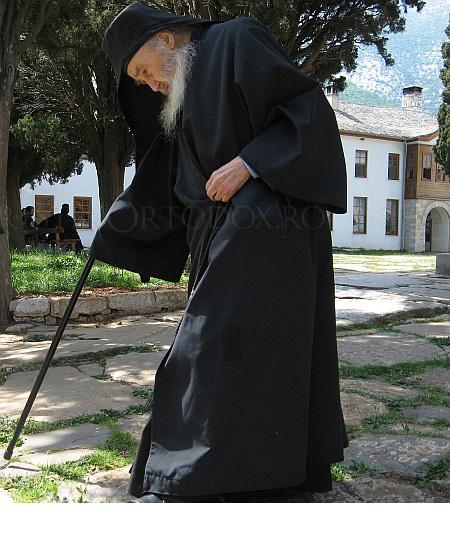
Elder Petroniu Tanase, former abbot of Prodromu Romanian Monastery from Mount Athos has followed sleep in the Lord, Tuesday, February 22.
May his memory be eternal!
On watching over the five senses
(With Elder Petroniu)
When man withdraws from the world escapes the temptation of sinful words and worldly images. By living in the world, man unwittingly hears and sees things that dirty his soul through his senses. And all these impressions and things of the world that enter his soul carry with them, a psychological and spiritual load. They awake memories you no longer want to remember, create undue spiritual tensions and leave fingerprints – as one may say – or dirty marks in the spiritual life of man. A man living in the world assimilates – even if it’s only in part, some of the sins of the world. As the old saying states that “man is what he eats”, we can also say that man is what he lives in the city, in his village or in his house. And as his body physiological composition is dependent of the materials contained in food that contribute to his good health, so the spiritual state of man becomes dependent on all these images and thoughts that penetrate through his five senses.
St. Nicodemus of the Holy Mountain has written a special work on this subject, “Guarding the five senses.”
Man must guard his senses as he would his gateways where friends but especially enemies could enter. Through these windows, dark impressions can penetrate into his soul.
These fingerprints can gradually shape the whole structure of man. During our lifetime, many impressions and deeds are recorded in one’ soul like in a book. … And these are the “books” that will be open at the Dreadful (Last) Judgment.
Man, until the end his life, is in a permanent transformation through what he hears, what he sees and what he lives. He is like a sculptor carving the wood, a piece here, a piece there… A chip on this side, a splinter on the other side and, little by little, the figure/sculpture appears. At the end of his life, man appears in his final form, modeled by everything he hears and does. And this transformation is noticed sometimes on his face. A wicket or a drunken man who lived a sinful life will show this. His figure acquires a certain appearance, connected to the sins he committed. And we elders can sense this.

But these evil fingerprints do not remain at the level of external appearance as we are accustomed to notice, but they will be engraved in man soul. Then at the Dreadful Judgment, when the books will be opened, that man will appear – though the great mystery of God – modeled by everything he did and thought. The Holy Fathers and especially of St. Niphon of the Danube says that people who have committed grievous sins, and have not change or repent, will remain distorted for eternity – a reflection of their soul, which after death will become a tangible reality. At the Last Judgment the state of man soul, more visible than his body, will portray everything man did. Sinners will have distorted figures and every grimace will reflect the sins they committed. Then – as St. Niphon says – everyone will see the sins we committed in our lifetime for they will be engraved in my personal appearance, they will express like a mirror, the structure of my soul irreparably damaged by sins. All our sins will be expressed and everyone will see our corruption.
And what is it said, in our church services, about the Dreadful Judgment? “Oh, who can suffer this scenery?” If now I’m ashamed to visibly sin against my neighbor, how will I look when everyone will see all the sins I have done?
On the Orthodox Church
1. The Orthodox Church is and must remain holy. There exists not one thing that can be accomplished without the power of the Holy Spirit. Today the spirit of the world penetrates everywhere, even in the life of the Church, in parishes and monasteries. With the help of the spiritual father, man is called to become holy through Christ who died and rose from the dead in order to deify human nature and to lift it up to heaven to the throne of the Holy Trinity.
2. The monastery ought to be far from the spirit of worldliness. According to St. Maximus the Confessor, a monk must constantly renounce the world and he will gain heavenly treasures.
3. Monasticism resembles martyrdom. Most saints mentioned in the Church ‘calendar are martyrs, and are followed by the monastics.
4. The monks have been entrusted with the liturgical treasure of the Church. A monk is called to maintain lit the lamp of liturgical life. First of all, he must attend all the daily liturgical services from his monastery.
5. The abbot has to be the spiritual father of the monastic community.
6. In his ministry, the Bishop is called to show firmness in defending the true faith before the heterodox and to promote the purity of life. The lives of St. John Chrysostom and St. Basil the Great ought to be eloquent examples to every bishop. The clergy and the faithful’ confidence in their hierarch is maintain when he remains steadfast in defending the Christian truth and in preserving the purity of life.
7. Gluttony, immorality and the love of money enslaves our world today.
Today, many sins are enacted by the so-called “human rights”. But according to the Christian teaching, man has only duties: towards God, his neighbor and God’ creation.
(Taken from the site “Friends of Mt. Athos”, translated by blog’author)
More about Elder Petroniu at:
The ABBOT OF THE ROMANIAN SKETE of MT. ATHOS, REPOSES IN THE LORD
“Repent, for the kingdom of heaven is at hand.”
(Matthew 4:17)

Repentance: Life’s Continual Effort
by Archpriest Victor Potapov
Bishop Ignaty Brianchaninov left us the following precious instruction: “In order to live spiritually and draw breath from grace, we must continually exhale the ashes of sin.” We sin almost constantly, if not in our deeds, then in our thoughts and feelings. Therefore it is essential to continually cleanse our souls. In the language of asceticism (teaching on religious struggle) it is known as “internal activity” or “attentiveness.” To continually repent is to pay unceasing attention to one’s spiritual life, to assess and remove from it all that is questionable and foolish. Bishop Theophanes the Recluse teaches us that one should do battle with sin at the moment it is born, i.e. when it is only in one’s thoughts. This is true battle, the ” invisible warfare” as it is called by the Athonite struggler Nicodemus of the Holy Mountain. This spiritual battle requires ability, God’s assistance, and constant prayer. As the holy Fathers of the Church write ” It is pointless to weep over the sins of the past if we do not struggle with them in the present.” Continual repentance or attentiveness is that poverty of spirit of which Christ speaks in the first Beatitude in His sermon on the mount. The call to such repentance is found throughout the Word of God and the texts of Orthodox worship.
In a sense, all of the teaching of the Church is a single call to repentance in the most profound sense of that term, i.e. it is a call to rebirth, to a complete reassessment of all values, to a new understanding and vision of life in the light of Christ.
It was not coincidentally that St. John the Baptist often repeated the words “Repent, for the Kingdom of Heaven is at hand.” The Christ began His sermon with these same words. According to the Venerable St. Ephraim the Syrian, “repentance is a field to be cultivated at all times. “Repentance is the tree of life, resurrecting those dead in sin.” Elsewhere he states, “Through repentance, earth has become heaven, for it has become filled with saints.”

In his book A Priest’s Observations, Fr. Alexander Elchaninov, an experienced spiritual director, writes, “Without our constant control over the spirit, confession, which takes place occasionally, is not successful”. The eye of the spirit, conscience, demands exercise, and without it you will see neither yourself nor your sins. According to the Venerable St. Isaac of Syria, ” He who has been able to see himself has accomplished more than one who has seen the angels.” He also wrote “One who apprehends his sin is better than one who through his prayers raises the dead.”
Sts. Ephraim and Isaac, and other spiritual strugglers after piety all recommend that in doing battle with sin, it is best to begin with the sin which most grievously attacks us. To the extent that we are rid of it, our conscience will see all the more. Moreover, it always behooves Christians to do battle against those sins which directly oppose love. The holy fathers of the Church teach that hatred, enmity, and condemnation utterly seal shut the gates of the Kingdom of God, the Kingdom of love. Thus, the first condition of true repentance is reconciliation with everyone. This is why in the Lord’s Prayer, the Christ included the words “forgive us our debts as we forgive our debtors.” This is why the Orthodox Church begins Great Lent with Forgiveness Sunday, when believers ask forgiveness of one another for personal insults and offenses, so that with a clear conscience they might begin Lent, their “invisible warfare.” The Church teaches that true love is indivisible, and that dislike for a single person will ultimately poison all love. Theophanes the Recluse writes: “In one who is at odds with anyone else, all friendship is fragile, and easily turns into enmity; of course, by bearing enmity, one cannot really love God. God is complete love, and tolerates nothing that is opposed to love.”
The commandments in the Gospel, while easy, appear difficult, for human consciousness, having fallen out of synch with life and harmony, is clouded. For example, people consider the Gospel commandment to love friend and enemy alike, to be difficult. In the sermon on the mount, the Lord says: “Love your enemies, bless them that curse you , do good to them that hate you, and pray for them which despitefully use you and persecute you” (Matt. 5:44). We see that no limits to good are imposed upon man in this commandment, one given to those who wish to rise above both their own and mankind’s selfishness, to be healed, and to depart from the state of sin.

Let us try to list those who have caused us some annoyance or insult, who have dealt with us poorly or spoken ill of us. In other words, let us recall those who are “not to our liking” and, forgiving each of them, let us sincerely pray for these souls. Let us drive out any grudge or irritation we bear them, and wish them well. Given the opportunity, let us say something nice about them to others. At every opportunity, let us help them.
Thus, as we will see for ourselves, fulfilling the commandment of love will engender a joyous feeling of spiritual freedom and profound peace. Many internal difficulties will depart from us, for we will have fulfilled the Christ’s words, believed in God, and given Him heed. The power of good will rejoice within us. Even if we do not immediately notice this peace within ourselves, it will certainly come to us as a reflection of our charity.
That a person is kind, honest, and generous always seems miraculous. Yes, it is a miracle, and a miracle far greater than moving a mountain. Something greater than a mountain is being moved – human selfishness. Such is the effect on man of our faith in God , our trust in the Lord, our repentance before Christ. When one who hates becomes one who loves, when a liar becomes truthful, when a vain person becomes modest, it is truly a miracle. Charity emanating from us first of all liberates us from our own evil; it opens within us the doors and windows through which flows the pure air of heaven. This is the rebirth born of repentance.
In repentance we see the operation not of natural forces but of supernatural grace-filled ones. And only one who believes in the Light can take into himself true love. According to biological law, men engag only in a “struggle for survival.” But according to the law of the Spirit, the battle is for the resurrection of the world, a spiritual battle which conquers selfishness, spiritual death. The Christ calls us to overcome our evil will and animal nature, to become human in the full spiritual sense of the term. The human soul is immeasurably greater than matter. As the Apostle Paul tells the Philippians, “I can do all things through Christ which strengtheneth me.” Such great, marvelous words: “I can do all things through Christ which strengtheneth me.” Through the faith granted us, we are called to be centered internally, mentally, not on our little selfish personality, but on the power of the Living God, the True Christ Jesus Who dwells in us.
The Creator and Father who brought us into being granted to our souls the freedom to make a free moral choice, to turn to Him and to repent of our sins, which constitute a betrayal of God’s truth. Yes, man is sometimes unfaithful to God; even if we do not frankly renounce God, we sometimes obliquely become betrayers of Christ, of His love and truth. Let us all repent of that.
Let us reflect upon how imperfect is our consciousness, and let us repent before God. Through repentance, the pure path to God is opened. Moreover, let us not tarry, for no one knows when his final hour will come. There is nothing more important and more needed than repentance and God’s saving forgiveness.
See Also: Many Confess, Few Repent
by Monk Moses of the Holy Mountain

 Christian Dogma
 Christian Martyrs
 Christian Orthodox Churches and Monasteries
 Christian Sermons and News
 Church's Teachings on Fasting
 Ecumenism – a Great Heresy
 Father George Calciu
 Life_a Sacred Gift form God
 Orthodox Saints and Church Fathers
 Spiritual Elders
 Daily Bible Readings
 Journey to Orthodoxy
 Listen to Ancient Faith Radio
 Orthodox Calendar of Feasts and Saints
 Orthodox Christian Mission Center
 Orthodox Institute
 OrthodoxChristianNetwork TV


Recent Comments