
You are currently browsing the category archive for the ‘Orthodox Sermons & News’ category.
Republished and translated by blog’ author from “Orthodox Typos”, October 1st, 2010
(one of the Orthodox publication of Greece)

Heated disagreement at Vienna between the representatives of the Orthodox Church, as reflected in the statements of Metropolitan Ioannupol of Pergamon, the representative of the Moscow Patriarchate: Bishop Hilarion and the Vatican representative for the „unity” of the Christian Churches.
Orthodox Typos: the dialogue with the heretics has to stop permanently, “here and now”, in order to stop the harm/deceit of the faithful and the clergy. Alive is our Lord God, Who protects His Orthodox Church.
Our Lord is a Living God! This was seen at Vienna, where the Theological Dialogue was held between the Orthodox and the Catholics over the Pope’s primacy in the first millennium. The dialogue ended in failure, to the great disappointment of the Ecumenist’ bishops of the Church of Greece, who constantly deceit/slander the faithful (that worrie to keep the tradition and the Holy Canons) and distort the thinking and the Orthodox faith by recognizing as canonical the heresy of Papism. The dialogue has ended in failure because the papal representatives did not step back and have remained steadfast in supporting the papal supremacy. The dialog was also led to failure due to the heated disagreements between the representatives of the Orthodox Churches. Each Orthodox representative exposed issues that brought hardship to the Dialogue. The Orthodox have exposed different views regarding of how the unity is to be understood. This arise from the official statements of both Ecumenist Metropolitan of Pergamon: Kir Ioannis Zizioulas, the Vatican official on „unity “: “Archbishop” and reformer – Mr. Koch, the Metropolitan and Foreign Minister of the Moscow Patriarchate: Bishop Hilarion, but also of Metropolitan Seraphim of Ioannupol, who in his interview, labeled those opposed to dialogue with the Catholics as mentally ill people. :(
It doesn’t means that if some people are crazy, they have the right to question our Orthodox thinking (Amen.gr, 09/26/2010 )
The Metropolitan of Ioannupol was the first of the participants, who made public in an interview, the failure of the Dialogue.
Seraphim of Ioannupol had declared: “At Vienna we continued the debate over text analysis that began in Cyprus and we had not yet completed the final form of this text. The Committees have the responsibility to edit this text based on the points made in the debate and to prepare us a working/text document with the additions and comments of the members from the Joint Commission. This text refers to the first millennium and analyzes the role of the bishop in the life of the Church at the local, regional and wider level. The text of this publication is not currently available, because does not have a final form . The Roman Catholics have their views on how they understand the role of the bishop of Rome in the first millennium, and the Orthodox are referring to the place that the historical Patriarchs had in the old historical Patriarchates of the East: in Constantinople, Alexandria, Antioch and Jerusalem …
NP (the interviewer): Your Eminence, lets insist a bit on the question of primacy …
Metropolitan of Ioannupol: As I already mentioned, the theme of primacy (in general, and not as something pertaining to the Pope, transl note) is something that appears as a pastoral need in the life of the Church, and pertains to the bishops of the Church, first in a diocese, and later in a larger region with several Dioceses,
– to convene to chair and to coordinate the synaxes of the bishops who act together, by invoking the descent of the Holy Spirit on the basis of Scripture and the Holy Tradition of the Church,
– for keeping the faith and the order of the Church which the heretics or schismatics were distorting.
It is a way to defend the soteriological path of the faithful.
In this context we refer to the bishop’s place in the life of the church during the first millennium and, of course of the bishops at Rome, Constantinople, Alexandria, Antioch, Jerusalem, Salamis, and other important religious centers that were developed in the first millennium, which we referred to.
It doesn’t mean that because the Roman Catholics presented points – as they desire to see the place of the bishop of Rome, the Orthodox have to accept them, nor that the Roman Catholics are obliged to accept the points that are presented by the Orthodox regarding the role of the bishops in the life of the Orthodox Church of the first millennium. We are just in the beginning of the dialogue, to prepare proposals for a later stage to be sent to our Holy Synods for decisions.
Those participating in the dialogue have no power to take decisions, our role is to highlight a common way of the church of the first millennium and to see how the faith was guarded in unity. The responsibility in making decisions belongs to the Holy Synods of the local Orthodox Churches, and if a final stage is reached, of course, to a Pan – Orthodox Synod. The dialogue is still in its early stage, and only the Holy Spirit knows how much of this will bear fruit … “
The Statements of the Representative of the Moscow Patriarchate
The Foreign Minister of the Moscow Patriarchate, Metropolitan Hilarion, according to “Romfea.gr ” had also made a declaration. The Metropolitan made it clear that some statements had been scheduled for debate while others have been debated, because there were serious disagreements over the Pope’s jurisdiction in the first millennium, something which the Metropolitan Ioannupol also reported. (…)
Bishop Hilarion noted that “the work (text) of the Joint International Commission for Theological Dialogue between the Roman Catholic Church and the Orthodox Church, which was made public by some mass-media does not reflect the position of the orthodox side in the issue over the primacy of the Bishop of Rome and can be treated only as an auxiliary material for future work.”
‘Despite media allegations, there was no openness in the meetings of the Commission for Theological dialog between the Orthodox and Roman Catholics in Vienna, ” Kir Hilarion added.
Kir Hilarion further added that:
“The meeting from Vienna was held to debate the role of the Bishop of Rome in the first millennium. On this basis of discussion a document was prepared last year in Cyprus by the Coordinating Committee. This axilliary text circulated in the mass media without approval for that. It has been assumed that at Vienna this text will be finalized and end the debate. However, things turned out to be different. Much time was spent debating this text status.”
Also, Kir Hilarion noted that
“The Orthodox representatives had insisted from the beginning that this text proposal cannot be formally published by the Commission nor that it can be signed by its members .”
‘ Our view is that this text requires an essential review in what follows, and only after that it can receive the status of an ‘ auxiliary text material’ ( instrumentum laboris ), which will be used to prepare future texts, but it will have no official status “, said Kir Hilarion added.
Referring to the role of Bishop of Rome, he stressed that:
“The text has purely a historical meaning, because it speaks only about the role of the Bishop of Rome and, does not cover nearly any of the bishops of other local Churches of the first millennium, thus giving a false impression of how the Old Christian Church was administrated at that time.”
“Furthermore – he added – the text lacks a clear and obvious finding that the jurisdiction of bishop of Rome in the first millennium did not include the Church in the East (the actual Orthodox Church, transl note).”
He also noted:
“We hope that these goals and gaps will be filled properly once the text is processed. After a debate, the Commission has decided that this text requires further processing and that the final decision on its status will be postponed for the next meeting of the Committee, that is in the next two years. Until then we will prepare a new text, which will deal with the same problem, but from a theological prospective.”
“For it is very evident for the Orthodox members that in the first millennium, the Bishop of Rome in the West did not exert exclusive jurisdiction over the Christian Church in the East, because in the East, the Church was divided territorial between the four patriarchs of the Constantinople, Alexandria, Antioch and Jerusalem, ” he stressed.
He concluded that:
„The Bishop of Rome had no direct jurisdiction in the East, although in some historical cases resorted to the Eastern bishops in theological disputes by arbitration”.
‘But these appeals were not systematic and can not in any way be interpreted as meaning that the Bishop of Rome in the East was seen as holder of supreme dominion over the Ecumenical Church”.
„I hope that at the next meeting of the Commission, the Roman Catholic Church will accept this position, which is based on countless historical evidence, ” the president for External Relations of the Moscow Patriarchate added.
The Metropolitan of Pergamum
The Ecumenist Metropolitan of Pergamon: Ioannis Zizioulas, admitted there are issues and agreed with the Vatican representatives for the „unity”, that this model of unity is deemed for the future.
He therefore requested that the Orthodox Church needs to strengthen its universal unity, a concluding fact for the sharp disagreements between the Orthodox representatives in the Dialogue. Because it resulted that the papacy has not taken any step back in the dialogue, Kir Ioannis also called out to the Catholic representatives to stress more the conciliatory dimension. He stated that “if these two things will happen, then the result will come quickly.”
Next, by referring to an Pan – Orthodox Synod he said (according to Romfea.gr) :
‘ Of course we must be united in faith a lot. Regarding an Pan – Orthodox Synod, we worry – and we admit it – that the autocephaly is a problem mainly when it is linked to nationalist themes. But I ‘m happy to say that we made a satisfactory progress towards a Pan -Orthodox Synod.
Orthodox Typos: “The Dialogues need to Stop!”
The Ecumenist bishops, the Phanar (Ecumenical Patriarchate) and the Church of Hellas (Greece) must stop these kind of theological dialogues, for they expose and scandalize the faithful people. The Papists have demonstrated once more at Vienna that are unrepentant and inflexible in their heretical theories such as the primacy and infallibility. They had demonstrated that they refuse the synodalicity. And, it is finally shown, that the representatives of the Orthodox Churches do not have a common position or vision on the ‘unity’, and that they do not consider papacy, “a sister Church”. To continue the Dialogue means a real provocation for the people of faith.
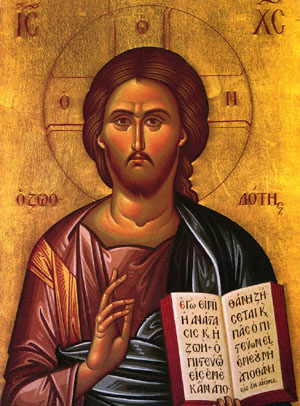
“Man by himself, has no power to fulfill the commandments of God”
Saint Siluan of Mt. Athos
A word that I think we should always bear in mind when we read or hear the Gospel and, especially the Gospel pertaining to the love of one’ enemies, that is read on this Sunday during Divine Liturgy.
Father Raphael Noica (a disciple of Elder Sophrony Sakharov from Essex) takes this further and says: “God, by commanding these things to us, does not expect us to be able to do them, because He knows that we do not have the power within us to fulfill His Word.”
How can this be? Does it mean then that God is asking us “the impossible”? Yes, and in a certain sense, this is what He asks of us! For His commandments are not merely moral requests accessible to the simple human’s will. God’s commandments are “a revelation of the divine life” (Elder Raphael N) to which Christ calls us. They are Divine commandments and not human commandments.
Does it mean then that God is absurd? No, but it means what Father N. Steinhardt used to call “God’s noble spirit,” Who put into your lap a “good measure, pressed down, shaken together, & run over” (cf. Lk. 6, 38). God wants to give us EVERYTHING, He wants us to be like Him, to partake of His life and therefore He commands us things impossible to human nature; in fact, through His commandments, He calls us to an absolute call, a call of a “final authority” which we cannot ignore.
At the same time, by this kind of commandments God wants us to discover our inability to live by ourselves and become humbled in Him, in a total hopelessness, to look deeply into our weakness and wickedness, and desperately ask Him for help. As we hear it in today’ Gospel: “My grace is sufficient for you, for my power is made perfect in weakness.” (2 Cor. 12, 9), and by living the awareness of our weakness in doing the divine will, we get ready to receive Him! In other word, if we would receive much more than our efforts or merits, we would be too proud and mock the “gift” (grace) that is given to us! “Joyfully I will praise rather in my weaknesses, so that the power of Christ may live in me” (Ibid.).
When I will empty myself of any trust in me, of any reliance on my own power and my own opinion that I did anything good, only then I can be filled up by the grace of God! For only by divine power, by the grace of the Holy Spirit one can do things of the Spirit and of God, that is … the Gospel’ commandments.
I thought that these things must be made clear before we talk about the Gospel commandments and, in particular about the commandment of love culminating in the love for enemies. And this is because many wrongly assume that it is very handy to love all people and love even the enemies of the Church, by imagining that they are already fulfilling so easily the hardest commandments of Christ and judging those whom according to their understanding, “do not love.”
While others, at the opposite pole, deceitfully believe that if they cannot naturally fulfill the divine commandments (i.e. they cannot love or can be gentle, ..), then these commandments are not been asked of them (especially if they live in the world), so they either give up the fight or will take from Christianity only certain things “accessible” to their nature. Both of these extremes are denounced by the Fathers of the Church as been wrong paths. Then, without realizing, they reduce the Gospel to a pure natural, humanistic or psychological content.
The first (category) live very much in imagination and, been lead by nature or emotions, by more intense or exalted feelings, they get to believe that it is very easy for them to love and that they even “have love” for all … to them, the more firm words by which Orthodoxy separates itself from deceit and called evil by its name, may seem too extreme and loveless. They only want to see “what is good” and “pink” and their “love” is more a projection of one’ psychological needs for safety and comfort which automatically exclude or deny what is “uncomfortable “.
At the other pole, love is almost out of the question, or something ” fad and sensible” we need not, because what is important is to be tough and courageous, and to use “strong” expressions against opponents, all under the motivation of “defending” the truth.
Some of us climb up in our imagination and believe to have reached the exceptional measures of our brother from the Paterikon (collection of sayings of the Desert Fathers) “that from so much goodness, He did not know what’s evil”, while others believe we are dispensed from the Gospel’ commandments, since we like more to win the fight over ideological “enemies of our nations” or strictly from the stand point of correctness of the Holy Canons.
Some dream of a universal peace and harmony and are troubled at the words of our Lord saying: “I came not to bring peace, but division” or when they hear that the Holy Fathers have commended us not to have fellowship with the heretics. While others understand spiritual warfare as an endless quarrel.
But authentic Orthodoxy is taking the “royal path”. Love for one’ enemies is necessary for our salvation, let us go on the narrow way of acquiring it, let’s recognize that we do not have it and that … we need to ask God for it!
At the same time, I cannot see the black as white or call the white, black because: the enemies of the Church are real, and there are many wolves in sheep’s clothing, not all are good, beautiful and well-indented and … I cannot confuse the brother with the foe. I ought to be (spiritually) awakened to discern the wheat from the chaff and not to compromise with the evil or become an advocate of the “son of lies”!
True love does not deny nor justify evil, does not overlook the cruel reality of the fallen world, does not cover injustice and shamelessness, but it assumes them with the burning pain of a compassionate heart. I must not sin by cowardice and stupidity and allow evil to unfold freely (without me doing anything). But this does not entitle me to condemn without appeal or to mock those who seem lost, some however without their consent. But I must have mercy towards all and pray for the salvation of all, to become truly a “son or daughter of the Most High; for He is kind to the ungrateful and the selfish.” (Luke 6, 35) and wants all men to be saved and come to the knowledge of the truth. Amen!
Reading from the Synaxarion

When the fame of our Lord Jesus Christ came to Abgar, the ruler of Edessa, who was suffering from leprosy, Abgar sent a messenger named Ananias, through him asking the Savior to heal him of his disease, while bidding Ananias bring back a depiction of Him. When Ananias came to Jerusalem, and was unable to capture the likeness of our Lord, He, the Knower of hearts, asked for water, and having washed His immaculate and divine face, wiped it dry with a certain cloth, which He gave to Ananias to take to Abgar; the form of the Lord’s face had been wondrously printed upon the cloth. As soon as Abgar received the cloth, which is called the Holy Napkin (Mandylion), he reverenced it with joy, and was healed of his leprosy; only his forehead remained afflicted. After the Lord’s Death, Resurrection, and Ascension, the Apostle Thaddaeus (see Aug. 21) came to Edessa, and when he had baptized Abgar and all his men, Abgar’s remaining leprosy also was healed. Abgar had the holy image of our Savior fixed to a board and placed at the city gate, commanding that all who entered the city reverence it as they passed through. Abgar’s grandson, however, returned to the worship of the idols, and the Bishop of Edessa learned of his intention to replace the Holy Napkin with an idol. Since the place where it stood above the city gate was a rounded hollow, he set a burning lamp before the Holy Napkin, put a tile facing it, then bricked up the place and smoothed it over, so that the holy icon made without hands was no longer to be seen, and the ungodly ruler gave no further thought to it.
With the passage of time, the hidden icon was forgotten, until the year 615, when Chosroes II, King of Persia, was assaulting the cities of Asia, and besieged Edessa. The Bishop of Edessa, Eulabius, instructed by a divine revelation, opened the sealed chamber above the city gate and found the Holy Napkin complete and incorrupt, the lamp burning, and the tile bearing upon itself an identical copy of the image that was on the Holy Napkin. The Persians had built a huge fire outside the city wall; when the Bishop approached with the Holy Napkin, a violent wind fell upon the fire, turning it back upon the Persians, who fled in defeat. The Holy Napkin remained in Edessa, even after the Arabs conquered it, until the year 944, when it was brought with honor and triumph to Constantinople in the reign of Romanus I, when Theophylact was Ecumenical Patriarch. The Holy Napkin was enshrined in the Church of the most holy Theotokos called the Pharos. This is the translation that is celebrated today.
Apolytikion in the Second Tone
We worship Thine immaculate icon, O Good One, asking the forgiveness
of our failings, O Christ our God; for of Thine own will wast Thou
well-pleased to ascend the Cross in the flesh, that Thou mightest deliver from
slavery to the enemy those whom Thou hadst fashioned. Wherefore, we cry
to Thee thankfully: Thou didst fill all things with joy, O our
Saviour, when Thou camest to save the world.
Apolytikion in the Fourth Tone
In faith, O ye people, leap for joy while clapping your hands; and gather in gladness on this day with longing and shout in radiant jubilance. For the Theotokos cometh nigh to departing from the earth unto the heights; and we glorify her with glory as the Mother of God in our unceasing hymns
Kontakion in the Fourth Tone
In the Immaterial Spirit, the whole world hath been mystically adorned upon the glorious memory; and it doth cry to thee joyously: Rejoice, O Virgin, thou boast of the Christian race.
The Dormition of the Mother of God
(by St. John of Damascus)
Our venerable and God-bearing Father
John of Damascus was also known as John Damascene, Chrysorrhoas, “streaming with gold,” (i.e., the golden speaker). He was born and raised in Damascus, in all probability at the Monastery of Saint Sabbas (Mar Saba), South East of Jerusalem. He is also recognized as a saint in the Roman Catholic Church.
Lovers are wont to speak of what they love, and to let their fancy run on it by day and night. Let no one therefore blame me, if I add a third tribute to the Mother of God, on her triumphant departure. I am not profiting her, but myself and you who are here present, putting before you a spiritual seasoning and refreshment in keeping with this holy night.
We are suffering, as you see, from scarcity of eatables.
Therefore I am extemporizing a repast, which, if not very costly nor worthy of the occasion, will certainly be sufficient to still hunger.
She does not need our praise.
It is we who need her glory.
How indeed can glory be glorified, or the source of light be enlightened? We are weaving a crown for ourselves in the doing.
“I live,” the Lord says, “and I will glorify those who glorify Me.”
Wine is truly pleasant to drink, and bread to eat. The one rejoices, the other strengthens the heart of man. But what is sweeter than the Mother of my God? She has taken my mind captive, and held my tongue in bondage. I think of her by day and night. She, the Mother of the Word, supplies my words.
The fruit of sterility makes sterile minds fruitful. We keep to-day the feast of her blessed and divine transit from this world. Let us then climb up the mystical mountain, where beyond the reach of worldly things, passing through the obscurity of storm, we stand in the divine light and may give praise to Almighty power.
How does He, who dwells in the splendor of His glory, descend into the Virgin’s womb without leaving the bosom of the Father?
How is He conceived in the flesh, and does He spontaneously suffer, and suffer unto death, in that material body, gaining immortality through corruptibility?
And, again, ascending to the Father, He drew His Mother, according to the flesh, to His own Father, assuming into the heavenly country her who was heaven on earth.
Today the living ladder, through whom the Most High descended and was seen on earth, and conversed with men, was assumed into heaven by death.
Today the heavenly table, she, who contained the bread of life, the fire of the Godhead, without knowing man, was assumed from earth to heaven, and the gates of heaven opened wide to receive the gate of God from the East.
Today the living city of God is transferred from the earthly to the heavenly Jerusalem, and she, who, conceived her first-born and only Son, the first-born of all creation, the only begotten of the Father, rests in the Church of the first-born: the true and living Ark of the Lord is taken to the peace of her Son.
The gates of heaven are opened to receive the receptacle of God, who, bringing forth the tree of life, destroyed Eve’s disobedience and Adam’s penalty of death. And Christ, the cause of all life, receives the chosen mirror, the mountain from which the stone without hands filled the whole earth.
She, who brought about the Word’s divine Incarnation, rests in her glorious tomb as in a bridal-chamber, whence she goes to the heavenly bridals, to share in the kingdom of her Son and God, leaving her tomb as a place of rest for those on earth.
Is her tomb indeed a resting-place? Yes, more famous than any other, not shining with gold, or silver, or precious stones, nor covered with silken, golden, or purple adornments, but with the divine radiance of the Holy Spirit.
The angelic state is not for lovers of this world, but the wondrous life of the blessed is for the servants of the Spirit, and passing to God is better and sweeter than any other life. This tomb is fairer than Eden.
And that I may not speak of the enemy’s deceit, in the one; of his, so to say, clever counsel, his envy and covetousness, of Eve’s weakness and pliability, the bait, sure and tempting, which cheated her and her husband, their disobedience, exile, and death, not to speak of these things so as not to turn our feast into sorrow, this grave gave up the mortal body it contained to the heavenly country. Eve became the mother of the human family, and is not man made after the divine image, convicted by her condemnation;
“earth thou art, and unto earth thou shalt return.”
This tomb is more precious than the tabernacle of old, receiving the real and life-giving receptacle of the Lord, the heavenly table, not the loaves of proposition, but of heaven, not material fire, but her who contained the pure fire of the Godhead.
This tomb is holier than the ark of Moses, blessed not with types and shadows, but the truth itself.
It showed forth the pure and golden urn, containing the heavenly manna, the living tablet, receiving the Incarnate Word of God from the impress of the Holy Spirit, the golden censer of the supersubstantial Word. It showed forth her who conceived the divine fire embalming all creation.
Let demons take to flight, and the thrice miserable Nestorians perish as the Egyptians of old, and their ruler Pharaoh, the younger, a cruel devastator. They were swallowed up in the abyss of blasphemy. Let us who are saved with dry feet, crossing the bitter waters of impiety, raise our voices to the Mother of God at her departure.
Let Mary, personifying the Church, lead the joyful strain. Let the maidens of the spiritual Jerusalem go out in singing choirs. Let kings and judges, with rulers, youths, and virgins, young and old, proclaim the Mother of God, and all peoples and nations in their different ways and tongues, sing a new canticle.
Let the air resound with praise and instrument, and the sun gladden this day of salvation. Rejoice, O heavens, and may the clouds rain justice.
Be glad, O divine apostles, the chosen ones of God’s flock, who seem to reach the highest visions, as lofty mountain tops.
And you God’s sheep, and His holy people, the flock of the Church, who look to the high mountains of perfection, be sad, for the fountain of life, God’s Mother, is dead.
It was necessary that what was made of earth should return to earth, and thus be assumed to heaven. It was fitting that the earthly tenement should be cast off, as gold is purified, so that the flesh in death might become pure and immortal, and rise in shining immortality from the tomb.
Today she begins her second life through Him who was the cause of her first being. She gave a beginning, I mean, the life of the body, to Him who had no beginning in time, although the Father was the cause of His divine existence.
Rejoice holy and divine Mount Zion, in which reposes the living divine mountain, the new Bethel, with its grace, human nature united with the Godhead.
From thee her Son ascended to heaven as from the olives. Let the world-embracing cloud be prepared and the winds gather the apostles to Mount Zion from the ends of the earth. Who are these who soar up as clouds and eagles to the cause of all resurrection, ministering to the Mother of God? Who is she who rises resplendent, all pure, and bright as the sun?
Let the spiritual lyres sing to her, the apostolic tongues. Let grave theologians raise their voices in praise, Hierotheus, the vessel of election, in whom the Holy Spirit abides, knowing and teaching divine things by the divine indwelling. Let him be wrapt out of the body and join willingly in the joyful hymn.
Let all nations clap their hands and praise the Mother of God. Let angels minister to her body.
Follow your Queen, O daughters of Jerusalem, and, together with her virgins in the spirit, approach your Bridegroom in order to sit at His right hand. Make haste, Lord, to give Thy Mother the welcome which is her due. Stretch out Thy divine hands.
Receive Thy Mother’s soul into the Father’s hands unto which Thou didst commend Thy spirit on the Cross. Speak sweet words to her:
“Come, my beloved, whose purity is more dazzling than the sun, thou gavest me of thy own, receive now what is mine. Come, my Mother, to thy Son, reign with Him who was poor with thee.”
Depart, O Queen, depart, not as Moses did who went up to die. Die rather that thou mayest ascend. Give up thy soul into the hands of thy Son.
Return earth to the earth, it will be no obstacle.
Lift up your eyes, O people of God. See in Zion the Ark of the Lord God of powers, and the apostles standing by it, burying the life-giving body which received our Lord. Invisible angels are all around in lowly reverence doing homage to the Mother of their Lord. The Lord Himself is there, who is present everywhere, and filling all things, the universal Being, not in place.
He is the Author and Creator of all things. Behold the Virgin, the daughter of Adam and Mother of God; through Adam she gives her body to the earth, her soul to her Son above in the heavenly courts.
Let the holy city be sanctified, and rejoice in eternal praise.
Let angels precede the divine tabernacle on its passage, and prepare the tomb.
Let the radiance of the spirit adorn it. Let sweet ointment be made ready and poured over the pure and undefiled body. Let a clear stream of grace flow from grace in its source.
Let the earth be sanctified by contact with that body. Let the air rejoice at the Assumption.
Let gentle breezes waft grace. Let all nature keep the feast of the Mother of God’s Assumption. May youthful bands applaud and eloquent tongues acclaim her, and wise hearts ponder on the wonder, priests hoary with age gather strength at the sight. Let all creation emulate heaven, even so the true measure of rejoicing would not be reached.
Come, let us depart with her. Come, let us descend to that tomb with all our heart’s desire.
Let us draw round that most sacred bed and sing the sweet words,
“Hail, full of grace, the Lord is with thee. Hail, predestined Mother of God. Hail, thou chosen one in the design of God from all eternity, most sacred hope of earth, resting-place of divine fire, holiest delight of the Spirit, fountain of living water, paradise of the tree of life, divine vine-branch, bringing forth soul-sustaining nectar and ambrosia. Full river of spiritual graces, fertile land of the divine pastures, rose of purity, with the sweet fragrance of grace, lily of the royal robe, pure Mother of the Lamb of God who takes away the sins of the world, token of our redemption, handmaid and Mother, surpassing angelic powers.”
Come, let us stand round that pure tomb and draw grace to our hearts. Let us raise the ever-virginal body with spiritual arms, and go with her into the grave to die with her. Let us renounce our passions, and live with her in purity, listening to the divine canticles of angels in the heavenly courts.
Let us go in adoring, and learn the wondrous mystery by which she is assumed to heaven, to be with her Son, higher than all the angelic choirs.
No one stands between Son and Mother. This, O Mother of God, is my third sermon on thy departure, in lowly reverence to the Holy Trinity to whom thou didst minister, the goodness of the Father, the power of the Spirit, receiving the Uncreated Word, the Almighty Wisdom and Power of God. Accept, then, my good-will, which is greater than my capacity, and give us salvation.
Heal our passions, cure our diseases, help us out of our difficulties, make our lives peaceful, send us the illumination of the Spirit. Inflame us with the desire of thy son. Render us pleasing to Him, so that we may enjoy happiness with Him, seeing thee resplendent with thy Son’s glory, rejoicing forever, keeping feast in the Church with those who worthily celebrate Him who worked our salvation through thee, Christ the Son of God, and our God.
To Him be glory and majesty, with the uncreated Father and the all-holy and life-giving Spirit, now and forever, through the endless ages of eternity. Amen
Please also see: The Perpetual Virginity of Mary
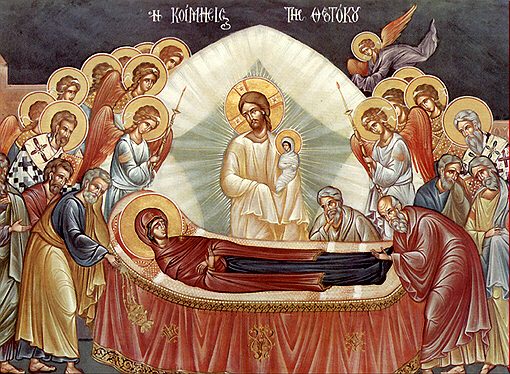
A Miracle of the Holy Virgin
Ay the Holy Monastery of Philoteous (Mt. Athos) during the German occupation, the stock of wheat was almost getting to the end and the fathers have decided to cut the charitable work! But a holy elder, Father Sava, was saddened by the fact and ask the leaders of the monastery not to do so because they will grieve Christ and His blessing will depart from the monastery. The elder appealed to many examples from the Scripture as the prophet Elijah, the Samaritan woman and others and, ultimately the fathers of the monastery listened to the elder. However they will say to elder Sava often:
– The wheat is almost finished. What are we ought to do? But the elder replied:
– My beloved fathers, that little that we have left will share with others, and our Most Holy Lady will not abandon us.
There were only 25 pounds of wheat remained in monastery stock and nothing else, thus the fathers begun to complaint again to the elder:
– Well, Father Sava the wheat is over. And now?… But the pious and faithful elder replied:
– My blessed children, do not lose hope in our “Sweet Kiss” (the Mother of God). God will take care of us all as a Good Father.
But once they have finished the bread and even before becoming hungry, a captain from Kavalla came to the monastery and asked to trade wood for wheat.
And seeing the care of the most Holy Virgin Mary that, like a good mother took care of her children, all fathers have praised and glorify God and thanked the Holy Virgin and elder Sava whom, by his holy life, was pleasing to the Virgin.
After this story the elder tells his fathers:
– Did I not say to you my beloved, that our Lady will not abandon us?

The Life of Father John (Iacob) the Romanian
Fom the Miracles of St John
The Miracles of Saint John Jacob Performed During His Reverence life
Father loanichius Paraiala (his spiritual child), as a result of a strike at the right elbow, had got an infection, and after a few years of suffering had got a tuberculosis of the bones. He had an open wound at his elbow, and through the infected wound, at the same time with the matter that drained all the time, there began to come out chips and pieces of decomposed bones.
Then the abbot of the monastery took father loanichius to a hospital in Jerusalem where the doctors decided that the father’s arm had to be cut, to which he said: ‘If I am to die from this, I want to die with all my limbs complete’, and he refused all medical intervention, running away from the hospital. When he arrived at the monastery, Saint John began to bandage him up, and to wash his wound with tea plants, and after a few washings the wound closed and healed.
Father loanichius said that as soon as Saint John put his hand on him, he felt a great quietness, the pains left him, and he was filled with a holy peace and joy, so that he felt no kind of pain .any more.
His arm recovered, but in exchange, it became rigid from the elbow.
~~~~~~~~~~~~~~~~~~~~~~~~~~~~~~~~~~~~~~~~~~~~~~
After the moving of Saint John at the cave of Saint Anna from Hazeva, father loanichius Paraiala carried with the donkey of the monastery some pieces of board, and some pieces of plate taken from some plate barrels, in order to separate the cell of Saint John. While going on a narrow and winding path, the donkey was frightened by a bird that flew out of the bush, and it threw father in an abyss of almost 20 metres.
Then father loanichius broke the same arm also from the elbow, he hurt his head and legs, and he could hardly get out of the abyss, and he could hardly arrive at the cave of the Saint who, when he saw him, was frightened too, by the way he looked.
He washed him, he tied his wounds, and his right hand was hanging from his elbow because the bones that had been caught and blocked were now broken, and his arm
Then Saint John tore a shirt, and with some towels wrapped up around his neck, he tied his arm a little bent from the elbow, and in a short time it cured again, and his right arm remained that way a litlle bent and fixed, so that he couldn’t even do the cross.
But the way he was, he worked in the garden, in the kitchen, he made bread and communion bread, he cleaned the church, he lit the icon lamps, and he did all the other obediences, because for a long time only he and father abbot Ambrose had been in the monastery.
So, this way, Saint John healed father Ioanichius twice.
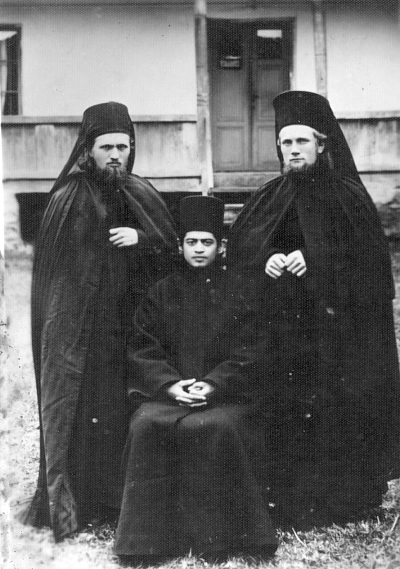
When Saint John was at the Monastery of St. Sava, there came a lot of old Bedouins or pilgrims, that fell ill on the way to the monastery, and as soon as he put his hands on them, the pains relieved them, and in a short time they recovered. The Moslem Bedouins that had known him tell about these, and they used to call him the doctor of the monastery.
~~~~~~~~~~~~~~~~~~~~~~~~~~~~~~~~~~~~~~~~~
When Saint John was at the cave one night, right at midnight some Jews came with their lanterns lighting, searching the caves where once hundreds of hermits had lived there. These were raking and digging, looking for old patrimony objects.
Not far from the cell of the Saint it was a cave in which there were put tens of skulls, and hundreds of bones of the Holy Fathers that had ended their lives in the caves.
When the robbers came near that cave, the Saint saw their flash lights, and heard them talking what they were planning to do.
Then Saint John with his hands up to the sky cried: ‘God, will you allow those outlaws break the quietness of your elected ones?’ And a great miracle happened right on the spot because the mountain fell down covering the entrance mouth of the cave, and the robbers ran away frightened falling at the bottom of the abyss from where they could hardly get out wounded, and nobody could disturb the peace of those saints.
There it became real God’s word that: if you have as faith as a mustard seed, you will move the mountains, too.
Here is how at Saint John’s pray the mountain quaked, and it did not allow those outlaws to come nearer and to disturb the peace of His Saints.
~~~~~~~~~~~~~~~~~~~~~~~~~~~~~~~~~~~~~~~~~
When Saint John lived at the cave, a Greek monk called Mitrofan, who was a painter came from the Holy Mountain. When he saw the loneliness and the quietness of the desert, he told Saint John that he wanted to come there too, but that first he had to go home to put order into his problems, and then he would come, but the saint told him: ‘If you want to come, come as you are now, and if you want to go to put order into your house, you will never come.’
Then father Mitrofan returned to the Holy Mountain, and he began to paint again some churches for two years with the thought of gainning some money, so that he won’t be in need of anything when he came in the desert.
Father Mitrofan had an apprentice that worked with him at the paintings.
That one stole him some bmshes, and other materials of great value, and the father scolded him, after which at night the· apprentice waited for him on a path and killed him.
So the prediction of Saint John became real, that if he did not come the way he was, then he would never come.
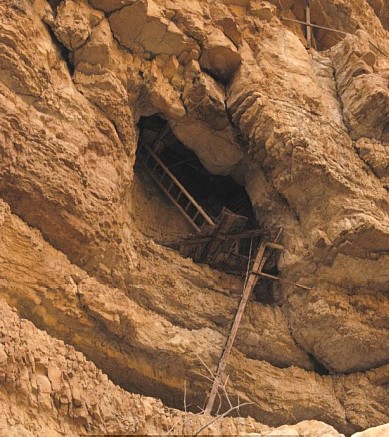
Another miracle performed by Saint John through his word when he was alive, it is told by His Reverence himself in what follows. I express exactly the words and lines written by Saint John: ‘Two years ago when father Sava came for the first time to the Jericho being very ill and disappointed, I wrote these lines to him and I asked him to keep his courage, and not to abandon us. Here is what I wrote to him then – here are the lines to father confessor Sava:
Keep the poverty of old age a little more,
Stop on the edge of life,
And first, think:
To whom do you leave your sons?
There where the Heavenly Height
Will see you, Holy Saint Sava,
He will ask you the question,
About the state of our souls.
So, prepare your disciple,
Which is worth taking your place,
Ahead the flock so poor,
And then you move in peace!
So, writing to him those lines, our old Father listened to me, and with God’s gift he gained strength and he lived two years more.’
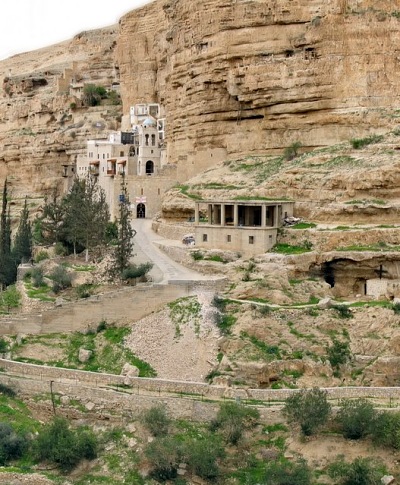
The Miracles Performed qfter He Passed Away to God
After the Relics of Saint John were brought, and they were put into the church, the Patriarch Benedict and another two bishops, summoned the synod in order to bury back the Saint saying he was not a saint, and he was not a Greek. Others said that he should be put in the grave of the monastery that was under the church, having an entrance under the staircase that climbed up to the belfry and the monastery.
But there were deposited there wheelbarrows, spades, sacks of cement, and all kinds of tools because at that time it was made the way that descended from the road to the monastery; and so, the Saint was left into the church because they did not have where to put him.
After a while when the Patriarch and the two bishops saw that there were many pilgrimages, and many people talked about St. John from Hazeva, they summoned again the synod, and they decided to bury St. John.
Immediately after that decision, the Patriarch had an infarct and he died, one of the bishops had a kidney obstruction, and in a year, all the three of them that wanted to bury St. John, died.
~~~~~~~~~~~~~~~~~~~~~~~~~~~~~~~~~~~~~~~~~~~~~
There came a group of pilgrims from Greece to cross themselves at the Holy Places, and when they arrived at Hazeva, a woman believer among them, called Hellen, when coming near the holy coffin of the Saint, said: ‘ 1’d better did not come to see this dead man which some consider to be a saint.’
When she arrived late at night to Jerusalem she couldn’t sleep, and when at daybreak she fell into a light slumber, she dreamt St. John young, with a lighted face, handsome, and he said to her: ‘Hellen! Why were you frightened by me, and what harm had I done to you?’
The following day Hellen wanted to come to Hazeva, and to pray the Saint to forgive her, but that wasn’t possible because she had to go back to Greece together with the other pilgrims.
Since then, a headache and a fright had kept bothering her until the following year she came, and she crossed at the holy coffin of the Saint, and then she healed, and she asked father Ioanichius to give her an icon of the Saint. Father had no icon, but he gave her a photo she received with great gladness, and every time she came to Jerusalem from then on, she said that the Saint helped her very much when she mentioned him in her prayers. That way she brought to the knowledge of many people from Greece the power of St. John Jacob the Romanian from Hazeva.
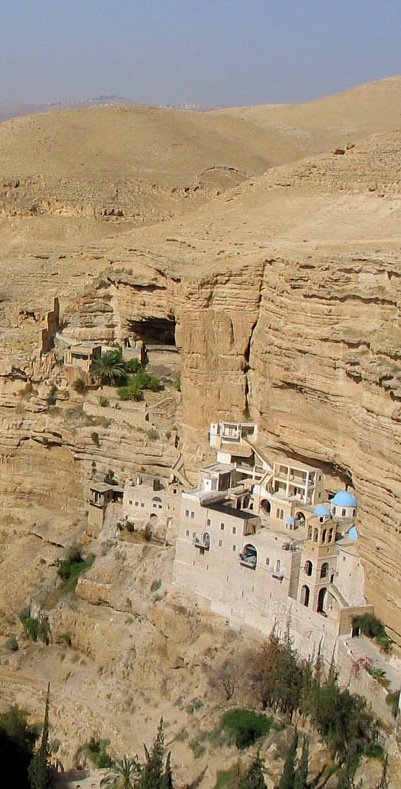
Another Christian woman from Australia dreamt a monk who told her to gather money for a holy coffin of a Saint with whole Saint Relics, but she was not told what was the name of the Saint. The following day she began to tell the dream to some more acquaintances, but nobody knew anything about that Saint.
After the Holy Relics of St. John were descended from the cave, and they were put into the church in a coffin, a group of orthodox pilgrims from Cyprus came. In that group there was a Christian woman called Cleopatra, who had seen in her dream St. John, who told her he hadn’t where to stay, he hadn’t a holy coffin. Then Cleopatra paid the money, so that the holy coffin of the Saint could be made, on which it was written it had been donated by Theodosius and Cleopatra Marcu from Cyprus.
~~~~~~~~~~~~~~~~~~~~~~~~~~~~~~~~~~~~~~~~~~~
After father abbot Amfilohius had passed away to eternity, the monastery had been left without an abbot for four years.
During that time father Ioanichius was the only monk that kept the icon lamps burning, read daily the seven praises, received the pilgrims coming to pray, and took care of the whole monastery. Then there came a Serbian father monk from the Holy Mountain, called hiero-monk Gregory who served the Holy Liturgy on Sundays and on holidays, together with father Ioanichius and nun Magdalene, when they came to receive the Holy Eucharist.
When father Gregory went to incense, after he incensed the Holy Icons and the Holy Relics, he used to pass on, without incensing the holy coffin ofSt. John because he had no piety for the Saint, and he said that he knew from the Patriarchate that father John was not a Saint, but father Ioanichius made him a Saint. One morning when he came out with the censer, he saw St. John standing up near the holy coffin and he told him: ‘You have incensed all the saints. Do you have anything against me? What wrong have I done to you that you don’t incense me, and speak ill of me?’ From then on, father Gregory had great piety, and he prayed a lot to St. John, and he said to many people what had happened at the holy coffin of the Saint.
~~~~~~~~~~~~~~~~~~~~~~~~~~~~~~~~~~~~~~~~~~~~
In 1988 the Patriarch Diodor of Jerusalem, named as an abbot at Hazeva hieromonk Sinesius, who had been before, the intendant of the Patriarch. Father abbot Sinesius was a young man of 24 when he came to Hazeva.
Like the other Greeks of the Greek Patriarchate neither that one had piety for St. John saying to father Ioanichius that he knew from other fathers and bishops that father John was a Romanian monk, and because of some sins he hadn’t putrefied, and that father Ioanichius cried up to all the pilgrims that came to Hazeva that he was a Saint, but in fact he was not.
In 1989 there came to Hazeva a Greek deacon from the Holy Mount, called Nichiforos.
That one was born in Germany. His father was a Turk that worked in a car factory, and his mother was a Greek from Greece, who had gone to Germany with her mother since childhood, and they had setded there.
Nichiforos’s grandmother (his mother’s mother) was of Macedonian origin, she had left Constanta in her youth with her parents, and she had gone to Greece where she had married a Greek, who had died after Nichiforos’s mother had been born.
Nichiforos’s grandmother grew him up in God’s fright. She took him and she christened him when he was older, in Greece, without his father knowing it, because he was a Moslem. When he was 18 he went to the Holy Mount and turned a monk, then after two years he went to America where the metropolitan bishop Natanail ordained him a deacon.
After a short time he went again to the Holy Mount where he made himself a hermit. Then he came to Jerusalem, where he met father abbot Sinesius, and that took him to Hazeva because he was alone between two Romanians and a Serbian.
Now, there were two Greeks against St. John and the two Romanians. Although the hieromonk Gregory had great piety for St. John, he could not say anything because he was also a foreigner as we were.
One day father abbot Sinesius scolded father Ioanichius because he took some Romanians to pray to the holy coffin of the Saint, and he gave them some books with the poems and the learnings ‘Spiritual Food’, and he forbade him to write anything about St. John saying that, that buried corpse stank (had a fetid smell), and that he had to be buried.
Then father Ioanichius sighed deeply, and he told him in my presence: ‘It won’t be 40 days, and you’ll see with your eyes, and your disciple too, if St. John is a Saint or not.’
The next morning I saw father abbot Sinesius entering the church with his beard out, and when father Ioanichie asked him why he had cut his beard he said: ‘A monk came last night in my cell which beat me terribly, and set fire on me, but there was nothing that could be burnt in my cell except for my beard.’
Then every night, for 40 days, that monk would come and beat him the whole night, until he confessed his guilt and he prayed to the Saint to forgive him.
During that time Nichiforos contradicted us all the time with regard to St. John to whom father Ioanichius told: ‘Never mind, St. John will take care of you, too.’ After that, Nichiforos began to go to the Bedouins, to eat and to sleep with them in their huts. After 6 months Nichiforos went to the Jericho, he took off his monk clothes, he left the great hermit clothes, he baptized as a Moslem, he got the name of Mustafa, and he married an Arabian widow with two children.
During that time father abbot Sinesius was moved too, in his place the Patriarch of Jerusalem brought another father abbot from the Monastery of St. Sava, father Anthony.
But as the other father abbot, neither that one had too great a piety for St. John, he didn’t treat us like Sinesius did, in exchange, for him, the Saint was father John, not the Saint.
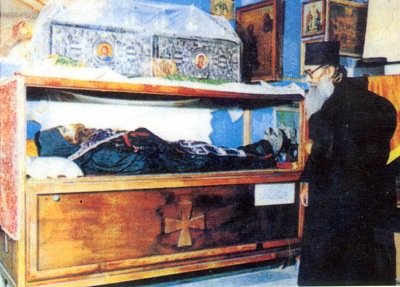
After St. John was canonized by the Romanian Orthodox Church, the Patriarch Diodor of Jerusalem settled to send to Romania two Metropolitan bishops of the Jerusalem Patriarchate to a Pan-Orthodox Synod that was organized by the Metropolitan Church of Moldavia in J assy.
The Patriarch of Jerusalem decided to send to Romania together with that two Metropolitan bishops, a piece from the Holy Relics of St. John.
Then, the Patriarch sent father abbot Antony to bring him a finger from the hand of the Saint to send it to Romania.
Father Abbot Anthony was in a hurry, he opened the holy coffin of the Saint, he broke in a hurry a finger from the right hand of the Saint, and that was all. He remained stiff with the Saint’s finger in his hands, and he felt a mortal cold shiver from top to toe. He felt on his head a cold hand, then a stream as cold as ice began to flow down his spine, after which some hot waves suffocated him, trying to take his soul of his chest, his heart beat so hardly that he thought something was breaking in his head, and he had a terrible buzzing in his ears, and he could not hear or see anything.
He would have wanted to shout at St. John to ask for his forgiveness but he had no voice. But his mind was clear and he said in his thought: ‘Saint John, I had sinned before you out of ignorance but now, please forgive me, and don’t punish me for my ignorance and my sins.’
Then it was a great miracle, and father Anthony was set free from those terrible ties, after which he put the Saint’s finger in his place, he fell down on his knees near the Saint’s holy coffin, he prayed a lot, after which crying, he entered the altar, he dressed with all the priest’s vestments, he burned the censer, he incensed the holy altar and the church, the holy coffin of St. John and for the first time a Greek priest sang to him the hymn of the Saint: ‘Into you, father … ‘ then he knelt again by the holy coffin of the Saint, he prayed a lot after which he opened the lid of the holy coffin, he kissed the hands of St. John, he took with great care and shyness the Saint’s finger, he put it in a silver box wrapped in a vestment, and he carried it to the Patriarchate. That miracle was performed in August 1992.
Since then, the father abbot had prayed much to St. John, he sang his hymn, and he mentioned him in all his prayers, and then he mentioned St. John with all the other Saints.
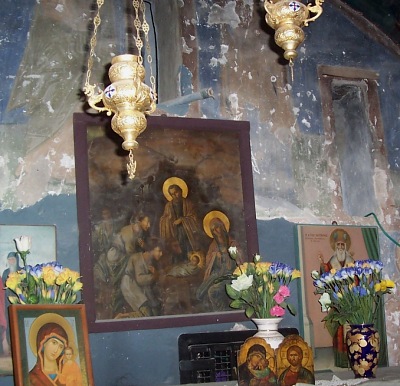
Not long after that, a group of worshippers from Greece entered the church, that left after they had prayed. Their guide saw that a woman was missing, so he went back to the monastery thinking she fell, and she had an accident on the stairs. He called for her, and he looked for her everywhere, and he found her by the Saint’s holy coffin, crying and praying, on her knees.
At that time I was in the church, and I changed the candles left burning by the worshippers. When the guide entered the church, father abbot Anthony came with him. Then the guide shouted at the woman saying: ‘Ela Maria. Let’s go Maria, the coach is leaving, and it’s a long way to go to the other monasteries, too.’
Maria stood up crying, she took the ring off her finger, she took off from her neck a golden chain with a medallion and a golden cross, she took her watch off her hand, and sobbing she said: ‘Let everybody leave because I don’t need anything from now on, and I don’t go anywhere because now I healed here at the holy coffin of the Saint from a hard disease I had suffered for 15 years, after I had given birth to a boy called Ioannis (John).’
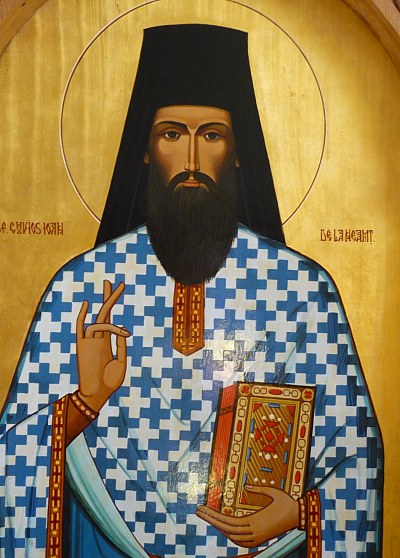
In April 1994 a group of worshippers from Greece came to Hazeva. There was in the group a woman with her daughter. The mother was almost 50 years old, and the daughter was almost 18 years old.
When the daughter tried to come near the holy coffin of St. John with a burning candle in her hands, a Greek monk Ghermanos stopped her because she was not dressed properly. Her mother being together with her daughter, making great noise, was down upon monk Ghermanos saying that her daughter, being a young lady, could dress as she liked. Monk Ghermanos replied: ‘The church is a holy place, a place of praying. It IS not a place of entertainment, and not a beach where you can go no matter how, even undressed.’
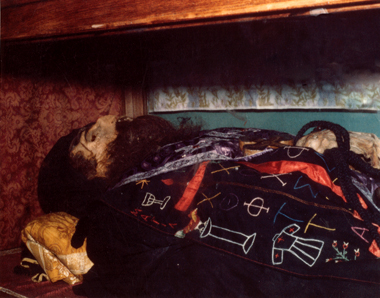
The daughter felt uneasy, she went out on the balcony, and when her mother approached to kiss the holy coffin of St. John, the Saint turned his head to her he sighed deeply, and the Saint’s face was covered all over by water drops.
The woman screamed, and she ran away down the stairs scared, descending towards the gate, where she fell down breaking both her legs.
All were frightened by that happening. The fathers of the monastery took a litter, and they helped the woman to be carried to the coach.
The woman confessed in front of everybody that she was guilty because she hadn’t brought up her daughter well, and when she came near to worship, she doubted the Saint, thinking he was a corpse, not a Saint.
Then asking father Ghermanos for forgiveness, she confessed that Saint John punished her for her sins.
Since then, St. John had remained with his head turned to the right, as ifhe reproved those who approach without piety, and dressed indecently.
(Taken from “The Life, The Miracles and the Akathistos Hymn of St. John Jacob, from Hazeva)
Akathistos Hymn to Saint John Jacob the Romanian
(written by Saint John Jacob’s disciple, father Ioanichius Paraiala)
Kontakion 1:
To thee, O great hermit of the Church of Christ, O pastoral adviser of the monks and offspring of Moldavia, come all ye faithful Christians to praise and cry out:
Rejoice, O pious Father John the New from Hazeva!
Ekos 1:
The Creator of Angels and of mankind, our Lord God Almighty has chosen thee from the beginning to leave all vanity of this world and with thy heart enflamed by divine love, thou ran to the salvation of reclusory, for which wondering we sing to thee:
Rejoice, thou who from childhood hast loved God;
Rejoice, for been burned by thine divine love, thou ran away from all vanity;
Rejoice, thou who rose from faithful parents Maxim and Katherine;
Rejoice, thou who didst receive the name of the Holy Prophet Elijah at thy baptism;
Rejoice, thou who wast left an orphan since childhood;
Rejoice, for Maria thy grandmother took care of thee;
Rejoice that for a while she was thy earthly protector;
Rejoice for she had taught thee in thine Holy Christian Faith since childhood;
Rejoice, for thy childhood had been difficult;
Rejoice, for it hast helped thee to gain eternal life;
Rejoice, O pious Father John the New from Hazeva!
Kontakion 2:
Having followed the schools of the time in thy village and alienated from thy acquaintances O father, thou hast kept in thy soul the yearning for the supreme serving of Christ, never taking part in childish games but always singing from thy heart to Thee: Alleluia!
Ekos 2:
When thou wert only 10 years old, thy grandmother and only earthly comforter dying, thou wert entrusted to see in the Holy Altar of the Church, a marvelous vision of Thy Resurrection of Christ our Savior, for which we sing to thee:
Rejoice, for having a pure heart thou saw Christ our God;
Rejoice for at the grave at thy parents, thou often used to go to burn candles;
Rejoice, for God hast been thy only comfort, strengthening and hope;
Rejoice, thou who from early childhood didst show to be a fervent worker of the prayer of Jesus;
Rejoice, for thy heart was not attached to vain things;
Rejoice, for thou hast taken Christ’ Pure Mother as thy protector;
Rejoice, for in thy loneliness, thou didst find quietness;
Rejoice, for in God’s will thou hast entrusted thy life;
Rejoice, O pious Father John the New from Hazeva!
Kontakion 3:
Having finished primary school in thy native village, the gymnasium then the secondary school, thou hast confessed thy thoughts to thy Elder – Abbot Eugene Laiu, wanting to become a monk and to sing unceaselesily to Thee: Alleluia!
Ekos 3:
Giving up all the vanity for Christ’s love and praying before the relics of the Holy Martyr John the New from Suceava, thou didst follow thy way to sacred Monastery of Neamt, for which we sing to thee:
Rejoice, Allhappy soul loved by God;
Rejoice, for bishop Nicodim Munteanu didst accept thee;
Rejoice, for thou wert given the obedience to the sick;
Rejoice, for thou didst help many by learning the physician’s skills
Rejoice, thou who didst wonder at thine creation;
Rejoice, thou who day and night un-ceaselessly prayed to Thy Heavenly Father;
Rejoice, for thy great zeal in reading spiritual councils;
Rejoice, thou who greatly loved thine Holy Church, thine people and the spiritual writings;
Rejoice, O pious Father John the New from Hazeva!
Kontakion 4:
After becoming a monk, thou took the name of the Great Baptist John, O pious father and sought God’s care day and night, for thee wert to live the life of a hermit in places where thine great prophet dwellest and sung to God: Alleluia!
Ekos 4:
As once Abraham left thy country and thy relatives, o father so didst thee left Moldavia for thine Holy Places, for which we sing to thee:
Rejoice, thou follower in the faith of the Patriarchs;
Rejoice, for resembling the Saints with thy strive;
Rejoice, thou – obedient with Abraham;
Rejoice, with Jacob who saw God;
Rejoice, thou without wickedness like Moses;
Rejoice, like David in meekness;
Rejoice, for thou didst show the patience of Job;
Rejoice, thou who reproved errors, with the boldness of the Great Baptist;
Rejoice, foreseer of the future with the old prophets;
Rejoice thou who fervently prayed at thine Holy Places;
Rejoice, O pious Father John the New from Hazeva!
Kontakion 5:
At the instruction of Holy Patriarch Damianos from thine Holy Church of Jerusalem, thou were accepted in the covenant of Saint Sava, singing to Thee: Alleluia!
Ekos 5:
Thy struggles in the monastic obedience were many, O pious father, but with the help of Thee, Whom you dearly held in thy heart, thou didst carry everything with love, for which we sing to thee:
Rejoice, O pious Father John;
Rejoice, follower of Saint Sava in virtues;
Rejoice, thou who resembled Anthony in holiness;
Rejoice, thou who didst strive as the Great Arsenius;
Rejoice, that all the badly sick fathers were seeking for thy help;
Rejoice, with the Great Sisoes in deeds;
Rejoice, consolation of the Christian’s pilgrims seeking for thee;
Rejoice, that for thy great charity
“Physician of the monastery” all called thee;
Rejoice, that through the miracle of thine Holy Mother, thou were saved from the Bedouins’ attack;
Rejoice, thou who carrest for all as didst Christ thy Master;
Rejoice, O pious Father John the New from Hazeva!
Kontakion 6:
Longing for the life of a hermit, O father, thou took the blessing of hieromonk Sava to depart for Kumrran desert, singing to Thee: Alleluia!
Ekos 6:
Thy stay in Kumrran wast short, O Father, when the Bedouins rushed in with their cattle so thou had to depart for the cave of Kalomana in the Valley of Jordan, for which thee hear from us:
Rejoice, thou who searched for silence;
Rejoice, that from the attack of a wild beast, thou wast saved through a great miracle;
Rejoice, that departing from passions, thou didst oppose evil;
Rejoice, thou who dwelled not far from the Monastery of Saint Gherassim form Jordan;
Rejoice, for great harness thou didst endure there;
Rejoice, for having settled in Kalomonas cave, thou didst receive a disciple;
Rejoice, thou who wast consumed by the same zeal and love for Thee;
Rejoice, for in the Jordan Valley, thou sang praises;
Rejoice, thou who wast struck by a serious illness of the stomach;
Rejoice, for despite of thy illness, thou carried out the monastic law and the cannons;
Rejoice, O pious Father John the New from Hazeva!
Kontakion 7:
This illness hast tormented thee for one-half year, O Father, and thee grew even weaker to a total exhaustion, but with joyful heart thou sang to Thee: Alleluia!
Ekos 7:
When the war burst in the Holy Land, thou wert put in the concentration camp with the Italians and the Germans for almost a year, for which hear from us these:
Rejoice, for these temptations didn’t frighten thee;
Rejoice, thou who didst endure all for Christ’s love;
Rejoice, for in the storms of life, thou grew stronger;
Rejoice, that in troubles and pain, thou hast run to God for help;
Rejoice, that weakened by the stomach pain, thy only hope was from Above;
Rejoice, that from the camp thou wast saved by the power of Jesus;
Rejoice, for once again, thou wast received in the Lavra of Saint Savas;
Rejoice, for thou wert ordered to the same obedience;
Rejoice, for thou went to the Monastery of Saint Theodosius;
Rejoice, thou who wast healed from Above’
Rejoice, O pious Father John the New from Hazeva!
Kontakion 8:
Having being deemed worthy to be received into the holy order of the deaconate and then the priesthood at our Lord Holy Sepulcher in Jerusalem, thou wast longing to go to the desert, singing to Thee: Alleluia!
Ekos 8:
So great was thy joy when thou arrived at a quiet place, having becoming the Abbot of the Romanian Skete in Jordan, thou prayed for thy native country and for all thine people, for which hear from us these:
Rejoice, thou who served with great zeal at the Skete in Jordan;
Rejoice, for great were thy battles;
Rejoice, that for 5 years thou hast served at this Romanian Skete;
Rejoice, that from there thou hast travelled to the Hazeva Desert;
Rejoice, O father much longing for the desert;
Rejoice, for in the Monastery of Saint George from Hazeva, thou hast served for a year;
Rejoice, thou who didst seek for a complete silence;
Rejoice, for in the sweat of reclusory, thou put out the coals of thy passions;
Rejoice, O pious Father John the New from Hazeva!
Kontakion 9:
Through God’s grace and the care of thine Pure Mother, thou arrived at a place of quietness and total collectedness in the cave where Saint Anna hast lived the life of a recluse, singing to Thee: Alleluia!
Ekos 9:
Burnt by the desire to live the rest of the days in that blessed place, thou hast strived in great labors, for which hear from us these:
Rejoice, seer of God;
Rejoice, dwelling of heavenly light;
Rejoice, for been crucified to the world, thou offered thyself as a sacrifice to Thee;
Rejoice, model of salvation of the country Above;
Rejoice, firm ground of the hesychasts;
Rejoice, rare flower of the Jordan Valley,
Rejoice, great hermit and instructor of the monks;
Rejoice, elect guardian of chastity;
Rejoice, fervent servant of thine Most Pure Mother;
Rejoice, for been enlightened form Above, thou hast accepted the priesthood;
Rejoice, O pious Father John the New from Hazeva!
Kontakion 10:
Having been difficult for many to reach that secluded place, thou didst receive at thy cave only those souls genuinely seeking salvation, urging them to unceaselessly sing to Thee: Alleluia!
Ekos 10:
Thou hast instructed all thy spiritual children to remember death, the Day of Judgment and the Holy Sacrifice of our Merciful Christ, for which we sing to thee:
Rejoice, father John pious thinker;
Rejoice, with Basil the Great teacher of the remembrance of death;
Rejoice, skillful instructor with John the Golden Mouth;
Rejoice, server of Liturgy with Saint Gregory;
Rejoice, O Father dwelling with thine angels;
Rejoice, bearer of Christ;
Rejoice, ardent guardian of the monastic promise;
Rejoice, dearest keeper of the Holy Cannons;
Rejoice, with Holy Nicodim defender of the Orthodox Faith;
Rejoice, preserver with great zeal of the Tradition of the Holy Fathers;
Rejoice, O pious Father John the New from Hazeva!
Kontakion 11:
Seeing thy angelic life in the Cave of Saint Anna, it is proper for us to strive for a sinless life, asking Christ for a new beginning and to sing to Thee: Alleluia!
Ekos 11:
Great comfort has found all those wondering to the Holy places, thy Cave and the Romanian Skete from Jordan, O pious Father, for which you hear from us these:
Rejoice, precious treasure of the One Christian Church;
Rejoice, ardent intercessor for your kinsmen;
Rejoice, chosen jewel of the pious priests;
Rejoice, strength and help for the meek;
Rejoice, for a great heavenly vision wast revealed to thee before departing this life;
Rejoice, thou who wast rise to great heights for thy striving;
Rejoice, oil with sweet fragrance of Heavenly Grace;
Rejoice, one longing for the remembrance of thy kinsmen;
Rejoice, our protector before the Righteous Judge;
Rejoice, heavenly pearl and skylight of the Romanian nation;
Rejoice, O pious Father John the New from Hazeva!
Kontakion 12:
Thy departure from this transient life was wondrous O father, when all thine saints whom thee honored and composed hymnody were awaiting thy soul to accompanying it into thine Heavenly Bliss, all crying with joy: Alleluia!
Ekos 12:
All pious Orthodox Christians rejoicing at thy holiness of life, O Pious Father John, and marveling at thy Holy Relics, they sing to thee:
Rejoice, angel in the body now rejoicing with them;
Rejoice, dweller with thine Saints,
Rejoice, intercessor with thine Apostles and Martyrs;
Rejoice, with the Righteous and Pious who left this life;
Rejoice, protector in times of danger;
Rejoice, shining star of the clergy;
Rejoice, for spiritual food thou left to us in thy writings;
Rejoice, comforter of the hopeless and despaired;
Rejoice, thou who hast work wonders though thy holy relics;
Rejoice, for venerating them, thou fillest our souls with endless yearnings;
Rejoice, O pious Father John the New from Hazeva!
Kontakion 13:
O Pious Father John pleasing Thee, receive from us this pious hymn and ardently pray to Allmerciful God for thy nation and all Orthodox faithful that we may be delivered from all snares, disgust, dangers and despair, and at the end of our lives intercede for us before thine Heavenly Throne, O father, so together with thee we may sing the angelic praise: Alleluia!
(This kotakion is read three times, then follow with the first ekos and the first kotakion).
A Prayer to Saint John Jacob the Romanian (to follow…)
Reading from the Synaxarion:
On the Sunday that falls from the 13th to the 19th of the present month, we chant the Service to the Holy and God-bearing Fathers who came together in the Seven Ecumenical Councils, that is:
– the First Council, of the 318 Holy Fathers who assembled in Nicaea in 325 to condemn Arius, who denied that the Son of God is consubstantial with the Father; the Fathers of the First Council also ordained that the whole Church should celebrate Pascha according to the same reckoning;
– the Second Council, of the 150 Holy Fathers who assembled in Constantinople in 381 to condemn Macedonius, Patriarch of Constantinople, who denied the Divinity of the Holy Spirit;
– the Third Council, of the 200 Holy Fathers who assembled in Ephesus in 431, to condemn Nestorius, Patriarch of Constantinople, who called Christ a mere man and not God incarnate;
– the Fourth Council, of the 630 Holy Fathers who assembled in Chalcedon in 451, to condemn Eutyches, who taught that there was only one nature, the divine, in Christ after the Incarnation, and Dioscorus, Patriarch of Alexandria, who illegally received Eutyches back into communion and deposed Saint Flavian, Patriarch of Constantinople, who had excommunicated Eutyches;
– the Fifth Council in 535, of the 165 Holy Fathers who assembled in Constantinople for the second time to condemn (which we celebrate on July 25th)
Origen and Theodore of Mopsuestia, the teacher of Nestorius;
– the Sixth Council in 680, of the 170 Holy Fathers who assembled in Constantinople for the third time, to condemn the Monothelite heresy, which taught that there is in Christ but one will, the divine; and
– the Seventh Council in 787, of the 350 Holy Fathers who assembled in Nicaea for the second time to condemn Iconoclasm.
On the Importance of Holy Tradition
By Father George Calciu
Faith has its place in a balanced Orthodox environment, and a natural relationship with the world. What I mean is that we live in the world and must do what it takes to survive in it, but not at the cost of compromises, betrayals, or renouncing Christ. Orthodoxy gives us balance.
We (the cradle Orthodox), possess a very ancient tradition. I look at the American Orthodox. They are very passionate for Orthodoxy, but they’re locking Holy Tradition. So, in a sense, they are streams branching off the Russian, Bulgarian, Serbian, or Romanian tradition, since they do not have that traditional instruction from their ancestors, as we do. We stand on a firm rock: the teachings of the Holy Fathers, the ascetic experience of the desert’ monks, the entire Orthodox Tradition handed to us in patristic books or by Oral tradition; and these, regardless of our sins, constitutes a stone foundation, that unshaken ground where our feet may walk and not sink, like a boat in which Jesus is present. We do not sink because we hold fast to tradition. Yes, we are sinners, but God preserves us when we follow Him and the teachings of the Holy Fathers, even though sometimes we fail… But is there anyone without sin? Is there anyone who has not been tempted? Who does not dirty his soul with evil thoughts, deeds or lust? But aside from all these failings, we have an unshaking ground.
This ground is the Orthodox Church, the tradition of the Holy Fathers, the Seven Ecumenical Councils, the struggle (experience) of the saints in the wilderness of Thebaida, Sinai…,in our country (Father refers here to Romania, his former country – tr.n.), and the monasteries found everywhere. Having this reaches, we do not sink.
“If I keep silent, I’ll be no different from unbelievers”
The following beautiful story is found in the Paterikon (collection of the old sayings of the Desert Fathers – tr.n.): the devil – taking the appearance of a man – came to a very holy monk and asked him: “Are you that monk…I heard off?” “This is him.” “That monk, the liar?” . ” Yes, that’s me.” ” That wicked monk?” “Yes.” “The greedy monk?”. “Yes, indeed.” “The liar who teaches the word of God, but does not live it? ” “Yes , I am one.” “That monk, the heretic?” “No. Such, I am not!”
So here is how far he would go! He accepted everything that demeaned him, but when he was tempted on heresy, he stood fast and said no. This is where the limit of tolerance is. When that tolerance goes beyond God and the Truth of our Christian faith, it becomes a blasphemy to our Lord and our soul.
The Holy Fathers had settled in Councils all aspects of church dogma that nowadays are trampled on. In the decisions of the Holy Synods many things (happening today), were foreseen: from heresies, ecumenism, denying God, public fornication, accepting as virtues: vices and perversions, to the fact of being proud to declare yourself gay. There’s no passion that the Holy Councils have not anticipated or spoken on, as they declared: him who does these is a heretic and a lunatic departed from faith and the Church .
Even (some of) our hierarchs have lost their sense of Christian dignity, which is incalculably greater than any human dignity. They place themselves under the attachment or helm of one or some another powerful elites of the day. I was greatly distressed by that. I had not yet wrote to the Patriarch (the former patriarch of Romania, now with the Lord tr.n), but I ‘ll write him later; for in a discussion I had with His Beatitude, I said:
“Your Holiness, God gave me a gift. He gave me “the gift” of suffering and through it I became wiser. Perhaps not wise enough considering all that I’ve been through (father is referring here to his 21 years of suffering in the communist gulag for having confessed the Christian faith – tr.n.), but the wisdom that God grant me gives me strength to speak up this word for Christ, for the Church and my nation;” and now I have to confess, for if I keep silent I’ll be like everyone else (who does not confesses Christ – tr.n). Because tolerance has a limit: that is not pushing beyond faith, or God. Beyond that, there is no tolerance.
Many hierarchies are silent, because “the time has come” (cf. Apoc) when if you confess (the Truth), will not be accepted in Europe (in the European Union – tr.n)! Such as this Europe means the ultimate paradise!! Will we not be accepted in Europe? (transl. note: the EU). Very good. Then know, we’ll be accepted in heaven. There (is the place), where God receives us. […]
I often wrote against ecumenism. I think I said everything I could have about this “heresy of our century ” as the Greek monks call it. I met many of the leaders of the “Ecumenist Group” and saw their compromised soul for the politics and their irrepressible desire to compromise others, even the Orthodox groups which defend the purity of faith. Whereever I go, the monks are wondering with pain and anxiety: “Where are we going with this? And to what limit shall we accept hierarchical compromise? Should we seek another jurisdiction? Shall we run towards the mountains, the forests and desert in order to be saved and escape this satanic temptation? Will we be hunted like long ago the defenders of icons by the iconoclasts? ” …
What I want to stress here is perhaps not the danger of ecumenism in itself – maybe things are not quite so serious as they may seem – but the distress that Satan is causing in the souls of monks through this ecumenism, and I mean not only in the hearts of monks from Romania, but throughout the orthodox world. This leads to anxieties and fear, and raises concerns for personal salvation from worldly dangers at the expense of sanctity and, the beginning of many compromises that once started, no-one knows where they will stop…
What I wrote here, I wanted to express to the hierarchs. But I think such letter would be doomed to be forgotten due to lack of interest and may be a cause for anger. What remains for us is prayer for the guarding of monasteries, for the inner peace of the monks and for the un-disturbance of the Orthodox life in our country and the world.
(Taken from Fr George’ Living Words, translated by EC, to be continued)
“Walking on the Sea” with Father George Calciu
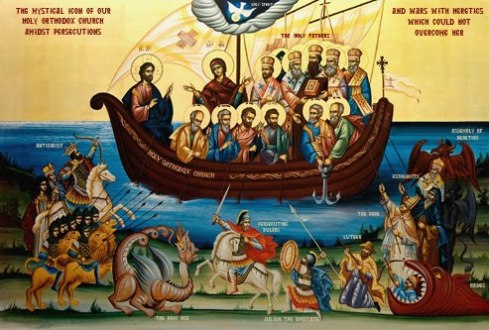
Why (get into) the boat? For it represents the Church. The church is built so much like a boat or shaped like (the sign of) the cross. The boat keeps you away from the waves of the see, but the Church from the waves of this life. And the Cross saves you from all hardships for Jesus Christ was crucified on it; and in that mystical sense, it is through the cross and our Savior’s blood shed there, that the church was founded. As for those who abandon the church, they are neither in her (the church) and nor can they be in Christ.
Peter wanted to leave the boat (the Church) so he can be somewhat greater than the other disciples, on the waves next to the Saviour. It was a temptation that he urged Jesus to grant him the power to walk on see. So Jesus bid him to walk and he did, so long as he hasn’t doubted and his faith was strong.
The Church is the only salvation of our souls. He, who places himself outside it, is a lost man. We are been saved only in her. It is inside this ship that we are washed off from our sins, and never outside it. Him who ventures to leave it, as did Peter, wanting to wonder further above the seas, after the heights of God must hold a great faith that the waves do not bend or disturb him no matter the winds, as long as his heart and mind are directed towards Jesus. But how many of us can really be saved outside this ship, such as to speak directly with God?
The Protestants say: “I have my own relationship with God and have no need of a priest or the Church, I need no sacraments, and I speak directly with God Himself!”
I do not know how much they’re speaking directly with God…, but from what I have seen, they are conversing more with their earthly interests then with God.
Our Saviour will save you from certain trials (if you cry out to Him). He will reach out His hand and caught you, and say: “O man of little faith, why did you doubt?” (cf. Matthew 14, 31).
We often travel the waters of this life and the temptations are many. In this world so troubled by snares, by wars and horrors, and by all means that will lead to its End, who can really come to Christ by walking alone on the sea? Who can venture so hard to cry out at his last minute, for Jesus to stretch out His hand and save him? For our own good and our salvation, it is best to remain in the Church. Amen!
(Taken from Fr. George’ Living Words: To serve Christ means suffering, translation by EC).
More on Elder biography and some of his writtings at: Elder Paisios
“It is good to have the intellectual powers that take man to the moon costing billions of dollars in fuel expenses and so on, but it is better to have the spiritual powers that raise man to God, his ultimate destination, with only a bit of fuel, a mere dried piece of bread” — Elder Paisios
”Spiritual Counsels” of Elder Paisios, A Spiritual Father for Our Times
The humble are like nightingales that hide in ravines and spread joy to the souls of men with their sweet songs.
We mustn’t despair when we struggle and continuously see nothing but the slightest progress. We all do nearly nothing, some a little more, some a little less. When Christ sees our little effort He gives us an analogous token and so our nearly nothing becomes valuable and we can see a little progress. For this reason we mustn’t despair, but hope in God.
Unfortunately, in our days, there are many people who upset the mother Church. Of these, those that are educated have understood dogma with their minds and not with the spirit of the Holy Fathers. At the same time, those who are unlettered have grabbed hold of dogma with their teeth, which is why they grind their teeth when they speak about ecclesiastical topics. In this way, greater harm is caused by those in the Church than by those who battle it from without.
That which is asked of every Orthodox person is to instill a “good uneasiness” into the heterodox,’ that they might understand that they are in delusion. This is so they will not falsely calm their conscience and thus be deprived in this life of the rich blessings of Orthodoxy and in the life to come of the even greater and eternal blessings of God.
The person who is possessed by material things is always subjugated to unhappiness and anxiety, for on the one hand he trembles for fear that they take his things away from him, while on the other he trembles for fear that his soul be taken from him. Now, the miser whose hand is sore from his tight hold on things, also squeezed his own heart, and turned it into stone. In order for him to be healed, he must visit unhappy people, to suffer, so he will be forced to open his hand slowly, slowly, and his heart of stone will also start to soften. It will become a human heart and in this way the gates of Paradise will also open.
When a monk doesn’t find spiritual work, he cannot be helped even by his elder, and spends his time with external things. He becomes spiritually wild and, even if he was to be tied down in his cell, he could not sit still. He will always enjoy contact with people, to give tours, to speak about the domes and archeology [of the monastery], to show them the pots with various flowers, to treat them to rich, worldly meals, and to give rest only to worldly people.
The monk flees far from the world, not because he detests the world, but because he loves the world and in this way he is better able to help the world through his prayer, in things that don’t happen humanly but only through divine intervention. In this way God saves the world.
The monk is helped greatly when the monastery is far from the world, far from archeological areas and worldly noises. Even monasteries that are great sites of pilgrimage lose sight of their true goal, for many times from being a monastery they end up as a business. For this reason some bishops, very rightly, would like to have these sites, for monastics must love poverty, which they were ordered by God to preserve. Unfortunately, however, they do not limit themselves to the necessary, the simple, as much for themselves as, more generally, for the monastery. Nor do they refuse things from the faithful, or encourage them to help, on their own, our poor, suffering brethren. But what do they do instead? They gather the sweat even of the poor and fill the monastery with a huge amount of oil lamps and bells, thinking that God is glorified in this way. This type of piety, however, is like the piety which many Russian clerics had who became the cause, though they didn’t intend it, of the oil lamps, chandeliers and bells being made into cannons so as to hit the very Church of Christ.
When an elder doesn’t have much experience, but has a great deal of love and much humility, he is able to help his spiritual children by means of the guidance of more experienced elders, as well as by the grace of God, which he continually receives due to his great humility. However, the young cleric who gathers young people as his disciples reveals his great pride, which he has down to the marrow of his bones. He is like a baby born with a beard-a monster-and those that follow him reveal that they have an ailment of the brain or heart. Also, those clerics who study psychology so as to help souls using human contrivances are not spiritually well. The strange thing is that their teachers of psychology don’t believe in God or in the existence of the soul. If they accept the soul’s existence, they do so in their own unique way. In this way these clerics show that they are spiritually sick and that they need to be examined by the Holy Fathers. Having been healed, they would be able to discern, on their own, the sick spirit and would experience divine grace at the same time. Thus from that time forth they would use the divine energy for those suffering souls and not human contrivances.
Those who rush to be made spiritual fathers, though they still have many spiritual toxins, are like unripe, sour quince, which, as much sugar as we may pour on, never becomes a nice sweet; but, even if it does, it quickly gets sour.’ Sweet words and great truths have value when they come from genuine mouths, and are received only by those souls that are well-disposed and by those great people who have a pure mind.
One word of a humble and [spiritually] experienced man that is painfully born from the depths of his heart has greater worth than a bunch of clever sayings of an external mans that come out quickly from his educated mouth. His words don’t speak truth to the souls of men, for they are fleshly words and not the flames of the fire of Pentecost.
If a passionate man tries to correct an egotist, steel hits flint and fires are ignited! If he tries to correct a sensitive person, he hurts him greatly. It would be like a wild man taking a thick wire brush to clean out a little mucus from a baby’s eye.
What a wonderful thing it will be when we know ourselves! Then humility will be for us a state of being, and God will position us well with His divine gifts. Then the spiritual laws will cease working, and the one who rises the highest will humble himself, for we will all walk low, we won’t fall and we will continually receive the grace of God which is given to the humble.
Holy asceticism, together with its great self-denial, which is born from great faith in a burst of love for God, brings man to true joy. He is happy to live, for his heart flutters, glorifying his God of benefactions. He is also happy to die, for he thus goes close to God again, and will continue there his doxology.
Virtue has the habit of betraying man, wherever he may hide. Though he may act as a fool-for-Christ,’ still he will be betrayed, though it may bee later on, and he will help many souls.
The goal of reading is the application, in our lives, of what we read. Not to learn it by heart, but to take it to heart. Not to practice using our tongues, but to be able to receive the tongues of fire and to live the mysteries of God. If one studies a great deal in order to acquire knowledge and to teach others, without living the things he teaches, he does no more than fill his head with hot air. At most he will manage to ascend to the moon using machines. The goal of the Christian is to rise to God without machines.
Let us not expect the spiritual spring if we don’t first pass through the spiritual winter during which the spiritual vermin die. We mustn’t expect the divine to blossom within us if the human hasn’t first died.
Costly (fervent) love, which sacrifices itself and does not partake of the world, is itself consumed by the love of God from within. The life of man is then a continuous Lent and all of his days are a continuous joy of light. Costly love for God, with its sacrifices sweetens the heart to boiling, and divine love, which cannot be held in, like steam, soars and so unites to God. This state of spiritual madness not only takes man out of himself, but even the heart is taken from the flesh, that is, from the fleshly desires, and is clothed completely in, and refined in God.
Those who constantly partake of the love of God are often indifferent to material nourishment. Or, if they eat, they don’t taste the food, for even then they continue to feel God intensely and to partake of the sweet blessing of His love. When the heart becomes a furnace through the love of God, it is then able to burn up all vanity that approaches, and this brings internal peace when man passes through the fiery trials of his life.
There are no people more blessed than those who have made contact with the “heavenly television station” and who are piously connected to God. In the same way, no people are more wretched than those who have cut contact with God and wander, dizzy, around the world, flipping through the world’s many television stations so as to forget, if only for a short time, the anguish of the derailment of their lives.
It is very helpful to read a bit of the Gerontikon before beginning to pray. Then your heart will warm up, the lid will come down on your many worldly cares, and you will be able to pray without distraction.
In the hour of prayer, when our mind wanders to thoughts of bad things, or if these thoughts come without our wanting them, we shouldn’t wage an offensive war against the enemy, because, even if all the lawyers in the world joined together, they wouldn’t make any headway with a little demon. Only through ignoring them can one chase these thoughts away. The same is true for blasphemous thoughts.
If you want to grab God’s attention so He’ll hear you during prayer, turn the dial to humility, for God always works in this frequency; then humbly ask for His mercy.
My brother, don’t ask for anything in prayer except for repentance. Repentance will bring you humility, humility will bring you the grace of God, and God will uphold you in His grace and will give you whatever you need for your own salvation as well as whatever is needed, should the case arise, for you to help another soul in need.
When man is spiritually healthy and distances himself from other people, so as to better help them through his prayers, then he regards all people as holy and only himself does he regard as a sinner.
If we haven’t got control of our mind during the hour of spiritual study we are not benefited at all. We simply yawn and tire ourselves without a goal, for we cannot remember anything. In the same way, when the printer doesn’t have his mind on his work and forgets to put ink in, the printing presses work without printing anything.
All evil begins in the mind, when it is interested only in science. Scientists don’t find their inner peace and their balance then. However, when their minds are attached to God, scientists use their science to cultivate their inner world and to help the world, for their minds are sanctified.
The mind, when it begins to spend time near God, oftentimes forgets, not only its dwelling, but even this dwelling of the soul, this earthen flesh.
In all things we must put forth good thoughts and refuse to accept evil telegrams” if we want to purify our heart and change the evil machines of the heart into good machines; then gold will be turned into holy chalices and broken bells into chandeliers.’ Even discarded paper will be turned into fresh napkins. When, however, the heart is evil and it views good gold as bronze, it will make it into bullets and cannonballs.
Oh, blessed desert by which created man is so greatly helped to be reconciled with his Creator, and is transformed into an earthly Paradise – as you gather once again the wild animals around the person you tamed!
As much as is possible, love the desert and the immaterial life, and fly from your material possessions to the fold of the poor. Simplify your life so as to be freed from worldly anxiety, so that your life might have meaning.
Conscience is the first law of God, which He carved deeply into the hearts of the first-created. In turn we each make a photocopy from our parents when we’re born. Those who manage to heighten their sense of conscience through daily study of themselves feel themselves to be foreigners in this world, and worldly people are baffled by their gracious behavior. Those who haven’t studied their conscience benefit neither from their spiritual studies nor from counsels from their elders. They won’t even be able to keep God’s commandments, for they have lost their senses altogether.
The soft life makes people useless. Without toil and struggle sanctification doesn’t come.
When one realizes one’s sinfulness and the great mercy of God, the heart cracks, as hard as it may be, and real tears fall of themselves and then man prays and weeps without effort. This is because humility works continuously together with philotimo and drills on the heart so that the springs increase, and the hand of God continually strokes the hard-working and philotimo child.
Let us struggle with all our powers to gain Paradise. The gate is very narrow, and don’t listen to those who say that everyone will be saved. This is a trap of satan so that we won’t struggle.
Christ is wholly love, goodness and consolation, and never suffocates. He has an abundance of spiritual oxygen.
[God allows temptations] so as to dust off our soul, for it to be purified through sorrows and weeping, so that we are forced to take refuge in God for our salvation.
Theology is the word of God that is comprehended by pure, humble and spiritually reborn souls. It is not the beautiful words of the mind which are formed with philological artistry and which are expressed with the juridical or worldly spirit. Created words can’t speak to man’s soul, just as a beautiful statue is not able to speak, unless the audience is very worldly and is satisfied simply by beautiful words. Theology that is taught as a [worldly] science usually examines things historically and consequently understands things externally. Because patristic asceticism and inner experience are absent, this theology is full of doubts and questions. With his mind man is not able to comprehend the divine energies unless he first struggles ascetically to live these energies, so that the grace of God might work within him.
Children contract their first spiritual colds from the open windows of their parents’ senses. The mother passes on her cold especially when she is not modestly dressed and scandalizes her children with her behavior.
The holy life of parents instructs the souls of their children and so they naturally obey them and grow up with piety and without psychological problems, and the children are pleased with their parents. The parents are gladdened by their children in this life and in life eternal, where they will once again glory in them.
Whoever is at peace in the material world and is not concerned about the salvation of his soul is like the senseless birds who don’t make a noise from within the egg, so as to break the shell and come out to enjoy the sun-the heavenly flight in the life of Paradise-but instead remain unmoving and die inside the egg shell.
The pretense of worldly politeness is very harmful, for it fools one and opens one’s heart to the worldly person, and in the final analysis it wastes one’s piety, for the worldly person doesn’t know what piety is. It’s like giving golden pounds to people that only know bronze pennies.
Blows are necessary for the salvation of our souls, for they cleanse the soul. The more one hits and rubs clothing, the better it is cleaned. Similarly, the more one hits octopus and cuttlefish, the more they are softened and washed from ink.
Live in constant glorification of and thanksgiving towards God, for the greatest sin is ingratitude and the worst sinner is the ungrateful person.
At the beginning of the spiritual life, out of love, God doesn’t allow anyone to realize either his sinfulness or the many benefactions that He bestows on him, so as to keep him from despair, especially if he is sensitive.
Those who are in the world must not despair when they are overcome by many passions, and when their nature is unruly and races passionately downwards. Rather, they must trust in the almighty power of God and turn the steering wheel of their powerful engine back onto the road toward God, upwards. Soon after they will pass other, slow-moving cars, which for years have been driving the road toward God.

On Spiritual Study
(An Excerpt from ”Spiritual Awakening”)
— Geronda (elder in Greek), what books should be read by those who are beginning their spiritual search?
— First, they should read the New Testament to learn the meaning of Christ, to be shaken up a little; later they can read the Old Testament. Do you know how hard it is when they have read nothing and yet they come to ask for help? It is like an elementary school child going to a university professor and saying, “Help me.” What can the professor tell him? “One plus one equals two”? Others, again, are not spiritually restless; they come and say, “Father, I have no problems and I am just fine; I only dropped by to see you.” Man can never say that he has no problems, no concerns; he will have something. The struggle for the spiritual life never ends. Or some people come and tell me, “Tell us spiritual things.” It is as if they went to the grocery store and said, “Give us some groceries.” The grocer is at a loss and needs to know what they need. They need to say, “I want so much sugar, so much rice, and so on, but they only say, ‘Give us groceries.’ “It is like going to the pharmacy and saying, “Give us medicines,” without first saying what their illness is, or whether or not they went to the doctor, and what he advised them to do. Go figure! You see, whoever is seriously concerned over his spiritual condition knows, more or less, what he is lacking, and once he seeks it, he benefits.
As a novice, when I read something I liked, I wrote it down so as not to forget it, and I would try to apply it to my life. I didn’t readjust to pass my time pleasantly. I had a spiritual restlessness and, when I could not understand something, I would ask for an explanation. I read relatively little, but I checked myself a great deal on what I read. “What point am I at? What must I do?” I would sit myself down and go through such a self-examination. I did not allow what I read to pass me by untaxed.
Today with so much reading people end up like tape recorders, filling up their cassettes with superfluous matters. According to Abba Isaac, however, Wisdom not based on righteous activity is a deposit of disgrace. [6] You see, many who are interested in sports read sports magazines and newspapers while they are sitting. They may be like the fatted calf, but they still marvel at the athletes. “Oh he is marvellous! He is great! Bravo!” But they don’t work up any sweat, and they don’t lose any pounds. They read and read about athletic events, and then they go and lie down; they gain nothing. They are satisfied with the pleasure of reading. Some worldly people read newspapers, others romantic literature or an adventure novel, still others watch a football game at the stadium and pass their time. The same thing is done by some people who read spiritual books. They may spend the whole night reading spiritual books with great intensity and be content. They take a spiritual book, sit comfortably, and begin reading. “Oh, I profited from that,” they say. It would be better to say, “I enjoyed myself, I spent my time pleasantly.” But this is not profit.
We profit when we understand what we read, when we censure ourselves and discipline ourselves by applying it: “What does this mean? Where do I stand in relation to this spiritual truth? What must I do now?” After all, the more we learn, the more responsibility we have to live up to what we have learned. I am not saying that we should not read so that we can plead ignorance and therefore be free of responsibility, for this is a cunning deception; I am saying that we should not read merely to pass our time pleasantly. The bad thing is that if someone reads a lot and has a strong memory, he may remember many things and may even talk a lot about what he has read, and thus deceive himself into thinking that he also personally observes the many things he reads. So he has created an illusion toward himself and others. So don’t be comforted by the thought that you read a lot. Instead, turn your attention to applying what you have read. Much reading alone will only educate you encyclopaedically. Isn’t that what they call it?
— Yes, Geronda.
— The goal, however, is to be transformed in a God-centred manner. I am not aiming to be a university professor where I would need to know many things. But if I ever need something from this worldly knowledge, I can easily learn it once I have acquired the God-centred knowledge. Do you see what I mean?
— When one has a distraction, is it beneficial to concentrate through study?
— Yes, one should read a little, something very demanding, in order to warm the soul. This keeps distractions and concerns under the lid, and the mind is transposed into a divine realm. Otherwise, the mind is diverted by whatever task is preoccupying it.
— Geronda, when someone is tired or upset, he usually wants to read something light and easy, a short story or a novel, perhaps, or something like that.
— Is there no spiritual book that is appropriate for such times? The purpose is not to forget one’s worry, but to be redeemed. Such light reading does not redeem. Novels, newspapers and television have no value in developing a spiritual life. Quite often even some religious periodicals are damaging to Christians, because they stir a foolish zealousness that leads to confusion. Take care. Do not read unnecessary things during your free time. Some reading matter is completely hollow, like a water-pumpkin; it is like looking in a haystack to find a kernel of wheat. Some people say, “Yes, but they relax me.” But how can they be relaxing, my good man, if they make you dizzy and cause your eyes to ache? It is better to rest by sleeping. You can learn much about a person’s spiritual state from what he reads. One who is very worldly will probably be reading indecent magazines. One who is less worldly will read less indecent magazines and newspapers. One who is religious will read religious periodicals, or contemporary religious books or patristic texts, and so on.
— Geronda, which spiritual books are the most helpful?

— The various patristic texts, which thank God are available by the thousands today, are very helpful. One can find whatever one needs and desires in these books. They are authentic spiritual nourishment and a sure guide on the spiritual path. However, in order to be of benefit to us, they have to be read with humility and prayer. Patristic texts reveal the inner spiritual condition of the soul, much as axial tomography reveals the inner structures of the body. Each sentence of the patristic texts contains a multitude of meanings, and each person can interpret them according to their own spiritual state of being. It is better to read the ancient text rather than a translation, because the translator interprets the original verse according to his own spirituality. In any case, in order to understand the writings of the Fathers one must constrain oneself, focus and live spiritually, for the spirit of the Fathers is perceived through and by the spirit only. Especially helpful are the Ascetical Homilies by Saint Isaac the Syrian, but they must be studied slowly so that they can be assimilated little by little as spiritual food. The Evergetinos is truly of great benefit, because it gives us insight into the Whole spirit of the Holy Fathers, it is helpful because it describes the struggles of the Fathers against each and every one of the passions, and, by learning how they worked on the spiritual life, the soul is greatly assisted. Also, the Synaxaria, the Lives of the Saints, are sacred history and very helpful, especially for young people, but they should not be read as stories.
We do not need great knowledge to be devout. If we concentrate and meditate on the few things we know, our heart will be spiritually embroidered. One may be profoundly affected by a single hymn, while another may feel nothing, even though he may know all the hymns by heart, as he has not entered into the spiritual reality. So, read the Fathers, even one or two lines a day. They are very strengthening vitamins for the soul.
Endnotes
6. See Saint Isaac the Syrian, The Ascetical Homilies, Homily 1, p. 8.
7. A familiar anthology of ascetic and patristic sayings and incidents, which were compiled by the Monk Paul the Evergetinos, the founder of the famous Holy Monastery of the Theotokos Evergetithos (Benefactress) in Constantinople.
A private letter Concerning Ecumenism
The Holy Mountain, January 23, 1969
Reverend Father Haralambos,
In as much as I see the great uproar which is happening in our Church because of the various movements of groups in favor of unification [of churches], as well as the interaction of the Oecumenical Patriarch with the Pope, I was pained as Her child, and considered it good, besides my prayers, to send a small thread (which I have as a poor monk), that it too may be used as a means of stitching together the multipart garment of our Mother. I know you will show love and share it only with your religious friends. Thank you.
First of all, I would like to ask forgiveness from everyone for being bold to write something when I am neither holy nor a theologian. I trust everyone will understand me, that my writing is nothing more than an expression of my deep pain for the unfortunate stance and worldly love of our father Patriarch Athenagoras.
It appears he loved another modern womanwhich is called the Papist Churchbecause our Orthodox Mother has not made an impression on him at all, for She is so modest. This love, which was heard from Constantinople, caused a sensational impression of sorts among many Orthodox, who nowadays live in an environment of such meaningless love, in cities across the entire world. Moreover, this love is of the spirit of our age: the family will lose its divine meaning from just such kinds of love, which have as their aim breakup and not union.
With just such a worldly love the Patriarch takes us to Rome. While he should have shown love first to us his children and to our Mother Church, he unfortunately sent his love very far away. The result, it’s true, delighted the secular children who love the worldwho have this worldly love, but completely scandalized us, the children of Orthodoxy, young and old, who have fear of God…
With sadness I must write that among all the “unionists” I’ve met, never have I seen them to have either a drop or shred of spirituality. Nevertheless, they know how to speak about love and union while they themselves are not united with God, for they have not loved Him.
I would like tenderly to beseech all our unionist brothers: Since the issue of the union of the Churches is something spiritual, and we have need of spiritual love, let’s leave it to those who greatly love God and are [genuine] theologians, like the Fathers of the Churchnot the legalistswho have offered up and continue to give themselves in service to the Church (instead of just buying big candles), and who were and are lit by the fire of love for God rather than by the lighter of the church sacristan
We should recognize that there exist not only natural but also spiritual laws. Therefore, the future wrath of God is not averted by a convocation of sinners (for then we shall receive double the wrath), but by repentance and adherence to the commandments of the Lord.
Also, we should know well that our Orthodox Church does not have even one shortcoming. The only apparent insufficiency is the shortage of sober Hierarchs and Shepherds with a Patristic foundation. “Few are chosen.” This should not, however be upsetting. The Church is Christ’s Church, and He governs Her. It is not a Temple built by the pious from rocks, sand and mortar, which is then destroyed by the fire of barbarians; the Church is Christ Himself. “And whosoever shall fall on this Stone shall be broken: but on whomsoever it shall fall, it will grind him to powder.” (Matt. 21:44-45)
When He must needs, the Lord will bring forth the Mark of Ephesuses and Gregory Palamases, so as to bring together all our scandalized brethren, to confess the Orthodox Faith, to strengthen the Tradition, and to give great joy to our Mother, the Church.
In times past we see that many faithful children of our Church, monastics and laymen, have unfortunately broken away from Her on account of the unionists. In my opinion, separation from the Church each time the Patriarch makes a mistake is not good at all. From within, close to the Mother Church, it is the duty and obligation of each member to struggle in their own way. To cease commemoration of the Patriarch; to break away and create their own Church; and to continue to speak insultingly to the Patriarch: this I think, is senseless.
If, for this or that occasional deviation of the Patriarchs, we separate ourselves and make our own Churchesmay God protect us!we’ll pass up even the Protestants. It is easy for one to separate but difficult to return. Unfortunately we have many “churches” in our times, created either by big groups or even just one person. Because there happened to be a church in their kalyve (I am speaking about things happening on the Holy Mountain), they figured they could create their own independent Church.
If the unionists gave the Church the first wound, the aforementioned give the second.
Let’s pray that God will illumine all of us, including our Patriarch Athenagoras, that union of these “churches” will come about first; that tranquility would be realized within the scandalized Orthodox fold; so that peace and love would exist among the Eastern Orthodox Churches. Then let’s think about union with other “Confessions”and only if they sincerely desire to embrace Orthodox Dogma.
I would further like to say that there does exist another, third group, within our Church. They are the brethren who remain as Her faithful children, but who don’t have spiritual concord between themselves. They spend their time criticizing one another, and not for the general good of the struggle. The one monitors the other (more than himself) to see what he will say or write so as to ruthlessly nail him. However, if this person had said or written the same thing, he’d certainly have supported it with numerous passages from the Holy Scriptures and the Fathers.
Great harm comes of this; for while the one injures his neighbor, the other strikes him back before the eyes of all the faithful. Often times, disbelief is sown in the souls of the weak, because they are scandalized by such people. Unfortunately, some from among us make senseless claims against the others. We want them to conform to our own spiritual character. In other words, when someone else doesn’t harmonize with our own character, or is only mildly tolerantor even a little sharpwith us, immediately we jump to the conclusion that he is not a spiritual person.
We’re all needed within the Church. All the Fathers, both the mild and the austere, offered their services to Her. Just as the sweet, sour, bitter and even pungent herbs are necessary for a man’s body (each has its own flavor and vitamins), the same is true of the Body of the Church. All are necessary. The one fills up the spiritual character of the other, and all of us are duty bound to endure not only the particular spiritual character, but even the human weaknesses we each have.
Again, I come sincerely asking pardon from all for being so bold to write. I am only a simple monk, and my work is to strive, as much as I am able, to divest myself of the old man, and to help others and the Church, through God, by prayer. But because heartbreaking news regarding our Holy Orthodoxy has reached even my hermitage, I was greatly pained, and thus considered it good to write that which I felt. Let’s all pray that God grants His Grace, and may each of us help in his own way for the glory of our Church.
With much respect to all,
Monk Paisios
Elder Paisios explains Philotimo
(from the book “Elder Paisios of the Holy Mountain” by monk Christodoulos of Mt Athos
Father Paisios told me an incident from his childhood years:
“When I was a child and my soul was still pure, I loved Christ very much. I used to walk in the woods carrying a cross in my hands, chanting and praying and wishing to become a monk. My parents told me that I should first grow up and then leave to go to the monastery. One day, as I was taking my usual walk in the woods, I met a fellow villager. When he saw me carrying the cross, he asked me; “what is this?” “The Cross of our Christ,” I replied. Since he did not have any positive thoughts in his mind, he said to me, “Arsenios, you are silly. You don’t mean to say that you believe in God. He does not exist. These religious stories are made up by some priests. We have evolved from the monkey. Christ was simply a man like all of us.
When he finished, he got up and left. His twisted thoughts filled my innocent soul with black heavy clouds. Being alone in the woods, I began to think that maybe God does not exist. As I was feeling confused, desperate and extremely asked, I asked Christ to give me an indication of His existence, so I could believe in Him. But He did not respond. Feeling exhausted, I lay on the ground to rest. Suddenly, a positive thought, full of philotimo (responsive gratefulness), entered my innocent soul; “Hold on for a second! Wasn’t Christ the kindest man ever on earth? No one has ever found anything evil in Him. So, whether He is God or not, I don’t care. Based on the fact that He is the kindest man on earth and I haven’t known anyone better, I will try to become like Him and absolutely obey everything the Gospel says. I will even give my life for Him, if needed, since He is so kind.

All my thoughts of disbelief disappeared and my soul was filled with immense joy. The power of my grateful thought (philotimo) dissolved all the ambiguous ones. When I started believing in Christ and decided to love Him as much as I could, solely out of philotimo (responsive gratefulness), I experienced a miracle that firmly sealed my grateful thought. Then, I thought, “I do not care any more if someone tells me that God does not exist!”
As the story of the Elder regarding his grateful thought did not completely satisfy me, I asked him with a certain curiosity to tell me about the miracle he experienced I the woods. Father Paisios was found in a difficult position and replied that he could not tell me about it. This way, he indicated that I, too, should not look for miracles, but rather trust my feeling of philotimo (responsive gratefulness), as it is the key which opens the door to every good.
Later on, Father Paisios told me that he had seen the Lord.
He had this to say about Philotimo:
“The righteous Christian does not practice good acts for his own benefit, i.e. in order to be rewarded or to avoid hell and gain paradise, but rather because he prefers good to evil. Everything else is a natural consequence of the good that fills our soul without having asked for it. This way, good has dignity; otherwise, it originates from the cheap attitude of “give and take.”
From the Miracles of Elder Paisios
A live shot of the Elder (taken from the movie dedicated to the athonite fathers of the Holy Mountain)
Please see other posts on my blog with Elder Paisios at:
– On The End Times
– On Common prayers (A Word on Ecumenism)
– Seek First the Kingdom of God
– On Raising Children
– On The worries of Life

“Last Days of Elder Paisios”
Eventually, Elder Paisios got cancer and was taken to the hospital in Thessaloniki. At the hospital, they looked after him as best they could. Nevertheless, his cancer spread so much that the end was very near. His departure for Heaven was a matter of time. He had been preparing himself for this journey all his life. Thus, for whatever time was left, he wished to stay at the monastery of St John the Apostle in Souroti. Mr. Christofer Oikonomou, now deceased, was near him and he describes in a letter Geronda’s departure from the hospital:

“Today, Fr Paisios left the hospital. There were many people there. We were told that he would give his blessing in the reception. Lots of people, women, doctors, nurses, even the ailing, were swarming besides him. He lifted up his hand and said goodbye to those sick in the other rooms. There was this man, who had the drip on his hand, who bowed to kiss Fr Paisios’s hand, but Fr. Paisios kissed his instead. While standing in front of the elevator, he blessed us all. He went into the elevator to go down to the street. We all ran down the stairs to see him for the last time. People surrounded the car while snowflakes danced on the street. The nurse was admonishing us so that people would let him get in the car, because he was sick and very weak.

“He finally got in the car after crossing himself. Everyone was trying to touch him, some were holding his hand, and some were touching the glass of the window. The car began leaving very slowly because there was a lot of traffic. Even then, doctors, nurses, all came down to say goodbye and were touching the car’s windows, since the car was moving very slowly. His car passed in front of my house.”
Mr Christopher continues:
“What was that all about? People were following him as if he was the Messiah. It was like something out of Palm Sunday, except that we had a car instead of the donkey! Everyone was moved, some women were crying. He himself was also touched because of the abundant love that people were showering him with. It was as if he was saying that he would pay everyone back with a lot of praying.”

And Mr Christopher went on to reflect:
“Does our generation owe little to the prayers of this man? He is a saint amongst us. He is the embodiment of the fulfillment of the Gospel.”
Source: Vatopaidi Monastery
“Holy Father Paisios pray to our Lord Jesus for us sinners!”
See also: Sunday of the Blindman and Those who assert that they can see!
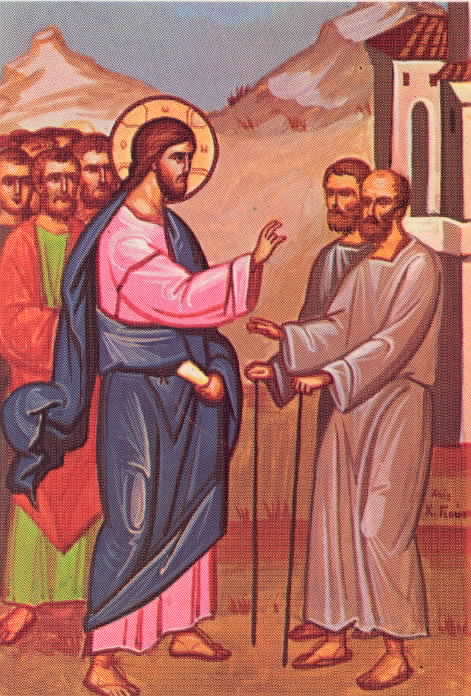
St. Nikodimus the Hagiorite – of the Holy Mountain on:
“Weak Faith”
(taken from: “What God has done for our Salvation”)
Faith is a power that dwells in the mind and the will of a man. The mind is enlightened by heavenly light and contains that which the Lord reveals to it. The will is likewise moved by God to the fulfillment of every good thing that the mind commands it to do. When faith is weak, the mind cannot understand the mysteries of God, and even before the mind understands them the will has no desire to love them. Blessed Augustine said that man can love what is invisible to him, but not what is unknown. This we see in those Christians who consider themselves believers, not because they live according to the teachings of Christ, but only because they were born of Christian parents and were baptized. In actuality they feel the greatness of the Mysteries very little, and know still less of the essence of our faith and how it differs from other religions. In this condition they differ very little from unbelievers.
I now ask every Christian: who are you, that you stand here in the church? Only by your name can I tell that you are a Christian, this being indicated by nothing else. If someone asks you who Christ was, in Whom you believe, it becomes apparent that you are unable to say anything intelligible. Thus, it is correct to say that in our days the faith of Christians has diminished, as the prophet David also said: Truths have diminished from the sons of men (Ps. 11:1); for even if they believe in the Mysteries of the Church, their faith is so confused, so cold and weak, that we can confidently say that they know them like the blind man who saw people like trees: I see men as trees, walking (Mark 8:24).
God was born in a cave and laid in a manger of dumb beasts in order to teach us not to be enamored of transitory good things. God lived for thirty years in a carpenter’s workshop, plying this trade Himself, that we might learn humility. God walked the streets of Jerusalem that He might show us the road leading to Heaven. God suffered on the Cross in order to destroy sin. Yet all of this does not touch the conscience of Christians and does not cause their hearts to tremble. And so I again repeat what I have just said: truths have diminished from the sons of men. Like truth, faith has also diminished among contemporary Christians, for their faith ought not to be simply rules for “what to believe,” but also rules for “what to do.” It should not merely consist of our believing correctly, but of our living according to our faith: Faith without works is dead (Jas. 2:26). Those who confess Christ to be the Teacher of the faith, the Mysteries, and the dogmas that He has revealed to us, nevertheless do not apply His law to their own lives. And though they hear from His lips that blessed are those who suffer for others, who refrain from pleasures, and who forgive the disgraces and offenses inflicted on them, in spite of this they transgress every commandment of God and the divine teaching of Christ, saying in their hearts: “All of this is true in relation to God, but not to the world.” Thus these unhappy ones believe that by this they will indeed be justified at the Judgment of the incarnate Wisdom of God. The faith of such people is like an amalgam of gold, which in its outward appearance is very similar to real gold, until it is thrown into a fire: then the real gold (if there was any) remains, while the mercury evaporates. So also with these people: they follow after the Divine Teacher only until they have to struggle with the passions. When the time for this arrives they leave Him to Himself. When Jesus Christ commands them to wage war with their passions and overcome them, they immediately renounce His teaching and “turn back.”
All evil comes from weak faith. Feebleness and dwindling of faith lead to the destitution of virtue and the enriching of evil. How deprived contemporary Christians are of the great wealth of the virtues that were so abundant in the first centuries of Christianity! Love for God was then so fervent that many Christians of their own free will gave themselves over to the persecutors of the faith for torture; indeed, at times there were not enough executioners to put them all to death. Love for one’s neighbor was likewise so ardent in these blessed ones that Clement of Alexandria wrote that he knew Christians who not only sold their property in order to give alms, but even sold themselves into slavery, only that they might be able to help their brothers.
Can the faith of ancient and contemporary Christians be compared? Truly, all contemporary evil comes from weakness of faith. If one cuts the branches from a tree, they may grow back; but if the root is cut the tree quickly dies. What the root is to the tree, faith is to the soul. It nourishes the soul and enables it to grow and bear fruit, and for this reason is called the root of immortality. If a Christian lives, he lives by faith, as says the Apostle Paul: The just shall live by faith (Rom. 1:17). Though such a man should come under attack from all the powers of hell, he will easily be able to put them to flight. With the help of faith man achieves perfection in the virtues. If, however, the root of faith is cut, not only do the fruits, that is, the virtues, quickly die, but also the leaves – that by which a Christian is outwardly distinguishable from other people.
When the Apostle Peter was walking upon the water and began to sink, he considered the strong wind the cause of this: When he saw the wind boisterous, he was afraid (Matt. 14:30). The Lord, however, told him that the cause was his lack of faith: 0 thou of little faith, wherefore didst thou doubt? So also Christians consider temptations, the cause of all their evil deeds and of their evil lives. The true cause of their unseemly deeds is that their faith is poor and weak, for if it were not the devil could not have so terribly enslaved them to sin.
The falcon who is born free, who is accustomed to fly in the pure and open air, and who has tremendous power in his beak and talons – how can he endure being controlled, prodded with a stick, and held in captivity? Will he not defend himself with beak and talon? So also the Christian who knows that sin is repugnant to God and worse than any calamity, and who confesses that the God – man Jesus was crucified in order to destroy sin – how can such a Christian sin? Many Christians think that sin is a childishly innocent evil, and not especially great. They not only consider it a lesser evil, but even make fun of it, some even boasting of the shameful sins they have committed. They are not afraid to sin, and constantly add sin to sin. We, however, just as we would fear to fall asleep at night if there were a snake in our bed, so let us also fear sin, and let us pray to Jesus Christ that He make strong our infirm faith.
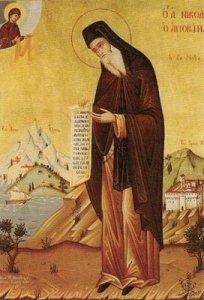
St. Nikodemos the Righteous of the Holy Mountain – is Commemorated on July 14
“Saint Nicodemus of the Holy Mountain was born on the Greek island of Naxos in the year 1748, and was named Nicholas at Baptism. At the age of twenty-six, he arrived on Mount Athos and received the monastic tonsure in the Dionysiou monastery with the name Nicodemus…”
More about the life of St. Nikodemos at: St. Nikodemos of the Holy Mountain
The late Elder Joseph of Vatopaidi have passed into eternity on July 1, 2009. Elder Joseph is an exemplary model of ascetic struggle belonging to the great generation of later hesychasts from Mt. Athos and he had been a close disciple of Geron Joseph the Hesychast. Elder Joseph left us many spiritual counsels as he also compiled the life and teachings of his spiritual elder: Joseph the Hesychast. Many theologians and spiritual fathers have rightfully considered Elder Joseph of Vatopaidi a modern day saint.
A documentary on the life of the hesychasts in Mt. Athos (Greek)
A year without Elder Joseph & the Synaxis of the 12 Apostles – double joy to celebrate the luminaries of our church and “a smile from eternity” gazing on the face of the later Elder Joseph Vatopaidinous. The first annual memorial service for the departed elder, took place on July 1st in the Sacred Monastery of Vatopaidi. More about this event, with English translation at: Funeral of Blessed Elder Joseph of Vatopaidi
More about Elder Joseph of Vatopaidi at:
Why’s the smile of elder Joseph of Vatopedi from eternity?
 Christian Dogma
 Christian Martyrs
 Christian Orthodox Churches and Monasteries
 Christian Sermons and News
 Church's Teachings on Fasting
 Ecumenism – a Great Heresy
 Father George Calciu
 Life_a Sacred Gift form God
 Orthodox Saints and Church Fathers
 Spiritual Elders
 Daily Bible Readings
 Journey to Orthodoxy
 Listen to Ancient Faith Radio
 Orthodox Calendar of Feasts and Saints
 Orthodox Christian Mission Center
 Orthodox Institute
 OrthodoxChristianNetwork TV


Recent Comments